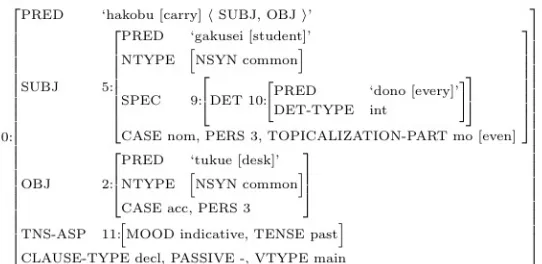
con-Fig. 1. F-structure corresponding to the sentence (1).
Fig. 2. Meaning constructors corresponding to the sentence (1).
Columns in the above table show labels, sequence numbers, and meaning constructors respectively. The left-hand side of a colon symbol represents a meaning expression, and the right-hand side provides a logical formula. The body of a meaning expression is shown in typewriter fonts, in which a capital letter represents a variable and the backslash symbol stands for lambda abstraction. A bold number in a logical formula represents the meaning of the f-structure tagged by the number. EVAR, VAR and RE-STR are features of semantic structure standing for event variable, variable and restriction respectively. Small characters e and t on the lower right of a term stand for the type of entity and that of truth-value respectively. A symbol consisting of a bar and a circle stands for implication in linear logic.
In meaning expressions, a generalized quantifier is expressed in the Prolog list notation, where its elements are the identifier quant, quantifier type exists or forall, cardinality such as sg that stands for singular, a restriction part, and a body part. The function cxr is placed as a hook to mark contextual de-pendencies. Subcategorization information is explicitly represented in subcat and xle_gf entries, and the latter stands for XLE grammatical function.
Common nouns in Japanese are not marked with regard to number. The cardinality of the noun repre-senting desk in the sentence is set to sg_pl, which does not specify the cardinality. Common nouns are often expressed as bare nouns, and the definiteness of common noun is usually underspecified.
Following two scope constraints are also imposed:
node 5.
All of the semantic expressions corresponding to the f-structure are to be obtained via logical deriva-tion. There are several possible proofs. One proof is to consume meaning constructors in the order of meaning constructors: (1, 2), 3, 8, (4, 5), (6, 7). Meaning constructors enclosed within parentheses are consumed before the resultant formulas are consumed with the right-hand neighbor meaning construc-tors. This proof derives the following meaning expression corresponding to the narrow reading:
Another proof is to consume meaning constructors in the order of (1, 2), 3, 8, (6, 7), (4, 5). This proof derives the meaning expression corresponding to the wide reading. Other distinct proofs might be con-sidered, for example (4, 5), 8, (6, 7), (1, 2), 3 or (6, 7), 8, (4, 5), (1, 2), 3, but the scope constraints pre-vent them.
3.2 Japanese Idiosyncratic Expressions
Floated Numeral Quantifiers
Subject-oriented floated quantifiers syntactically combine with VP, whereas object-oriented floated quantifiers combine with the verb only. The former constructions do not allow a collective reading, but a distributive one. There is a mapping from events to individuals, and measure functions indirectly meas-ure events by measuring individuals related to the events [9]. The following is a sample sentence con-taining floated numeral quantifiers 2 :
(2) gakusei-ga 3-nin biiru-o 6-hai nonda. student-NOM 3-CLS beer-ACC 6-CLS drink-PAST `Three students drank six glasses of beer.'
I divided classifiers into two types: one is specifying the cardinality of a countable referent, and the other is measuring an uncountable referent. If a subject-oriented floated quantifier has a countable ref-erent, there are distributive multiple events, each of which is corresponding to one of the elements rep-resented by the host noun. I introduced two features of semantic structure: a distributive element of the host noun and a distributive event variable, standing for D and DVAR respectively.
The sample sentence (2) has at least two possible readings: a cumulative reading and a distributive reading in which the scope of 3-nin contains the denotation of 6-hai. The total number of glasses of beer that are drunk is six in the former reading and eighteen in the latter [10]. From the meaning constructors and scope constraints corresponding to the sentence (2), seven analyses are obtained, which contains both readings. A final meaning expression corresponding to the cumulative reading is shown below:
Double-Subject Construction
Sentences where adjectives dominate two surface subjective cases are common in Japanese, which are called double-subject construction sentences [12]. The basic sentence pattern of the double-subject con-struction is `X wa Y ga -- predicate', where X and Y are NPs [11]. Here is a sample sentence:
(3) zoo-wa subete hana-ga nagai. elephant-TOP every nose-NOM long-PRES `Every elephant has a long trunk.'
The double-subject construction is classified into several types, and in the case of the above sentence, the topic marker wa is a proxy for the particle no representing a noun modifier [12]. In other words, the subject word hana and the topicalized word zoo have a part-whole relation. The meaning expression of the sentence is as follows.
Focus Particles
(4) Taro-dake-ga kasikoi. Taro only-NOM clever-PRES. `Only Taro is clever.'
(5) Taro-dake-ni kasikoi. Taro because-ADJUNCT clever-PRES
`Taro is clever because he is Taro (known to be clever).'
The particle dake tends to show the function of restricting its PRED(icate) noun if it precedes a case marker. On the other hand, it tends to present the function of reasoning if it is included in an adjunct [13]. The meaning expressions of the above sentences are shown below:
Syntactically Parallel but Semantically Distinct Expressions
There are exceptions for applying mapping rules for English to Japanese syntactically parallel expres-sions. One of them is relative tense in subordinate clauses. It is claimed that Japanese has a relative tense system, and a tense morpheme is interpreted in relation to the tense that locally c-commands it [14]. Consider the following sentence:
(6) watasi-ga nihon-e iku toki-ni purezento-o katta. I-NOM Japan-to go-PRES time-DAT present-ACC buy-PAST `When/Before I went to Japan, I bought a present/presents.'
Regardless of whether the main clause is in the present or the past, the subordinate clause adjoined to toki takes the present tense if the action in the clause has not been completed before the action expressed in the main clause takes place. If, however, the action in the toki clause has been completed before the action in the main clause takes place, the toki clause takes the past tense. [11]
(7) watasi-ga nihon-e itta toki-ni purezento-o katta. I-NOM Japan-to go-PAST time-DAT present-ACC buy-PAST `When/After I went to Japan, I bought a present (in Japan).'
Acknowledgements. I gratefully acknowledge the support of Dick Crouch at Palo Alto Research Center Inc. for helping me to understand the theory and the system of glue semantics.
References
1. Dalrymple, M., ed.: Semantics and Syntax in Lexical Functional Grammar: The Resource Logic Approach. The MIT Press, Cambridge, MA (1999)
2. Dalrymple, M., ed.: Lexical Functional Grammar. Volume 34 of Syntax and Semantics. Academic Press (2001) 3. Asudeh, A., Crouch, R.: Glue semantics for HPSG. In: Proceedings of the 8th Intl. HPSG Conference. (2001) 4. Crouch, D., Condoravdi, C., Stolle, R., King, T., de Paiva, V., Everett, J.O., Bobrow, D.G.: Scalability of
redun-dancy detection in focused document collections. In: Proceedings First International Workshop on Scalable Natural Language Understanding (SCANALU-2002). (2002)
5. Crouch, D.: Packed rewriting for mapping semantics to KR. In: Proceedings of the 6th International Workshop on Computational Semantics. (2005)
6. Masuichi, H., Ohkuma, T.: Constructing a practical Japanese parser based on Lexical-Functional Grammar. Journal of Natural Language Processing 10(2) (2003) 79-109 (in Japanese).
7. Butt, M., Dyvik, H., King, T.H., Masuichi, H., Rohrer, C.: The parallel grammar project. In: Proceedings of COLING2002, Workshop on Grammar Engineering and Evaluation. (2002) 1-7
8. Asudeh, A.: Resumption as Resource Management. PhD thesis, Stanford University (2004)
9. Nakanishi, K.: The semantics of measure phrases. In: the Proceedings of the 33rd Conference of the North East Linguistic Society (NELS 33). (2003) 225-244
10. Gunji, T., Hasida, K.: Measurement and quantification. In Gunji, T., Hasida, K., eds.: Topics in Con-straint-Based Grammar of Japanese. Kluwer Academic Publishers, Dordrecht (1998)
11. Storm, H.: A Handbook of Japanese Grammar. Volume 18 of LINCOM Handbooks in Linguistics. LINCOM GmbH (2003)
12. Oku, M.: Analysing Japanese double-subject construction having an adjective predicate. In: COLING-96. (1996) 865-870
13. Ohkuma, T., Masuichi, H., Yoshioka, T.: Disambiguation of Japanese focus particles by using lexical functional grammar. Journal of Natural Language Processing 13(1) (2006) 27-52 (in Japanese).
14. Ogihara, T.: Tense and aspect. In Tsujimura, N., ed.: The Handbook of Japanese Linguistics. Blackwell Pub-lishers (1999) 326-348