Available Online atwww.ijcsmc.com
International Journal of Computer Science and Mobile Computing
A Monthly Journal of Computer Science and Information Technology
ISSN 2320–088X
IMPACT FACTOR: 6.017IJCSMC, Vol. 5, Issue. 10, October 2016, pg.171 – 178
Algorithm and Architecture Design of High
Efficiency Video Coding (HEVC) Standard
Kanika Sihag
1, Dr. C.S Lamba
21
Scholar Computer Science and Engineering JECRC University Jaipur, India
2
Professor Computer Science and Engineering JECRC University Jaipur, India
1
2
Abstract- This paper deals with the latest H.265/HEVC video coding standard. The main goal of the HEVC standardization effort is to facilitate significantly improved compression performance relative to existing standard H.264/AVC. HEVC offer 50% bit-rate reduction for equal video quality compared to H.264/AVC. The objective of this paper is to provide the technical features and characteristics of the HEVC standard, particularly focusing on the key features of hybrid coding tools and also provide theoretical analysis, summaries of the technological advancements, and compares its performance with the H.264/ MPEG-4 AVC standard.
Keywords- Advanced Video Coding (AVC), H.264, High Efficiency Video Coding, HEVC, video quality.
I. INTRODUCTION
However HEVC contains many additional improvements such as:
• Flexible partitioning, from large to small partition sizes.
• Improved variable block size segmentation.
• Increased “intra” prediction and motion region merging.
• Improved compensation filtering and new filtering step called Sample-adaptive offset filtering.
• Features to support efficient parallel processing.
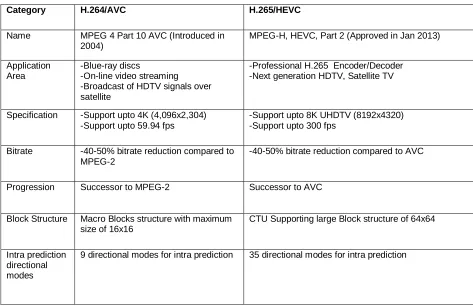
With H.265/HEVC, it is possible to store or transmit video more comfortably than with earlier technologies. This means: At the equivalent picture size and quality, an HEVC video sequence should utilize less storage or transmission capacity than the H.264 video sequence. At the same storage or transmission bandwidth, the quality and resolution of an HEVC video sequence should be greater than the corresponding AVC video sequence. H.265 has many big advantages over H.264, including better compression, delicate image and bandwidth saving. The technical content of HEVC was settled on January 25, 2013, while the specification was approved as a standard on April 13, 2013. Last year, Apple applied next-generation H.265 technology to its new iPhone6 and large iPhone6 Plus for FaceTime over cellular. Some of the key differences between H.264/AVC and H.265/HEVC are listed below in table1:
Table 1. H.264 vs H.265
Category H.264/AVC H.265/HEVC
Name MPEG 4 Part 10 AVC (Introduced in
2004)
MPEG-H, HEVC, Part 2 (Approved in Jan 2013)
Application Area
-Blue-ray discs
-On-line video streaming -Broadcast of HDTV signals over satellite
-Professional H.265 Encoder/Decoder -Next generation HDTV, Satellite TV
Specification -Support upto 4K (4,096x2,304)
-Support upto 59.94 fps
-Support upto 8K UHDTV (8192x4320) -Support upto 300 fps
Bitrate -40-50% bitrate reduction compared to
MPEG-2
-40-50% bitrate reduction compared to AVC
Progression Successor to MPEG-2 Successor to AVC
Block Structure Macro Blocks structure with maximum
size of 16x16
CTU Supporting large Block structure of 64x64
Intra prediction directional modes
9 directional modes for intra prediction 35 directional modes for intra prediction
coding design. The HEVC coding technology is described in Section III. Since writing an overview of a technology HEVC involves a significant amount of summarization, the reader is referred to [1] for any details. The history of the HEVC standardization effort is discussed in Section IV.
II. HEVC CODING DESIGN AND FEATURE HIGHLITS
The HEVC standard is designed to achieve multiple goals, including coding efficiency, ease of transport system integration and data loss resilience, as well as implementability using parallel processing architectures. The following subsections briefly describe the key elements of the design by which these goals are achieved.
Video Coding Layer
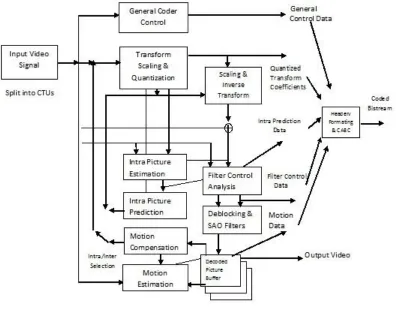
The video coding layer of H.265/HEVC employs the same hybrid approach used in all video compression standards since H.261. Fig. 1 depicts the block diagram of a hybrid video encoder, which could create a bitstream conforming to the HEVC standard.
An algorithm producing an HEVC compliant bitstream would proceed as follows. Each and every picture is split into regions of block-shaped, with the exact block partitioning being conveyed to the decoder. The first picture is coded using only intrapicture predictionof a video sequence. For all remaining pictures of a sequence or between random access points, interpicture predictive coding modes are used for most blocks. The encoding process for interpicture prediction consists of electing motion data comprising the selected reference picture and motion vector (MV) to be applied to the samples of each block. The encoder and decoder generate identical interpicture prediction signals by applying motion compensation using the motion vector and mode decision data, which are transmitted as side information. The residual signal of the intrapicture/interpicture prediction, which is the difference between its prediction
and the original block, is transformed by a linear spatial transform. The transform coefficients with the prediction information are then scaled, entropy coded, quantized and transmitted.
The encoder duplicates the decoder processing loop so that both will develop identical predictions for subsequent data. Therefore, the quantized transform coefficients are created by inverse scaling and are then inverse transformed to duplex the decoded approximation of the residual signal. The residual is then combined to the prediction, and the result of that addition may then be fed into 1 or 2 loop filters to stable out artifacts induced by quantization and block-wise processing. For the prediction of subsequent pictures a decoded picture buffer stored the final picture representation. In general, the order of encoding/decoding processing of pictures differs from the order in which they arrive from the source; constraining a distinction between the output order and the decoding order for a decoder.
The video coding layer of H.265/HEVC employs the same hybrid approach used in all video compression standards since H.261. The various features involved in hybrid video coding using HEVC are highlighted as follows:
Coding Tree Unit: HEVC is not using fixed macro block size as earlier standards any more. Instead of macro block, the term Coding Tree Unit (CTU or CU) is used. Coding Tree Unit consists of luma Coding Tree Block (CTB), chroma CTBs and syntax. For luma component, the size of CTB can be 16x16, 32x32 or even 64x64. These CTBs further divided into smaller blocks called Coding Blocks. These blocks do not have same size with in the CTB and the encoder determined their size and position according to the image content.
Entropy Coding: Context Adaptive Binary Arithmetic Coding (CABAC) is used for entropy coding. This is similar to the CABAC scheme in AVC. CABAC is the only entropy encoder method that is allowed in HEVC. While there are two entropy encoder methods allowed by AVC. CABAC and the entropy coding of transform coefficients in HEVC were designed for a higher throughput then AVC, while maintain higher compression efficiency for larger transform block size relative to simple extensions.
Intra Prediction: HEVC specifies 33 directional modes for intra prediction compared to the 8 directional mode for intra prediction specified by H.264/AVC. HEVC also specifies DC intra prediction and planar prediction modes. The intra prediction modes use data from neighboring prediction blocks that have been previously decoded from within the same picture.
can also use data from adjacent prediction blocks. The merge mode allows for the MVs to be inherited from neighboring prediction blocks.
Deblocking filter: it is similar to the one used by AVC but with a simpler design and better support for parallel processing. In HEVC the DBF only applies to an 8x8 sample grid while the AVC the DBF applies to a 4x4 sample grid.
Sample adaptive offset: The SAO filter is applied after the DBF and is designed to allow for better reconstruction of the original signal amplitudes by applying offsets stored in a look up table in the bit stream.
III. HEVC VIDEO CODING TECHNIQUE:
The HEVC design follows the classic block-based hybrid video coding approach (as depicted in
Fig. 2). The basic source-coding algorithm is a hybrid of interpicture prediction to exploit
temporal statistical dependences, intrapicture prediction to exploit spatial statistical
dependences, and transform coding of the prediction residual signals to further exploit spatial
statistical dependences. There is no single coding element in the HEVC design that provides
the majority of its significant improvement in compression efficiency in relation to prior video
coding standards. It is, rather, a plurality of smaller improvements that add up to the significant
gain.
HEVC Encoding/Decoding Algorithm:
1. Read the video clip
2. Encoding
2.1 Assign the pattern which you want to convert
2.2 Convert the color format from RGB to YCbCr
2.3 Start encoding the block
2.3.1 Define the size of the CTU as 64x64
2.3.2 Encode each and every CTU or CU
2.3.2.1 Divide the CTU in to CTB and may be further divided in to CB
2.3.2.2 Entropy Coding is being done on each and every CU
2.3.2.3 Calculate the motion vector using logarithmic search and the CU of size 4:2:1
2.3.2.4 Apply MV to each 16x16 block Decode this CU
3. Decoding
3.1 Decode the block
3.3 Convert the color format from YCbCr to RGB
3.4 Make sure that the block is in 16 bit range
3.5 Store the block
As we choose HEVC encoder for video compression. The above algorithm of HEVC shows how
the video file is encoded and decode for video compression. First read the video clip, after
reading the video clip encoding is done. In encoding first assign the pattern which you want to
convert. Then convert the format fron RGB to YCbCr.
A. Sampled Representation of Pictures
For representing color video signals, HEVC typically uses a tristimulus YCbCr color space with
4:2:0 sampling. This separates a color representation into three components called Y, Cb, and
Cr. The Y component is also called luma, and represents brightness. The two chroma
components Cb and Cr represent the extent to which the color deviates from gray toward blue
and red, respectively.
B. Division of the Picture into Coding Tree Units
A picture is partitioned into coding tree units (CTUs), which each contain luma CTBs and
chroma CTBs. A luma CTB covers a rectangular picture area of L×L samples of the luma
component and the corresponding chroma CTBs cover each L/2×L/2 samples of each of the
two chroma components. The value of L may be equal to 16, 32, or 64 as determined by an
encoded syntax element specified in the SPS.
C. Division of the CTB into CBs
The blocks specified as luma and chroma CTBs can be directly used as CBs or can be further
partitioned into multiple CBs. Partitioning is achieved using tree structures. The tree partitioning
in HEVC is generally applied simultaneously to both luma and chroma, although exceptions
apply when certain minimum sizes are reached for chroma. The CTU contains a quadtree
syntax that allows for splitting the CBs to a selected appropriate size based on the signal
characteristics of the region that is covered by the CTB. The quadtree splitting process can be
iterated until the size for a luma CB reaches a minimum allowed luma CB size that is selected
by the encoder using syntax in the SPS and is always 8×8 or larger (in units of luma samples).
D. Entropy Coding
Context Adaptive Binary Arithmetic Coding (CABAC) is used for entropy coding. This is similar
to the CABAC scheme in AVC. CABAC is the only entropy encoder method that is allowed in
higher throughput then AVC, while maintain higher compression efficiency for larger transform
block size relative to simple extensions.
E. Motion Vector Prediction
HEVC allows for two MV modes which are Advanced Motion Vector Prediction (AMVP) and
merge mode. AMVP uses data from the reference picture and can also use data from adjacent
prediction blocks. The merge mode allows for the MVs to be inherited from neighboring
prediction blocks.
IV. APPLICATIONS
Regarding the compression HEVC offers technical and commercial benefits to existing
applications and usage scenarios, including extended-range uses with enhanced precision and
color format support, scalable video coding and 3-D/Stereo/multiview video coding. Moreover
multiscreen applications or over-the-top (OTT) Services can also benefits from HEVC by
improving the overall quality of video to mobile devices. HEVC enabling better picture quality at
lower bitrates [10], it will offer sports fans, for instance, a better viewing experience on mobile
devices. Last but not least, a 4K application for which HEVC was originally designed.
V. CONCLUSION
The HEVC standard has been developed and standardized by both the ITU-T VCEG and
ISO/IEC MPEG organizations. HEVC represents a number of advances in video coding
technology. Its video coding layer design is based on conventional block-based motion
compensated hybrid video coding concepts, but with some important differences relative to prior
standards. When used well together, the features of the new design provide approximately a
50% bit-rate savings for equivalent perceptual quality relative to the performance of prior
standards (especially for a high-resolution video). For more details on compression
performance, please refer to [23]. Implementation complexity analysis is outside the scope of
this paper; however, the decoder implementation complexity of HEVC overall is not a major
burden (e.g., relative to H.264/MPEG-4 AVC) using modern processing technology, and
encoder complexity is also manageable. For more details on implementation complexity, please
REFERENCES
[1] MPEG. Available at: https://www.mpeg.org.
[2] Niikhet OZBEK, Turhan TUNALI, “A Survey on the H.264/AVC Standard”, Turk J Elec Engin, VOL.13 NO. 3, Year 2005.
[3] Gary J. Sullivan, Detlev Marpe and Thomas Wiegand, ”The H.264/MPEG 4 Advanced Video Coding Standard and its Applications”, IEEE, Year 2006.
[4] Gary J. Sullivan, Pankaj Topiwala, “The H.264/AVC Overview and Introduction to the Fidelity Range Extensions”, Presented at the SPIE Conference on Applications of Digital Image Processing, Year 2004.
[5] Grzegorz Pastuszak and Andrzej Abramowski, “Algorithm and Architecture Design of the H.265/HEVC Intra Encoder”, IEEE Transactions on Circuits and Systems for Video Technology, Year 2015.
[6] Ondrej Zach, Martin Slanina, “Comparison of H.265/HEVC Implementation”, International Symposium ELMAR-2014.
[7] Thomas Wiegand, Woo-Jin Han, Gary J. Sullivan, “Overview of High Efficiency Video Coding (HEVC) Standard”, IEEE Transactions on Circuits and Systems for Video Technology, VOL. 22, NO. 12, December 2012.
[8] Dan Grois, Detlev Marpe, “Performance Comparison of H.265/MPEG-HEVC, VP9, and H.264/MPEG-AVC Encoders”, IEEE, 2013.
[9] Frank Bossen, Benjamin Bross, David Flynn, “HEVC Complexity and Implementation Analysis”, IEEE Transactions on Circuits and Systems for Video Technology, VOL. 22, NO. 12, December 2012.