An RTOS Based Bomb Detection RF Remote Controlled
Robot Using ARM Cortex Controller
Shaik Razak Babu & Ashok Kumar Balijepalli
1PG- Student, Dept. of ECE, Universal College of Engineering & Technology, Perecherla, Guntur, A P,
India 522438.
2Assistant Professor, Dept. of ECE., Universal College of Engineering & Technology. Perecherla, Guntur, A
P, India 522438
ABSTRACT:A robot is a machine designed to execute one or more tasks automatically with speed and precision. There are as many different types of robots as there are tasks for them to perform. A robot is usually an electro-mechanical machine that is guided by computer and electronic programming. Many robots have been built for manufacturing purpose and can be found in factories around the world. The main aim of this project is to design a Metal Detecting robot using RF technology in the Real Time Operating System (RTOS) environment using an advanced microcontroller (ARM Cortex). Nowadays, robots plays a major role in all human activities like house maintenance, aerospace, factories, lifting of heavy equipment, etc. It will also help to do the risky jobs which cannot do by humans such as mining. The main aim of this project is to extend the use of robots in national defense system. In that case, the part of detecting explosives made of either metal or chemical is very important. This project is to implement the robots for metal detection for national security. It consists of metal detecting unit.
KEY WORDS: Wireless Technology, Robotics Remote based Controlling, ARM Cortex, Real Time Operating System (RTOS), LM 393D.
I.INTRODUCTION
The Army's remote-controlled, bomb-finding robots aren't bomb-finding enough bombs in Afghanistan. So, the military is toying with a new notion: Let the robot drive itself; and make it bigger, like the size of a golf cart. In a recent solicitation for small businesses, the Army expresses interest in a remote-controlled vehicle that's bigger than most robots but (way) smaller than its fleet of tactical vehicles. Really, it's a software system outfitted with sensors for detecting a variety of bombs – "pressure activated devices and command detonated explosive
devices" alike – that can turn an existing "mid-sized" vehicle into a self-driving or Remotely-controlled car. The so-called "Intelligent Behavior Engine" has to
support "skid steer hydraulic arm
attachments" – Doctor Octopus-like robot arms, to defuse the bombs it finds. And it's got to weigh between 500 and 3000 pounds (the size of a golf cart, Smart car, or John Deere Gator), making it hypothetically "capable of traversing long distances on narrow, rugged paths. “It was just two months ago that the Army announced it would buy dozens of radar add-ones for armored Husky vehicles to spot and stop improvised explosive devices, a $106.5 million push. But the solicitation says the bulky Husky isn't right for Afghanistan since it "cannot traverse the rugged terrain and narrow paths" that pass for the country's bomb-infested roads.
Ideally, the Intelligent Behavior Engine will have "off-board, 'back-seat driving' capabilities" – controls that let troops on patrol operate the car remotely, using it for
"scanning, digging and emplacing
explosive charges" when it senses a bomb nearby. The Army doesn't have either a software or a vehicle design in mind, but it says that it'll favor "intelligent, adaptive software behaviors that provide standoff operation in terms of navigation, detection and neutralization." In other words, when the car finds an improvised explosive device, it should know how to safely avoid, defuse or detonate it.
II. IMPLEMENTATION
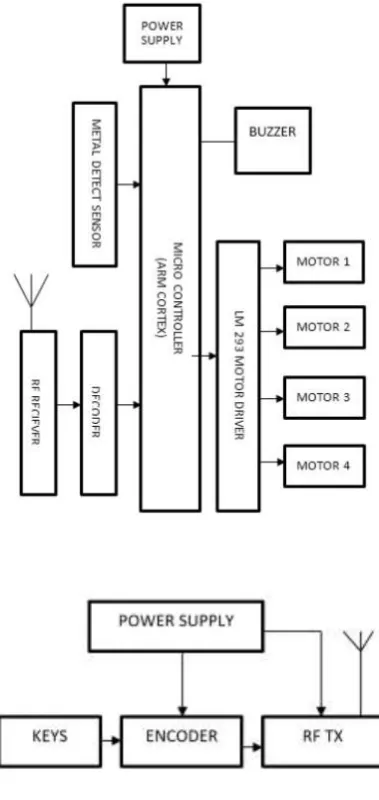
Our project implemented by using RTOS with advanced microcontroller (ARM Cortex). In our project we can control the robot by using wireless communication i.e. from Control section (acts as transmitter) we are sending the control signals, then the robot receives (acts as receiver) the signals, according to the signals being received the direction of the robot is controlled. According to this project, an RF transmitter is used to transmit the control signals, which controls the direction of the robot. In the same way, RF receiver which is placed on the robot receives the RF signals according to which the direction of the
robot is controlled. It also contains an automated unmanned system being designed around a
microcontroller which serves for detecting hazardous parameters such as metal detection. According to this project, a robot is designed which is made to move all the time. Apart from this, the system also detects the presence of any metal with the help of a metal detector. All the devices such as metal detector, motor by which robot is made to move, buzzer are being interfaced to microcontroller which forms the control unit of the project. In the standby mode the robot is moved here and there. Whenever any metal is detected by the metal detector, the same is sensed and is
Fig. 1. The Block Diagram of Implemented Project
intimated to the user by the microcontroller using buzzer.
This project finds its place in places where one wants to make the unmanned system to
sense some hazardous condition. In this
project we are going to merge two applications that is spying and bomb detection. The Mini Spy Robot is small robot with a camera attached to it. The motors will be run by the relays which will be then controlled through Remote via RF module. The work is designed to develop a War field robot which is capable of detecting bombs land mines in its path and which is wirelessly controlled through RF module. It is used to monitor the Warfield. The robot can be moved in all the directions using the remote wirelessly. The robot system is also used for bomb detection. The controlling device of the whole system is an ARM Cortex. Due to that circuit complexity is reduced and performance speed is increased. Whenever, land mines or bombs are detected, it alerts through buzzer ringing system.
a) Motor driver L293D
The L293 and L293D devices are quadruple high current half H-Drivers. The L293 is designed to provide bidirectional drive currents of upto 1A at voltage from4.5V to 36V. The L293D is designed to provide bidirectional drive currents of upto 600mA at voltages from 4.5V to 36V. Both devices are designed to drive inductive loads such as relays, solenoids, dc and bipolar stepping motors, as well as other high current/ high
voltage loads in positive supply
applications.
b) DC Motors
Almost every mechanical movement that we see around us is accomplished by an electrical motor. Electric machines are means of converting electrical energy into mechanical energy. Electric motor is used to power hundreds of devices we use in everyday life. An example of small motor applications includes motors used in
automobiles, robot, hand power tools and food blenders. Micro-machines are electric machines with parts with the size of red blood cells and find many applications in medicine.
c) RF Tx and Rx
This circuit utilizes the RF module (Tx/Rx) for making a wireless remote, which could be used to drive an output from a distant place. RF module, as the name suggests, uses radio frequency to send signals. These signals are transmitted at a particular frequency and a baud rate. A receiver can receive these signals only if it is configured for that frequency. A four-channel encoder/decoder pair has also been used in this system. The input signals, at the transmitter side, are taken through four switches while the outputs are monitored on a set of four LEDs corresponding to each input switch. The circuit can be used for designing Remote Appliance Control system. The outputs from the receiver can drive corresponding relays connected to any household or any appliance.
d) ARM Cortex Controller
Arm Cortex-A processors are at the heart of
the most powerful and compelling
technology products. They are deployed in laptop devices, networking infrastructure, home and consumer devices, automotive in-vehicle infotainment and driver automation systems, and embedded designs. Cortex-A processors power intelligent solutions, from
edge to cloud, for next-generation
experiences.
e) Metal Detector
A metal detector is an electronic instrument which detects the presence of metal nearby. Metal detectors are useful for finding metal inclusions hidden within
objects, or metal objects buried
indication of distance; the closer the metal is, the higher the tone in the earphone or the higher the needle goes. Another common type are stationary "walk through" metal detectors used for security screening at access points in prisons, courthouses, and airports to detect concealed metal weapons on a person's body.
The simplest form of a metal detector
consists of an oscillator producing
an alternating current that passes through a coil producing an alternating magnetic field. If a piece of electrically conductive metal is close to the coil, eddy currents will be induced in the metal, and this produces a magnetic field of its own. If another coil is used to measure the magnetic field (acting as a magnetometer), the change in the magnetic field due to the metallic object can be detected.
f) RTOS
A real-time operating system (RTOS) is an Operating system (OS) intended to serve real-time applications that process data as it comes in, typically without buffer delays. Processing time requirements (including any OS delay) are measured in tenths of seconds or shorter increments of time. A real time system is a time bound system which has well defined fixed time constraints. Processing must be done within the defined constraints or the system will fail. They either are event driven or time sharing. Event driven systems switch between tasks based on their priorities while time sharing systems switch the task based on clock interrupts.
III. WORKING, EXECUTION & RESULTS
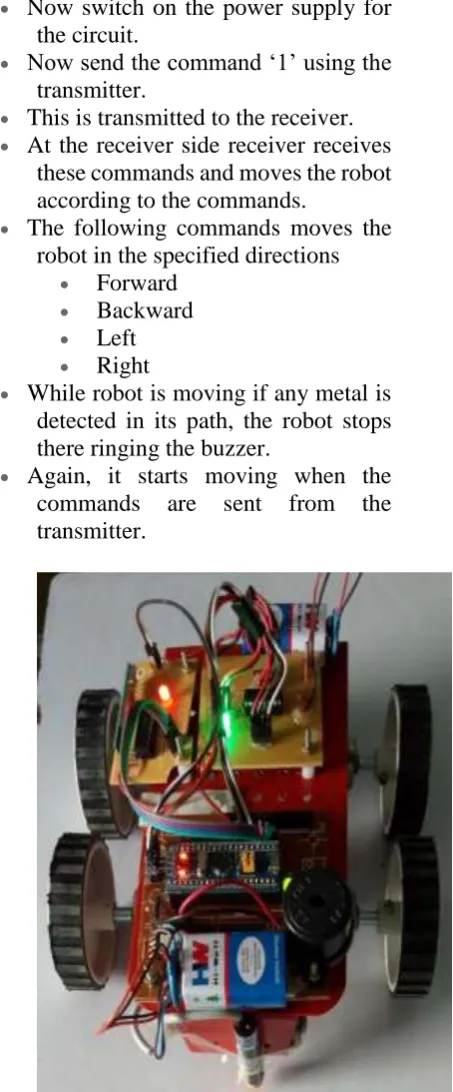
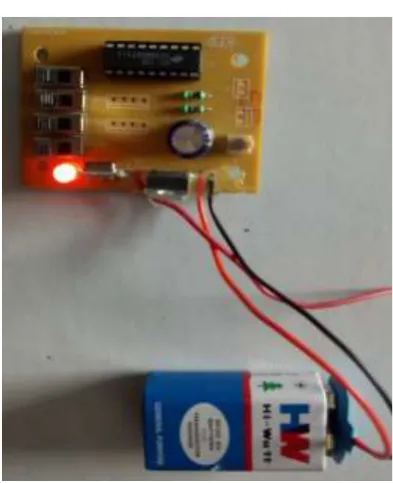
The proposed system consists of transmitter and receiver circuit. The transmitter circuit transmits the commands required to operate the robot. The receiver circuit receives these commands through RF and moves the robot according to the received commands. A metal detector is interfaced to the
controller in the receiver side. Thus, whenever any metal is detected the robot stops there and buzzer starts ringing.
Initially burn the code into the
microcontroller using flash magic.
Now switch on the power supply for
the circuit.
Now send the command ‘1’ using the
transmitter.
This is transmitted to the receiver.
At the receiver side receiver receives
these commands and moves the robot according to the commands.
The following commands moves the
robot in the specified directions
Forward
Backward
Left
Right
While robot is moving if any metal is
detected in its path, the robot stops there ringing the buzzer.
Again, it starts moving when the
commands are sent from the transmitter.
1) Algorithm
Initially, declare port2 as input as this is
connected to the decoded input.
Now declare port1 as output as the
motor pins of the robot are connected to the port1.
Enable the external interrupt.
Now check the input of port2.
If the received value is equal to 1 then
move the robot in forward direction by making port value as 0x01.similarly move the robot according to the input value.
When interrupt occurs make the output
pins to the motor low. This is written in ISR.
2) Applications
These robots are used in detecting
landmines.
Robots are used for in detecting the
minerals present in the ground.
These robots are used for detecting the
bombs.
These can be used in construction
industry for locating steel bars present in concrete.
They are used in airports and building
security to detect the weapons.
IV. CONCLUSION & FUTURE
WORK
It detects the RF data send by transmitter and according to that control robot in Forward, backward, left turn, right turn movements. Metal/Bomb detector can detect the metals and alert with LED to notify the Metal/Bomb. Because, we can’t detect the actual bomb we don’t have that much authority. The camera detects the exact location of the robot. In this manner our project plays a crucial role in Military as well as in our police department. In this project, we have introduces a new application using two techniques i.e. spying and bomb detection implemented by using ARM Cortex with RTOS kit. In future, we can also implement bomb diffusion technique in this project. It can be used in radar detection systems to detect objects by implementing other hardware. It is concluded that smart living will gradually turn into reality that consumer can control their home remotely and wirelessly. The knowledge is ever expanding and so are the problems which the mankind strives to solve. In this spirit, it is hoped that the current activity will lead to further enhancements. For example, work on future for defense applications.
V. REFERENCES
[1].Dr. B.Subrahmanyeswara Rao,
C.Soumya, G.Shamala Siresha, M.
Sushma, N. Sai Priyanka“PC Controlled
Bomb Detection and Diffusion
Robot”International Journal of Advanced Research in Electrical, Electronics and Instrumentation Engineering (An ISO 3297: 2007 Certified Organization)Vol. 5, Issue 4, April 2016.
[2]. Saurabh Nalwade “Robots for
surveillance in military
applications”International Journal of
Electronics and Communication
Engineering & Technology (IJECET), ISSN 0976 –6464(Print), ISSN 0976 –
6472(Online), Volume 5, Issue 9,
September (2014).
[3]. Ankita Patel, Kinjal Chaudhari, Dattukumar Patel “Touch screen controlled
multipurpose spy robot using
zigbee”International Journal of Advanced Research in Computer Engineering & Technology (IJARCET) Volume 3 Issue 4, March 2014.
[4]. Sagar Randive, Neha Lokhande, Apoorva Kamat , Shubhrojit Chakraborty, Vishal Pande “Hand Gesture Recognition Bomb Diffusing Surveillance Robot”
International Journal of Engineering
Research and Applications (IJERA) ISSN:
2248-9622 National Conference on
Emerging Trends in Engineering & Technology (VNCET-30 Mar’12) .
[5]. Prof. Y. M. Naik, Chiranjivi, M. Deshpande, Ravija.R. Shah, Rashmi. R. Kulkarni “ANDROID CONTROLLED SPY-ROBOT” International Journal of Software and Web Sciences (IJSWS)4 (1)ISSN (Print): 2279-0063 ISSN (Online): 2279-0071March-May, 2013.
[6].Reza Abbaspour,vaasa. Design and implementation of multi sensorbased
autonomous minesweeping robot.
International congress on ultra modern telecommunication and Control Systems and workshops ,443-447: 2010.
[7]. Premkumar .M. unmanned multi-functional robot using zigbee adopter
network for defense application.
International Journal of Advanced
Research in Computer Engineering & Technology,2 (1): 47-55, January 2013. [8] Fan Wu, Johnathan Williams. Design and Implementation of a Multi-Sensor Based Object Detecting and Removing Autonomous Robot Exploration System.
Journal of Computer and
Communications,2(8): 8-16,2014.
[9] Hajime Aoyama et.al. Development of
Mine Detection Robot System.
International Journal of Advanced Robotic Systems, 4( 2): 229-236, 2007.