On the Connection between Signcryption and One-pass Key
Establishment
⋆M. Choudary Gorantla, Colin Boyd, and Juan Manuel Gonz´alez Nieto
Information Security Institute, Queensland University of Technology, GPO Box 2434, Brisbane, QLD 4001, [email protected], {c.boyd,j.gonzaleznieto}@qut.edu.au
Abstract. Key establishment between two parties that uses only one message transmission is referred to as one-pass key establishment (OPKE). OPKE provides the opportunity for very efficient construc-tions, even though they will typically provide a lower level of security than the corresponding multi-pass variants. In this paper, we explore the intuitive connection between signcryption and OPKE. By es-tablishing a formal relationship between these two primitives, we show that with appropriate security notions, OPKE can be used as a signcryption KEM and vice versa. In order to establish the connection we explore the definitions of security for signcryption (KEM) and give new and generalised definitions. By making our generic constructions concrete we are able to provide new examples of signcryption KEMs and an OPKE protocol.
Keywords.One Pass Key establishment, Signcryption, Signcryption KEM
1 Introduction
One of the fundamental problems of cryptography is to establish a secret key between two parties with no prior shared state. In a groundbreaking paper, Diffie and Hellman [20] provided an ele-gant, yet simple way of solving this problem using public key cryptography. Later, many protocols have been proposed with improved security properties [29, 24, 28, 26, 13]. Although most of these protocols are interactive, many such protocols also provide simplifiedone-pass versions which use only one message. One-pass key establishment (OPKE) provides the opportunity for very efficient constructions, even though they will typically offer a lower level of security than the corresponding multi-pass variants. OPKE protocols can be deployed in systems that do not require the parties to participate interactively, such as E-mail or over networks with intermittent connectivity.
Another variant of two-party key establishment is non-interactive key establishment. The session key in a non-interactive protocol is established using the long-term private keys of the parties and optionally some session specific public information, like timestamps. As the secret values used in computing the session key are only the long-term keys, non-interactive protocols cannot offer forward secrecy i.e. revealing the long-term key of any of the parties would compromise the session keys established in the past. On the other hand, forward secrecy for the sender is a desired security property for OPKE protocols. Hence, OPKE protocols offer balanced security-efficiency trade off when compared to the non-interactive and multi-pass variants. For example, when a message needs to be encrypted with a session key, they require two less message flows than two-pass protocols and at the same time provide better security properties than non-interactive protocols.
1.1 OPKE and Signcryption
Zheng [34] introduced signcryption as a public-key cryptographic primitive that provides both privacy and authenticity at greater efficiency than the naive composition of signature and encryption
⋆This is the full version of the paper appeared in IMA Conference on Cryptography and Coding 2007. Research
schemes. Zheng [35] later observed that a signcryption scheme could be used in a key transport protocol by simply choosing a new key for each session and sending it in a signcrypted message. This intuitively gives the desired properties for key establishment since signcryption gives assurance to the sender that the key is available only to the recipient and assurance to the recipient that the key came from the sender. However, this work contains neither a security model nor a proof for this construction and there remains currently no formal treatment. Since key establishment is notoriously tricky to get right, it is important to decide exactly what security properties such a construction can provide. The main purpose of this paper is to define appropriate notions of security for signcryption and show how signcryption and OPKE can be related under those notions.
Since the introduction of signcryption, different definitions of security have emerged. An, Dodis and Rabin [2] divided security notions for signcryption into two types:outsider security assumes that the adversary is not one of the parties communicating whileinsider securityallows the adversary to be one of the communicating parties. Insider security for signcryption protects the authenticity of a sender from a malicious receiver and privacy of a receiver from a malicious sender. Therefore insider security implies the corresponding notion for outsider security. The notions of outsider security and insider security with respect to authenticity are similar to third-person unforgeability and receiver unforgeability defined for asymmetric authenticated encryption [1].
Because signcryption is intended to include functionality similar to that of digital signatures, it is natural that non-repudiation is a desirable property. Non-repudiation requires insider security since the sender of a signcrypted message must be prevented from showing that it could have been formed by the recipient of that message. For key establishment there is no need for non-repudiation as it is never required for a single party to claim responsibility for the shared key. On the other hand, a commonly required property for key establishment is forward secrecy which ensures that if the long-term key of a participant in the protocol is compromised then previously established keys will remain secure. We can regard forward secrecy as analogous to insider security in signcryption with respect to confidentiality. Compromise of the sender’s private key should not allow an adversary to obtain previously signcrypted messages.
In addition to forward secrecy, another common security requirement for key establishment is security against compromise of ephemeral protocol data. This is not considered in the existing models for signcryption schemes and so it is not possible, in general, to convert from a signcryption scheme to a key establishment protocol with this stronger security notion. We will argue later in this paper that there is good reason that signcryption schemes should consider security against compromise of ephemeral data. In particular this observation allows us to explain a potential weakness observed by Dent in one of his own constructions [19].
Cramer and Shoup [16] formalised the concept of hybrid encryption which securely uses public key encryption technique to encrypt a session key, and symmetric key encryption technique to encrypt the actual message. This hybrid construction has a key encapsulation mechanism (KEM) and a data encapsulation mechanism (DEM) as its underlying tools. A KEM is similar to a public key encryption scheme and is used to generate a random key and its encryption. In a series of papers, Dent [17, 19, 18] extended this hybrid paradigm to signcryption, resulting in the construction of signcryption KEM and signcryption DEM with different security notions.
and key establishment apply equally when signcryption KEMs are considered in place of plain signcryption.
1.2 Related Work
An et al. [2] defined security notions for signcryption schemes as insider and outsider security in a two-user setting. They also described how to extend these notions to multi-user setting. Baek et al. [4] independently provided similar notions of security for signcryption, but their model was not completely adequate. Recently, the same authors [5] extended these notions to match the corresponding definitions given by An et al. However, their security notions are still not complete, as discussed in Section 3.
Zheng [35] informally showed how a signcryption scheme can be used as a key transport protocol. Dent [17, 19] and Bjørstad and Dent [11] discussed how a signcryption KEM can be used as an OPKE protocol. Bjørstad and Dent [11] proposed the concept of signcryption tag-KEM and claimed that better key establishment mechanisms could be built with this. However, none of these papers formally defined security in a model that is suitable for key establishment protocols. Moreover, the confidentiality notion defined for all these KEMs does not offer security against insider attacks. Insider security for confidentiality enables achieving forward secrecy i.e. the compromise of the sender’s private key does not compromise the confidentiality of signcryptions created using that key [2]. However, this has been ignored or its absence has been treated as a positive feature called “Past Message Recovery” in earlier work [34, 5].
1.3 Contributions
We provide new definitions of insider confidentiality and outsider unforgeability for signcryption. These notions complement Baek et al.’s [5] notions of outsider confidentiality and insider unforge-ability. We also extend security notions for signcryption KEM defined by Dent [18, 19] to multi-user setting. Furthermore, security notions for both signcryption and signcryption KEM are revised by allowing the adversary to reveal the random coins used in computing signcryptext and encapsulation respectively.
We then show the suitability of the new/revised notions in deriving OPKE from signcryption KEMs. Generic constructions of OPKE protocols from signcryption KEMs and vice versa are proposed. These constructions are instantiated using existing schemes. In particular, we use existing OPKE protocols [26, 32, 22] to derive new signcryption KEMs with stronger security properties than the current signcryption KEMs. One of the main observations of our paper is that the security models for key establishment are stronger than those normally accepted for signcryption. Moreover, the stronger security seems to be just as appropriate for signcryption as it is for key establishment. Specific contributions of the paper are:
– new definitions for signcryption (KEM)s;
– generic construction from OPKE to signcryption KEM and vice versa;
– new signcryption KEMs with forward secrecy;
1.4 Organization
Section 2 reviews the security goals and formal models for OPKE protocols. We present new notions of security for both signcryption and signcryption KEMs in Section 3. Section 4 examines the outsider secure signcryption KEMs designed by Dent [19]. The generic construction of signcryption KEM from OPKE is covered in Section 5, while the reverse construction is covered in Section 6.
2 Security Model for One-pass Key Establishment
Before introducing the formal notion of security for OPKE protocols, we first discuss security goals desired of a key establishment protocol in general and then identify how these goals can be adapted to OPKE protocols.
2.1 Security Goals
Blake-Wilson et al. [12] defined the desirable security goals of a two-party key establishment protocol as below:
known key security: The knowledge of a session key should not enable an adversary to compromise other session keys.
(perfect) forward secrecy: A protocol is said to have perfect forward secrecy if the compromise of long-term keys of one or more entities does not lead to compromise of past session keys estab-lished using those long-term keys.
unknown-key share: If a protocol resists unknown-key share attacks, an entityAcannot be coerced into sharing a key with entityB withoutA’s knowledge, i.e., when Abelieves the key is shared with some entityC 6=B.
key compromise impersonation: A protocol is resilient to key compromise impersonation attacks, if compromising an entityA’s long-term private key does not enable the adversary to impersonate other entities to A.
key control: Neither entity should be able to force the session key to be a preselected value
Out of the above goals, OPKE protocols can provide neither perfect forward secrecy nor key compromise impersonation resilience. An adversary with the knowledge of a receiver B’s long-term private key can always compute all the session keys for the sessions in which it was just passively observing the communication to B. Moreover, if the ephemeral public key from A is not explicitly authenticated, the adversary can always impersonate other users toB. These attacks are inevitable due to lack of ephemeral contribution to the session key from B. However, a form of partial forward secrecy described below is desirable for OPKE protocols [30].
sender forward secrecy: A protocol is said to have sender forward secrecy if the compromise of long-term private key of a sender A does not lead to compromise of past session keys established using that key.
the parties can be revealed. This restriction equally applied to OPKE protocols and by sender forward secrecy, we mean weak forward secrecy with respect to sender’s long-term key exposure.
Okamoto et al. [30] identified sender key compromise impersonationas a desired security goal for OPKE protocols. However, we observe that mounting a key compromise impersonation attack on the sender in a OPKE protocol does not make sense as there is only one message flowing from the sender to the receiver i.e., there is no incoming message for the sender.
2.2 Security Model for Authenticated Key Exchange
Bellare and Rogaway [9] initiated the formal security treatment of key establishment protocols in the complexity theoretic framework. Later models [10, 12, 6, 8, 15] extended this model to cap-ture different attack scenarios. Although the model proposed by Canetti and Krawczyk [15](CK model) can be regarded adequate to analyse the security of a key establishment protocol, it is known that the CK model does not capture weak forward secrecy and resilience to key compromise impersonation (KCI).
Krawczyk [26] proposed extensions to the CK model which capture the properties of weak forward secrecy, KCI resilience and resilience to ephemeral private key leakage. Earlier models [9, 15] assumed strong corruption model, where the adversary is allowed to reveal session specific information in addition to long-term private key through a singlecorruptquery. On the other hand, the extensions proposed by Krawczyk assumed a weak corruption model in which the adversary is allowed to compromise only the long-term private key of a party by issuing corrupt query. Later, LaMacchia et al. [27] extended the CK model and proposed a unified model (called eCK model) which captures most of the desired security properties of key establishment protocols. We now briefly review the eCK model using some well known notations from earlier models.
A protocol π is modelled as a collection of programs running at n different parties. Let U be the set of n parties. Each party is assumed to have a pair of long-term public and private keys, (PKU,SKU) generated during an initialization phase prior to the protocol run. Each instance of
π within a party is defined as a session and each party may have multiple such sessions running concurrently. LetπUi be thei-th run of the protocolπ at party U ∈ U.
Each protocol instance at a party is identified by a unique session ID. The session ID of an instance πUi is denoted by sidi
U. We assume that the session ID is derived during the run of the
protocol and also that each party knows who the other participant is for each protocol instance. The partner ID pidi
U of an instanceπUi , is a set containing the identity of the party U and that of
the intended peer to the session.
An instance πiU enters an accepted state when it computes a session key skiU. Note that an instance may terminate without ever entering into an accepted state. The information of whether an instance has terminated with acceptance or without acceptance is assumed to be public. Two instancesπiU andπjU′ at two different partiesU andU′ respectively are consideredpartnered iff (1)
both the instances have accepted, (2) sidi U=sid
j
U′ and (3)pidiU=pid
j U′.
The communication network is assumed to be fully controlled by an adversary A, which sched-ules and mediates the sessions among all the parties. A is allowed to insert, delete or modify the protocol messages. If the adversary honestly forwards the protocol messages among all the par-ticipants, then all the instances are partnered and output identical session keys. In addition to controlling message transmission, Ais empowered with the ability to ask the following queries:
– Send(πUi , m): sends a unique messagem to the instanceπiU and the response is returned toA. If m contains only the partner IDpidi
– RevealKey(πiU): IfπUi has accepted, the session key established at πUi is returned.
– LongTermKeyReveal(U): The long-term private key of the partyU is returned.
– EphemeralKeyReveal(πUi ): The ephemeral private key used during the execution ofπUi is returned to A. This includes the random coins generated during the protocol. We assume that the ephemeral private information is erased from the party’s memory once the session is accepted.
– Test(πUi ): On this query a random bitb is chosen. Ifb= 0, the session key established at πUi is returned to A, otherwise a random value from the session key distribution is returned.
A is allowed to continue with its execution by issuing the above queries even after the Test
query. Finally, it terminates by outputting its guess b′ on distinguishing the session key from a random value.
Freshness LetπiU be an instance completed at party U and let πjU′ be the partnered instance at
U′ ∈pidi
U (there may be no suchπ j
U′). An instanceπUi is said to be notfreshif any of the following
conditions holds:
– A issues RevealKey(πi
U) orRevealKey(π j
U′) (if there exists such a π
j U′)
– A partnered instanceπjU′ exists and
• A issues [LongTermKeyReveal(U) andEphemeralKeyReveal(πUi )]
or[LongTermKeyReveal(U′) and EphemeralKeyReveal(πjU′)]
– A partnered instanceπjU′ does not exist and
• A issues [LongTermKeyReveal(U) andEphemeralKeyReveal(πUi )]
orLongTermKeyReveal(U′)
In all other cases the instance is said to be fresh. A wins the game if the selected test session remains fresh till the end of its execution and its guess b′ = b. The advantage of A is defined as below:
AdvAπ =|2·Pr[Awins ]−1|
A protocol π is said to be secure in the above model if for all PPT adversaries A, AdvAπ is negligible in the security parameter.
2.3 Security Model for OPKE
The above model can be easily adapted to capture the goals of OPKE protocols. The initial setup phase, the adversarial and communication models remain the same as defined for multi-pass key establishment protocols in the traditional public key setting. In independent work, Ustaoglu [32] defined a notion of freshness for OPKE protocols. We now present a slightly different notion.
Freshness LetπiU be an instance completed at party U and let πjU′ be the partnered instance at
U′ (there may be no such πUj′). An instance πUi is said not be opke-fresh if any of the following
conditions holds:
– A issues RevealKey(πi
U) orRevealKey(π j
U′) (if there exists such a π
j U′)
– A partnered instanceπjU′ exists and
• IfπiU is an initiator session,Aissues [LongTermKeyReveal(U) and EphemeralKeyReveal(πi
• IfπiU is a responder session,A issues [LongTermKeyReveal(U)]
or[LongTermKeyReveal(U′) and EphemeralKeyReveal(πjU′)]
– A partnered instanceπjU′ does not exist and
• A issues [LongTermKeyReveal(U)]or LongTermKeyReveal(U′)
In all other casesπiU is said to beopke-fresh. The advantage of Ain winning the above game is defined in the same way as defined for multi-pass protocols above.
The adapted model for OPKE protocols explicitly takes into the account the fact that there is no ephemeral contribution from the responder. At a high level, the difference between this model and the model for two-pass protocols is that anEphemeral Key Reveal to a session at the responder returns no information in an OPKE protocol.
2.4 Replay Attacks and Receiver’s Forward Secrecy
As mentioned in the security model above, we have defined session-ID as the concatenation of the identities of the peers and the message sent in that session. Since the security model insists that each session should have a unique session-ID, this formulation of session-IDs fails to model replay attacks for OPKE protocols. If the adversary replays the single message of a successfully completed past session, it will be accepted as that of the particular past session. This may be seen as an artificial way of preventing replay attacks on OPKE protocols. The situation could be addressed by including a time-stamp to uniquely identify a session. However, such an approach requires the parties to have access to a reliable universal time oracle [31] or a trusted time stamping authority which have to be online. Furthermore, as discussed earlier, OPKE protocols cannot provide forward secrecy for the receiver.
Both the above problems can be addressed in an elegant way using a key evolving scheme for the receiver. In a key evolving scheme [3, 7, 14] the private key of a partyevolves over time; private keys for future time periods can be generated from the current private key but it is uncondition-ally/computationally infeasible to recover private keys of elapsed time periods from the current one. If we use a key evolving scheme to generate the private key for the receiver, we can design an OPKE protocol with receiver’s forward secrecy such that session keys established during elapsed time periods cannot be recovered from the knowledge of the private key corresponding to the cur-rent time period. However it should be noted that compromising the private key for a time period τi allows the adversary to recover all the session keys already established duringτi.
By employing the key evolving approach, replay attacks can also be thwarted to some extent. The adversary in this case can only successfully replay messages exchanged during the current time period, but not the ones from the sessions in the elapsed time period. If the parties execute only one session per time period, replay attacks can be completely eliminated.
3 Security Model for Signcryption
3.1 New security notions for signcryption
A signcryption scheme SC is specified by four polynomial-time algorithms: common-key-gen, key-gen,signcryption andunsigncryption.
common-key-gen: is a probabilistic polynomial time (PPT) algorithm that takes the security pa-rameterkas input and outputs the common/public parametersparamsto be used in the scheme.
key-gen: is a PPT algorithm that takes params as input and outputs a public-private key pair (pk, sk) used for signcryption and/or unsigncryption.
signcryption: is a PPT algorithm that takes params, a private key sks of a sender, a receiver’s
public key pkr and message m to be signcrypted as input. It returns a signcryptextC.
unsigncryption: is a deterministic polynomial-time algorithm that takes params, a sender’s public keypks, a receiver’s private keyskrand a signcryptext Cas input. It outputs either a plaintext
m or an error symbol ⊥.
ForSCto be considered valid it is required thatunsigncryption(pks, skr,signcryption(sks, pkr, m)) =
m for all sender key pairs (pks, sks), receiver key pairs (pkr, skr) and any messagem.
In a signcryption scheme, the users need private keys for two purposes: for signcrypting messages to be sent and for unsigncrypting messages received from other users. The private keys used for each of these purposes, along with their corresponding public keys, can be the same or different. This is much the same as the option to use the same, or different, keys for decryption and signing. In this paper, we assume that the users have only a single key pair for both signcryption and unsigncryption. At first look, this may seem to deviate from the common practice. However, we explain in Section 3.4 why our assumption is appropriate, particularly for the case of signcryption. We define insider and outsider security notions for signcryption in multi-user setting based on the discussion given by An et al. [2]. It is natural to consider the security of a signcryption scheme in a multi-user setting where an honest party can generate signcryptexts for any user and also receive signcryptexts from any user in the system. In the security model, the adversary is given the ability to obtain signcryptions of an honest party that are created for any user through a flexible signcryption oracle (FSO). Similarly, it is also given access to a flexible unsigncryption oracle (FUO) that unsigncrypts a given signcryptext created for an honest party by any user. Because of these additional adversarial powers, security in the two-user setting does not imply security in multi-user setting [5].
The adversary is also empowered withOpenqueries, which allow it to reveal the random coins used while generating a signcryption by an honest party. This query can be seen as a way of modelling faulty random number generators. As we treat the security of signcryption schemes in multi-user setting, we explicitly allow the adversary to issueCorruptqueries to parties through which it can obtain the long-term private keys. Note that after corrupting a party the adversary can act on behalf of that user and interact with other honest users in the system. Intuitively, this query models the attack scenario where an adversary tries to break the confidentiality/unforgeability of a signcryption between two honest users with the knowledge of the signcryptions generated/obtained by interacting with honest users. TheCorruptquery is also crucial in modelling the insider security notions for signcryption.
FSO: On the input (pks, pkr, m), FSO returns a signcryptext C generated usingskscorresponding
topks and the public key pkr on the message m.
FUO: On the input (pks, pkr, C), FUO returns a plaintext m or a ⊥ symbol after performing
unsigncryption on C using skr corresponding topkr and pks.
Open: On the input (pks, pkr, C),Open oracle returns⊥ifC was not an output of an earlier FSO
query. Otherwise, the random coins used while generatingC undersks and pkr are returned.
Corrupt: On input Ui, this oracle returns the private key of the userUi.
Baek et al. [5] defined the notions of outsider security for confidentiality and insider security for unforgeability in multi-user setting. Note that they implicitly consideredCorruptqueries, while
Openqueries were not considered at all. In this section, we extend the desired security notions for signcryption by introducing insider security for confidentiality and outsider security for unforge-ability in multi-user setting.
Insider confidentiality Informally, the goal ofACCA
is to break the confidentiality of messages signcrypted for an honest target user by any user (including insiders).
– Phase 1: ACCA
is allowed to issue FSO, FUO, Openand Corrupt queries.
– Challenge: At the end of phase 1,ACCA
outputs two equal length messagesm0,m1 and a pair of public keys (pk∗s, pkr∗) and submits them to the challenger. The challenger chooses a random bit b and gives ACCA a challenge signcryptext C∗ created on m
b using the private key sks∗
(corresponding to pk∗s) and pk∗r.
– Phase 2: ACCA
can continue executing as in phase 1, except asking the trivial FUO query on the input (pks∗, pk∗r, C∗).
– Guess: Finally,ACCA
outputs a bit b′. LetUAandUBbe the owners of the public keyspks∗ and
pkr∗ respectively. ACCA
wins the game ifb′ =b and if the following conditions hold. 1. ACCA
has not issued Corrupt(UB) query,
2. BothOpen(pks∗, pkr∗, C∗) andCorrupt(UA) have not been issued.
The advantage of ACCA
in winning the insider confidentiality game is:
AdvACCA,SC = |2·Pr[b′ =b]−1|
Outsider confidentiality An adversary against outsider confidentiality of SC operates in the same way as the adversary against insider confidentiality described above except that it is not allowed to issueCorrupt(UA) query. Informally, the goal of the adversary in this notion is to break
the confidentiality of messages signcrypted by an honest userUA for another honest user UB. The
advantage of the adversary in winning the outsider confidentiality game is defined in the same way as above.
Outsider unforgeability Informally, the goal of an outsider adversary ACMA
against unforge-ability of SC is to forge a valid signcryptext created by an honest userUA for another honest user
UB. ACMA is allowed to issue FSO, FUO, Open and Corrupt queries. At the end of its execution,
ACMA
outputs (pks∗, pkr∗, m∗, C∗) as its forgery. Let UA and UB be the owners of the public keys
1. C∗ is a valid signcryption ofm∗ under (pk∗s, pk∗r)
2. there has been no Corruptquery with the input UA orUB.
3. C∗ is not an output of an earlier FSO query
The above game models strong unforgeability notion for signcryption. The advantage of ACMA
in the outsider unforgeability game is the same as its probability of success in winning the game.
Insider unforgeability An adversary against insider unforgeability of SC operates in the same way as an adversary against outsider unforgeability described above except that it is now allowed to issue Corrupt(UB) query. Informally, the goal of adversary in this notion is to produce a valid
forgery of a signcryptext created by an honest userUA for any other user (including insiders). The
advantage of an adversary in the insider unforgeability game is the same as its probability of success in winning the game.
3.2 New security notions for signcryption KEM
A signcryption KEMSKis specified by four polynomial-time algorithms:common-key-gen,key-gen,
encapsulationand decapsulation. The algorithmscommon-key-gen andkey-genare identical to those defined in Section 3.1. The public-private key pair generated by thekey-genalgorithm are now used for encapsulation and/or decapsulation.
encapsulation: is a PPT algorithm that takes params, a sender private key sks and a receiver
public key pkr as input. It returns the pair (K, C), where K is a symmetric key and C is its
encapsulation.
decapsulation:is a deterministic polynomial-time algorithm that takesparams, a sender public key pks, a receiver private keyskrand an encapsulation C. It outputs either a symmetric keyK or
an error symbol ⊥.
For SK to be considered valid it is required that if (K, C) = encapsulation(sks, pkr), then
decapsulation(pks, skr, C) =K for all sender key pairs (pks, sks) and receiver key pairs (pkr, skr).
Dent [17, 19, 18] defined both insider and outsider security notions for signcryption KEM in the two-user setting. He also provided an informal description of how to define security for sign-cryption KEMs in multi-user setting [17]. Recently, Yoshida and Fujiwara [33] defined security notion for signcryption Tag-KEMs in multi-user setting. Here, we present new notions of security for signcryption KEMs in multi-user setting building on the definitions in Section 3.1.
In our security model, the adversary is given the power to obtain encapsulations created by an honest party for any user through a flexible encapsulation oracle (FEO). The adversary is also allowed to issue queries to a flexible decapsulation oracle (FDO) that decapsulates a given encapsulation created for an honest party by any user. It can also issue Openand Corrupt queries as explained earlier.
Let n be the number of users in the system, where n is polynomial in the security parameter k. The key pairs of the honest parties are generated by the challenger according to the specified key generation algorithm. The adversary is given the public keys of all the honest users initially. It is given access to FEO, FDO, Open and Corrupt oracles corresponding to the honest parties as described below.
FEO: On the input (pks, pkr), FEO returns a pair (K, C), where C is an encapsulation of K
FDO: On the input (pks, pkr, C), FDO returns a symmetric keyK or a⊥symbol after performing
decapsulation on C using skr andpks.
Open: On the input (pks, pkr, C),Open oracle returns⊥ifC was not an output of an earlierFEO
query. Otherwise, the random coins used while generatingC undersks and pkr are returned.
Corrupt: On input Ui, this oracle returns the private key of the userUi.
Insider confidentiality Informally, the goal of ACCA is to break the confidentiality of encapsu-lations created for an honest target user by any user (inlcuding insiders).
– Phase 1: ACCA
is allowed to issue FEO, FDO, Open andCorrupt queries.
– Challenge: At the end of phase 1, ACCA
outputs a pair of public keys (pks∗, pkr∗). The chal-lenger generates a valid symmetric key, encapsulation pair (K0, C∗) using the private keysks∗
corresponding to pk∗s and public key pk∗r. It selects a keyK1 randomly from the symmetric key
distribution. It then chooses b∈R{0,1}and gives (Kb, C∗) as the challenge to ACCA.
– Phase 2: ACCA
can continue executing as in phase 1, except asking the trivial FDO queries on the input (pks∗, pk∗r, C∗).
– Guess: Finally,ACCA
outputs a bit b′. LetUAandUBbe the owners of the public keyspks∗ and
pkr∗ respectively. ACCA wins the game ifb′ =b and if the following conditions hold.
1. ACCA
has not issued Corrupt(UB) query.
2. BothOpen(pks∗, pkr∗, C∗) andCorrupt(UA) have not been issued.
The advantage of ACCA
in winning the insider confidentiality game is:
AdvACCA,SK def
= |2·Pr[b′ =b]−1|
Outsider confidentiality An adversary against outsider confidentiality of SK operates in the same way an adversary against insider confidentiality described above except that it is not allowed to issue Corrupt(UA) query. Informally, the goal of the adversary in this notion is to break the
confidentiality of encapsulations created by an honest user UA for another honest user UB. The
advantage of the adversary in winning the outsider confidentiality game is defined in the same way as above.
Outsider unforgeability Informally, the goal of an outsider adversary ACMA
against unforge-ability ofSKis to forge a valid encapsulation created by an honest userUAfor another honest user
UB. ACMA is allowed to issue FEO, FDO, Open and Corrupt queries. At the end of its execution,
ACMA
outputs (pks∗, pk∗r, K∗, C∗) as its forgery. Let UA and UB be the owners of the public keys
pk∗s and pk∗r respectively. ACMA wins the outsider unforgeability game if the following conditions hold:
1. C∗ is a valid encapsulation ofK∗ under (pks∗, pk∗r)
2. there has been no Corruptquery with the input UA orUB.
3. (K∗, C∗) is not an output of an earlier FEO query
The above game models strong unforgeability notion for signcryption KEM. The advantage of
Insider unforgeability An adversary against insider unforgeability of SK operates in the same way as an adversary against outsider unforgeability described above except that it is now allowed to issue Corrupt(UB) query. Informally, the goal of adversary in this notion is to produce a valid
forgery of an encapsulation created by an honest user UA for any other user (including insiders).
The advantage of an adversary in the insider unforgeability game is the same as its probability of success in winning the game.
3.3 On the unforgeability notion for signcryption KEMs
Dent [19] defined a different notion, called Left-or-Right (LoR) security, for outsider unforgeability of signcryption KEM. He showed that an adversary that can output a valid forgery (K∗, C∗) under the notion described in the previous section could be efficiently turned into another adversary that can win the LoR game. Dent pointed out that LoR security was a strong requirement for outsider secure signcryption KEMs. An outsider secure signcryption KEM under our definition can be combined with an outsider secure signcryption DEM in the notion defined by Dent [19] to achieve an outsider secure hybrid signcryption scheme. However, this composition may not yield a tight reduction when compared to the hybrid signcryption scheme that is composed of an LoR secure signcryption KEM and an outsider secure signcryption DEM. However, in our generic constructions we show that our notion of outsider unforgeability is enough when relating OPKE protocols with signcryption KEMs. One may still use an LoR secure signcryption KEM to derive an OPKE protocol, as LoR security guarantees security under our notion of unforgeability.
We emphasise that a hybrid signcryption scheme with insider security cannot be guaranteed using a signcryption KEM secure under the insider unforgeability notion described in the previous section. Dent [18] described the impossibility of achieving an insider secure hybrid signcryption scheme by generic composition of such a signcryption KEM and an insider secure signcryption DEM. The difficulty is that a signcryption KEM that generates symmetric keys and encapsulations independent of the message to be signcrypted cannot provide the non-repudiation service and thus cannot be insider secure. But our definitions of security for insider security of signcryption KEMs are still useful when one observes their connection with OPKE protocols. A signcryption KEM that is insider confidential in our definition can be used to derive a OPKE protocol with sender forward secrecy. However, it is unclear what property is implied by our definition of insider unforgeability, when a signcryption KEM secure under this notion is used to derive an OPKE protocol.
3.4 On using a single key pair for both signcryption and unsigncryption
We have assumed that the users employ only a single key pair for both signcryption and unsign-cryption in a signunsign-cryption scheme and similarly for both encapsulation and decapsulation in a signcryption KEM. As signcryption aims to provide both confidentiality and authentication simul-taneously, our assumption may seem to contravene the practice of using a separate key pair each for encryption and signing. It is known in the folklore that if we use a single key pair for both encryp-tion and signing, a conflict between confidentiality and authenticaencryp-tion may arise. The signing key has to be under the sole control of the signer to guarantee non-repudiation, while the decryption key may have to be backed up by a trusted authority for enabling it with key escrow capability or for recovering the encrypted data in case the decryption key is lost.
always forge a valid signcryption. Hence, even if we have two separate key pairs, backing up users’ unsigncryption keys enables the trusted authority to forge the signcryption of a party intended to any other party. Note that this can be done even if the signcryption keys are under the sole possession of the corresponding parties. Since we concentrate on signcryption schemes with only outsider unforgeability it is reasonable to assume that the users have only a single key pair for both signcryption and unsigncryption. The above argument equally applies to signcryption KEM.
4 Outsider Secure Signcryption KEMs
Dent [19] proposed an outsider secure signcryption KEM called elliptic curve integrated signcryption scheme KEM (KEM1) based on the ECIES-KEM [25]. A potential problem with the ECISS-KEM1 was identified by Dent who then proposed another signcryption KEM that was claimed to overcome this problem, but without a proof of security. Both the schemes are described below.
4.1 ECISS-KEM1
Let (G, P, q) be the system parameters, whereGis a large additive cyclic group of prime orderqand P is an arbitrary generator ofG. Let (Ps=sP, s) and (Pr =rP, r) be the public-private key pairs
of the sender and receiver respectively, where s, r ∈R Zq∗. ECISS-KEM1 is described in Figure 1.
The scheme uses a hash function Hthat outputs a symmetric key of desired length. ECISS-KEM1 is proven secure by Dent in the two-user setting against outsider security (for both confidentiality and unforgeability) assuming the hardness of the computational Diffie-Hellman problem.
– Encapsulation
1. Choose an elementt∈RZq∗
2. SetK=H(sPr+tP) 3. SetC=tP
4. Output (K, C)
– Decapsulation
1. SetK=H(rPs+C) 2. OutputK
Fig. 1.ECISS-KEM1
4.2 Potential problems with ephemeral data
Dent discussed a potential weakness with ECISS-KEM1 as follows. If an attacker is ever to obtain sPr+tP (through a temporary break-in), the component sPr can be recovered easily. This allows
the adversary to indefinitely impersonate the sender.
The feasibility of an adversary revealing ephemeral data will certainly vary according to the application scenario. Factors that might influence the feasibility include the security of storage during processing and the quality of practical random number generators. It may also be argued that applications such as signcryption or OPKE are of limited vulnerability to ephemeral data leakage queries since local values can be erased immediately once they are used. In contrast, two-pass protocols often require some ephemeral values to be stored until interaction with a protocol peer are completed.
In our security model for signcryption KEM, Open query reveals only the random coins used while generating encapsulation, but not any other session specific information. This query can be seen as a way of modelling faulty random number generators. We assume that the operation of computing encapsulation to be atomic and also that the local values are securely erased immediately once they are used. Thus ECISS-KEM1 would still be secure under our new model. In fact we prove a slightly modified version of ECISS-KEM1 to be secure under our new outsider security notions.
Note that leaking the value sPr+tP allows the adversary to compute the static Diffie-Hellman
key between the parties Ps and Pr with which the adversary can compromise the communication
between these two parties forever. Hence, we emphasize that the static Diffie-Hellman key between two parties in this scheme should be protected with the same care as the long term private key would be protected. We leave it an open problem to construct a Diffie-Hellman based OPKE protocol/signcryption KEM even secure when the static Diffie-Hellman shared key is revealed.
4.3 ECISS-KEM2
Dent proposed another signcryption KEM (ECISS-KEM2) which was aimed to address the ephemeral data exposure problem. The system parameters, key pairs and hash function are the same as those in ECISS-KEM1. The symmetric key in the encapsulation algorithm of ECISS-KEM2 is computed asK =H(sPr+tPr) and its encapsulation isC=tP. Given an encapsulation, the symmetric key
can be recovered using the deterministic decapsulation algorithm asK =H(rPs+rC).
Dent argued that even if an attacker discovered the valuesPr+tPr, it would help in recovering
only a single message for which the hashed material was used to produce the symmetric key. This is because it is not easy to computesPr from the discovered value andC. Although the security of
the scheme was stated informally, Dent claimed that a proof could be given with a non-standard security assumption. However, the attack below enables an active adversary to impersonate a sender to any receiver indefinitely.
Attack on ECISS-KEM2 An active adversary calculatesC∗ asP−Psand sends it to the receiver
as a message from a sender with public keyPs. This forces the receiver to compute the symmetric
key asK=H(rPs+rC∗) =H(rsP+r(P−sP)) =H(rsP+rP−rsP) =H(Pr), which can easily
be computed by the adversary. Now, the adversary can use a DEM along with ECISS-KEM2 and signcrypt messages as having come from the original sender. This attack directly violates the Left or Right security defined by Dent for outsider unforgeability.
4.4 ECISS-KEM1 in multi-user setting
embedded in the encapsulation and decapsulation processes. We also make an efficiency improve-ment by directly choosing the encapsulationCuniformly at random from the groupG. Note that in the scheme described in Figure 1, the same effect has been achieved at an additional exponentiation.
– Encapsulation 1. ChooseC∈RG
2. SetK=H(sPr+C,S,ˆ Rˆ) 3. Output (K, C)
– Decapsulation
1. SetK=H(rPs+C,S,ˆ Rˆ) 2. OutputK
Fig. 2.ECISS-KEM1 in the multi-user setting
We show that the modified ECISS-KEM1 satisfies the outsider notions confidentiality and un-forgeability defined in Section 3.2. Before proceeding to security proofs, we briefly describe the computational assumptions on which the security of ECISS-KEM1 in multi-user setting is based.
Computational Diffie-Hellman (CDH) problem: The CDH problem in a groupGis to com-pute abP, given an instance hP, aP, bPi, whereP is an arbitrary generator of Gand a, b∈Z∗q.
It is assumed that CDH problem is hard to solve in G if for any polynomial time adversary the probability of computing the correct CDH, given a uniformly random CDH instance, is negligible in the security parameter.
Decisional Diffie-Hellman (DDH) problem: Given an instancehP, aP, bP, cPi, the DDH prob-lem is to output whethercP is the CDH ofaP andbP or not. It is assumed that DDH problem is hard to solve in G if for any polynomial time adversary the probability of solving the DDH problem, given a uniformly random DDH instance from G, is negligibly close to 12.
Gap Diffie-Hellman (GDH) problem: The GDH problem in a groupG is to solve CDH inG given access to an oracleODDH which solves the DDH problem for a given instance. It is assumed
that GDH problem is hard to solve inGif for any polynomial time adversary the probability of solving GDH, given a uniformly random CDH instance, is negligible in the security parameter.
Theorem 1. ECISS-KEM1 in multi-user setting is secure in the outsider unforgeability notion in the random oracle model assuming hardness of the GDH problem in G. The advantage of a polynomial adversaryACMA
against the outsider unforgeability notion of the scheme is bounded by n(n−1)ǫ, whereǫ is the advantage of a polynomial time GDH solver AGDH and n is the number of users in the multi-user setting.
Proof. Let A =aP, B =bP be the problem instance given to AGDH
.AGDH
injects the values A and B as public keys Ps∗ and Pr∗ of two users with identities ˆS∗ and ˆR∗ respectively. By selecting these two users, AGDH
guesses that ACMA
will output a forgery between ˆS∗ and ˆR∗. For all the other users AGDH
chooses the private-public keys pairs. It also maintains two lists LH and LE
which are used to answer the random oracleHand theFEOqueries. These lists are initially empty and will be filled in while AGDH
simulates answers toACMA
’s queries as below:
– HQueries:On input (X,S,ˆ Rˆ),AGDH
first checks to see if there is an existing entry (X,S,ˆ R, Kˆ ) for some K inLHthat stores the past returned hash values. If so, it returns the corresponding
if (C, K,S,ˆ Rˆ)∈ LE for some K and C values then
computeY = (X−C)
if ODDH(Ps, Pr, Y) = True then
if Ps=A and Pr=B then
returnY as solution to the GDH challenger
else
returnK toACMA
updateLH=LHk(X,S,ˆ R, Kˆ ) end
else
SelectK ← {R 0,1}k and return it toACMA
updateLH=LHk(X,S,ˆ R, Kˆ ) end
else
SelectK← {R 0,1}k and return it to ACMA
updateLH=LHk(X,S,ˆ R, Kˆ )
end
– FEO: AGDH
starts with an empty encapsulation list LE. On input (Ps, Pr), AGDH first selects
C ∈R G. It then checks each entry (X,S,ˆ R, Kˆ ) ∈ LH to see ifODDH(Ps, Pr, X−C) = True
for the same (Ps, Pr) as in the input to FEO. If so, it fetches the corresponding K from LH;
otherwise it selects K ← {R 0,1}k. It returns (K, C) to ACMA. Finally, LE is updated to LE =
LE k(C, K,S,ˆ Rˆ).
– FDO: On input (Ps, Pr, C), AGDH first checks to see if there is an entry (C, K,S,ˆ Rˆ) ∈LE. In
case of a match it returns the corresponding symmetric keyK. Otherwise, it does the following:
if (X,S,ˆ R, Kˆ )∈LH for some X then
computeY = (X−C)
if ODDH(Ps, Pr, Y) = True then
if Ps=A and Pr=B then
returnY as solution to the GDH challenger
else
fetch correspondingK from LH and return it toACMA
updateLE =LEk(C, K,S,ˆ Rˆ) end
else
SelectK ← {R 0,1}k and return it toACMA
updateLE =LEk(C, K,S,ˆ Rˆ) end
else
SelectK← {R 0,1}k and return it to ACMA
updateLE =LEk(C, K,S,ˆ Rˆ) end
– Corrupt:AGDH
aborts on aCorruptquery with inputS∗orR∗. For all the other users this query can be trivially answered since AGDH
generated the key pairs for them.
Answering the GDH challenger: Eventually,ACMA
outputs a forgery (K∗, C∗) as an encapsulation created by S∗ from R∗. For the forgery to be valid under the outsider unforgeability notion, C∗ must be a valid encapsulation of K∗. IfC∗ is a valid encapsulation of K∗ then ACMA
must have queried the Hwith corresponding keying material, in which case AGDH
would have answered the GDH challenger already. The probability ACMA
selectingS∗ as sender andR∗ as recipient from a set ofnusers is n(n1−1). Hence, the advantage of AGDH
,ǫin solving the GDH problem is≥ n(nǫ′−1), whereǫ′ is the advantage ofACMA
.
Theorem 2. ECISS-KEM1 in multi-user setting is secure in the outsider confidentiality notion in the random oracle model assuming hardness of the GDH problem in G. The advantage of a polyno-mial adversary ACCA against the outsider confidentiality notion of the scheme is upper bounded by
2n(n−1)ǫ+2(qe+qd)
q
, whereǫis the advantage of a polynomial time GDH solverAGDH
,nis the number of users in the multi-user setting and qe and qd are the maximum number of encapsulation
and decapsulation queries respectively that ACCA is allowed to ask.
Proof. Let A = aP, B = bP be the problem instance given to AGDH. AGDH injects the input values as the public keys of two users and simulates answers to allH,FEO, FDO, CorruptandOpen
queries of ACCA
in the same way as described above.
Answering the GDH challenger: In the Challenge phase, AGDH
aborts if ACCA
does not output (pks∗, pk∗r). Otherwise, it randomly selects an encapsulation C∗ ∈ G, a random key K∗ ← {R 0,1}∗
and returns (K∗, C∗) as the challenge to ACCA
. IfACCA
can distinguish the random keyK∗from the real key corresponding to the encapsulation C∗ with non-negligible advantage, either (1) it must have queried the random oracle H with the input (X∗,Sˆ∗,Rˆ∗) such that (X∗−C∗) is the CDH of Ps∗ and Pr∗ or (2) C∗ was an output of an earlier FEO query or input to an earlier FDO query. In case 1, AGDH
would have answered the GDH challenger correctly as explained in the simulation above.
Let E1 and E2 be the events that the cases 1 and 2 occur respectively. Note that if the event
E1 happens, the success probability of AGDH, ǫ ≥ n(nPr[E−11)], while it does not have any advantage
when the eventE2 occurs. Since C∗ was chosen at randomly from the groupG, the probability of
occurrence for E2 is qe+qd
q . The probability of success for A
CCA
is given as:
Pr[SuccACCA] = Pr[SuccACCA|E2] Pr[E2] + Pr[SuccACCA|¬E2] Pr[¬E2]
≤Pr[E2] + Pr[SuccACCA|¬E2]
≤ qe+qd
q + Pr[SuccACCA|¬E2] (1)
We also have
Pr[SuccACCA|¬E2] = Pr[SuccACCA|E1∧ ¬E2] Pr[E1] + Pr[SuccACCA|¬E1∧ ¬E2] Pr[¬E1]
≤Pr[E1] + Pr[SuccACCA|¬E1∧ ¬E2]
≤Pr[E1] +
1
2 (2)
Pr[E1]≥
1 2
AdvACCA−
2(qe+qd)
q
Hence,
ǫ≥ 1
2n(n−1)
AdvACCA−
2(qe+qd)
q
By rearranging the above equation, we have the claimed advantage forACCA.
5 From OPKE to Signcryption KEM
Letπbe an OPKE protocol. We show thatπ can be directly used as a signcryption KEMSK. The session key computed inπ serves as the symmetric key output of the signcryption KEM, while the outgoing message of π becomes the encapsulation of the key in SK. The session key computation process at the receiver end inπ can be applied as thedecapsulation algorithm inSKto retrieve the symmetric key.
We now examine how the properties of an OPKE protocol transfer into the context of a sign-cryption KEM scheme. Note that if an OPKE protocol has sender forward secrecy, the session key remains uncompromised even if the long-term private key of the sender is revealed. This property essentially is the same as the insider confidentiality notion defined for signcryption KEM, which protects the confidentiality of symmetric key even when the sender’s private key is compromised. Similarly, the implicit authentication property guarantees the parties in an OPKE protocol that only the intended peers can compute the session key. This property is identical to the outsider unforgeability notion of signcryption KEM, which guarantees that only the sender or the receiver can produce valid encapsulation-symmetric key pairs between themselves. We now give a formal proof for our generic construction.
Theorem 3. If π is an OPKE protocol secure as per the model in Section 2.3, then it can be used as a signcryption KEMSKsecure in the insider confidentiality and outsider unforgeability notions.
Proof. We prove the theorem by showing that if SK is not secure in the insider confidentiality or
outsider unforgeability notion, then π is also not secure as per the security model in Section 2.3. Given an adversary ACCA against insider confidentiality orACM A against outsider unforgeability
with non-negligible advantage, we construct an adversary Aπ against π, which can distinguish a
real session key from a random number in polynomial time.
Constructing Aπ from ACM A: We start by assuming the existence of ACM A against outsider
unforgeability, with a non-negligible advantage ǫu. Then, we prove that Aπ can distinguish a
real session key from a random value with the same advantage usingACM A as subroutine. The
running time ofAπ ist1 ≤tu+ (nf eo+nf do)(ts+tk), wheretu is the time required forACM Ato
forgeSK,nf eo andnf do are the number of FEO and FDO queries issued byACM Arespectively
and ts and tk are the response times forsend and session-key queries respectively.
Let U ={U1, . . . , Un} be a set of n users, where n is polynomial in the security parameter k.
Aπ obtains the public keys of all the users from its challenger and forwards them toACMA.Aπ
answers the queries asked by ACMA
– FEO Queries: For an FEO query asked byACMA
with input (pks, pkr),Aπ initiates a session
by issuing asend(πUi
s,pid
i
Us) query, wherepid
i
Us ={Us, Ur}andUs andUr are the owners of
the public keyspks andpkr respectively. LetCbe the outgoing message returned byπiU.Aπ
then issues a RevealKey(πUi ) query and receives the session keyK accepted in that session. The pair (K, C) is returned as the output of the FEO query toACMA
.
– FDO Queries: On an FDO query with the input (pks, pkr, C),Aπissues asend(πjUr,(pidjUr, C)),
wherepidjUr ={Us, Ur}. If the session is accepted, it issues aRevealKey(πjUr) query and
re-turns the session keyK toACMA
. Otherwise, it returns a⊥ symbol.
– Corrupt Queries: On a Corrupt query with the input U,Aπ issues a
LongTermKeyReveal(U) and forwards the output toACMA
.
– Open Queries: On anOpenquery with the input πiU,Aπ issues a
EphemeralKeyReveal(πiU) and forwards the output toACMA
.
Answering the challenger: ACMA
finally outputs (pks∗, pk∗r, K∗, C∗) as its forgery such that C∗ is a valid encapsulation of K∗ created byUs∗ forUr∗.Aπ now establishes a fresh session between Us∗ and Ur∗, by issuing send(πUj∗
r,(pid
j U∗
r, C)). It chooses this session as the test session. The
challenger computes the session key K0 of the test session and selects a random valueK1 from
session key distribution. It then chooses b∈R {0,1} and givesKb to Aπ. Aπ outputs its guess
as 0 if Kb =K∗ or 1 otherwise.
For ACMA
to be successful it has to forge a valid encapsulation of Us∗ created for Ur∗ such that Us∗ and Ur∗ have not been corrupted. As explained above, Aπ wins whenever ACMA
outputs such a forgery by establishing a test session between those two users. Hence, the advantage of
Aπ constructed fromACMA
is
Adv1π(k) =ǫu (3)
For each FEO or FDO query, Aπ has to establish a session through a send query and retrieve
the session key through a session-key query. Hence, the running time of Aπ is bounded by t1 ≤tu+ (nf eo+nf do)(ts+tk).
Constructing Aπ from ACCA: Now, we assume that there exists ACCA against insider
con-fidentiality with a non-negligible advantage ǫc. Using ACCA as subroutine, we construct an
adversary Aπ that can distinguish real session key from a random value with an advantage of
at least ǫc
n(n−1). The running time ofAπ is t2 ≤tc+nf do(ts+tk), where tc is the running time
of ACCA, nf do is the number of FDO queries issued by ACCA and ts and tk are the response
times for send and session-key queries respectively.
Let U ={U1, . . . , Un} be a set of n users, where n is polynomial in the security parameter k.
Aπ obtains the public keys of all the users from its challenger and forwards them to ACCA
.
Aπ selects two users U∗
s, Ur∗ ∈ U. By selecting these users, Aπ guesses that Us∗ and Ur∗ will be
the chosen as the sender and receiver respectively by ACCA
in the challenge phase. Aπ now
initiates a session πUt∗
s by issuing a send(π
t U∗
s,pid
t U∗
s), where pid
t U∗
s = {U ∗
s, Ur∗}. It obtains the
outgoing message C∗ and establishes a matching session by issuing a send(πUt′∗
r,pid
t′ U∗
r) query,
where pidtU′∗
r = pid
t U∗
s. A
π now chooses either πt U∗
s or π
t′
U∗
r as the test session. The challenger
selects b∈R{0,1} and gives real session key computed in the test session ifb= 0 or a random
value chosen from session key distribution otherwise. Let Kb be the value returned toAπ.
– FDO, FEO, Corrupt and Open Queries: These queries are answered byAπ in the same as way described above. Note thatACCA
Answering the challenger: After adaptively asking the queries ACCA
outputs a pair of public keys (pk′s, pk′r). If pks′ 6= pks∗ and pk′r 6= pkr∗, Aπ aborts its execution. Otherwise, it gives
(Kb, C∗) as the challenge to ACCA. ACCA may continue to ask the queries in Phase 2 with
trivial restrictions stated in Section 3.2. It finally returns a bitθ as its guess with an advantage ǫc. In case θ= 0,Aπ outputsb = 0, which impliesC∗ is a valid encapsulation of Kb and thus
Kb is a real session key. Aπ outputsb= 1 otherwise.
Note that Aπ wins its game with non-negligible advantage only if its guess for the public
keys output by ACCA
is correct i.e. only if Us∗ and Ur∗ are chosen by ACCA
as sender and receiver respectively in the challenge phase. This occurs with the probability n(n1−1). Hence, the advantage of Aπ when constructed from ACCA is
Advπ2(k)≥ ǫc
n(n−1) (4)
For each FDO query asked by ACCA, Aπ has to establish a session through a send query and retrieve the session key through a session-key query. Hence, the running time ofAπ is bounded
by t2 ≤tc+nf do(ts+tk).
From (3) and (4), the advantage of Aπ when constructed from ACMA
or ACCA
is Advπ(k) ≥
min{Adv1π(k), Adv2π(k)}, which is non-negligible. The running time of suchAπ with the advantage
Advπ(k) is t
π ≤ max{t1, t2}. But, as the protocol π is secure Advπ(k) must be negligible. This is
a contradiction to the construction ofAπ fromACMA
orACCA
. Hence, there exists no suchACMA
orACCA
that has non-negligible advantage againstSK
Note that if π does not provide sender forward secrecy, then the resultingSK will be outsider secure for both confidentiality and unforgeability notions.
5.1 New signcryption KEMs
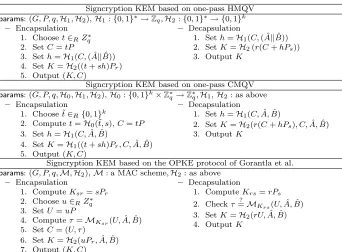
OPKE protocols proposed by Krawczyk [26], Ustaoglu [32] and Gorantla et al. [22] can be used as signcryption KEMs secure in the insider confidentiality and outsider unforgeability notions. The new signcryption KEMs between the partiesAandB in multi-user setting are presented in Figure 3. The private-public key pairs ofA and B are (s, Ps) and (r, Pr) respectively.
5.2 Security of the new KEMs
Krawczyk [26] gave a sketch of the proof of security for one-pass HMQV in the random oracle model. The security model considerssession-state revealquery instead ofEphemeralKeyRevealquery. It can be easily shown that one-pass HMQV is secure under the model in Section 2.3. By combining this result with Theorem 3, it follows that the new signcryption KEM obtained from one-pass HMQV is secure in the insider confidentiality and outsider unforgeability notions.
We can also obtain signcryption KEMs from the OPKE protocols proposed by Ustaoglu [32] and Gorantla et al. [22]. The one-pass CMQV protocol of Ustaoglu was proven secure in the eCK model described in Section 2.3 assuming random oracles. On the other hand, the OPKE protocol of Gorantla et al. [22] was proven in a weaker model that does not consider session-state revealor
Signcryption KEM based on one-pass HMQV params: (G, P, q,H1,H2),H1:{0,1}∗
→Zq,H2:{0,1}∗→ {0,1}k – Encapsulation
1. Chooset∈RZ∗q
2. SetC=tP
3. Seth=H1(C,( ˆA||B))ˆ 4. SetK=H2((t+sh)Pr)
5. Output (K, C)
– Decapsulation
1. Seth=H1(C,( ˆA||B))ˆ 2. SetK=H2(r(C+hPs))
3. OutputK
Signcryption KEM based on one-pass CMQV params: (G, P, q,H0,H1,H2),H0:{0,1}k×
Z∗q→Z∗q,H1,H2: as above – Encapsulation
1. Choose ˜t∈R{0,1}k
2. Computet=H0(˜t, s),C=tP 3. Seth=H1(C,A,ˆ B)ˆ
4. SetK=H1((t+sh)Pr, C,A,ˆ B)ˆ
5. Output (K, C)
– Decapsulation
1. Seth=H1(C,A,ˆ B)ˆ
2. SetK=H2(r(C+hPs), C,A,ˆ B)ˆ
3. OutputK
Signcryption KEM based on the OPKE protocol of Gorantla et al. params: (G, P, q,M,H2),M: a MAC scheme,H2: as above
– Encapsulation
1. ComputeKsr=sPr
2. Chooseu∈RZq∗
3. SetU=uP
4. Computeτ=MKsr(U,A,ˆ B)ˆ
5. SetC= (U, τ)
6. SetK=H2(uPr,A,ˆB)ˆ
7. Output (K, C)
– Decapsulation
1. ComputeKrs=rPs
2. Checkτ=? MKrs(U,A,ˆ B)ˆ
3. SetK=H2(rU,A,ˆ B)ˆ 4. OutputK
Fig. 3.New Signcryption KEM
of this paper [23], we defined security for signcryption KEMs without considering Open queries and also established connection between signcryption KEM and OPKE protocols using that model. Hence, the signcryption KEM resulting from the OPKE protocol of Gorantla et al. [22] would be the first signcryption KEM secure in the standard model under the security notions defined in the earlier version of this paper.
Confidentiality Unforgeability Efficiency
Model Outsider Insider Outsider Insider Encap. Decap.
ECISS-KEM1 [19] Y N Y N 2 Exp 1 Exp ROM
ECISS-KEM2 [19] broken ROM
Dent [18] Y N Y Y 1 Exp 2 Exp ROM
Bjørstad and Dent [11] Y N Y Y 1 Exp 2 Exp ROM One-pass HMQV [26] Y Y Y N 2 Exp 1.5 Exp ROM One-pass CMQV [32] Y Y Y N 2 Exp 1.5 Exp ROM Gorantla et al. [22] Y Y Y N 1 Exp 1 Exp Std.
Table 1.Security and efficiency comparisons with existing signcryption KEMs
HMQV/CMQV achieve this additional property only at the cost of an extra half-length exponenti-ation1compared to the ECISS-KEM1 in thedecapsulationalgorithm. Moreover, these schemes also
have a proof of security when the adversary leaks session state/ephemeral key. Although the scheme based on Gorantla et al.’s [22] protocol does not have a proof of security when the adversary has access to ephemeral data, it is more efficient than the other signcryption KEMs, when the static Diffie-Hellman key between the sender and the receiver is pre-computed. It should also be noted that the security of the new signcryption KEMs is treated in multi-user setting.
Note that we have not considered ephemeral pubic key validation when comparing efficiency of signcryption KEMs. In each of the schemes in Table 3 schemes, it requires an additional exponen-tiation for the recipient to perform this operation.
6 From signcryption KEM to OPKE
We now consider the generic construction in the other direction. We first discuss how a signcryption KEMSKcan be used as an OPKE protocolπ. WhenSKis used asπ, the encapsulationalgorithm of SKbecomes the session key computation process for the sender inπ. The generated symmetric key serves as the session key, while the encapsulation of the symmetric key as the outgoing message to the receiver. The receiver can compute the same session key by executing the decapsulation
algorithm on the incoming message.
ForSKto be suitable to be used as an OPKE protocol secure in the model defined in Section 2.3, it should be secure in the insider confidentiality and outsider unforgeability notions. Informally, se-curity under insider confidentiality and outsider unforgeability enables the resulting protocol to have sender forward secrecy and implicit authentication respectively. If SK is secure when considering
openqueries, the resulting π will be secure under against compromise of ephemeral data.
Theorem 4. If a signcryption KEM is secure in the insider confidentiality and outsider unforge-ability notions, then it can be used as an OPKE π that is secure under the model defined in Sec-tion 2.3.
Proof. The truth value of the above theorem is the same as the statement: if π is not secure in the model defined in Section 2.3, thenSKis not secure in either insider confidentialityor outsider unforgeability notion. Hence, it is enough to show that given an adversary Aπ against π that can
distinguish a real session key from a random number with advantageǫ, then eitherACM A orACCA
againstSK can be constructed with advantageǫ′≥ǫin polynomial time.
The proof is divided into two parts. In the first part ACM A is constructed with non-negligible
advantage only if an eventForgery(explained later) occurs. In the second partACCA is constructed
from Aπ with non-negligible advantage if the event Forgery does not occur. Let {U1, U2, ..., Un}
be set of n users and assume each user is activated at most m times by Aπ, where n and m are
polynomials in the security parameter.
Constructing ACM A from Aπ: We assume the existence ofAπthat can distinguish a real session
key from a random value in time tf. We then construct ACM A within time t1 ≤ tf +m(n−
1)(tf eo + 2·tf do), where tf eo and tf do are the response times for the FEO and FDO queries
respectively.
1
Krawczyk [26] explained that choosing the output length of the hash function H1 as q2 provides the right