Partial Signatures and their Applications
Mihir Bellare∗ Shanshan Duan†
July 2009
Abstract
We introduce Partial Signatures, where a signer, given a message, can compute a “stub” which preserves her anonymity, yet later she, but nobody else, can complete the stub to a full and verifiable signature under her public key. We provide a formal definition requiring three properties, namely anonymity, unambiguity and unforgeability. We provide schemes meeting our definition both with and without random oracles. Our schemes are surprisingly cheap in both bandwidth and computa-tion. We describe applications including anonymous bidding and betting.
Keywords: Signatures, anonymity, hash functions
∗
Dept. of Computer Science & Engineering, University of California at San Diego, 9500 Gilman Drive, La Jolla, California 92093, USA. E-Mail: [email protected]. URL:http://www-cse.ucsd.edu/users/mihir. Supported in part by NSF grants CCF-0915675, CNS 1116800 and CNS 0904380.
Contents
1 Introduction 3
2 Related work 6
3 Definitions 8
4 Constructions 9
5 A Reverse Connection 13
A Security Definitions of Signatures and Commitments 15
B Proof of Theorem 4.1 16
C Proof of Theorem 4.2 18
D Proof of Theorem 4.3 20
E Proof of Theorem 5.2 24
1
Introduction
Alice wishes to place a bid with valuebidA. She wants to be able to claim the bid as hers in case it wins, but otherwise wishes to remain anonymous. Partial signatures allow her to do this as follows. Alice accompanies her bidbidAwith a “stub” σ. The stub cannot be verified given Alice’s public verification key, and her anonymity is protected. When Alice’s bid is pointed to as the winning one, sheand only she can provide a de-anonymizer κsuch that (σ, κ) is a full and normal signature which can be verified under the (certified) public verification key that she also now provides.
Partial signatures, unlike group [11, 4] and ring [19, 9] signatures, offer Alice a practical way to get anonymity in settings where she has no a priori knowledge of the “crowd” of people within which she wants to stay anonymous; they are suitable for anonymity in which the crowd, such as the set of all bidders in an auction, is dynamic and unknown to any individual bidder. Below we expand on the primitive and its formalization, and discuss solutions, both theoretical and practical. In Section 2 we explain in more depth how partial signatures differ from group [11, 4], ring [19, 9] and anonymous signatures [22, 14].
Partial Signatures. Signer Alice in a Partial Signature (PS) scheme generates for herself a secret
signing key sk and a matching public verification keyvk, and gets the latter certified in the usual way. Her verification key and certificate are then available to any potential verifier. So far, there is nothing different from a regular signature scheme.
The difference is that a signature of a message M under signing key sk is a pair (σ, κ). The stub σ is a “partial” signature, not by itself verifiable, provided in a first phase as a placeholder. Later the signer provides the de-anonymizer κ together with vk, and it is now possible to verify that (σ, κ) is a valid signature of M under vk. We now discuss the three security requirements, namely anonymity, unambiguity and unforgeability.
Anonymity. Briefly, the stub-creator’s identity cannot be determined from the stub and message. To
elaborate, with identities bound to verification keys, we imagine that the adversary has some a priori information about the potential verification key of the signer, for example that it belongs to some setS of keys. In the worst case, this set contains just two verification keys. Knowing both these keys, given a stub created under one of them, and given the message, the adversary has negligible advantage over guessing in determining under which of the two keys the stub was created.
An implication is that stubs, unlike full signatures, cannot be verified. Otherwise the adversary could test versus the two candidate verification keys to see which matched the stub.
Unambiguity. Anonymity by itself is easy to achieve: just let the stub be the empty string σ = ε
and let the de-anonymizer be the entire signature. But suppose Alice provides this trivial stub with her bid. Bob is watching, sees Alice’s stub and bid, and sees that she wins. He now decides to claim the winning bid as his own by sending in his own public verification key vk′ together with the de-anonymizer κ′ consisting of Bob’s signature of M under vk′ which he can compute since he has the signing keysk′ corresponding tovk′. Verification succeeds (recall in our example the de-anonymizer is the whole signature and the stub is empty) and Bob has now claimed the winning bid. Unambiguity prevents this by requiring that an adversary, given a stub σ under sk of a message M of her choice, is unable to create κ′,vk′ such that (σ, κ′) verifies as a signature of m undervk′.
In the above attack, it sufficed for Bob to create vk′ honestly, but in fact he is under no compulsion to do so. This is why we let the keyvk′ above be entirely under adversary control, leading to a strong security requirement. In fact our formal definition is stronger still, not even requiring thatvkbe honestly generated. The adversary simply provides verification keysvk0,vk1, messages M0, M1, de-anonymizers κ0, κ1 and a (single!) stub σ, and wins if (σ, κb) is a valid signature of Mb under vkb for both b= 0,1 as long as the verification keys vk0,vk1 are distinct. The adversary can generate vk0,vk1 any way it wants as long as they are different, and in particular might know both underlying secret keys.
very simply stated and turns out to be achievable without significant additional overhead, so we have adopted it. Unambiguity can be viewed as a signature analog of the robustness property of anonymous encryption defined in [2]. As there, it ensures that anonymity is not at the cost of authenticity.
Unforgeability. Strong as it is, our formulation of unambiguity does not imply standard
unforge-ability because the keysvk0,vk1 in the winning condition must be different. Unambiguity, thus, can be viewed as preventing “forgery” under an adversarially-modified verification key, something not part of the normal definition of a signature [15], and we will separately formulate an unforgeability requirement preventing forgery on the target verification key itself. However, here, too, something novel emerges, for we want to say that the adversary cannot forge a full signature on a message even if it already knows a stub for this message. That is, even if it has a piece of the signature, it should not be able to compute the rest. Furthermore we would like this to be true when the adversary has more capabilities than represented by the traditional signing oracle. We give it a partial signing oracle that returns stubs of messages of the adversary’s choice. It can obtain corresponding de-anonymizers adaptively from an opening oracle and then wins if it forges on a stub for which it did not obtain the de-anonymizer. The ability to adaptively obtain de-anonymizers after seeing stubs is reminiscent of a selective-opening attack [12, 3] but we will be able in this context to provide solutions without heavy tools or additional overhead.
Applications. Partial signatures are applicable in any setting where one wants anonymity in a first
stage while reserving the capability, in a second stage, of identifying oneself and linking oneself to the first stage transaction. One such application is Alice placing a bid anonymously and then being able to claim it, if she so desires, at a later stage. Another is Alice betting anonymously and identifying herself only if she wins in order to claim the winnings. Author Alice could submit a paper to a conference anonymously, identifying herself only if the paper is accepted. Unambiguity prevents an adversary from, respectively, claiming the bid as its own; taking Alice’s winnings; and claiming to be the author of Alice’s paper.
Achieving security. Having sketched the security requirements of a Partial Signature scheme we see
that it asks for rather a lot more than a normal signature scheme. It requires a structured signature having two parts, one, the stub, not verifiable on its own but capable of being completed only by the stub creator. Unambiguity, a requirement on adversarially-chosen verification keys, is quite different from, and not in any way implied by, standard unforgeability, which pertains to honestly generated keys. This raises two questions. The first, a theoretical one, is whether security is achievable at all, and particularly without random oracles; the second a practical one, is whether one can find efficient solutions, now, if necessary, allowing random oracles. Let us address these questions in turn.
Theoretical construction. We provide a simple, general transform of any standard signature
scheme into a (secure, meaning meeting all three of our requirements) partial signature scheme. The transform uses as a tool any commitment scheme. This immediately yields constructions without random oracles, because standard signature schemes, as well as commitment schemes, without random oracles, are well known.
Proving unforgeability of our commitment-based partial signature scheme runs into the selective de-commitment problem [12, 3]. The problem is, can an adversary who, given a number of de-commitments can choose to open some of them, obtain information about the unopened ones? Intuitively not, but nobody has been able to prove this, and results in [12, 3] indicate that it is hard. In our particular setting, we are able to resolve the problem and prove security of our scheme by exploiting the fact that the privacy required for un-opened commitments is of a limited nature.
Practical constructions. The theoretical existence question thus settled, we turn to finding
Class Scheme Sign Ver |σ| |κ| Assumption
RH RH-BLS 1 exp 1 pr 160 320 CDH DH DH-Sch 1 exp 2 exp 160 240 DL DH DH-GQ 1 exp 2 exp 160 2048 Factoring
SP SP-Sch 1 exp 2 exp 80 160 DL
Figure 1: Costs of our partial signature schemes. For each scheme, we show the computational cost Sign
of signing (this means generation of the full signature (σ, κ)); the computational cost Ver of verification; the bitlength|σ|of a stubσ; the bitlength|κ|of the de-anonymizerκ; and theAssumptionused to prove security. By “RH” we mean randomized hash. By “DH” we mean deterministic hash. By “SP”, we mean splitting. By “exp” we mean an exponentiation. By “pr” we mean a pairing.
The motivation for the second is that for wireless devices such as PDAs, cell phones, RFID chips and sensors, battery life is the main limitation. Here, communicating even one bit of data uses significantly more power than executing one 32-bit instruction. Reducing the number of bits to communicate saves power and is important to increase battery life. Also, in many settings, communication is not reliable, and so the fewer the number of bits one has to communicate, the better. For such reasons, we want schemes in which both the stub and the de-anonymizer are as short as possible.
How well can we hope to do? Any partial signature scheme is, of course, a standard signature scheme. (The stub and the de-anonymizer together constitute a full signature.) So we cannot hope for computation or bandwidth costs lower than those of standard signature schemes. The issue is to reduce the overhead as much as possible. As we now explain, we do very well.
All our constructions start with a base, standard signature scheme and transform it into a partial one. We measure overhead with respect to the base scheme, with the bandwidth overhead being defined as the difference between the length of a full signature in the partial scheme and a signature in the base scheme. The computational overhead of our schemes is at most one hash. The bandwidth overhead ranges from 320 bits to (surprisingly) zero bits. In particular, our Schnorr [21] based scheme, SP-ScH, has an 80 bit partial signature and a 160 bit de-anonymizer and has zero overhead, inboth computation and bandwidth. Refer to Figure 1 for a summary of the characteristics of our schemes. We now discuss the schemes in more detail.
RH construction. We can obtain fairly efficient schemes by instantiating the commitment scheme
in our above-mentioned general transform by a random-oracle based randomized hash. The stub is the hash of a 160 bit random string together with the base signature, and the de-anonymizer is the base signature together with the random string. We call this the RH construction. The computational overhead is one hash, and the bandwidth overhead is 320 bits. Bandwidth is minimized by choosing BLS [10] as the base signature scheme, and Figure 1 displays the characteristics of the resulting RH-BLS scheme.
DH construction. We then consider a class of signature schemes that we call high-entropy schemes.
base scheme under DH. And, indeed, DH-BLS is insecure.) Figure 1 summarizes the characteristics of the DH-Sch and DH-GQ schemes.
Splitting construction. However, we can do even better. In identification-based signature schemes
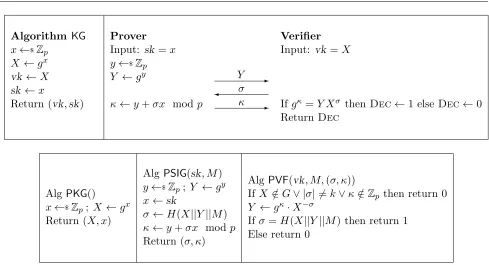
such as that of Schnorr [21], the signature is a pair (σ, κ) where σ is the hash of the commitment (the name given to the first message from the prover) and the message, whileκ is the response of the prover when the verifier challenge isσ. We observe that such signature schemes lend themselves very directly to partial signatures: we simply useσas the stub, andκas the de-anonymizer. We call this the splitting construction (SP). The result is a scheme that has zero overhead, in both computation and bandwidth. Of course, we need to show that this works. We are able to do this by direct proof based on the general forking lemma of [5]. Observing that the verifier challenge need be only 80 bits long (there are no birthday attacks on the challenge) we obtain the SP-Sch scheme whose characteristics are summarized in Figure 1.
Reverse connection. As indicated above, we have shown that one can build a partial signature
scheme from a commitment scheme. It is natural to ask whether the use of a commitment scheme is necessary. We show that it is. Namely, we show in Section 5 that any partial signature scheme can be converted into a commitment scheme. (At the theoretical level there is nothing interesting here since all of these primitives are equivalent to one-way functions [17, 18]. However, our transformation is direct and efficient.)
2
Related work
Anonymity means being lost in the crowd. Partial, group [11, 4] and ring [19, 9] signatures differ in how, when and by whom this crowd is defined. In group signatures the crowd is a pre-created group with corresponding management overhead and lack of flexibility; in ring signatures, the signer must explicitly pick the crowd at signing time and compute her signature as a function of it; but in a partial signature, the signer functions autonomously and obliviously of the crowd, which she does not need to know in order to compute a signature. Partial signatures are for settings where the crowd is ephemeral and dynamic and when the signer is potentially part of multiple crowds. Group and ring signatures are not applicable to anonymous bidding, where the crowd is ephemeral and not known in advance to any individual bidder. Anonymous signatures [22, 14] have the same intent as partial signatures but their definition does not lend itself well to the claimed applications and they lack security properties including unambiguity. Let us now look at these items in more detail.
Group signatures. In a group signature scheme [11, 4], all members of the group share a public
verification key. A group manager provides each group member with a signing key, so that any group member can sign on behalf of the group. Anonymity means that, from the signature, one cannot tell which member of the group was the signer. In a partial signature, a signer generates her keys on her own and gets the verification key certified in the ordinary way. There is no explicit group. No manager or additional infrastructure is required.
There is no clear way to identify, in advance, the set of individuals who will bid in an open electronic auction, meaning form the crowd within which anonymity is sought. Even if one could, it is rather unlikely that this crowd is either able or willing to cooperate to form a group-signature group, which would involve finding a manager, getting a common public key, and setting up secure channels to the manager over which signing keys could be issued. Bidding crowds will be ephemeral, differing from bid to bid, making the overhead of group formation even more onerous. Partial signatures allow signers to sign in ignorance of the crowd and as members of ephemeral crowds not even defined at signing time.
Ring signatures. In a ring signature [19, 9], like in a partial signature, Alice generates her own keys
signature as a function ofS. Anonymity means that, from the signature, one cannot tell which member of S was the signer. In a partial signature, in contrast the signing process does not have as input the crowd S. This reflects the needs of applications like anonymous bidding where the crowd will not be known in advance to an individual bidder.
Anonymous signatures. Introduced by Yang, Wong, Deng and Wang (YWDW) [22], anonymous
signatures aim to address the same types of applications as partial signatures. We will argue however that they fall short in that the formulation does not lend itself well to applications and the security requirements are weak.
In an anonymous signature scheme, the recipient is provided with a full signature. The problem is that this is verifiable, and there are often only a few candidate verification keys, for example all bidders who eventually bid in the auction. By trial verification under the candidate verification keys, the signer can be determined. So how is one to get anonymity? The solution of YWDW [22] was, while giving the recipient the signature, to deny it the message. For this to prevent trial verification and provide anonymity, however, they require the message to be randomly chosen from a large space. Thus, they envisage providing the signature in a first phase and, in the second, providing the message and verification key.
The problem from the application perspective is that here messages are certainly not random, and may need to be known in advance to potential verifiers. For example, under the anonymous signatures approach, when Alice wishes to place a bid with valuebidA, she provides, at bidding time, her anonymous signature of bidA, but not the message bidA itself. However, the auctioneer needs to know the bid in order to determine the winner.
This problem is to some extent recognized in [22, 14]. To solve it, they suggest that the message to be signed be obtained by padding the bid with a random string. Only the random string would be withheld in the first phase. The difficulty is that while this may “work”, it moves us outside the YWDW definitional framework, which does not cover such usage and does not give us any guarantees about it. (The explanation for this is somewhat technical. The YWDW definition requires the message to be drawn at random from a message space that is large and fixed beforehand. It is unclear, in this context, how to define this message space, given that the bid may have many possible values, and bids are simply objects chosen by users, rather than ones on which there is some probability distribution.) These difficulties may potentially be resolved by using classes of distributions as per [14], but things are getting more complicated than seems desirable. The same issues arise with other applications mentioned in [22]. In summary, the whole “anonymity by message withholding” approach of YWDW just does not seem to map well to applications.
Partial signatures, in contrast, are a “anonymity by partial signature withholding” approach where the recipient is provided the message in full and no assumptions are made on its distribution. They better fit the applications for which anonymous signatures were intended.
The second weakness of the YWDW definition of anonymous signatures is that it fails to require unambiguity. Namely, given Alice’s signature, Bob may be able to produce a public key, different from Alice’s, under which the signature verifies, thereby effectively claiming the signature as his own. This means that when Alice’s bid wins the auction, Bob can open it, and claim thathe won the auction. (This does not contradict unforgeability, because the public key Bob provides is different from Alice’s.) In fact, we can give specific examples of schemes that meet the YWDW definition but are not unambiguous, meaning are subject to the above attack. Partial signatures, in contrast, explicitly demand unambiguity, and all our schemes provide it.
Zhang and Imai [23] consider the case of anonymous signatures where messages have lower entropy. In work independent of ours, Saraswat and Yun [20] mount critiques on anonymous signatures similar to ours and suggest, instead of introducing hidden randomness to the message, to introduce hidden randomness to the signature. Instead of withholding part of the message, they too withhold part of the signature.
Schemes. Our partial signature schemes are simple and efficient and have minimal, even zero, overhead
compared to standard signature schemes, which is appealing from the deployment perspective and is not true for any known group or ring signature schemes.
3
Definitions
Notation and conventions. We denote by a= a1k · · · kan an encoding of strings a1, . . . , an from
which the constituents are easily recoverable via a1k · · · kan ← a. We denote the empty string by ε. Unless otherwise indicated, an algorithm may be randomized. If A is a randomized algorithm then y←$A(x1, . . .) denotes the operation of running A with fresh coins on inputs x1, . . . and letting y
denote the output. If S is a (finite) set then s←$S denotes the operation of picking s uniformly at
random from S. IfX= (x1, x2, . . . , xn) is ann-tuple, then (x1, x2, . . . , xn) ←X denotes the operation of parsingX into its elements.
Code-based games. We will use code-based games [8] in definitions and proofs and we recall some
background here. A game has an Initialize procedure, procedures to respond to adversary oracle queries, and a Finalize procedure. A game G is executed with an adversary A as follows. First, Initialize executes and its outputs are the inputs to A. Then, A executes, its oracle queries being answered by the corresponding procedures of G. When A terminates, its output becomes the input to theFinalizeprocedure. The output of the latter is called the output of the game, and we letGAdenote the event that this game output takes value true. Variables not explicitly initialized or assigned are assumed to have value ⊥, except for booleans which are assumed initialized to false. Games Gi, Gj areidentical untilbad if their code differs only in statements that follow the setting of the boolean flag bad to true. The following is the Fundamental Lemmas of game-playing:
Lemma 3.1 [8] Let Gi, Gj be identical until bad games, and A an adversary. Let BDi (resp. BDj) denote the event that the execution ofGi (resp. Gj) withAsets bad. Then
Pr
GAi ∧BDi= PrGAj ∧BDjand PrGAi −PrGAj ≤Pr [BDj].
When we refer to the running time of an adversary A we mean the total time for the execution of G with A where G is the game defining the adversary’s advantage. This convention simplifies running time analyses.
Digital signatures. A digital signature scheme DS consists of three algorithms with the following
functionality. The key generation algorithmSKGreturns a pair (vk,sk) of keys consisting of the public key and matching secret key, respectively. The signing algorithm SIG takes the secret key sk and a messageM to return a signatures. The deterministic verification algorithmSVF takes a public keyvk, a candidate signaturesand a message M to return either 1 or 0. We require that all public keys have the same length, as do all signatures output bySIG. The consistency requirement is that for allM we
haveSVF(vk, s, M) = 1 with probability 1 in the experiment (vk,sk)←$SKG() ; s←$SIG(sk, M). The
standard unforgeability notion [15] is captured by the game EUF-CMA of Figure 8 in Appendix A.
Partial Signatures. A partial signature schemePS= (PKG,PSIG,PVF) is simply a digital signature
Initialize
(vk,sk)←$PKG() i←0 ;E ← ∅ Returnvk Open(j)
If (j≤0∨j > i) Return⊥
E←E∪ {Mj} Returnκj
PSign(M)
i←i+ 1 ; Mi ←M (σi, κi)←$PSIG(sk, Mi)
Returnσi
Finalize(M,(σ, κ))
Return (M 6∈E∧PVF(vk, M,(σ, κ)) = 1) Initialize
b←${0,1}
(vk0,sk0)←$PKG()
(vk1,sk1)←$PKG()
Return ((vk0,sk0),(vk1,sk1)) CH(M)
(σ, κ)←$PSIG(skb, M)
Returnσ
Finalize(d) Return (b=d)
Initialize
Finalize(vk0,vk1, M0, M1, σ, κ0, κ1) d0←PVF(vk0, M0,(σ, κ0))
d1←PVF(vk1, M1,(σ, κ1))
Return (d0= 1∧d1= 1∧vk16=vk0)
Figure 2: Games UF, AN and UNAMB used to define, respectively, unforgeability, anonymity and unambiguity of partial signature schemePS= (PKG,PSIG,PVF).
by AdvufPS(A) = Pr
UFAPS
,AdvanPS(A) = 2·Pr
ANAPS
−1 and AdvunambPS (A) = Pr
UNAMBAPS
respectively.
In game UF, an adversaryF can query the oraclePSign to get a stub on any message of its choice. It can then, selectively, “open” whichever of these it pleases, meaning obtain the de-anonymizer, via its Open oracle. To winF must output a messageM and a valid full signature (σ, κ) of M such that either M was not queried to PSign or M was queried to PSign but the signature returned was not opened.
The formalization of anonymity follows [4]. The adversary not only gets target public keysvk0 and vk1 but also knows the corresponding secret keyssk0 andsk1. Via theCH oracle, it can obtain a stub, underskb, of a messageM of its choice, and it wins if it guesses the challenge bit b. It is allowed only one query to theCH oracle. Security against multiple queries follows by a hybrid argument.
Suppose Alice has produced a stub σ of some message M0 under her public key vk0. Unambiguity ensures that only Alice can open σ, by requiring that an adversary be unable to produce a public key vk1, message M1 and de-anonymizer κ1 such that PVF(vk1, M1,(σ, κ1)) = 1 but vk0 6= vk1. Actually the requirement is stronger, preventing even Alice herself from a priori creating σ which she can later open in two ways. This addresses the concern that Alice may create for herself two identities and, after sending a stub, “change” the message or identity from which it “originated”.
4
Constructions
The StC Construction. We describe a general transform of any signature scheme into a partial
one based on the following simple idea: the stub is a commitment to the base signature, and the de-anonymizer is the decommital key together with the base signature. We consider this a good starting point because this simple construction will later be the basis for numerous refinement leading to more efficient schemes. It is also of direct interest because it shows how to achieve partial signatures without random oracles and because the proof of unforgeability shows a special case in which we can solve the selective de-commitment problem.
AlgPKG()
(vk,sk)←$SKG()
Return (vk,sk)
AlgPSIG(sk, M) s←$SIG(sk, M)
(σ, ω)←$CMT(s||vk)
κ←(s, ω) Returnσ
AlgPVF(vk, M,(σ, κ)) (s, ω)←κ
If (CVF(σ, s||vk, ω) = 1) then If (SVF(vk, s, M) = 1)
then Return 1 Return 0
Figure 3: Algorithms defining partial signature schemePS = (PKG,PSIG,PVF) derived via the StC transform
from base signature schemeDS = (SKG,SIG,SVF) and commitment schemeCMT = (CMT,CVF).
AlgPKG()
(vk,sk)←$SKG()
Return (vk,sk)
Alg PSIGH(sk, M)
s←$SIG(sk, M) ; ω←${0,1}k
σ←$H(ω||s||vk)
κ←(ω, s) Return (σ, κ)
Alg PVFH(vk, M,(σ, κ)) (ω, s)←κ
If (H(ω||s||vk) =σ∧ |ω|=k) then If (SVF(vk, s, M) = 1) then return 1 Return 0
Figure 4: Algorithms defining partial signature scheme PS = (PKG,PSIG,PVF) derived via the RH transform
from base signature schemeDS = (SKG,SIG,SVF).
The commitment algorithm CMT takes the message M to be committed and returns a pair of (σ, ω)
consisting of a commitment σ and decommital key ω. The deterministic verification algorithm CVF
takes as input candidate values σ, M, ω of a commital, message and decommital, respectively, and returns either 1 or 0. The consistency requirement is that for all M we have CVF(σ, M, ω) = 1 with
probability 1 in the experiemnt (σ, ω)←$CMT(M). The definitions of hiding and binding are formalized
by the games of Figure 8 in Appendix A.
Our Sign-then-Commit (StC) transform associates to base digital signature schemeDS= (SKG,SIG, SVF) and base commitment scheme CMT = (CMT,CVF) the partial signature scheme PS = (PKG, PSIG,PVF) whose constituent algorithms are defined in Figure 3. The following theorem says that (1)
if DS is unforgeable and CMT is hiding then PS is unforgeable (2) If CMT is hiding then PS is anonymous, and (3) ifCMT is binding then PS is unambiguous. The proof is in Appendix B.
Theorem 4.1 Let DS = (SKG,SIG,SVF) be a digital signature scheme and CMT = (CMT,CVF) a
commitment scheme. Let PS = (PKG,PSIG,PVF) be the partial signature scheme constructed from
DS andCMT as in Figure 3. Then we have:
1. Unforgeability: Let F be an adversary against the unforgeability of PS making q ≥ 1 queries
to oracle PSign. Then there exist adversaries A, B such that AdvufPS(F) ≤ 2q·AdvufDS(A) +q · AdvhdCMT(B). Furthermore, the running times of A, B are the same as the running time of F, and A makesq queries to its Signoracle.
2. Anonymity: LetAbe an adversary against the unambiguity ofPS. Then there exists an adversary
B such thatAdvunambPS (A)≤AdvbndCMT(B). Furthermore, the running time of B is that ofA. 3. Unambiguity: LetA be an adversary against the anonymity ofPS that makes one query to oracle
CH. Then there exists adversaryB such thatAdvanPS(A)≤AdvhdCMT(B). Furthermore, the running time of B is that ofA.
The RH Construction. The Randomized Hash (RH) construction is the result of instantiating
the commitment scheme of the StC construction with the RO-model commitment scheme CMT = (CMT,CVF) defined as follows. Algorithm CMTH(M) picks ω←${0,1}k and returns H(ω||M) as the
commitment, where H is the RO. Algorithm CVFH(σ, M, ω) lets σ′ ← H(ω||M). If |ω| 6= k then it
signature schemePS= (PKG,PSIG,PVF) obtained from the StC construction of Section 4 applied to a
base signature schemeDS = (SKG,SIG,SVF) and the commitment scheme we just defined.
We can set the output length k of the RO to 160 bits. (80 bits is not enough because binding reduces to finding collisions and is subject to the birthday attack.) The results of Section 4 imply that the PS scheme of Figure 4 is secure in the RO model. In this way, we can transform any standard signature scheme into an anonymous one with the following characteristics. The computational overhead is just one hash, meaning signing and verifying are effectively just as efficient as before. The bandwidth overhead is 320 bits: the stub is 160 bits and the de-anonymizer is 160 bits longer than the base signature. This is pretty good, yet, in what follows, we will provide alternative constructions that reduce the bandwidth overhead even further.
A word of warning. If the base signature scheme already uses a RO then the ROH of Figure 4 must be different and independent. This can be ensured by domain seperation as discussed in [6]. This issue arises also below and should be addressed in the same way.
The DH Construction. Base signature schemes such as Schnorr [21], GQ [16] and Fiat-Shamir [13]
are randomized, and their signatures have quite a bit of entropy. We will now show that in such cases, the randomizerω of Figure 4 can be dropped. This saves 160 bits in bandwidth. But the scheme is no longer an instance of the StC transform, and a tailored analysis is needed. We now proceed to detail the construction and provide the analysis.
The DH (Deterministic Hash) construction transforms a base standard signature schemeDS = (SKG, SIG,SVF) into a partial one PS = (PKG,PSIG,PVF) using a RO H: {0,1}∗ → {0,1}k, as shown in
Figure 5. For the analysis, we make the following definition. Let DS = (SKG,SIG,SVF) be a digital
signature scheme. The min-entropyH∞(DS) ofDS is defined by the equation
2−H∞(DS)= max
(vk,sk),s,MPr [s=s:s←
$SIG(M,sk) ]
where the maximum is over all (vk,sk) that might be output by SKG, all strings s, and all messages
M. For example, the Schnorr (Sch) scheme [21] over a group of order p has min-entropy lg(p). A deterministic scheme such as FDH [7] or BLS [10], however, has min-entropy 0. The DH-Sch scheme has bandwidth overhead 160 bits as compared to 320 bits for RH-Sch.
The following theorem says that the partial signature scheme of Figure 5 is secure in the RO model assuming a secure, high entropy base signature scheme. The proof is in Appendix C.
Theorem 4.2 Let DS = (SKG,SIG,SVF) be a digital signature scheme. Let PS = (PKG,PSIG,PVF)
be the partial signature scheme constructed as in Figure 5. Letkbe the output length of the ROH in the scheme. Then we have:
1. Unforgeability: Let F be an adversary against the unforgeability of PS, making qs queries to
oracle PSign,qH queries to random oracle Hand qo queries to oracle Open. Then there exists an adversary A such that AdvufPS(F) ≤ AdvufDS(A) +qs(qs+ 4(qH +qo))·2−1−H∞(DS). Furthermore, the running time of A is that of F and Amakes qo queries to its Sign oracle.
2. Anonymity: Let A be an adversary against the anonymity of PS making qH queries to random
oracleH and one query to oracleCH. ThenAdvanPS(A)≤2qH·2−H∞(DS).
3. Unambiguity: LetAbe an adversary against the unambiguity ofPS makingqH queries to random
oracleH. Then we have AdvunambPS (A)≤qH2 ·2−k−1.
We remark that the proof shows that for unambiguity it suffices for the hash function to be collision resistant rather than a random oracle.
The Splitting Construction. The splitting construction of a partial signature is based on the
AlgPKG()
(vk,sk)←$SKG()
Return (vk,sk)
Alg PSIGH(sk, M)
s←$SIG(sk, M) ; σ←$H(s||vk)
κ←s
Return (σ, κ)
Alg PVFH(vk, M,(σ, κ)) s←κ
If (H(s||vk) =σ)∧(SVF(vk, s, M) = 1) then Return 1
Return 0
Figure 5: Algorithms defining partial signature scheme PS= (PKG,PSIG,PVF) derived via the DH transform
applied to high-entropy base signature schemeDS = (SKG,SIG,SVF).
Algorithm KG
x←$Zp
X ←gx vk ←X sk ←x
Return (vk,sk)
Prover Input: sk =x y←$Z
p Y ←gy
κ←y+σx mod p
Y
-σ
κ
-Verifier Input: vk =X
If gκ =Y Xσ thenDec←1 elseDec←0
Return Dec
AlgPKG()
x←$Z
p; X←gx Return (X, x)
AlgPSIG(sk, M) y←$Zp; Y ←gy
x←sk
σ←H(X||Y||M) κ←y+σx modp Return (σ, κ)
Alg PVF(vk, M,(σ, κ))
If X /∈G∨ |σ| 6=k∨κ /∈Zp then return 0 Y ←gκ·X−σ
If σ=H(X||Y||M) then return 1 Else return 0
Figure 6: At the top is the Schnorr identification protocol. Below are the algorithms defining partial signature scheme PS = (PKG,PSIG,PVF) derived from this protocol via the splitting construction.
Here Gis a group of prime orderp and g is a generator ofG.
The associated partial signature scheme PS = (PKG,PSIG,PVF) is defined in Figure 6. Here, and
throughout this section, we have fixed a group G of prime order p and a generator g of G. Note that this SP-Sch partial signature scheme has zero overhead relative to the base scheme since the full signature is exactly a Schnorr signature. Since the challenge in the Schnorr protocol need be only 80 bits long (not 160) we get a partial signature scheme with an 80-bit stub and a 160 bit de-anonymizer for a 240-bit full signature. Our proof will exploit the general forking lemma of [5], recalled in Appendix D. To discuss security we first recall the Discrete Logarithm Assumption. LetG∗ =G− {1}be the set of generators ofG, where 1 is the identity element ofG. We let DLogg(h) denote the discrete logarithm of h∈Gto base a generator g∈G∗. Let
AdvdlG,g(A) = Prhx←$Z
p; x′←$A(g, gx) : gx
′
=gxi
denote the advantage of an adversary Ain attacking the discrete logarithm (dl) problem. The proof of the following theorem is in Appendix D.
Theorem 4.3 LetGbe a group of prime orderpand letgbe a generator ofG. LetPS= (PKG,PSIG, PVF) be the splitting-based partial signature scheme constructed in Figure 6. Let the range of the RO
H in the scheme be {0,1}k ⊆Z
Alg CMT(M)
(vk0,sk0)←$PKG()
(vk1,sk1)←$PKG()
If (vk0 =vk1) thenbad←true n← |M|
For i= 1 to n
(σi, κi)←$PSIG(sk
M[i], i) σ ←(0, σ1||. . .||σn||vk0||vk1) ω ←κ1||. . .||κn
If bad=truethenσ←(1, M) ; ω←M Return (σ, ω)
Alg CVF(σ, M, ω)
(b, σ′)←σ If (b= 1) then
If (σ′ =M ∧ω=M) then return 1 Else return 0
Else
κ1||. . .||κn←ω
σ1||. . .||σn||vk0||vk1 ←σ′ If (vk0=vk1) then return 0
Fori= 1 to n di←PVF(vkM[i], i,(σi, κi)) Returnd1∧. . .∧dn
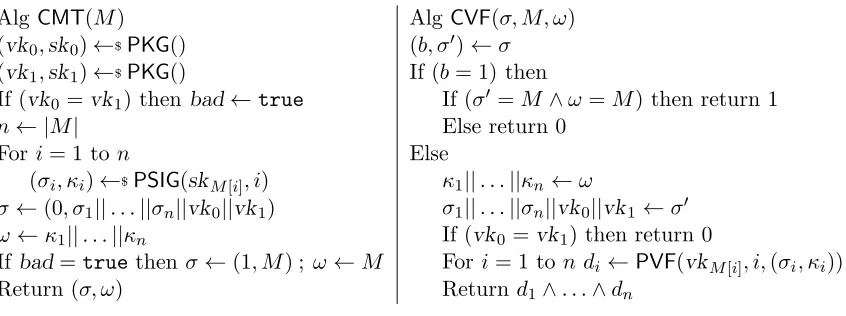
Figure 7: CMT construction from PS.
1. Unforgeability: Let F be an adversary against the unforgeability of PS, making qs queries to
oracle PSign, qH queries to random oracle H and having running time tF. Then there exists an algorithm B against the discrete logarithm problem such that
AdvufPS(F)≤ q 2
s + 4qsqH + 2qsqo
2p +
qH p +
q
qH ·AdvdlG,g(B).
Furthermore, the running time of B is 2tF.
2. Anonymity: Let A be an adversary against the anonymity of PS making qH queries to random
oracleH and one query to oracleLR. ThenAdvanPS(A)≤2qH/p.
3. Unambiguity: LetAbe an adversary against the unambiguity ofPS makingqH queries to random
oracleH. Then AdvunambPS (A)≤qH2/2k+1.
5
A Reverse Connection
From the primitive definitions, we can see that partial signatures (PS) and commitment schemes (CMT) share something in common. Firstly, PS hide the identity of the signer while CMT hide the committed message. Secondly, in the PS setting the signature can not be opened under a different public key while in the CMT setting the committed message can not be opened in a different way. Do these imply that when we have a scheme of one primitive we can transform it to that of the other primitive? We have showed one direction in our CMT construction in Section 4. To complete the whole picture, we are going to propose a generic transformation, to convert any partial signature scheme into a commitment scheme. However the similarities between these two primitives don’t imply that it is trivial to find such a transformation, especially an efficient one. Our transformation, which provides a direct and efficient conversion from PS to CMT, is depicted in Figure 7.
Security of our construction. We prove that if the given partial signature scheme can achieve
procedure Initialize //PKCollPS (vk0,sk0)←$PKG()
(vk1,sk1)←$PKG()
Return (vk0 =vk1)
Lemma 5.1 Let PS = (PKG,PSIG,PVF) be a partial signature scheme. Then there is an adversary
F against the unforgeability of PS such that Pr [ PKCollPS]≤AdvufPS(F). The running time of F is that ofPKG andF makes no oracle queries.
Proof: On input vk F let vk0 ← vk and (vk1,sk1)←$PKG. It let M be any message, for example
M = 0. It lets (σ, κ)←$PSIG(sk, M) and returns (M,(σ, κ)). If vk
1 = vk0, then it wins the game UFPS, so we have Pr [ PKCollPS]≤AdvufPS(F).
Theorem 5.2 Let PS = (PKG,PSIG,PVF) be a partial signature scheme and CMT = (CMT,CVF)
the commitment scheme constructed fromPSas in Figure 7. Let Abe an adversary against the hiding property of CMT, making one query to oracleLR, this always consisting of a pair of n-bit messages, and having running time at most tA. Then there exists adversary B making n queries to oracle CH and adversaryF making no queries such that
AdvhdCMT(A)≤n·AdvPSan (B) + 2·AdvufPS(F).
Furthermore, the running times of B and F are the same as that of A. B makes one query to its CH oracle andF makes no queries.
The proof is in Appendix E.
Theorem 5.3 LetPS = (PKG,PSIG,PVF) be a partial signature scheme andCMT = (CMT,CVF) the
commitment scheme constructed from PS as in Figure 7. Let A be an adversary against the binding property ofCMT. Then there exists an adversaryB such that
AdvbndCMT(A)≤AdvunambPS (B). Furthermore, the running time of B is that of A.
Due to space limit, the whole proof is deferred to Appendix F.
References
[1] M. Abdalla, J. H. An, M. Bellare, and C. Namprempre. From identification to signatures via the Fiat-Shamir transform: Minimizing assumptions for security and forward-security. In L. R. Knudsen, editor,
EUROCRYPT 2002, volume 2332 ofLNCS, pages 418–433. Springer, Apr. / May 2002. 5
[2] M. Abdalla, M. Bellare, and G. Neven. Robust encryption. In D. Micciancio, editor, TCC 2010, volume 5978 ofLNCS, pages 480–497. Springer, Feb. 2010. 4
[3] M. Bellare, D. Hofheinz, and S. Yilek. Possibility and impossibility results for encryption and commitment secure under selective opening. In A. Joux, editor,EUROCRYPT 2009, volume 5479 ofLNCS, pages 1–35. Springer, Apr. 2009. 4
[4] M. Bellare, D. Micciancio, and B. Warinschi. Foundations of group signatures: Formal definitions, simplified requirements, and a construction based on general assumptions. In E. Biham, editor,EUROCRYPT 2003, volume 2656 of LNCS, pages 614–629. Springer, May 2003. 3, 6, 9
[6] M. Bellare and P. Rogaway. Random oracles are practical: A paradigm for designing efficient protocols. In V. Ashby, editor, ACM CCS 93, pages 62–73. ACM Press, Nov. 1993. 11
[7] M. Bellare and P. Rogaway. The exact security of digital signatures: How to sign with RSA and Rabin. In U. M. Maurer, editor,EUROCRYPT’96, volume 1070 ofLNCS, pages 399–416. Springer, May 1996. 11 [8] M. Bellare and P. Rogaway. The security of triple encryption and a framework for code-based
game-playing proofs. In S. Vaudenay, editor,EUROCRYPT 2006, volume 4004 ofLNCS, pages 409–426. Springer, May / June 2006. 8
[9] A. Bender, J. Katz, and R. Morselli. Ring signatures: Stronger definitions, and constructions without random oracles. In S. Halevi and T. Rabin, editors,TCC 2006, volume 3876 ofLNCS, pages 60–79. Springer, Mar. 2006. 3, 6
[10] D. Boneh, B. Lynn, and H. Shacham. Short signatures from the Weil pairing. Journal of Cryptology, 17(4):297–319, Sept. 2004. 5, 11
[11] D. Chaum and E. van Heyst. Group signatures. In D. W. Davies, editor,EUROCRYPT’91, volume 547 of
LNCS, pages 257–265. Springer, Apr. 1991. 3, 6
[12] C. Dwork, M. Naor, O. Reingold, and L. J. Stockmeyer. Magic functions. In40th FOCS, pages 523–534. IEEE Computer Society Press, Oct. 1999. 4
[13] A. Fiat and A. Shamir. How to prove yourself: Practical solutions to identification and signature problems. In A. M. Odlyzko, editor,CRYPTO’86, volume 263 ofLNCS, pages 186–194. Springer, Aug. 1987. 5, 11 [14] M. Fischlin. Anonymous signatures made easy. In T. Okamoto and X. Wang, editors,PKC 2007, volume
4450 ofLNCS, pages 31–42. Springer, Apr. 2007. 3, 6, 7
[15] S. Goldwasser, S. Micali, and R. L. Rivest. A digital signature scheme secure against adaptive chosen-message attacks. SIAM Journal on Computing, 17(2):281–308, Apr. 1988. 4, 8
[16] L. C. Guillou and J.-J. Quisquater. A practical zero-knowledge protocol fitted to security microprocessor minimizing both trasmission and memory. In C. G. G¨unther, editor,EUROCRYPT’88, volume 330 ofLNCS, pages 123–128. Springer, May 1988. 5, 11
[17] J. H˚astad, R. Impagliazzo, L. A. Levin, and M. Luby. A pseudorandom generator from any one-way function.
SIAM Journal on Computing, 28(4):1364–1396, 1999. 6
[18] M. Naor. Bit commitment using pseudorandomness. Journal of Cryptology, 4(2):151–158, 1991. 6
[19] R. L. Rivest, A. Shamir, and Y. Tauman. How to leak a secret. In C. Boyd, editor, ASIACRYPT 2001, volume 2248 of LNCS, pages 552–565. Springer, Dec. 2001. 3, 6
[20] V. Saraswat and A. Yun. Anonymous signatures revisited. Cryptology ePrint Archive, Report 2009/307, 2009. http://eprint.iacr.org/. 8
[21] C.-P. Schnorr. Efficient signature generation by smart cards. Journal of Cryptology, 4(3):161–174, 1991. 5, 6, 11
[22] G. Yang, D. S. Wong, X. Deng, and H. Wang. Anonymous signature schemes. In M. Yung, Y. Dodis, A. Kiayias, and T. Malkin, editors, PKC 2006, volume 3958 ofLNCS, pages 347–363. Springer, Apr. 2006. 3, 6, 7
[23] R. Zhang and H. Imai. Strong anonymous signatures. In M. Yung, P. Liu, and D. Lin, editors,INSCRYPT08, volume 5487 of LNCS, pages 60–71. Springer, Dec. 2008. 8
A
Security Definitions of Signatures and Commitments
The advantage of an adversaryF in attacking the unforgeability is AdvufDS(F) = Pr
EUF-CMAFDS ,
Initialize
b←${0,1}
LR(M0, M1)
If (|M0| 6=|M1|) then return⊥
(σ, ω)←$CMT(Mb)
Returnσ
Finalize(d) Return (b=d)
Initialize
Finalize(σ,(M0, ω0),(M1, ω1))
d0←(CVF(σ, M0, ω0) = 1)
d1←(CVF(σ, M1, ω1) = 1)
Return (d0∧d1∧M06=M1)
Initialize
(vk,sk)←$SKG() ; i←0 ; S← ∅
Returnvk Sign(M)
i←i+ 1 ; Mi←M
S←S∪ {Mi}; si←$SIG(sk, M)
Returnσi
Finalize(M, s)
Return (M /∈S∧SVF(vk, s, M) = 1)
Figure 8: Game HD in the left used to define hiding and game BND in the center used to define binding of commitment schemeCMT = (CMT,CVF). Game EUF-CMA in the right used to define existential unforgeability
of signature schemeDS= (SKG,SIG,SVF).
Initialize// G0,G1,G2,G3,G4
(vk,sk)←$SKG()
S ← ∅; E← ∅;i←0 ; j←0
g←${1, . . . , q}
Returnvk
Open(j)// G0, G1,G2, G3 , G4
If (j ≤0∨j > i) Return⊥
E←E∪ {Mj}
If (j=g) thenbad←true; κj ←⊥ Returnκj
PSign(M)// G0,G1,G2,G3
i←i+ 1 ; Mi←M; S←S∪ {Mi}
si←$SIG(sk, M)
(σi, ωi)←$CMT(si||vk) ; κi←(si, ωi)
Returnσi
PSign(M)// G4
i←i+ 1 ; Mi←M; S←S∪ {Mi} If (i=g) thensi←${0,1}l
else si←$SIG(sk, Mi)
(σi, ωi)←$CMT(si||vk) κi←(si, ωi)
Returnσi
Finalize(M,(σ, κ))// G0
Return (M /∈S∧M /∈E∧PVF(vk, M,(σ, κ)) = 1) Finalize(M,(σ, κ))// G1
Return (M ∈S∧M /∈E∧PVF(vk, M,(σ, κ)) = 1) Finalize(M,(σ, κ))// G2,G3,G4
Return (M =Mg∧M /∈E∧PVF(vk, M,(σ, κ)) = 1)
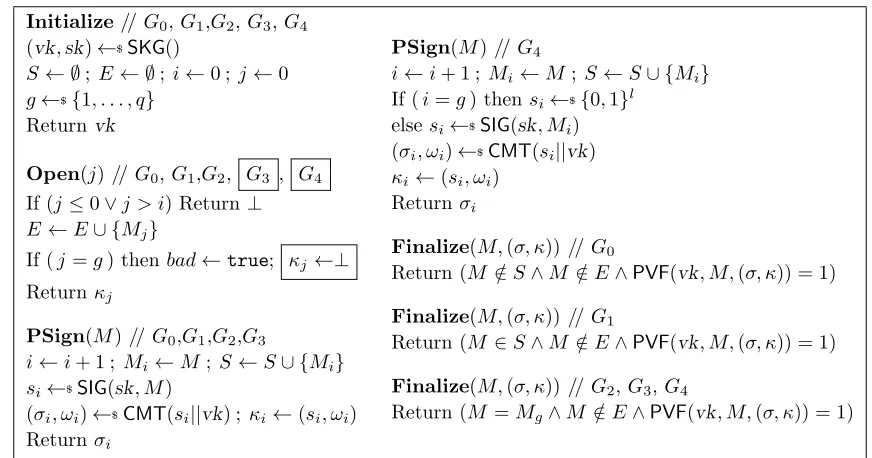
Figure 9: Game sequence used in proof of Theorem 4.1. GameG3, G4 include the boxed code whileG0, G1, G2
do not.
The advantage of an adversaryA in attacking the hiding property is
AdvhdCMT(A) = 2·Pr
HDACMT −1.
where game HD is in Figure 8. In the game, A is allowed only one query to its LR oracle. The advantage of an adversary Ain attacking the binding property is
AdvbndCMT(A) = Pr
BNDACMT
where game BND is in Figure 8.
B
Proof of Theorem 4.1
q. Note that G0 and G1 are different only in procedure Finalize. For G0, any execution with F in which the outcome istruesatisfiesM /∈S. ForG1, any execution withF in which the outcome istrue
satisfiesM ∈S. So we have
AdvufPS(F) ≤ Pr GF0
+ Pr GF1
. (1)
GamesG1 andG2 are identical except for the first condition in the procedureFinalize. Any execution of G2 with F in which the outcome is true must have not only M ∈ S but also M = Mg. On the other handG1 does not use ganywhere and thus the eventsGF1 and M =Mg are independent and the probability of the latter is 1/q. Hence, we have
Pr GF1
≤q·Pr GF2
. (2)
The difference between G3 and G2 is that the former includes the boxed code in Open. But any execution of G3 with F in which the outcome is true must have M =Mg and M 6∈E, so the boxed code would not have been executed. Recall thatBDi denotes the event that bad is set totruein game
Gi. Then based on Lemma 3.1, we have Pr
GF2
= Pr
GF2 ∧BD2
= Pr
GF3 ∧BD3
. (3)
Combining (1), (2) and (3), we get
AdvufPS,F(k) ≤ Pr GF0
+ q·Pr
GF3 ∧BD3. (4)
We will build A0, A1, B so that
Pr GF0
≤ AdvufDS(A0) (5)
Pr
GF3 ∧BD3 −Pr
GF4 ∧BD4
≤ AdvhdCMT(B) (6)
Pr
GF4 ∧BD4
≤ AdvufDS(A1) (7)
A0, A1 will make q oracle queries and A0, A1, B will have the same running time as F. Now let A on inputvk pick c←${0,1}and runAc(vk). Then
AdvufDS(A) = 1 2Adv
uf
DS(A0) + 1 2Adv
uf
DS(A1). (8)
Part1. of Theorem 4.1 follows from (4), (5) (6), (7) and (8). We proceed to describeA0,A1,B.
AdversaryA0 gets inputvk and then does the following initializations:
S ← ∅; E ← ∅; i←0 ; j ←0 ; g←${1, . . . , q}. (9)
It then runsF(vk). It answersF’s queries to PSign using the following procedure:
procedure PSign(M)
i←i+ 1 ; Mi ←M; S←S∪ {Mi}; si←$Sign(M)
(σi, ωi)←$CMT(si||vk) ; κ
i ←(si, ωi) Return σi
A0 answersF’s queris toOpenexactly asG0 does. Finally,F outputs (M,(σ, κ)). AdversaryA0parses κ to (s, ω) and then outputs (M, s).
Adversary B against the hiding property of CMT begins by executing the code of the Initialize procedure of G3, thereby defining for itself the parameters vk,sk, S, E, i, j, g. It then starts runningF onvk. It answersF’s queries toPSign using the following procedure:
procedure PSign(M)
i←i+ 1 ; Mi ←M; S←S∪ {Mi}; si←$SIG(sk, M)
Else (σi, ωi)←$CMT(si||vk) ; κi ←(si, ωi)
Return σi
It answersF’s queries toOpenexactly asG3does. Finally,F outputs (M,(σ, κ)). AdversaryBoutputs 1 ifM =Mg∧M 6∈E∧PVF(vk, M,(σ, κ)) = 1, and 0 otherwise. Lettingddenote the output ofB, we have
Pr [d= 1 | b= 1 ] = Pr
GF3 ∧BD3
and Pr [d= 1 | b= 0 ] Pr
GF4 ∧BD4 .
Subtracting, we get
Pr
GF3 ∧BD3 −Pr
GF4 ∧BD4
=AdvhdCMT(B).
Adversary A1 gets input vk and then does the initializations (9). It then runsF(vk). It answersF’s queries toPSign using the following procedure:
procedure PSign(M)
i←i+ 1 ; Mi ←M; S←S∪ {Mi} If (i=g) then si←${0,1}l else s
i←$Sign(M)
(σi, ωi)←$CMT(s
i||vk) ; κi ←(si, ωi) Return σi
It answersF’s queris toOpenexactly as G4 does. Finally,F outputs (M,(σ, κ)). A1 parsesκto (s, ω) and outputs (M, s).
Proof of Part 2.: AdversaryB begins with (vki,ski)←$PKG() fori= 0,1. It then runsA((vk
0,sk0), (vk1,sk1)) and answers A’s queries toCH using the following procedure:
procedure CH(M) s0←$SIG(sk
0, M) ; s1←$SIG(sk
1, M) ; σ←LR(s0||vk0, s1||vk1) Return σ
After Aoutputs its guess d, adversaryB outputs the samed. We have Pr
HDBCMT | b= 1
= Pr
ANAPS | b= 1
and Pr
HDBCMT | b= 0
= Pr
ANAPS | b= 0
from which Part2. of Theorem 4.1 follows.
Proof of Part 3.: Adversary B runsA to get (vk0,vk1, M0, M1, σ, κ0, κ1). It lets (s0, ω0)← κ0 and (s1, ω1)←κ1. AdversaryB then outputsσ,(s0||vk0, ω0),(s1||vk1, ω1).
C
Proof of Theorem 4.2
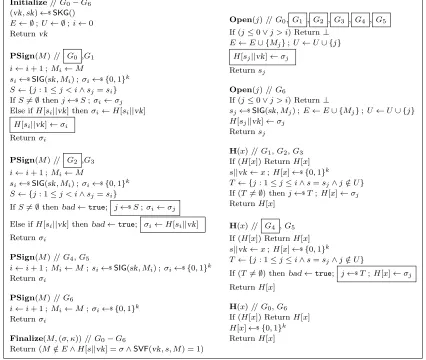
Proof of Part 1.: We refer to the games of Figure 10. Game G0 is equivalent to UFPS, so AdvufPS(F) = Pr
GF0 .
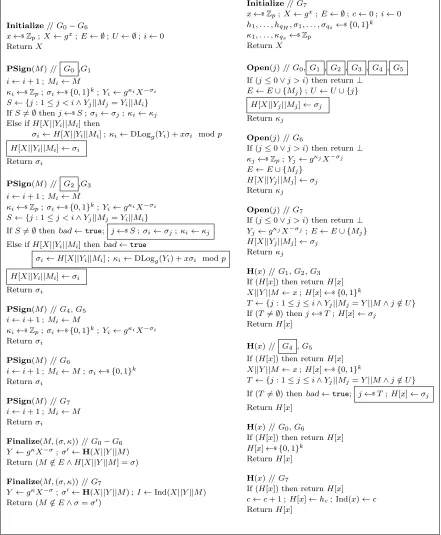
Game G1 omits the boxed code in PSign, meaningH[si||vk] is not assigned σi at this point. Instead the assignment is delayed, being done by H(x) or Open as necessary . So
Pr GF0
= Pr GF1
.
ButG1,G2 are equivalent and G2 and G3 are identical until bad, so by Lemma 3.1
Pr GF1
= Pr GF2
= Pr GF3
+ Pr GF2
−Pr GF3
≤Pr GF3
Initialize// G0−G6
(vk,sk)←$SKG() E← ∅;U← ∅;i←0 Returnvk
PSign(M)// G0 ,G1
i←i+ 1 ; Mi←M
si←$SIG(sk, Mi) ;σi←${0,1}k S← {j: 1≤j < i∧sj=si} IfS6=∅thenj←$S;σi←σj
Else ifH[si||vk] thenσi←H[si||vk]
H[si||vk]←σi
Returnσi
PSign(M)// G2 ,G3
i←i+ 1 ; Mi←M
si←$SIG(sk, Mi) ;σi←${0,1}k
S← {j: 1≤j < i∧sj=si}
IfS6=∅thenbad←true; j←$S;σi←σj
Else ifH[si||vk] thenbad←true; σi←H[si||vk]
Returnσi
PSign(M)// G4,G5
i←i+ 1 ; Mi←M;si←$SIG(sk, Mi) ; σi←${0,1}k Returnσi
PSign(M)// G6
i←i+ 1 ; Mi←M;σi←${0,1}k Returnσi
Finalize(M,(σ, κ))// G0−G6
Return (M /∈E∧H[s||vk] =σ∧SVF(vk, s, M) = 1)
Open(j)// G0,G1 ,G2 , G3 ,G4 ,G5
If (j≤0∨j > i) Return⊥ E←E∪ {Mj};U←U∪ {j}
H[sj||vk]←σj
Returnsj Open(j)// G6
If (j≤0∨j > i) Return⊥
sj←$SIG(sk, Mj) ;E←E∪ {Mj};U←U∪ {j} H[sj||vk]←σj
Returnsj
H(x)// G1,G2,G3
If (H[x]) ReturnH[x] s||vk←x;H[x]←${0,1}k
T ← {j: 1≤j≤i∧s=sj∧j /∈U} If (T 6=∅) thenj←$T;H[x]←σj
ReturnH[x] H(x)// G4 ,G5
If (H[x]) ReturnH[x] s||vk←x;H[x]←${0,1}k
T ← {j: 1≤j≤i∧s=sj∧j /∈U}
If (T 6=∅) thenbad←true; j←$T;H[x]←σ
j ReturnH[x]
H(x)// G0,G6
If (H[x]) ReturnH[x] H[x]←${0,1}k
ReturnH[x]
Figure 10: Game sequence used in proof of Theorem 4.2.
G3 and G4 are equivalent and G4 and G5 are identical until bad, so by Lemma 3.1 Pr
GF3
= Pr GF4
= Pr GF5
+ Pr GF4
−Pr GF5
≤Pr GF5
+ Pr [BD5].
In G5, the signaturesi fori /∈U is unused beyond for setting bad, so inG6 we don’t compute it. We have
Pr GF5
= Pr GF6
.
Putting the above together we have
AdvufPS(F)≤Pr GF6
+ Pr [BD3] + Pr [BD5]. (10)
AdversaryA sets input vk and perform the initialization E ← ∅; U ← ∅; i← 0. It then runsF(vk). It responds toH and PSign queries as does G6, and toOpen queries via the Open procedure of G6 except that the computationSIG(sk, Mi) is substituted by a callSign(Mi) toA’s sign oracle. Aoutputs the same thing asF. We have
Pr GF6
≤AdvufDS(A) (11)
Now
Pr [BD3] ≤
qs
X
i=1
( i−1 2H∞(DS) +
qH+qo 2H∞(DS)) =
qs(qs−1) + 2qs(qH +qo)
Initialize// G0,G1,G2
b←${0,1}
(vk0,sk0)←$SKG()
(vk1,sk1)←$SKG()
Return ((vk0,sk0),(vk1,sk1)) CH(M)// G0
s←$SIG(skb, M) ; σ←H(s||vkb)
Returnσ
Finalize(d)// G0, G1,G2
Return (b=d)
CH(M)// G1 ,G2
s←$SIG(skb, M) ; σ←${0,1}k
If (H[s||vkb]) thenbad←true; σ←H[s||vkb] H[s||vkb]←σ
Returnσ
H(x)// G0,G1,G2
If (H[x]) ReturnH[x]
H[x]←${0,1}k
ReturnH[x]
Figure 11: Game sequence used in proof of Theorem 4.2.
Finally the maximum size of T in procedureH ofG5 is qs and hence Pr [BD5]≤ qsqH
2H∞(DS) . (13)
Putting together (10), (11), (12) and (13) completes the proof.
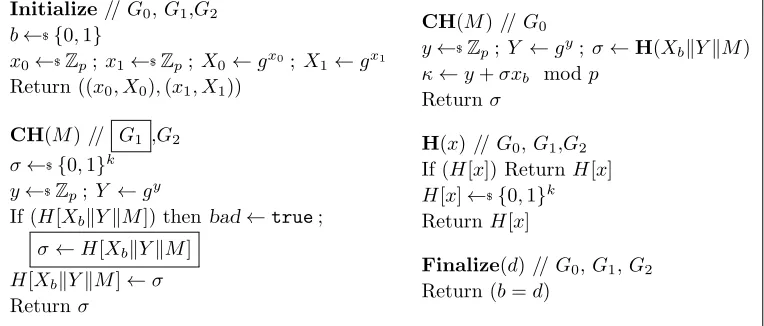
Proof of Part 2.: We use games G0, G1, G2 of Figure 11. So we have AdvanPS(A) = 2·Pr
GA0
−1. (14)
Games G0 and G1 are equivalent, and G1 and G2 are identical until bad so by Lemma 3.1 we have Pr
GA0
= Pr GA1
= Pr GA1
−Pr GA2
+ Pr GA2
≤Pr [BD2] + Pr GA2
. (15) Combining (14) and (15), we get
AdvanPS(A)≤2·(Pr GA2
+ Pr [BD2])−1.
In game G2, the challenge signature H[s||vkb] is set to be a random string with length k, so we have Pr
GA2
= 1/2 and thus
AdvanPS(A)≤2·Pr [BD2]. (16)
In game G2,bad is set truewhen the signature generated inLR is equal to somex which A queried to H, so we have
Pr [BD2]≤qH ·2−H∞(DS). (17)
Part2. of Theorem 4.2 follows from (16) and (17).
Proof of Part 3.: Let (vk0,vk1, M0, M1, σ, κ0, κ1) denote the output ofA. Lets0←κ0 and s1←κ1. If A wins the game UNAMBPS, then we have H(s0||vk0) =H(s1||vk1) =σ but vk0 6=vk1, meaning that we have a collision for H. Since A makesqH queries toH we have Part 3. of Theorem 4.2.
D
Proof of Theorem 4.3
Before giving the security proof, we first recall the general forking lemma [5], which will be used later.
Initialize// G0−G6
x←$Zp;X←gx;E← ∅;U← ∅;i←0
ReturnX
PSign(M)// G0 ,G1
i←i+ 1 ;Mi←M
κi←$Zp;σi←${0,1}k;Yi←gκiX−σi S← {j: 1≤j < i∧Yj||Mj=Yi||Mi} IfS6=∅thenj←$S;σi←σj;κi←κj
Else ifH[X||Yi||Mi] then
σi←H[X||Yi||Mi] ;κi←DLogg(Yi) +xσi modp H[X||Yi||Mi]←σi
Returnσi
PSign(M)// G2 ,G3
i←i+ 1 ;Mi←M
κi←$Zp;σi←${0,1}k;Yi←gκiX−σi S← {j: 1≤j < i∧Yj||Mj=Yi||Mi}
IfS6=∅thenbad←true; j←$S;σi←σj;κi←κj
Else ifH[X||Yi||Mi] thenbad←true
σi←H[X||Yi||Mi] ;κi←DLogg(Yi) +xσi modp H[X||Yi||Mi]←σi
Returnσi
PSign(M)// G4,G5
i←i+ 1 ;Mi←M
κi←$Zp;σi←${0,1}k;Yi←gκiX−σi Returnσi
PSign(M)// G6
i←i+ 1 ;Mi←M;σi←${0,1}k
Returnσi PSign(M)// G7
i←i+ 1 ;Mi←M Returnσi
Finalize(M,(σ, κ))// G0−G6
Y ←gκX−σ;σ′←H(X||Y||M) Return (M /∈E∧H[X||Y||M] =σ) Finalize(M,(σ, κ))// G7
Y ←gκX−σ;σ′←H(X||Y||M) ;I←Ind(X||Y||M) Return (M /∈E∧σ=σ′)
Initialize// G7
x←$Zp;X←gx;E← ∅;c←0 ;i←0
h1, . . . , hqH, σ1, . . . , σqs←${0,1}k κ1, . . . , κqs←$Zp
ReturnX
Open(j)// G0,G1 , G2 ,G3 ,G4 , G5
If (j≤0∨j > i) then return⊥ E←E∪ {Mj};U←U∪ {j}
H[X||Yj||Mj]←σj Returnκj
Open(j)// G6
If (j≤0∨j > i) then return⊥ κj←$Zp;Yj←gκjX−σj E←E∪ {Mj}
H[X||Yj||Mj]←σj Returnκj
Open(j)// G7
If (j≤0∨j > i) then return⊥ Yj←gκjX−σj;E←E∪ {Mj} H[X||Yj||Mj]←σj
Returnκj
H(x)// G1,G2,G3
If (H[x]) then returnH[x] X||Y||M←x;H[x]←${0,1}k
T ← {j: 1≤j≤i∧Yj||Mj=Y||M∧j /∈U} If (T 6=∅) thenj←$T;H[x]←σ
j ReturnH[x]
H(x)// G4 ,G5
If (H[x]) then returnH[x] X||Y||M←x;H[x]←${0,1}k
T ← {j: 1≤j≤i∧Yj||Mj=Y||M∧j /∈U} If (T 6=∅) thenbad←true; j←$T;H[x]←σj
ReturnH[x] H(x)// G0,G6
If (H[x]) then returnH[x] H[x]←${0,1}k
ReturnH[x] H(x)// G7
If (H[x]) then returnH[x] c←c+ 1 ; H[x]←hc; Ind(x)←c ReturnH[x]
Figure 12: Game sequence used in proof of Theorem 4.2.
defined as the probability that J ≥1 in the experiment
X←$IG; h1, . . . , hq←$H; (J, s)←$A(X, h1, . . . , hq).
The forking algorithm FA associated to A is the randomized algorithm that on input x proceeds as follows:
Pick coins ρforA at random
h1, . . . , hq←$H; (I, s)←A(x, h1, . . . , hq;ρ)
IfI = 0 then return (0, ε, ε) h′
I, . . . , h′q←$H; (I′, s′)←A(x, h1, . . . , hI−1, h′I, . . . , h′q;ρ) If (I =I′ and hI 6=h′I) then return (1, s, s′)
Else return (0, ε, ε).
Let
frk = Pr
b= 1 : X←$IG; (b, s, s′)←$FA(X) .
Then
frk ≥ acc· acc q − 1 h
and acc ≤ q h +
p
q·frk. (18)
Proof of Part 1.: Let q=qs+qH and consider games G0−G7 of Figure 12. We have
AdvufPS(F) = Pr GF0
= Pr GF1
= Pr GF2
= Pr GF3
+ Pr GF2
−Pr GF3
≤ Pr GF3
+ Pr [BD3]
Pr GF3
= Pr GF4
= Pr GF5
+ Pr GF4
−Pr GF5 ≤ Pr
GF5
+ Pr [BD5] ≤ Pr GF6
+ Pr [BD6].
Pr [BD3] ≤
i−1 X
i=1
i−1 p +
qH+qo p
≤ q
2
s+ 2qs(qH +qo)
2p .
Pr [BD5] ≤ qsqH
p .
So
AdvufPS(F)≤Pr GF6
+q 2
s + 4qsqH+ 2qsqo
2p .
Let A be the algorithm that on input X ∈ G, h1, . . . , hqH ∈ {0,1}
k and coins ρ = ρFkσ1k. . .kσq s kκ1k. . .kκqs where σ1, . . . , σqs ∈ {0,1}
k and κ
1, . . . , κqs ∈ Zp, runs F on input X and coins ρF. It lets σ1, . . . , σqs and κ1, . . . , κqs play the role of the quantities of the same name inInitialize of G7. It answersF’s queries toPSign,H,Openin the same way asG7. WhenF outputs (M,(σ, κ)), algorithm Alets
Y ←gκ·X−σ ;σ′ ←H(XkYkM) ; I ←Ind(XkYkM).
where the call to H is answered as in G7. If M ∈ E or σ 6= σ′ then A returns (0, q), else it returns (I,(M, σ, κ, Y)). Now consider the experiment where ρ = ρFkσ1k. . .kσqskκ1k. . .kκqs is chosen at random and then
x←$Z
p; h1, . . . , hqH←${0,1}
k; (I, s)←$A(gx, h
1, . . . , hqH;ρ).
Let acc be the probability that I 6= 0 in this experiment. Notice that if M /∈ E then H[XkYkM] was defined by an H-queryXkYkM rather than by Open, so Ind(XkYkM)∈ {1, . . . , qH}. So acc = Pr
GF 7
. Let IG be the algorithm that let x←$Zp and returns gx. Let FA be the algorithm of
Lemma D.1 and let frk be defined as there. Now consider the experimentx←$Zp; (b, s, s′)←FA(gx)