Study on Strength Characteristics of Expansive Soil by Adding
Vitrified Tile Sludge
Angaluri Satya Sri & Dr. D S V Prasad
1
PG student dept. Of civil Engg, BVC Engineering College, Odalarevu,
2
M.E, Ph.D., MIE, MISTE, MIGS Professor & Principal, Dept. of Civil Engg. BVC Engineering
College, Odalarevu, AP
ABSTRACT
Due to the rapid, urban and industrial development in the society, the construction of highways, embankments and many other engineering structures. The existing site may or may not be sufficiently strong enough to withstand the load coming over it. In order to overcome this problem, ground improvement techniques such as soil stabilization, soil reinforcing techniques, etc. have evolved which have now emerged as a part of the civil engineering practice. In this connection, Mechanical Stabilization of soil proves to be cost effective and reliable. As a property of clayey soil proves to be suitable for mechanical stabilization.
Expansive soils present significant geotechnical and structural engineering challenges the world over, with costs associated with expansive behavior estimated to run in to several billion annually. Expansive soils are soils that experience significant volume change associated with changes in water content that means it is volumetrically unstable due to seasonal moisture variation. Its strength decreases and compressibility increases tremendously on wetting. By keeping the above problem the cohesive nature clayey soil was chosen and checked for compaction properties along with other general soil characteristics by varying the content of vitrified tile sludge. From the present study it deduced that there is a significant decrease in compressibility characteristics of the clay with increase in vitrified tile sludge content as a result of gradual reaction in Atterburg’s limits. The results obtained are reliable with vitrified tile sludge replacement of original clayey soil. Ultimately, the composite soil with certain vitrified tile sludge content proves to be good construction material for complex civil engineering structures such as embankment, earthen dams, and runways.
1 INTRODUCTION
Soil is a natural body consisting of layers that are primarily composed of minerals which differ from their parent materials in their texture, structure, consistency, and colour, chemical, biological and other characteristics. It is the unconsolidated or loose covering of fine rock particles that covers the surface of the earth. Soil is the end product of the influence of the climate (temperature, precipitation), relief (slope), organisms (flora and fauna), parent materials (original minerals), and time. In engineering terms, soil is referred to as regolith, or loose rock material that lies above the 'solid geology'. In horticulture, the terms 'soil' is defined as the layer that contains organic material that influences and has been influenced by plant roots and may range in depth from centimetres to many metres.
Soil is composed of particles of broken rock which have been altered by physical, chemical and biological processes that include weathering (disintegration) with associated erosion (movement). Soil is altered from its parent material by the interactions between the lithosphere, hydrosphere, atmosphere,
and biosphere.
Soil forms a structure filled with pore spaces and can be thought of as a mixture of solids, water, and gases. Accordingly, soils are often treated as a three-state system. Most soils have a density between 1 and 2g/cm³.
1.1 SCOPE OF THE STUDY
1.2 OBJECTIVES OF THE STUDY
The following are the main objectives of our project work.
To increase the load bearing capacity of the soil.
To increase resistance against the temperature and moisture changes.
To decrease the void ratio and so permeability, thus reducing potential frost heave.
To increase the stiffness and therefore reduce future settlement.
To increase the shear strength and therefore bearing capacity.
1.3 SOIL STABILIZATION METHODS
The methods of soil stabilization, which are in common use, are
Mechanical Stabilization Soil-cement Stabilization
Soil-lime Stabilization
Soil-bitumen Stabilization
a) Mechanical stabilization:
The most basic form of mechanical stabilization is compaction, which increases the performance of a natural material. Mechanical stabilization of a material is usually achieved by adding a different material in order to improve the grading or decrease the plasticity of the original material
b) Soil-cement stabilization:
Any cement can be used for stabilization, but ordinary Portland cement is the most widely used throughout the world. The addition of cement to a material, in the presence of moisture, produces hydrated calcium aluminates and silicate gels, which crystallize and bond the material particles together. Most of the strength of a cement-stabilized material comes from the physical strength of the matrix of hydrated cement.
Soil-cement:
Soil cement usually contains less than 5% cement.(lay,1986). It can be either mixed in-situ (usually up to 300mm layer at a time) or mixed in plant. The technique involves breaking up the soil,
adding and mixing in the cement, then adding water and compacting in the usual way.
Cement bound granular material (CBM):
This can be regarded as a stronger form of soil-cement but uses a granular aggregate (crushed rock or natural gravel) rather than a soil. The process works best if the natural granular material has limited fines content. This is almost always mixed in plant and the strength requirement is 5-7mpa (7day cube crushing strength), (corny ,1998).
Lean concrete:
This material has higher cement content than CBM and hence looks and behaves more like a concrete than a CBM.it is usually made from batched coarse and fine crushed aggregate , but natural washed aggregate (e.g. river gravels) can also be used.
2 REVIEW OF LITERATURE 2.1 GENERAL
In India, the area covered by expansive soil is nearly 20% of the total area. The expansive soils normally spread over a depth of 2 to 20m. In rainy season, they undergo heave and lose weight. In summer, they shrink and gain density and become hard. This alternate swelling and shrinkage damage structures severely. This is more severe for the light structures.
During summer, polygonal cracks are appear at the surface, which may extend to a depth of about 2m indicating the active zone in which volume change occurs. The depth of active zone defined as the thickness of the soil below the ground surface within which moisture content variations and hence volume changes do take place.
Sustained efforts are being made all over the world on highway research field to evolve more promising treatment methods for proper design and construction of pavements running over expansive soil subgrade.
2.2 TILES 2.2.1 Introduction
A tile is a manufactured piece of hard-wearing material such as ceramic, stone, metal or even glass, generally used for covering roofs, floors, walls, showers, or other objects such as tabletops
designs on vitrified tiles are printed with soluble salts which are essentially penetrating pigments that penetrate to a depth of 2 to 3 mm below the surface of the tile .The design is present at depths of up to 25% of the tiie‘s thickness and high hardness and abrasion resistance of vitrified tiles essentially means that the design is permanent for all practical purposes. In contrast, some floor polishes exist over the surface of the floor and have little abrasion resistance.
2.2.2 Raw Materials
The raw materials used to form tile consist of clay minerals mined from the earth's crust, natural minerals such as feldspar that are used to lower the firing temperature, and chemical additives required for the shaping process. The minerals are often refined or beneficiated near the mine before shipment to the ceramic plant.
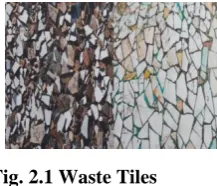
Fig. 2.1 Waste Tiles 2.2.3 Characteristics of Ceramic Tile
All ceramic tiles share unique and exceptional qualities found in no other type of decorative building products.
Abrasion Resistance .
Water absorption
Frost Resistance. Stain resistance. Dirt Resistance fire Resistance Hygiene
2.3 CHARACTERIZATION OF EXPANSIVE SOILS
2.3.1 Field Identifications
Color: May be black, grey, yellow grey.
During summers, side and deep map type cracking is observed.
During heavy rains, when such soils get saturated, it would be very difficult to work through these soils because of high stickiness.
Normally the slope of terrains very flat in the range of 00 to 20.
2.3.2 Laboratory Identification
Laboratory identification tests for expansive soils includes grain size analysis, Atterberg limits, swelling pressure, free swell index test, etc as per IS codes. The range of physical properties of swelling soils is as follows:
Liquid Limit 40 – 100%
Plastic Limit 20-60%
Shrinkage Limit 6-18%
Free swell Index 20-150%
Montmorillonite is the prime mineral, which causes the problem of swelling and shrinking. Further, the swelling characteristics depend upon the structure of the clay mass and the cation change capacity of the mineral. Hence it is necessary to evaluate the swelling potential of nay clay mineral. In order to estimate the swelling potential of expansive soils, the following laboratory tests are conducted.
Free swell test to determine the volume change of the soil.
Swelling pressure test to evaluate the development of swelling pressure if no volume change of soil is allowed.
2.4. DAMAGE CAUSED BY EXPANSIVE SOILS
The alternate swell-shrink behavior of expansive soils due to moisture fluctuations results in differential movements in the structures resulting in severe damages. Some of the typical case histories involving damage to Civil Engineering structures due to the presence of expansive soil are reviewed critically in the following sections.
1) Cracks in exterior walls, as a result of upward soil expansion
2) Failure of domestic retaining wall
3) Craks in an Earthen Dam,
2.5 REMEDIAL MEASURES TO OVERCOME PROBLEMS OF EXPANSIVE SOILS:
made during the last 20 years in providing practical solutions to the problems of expansive soils. Stiffening the foundation and superstructure, mat foundation, under reamed pile foundation, cohesive non-swelling layer (CNS-layer) technique, soil replacement, surcharge loading, heat treatment, moisture control, chemical stabilization, pre-wetting, are some of the remedial measures to overcome the problems of expansive soils.
3 MATERIALS & METHODOLOGY
3.1 INTRODUCTION:
In this chapter a brief description of the experimental procedures adopted in this investigation and the methodology adopted during the course of the study are briefly presented. The methods adopted during the course of this investigation have been presented below. Standard scientific methods were used for both field and laboratory investigations. The methodology has been presented in the following heads:
1. Field methods.
2. Laboratory Analysis.
Field methods
Soil samples are often categorised as being either “disturbed” or “undisturbed” however, “undisturbed” samples are not truly undisturbed. A disturbed sample is one in which the structure of the soil has been changed sufficiently that tests of structural properties of the soil will not be representative of in-situ conditions, and only properties of the soil grains (e.g., grain size distribution, Atterburg’s limits, and possibly the water content ) can be accurately determined. An undisturbed sample is one where the condition of the soil in the sample is close enough to the conditions of the soil in-situ to allow tests of structural properties of the soil to be used to approximate the properties of the soil in-situ.
3.2 SCOPE AND OBJECTIVE OF THIS PROJECT
The aim of this project is follows;
•
Determination of the engineering properties of expansive soil sample as well as vitrified tile sludge sample.•
Determination of content on strength characteristics of expansive soil and vitrified tilesludge.
•
Effect of vitrified tile sludge on index properties, atterberg limit( i.e liquid limit, plastic limit, plasticity index) of expansive soil and vitrified tile sludge.
•
Effect of curing period of the strength of the soil.3.3 MATERIAL USED:
Vitrified Tiles are the latest and largest growing industry alternate for many tiling requirements across the globe with far superior properties compared to natural stones and other manmade tiles. India and China are the largest regions to contribute to the 6900 million square meters of production every year. With an annual growth rate of 20% worldwide and 25% in India, Vitrified tile is the fastest growing segment in the tile industry. Vitrified tiles own 12% share of the overall tile production across the world. With the increase in production of vitrified tiles in India, there is growing concern about the huge generation of tile polishing dust.
The raw material composition of Vitrified tiles is:
Quartz of 99% Silica,
Potash Feldspar of 12% to 14% Alkalis,
Soda Feldspar of 12% to 14% Alkalis,
Strengthening agent, China clay, body stains for producing in various colors.
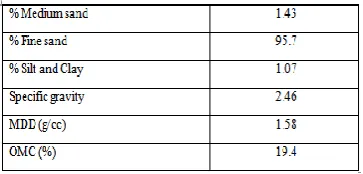
Table 3.2 (4.2 Properties of VTS). Engineering properties of pure vitrified tile sludge
3.4 LABORATORY TESTING:
The following tests were conducted on the soil. The index and engineering properties of soil were determined.
1.
Grain size analysis confirming (IS: 2720-part 4, 1985)2.
Specific gravity testconfirming (IS:2720- part 5, 1985)
4.
Compaction test confirming (IS: 2720- Part 8: 1983)5.
California bearing ratio test confirming (IS: 2720- Part 16: 1987)6.
Unconfined compression test (IS 2720-10-Part 10:1973)3.4.1 Particle Size Distribution:
Soil at any place is composed of particles of a variety of sizes and shapes, sizes ranging from a few microns to a few centimeters are present sometimes in the same soil sample. The distribution of particles of different sizes determines many physical properties of the soil such as its strength, permeability, density etc.
Particle size distribution is found out by two methods, first is sieve analysis which is done for coarse grained soils only and the other method is sedimentation analysis used for fine grained soil sample
3.4.2 Specific Gravity:
Specific gravity of a substance denotes the number of times that substance is heavier than water. In simpler words we can define it as the ratio between the mass of any substance of a definite volume divided by mass of equal volume of water. In case of soils, specific gravity is the number of times the soil solids are heavier than equal volume of water.
3.4.3 Atterberg’s Limits:
Liquid Limit:It is the water content of the soil between the liquid state and plastic state of the soil. It can be defined as the minimum water content at which the soil, though in liquid state, shows small shearing strength against flowing. It is measured by the
Plastic Limit:This limit lies between the plastic and semi-solid state of the soil. It is determined by rolling out a thread of the soil on a flat surface which is non-porous. It is the minimum water content at which the soil just begins to crumble while rolling into a thread of approximately 3mm diameter. Plastic limit is denoted by wP.
3.4.4 Proctor Compaction Test:
This experiment gives a clear relationship between the dry density of the soil and the moisture content of the soil. The experimental setup consists of (i) cylindrical metal mould (internal diameter- 10.15 cm and internal height-11.7 cm), (ii) detachable base plate, (iii) collar (5 cm effective height), (iv) rammer (2.5 kg). Compaction process helps in increasing the bulk density by driving out the air from the voids. The theory used in the experiment is that for any compactive effort, the dry density depends upon the moisture content in the soil. The maximum dry density (MDD) is achieved when the soil is compacted at relatively high moisture content and almost all the air is driven out, this moisture content is called optimum moisture content (OMC). After plotting the data from the experiment with water content as the abscissa and dry density as the ordinate, we can obtain the OMC and MDD.
Fig 3.2 Proctor compaction test
3.4.5 California Bearing Ratio Test:
The samples were prepared at their maximum dry density and the test was conducted as per IS:2720 (part-xvi), 1987.
The laboratory CBR apparatus consists of consists of a mould 150 mm diameter with a base plate and a collar, a loading frame with the cylindrical plunger of 50 mm diameter and dial gauges for measuring the expansion on soaking and the penetration values. Briefly the penetration tests consists of causing a cylindrical plunger of 50 mm diameter to penetrate a pavement component material at 1.25 mm/min. the load value to cause 2.5 mm and 5.0 mm penetration are recorded. These loads were expressed as percentage of standard load value at respective deformation levels to obtain CBR values. The standard load values obtained from average of a large number of tests on crushed stones are 1370 and
2055 kg (70 and 105 kg/cm2) respectively at 2.5 and 5.0 mm penetration.
The CBR values are calculated using the relation
as the CBR value of the material. However, if the CBR value obtained from the test at 5.0 mm penetration is higher than that at 2.5 mm, then the test is to be prepared for checking. If the check test again gives similar results, the higher value obtained at 5.0 mm penetration is reported as the CBR value. The average CBR value of three test specimens is reported to the first decimal place, as the CBR value of material. If the variation in the CBR value between the three specimens is more than the prescribed limits, tests should be repeated on additional three samples and the average CBR value of six specimens is accepted.
Fig 3.3california Bearing Ratio Test. 3.4.6 Unconfined Compression Test
This experiment is used to determine the
unconfined compressive strength of the soil sample which in turn is used to calculate the unconsolidated, undrained shear strength of unconfined soil. The unconfined compressive strength (qu) is the compressive stress at which the unconfined cylindrical soil sample fails under simple compressive test. The experimental setup constitutes of the compression device and dial gauges for load and deformation. The load was taken for different readings of strain dial gauge starting from ε = 0.005 and increasing by 0.005 at each step. The corrected cross-sectional area was calculated by dividing the area by (1- ε) and then the compressive stress for each step was qu= load/corrected area (A’)
Fig 3.4 Unconfined compression test set up
The properties of materials used and the experimental procedures followed during the laboratory experimentation are discussed in this chapter. The results for Compaction, CBR, Unconfined compression test for the Expansive Soil with vitrified tile sludge (VTS) have been resented and results of the laboratory tests will be discussed in the following chapter.
4 EXPERIMENTAL INVESTIGATION. 4.1 INTRODUCTION
Details of the laboratory experimentation carried-out with VITRIFIED TILE SLUDGE have been discussed in the previous chapter. In this chapter a detailed discussion on the results obtained from various laboratory were presented.
4.2 LABORATORY TEST RESULTS ON EXPANSIVE SOIL:-
The effects of adding VTS to the expansive soil on Atterberg limits, and Specific Gravity, Compaction Characteristics (O.M.C, M.D.D), California Bearing Ratio, unconfined compression test, direct shear test are discussed in the following sections.
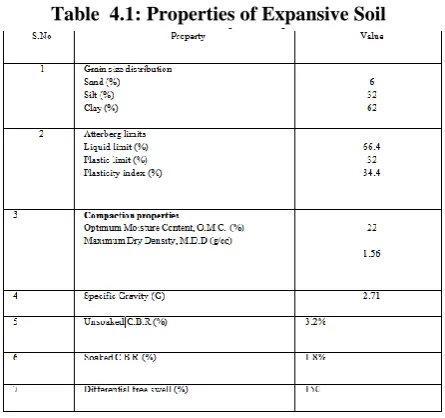
Table 4.1: Properties of Expansive Soil
Table 4.3: EFFECT OF VTS ON ATTERBERG LIMITS
As the admixed proportion of VTS increases from 10% to 40%, the liquid limit of the clayey soil is decreasing gradually.
Fig 4.1 Variation of liquid limit and plastic limit with addition of percentage VTS to the Expansive
Soil
EFFECT OF VTS ON COMPACTION PROPERTIES
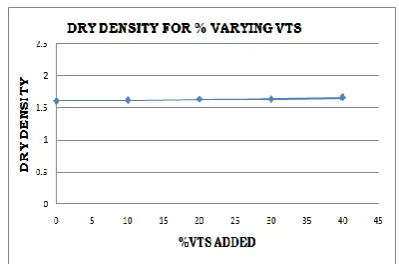
Standard Proctor tests were used to establish the dry density-moisture content relationship and carried out the test of soil with various amounts of VTS added consider the effect of VTS on optimum moisture content and maximum dry density the test of soil with 0 % to 40% by dry weight of soil.
Table 4.4 Effects of VTS on MDD and OMC
Fig 4.2 Variation of MDD and OMC with addition of percentage VTS to the Expansive Soil
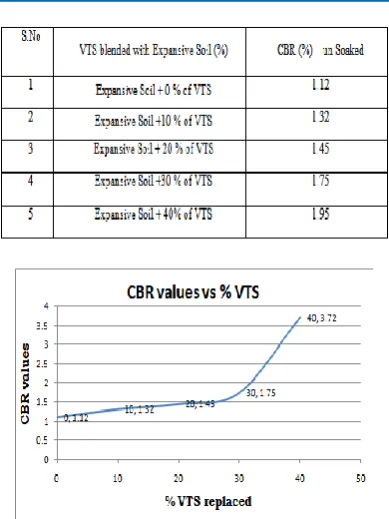
Effect of VTS on California Bearing Ratio Test
Soil with various amounts of VTS added to determine the effect on California bearing ratio test of soil with 0 % to 40% by dry weight of soil.
Fig 4.3 Variation of CBR value (unsoaked) at 2.5mm penetration with addition of percentage
VTS to the Expansive Soil
Table 4.6 Effect of VTS on CBR value for soaked soil
Fig 4.4 Variation of CBR value (soaked) at 2.5mm penetration with addition of percentage VTS to the
Expansive Soil
4.2.5 Effect of VTS on Unconfined Compressive Strength
Soil with various amounts of VTS added to determine the effect on compressive strength of soil
with 0 % to 40 % by dry weight of soil.
Effect of VTS on Unconfined Compressive Strength.
Fig 4.5 Variation of UCS value with addition of percentage VTS to the Expansive Soil
CHAPTER 5-CONCLUSION
The following conclusions are made based on the
laboratory experiments carried out in this investigation The changes in the properties in the clay
sample with varying vitrified tile sludge was
clearly noted and key points in the discussion
are, the maximum dry density was achieved
with clay replaced by 40% of vitrified tile
sludge.
From the study it is clearly observed that after
Replacement of vitrified tile sludge, atterburg’s limits of the clay sample have decreased gradually and the percentage of
vitrified tile sludge content is increased.
Therefore it can be deduced that the flow
characteristics, plastic characteristics and
shrinkage characteristics of the soil sample are
gradually decreasing with increase in the
The maximum dry density of 1.66 gm/cc is
achieved at an optimum moisture content of
10% with 50% replacement but there is a
drastic increase in shrinkage characteristics,
which is a remarkable point to be noted.
REFERENCES
[1] T .S. Ijimdiyaa et aL., (2012), has conducted series of Laboratory studies to investigate the possibility of utilizing Groundnut Shell Ash (GSA) as a stabilizing 11ng to improve the engineering properties of black cotton soil was carried out.
[2] Al-Rawasa, A.A., et al.: Build. Environ. 40(5), 681–687 (2005). Elsevier
[3] Bell, F.G.: Lime stabilization of clay soils. Bull. Int. Assoc. Eng. Geol. 39, 67 (1989) Boardman, D.I., et al.: Development of stabilization and solidification in lime-clay mixes.
[4] Geotechnique 51, 533–543 (2001)
[5] Britpave: Stabilized soils as sub-base or base for roads and other pavements. The British In-situ Concrete Paving Association, Camberley BP/08 (2004)
[6] Buhler, R.L., Cerato, A.B.: Stabilization of Oklahoma expansive soils using lime and class c flyash. In: Problematic Soils and Rocks and In-situ Characterization, GSP 162, pp. 1–10. ASCE (2007)
[7] Çokça, E.: Use of class C flyash for the stabilization of an expansive soil. J. Geotech. Geoenviron. Eng. 127(7), 568–573 (2001). ASCE
[8] Cristelo, N. et al.: Effects of alkaline-activated fly ash and portland cement on soft soil stabilization. Acta Geotech. (2013). doi:
10.1007/s11440-012-0200-9
[9] Eades, J.L., Grim, R.E.: A quick test to determine requirements for lime stabilization.Highw. Res. Board Bull. 139(1966), 61–72 (1966)