© 2015, IJCSMC All Rights Reserved 370 Available Online atwww.ijcsmc.com
International Journal of Computer Science and Mobile Computing
A Monthly Journal of Computer Science and Information Technology
ISSN 2320–088X
IJCSMC, Vol. 4, Issue. 6, June 2015, pg.370 – 380
RESEARCH ARTICLE
Implementation of Improvement in Handling Virtual
Machine Migration using Multiphase Optimization
Ganya Poonacha C
1, Prof. Rashmi S
2Student, M.Tech (Software Engineering), EPCET, Bangalore, India1
Assistant Professor, Computer Science & Engineering Department, EPCET, Bangalore, India2
Abstract- Cloud Computing is defined as a term being used for distributing services along with recourses hosted over the online network. It is nothing but Infrastructure and then Platform and finally Software as a Service whose abbreviations are IaaS and then PaaS and finally SaaS respectively. Cloud computing permits user to utilize the resources by paying for those resources the user demands for. Due to this Cloud Computing is famous among the IT Industries. The increase in popularity of Cloud Computing in the IT environment leads to a large amount of energy consumption. This results in high level of pollution in the environment. Thus in the proposed system VM scheduling technique are being used by keeping the quality of service as high as possible in order to achieve minimization in energy consumption. This is done by making use of CloudSim tool-kit.
Keywords: Cloud computing, CloudSim tool-kit, VM Placement, VM Migration
I. INTRODUCTION
Cloud Computing provides an environment for users to access a pool of resources such as Applications, Development Environments, Virtual Machines and so on, by using network communication media to access computing resource. The superiority of this model of access lies in the way it is on demanded fashion and “Pay-per-use” model. Due to its resource sharing nature, this model can cause huge savings in resource consumption cost, maintenance cost, resource upgrading cost, etc. Moreover, it is predicted that Cloud Computing will be dominant in whole IT industry, from user application in form of web services or online storages to whole users machine as Virtual Machines that store on remote computer and user can access to that through a terminal whenever and wherever they wish to. On the other hand, increasing demand on computing causes
© 2015, IJCSMC All Rights Reserved 371
In a research conducted on more than 5000 production servers over more than six months, they observed that in most of the times, servers worked at 11-50% of machines total utilization capacity and it caused huge loss of investigation money, resource utilization, electricity power and consequently increase in total cost. Therefore, this research aims to solve this problem and reduce costs by exploiting this phenomena in Cloud Computing “Infrastructure as a Service” (IAAS) environment where users are provided with their virtual machines on their demands and configuration of the virtual machines determined by an agreement on specifics of virtual machines such as amount of RAM memory, Storage capacity, amount of Bandwidth and CPU power. This agreement made between user and cloud administrator is known as “Service Level Agreement (SLA)”. So the main idea is to consolidate virtual machines in cloud data center such that virtual machines with under-utilized resources use resources in share mode and turn off extra machines to reduce energy consumption of host machines and save resources.
II. PROBLEM STATEMENT AND SOLUTION
There is a very high necessity for computational power. And because of this the concept of “Cloud Computing” came into existence. Now since there is a drastic growth in computing and communication due to its popularity, a need for greater energy power increases, hence the field of Green Computing try to diminish this procedure by revising early computing techniques or inventing new procedures to have more efficient computing material that would perform more work more while consuming less energy and making less pollution.
In this implemented system, there is trial made in order to minimize the energy that is being used in a Cloud computing data centre environment by reconsidering the virtual machines scheduling technique, but the quality of service parameters are kept as highest as possible. This approach is implemented by using the “CloudSim toolkit” and is evaluated by comparing with recent popular methods. The final evaluated result clearly demonstrates the success in achieving aims to reduce energy consumption whilst keeping quality of service in a moderate range by reducing the number of virtual machines migrations.
III. SYSTEM ARCHITECTURE
VM placement
Resource usage collector
Perform VM Migration
VM VM scheduler
Green Scheduler
PM Check VM
Migration to Under Utilized Host
To overcome the problems of Useless Migration obtained from the existing system which include SLA violation occurring between the user and the cloud service provider who provides the resources for VMs based on the user’s demand, and the unnecessary increase in the energy consumption a 2 phase optimization technique is used. Using this technique it is possible to achieve reduction in energy consumption and also reduction in violation of SLA.
VM
Scheduler
© 2015, IJCSMC All Rights Reserved 372
The architectural view of the 2 phase optimization technique involves two major steps which are Virtual Machine Placement and Virtual Machine Migration. The architecture consists of the following models:-
Physical Machine (PM):- The physical machine consists of 1 or more virtual machines based on the requests sent by the
user. It also consists of VM schedulers.
The Green Scheduler is that point of the architecture where steps are being taken to conserve the energy. It consists of:-
VM scheduler:- For the VMs to be scheduled effectively and efficiently Resource Usage Collection, VM Placement and VM Migration is being performed
Resource usage Collector:- In order to have an optimized scheduling process the resource usage collector will keep a track of the resources used by the virtual machines. It will also keep track of all the VMs present in the PMs. It will perform the task of putting all the VMs of an over-utilized host into the VM pool. VM pool will consist of VMs belonging to over as well as under-utilized hosts. Now the VMs from the VM pool can be assigned to a host where it is needed. This is done based on scheduling algorithms.
VM Placement:- This is an important module of the proposed system. Here the VM from the VM pool is being
picked and is placed on to an appropriate host according to the VM Placement method. The VM placement method used here is Minimum Best Fit Decreasing (MBFD).In MBFD method the host with the most minimum number of VMs will be opted for placing the VMs that are present in the pool. This is done to achieve best fit. This process of moving the VM from the pool to the host is called as VM Placement. Picking of PM is done based on the resource requirements virtual machine’s hardware that the host will render and finally the utilization of resources. Main aim of performing placement is to ensure that the resources are being conserved by maximizing the resources on individual hosts because of which other hosts can be switched off leading to saving of resources or balancing the load among the hosts again to conserve resources by using it in limitation.
Check VM migration to under-utilized host:- There are certain steps to be performed before migration can occur. Firstly, check if there are any under-utilized hosts present. If they are present then check if the VMs present within the under-utilized hosts can be migrated onto another active host. Here, it should even check if it is going to be compatible in the host onto which it is getting migrated. If all these are possible then perform the migration.
VM Migration:- This also considered as the major module of this system. If the system gets to know that a VM
can be successfully migrated, it will migrate that VM onto the decided host. It will then update the information of the host. This process of migration from one host to another host is known as VM Migration and all these activities are unknown to the users.
Virtual Machine(VM):- Instead of creating many different PMs and assigning resources to them which increases
the resource utilization drastically and unnecessarily, it is possible to create many different virtual machine on a single physical host. Virtual Machine is nothing but a software running on physical machine. It works exactly like a PM which runs the OS and other applications. The VM will comprise of specification as well as configuration file and important files such as log file, NVRAM setting file and virtual disk files that is being supported by the physical resources of the PM. Since VMs use the resources of the PM there is no need for separately assigning new set of resources to the VMs created. This leads to great savings of the resources. Main feature of a VM is that, its presence inside a PM is not known to the user.
© 2015, IJCSMC All Rights Reserved 373
IV. IMPLEMENTATION
A. Language used for execution
For the execution of this project the coding language that is undertaken is JAVA and the reason for choosing this as the base language in the expansion of the project is because of its following nature
:-
(i) Its independent of a platform; (ii) Its oriented towards object; (iii) Its library has high benchmark; (iv) Consists of interface designed using applet’ (v) Has syntax equivalent to C++; (v) Has Swing supportB. Type of Testing
Unit Testing
Unit test is being performed by verifying even the trivial units of a software design present in each module. In this step of testing all the modules are observed to be doing their activity in a satisfactory manner by observing the required o/p from the sub divided components. In this testing the single separate blocks of code are being tested to see if they are working fine, so that, during functional testing the testing will be working fine for the functionalists that are associated with those units.
Functionality to be tested Tests performed Status
Working of VM Placement Tested to check whether the VMs were
picked and added at the appropriate hosts according specific methods.
Successful result obtained after testing
Working of VM Migration Tested for check whether any
underutilized hosts present, if present, pick that host and migrate to other active host.
Successful result obtained after testing
Working of CloudSim Tested for check whether the hosts and
VM are added and scheduling done.
Successful result obtained after testing
Table:- Unit testing table
Bottom Top Integration
© 2015, IJCSMC All Rights Reserved 374
Integrated Classes Name
Functionality merged in each of the class Tests performed Status
Class Name:
Main
createCloud()
addPM()
addVM()
schedule()
Test is performed on this class to verify whether all the cmds that were used are working properly or is it leading to any faults.
Successful result obtained after testing
Class Name:
CloudSim
Init()
addHosts()
addVM()
schedule()
Test is performed on this class to verify whether all the cmds that were used are working properly or is it leading to any faults.
Successful result obtained after testing
Class Name:
Broker scheduleVM() executeTask() migrateVM() placeVMonPM() executeVM()
Test is performed on this class to verify whether all the cmds that were used are working properly or is it leading to any faults..
Successful result obtained after testing
Table:- Integration testing table
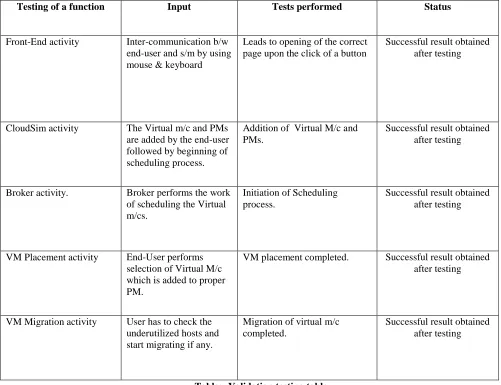
Testing performed upon Validation
© 2015, IJCSMC All Rights Reserved 375
Testing of a function Input Tests performed Status
Front-End activity Inter-communication b/w
end-user and s/m by using mouse & keyboard
Leads to opening of the correct page upon the click of a button
Successful result obtained after testing
CloudSim activity The Virtual m/c and PMs
are added by the end-user followed by beginning of scheduling process.
Addition of Virtual M/c and PMs.
Successful result obtained after testing
Broker activity. Broker performs the work
of scheduling the Virtual m/cs.
Initiation of Scheduling process.
Successful result obtained after testing
VM Placement activity End-User performs
selection of Virtual M/c which is added to proper PM.
VM placement completed. Successful result obtained
after testing
VM Migration activity User has to check the
underutilized hosts and start migrating if any.
Migration of virtual m/c completed.
Successful result obtained after testing
Table:- Validation testing table
V. RESULT
The following snapshot represents the results or outputs which are obtained after step by step execution of all the modules of the system.
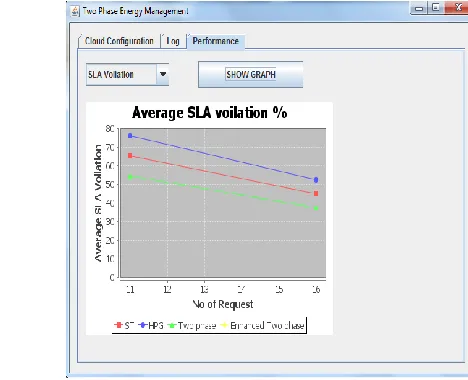
No Consolidation Technique
© 2015, IJCSMC All Rights Reserved 376
Fig: 1 Fig: 2
Fig: 3
© 2015, IJCSMC All Rights Reserved 377
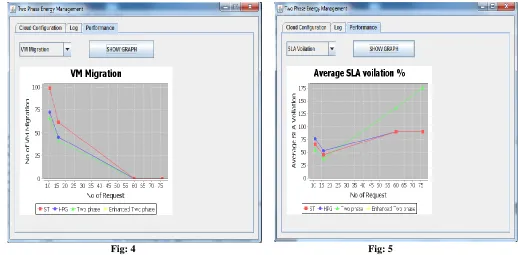
Two Phase Consolidation Technique
Fig: 4 Fig: 5
Figure 4, shows the 1st performance graph which is the VM Migration for Two phase consolidation technique
.
Figure 5, shows the 2nd performance graph which is the SLA violation for Two phase consolidation techniqueFig: 6
Figure 6, shows the 3rd performance graph which is the Energy Consumptionfor Two phase consolidation technique.
© 2015, IJCSMC All Rights Reserved 378
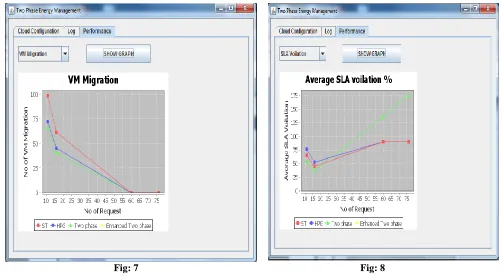
Enhanced Two Phase Consolidation
Fig: 7 Fig: 8
Figure 7, shows the 1st performance graph which is the VM Migration for Enhanced Two phase consolidation technique
.
Figure 8, shows the 2nd performance graph which is the SLA violation for Enhanced Two phase consolidation technique
Fig: 9
© 2015, IJCSMC All Rights Reserved 379
VI. CONCLUSION & FUTURE SCOPE
Another aspect of VM scheduling optimization is “Fairness”. Current scheduling methods migrates VMs to optimize overall parameters, despite user’s behaviour and their SLA Violation history, and sometimes cause starvation for servicing and extreme SLA violations for some users with specific VM configuration. We are now concerning this subject and try to make value of maximum SLA Violation that happens for a user to average SLA Violation value while try to reduce both values.
The future enhancement that is being taken up in this project is occurring in the phase 2 of the proposed Two Phase Optimization Technique.
In the migration phase the following enhancements can be made:- During the process of choosing a VM to be migrated, we firstly going to analyze the primary machines based on how many VMs are pending in them in an ascending order, i.e., from lowest to highest and then we perform the process of migration.
We allocate the migrating VM in the order of lowest to the highest.
REFERENCES
[1] Bo Li et al., "EnaCloud: An Energy-saving Application Live Placement Approach for Cloud Computing Environments," in IEEE International Conference on Cloud Computing, 2009.
[2] Truong Vinh Truong Duy, Yukinori Sato, and Yasushi Inoguchi, "Performance Evaluation of a Green Scheduling Algorithm for Energy Savings in Cloud Computing," in IEEE International Symposium on Digital Object Identifier, 2010, pp. 1-8.
[3] Anton Beloglazov and Rajkumar Buyya, "Energy Ef cient Resource Management in Virtualized Cloud Data Centers," in 10th IEEE/ACM International Conference on Cluster, Cloud and Grid Computing, 2010.
[4] Anton Beloglazov and Rajkumar Buyya, "Adaptive Threshold-Based Approach for Energy-Ef cient Consolidation of Virtual Machines in Cloud Data Centers," in ACM/IFIP/USENIX 11th International Middleware Conference, 2010.
[5] Anton Beloglazov, Jemal Abawajy, and Rajkumar Buyya, "Energy-Aware Resource Allocation Heuristics for Efficient Management of Data Centers for Cloud Computing," journal of Future Generation Computer Systems, vol. 27, no. 8, April 2011.
[6] Rodrigo N Calheiros, Rajiv Ranjan, Anton Beloglazov, César A. F De Rose, and Rajkumar Buyya, CloudSim: A Toolkit for Modeling and Simulation of Cloud Computing Environments and Evaluation of Resource Provisioning Algorithms. USA: Wiley Press, 2010.
[7] SUN Microsystems, "IntroductIon to Cloud Computing Architecture," White Paper 2009.
[8] Greg Boss, Padma Malladi, Dennis Quan, Linda Legregni, and Harold Hall, "Cloud Computing," IBM Corporation, White Paper 2007.
[9] Richard E Brown, Carrie Webber, and Gregory K Homan, "Report to congress on server and data center energy efficiency Public law 109-431," Lawrence Berkeley National Laboratory, Report to congress 2008.
[10] Haibo Mi et al., "Online Self-Reconfiguration with Performance Guarantee for Energy-Efficient LargeScale Cloud Computing Data Centers," in IEEE International Conference on Services Computing, 2010, pp. 514 - 521.
[11] Peter Mell and Tim Grance, "The Nist Definition of Cloud Computing," National Institute of Standard and Technology (NIST), Standard Definition 2008.
© 2015, IJCSMC All Rights Reserved 380
[13] Ankur Gupta and Lalit K. Awasthi, "Peer Enterprises: A Viable Alternative to Cloud Computing?," in IEEE International Conference on Internet Multimedia Services Architecture and Applications (IMSAA), 2009, pp. 1 - 6.
[14] L.A. Barroso and U. Holzle, "The Case for EnergyProportional Computing," Computer, vol. 40, no. 12, pp. 33 - 37, 2007.
[15] M. R. Garey and D. S. Johnson, "Strong' NPCompleteness Results: Motivation, Examples, and Implications," Journal of the ACM (JACM), vol. 25, no. 3, 1978.
[16] D. Kusic, J.O. Kephart, J.E. Hanson, N. Kandasamy, and Jiang Guofei, "Power and Performance Management of Virtualized Computing Environments Via Lookahead Control," in International Conference on Autonomic Computing, 2008, pp. 3 - 12.
[17] Xiaobo Fan, Wolf-Dietrich Weber, and Luiz Andre Barroso, "Power provisioning for a warehouse-sized computer," in 34th annual international symposium on Computer architecture, 2007.
[18] Jeffrey S. Chase, Darrell C. Anderson, Prachi N. Thakar, Amin M. Vahdat, and Ronald P. Doyle, "Managing energy and server resources in hosting centers," in Proceedings of the eighteenth ACM symposium on Operating systems principles, 2001.