Universally Composable Adaptive Oblivious Transfer
Matthew Green Susan Hohenberger
Johns Hopkins University {mgreen,susan}@cs.jhu.edu
September 14, 2013
Abstract
In an oblivious transfer (OT) protocol, a Sender with messagesM1, . . . , MN and a Receiver with indices σ1, . . . , σk ∈ [1, N] interact in such a way that at the end the Receiver obtains
Mσ1, . . . , Mσk without learning anything about the other messages and the Sender does not learn anything aboutσ1, . . . , σk. In anadaptiveprotocol, the Receiver may obtainMσi−1 before
deciding onσi. Efficient adaptiveOTprotocols are interesting both as a building block for secure multiparty computation and for enabling oblivious searches on medical and patent databases.
Historically, adaptive OT protocols were analyzed with respect to a “half-simulation” defi-nition which Naor and Pinkas showed to be flawed. In 2007, Camenisch, Neven, and shelat, and subsequent other works, demonstrated efficient adaptive protocols in the full-simulation model. These protocols, however, all use standard rewinding techniques in their proofs of security and thus are not universally composable. Recently, Peikert, Vaikuntanathan and Waters presented universally composable (UC)non-adaptiveOT protocols (for the 1-out-of-2 variant). However, it is not clear how to preserve UC security while extending these protocols to the adaptivek -out-of-N setting. Further, any such attempt would seem to requireO(N) computation per transfer for a database of sizeN. In this work, we present an efficient and UC-secureadaptivek-out-of-N OT protocol, where after an initial commitment to the database, the cost of each transfer is constant. Our construction is secure under bilinear assumptions in the standard model.
1
Introduction
Oblivious transfer (OT) was introduced by Rabin [31] and generalized by Even, Goldreich and Lempel [19] and Brassard, Cr´epeau and Robert [8]. It is a two-party protocol, where a Sender with messages M1, . . . , MN and a Receiver with indicesσ1, . . . , σk ∈[1, N] interact in such a way
that at the end the Receiver obtains Mσ1, . . . , Mσk without learning anything about the other
messages and the Sender does not learn anything about σ1, . . . , σk. Naor and Pinkas were the first to consider an adaptive setting, OTNk×1, where the Receiver may obtain Mσi−1 before deciding on σi [28]. EfficientOTschemes are very important. OT41 is a key building block for secure multi-party computation [34, 20, 25]. OTNk×1 is a useful and interesting tool in its own right, enabling oblivious databases for applications such as medical record storage and patent searches [29].
Developing efficientadaptiveprotocols appears to be a more difficult and involved process than in the non-adaptive case. Indeed, even finding the right security definition has proven challenging. Historically, many efficient OT constructions were analyzed under a “half-simulation” definition, where the Sender and Receiver’s security are described by a combination of simulation and game-based definitions. Naor and Pinkas [28] showed that schemes analyzed under this definition may admit practical attacks on the Receiver’s privacy. To address this, Camenisch, Neven and shelat [10] and subsequently Green and Hohenberger [21] proposed efficient and fully-simulatableOTNk×1 proto-cols under bilinear assumptions. Each of these protoproto-cols achieve the optimal total communications cost ofO(N +k) with reasonable constants. Unfortunately, the security proofs for these protocols employ adversarial rewinding, and thus do not imply security under concurrent execution.
Recently, Lindell [26] showed how to achieve efficient and fully-simulatable non-adaptive OT21
under the DDH,Nth residuosity and quadratic residuosity assumptions, as well as the assumption that homomorphic encryption exists. Simultaneously, Peikert, Vaikuntanathan and Waters [30] proposed several non-adaptive, but universally composableOT21protocols based on DDH, quadratic residuosity and lattice-based assumptions. While both of these valuable works add to our collective knowledge for non-adaptive OT, they do not shed much light on how to achieve efficient adaptive protocols. Indeed, Lindell points out that the adaptive case is considerably harder [26].
The general framework used in [26, 30] (where the Receiver chooses the encryption keys) seems inherently at odds with allowing efficient adaptive schemes. Each transfer requiresO(N) work for the Sender, whereas this can be constant in our protocols. Even more alarming, it isn’t clear how (without killing the efficiency and perhaps the UC security of [30]) a Sender could convince the Receiver that he is not changing the database values with each request. This problem of ensuring a
consistentdatabase gets even worse when multiple Receivers are considered, as we do in Section 5.
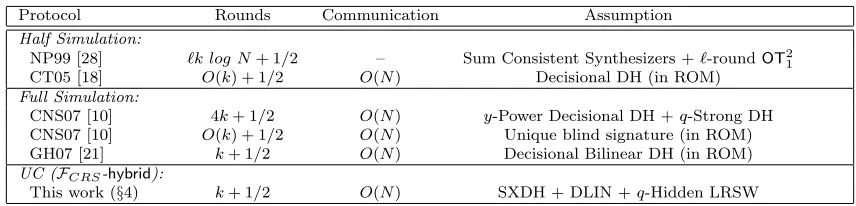
Our Results. In this work, we take a different approach to constructingOTprotocols, which allows them to be simultaneously efficient, adaptive, universally composable and globally consistent. We summarize what is known about OTNk×1 protocols in Figure 1. Let us describe some highlights.
1. Universal Composability: The Universal Composability framework [13] allows for the design of concurrent and composable cryptographic protocols, which are important properties in any practical deployment of an oblivious database. Canetti and Fischlin showed that OT
cannot be UC-realized without additional trusted setup assumptions such as the existence of a Common Reference String (CRS) [15]. This is formally referred to as the FCRS-hybrid
model, and is assumed by the constructions of Peikertet al. [30] as well as those in this work. As in [30], we work in a static corruption model.
2. Efficiency: Our protocol is practical. For a database of N objects, the initialization phase requires O(N) communication cost, and each transfer phase requires only constant cost, for reasonable constants. In contrast, simply repeating a OTN1 scheme (such as [30]) k times would requireO(N) communication cost foreach transfer plus the additional work required for the Sender to convince the Receiver that he isn’t changing the database values dynamically. Moreover, the message space of our protocol is a group element (so at least 160 bits), whereas the quadratic residuosity and lattice-based schemes of [30] have one-bit message spaces. We note, however, that the DDH-based scheme of [30] allows for longer messages.
Protocol Rounds Communication Assumption Half Simulation:
NP99 [28] `k log N+ 1/2 – Sum Consistent Synthesizers +`-roundOT21
CT05 [18] O(k) + 1/2 O(N) Decisional DH (in ROM)
Full Simulation:
CNS07 [10] 4k+ 1/2 O(N) y-Power Decisional DH +q-Strong DH CNS07 [10] O(k) + 1/2 O(N) Unique blind signature (in ROM)
GH07 [21] k+ 1/2 O(N) Decisional Bilinear DH (in ROM)
UC (FCRS-hybrid):
This work (§4) k+ 1/2 O(N) SXDH + DLIN +q-Hidden LRSW
Figure 1: Survey of efficient, adaptive k-out-of-N Oblivious Transfer protocols.
and 5), then multiple receivers, all of whom start with the same commitment, can be sure that whenever their request on index i succeeds, they receive the same message Mi as any other receiver. In other words, globally consistency ensures that a sender cannot return patentMi to Alice and a different patent Mi0 6=Mi to Bob.
4. Model and Assumptions: It seems undesirable to use random oracles for a primitive as funda-mental as OT. Thus, we focus on protocols secure in the standard model.1 Our construction
can be implemented under the SXDH [32, 5, 2, 24], Decision Linear [5], andq-Hidden LRSW assumptions (a non-interactive variant of the standard LRSW assumption [27, 1], for which we give a generic group proof in Appendix C.)
By using only aq-basedcomputationalassumption and simpledecisional assumptions, we improve over the (non-UC) adaptiveOT of Camenisch et al. [10], which used the (computational)q-Strong Diffie-Hellman and introduced a strong (decisional) q-Power Decisional DH requiring that in a bilinear setting e:G1×G2 →GT with prime order q, given (g, gx, gx
2
, . . . , gxq, H) where g←G1, x←Zq and H←GT, thevector (Hx, Hx
2
, . . . , Hxq) be indistinguishable from a randomvector.
Intuition behind the Construction. Oblivious Transfer protocols can be roughly divided into two categories. Let’s restrict our attention to non-adaptiveOTN1 for the moment. In approach (1), which is used by [31, 19, 26, 30], the Receiver transmits a collection of specially-formed encryption keys to the Sender, who encrypts each message and returns theN ciphertexts to the Receiver. The protocol is secure provided that the encryption keys are formed such that a Receiver is able to decrypt at mostoneof the resulting ciphertexts. In approach (2), which is used by [10, 21] and this work, the Sender encrypts the message collection under keys of her own choosing, and— in some interactive protocol with the Receiver— helps to decrypt oneciphertext.
While both approaches can be used to implement adaptiveOT, the first approach requires that the Sender generate a new set of ciphertexts ateach transfer stage (foreachreceiver), requiring at leastO(N·k) cost. Even worse, the Sender might be able to maliciously change the database from one transfer stage to another and to present different versions of the database to different receivers. The latter approach is better suited for the adaptive case. A single database can be committed to and then each decryption can be performed in constant computational and communication cost, for a total O(N +k) cost. This approach is taken by the fully-simulatable protocols of [10], which both use rewinding in their simulations to (1) simulate proofs and (2) extract knowledge.
1However, if the random oracle model is of interest, it seems possible to achieve efficient UC-secureOTby adapting
An appealing approach to achieving UC secure adaptive OT would be to modify the efficient standard-model protocol of Camenischet al. [10] by simply replacing rewinding-based proofs with the non-interactive proof techniques of Groth and Sahai [24]. Unfortunately, this is non-trivial for two reasons. First, the Groth-Sahai techniques provide broad support for non-interactive,
witness indistinguishable proofs of algebraic assertions in bilinear groups, but only provide non-interactive, zero-knowledgeproofs for a restricted class of algebraic assertions. Unfortunately, the proof statements required by [10] fall outside of this class, and it does not seem easy to rectify this problem. Secondly, the protocol of [10] requires some form of extraction (e.g., extracting the chosen index from the adversarial Receiver or extracting the secret encryption keys from the adversarial Sender) for proofs containing elements ofZp; unfortunately, Groth-Sahai proofs of knowledge aref -extractable (but not fully -extractable), where only some one-way function of the witness,f(w), can be extracted (e.g.,gw) and not the witnesswitself. Dealing with this limitation would necessitate substantial changes to the CNS protocol.
Instead, our construction starts from scratch. While we follow the “assisted decryption” frame-work of the CNS protocol, we are able to do so without the need for strong q-based decisional assumptions. We instead base the security of the ciphertexts in our scheme on the more standard Decision Linear assumption [5]. Finally, since the Groth-Sahai proofs have not yet been shown to be either simulation-sound or UC in general, we develop techniques that permit UC simulation (even in the advanced case where multiple receivers interact with a single sender).
2
Definitions
Notation. By OTNk (resp.,OTNk×1), we denote a non-adaptive (resp., adaptive) k-out-of-N oblivi-ous transfer protocol. Let ≈c denote computational indistinguishability, as defined in [13].
Adaptivek-out-of-N Oblivious Transfer. OTNk×1protocols consist of two phases: Initialization and Transfer. In the Initialization phase, the Sender commits to the input database M1, . . . , MN.
Subsequently, the Sender and Receiver engage in up to k Transfers. During the ith Transfer, the Receiver adaptively selects a message index σi ∈ [1, N] and engages in a protocol such that it obtains Mσi (or ⊥ if the protocol fails) and nothing else, while the Sender learns nothing about
σi. The simulation-based nature of the security definition we use ensures that protocol failures must occur independently of the message index σi chosen by the Receiver (capturing the strong selective-failure blindness property [10].)
Universally Composable Security. Here, as in [30], we work in the standard UC framework with static corruptions, where all parties are modeled as p.p.t. interactive Turing machines. Security of protocols is defined by comparing the protocol execution to an ideal process for carrying out the desired task. More formally, there is an environment Z whose task is to distinguish between two worlds: ideal and real. In the ideal world, “dummy parties” (some of whom may be corrupted by the ideal adversary S) interact with an ideal functionality F. In the real world, parties (some of whom may be corrupted by thereal world adversaryA) interact with each other according to some protocolπ. We refer to Canetti [13, 14] for a fuller description, as well as a definition of the ideal world ensembleIDEALF,S,Z and the real world ensembleEXECπ,A,Z. We use the established notion
Functionality FCRSD,P
Upon receiving input (sid,crs) from party P, first verify thatp∈ P; else ignore the input. If there is no valuer recorded, then choose and recordr←D. Finally send output (sid,crs, r) toP.
Figure 2: Ideal functionality for the common reference string [14].
FunctionalityFN×1
OT
FN×1
OT proceeds as follows, parameterized with integersN, `and running with an oblivious transfer SenderS, a receiverRand an adversaryS.
• Upon receiving a message (sid,sender, m1, . . . , mN) from S, where each mi ∈ {0,1}`, store (m1, . . . , mN).
• Upon receiving a message (sid,receiver, σ) from R, check if a (sid,sender, . . .) message was previously received. If no such message was received, send nothing to R. Otherwise, send (sid,request) to S and receive the tuple (sid, b ∈ {0,1}) in response. Pass (sid, b) to the adversary, and: Ifb= 0, send (sid,⊥) toR. Ifb= 1, send (sid, mσ) toR.
Figure 3: Functionality for adaptive Oblivious Transfer, based on the OT21 definition from [16].
Definition 2.1 Let F be a functionality. A protocol π is said to UC-realizeF if for any adversary
A, there exists a simulator S such that for all environments Z, IDEALF,S,Z
c
≈EXECπ,A,Z.
Canetti and Fischlin showed that OT cannot be UC-realized without a trusted setup assump-tion [15]. Thus, as in [16, 30], we assume the existence of an honestly-generated Common Reference String (crs), and work in the so-called FCRS-hybrid model. The functionality is parameterized by a distribution D and a set P of recipients. For our purposes, P will include the OT Sender and Receiver only. Here the environment learns about the reference string from the adversary, and thus the simulator can set up a string with “trapdoor information”, etc.
3
Preliminaries
Bilinear Groups. Let BMsetupbe an algorithm that, on input 1κ, outputs the parameters for a bilinear mapping as γ = (p,G1,G2,GT, e, g∈G1,g˜∈G2), whereg generates G1 and ˜g generates
G2, the groupsG1,G2,GT each have prime order p, and e:G1×G2→GT.
Symmetric External Diffie-Hellman Assumption (SXDH)[32, 5, 2, 24]: LetBMsetup(1κ)→ γ = (p,G1,G2,GT, e, g,g˜). The SXDH assumption states that the Decisional Diffie-Hellman prob-lem is hard within bothG1 and G2.
Groups where SXDH holds is one of the three settings of the Groth-Sahai proof system [24].
Decision Linear Assumption (DLIN) [5]: Let BMsetup(1κ) → (p,G1,G2,GT, e, g,˜g). For all p.p.t. adversaries Adv, the following probability is strictly less than 1/2 + 1/poly(κ):
Pr[a, b, c, d←$ Zp;f ←gc; ˜f ←g˜c;h←gd; ˜h←˜gd; z0 ←ha+b;z1
$
←G1;d← {0,1}:Adv(γ, g,g, f,˜ f , h,˜ ˜h, ga, fb, zd) =d]. The original DLIN assumption of Boneh, Boyen and Shacham [5] is set in symmetric groups; here we use a weaker asymmetric version.
q-Hidden LRSW Assumption: Let BMsetup(1κ) → γ = (p,G1,G2,GT, e, g,g˜). For all p.p.t. adversaries Adv, the following probability is strictly less than 1/poly(κ):
Pr[s, t, x1, . . . , xq, y1, . . . , y1 $
←Zp;i∈[1. . . q], bi ←gy1,˜bi←g˜yi;S←g˜s, T ←˜gt;
A←Adv(γ, g,˜g, S, T,{b1, b1s+x1st, bx11, bx11t, gx1,b˜1}, . . . ,{bq, bsq+xqst, bqxq, bxqqt, gxq,˜bq}) : A= (a1, a2, a3, a4, a5, a6)∧x /∈ {x1, . . . , xq} ∧x∈Z∗p∧a1∈G1∧
a2=as1+xst∧a3 =ax1∧a4 =a1xt∧a5 =gx∧e(a1,˜g) =e(g, a6)].
Related formulations of the above assumption in an oracle-setting, where the xi values are chosen dynamically by Adv, are the LRSW assumption which was introduced by Lysyanskaya et al. [27] and the Strong LRSW assumption of Ateniese, Camenisch and de Medeiros [1] We eliminate the oracle and instead giveq random tuples, which are also slightly changed. In Appendix C, we show that the above assumption admits a proof in Shoup’s generic group model [33].
3.1 Groth-Sahai Proofs
The Groth-Sahai proof system [24] permits a variety of efficient non-interactive proofs of the satis-fiability of one or more pairing product equations. For variables{X }1...m ∈G1,{Y}1...n ∈G2 and constants{A}1...n ∈G1,{B}1...m∈G2, ai,j ∈Zp, and tT ∈GT, these equations have the form:
n Y i=1
e(Ai,Yi) m Y i=1
e(Xi,Bi) m Y i=1
n Y j=1
e(Xi,Yj)ai,j =tT
same variables. Additionally, they point out that in some special cases, their techniques can be strengthened to provide Zero Knowledge. Unlike the interactive proofs used in [10, 21], the Groth-Sahai proofs do not use adversarial rewinding in their security analysis.
Groth-Sahai Commitments [24]. At the core of the Groth-Sahai system is a homomorphic commitment scheme to elements ofG1 orG2.2 The public parameters for the commitment scheme
can be generated in one of two ways. Method (1) leads to a perfectly-binding commitment scheme, while method (2) leads to a perfectly-hiding scheme. Note that the two parameter distributions are computationally indistinguishable under the SXDH assumption. When the GS commitment parameters are configured according to method (1), they are equivalent to an Elgamal encryption of a group element, and can be decrypted by a party that knows a trapdoor to the commitment parameters. When commitments are configured according to method (2), a “simulation” trapdoor can be used on random commitments to open them to any valuegx (or ˜gx) for known x.
The Proof System. We now describe the proof system at a high level, adopting some notation and exposition from [3]. For this description we will conceal many of the underlying details, though the reader can refer to [24, 3] for a more detailed explanation. The proof system contains the following (possibly probabilistic) polynomial time algorithms:
GSSetup(γ). On inputγ ∈BMsetup(1κ), outputs a stringGS containing parameters for the proof system. This string embeds binding parameters for the G-S commitment scheme.
GSProve(GS, S, W). On input a statement S describing the equation, and a satisfying witness W ∈ h{X }1...m,{Y}1...ni, outputs a proof π. To formulate this proof, a commitment ˆCi is generated for each element in W. The proof embeds openings to the commitments in such a way that a prover can ascertain that S is verifiably satisfied, and yet the elements of W remain hidden.
GSVerify(GS, π). Verifies the proof π (using the commitments and opening values) and outputs Accept ifπ is valid, Rejectotherwise. (For compactness of notation, we will specify that π embeds the statement S).
Above we describe the proof system in normal operation. Our security proofs additionally use:
GSExtractSetup(γ). Outputs GS (distributed identically to the output of GSSetup(γ)) and an extraction trapdoor tdext containing a trapdoor for the commitment scheme. This trapdoor permits an extraction of a valid witness from the commitments embedded within a proof.
GSExtract(GS, tdext, π). Given a proof π and the extraction trapdoor, extracts Xi or Yi from each commitment ˆCi, and outputs the witness W = h{X }1...M,Y}1...Ni that satisfies the equations.
GSSimulateSetup(γ). Outputs parametersGS0that are computationally indistinguishable from the output of GSSetup(γ), as well as a simulation trapdoor tdsim which consists of a simulation trapdoor for the commitment scheme.
GSSimProve(GS0, tdsim, S). Given simulation parametersGS0 and trapdoortdsim, outputs a proof π of statement S that such that GSVerify(GS0, π) = Accept. Note that this algorithm operates on certain restricted classes of statements (see below).
2
As noted in [24, 3] commitment scheme can also be used to commit to elements ofZp, though we use this only
In the general case, Groth-Sahai proofs provide strong Witness Indistinguishability in groups where the SXDH assumption holds. However, in the special case where in all equations being simultane-ously satisfied, the valuetT = 1 (ortT can be decomposed in a specific way), then it is also possible to form proofs that meet a strong definition of composable Zero-Knowledge. We will further discuss the set of statements for which Zero-Knowledge proofs are possible below, and momentarily refer to this class asSZK~ . We now discuss the security properties of the proof system:
Correctness. For honestly-generatedGS and π,GSVerify(GS, π) will always output Accept.
Extractability (Soundness). For (GS, tdext) ∈ GSExtractSetup(γ) and some π (embedding a statement S): if GSVerify(GS, π) outputs Accept then with probability 1 the algorithm
GSExtract(GS, td, π) extracts a witnessW that satisfies S.
Composable Witness Indistinguishability. We first require that the parameters generated by GSSimulateSetup(γ) be computationally indistinguishable from the parameters generated byGSSetup(γ). We additionally require that all p.p.t. adversaries Ahave advantage 0 in the following game. Hand A the parametersGS0 ←GSSimulateSetup(γ), and allow A to output (S, W0, W1) where S is a statement and W0, W1 are distinct satisfying witnesses. Select
b← {0$ ,1}, giveAthe proofπ←GSProve(GS0, S, Wb), and collect its guessb0. A’s advantage is defined as |Pr[b=b0]−1/2|.
Composable Zero-Knowledge. We again require that the parameters generated by
GSSimulateSetup(γ) be computationally indistinguishable from the parameters gener-ated by GSSetup(γ). We additionally require that all p.p.t. adversaries A have advantage 0 in the following game. Generate (GS0, tdsim) ← GSSimulateSetup(γ), and give GS0 to A. Allow A to output (S, w) where S ∈ SZK~ and w is a satisfying witness. Let π0 ← GSProve(GS0, S, w), π1 ← GSSimProve(GS0, tdsim, S). Select b
$
← {0,1}, give A the proof πb, and collect its guess b0. A’s advantage is|Pr[b=b0]−1/2|.
Note that GS proofs can be defined over multiple pairing product equations. In this case, satisfia-bility implies knowledge of a witness for each statement. In our constructions, we will denote a GS proof statement using the notation of Camenisch and Stadler [11]. For instance,NIW IGS{(a1, a2) :
e(a1, a2)e(g, h−1) = 1 ∧ e(a2, g2)e(d−21, a3) = 1}represents a non-interactive Witness
Indistinguish-able proof of knowledge, formed under parametersGS, of a witnessW =ha1, a2ithat satisfies both
statements. All values not in enclosed within the initial ()’s are assumed to be known to the verifier. We will alternatively use the notationNIZK to denote a Zero-Knowledge proof.
Statements with Zero-Knowledge Proofs. While Groth and Sahai [24] generally accomplish Witness-Indistinguishable (WI) proofs, they note that certain classes of pairing-product statements admit Zero-Knowledge proofs as well. In order to prove a statement in Zero-Knowledge (as per the definition above), a simulator must be able to produce a simulated proof π without being given specific knowledge of a witness to the statement. Note that if the simulator can compute a valid witness by itself, then it is sufficient to simply use a WI proof. For instance, in the special case wheretT = 1 for a pairing product equation, the simulator can always compute a satisfying witness by selecting eachXi orYi to beg0 or ˜g0 respectively.
some cases, we may need to re-write a statement in order to construct a ZK proof. For example, consider the proof NIW IGS{(a) : e(a, d) =e(g, h)} made on variable a and constants d, g, h. By adding a second variable bwe obtain the equivalent N IZK statement:
NIZK{(a, b) :e(a, d)e(b, h−1) = 1 ∧ e(b, g)e(g−1, g) = 1}
Note that the equivalence holds by the property thatb=g is the only valid solution to the revised equation. However, we can simulate the statement by opening the appropriate commitments such that a = b = g0 in the first equation, while in the second equation b = g. We will use similar techniques to simulate the Zero-Knowledge proofs in our constructions.
3.2 Additional Tools
Modified CL Signatures. Our constructions use a weak variant of the Camenisch-Lysanskyaya signature scheme [9], altered to operate on messages in G1. Whereas CL signatures rely on the
interactive oracle LRSW assumption to achieve security against adaptive chosen-message attacks, in the context of our construction we will require only a non-interactive q-Hidden LRSW assumption to achieve a weaker property (unforgeability given a set of signatures on randommessages).
CLKeyGen(γ, g,g˜). On input γ = (p,G1,G2,GT, e, . . .) and generators (g,g˜), selects, t←$ Zp and set ˜S ←˜gs,T˜ ←g˜t. Outputvk = (γ, g,˜g,S,˜ T˜), andsk = (vk, s, t).
CLSignsk(m). On input a message m ∈ G1, select w $
← Zp and output the signature sig = (gw, mw, gwsmwst, mwt,g˜w)∈G4
1×G2.
CLVerifyvk(sig, m). On input the value m ∈G1 and sig= (a1, a2, a3, a4,˜a5), verify that e(g,a˜5) =
e(a1,˜g) ∧ e(m,a˜5) =e(a2,g˜) ∧ e(a2,T˜) =e(a4,g˜) ∧ e(a3,g˜) =e(a1a4,S˜).
Note that the verification algorithm can be represented as a set of pairing product equations, and thus it is possible to prove knowledge of a pair (m,sig) using the GS proof system. To prove
knowledge ofm,sig, first selecty ←$ Zp, compute sig0 =ha01, a02, a03, a04,˜a05i =ha
y
1, a
y
2, a
y
3, a
y
4,a˜
y
5i and
release the pair a01,˜a05 along with the following witness indistinguishable proof:
π=NIW IGS{ m, a02, a03, a04
:
e(m,a˜05)e(a02,g˜−1) = 1 ∧ e(a02,T˜)e(a04,g˜−1) = 1 ∧ e(a03,g˜)e(a0−4 1,S˜) =e(a01,S˜)} The verifier checks both the proof and the fact thate(a01,g˜) =e(g,a˜05).
A “Signature-Like” Scheme Derived from the Boneh-Boyen IBE.Our constructions also make use of a signature-like scheme built from the Boneh-Boyen selective-ID IBE scheme [4] (§4).
BBKeyGen(γ, g1,g˜1). On input γ = (p,G1,G2,GT, e, . . .) and bases (g1,˜g1), select α, z $
← Zp, g ← g11/α, ˜g ← g˜11/α, g2 ← gz, ˜g2 ← g˜z, h
$
← G1. Output vk = (γ, g,g, g˜ 1, g2, h,˜g2), and
sk = (vk, g2α).
BBSignsk(m). On input a message m ∈ G1, select r $
← Zp and output the signature sig = ((mh)rg2α,g˜r, gr)∈G2
1×G2.
BBVerifyvk(sig, m). On input m ∈ G1 and sig = (s1,s˜2, s3), verify that e(s1,˜g)/e(mh,˜s2) =
We can prove knowledge of a pair (m,sig) as follows. Select y ←$ Zp and set sig0 = (s01,s˜02, s03) =
(s1(mh)y,s˜2g˜y, s3gy). Output ˜s02, s03 and the witness indistinguishable proof:
π =NIW IGS{ m, s01
:e(s01,˜g)e(m,s˜0−2 1) =e(h,s˜02)e(g1,g˜2)}
The verifier checks the proof and the fact that e(g,s˜02) =e(s03,g˜).
Clarification on the Security of the above Signature-like Scheme. In a prior version of this work [22], we called the above a “selective-message” secure signature scheme due to the fact that it was derived from a selectively-secure IBE. However, our derivation actually changed the IBE private keys so that the identity (or signature message) could be treated as a group element (instead of an exponent).
Subsequently in October of 2012, Zhengjun Cao, Fr´ed´eric Lafitte and Olivier Markowitch com-municated to us that this scheme does not withstand a known-message attack. They demonstrated such an attack and questioned the security of this building block. While known-message security is a separate notion from selective security, we were not able to argue that the scheme is selectively secure upon further evaluation (the analogous proof from Boneh-Boyen no longer works when the message is a group element as opposed to a exponent.) We thus removed the misleading claim that the scheme was selectively secure and left open whether the scheme is selectively secure or not.
However, it is important to note that our proofs of security for the OT scheme that uses this construction did not rely on any security properties of this scheme directly, rather the OT proof reduced directly to specific complexity assumptions. Thus, whether or not this scheme is selectively secure has no impact on the security of the OT construction. Indeed, only a very weak “signature-like” property mainly forrandommessages is required for our OT scheme, and we leave the formalism of this property as an interesting open problem.
Double-Trapdoor BBS Encryption. Our constructions also use a variant of the Boneh-Boyen-Shacham encryption scheme [5] with a double trapdoor for decryption. Details are in Appendix B.
4
A UC-secure
OT
Construction
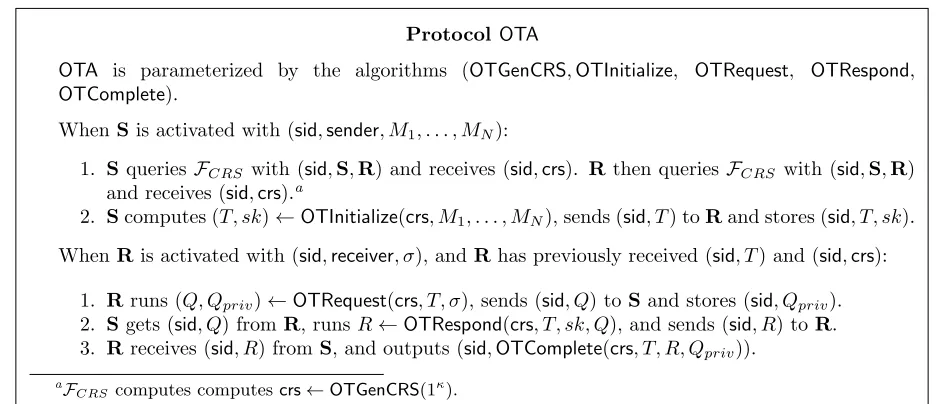
Our adaptive oblivious transfer protocol, OTNk×1, is described in Figure 4, with each of the algo-rithms (OTGenCRS,OTInitialize,OTRequest,OTRespond,OTComplete) described below.
OTGenCRS(1κ). Given security parameter κ, generate parameters for a bilinear mapping γ = (p,G1,G2,GT, e, g,g˜) ← BMsetup(1κ). Compute GSS ← GSSetup(γ) and GSR ←
GSSetup(γ). Choosea, b, c ←$ Zp, and set (g1, g2, h,g˜1,g˜2,˜h) ←(ga, gb, gc,g˜a,˜gb,g˜c). Output
crs = (γ, GSS, GSR, g1, g2, h,g˜1,g˜2,h˜). (In the full version, we describe how this common
reference string can be replaced by a common random string.)
OTInitialize(crs, m1, . . . , mN).This algorithm is executed by the Sender. On input a collection of
N messages and the crs, it outputs a commitment to the database, T, for publication to the Receiver, as well as a Sender secret key,sk. We treat messages as elements ofG1, since there
exist efficient mappings between strings in{0,1}` and elements in
G1 (e.g., [6, 1]).
Protocol OTA
OTA is parameterized by the algorithms (OTGenCRS,OTInitialize, OTRequest, OTRespond,
OTComplete).
WhenSis activated with (sid,sender, M1, . . . , MN):
1. SqueriesFCRS with (sid,S,R) and receives (sid,crs). R then queriesFCRS with (sid,S,R) and receives (sid,crs).a
2. Scomputes (T, sk)←OTInitialize(crs, M1, . . . , MN), sends (sid, T) toRand stores (sid, T, sk).
WhenRis activated with (sid,receiver, σ), andRhas previously received (sid, T) and (sid,crs):
1. Rruns (Q, Qpriv)←OTRequest(crs, T, σ), sends (sid, Q) toSand stores (sid, Qpriv). 2. Sgets (sid, Q) fromR, runs R←OTRespond(crs, T, sk, Q), and sends (sid, R) toR. 3. Rreceives (sid, R) from S, and outputs (sid,OTComplete(crs, T, R, Qpriv)).
aF
CRScomputes computescrs←OTGenCRS(1κ).
Figure 4: A high-level outline of the OTNk×1 protocol, with details of each algorithm described in Section 4. We make no explicit mention of the value k, the total transfers permitted by the Sender, because our protocol does not depend on it. The Sender may choose to stop answering the Receiver’s queries at any point, in which case OTRespond outputs “reject” and OTComplete
accepts this as the message⊥.
2. Choose random values x1, x2∈Zp.
3. Set (u1, u2)←(h1/x1, h1/x2), (˜u1,u˜2)←(˜h1/x1,˜h1/x2).
4. Set (vk1,sk1)←CLKeyGen(γ, u1,u˜1), (vk2, sk2)←CLKeyGen(γ, u2,u˜2)
and (vk3,sk3)←BBKeyGen(γ, u1,u˜1). Setpk ←(u1, u2,u˜1,u˜2,vk1,vk2,vk3).
5. Forj= 1, . . . , N encrypt each messagemj as: (a) Select random r, s, t∈Zp.
(b) Computesig1 ←CLSignsk1(ur1),sig2←CLSignsk2(us2), andsig3 ←BBSignsk3(ur1us2). (c) Set Cj ←(ur1, us2, g1r, g2s, mj·hr+s, sig1, sig2, sig3).
6. SetT ←(pk, C1, . . . , CN) andsk ←(x1, x2). Output (T, sk).
Each ciphertext Cj above can be though of as a signcryption where it is the randomnessfor each ciphertext that is signed, rather than the plaintext itself. Each plaintextmj is encrypted underS’s public keyu1, u2, as well as a “key”g1, g2 drawn fromcrs. This “double-trapdoor”
encryption is necessary for the security proof of theOT scheme.
To verify the format of each ciphertext Cj = (c1, . . . , c5, sig1, sig2, sig3) in T, anyone can
check thatCLVerifyvk1(c1,sig1),CLVerifyvk2(c2,sig2), andBBVerifyvk3(c1c2,sig3) each succeed,
and thate(c1,˜g1) =e(c3,u˜1)∧e(c2,˜g2) =e(c4,u˜2).
OTRequest(crs, T, σ). This algorithm is executed by a Receiver. On input T generated by the Sender, along with an item indexσ, generates a queryQ for transmission to the Sender.
1. Parse T as (pk, C1, . . . , CN), and ensure that it is correctly formed (see above). IfT is
2. Parsecrsto obtain (GSR,h˜), and parsepk as (u1, u2,u˜1,u˜2,vk1,vk2,vk3). Parse theσth
ciphertext Cσ as (c1, . . . , c5,sig1,sig2,sig3).
3. Select randomv1, v2 ∈Zp and setd1 ←(c1·uv11), d2←(c2·uv22),t1 ←hv1,t2 ←hv2.
4. Use the Groth-Sahai techniques and reference string GSR to compute a Witness Indis-tinguishable proof π that the values d1, d2 pertaining to the ciphertext Cσ (which the Receiver wishes to have the Sender help him open) have the correct structure:
π=NIW IGSR{(c1, c2, t1, t2,sig1,sig2,sig3) :
e(c1,h˜)e(t1,u˜1) =e(d1,˜h) ∧ e(c2,˜h)e(t2,u˜2) =e(d2,˜h) ∧
CLVerifyvk1(c1,sig1) = 1 ∧ CLVerifyvk2(c2,sig2) = 1 ∧BBVerifyvk3(c1c2,sig3) = 1}
5. Set requestQ←(d1, d2, π), and private state Qpriv←(Q, σ, v1, v2). Output (Q, Qpriv). To explain what is happening in the statement of step (4), first observe that the signature proofs of knowledge ensure that the valuesc1, c2 and the product (c1c2) each correspond to a
valid signature held by the Receiver. The remaining equations ensure that the valuesd1, d2
correspond to “blinded” versions of the elements c1, c2. These checks guarantee that the
witness used by the Receiver, and thus the decryption request being made, corresponds to one of the N ciphertexts published by the Sender.
OTRespond(crs, T, sk, Q).This algorithm is executed by the Sender. If the Sender does not wish to answer any more requests for the Receiver, then the Sender outputs the message “reject”. Otherwise, the Sender processes the Receiver’s requestQ as:
1. Parsecrs to obtain (GSR,˜g,h˜), and parseT as (pk, C1, . . . , CN), andsk as (x1, x2).
2. Parsepk (from T) as (u1, u2,u˜1,u˜2,vk1,vk2,vk3).
3. ParseQ as (d1, d2, π) and verify proof π using GSR. Abort if verification fails. 4. Seta1←dx11,a2←dx22, and s←a1·a2.
5. Use the Groth-Sahai techniques and reference stringGSS to formulate a zero-knowledge proof3 that the decryption valuesis properly computed:
δ=NIZKGSS{(a1, a2) :e(a1,u˜1)e(d
−1
1 ,˜h) = 1
∧ e(a2,u˜2)e(d−21,˜h) = 1 ∧ e(a1a2,h˜)e(s−1,˜h) = 1}
The third equation ensures that s = a1 ·a2, while the first two, since the values
(u1, d1, u2, d2,˜h) are known to both parties, ensure thata1 =dx11 and a2 =dx22.
6. OutputR←(s, δ).
OTComplete(crs, T, R, Qpriv).This algorithm is executed by the Receiver. On input R generated by the Sender in response to a requestQ, along with stateQpriv, outputs a messagem or⊥. IfR is the message “reject”, then the Receiver outputs ⊥. Otherwise, the Receiver does:
1. Parse crs to obtain (GSS, h). Parse T as (pk, C1, . . . , CN), R as (s, δ), and Qpriv as (Q, σ, v1, v2).
2. Verify proof δ using GSS. If verification fails, output⊥.
3. ParseCσ to obtain the first five elements (c1, . . . , c5) and outputm=c5/(s·h−v1·h−v2). 3
We present a simplified version of this proof above. However, to permit simulation, we must add a third vari-able ˜a3 = ˜h and re-write the proof as NIZKGSS{(a1, a2,˜a3) : e(a1,u˜1)e(d
−1
4.1 Efficiency Analysis
When the protocol in Figure 4 is implemented using the algorithms described above, we obtain a (k+ 1/2)-round protocol with communications cost O(N +k), where k ≤N. More concretely, the crs is comprised of 7 elements in G1 and 7 elements of G2, the Sender’s public key contains
5 elements in G1 and 6 elements in G2. Each of the N ciphertexts in T requires 15 elements in
G1 and 3 elements in G2. Moreover, each item transfer involves transmission of 68 elements ofG1
and 38 elements ofG2 from Receiver to Sender, and then 20 elements ofG1 and 18 elements ofG2
from Sender to Receiver. The message space of our OT protocol is elements inG1, which will be
sufficient for transferring a symmetric encryption key to unlock a file of arbitrary size.
4.2 Security Analysis
Theorem 4.1 Instantiated with the above algorithms,OTAsecurely realizes the functionalityFOTN×1
in the FCRS-hybridmodel under the SXDH, DLIN, and q-Hidden LRSW assumptions.
Let us now provide some intuition behind this proof, with the details contained in Appendix A. When either the Sender or the Receiver is corrupted, we wish to describe a simulator S such that it can interact with the ideal functionality FOTN×1 (which we’ll denote simply as F) and the environmentZ appropriately; i.e., IDEALF,S,Z
c
≈EXECOTA,A,Z.
Simulating the case where only S is corrupted. We first consider the case where the real-world adversary A corrupts the Sender, and thus S must interact with F as the ideal Sender and with (an internal copy of)A as a real-world Receiver. HereS does the following:
1. Ask A to begin an OT protocol, and set the crs for these two parties by running γ = (p,G1,G2,GT, e, g ∈G1,g˜∈G2) ← BMsetup(1κ), GSS ← GSSetup(γ), GSR ← GSSetup(γ),
selecting random elements a1, a2 ∈ Zp, and setting g1a1 = g
a2
2 = h (and a corresponding
re-lationship for ˜g1,g˜2,˜h). Set crs = (γ, GSS, GSR, g1, g2, h,˜g1,g˜2,˜h). When the parties query
FCRS, return (sid,crs).
2. Obtain the database commitment T from A. Verify that T is well-formed, abort if not. Otherwise, use a1, a2 to decrypt each ciphertext Ci = (c1, . . . , c5, . . .) as mi = c5/(ca31c
a2 4 ).
Map each elementmi ∈G1 to a string in{0,1}` [1]. Send (sid,S, m1, . . . , mN) toF.
3. Upon receiving (sid,request) fromF, returnOTRequest(crs, T,1) toA. This response includes two random valuesd1, d2and a non-interactive witness indistinguishable proofπ with respect
toGSR ∈ crs that d1, d2 are “blinded” values corresponding to a ciphertext Cσ. This proof
can be performed honestly and without rewinding.
4. IfAissues a “reject” message or responds with anything other than a value inG1 and a valid
NIZK proof, thenS tellsF to fail the request by sending message (sid,0). Otherwise,S sends the message (sid,1) toF.
The indistinguishability argument here follows from the indistinguishability of thecrs(which is identically distributed to a real crs), the perfect extraction of the messages mi4, and the Witness Indistinguishability of the GS proof π issued during each request phase, which guarantees that A
4Note that a ciphertext that passes the validity check can be represented asC = (ur
(the corrupt Sender) cannot distinguish a request to decrypt C1 from a request to decrypt any
other valid ciphertext. Thus,S can adequately mimic its response pattern.
Simulating the case where only R is corrupted. Next, we consider the case where the real world adversary A corrupts the Receiver, and thus S must interact with F as the ideal Receiver and with (and internal copy of) A as real-world Receiver. This case requires that the q =N for theq-Hidden LRSWassumption. Here S does the following:
1. Ask A to begin an OT protocol, and set the crs for these two parties by running γ = (p,G1,G2,GT, e, g ∈ G1,˜g ∈ G2) ← BMsetup(1κ), (GSS, tdsim) ← GSSimulateSetup(γ) and (GSR, tdext) ← GSExtractSetup(γ). Select random elements for g1, g2, h,g˜1,g˜2,˜h. Set
crs←(γ, GSS, GSR, g1, g2, h,g˜1,˜g2,˜h). When the parties query FCRS, return (sid,crs). 2. S must commit to a database of messages for A withoutknowing the messages m1, . . . , mN.
Thus,S simply commits to random junk messages, and sends the corresponding T toA. 3. When A makes a transfer request, S uses tdext to extract the witness W corresponding to
A’s decryption request from the NIWI proof. (This extraction is done via opening perfectly-binding commitments which are included in the WI proof and does not require any rewinding.) This witness includes the first two elements (c1, c2) of the ciphertext thatA is requesting to
decrypt, and from these it is possible to determine the indexσ0 of the ciphertext thatAhas requested to open.
4. S now sends (sid,R, σ0) to F to obtain the realmσ0 message.
5. Finally, S returns a response to A which opens Cσ0 to mσ0 and then uses tdsim to simulate
an NIZK proof that this opening is correct. The NIZK proof here is designed in such a way that simulation is always possible and no rewinding is necessary.
The indistinguishability argument here follows from the indistinguishability of the crs (from a real crs), the indistinguishability of the “fake” database T, the ability to extract witnesses from the NIWI proofs, and the zero-knowledge property of “fake” NIZK proofs. In particular, note that the N-Hidden LRSW assumption ensures that any decryption request made by the receiver corresponds to a valid ciphertext from the databaseT (if Aproduces a proofπ embedding invalid ciphertext values, we can useAto solveN-Hidden LRSWor the co-CDH problem, which is implied by N-Hidden LRSW). Unlike the protocol of [10] we are able to base the semantic security of the ciphertexts on a standard decisional assumption (the Decision Linear assumption). This is possible because the full ciphertext can be constructed using only the DLIN input (see the note on Ciphertext security below). Notice that S is neverbothsimulating and extracting via the same (subsection of the) common reference string; indeed, we do not require that the proofs be simulation-sound.
Simulating the case where both S and R are corrupted. In the case where both the Receiver and Sender are corrupted, S knows the inputs to S and R and can simulate a protocol execution by generating the real messages exchanged between the two parties.
Simulating the case where neither party is corrupted. When S receives messages of the form (sid, bi) indicating that transfers have occurred, S generates a simulated transcript between the honest S and R. In this case,S runs the protocol as specified, using as S’s input the random database ( ˆm1, . . . ,mNˆ ), and (for each transfer), R’s input σ0 = 1. If in the ith transfer bi = 0
thenS’s responds with an invalid R (the empty string). Else, S returns a valid response as in the protocol.
random messages is indistinguishable from a vector encrypting the real message database. We argue that this is the case under the Decision Linear assumption. LetD= (g,g, f,˜ f , h,˜ ˜h, ga, fb, z
d) be a candidate Decision Linear tuple. We consider a simulation that behaves as follows:
1. Setu1 =g, u2 =f,u˜1 = ˜g,u˜2 = ˜f. Select randomy1, y2 ∈Zp, and setg1 =u1y1, g2=uy22 (and
similarly for ˜g1,g˜2). Fixcrs←(γ, GSS0, GSR0 , g1, g2, h,g˜1,g˜2,h˜).
2. Generate (vk1,sk1),(vk2,sk2),(vk3,sk3) as in normal operation. Setpk = (u1, u2,u˜1,u˜2,vk1,vk2,vk3).
3. Fori= 1 to N, choose fresh random s, t1, t2 ∈Zp and setc1 =gasgst1, c2 =fbsfst2. SetCi:
Ci = (c1, c2, cy11, c
y2
2 , zdshs(t1+t2)mj,sig1,sig2,sig3)
wheresig1,sig2,sig3 are generated normally using the appropriate secret keys. 4. SetT ←(pk, C1, . . . , CN).
5. The simulation answers requests from the malicious Receiver by extracting from its proof and simulating correct responses (as described above.)
Note that in the above, if zd=ha+b, then the above simulation perfectly encrypts (m1, . . . , mN). However, when zd is a random element of G1, then the ciphertexts correspond to encryptions of
random elements inG1. Now, suppose for the sake of contradiction, that there exists an environment
Z who can distinguish case one from case two with non-negligible probability. Then, it is easy to see that we can useZ to decide Decision Linear.
Sampling from a Common Random String. We briefly note that by the same arguments used above, the Reference String used in our construction can be replaced with a Common Random String. Note that crs embeds (γ, GSS, GSR, g1, g2, h,˜g1,˜g2,˜h), for GSR, GSS ∈ GSSetup(γ) and
g1, g2, h,g˜1,g˜2,h˜∈RG31×G32. Each set of Groth-Sahai commitment parameters embeds a tuple in
G1(resp. G2). WhenGSSetupis used, the parameters are generated such that the parameters are a
DDH tuple in the respective group, and whenGSSimulateSetupis used, they are uniformly random. Under SXDH, the latter distribution is indistinguishable from the correct one, and thus we may sample the components of GSS, GSR uniformly. Since the parameters γ can be sampled from a random string [23], then all elements ofcrscan therefore be derived from a uniformlyrandomstring when a source of common randomness is available.
5
On Multiple Receivers
OTis traditionally described as a two-party protocol between a Sender and Receiver. We presented our main construction in this setting. However, since we are motivated by the application of OT
to database systems, we would also like to support applications where multiple users share a single database. Naively this can be accomplished by requiring the database to run separateOTprotocol instances with each user. However, this approach can be quite inefficient, and moreover does not ensureconsistencyin the database viewed by individual Receivers. Consider a strengthening of the security definition of FOTN×1 (in Figure 3) to include the additional requirement that all Receivers “view” the same database, i.e., the database owner cannot selectively alter the messages in the database when interacting with different receivers – on query σ from anyreceiver, he must return a value in{mσ,⊥}. Fortunately,consistencyis easy and inexpensive to achieve in our construction – simply alter FCRSD,P to return the same values (g1, g2, h) as part of the crs to all receivers and
Intuitively, this captures consistency because the simulator can set the values (g1, g2, h) and then
trapdoor decrypt all messages in T (see Appendix B). Given the soundness of the GS proofs, all of the Sender’s responses to any Receiver must be consistent with T, even if the other parts of their common reference strings are distinct. Note that it is not at all clear how consistencycan be achieved efficiently even in the non-adaptive setting using prior UC results [30], since there each Receiver provides her own encryption key for the Sender to bundle the messages in.
References
[1] Giuseppe Ateniese, Jan Camenisch, and Breno de Medeiros. Untraceable RFID tags via in-subvertible encryption. InCCS ’05, pages 92–101. ACM Press, 2005.
[2] Lucas Ballard, Matthew Green, Breno de Medeiros, and Fabian Monrose. Correlation-resistant storage from keyword searchable encryption. Cryptology ePrint Archive, Report 2005/417, 2005.
[3] Mira Belenkiy, Melissa Chase, Markulf Kolweiss, and Anna Lysyanskaya. Non-interactive anonymous credentials. InTCC ’08, volume 4948 of LNCS, pages 356–374, 2008.
[4] Dan Boneh and Xavier Boyen. Efficient selective-ID secure Identity-Based Encryption without random oracles. InEUROCRYPT ’04, volume 3027 of LNCS, pages 223–238, 2004.
[5] Dan Boneh, Xavier Boyen, and Hovav Shacham. Short group signatures. In CRYPTO ’04, volume 3152 of LNCS, pages 45–55, 2004.
[6] Dan Boneh and Matthew K. Franklin. Identity-based encryption from the Weil Pairing. In
CRYPTO ’01, volume 2139 of LNCS, pages 213–229, 2001.
[7] Xavier Boyen and Brent Waters. Full-domain subgroup hiding and constant-size group signa-tures. InPKC ’07, volume 4450 of LNCS, pages 1–15. Springer, 2007.
[8] Gilles Brassard, Claude Cr´epeau, and Jean-Marc Robert. All-or-nothing disclosure of secrets. InCRYPTO ’86, volume 263 of LNCS, pages 234–238, 1986.
[9] Jan Camenisch and Anna Lysyanskaya. Signature schemes and anonymous credentials from bilinear maps. InCRYPTO ’04, volume 3152 of LNCS, pages 56–72. Springer, 2004.
[10] Jan Camenisch, Gregory Neven, and abhi shelat. Simulatable adaptive oblivious transfer. In
EUROCRYPT ’07, volume 4515 of LNCS, pages 573–590, 2007.
[11] Jan Camenisch and M. Stadler. Efficient group signature schemes for large groups. InCRYPTO ’97, volume 1296 of LNCS, pages 410–424, 1997.
[12] R. Canetti, Y. Dodis, R. Pass, and S. Walfish. Universally composable security with pre-existing setup. InTCC ’07, volume 4392 of LNCS, pages 61–85, 2007.
[14] Ran Canetti. Universally composable security: Towards the bare bones of trust. In Asiacrypt ’07, volume 4833 of LNCS, pages 88–112, 2007.
[15] Ran Canetti and Marc Fischlin. Universally composable commitments. In CRYPTO ’01, volume 2139 of LNCS, pages 19–40. Springer, 2001.
[16] Ran Canetti, Yehuda Lindell, Rafail Ostrovsky, and Amit Sahai. Universally composable two-party and multi-party secure computation. In STOC ’02, pages 494–503. ACM Press, 2002.
[17] Ran Canetti and Tal Rabin. Universal composition with joint state. InCRYPTO ’03, volume 2729 of LNCS, pages 265–281. Springer, 2003.
[18] Cheng-Kang Chu and Wen-Guey Tzeng. Efficient k-out-of-n oblivious transfer schemes with adaptive and non-adaptive queries. InPKC ’05, volume 3386 of LNCS, pages 172–183, 2005.
[19] Shimon Even, Oded Goldreich, and Abraham Lempel. A randomized protocol for signing contracts. InCRYPTO ’82, pages 205–210, 1982.
[20] Oded Goldreich, Silvio Micali, and Avi Wigderson. How to play any mental game or a com-pleteness theorem for protocols with honest majority. InSTOC ’87, pages 218–229, 1987.
[21] Matthew Green and Susan Hohenberger. Blind identity-based encryption and simulatable oblivious transfer. InASIACRYPT ’07, volume 4833 of LNCS, pages 265–282, 2007.
[22] Matthew Green and Susan Hohenberger. Universally composable adaptive oblivious transfer. InASIACRYPT, pages 179–197, 2008.
[23] Jens Groth, Rafail Ostrovsky, and Amit Sahai. Perfect non-interactive zero knowledge for NP. InEUROCRYPT ’06, volume 4004 of LNCS, pages 339–358. Springer, 2006.
[24] Jens Groth and Amit Sahai. Efficient non-interactive proof systems for bilinear groups. In
EUROCRYPT ’08, volume 4965 of LNCS, pages 415–432. Springer, 2008.
[25] Joe Kilian. Founding cryptography on oblivious transfer. InSTOC ’88, pages 20–31, 1988.
[26] Yehuda Lindell. Efficient fully-simulatable oblivious transfer. In CT-RSA ’08 (to appear), 2008. Available athttp://eprint.iacr.org/2008/035.
[27] Anna Lysyanskaya, Ronald L. Rivest, Amit Sahai, and Stefan Wolf. Pseudonym systems. In SAC ’99: Proceedings of the 6th Annual International Workshop on Selected Areas in Cryptography, pages 184–199. Springer, 1999.
[28] Moni Naor and Benny Pinkas. Oblivious transfer with adaptive queries. In CRYPTO ’99, volume 1666 of LNCS, pages 573–590, 1999.
[30] Chris Peikert, Vinod Vaikuntanathan, and Brent Waters. A framework for efficient and com-posable oblivious transfer. In CRYPTO ’08 (to appear), 2008. http://eprint.iacr.org/ 2007/348.pdf.
[31] Michael Rabin. How to exchange secrets by oblivious transfer. Technical Report TR-81, Aiken Computation Laboratory, Harvard University, 1981.
[32] Mike Scott. Authenticated id-based key exchange and remote log-in with simple token and pin number, 2002. Available athttp://eprint.iacr.org/2002/164.
[33] Victor Shoup. Lower bounds for discrete logarithms and related problems. InEUROCRYPT ’97, volume 1233 of LNCS, pages 256–266. Springer, 1997.
[34] Andrew Yao. How to generate and exchange secrets. InFOCS ’86, pages 162–167, 1986.
A
Proof of Theorem 4.1
Notation: Let νi(·) denote a negligible function where for every polynomial p(·), there exists an N such that for all integers n > N, it holds thatνi(n)<1/p(n).
Proof. Let Abe a static adversary that interacts with parties S,R running protocol OTA param-eterized with the algorithms of section 4. We construct an adversary S for the ideal functionality FOTN×1. S begins by invoking a copy ofAand running a simulated interaction with the environment Z and the parties running the protocol. S proceeds as follows.
Simulating the communication with Z. Every input value thatS receives from Z is written into the adversary A’s input tape. Similarly, every output value written by A on its output tape is copied toS’s own output tape (to be read byS’s environment Z).
Simulating the case where only R is corrupted. Let γ ← BMsetup(1κ), then compute (GSS0, tdsim)← GSSimulateSetup(γ) and (GSR0 , tdext)←GSExtractSetup(γ). Generate the remain-ing elements of crs normally, and set crs ← (γ, GSS0, GSR0 , g1, g2, h,g˜1,g˜2,h˜). When the parties
queryFCRS, return (sid,crs).
S initiates the communication withAby generating a random message database ˆm1, . . . ,mˆN
$
← G1, computing T ← OTInitialize(crs,mˆ1, . . . ,mˆN) and sending (sid, T) to A as if from S. Next, wheneverAoutputs (sid, Q),Sperforms as follows. First, it parsesQas (d1, d2, π) and (ifπis valid)
computes GSExtract(crs, tdext, π) to extract a satisfying witnessW = (ω1, ω2, ω3, ω4, . . .). Parse T
as (pk, C1, . . . , CN), and for each ciphertextCi= (c1, c2, . . .) determine whether (ω1, ω2) = (c1, c2).
If no matching ciphertext is found (or multiple ciphertexts match), then S aborts the simulation and gives no further messages toA.
Otherwise, let σ0 be the index of the matching ciphertext: S sends (sid,receiver, σ0) to FOTN×1. When FOTN×1 outputs (sid, mσ0) for mσ0 6=⊥, S formulates the response s = (c5ω3ω4)/mσ0 and—
using the simulation trapdoor tdsim— simulates the zero-knowledge proof δ0 indicating that s is correctly formed according to the statement defined in theOTRespond algorithm (see Lemma A.7 for details on simulating this proof). S then sends R ← (s, δ0) to A as if from S. S repeats this process for each request received fromA.
Simulating the case where only S is corrupted. Our simulation proceeds as follows. Letγ ←
such that gy1
1 = g
y2
2 = h (and ˜g
y1 1 = ˜g
y2
2 = ˜h) for (y1, y2) known to the simulator. Set crs ←
(γ, GSS, GSR, g1, g2, h,g˜1,g˜2,˜h). When the parties queryFCRS, return (sid,crs).
S activates Aand receives the message (sid, T) that would beA’s first move in a real execution withR. S verifies thatT is correctly-structured, using the public check described in§4. (IfT does not pass this check, S will instruct FN×1
OT to fail on all message requests from R.) Otherwise, S parsesT as (pk, C1, . . . , CN) and fori= 1 toN first parses ciphertextCi into (c1, c2, c3, c4, c5, . . .),
then computes m0i ← c5/(cy31c
y2
4 ). S decodes each m
0
1, . . . , m0N to a value in {0,1}` and sends (sid,sender, m01, . . . , m0N) to FN×1
OT .
Whenever FOTN×1 outputs (sid) to the dummy S (indicating that R has initiated a transfer request), S computes (Q, Qpriv) ← OTRequest(crs, T,1) and hands (sid, Q) to A as if from R. When S returns (sid, R), S checks whether OTComplete(crs, T, R, Qpriv) = ⊥. If so, then S sets b←0, andb←1 otherwise. S returns (sid, b) to FOTN×1.
Simulating the case where neither party is corrupted. When S receivesk messages of the form (sid, bi) indicating that transfers have occurred, S generates a simulated transcript between the honest S and R. In this case,S runs the protocol as specified, using as S’s input the random database ( ˆm1, . . . ,mNˆ ), and (for each transfer), R’s input σ = 1. If in the ith transfer bi = 0
thenS’s responds with an invalid R (the empty string). Else, S returns a valid response as in the protocol.
Simulating the case where both parties are corrupted. In this caseSknows the inputs toS
and R and can simulate a protocol execution by generating the real messages exchanged between the two parties.
We now address the environment’s ability to distinguish the ideal execution from the real protocol execution. This is shown via the following claims.
Claim A.1 When A corrupts only R, then IDEALFN×1
OT ,S,Z
c
≈ EXECOTA,A,Z under the SXDH,
Decision Linear and N-Hidden LRSWassumptions.
Proof. Consider the simulation described above. We will begin with the real-world protocol execu-tion, whereRinteracts with an honestS that knows the message database. We will then show via a series of hybrids that the real execution transcript is computationally indistinguishable from the simulated transcript. For notational convenience, we define Pr[Game i] as the probability that environment Z distinguishes the transcript of Game i from that of the real execution. We now describe the cases:
Game 0. This is the real-world protocol execution, where R interacts with an honest S
running protocolOTAon message database (m1, . . . , mN). ClearlyPr[Game 0] = 0.
Game 1 (Parameter switching). This execution proceeds as above, except that we com-pute (GSS0, tdsim) ∈ GSSimulateSetup(γ), (GSR0 , tdext) ∈ GSExtractSetup(γ), and substitute GSS0, GSR0 in place of the honestly-generated parameters GSS, GSR (tdsim, tdext are not re-vealed). When the parties query FCRS, returncrs = (γ, GSS0, GSR0 , g1, g2, h,˜g1,˜g2,˜h). Note
that if the SXDH assumption holds inG1,G2, then (GSS0, GSR0 ) c
≈(GSS, GSR) (Lemma A.5) and thus |Pr[Game 1]−Pr[Game 0]| ≤ν1(κ).
from its PoK π. Parse R’s ith request (sid, Qi) to obtain (d1, d2, π) and (provided that π
is valid) run GSExtract(crs, tdext, π) to extract a satisfying witness W = (ω1, ω2, ω3, ω4, . . .).
Parse T as (pk, C1, . . . , CN), and for each ciphertext Ci = (c1, . . . , c9) determine whether
(ω1, ω2) = (c1, c2). Letσ0i be the index of the matching ciphertext. If no matching ciphertext is found (or multiple ciphertexts match), then outputExtract-FailtoZand send no further messages to R. By Lemma A.6, this event will occur with negligible probability under the N-Hidden LRSW assumption; thus|Pr[Game 2]−Pr[Game 1]| ≤ν2(κ).
Game 3 (Simulating S’s responses). This execution proceeds as above, except that we will formulate each of S’s transfer responses independently of sk. We parse Cσ0
i to obtain
(c1, . . . , c5) and computes0 = (c5ω3ω4)/mσ0i. LetSbe the statement proved by the Sender dur-ing theOTRespondalgorithm: we compute a simulated PoKδ0 ←GSSimProve(GSS, tdsim, S) and set R0 ← (s0, δ0). Note that in order to simulate a response during transfer i, it is only necessary to know the subset of messages, (mσ0
1, . . . , mσ
0
i). By Lemma A.7, the transcript
in-cluding these responses is computationally indistinguishable from the distribution with valid PoKs. Thus|Pr[Game 3]−Pr[Game 2]| ≤ν3(κ).
Game 4 (Substituting the ciphertexts). This execution proceeds as above, except that we replace S’s first message with (sid, T0) where T0 ∈ OTInitialize(crs,mˆ1, . . . ,mˆN) for
ˆ
m1, . . . ,mNˆ $
← G1. For i = 1 to k, we also modify the ith transfer phase such that S’s
response is (sid, R0i) for Ri0 = (s0, δ0) computed as in Game 3, except that we must now compute the PoK δ on a possibly invalid statement S. By Lemma A.8, the hardness of the Decision Linear problem implies that the distribution of messages is indistinguishable from the real execution, even though s0 may be incorrectly formed with respect toS. Thus |Pr[Game 4]−Pr[Game 3]| ≤ν4(κ).
Notice that the distribution produced in Game 4 is identical to that of our simulation. By sum-mation, we have that Pr[Game 4] ≤ν5(κ) and thus IDEALFN×1
OT ,S,Z
c
≈EXECOTA,A,Z under the
N-Hidden LRSW and Decision Linear assumptions.
2
Claim A.2 When A corrupts only S, then IDEALFN×1
OT ,S,Z
c
≈EXECOTA,A,Z under the SXDH and
N-Hidden LRSW assumptions.
Proof. Consider the simulation described above. Again we begin with the real-world protocol execution, where S interacts with an honest R that chooses messages according to an arbitrary selection strategy Σ. We then show via a series of hybrids that the real execution transcript is computationally indistinguishable from the simulated transcript.
Game 0. This is the real-world protocol execution, where S interacts with an honest R
running protocolOTAusing selection strategy Σ. ClearlyPr[Game 0] = 0.
Game 1 (Parameter generation). This execution proceeds as above, except that we select elements of crssuch that gx1 =gy2 =h (and ˜g1x= ˜g2y = ˜h) for known (x, y). When the parties query FCRS, return crs= (γ, GSS, GSR, g1, g2, h,g˜1, g2, h). Note that the distribution of crs
Game 2 (Substituting R’s queries). Next, during transfer i = 1 to k, we modify the transcript by generating Q0i ← OTRequest(T,1) and replacing R’s request with (sid, Q0i). Let Q0 = (d01, d02, π0). Observe that for any i ∈ [1, N], where Ci = (c1, . . . , c5, . . .), we
can express d01, d02 as c1u
v10
1 , c2u
v20
2 for some v10, v20. Thus for every Ci there exists a witness (c1, c2, hv
0
1, hv02,sig
1,sig2,sig3) that satisfies the pairing product equationSπ. By the Witness-Indistinguishability property of the Groth-Sahai proof system, the valueQ01 is indistinguish-able from a request formed on a differentσj ∈[1, N]. Thus|Pr[Game 2]−Pr[Game 1]| ≤ ν1(κ).
Game 2 has an identical distribution to our simulation, andPr[Game 2]≤ν1(κ). It remains to
show that the in our simulation the distribution of messages obtained by an idealRinteracting with FOTN×1 are identical to the messages recovered by an honest R running the protocol directly with
S. This implies that for every set of indices (σ1, . . . , σk) the plaintexts (m0σ1, . . . , m
0
σk) obtained by
S— which decrypts the ciphertexts in T with the trapdoor (x, y)— are identical to the messages recovered by an honest Rrunning the protocol with S.
S’s initial output T embedspk = (u1, u2, . . .). Let (a, b) be S’s secret key, which is implicitly
defined byua1 =ub2 =h. We observe that ifT passes the validity check run by honestR, then each ciphertextCi can be expressed as (ur1, us2, g1r, gs2, mihr+s, . . .) for somer, s∈Zp andmi ∈G1. Since
the simulator constructed g1, g2 such that g1x = g
y
2 = h then it necessarily holds that (pra1 psb2 ) =
(g1rxgsy2 ) =hr+s. Let us consider an honestRthat requests indexifromS. It selectsv1, v2 ∈Zp and sets d1 =ur1u
v1
1 , d2 =us2u
v2
2 , sending request Q = (d1, d2, π). Let R = (s, δ) be the response from S. If PoK δ verifies, then (by the soundness property of the proof system) with all but negligible probability s = da1db2 and the honest R computes the message as (mihs+r)/(da1db2h−v1h−v2) =
mi. This is identical to the decryption obtained by S using the trapdoor (x, y), which produces hs+r/(g1rxg2sy) =mi . Thus, the distribution of messages given to FOTN×1 by S is indistinguishable from the distribution of messages obtained by running the protocol directly withS.
2
Claim A.3 When A corrupts neither S nor R, then IDEALFN×1
OT ,S,Z
c
≈ EXECOTA,A,Z under the
SXDH, Decision Linear and N-Hidden LRSW assumptions.
We omit a formal proof of this claim, but note that it re-uses techniques identical to those of the previous claims. Specifically, we replace the Sender’s initial message T with a commitment to a random database, and show that this random database is indistinguishable from a real database under the Decision Linear assumption (as in Claim A.1). We then argue that by the Witness-Indistinguishability property of the Groth-Sahai proof system, the extractions on message index 1 are indistinguishable from extractions on other message indices (as in Claim A.2).
Claim A.4 When A corrupts both S and R, then IDEALFN×1
OT ,S,Z
c
≈EXECOTA,A,Z.
We omit a formal proof of this claim.
Lemma A.5 Under the SXDH assumption, the parameters generated byGSSetup(andGSExtractSetup) are computationally indistinguishable from those produced by GSSimulateSetup.
Lemma A.6 Under theN-Hidden LRSWand co-CDH5assumptions, the probability thatSoutputs
Extract-Fail in Game 3 is negligible.
Proof sketch. LetT = (pk, C1, . . . , CN) be honestly-generated as inGame 3. ConsiderA’s request
(sid, Qi) at transferi∈[1, k], and parseQias (d1, d2, π) whereπis a PoK (of the statement described
in the definition ofOTRequest) using parametersGSR0 . Note that the simulator knows the trapdoor tdext corresponding to GSR0 , and can therefore extract a satisfying witness W = (ω1, ω2, . . .) ←
GSExtract(GSR, tdext, π) (in the general case, extraction succeeds with probability ≥ 1−ν(κ) by the Soundess property of the Groth-Sahai proof system).6 Since extraction fails with at most negligible probability, then if S outputs Extract-Fail with non-negligible probability, then it must be that that forj∈[1, N] there is either (a)nosingle ciphertextCj = (cj,1, . . . , cj,5, . . .) such
that (ω1, ω2) = (cj,1, cj,2),or (b) there are multiple ciphertexts for which the relation holds.
We can easily dispose of case (b): since T is honestly generated, then for each ciphertext (cj,1, . . . , cj,5,sig1,sig2,sig3), the values cj,1, cj,2 are uniformly distributed in G1. Therefore, the
probability is negligible that any two distinct ciphertexts are identical in the first two elements. This it remains only to address case (a) where there is no ciphertext Cj such that (cj,1, cj,2) = (ω1, ω2).
This condition can be further divided into two sub-cases:
1. Where fori6=jthere exists some pair of ciphertextsCi, Cj such thatω1 =ci,1 and ω2=cj,2.
2. Where there is no pair of ciphertexts such that the above condition holds, i.e.,either ω1 or
ω2 is not contained within any ciphertext inT.
We now show that if Aoutputs a PoK satisfying condition (1) then we can use its response to solve the co-CDH problem, and ifAsatisfies condition (2) we can solveN-Hidden LRSW. We now describe each of the two simulations:
Case 1: co-CDH. We consider the case whereAproduces (ω1, ω2) = (ci,1, cj,2) fori6=j, and show
that an A that produces such a query can be used to solve the Computational co-Diffie-Hellman problem in G1,G2,i.e.,given (g, ga, gb,˜g,g˜a,g˜b) for a, b∈RZp, solve for gab. The intuition behind this argument is that the final component sig3 is a “weak” signature on the product (c1c2). This
weak signature is built from the Boneh-Boyen selective-ID IBE scheme from [4] (§4). Our reduction is based on the one given by Boneh and Boyen, although we reduce to co-CDH. Since theN-Hidden LRSWassumption implies the hardness of co-CDH, we are not introducing a new assumption.
Given an input (g, ga, gb,˜g,g˜a,g˜b) to the co-CDH problem: select random valuesu, v, w, y←$ Zp. Set (u1, u2)← (ga, gau), (˜u1,u˜2)←(˜ga,˜gau) and h0 ←(ga)−vgw. Generate (vk1,sk1),(vk2,sk2) as
in the normal scheme, but set vk3 = (γ, g,˜g, ga, gb, h0,g˜b). Set pk ← (u1, u2,u˜1,u˜2,vk1,vk2,vk3).
Randomly select two ciphertext indices i∗, j∗ such that i∗ 6=j∗.
Now for i = 1 to N, choose ri, si, yi uniformly from Zp with the restriction that (ri∗+usj∗) =
v mod p. Set zi = (ri+usi) mod p. Generate sig1 ←CLSignsk1(u r
1),sig2 ←CLSignsk2(u s
2), and set
sig3←(gb)
−w
zi−v((ga)zi−vgw)yi,(˜gb) −1
zi−vg˜yi,(gb) −1
zi−vgyi
. Construct theith ciphertext as:
Ci= uri 1 , u
si 2 , g
ri 1, g
si 2 , mjh
ri+si,sig
1,sig2,sig3
5Computational co-Diffie-Hellman (CDH) is implied byN-Hidden LRSW; thus, no new assumptions are being
introduced here. 6