HAIL: A High-Availability and Integrity Layer
for Cloud Storage
Kevin D. Bowers
RSA Laboratories
[email protected]
Ari Juels
RSA Laboratories
[email protected]
Alina Oprea
RSA Laboratories
[email protected]
Abstract
We introduce HAIL (High-Availability and Integrity Layer), a distributed cryptographic system that permits a set of servers to prove to a client that a stored file is in-tact and retrievable. HAIL strengthens, formally unifies, and streamlines distinct approaches from the cryptographic and distributed-systems communities. Proofs in HAIL are efficiently computable by servers and highly compact— typically tens or hundreds of bytes, irrespective of file size. HAIL cryptographically verifies and reactively reallocates file shares. It is robust against an active, mobile adver-sary, i.e., one that may progressively corrupt the full set of servers. We propose a strong, formal adversarial model for HAIL, and rigorous analysis and parameter choices. We show how HAIL improves on the security and efficiency of existing tools, like Proofs of Retrievability (PORs) deployed on individual servers. We also report on a prototype imple-mentation.
1 Introduction
Cloud storagedenotes a family of increasingly popular on-line services for archiving, backup, and even primary storage of files. Amazon S3 [1] is a well known exam-ple. Cloud-storage providers offer users clean and simple file-system interfaces, abstracting away the complexities of direct hardware management. At the same time, though, such services eliminate the direct oversight of component reliability and security that enterprises and other users with high service-level requirements have traditionally expected. To restore security assurances eroded by cloud environ-ments, researchers have proposed two basic approaches to client verification of file availability and integrity. The cryp-tographic community has proposed tools called proofs of retrievability (PORs) [24] and proofs of data possession (PDPs) [2]. A POR is a challenge-response protocol that enables a prover (cloud-storage provider) to demonstrate to
a verifier (client) that a file F is retrievable, i.e., recover-able without any loss or corruption. The benefit of a POR over simple transmission ofF is efficiency. The response can be highly compact (tens of bytes), and the verifier can complete the proof using a small fraction ofF. Roughly speaking, a PDP provides weaker assurances than a POR, but potentially greater efficiency.
As a standalone tool for testing file retrievability against a single server, though, a POR is of limited value.1
De-tecting that a file is corrupted is not helpful if the file is irre-trievable and thus the client has no recourse. Thus PORs are mainly useful in environments whereFis distributed across multiple systems, such as independent storage services. In such environments, F is stored in redundant form across multiple servers. A verifier (user) can test the availability of
F on individual servers via a POR. If it detects corruption within a given server, it can appeal to the other servers for file recovery. To the best of our knowledge, the application of PORs to distributed systems has remained unexplored in the literature.
A POR uses file redundancywithin a server for verifi-cation. In a second, complementary approach, researchers have proposed distributed protocols that rely on queries across servers to check file availability [26, 35]. In a distributed file system, a file F is typically spread across servers with redundancy—often via an erasure code. Such redundancy supports file recovery in the face of server er-rors or failures. It can also enable a verifier (e.g., a client) to check the integrity ofF by retrieving fragments ofF from individual servers and cross-checking their consistency.
In this paper, we explore a unification of the two ap-proaches to remote file-integrity assurance in a system that we callHAIL (High-Availability and Integrity Layer).
HAIL manages file integrity and availability across a col-lection of servers or independent storage services. It makes use of PORs as building blocks by which storage resources can be tested and reallocated when failures are detected.
1A standalone POR is useful for quality-of-service testing. Thespeed
HAIL does so in a way that transcends the basic single-server design of PORs and instead exploits both within-server redundancy and cross-within-server redundancy.
HAIL relies on a single trusted verifier—e.g., a client or a service acting on behalf of a client—that interacts with servers to verify the integrity of stored files. (We do not consider a clientless model in which servers perform mu-tual verification, as for distributed information dispersal al-gorithms such as [16, 18, 8, 21].)
HAIL offers the following benefits:
• Strong file-intactness assurance: HAIL enables a set of servers to prove to a client via a challenge-response protocol that a stored fileF is fully intact—more pre-cisely, that the client can recoverF with overwhelm-ing probability. HAIL protects against even small, e.g., single-bit, changes toF.
• Low overhead:The per-server computation and band-width required for HAIL is comparable to that of previously proposed PORs. Apart from its use of a natural file sharing across servers, HAIL improves on PORs by eliminating check values and reducing within-server file expansion.
• Strong adversarial model: HAIL protects against an adversary that isactive, i.e., can corrupt servers and al-ter file blocks andmobile, i.e., can corrupt every server over time.
• Direct client-server communication: HAIL involves one-to-one communication between a client and servers. Servers need not intercommunicate—or even be aware of other servers’ existence. (In comparison, some information dispersal algorithms involve server-to-server protocols, e.g., [16, 18, 8, 21].) The client stores just a secret key.
• Static / dynamic file protection: In this paper, we show how HAIL protects static stored objects, such as backup files and archives. But our tools and framework can be modified with little added overhead to accom-modate file updates, i.e., to provide integrity assurance for dynamically changing objects. We briefly explain this direction in the paper conclusion.
Our two broad conceptual contributions in HAIL are:
Security modeling We propose a strong, formal model that involves amobile adversary, much like the model that motivates proactive cryptographic systems [23, 22]. A mo-bile adversary is one capable of progressively attacking storage providers—and in principle, ultimately corrupting all providers at different times.
None of the existing approaches to client-based file-integrity verification treats the case of a mobile adversary.
We argue that the omission of mobile adversaries in previ-ous work is a seriprevi-ous oversight. In fact, we claim that a mobile adversarial model is the only one in which dynamic, client-based verification of file integrity makes sense. The most common alternative model is one in which an ad-versary (static or adaptive) corrupts a bounded number of servers. As real-world security model for long-term file storage, this approach is unduly optimistic: It assumes that some servers are nevercorrupted. More importantly, though, an adversarial model that assumes a fixed set of honest servers for all time does not require dynamic in-tegrity checking at all: A robust file encoding can guarantee file recovery irrespective of whether or not file corruptions are detected beforehand.
HAIL design strategy: Test-and-Redistribute (TAR)
HAIL is designed like a proactive cryptographic system to withstand a mobile adversary. But HAIL aims to protect integrity, rather than secrecy. It can therefore bereactive, rather than proactive. We base HAIL on a new protocol-design strategy that we call TAR (Test-And-Redistribute). With TAR, the client uses PORs to detect file corruption and trigger reallocation of resources when needed—and only when needed. On detecting a fault in a given server via challenge-response, the client communicates with the other servers, recovers the corrupted shares from cross-server re-dundancy built in the encoded file, and resets the faulty server with a correct share.
Our TAR strategy reveals that for many practical applica-tions, PORs and PDPs areoverengineered. PORs and PDPs assume a need to store explicit check values with the prover. In a distributed setting like that for HAIL, it is possible to obtain such check values from the collection of service providers itself. On the other hand, distributed protocols for checking file availability are largely underengineered: Lacking robust testing and reallocation, they provide inade-quate protection against mobile adversaries.
Three main coding constructions lie at the heart of HAIL:
• Dispersal code: In HAIL, we use what we call a dispersal code for robustly spreading file blocks across servers. For the dispersal code in HAIL, we propose a new cryptographic primitive that we call anintegrity-protected error-correcting code(IP-ECC). OurIP-ECCconstruction draws together PRFs, ECCs, and universal hash functions (UHFs) into a single primitive. This primitive is an error-correcting code that is, at the same time, a corruption-resilient MAC on the underlying message. The additional storage over-head is minimal—basically just one extra codeword symbol.
proper-ties of (certain) universal hash function families h: (1) h is linear, i.e., hκ(m) + hκ(m0) = hκ(m +
m0) for messages m and m0 and key κ; (2) For
a pseudorandom function family (PRF) g, the func-tion hκ(m) + gκ0(m) is a cryptographic
message-authentication code (MAC) onm; and (3)hκ(m)may be treated as a parity block in an error-correcting code applied tom.
• Server code: File blockswithineach server are addi-tionally encoded with an error-correcting code that we call aserver code. This code protects against the low-level corruption of file blocks that may occur when in-tegrity checks fail. (For efficiency, our server code is a computational or “adversarial” error-correcting code as defined in Bowers et al. [6].)
• Aggregation code: HAIL uses what we call an aggre-gation codeto compress responses from servers when challenged by the client. It acts across multiple code-words of the dispersal code. One feature of the aggre-gation code is that it combines / aggregates multiple MACs in our IP-ECC into a singlecomposite MAC. This composite MAC verifies correctly only if it rep-resents a combination of valid MACs on each of the aggregated codewords.
Note that while the aggregation code is built on an error-correcting code, it is computed as needed, and thus imposes no storage or file-encoding overhead.
Organization We review related work in section 2. We give an overview of the HAIL construction and its main technical ingredients in Section 3. We present our adver-sarial model in section 4 and describe technical building blocks for HAIL in section 5. We detail the HAIL protocol in section 6, and analyze its security and discuss parame-ter choices in Section 7. Finally, we give implementation results in section 8 and conclude in section 9.
2 Related Work
HAIL may be viewed loosely as a new, service-oriented version of RAID (Redundant Arrays of Inexpensive Disks). While RAID manages file redundancy dynamically across hard-drives, HAIL manages such redundancy across cloud storage providers. Recent multi-hour failures in S3 [17] il-lustrate the need to protect against basic service failures in cloud environments. In view of the rich targets for attack that cloud storage providers will present, HAIL is designed to withstand Byzantine adversaries. (RAID is mainly de-signed for crash-recovery.)
Information dispersal Distributed information dispersal algorithms (IDA) that tolerate Byzantine servers have been proposed in both synchronous networks [16], as well as asynchronousones [18, 8, 21]. In these algorithms, file in-tegrity is enforced within the pool of servers itself. Some protocols protect against faulty clients that send inconsis-tent shares to different servers [18, 8, 21]. In contrast, HAIL places the task of file-integrity checking in the hands of the client or some other trusted, external service and avoids communication among servers. Unlike previous work, which verifies integrity at the level of individual file blocks, HAIL provides assurance at the granularity of a full file. This difference motivates the use of PORs in HAIL, rather than block-level integrity checks.
Universal Hash Functions OurIP-ECCprimitive fuses several threads of research that have emerged indepen-dently. At the heart of this research are Universal Hash-Functions (UHFs). (In the distributed systems literature, common terms for variants of UHFs are algebraic signa-tures[28, 35] orhomomorphic fingerprinting[21].) UHFs can be used to construct message-authentication codes (MAC) [4, 20, 14] (see [31] for a performance evaluation of various schemes). In particular, a natural combination of UHFs with pseudorandom functions (PRFs) yields MACs; these MACs can be aggregated over many data blocks and thus support compact proofs over large file samples.
PORs and PDPs Juels and Kaliski (JK) [24] propose a POR protocol and give formal security definitions. The main JK protocol supports only a limited number of chal-lenges, whose responses are precomputed and appended to the encoded file. Shacham and Waters (SW) [36] use an im-plicit MAC construction that enables an unlimited number of queries, at the expense of larger storage overhead. Their MAC construction is based on the UHF + PRF paradigm, but they construct a UHF based on a random linear func-tion, rather than a more efficient, standard error-correcting code.
In concurrent and independent work, Bowers et al. [6] and Dodis et al. [13] give general frameworks for POR pro-tocols that generalize both the JK and SW propro-tocols. Both papers propose the use of an error-correcting code in com-puting server responses to client challenges with the goal of ensuring file extraction through the challenge-response in-terface. The focus of [13] is mostly theoretical in providing extraction guarantees for adversaries replying correctly to an arbitrary small fraction of challenges. In contrast, Bow-ers et al. consider POR protocols of practical interest (in which adversaries with high corruption rates are detected quickly) and show different parameter tradeoffs when de-signing POR protocols.
file retrievability. Subsequent work shows how file updates might be performed in the PDP model [3]. Curtmola et al. [12] proposed an extension of PDPs to multiple servers. Their proposal essentially involves computational cost re-duction through PDP invocations across multiple replicas of a single file, rather than a share-based approach.
Filho and Barreto [15] describe a PDP scheme based on full-file processing. Shah et al. [37] consider a symmetric-key variant, but their scheme only works for encrypted files, and auditors must maintain long-term state. Naor and Rothblum [30], extending the memory-checking schemes of Blum et al. [5], describe a theoretical model that may be viewed as a generalization of PORs.
Distributed protocols for dynamic file-integrity check-ing Lillibridge et al. [26] propose a distributed scheme in which blocks of a fileF are dispersed acrossnservers using an(n, m)-erasure code (i.e., anymout of then frag-ments are sufficient to recover the file). Servers spot-check the integrity of one another’s fragments using message au-thentication codes (MACs).
Schwartz and Miller (SM) [35] propose a scheme that ensures file integrity through distribution across multiple servers, using error-correcting codes and block-level file in-tegrity checks. They employ keyed algebraic encoding and stream-cipher encryption to detect file corruptions. Their keyed encoding function is equivalent to a Reed-Solomon code in which codewords are generated through keyed se-lection of symbol positions. Their corruption-detection sys-tem is in this view the message-authentication code (MAC) construction proposed in [39]. We adopt some ideas of si-multaneous MACing and error-correcting in our HAIL con-structions, but we define the construction rigorously and formally analyze its security properties.
Proactive cryptography Our adversarial model is in-spired by the literature on proactive cryptography initiated by [23], which has yielded protocols resilent to mobile adversaries for secret sharing [23, 7] as well as signature schemes [22].
Proactive recovery has been proposed for the BFT sys-tem by Castro and Liskov [10]. Their syssys-tem constructs a replicated state machine that tolerates a third of faulty repli-cas in a window of vulnerability, but any number of faults over the lifetime of the system.
In previous proactive systems, key compromise is a silent event; consequently, these systems must redistribute sharesautomaticallyand provide protections that are proac-tive. Corruption of a stored file, however, is not a silent event. It results in a change in server state that a verifier can detect. For this reason, HAIL can rely on remediation that isreactive. It need not automatically refresh file shares at each interval, but only on detecting a fault.
3 HAIL Overview
In this section, we present the key pieces of intuition be-hind HAIL. We start with simple constructions and build up to more complex ones.
In HAIL, a client distributes a file F with redundancy acrossnservers and keeps some small (constant) state lo-cally. The goal of HAIL is to ensure resilience against a mobile adversary. This kind of powerful adversary can po-tentially corrupt all servers across the full system lifetime. There is one important restriction on a mobile adversary, though: It can control onlybout of thenservers within any given time step. We refer to a time step in this context as an epoch.
In each epoch, the client that owns F (or potentially some other entity on the client’s behalf) performs a number of checks to assess the integrity ofF in the system. If cor-ruptions are detected on some servers, thenFcan be recon-stituted from redundancy in intact servers and known faulty servers replaced. Such periodic integrity checks and reme-diation are an essential part of guaranteeing data availabil-ity against a mobile adversary: Without integravailabil-ity checks, the adversary can corrupt all servers in turn across dn/be
epochs and modify or purgeF at will.
Let us consider a series of constructions, explaining the shortcomings of each and showing how to improve it. In this way, we introduce the full conceptual complexity of HAIL incrementally.
Replication system. A first idea for HAIL is to replicate
F on each of thenservers. Cross-server redundancy can be used to check integrity. To perform an integrity check, the client simply chooses a random file-block positionjand retrieves the corresponding blockFjofFfrom each server. Provided that all returned blocks are identical, the client concludes thatF is intact in that position. If it detects any inconsistencies, then it reconstructsF (using majority de-coding across servers) and removes / replaces faulty servers. By sampling multiple file-block positions, the client can boost its probability of detecting corruptions.
A limitation of this approach is that the client can only feasibly inspect a small portion ofF. Another is that while the client checksconsistencyacross servers, it does not di-rectly checkintegrity, i.e., that the retrieved block for posi-tionjis the one originally stored withF. Consequently, this simple approach is vulnerable to acreeping-corruption at-tack. The adversary picks a random positioniand changes the original block valueFi to a corrupted valueFˆi in allb servers corrupted during a given epoch. Afterdn/beepochs, the adversary will have changedFitoFˆionallservers. At this point, blocks in positioniwill pass a consistency check by the client—even though they are corrupted.
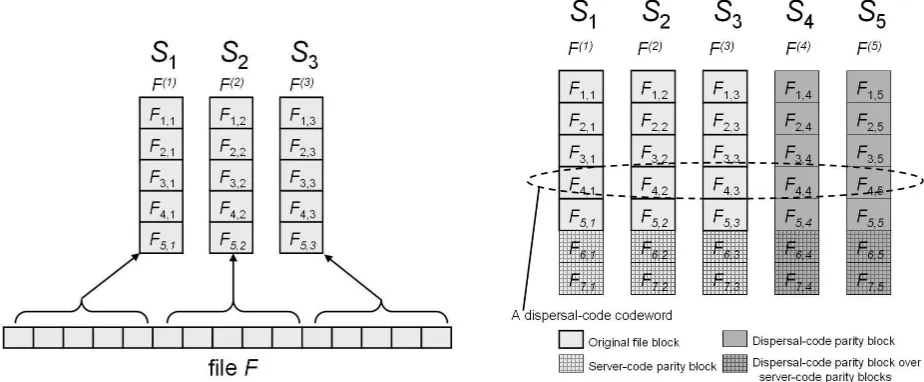
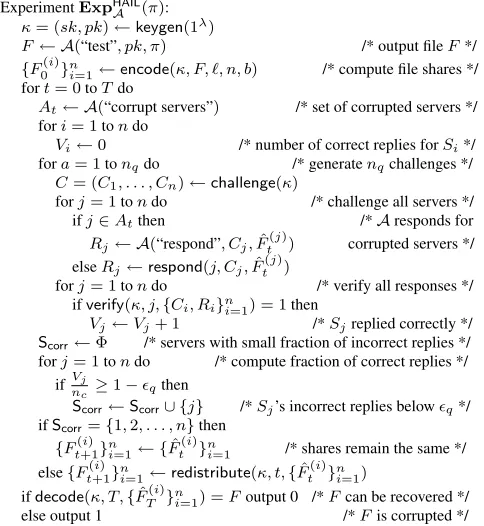
Figure 1. Encoding of fileF: on the left, original file represented as a matrix; on the right, encoded file with parity blocks added for both the server and dispersal codes.
of the blocks in any positioni. At that point, majority de-coding will fail. The adversary can do this inT =dn/(2b)e
epochs.
Because the client can feasibly check only a small frac-tion of the file, the probability that it will detect temporary inconsistencies introduced by the adversary’s corruptions is low. Thus, the adversary can escape detection and renderF
unretrievable with high probability inT epochs.
Replication system with POR. To achieve better resi-lence against a creeping-corruption attack, we might em-ploy a POR system (e.g., [24, 36, 6]) on each of the n
servers. In a single-server POR system, F is encoded un-der an error-correcting code (or erasure code) that we refer to in HAIL as the server code. The server code renders each copy of F robust against a fraction ²c of corrupted file blocks, protecting against the single-block corruptions of our previous approach. (Here²c is the error rate of the server code.)
There are then two options to check the integrity ofF. One is to use the single-server POR approach of embedding integrity checks within each server’s copy ofF. This ap-proach, however, imposes high storage overhead: It does not take advantage of cross-server redundancy.
An alternative approach is to perform integrity checks by comparing block values in a given positionj using cross-server redundancy as in our previous construction. With this approach, the system is still vulnerable to a creeping-corruption attack, but much less than in the previous con-struction. Suppose that the POR can detect inconsistencies across the servers in any ²d fraction of blocks of F with
high probability, i.e., the adversary can escape detection by modifying at most²dblocks in corrupted servers.
Assuming that the client performs majority decoding to replace faulty servers whenever it detects corruption, this approach will ensure the integrity ofFwith high probability for T = dn/(2b)e ×(²c/²d)epochs—improving over the previous approach by a factor of²c/²d.
Dispersal code with POR. We can improve the storage overhead of the previous approach with a more intelligent approach to creating file redundancy across servers. Rather than replicatingF across servers, we can instead distribute it using an error-correcting (or erasure) code. We refer to this code in HAIL as thedispersal code. In HAIL, each file block is individually distributed across thenservers under the dispersal code.
Let(n, `)be the parameters of the dispersal code. We assume for convenience that this code is systematic, i.e., that it preserves ` message blocks in their original form. Then`is the number ofprimary servers, those servers that store fragments of the original fileF. The remainingn− `aresecondary servers, or redundant servers, i.e., servers that maintain additional redundancy/parity blocks and help recover from failure.
A graphical representation of dispersal encoding is given in Figure 1. Before transforming the file F into a dis-tributed, encoded representation, we partition it into` dis-tinct segmentsF(1), . . . , F(`)and distribute these segments
under the server code with error rate²c. The effect of the server code is to extend the “columns” of the encoded ma-trix by adding parity blocks. Next, we apply the dispersal code to create the parity blocks that reside on the secondary servers. It extends the “rows” of the encoded matrix across the full set ofnserversS1, . . . , Sn.
With this scheme, it is possible to use cross-server re-dundancy to check the integrity ofF. The client / verifier simply checks that the blocks in a given position, i.e., “row,” constitute a valid codeword in the dispersal code.
By means of the dispersal code, we reduce the over-all storage cost of our previous construction fromn|F|to
(n/`)|F|.
Use of a dispersal code does reduce the number of epochs T over which it is possible to ensure the integrity of F with high probability. This is because the adversary can now corrupt a given “row” / codeword merely by cor-rupting at least(d−1)/2blocks, wheredis the minimum distance of the dispersal code. (For an (n,`)-Reed-Solomon dispersal code, for instance, d =n−`+ 1.) In our next construction, however, we show how to reduce vulnerabil-ity to creeping-corruption attacks considerably using cryp-tographic integrity checks. This improvement greatly ex-tends the integrity lifetimeTof the fileF.
Remark. The three simple constructions we have shown thus far have the attractive property of beingpublicly veri-fiable. It may be thatF is encrypted and that server code is cryptographically keyed (for reasons we explain below). Thus only the client that storedF can retrieve it. But it is still possible for anyentity to perform an integrity check on F. Integrity checks only involve verification of block consistency across servers, and therefore don’t require any secret keys. In our next construction, we sacrifice public verifiability in favor of a much longer lifetimeTof integrity assurance forF.
Embedding MACs into dispersal code. We now show how to address the problem of creeping-corruption attacks. Our solution is to authenticate matrix rows with a message-authentication code (MAC), computed with a secret key known by the client. A simple approach is to attach a MAC to each file block on each server. We achieve a solution with lower storage overhead, however.
Our key insight (inspired by ideas of Schwartz and Miller [35]) is to embed MACs in the parity blocks of the disper-sal code. As we show, both MACs and parity blocks can be based on a universal hash function. Consequently, it is possible to create a block that is simultaneouslybotha MAC and a parity block. One of our main contributions is a construction based on this idea that we call an integrity-protected error-correcting code (IP-ECC). By inserting MACs into each row of the encoded matrix, we are able to
effectively verify the responses received from servers. This mechanism protects against creeping-corruption attacks be-cause it does not just check that rows are self-consistent as in the simpler approaches described above. Instead, with MACs, it is possible to ensure that rowsdo not differ from their original values inF.
Aggregating responses. While the client could check in-dividual blocks in the encoded file, a more efficient ap-proach is to check multiple blocks of the file simultane-ously. Another contribution of our paper is to provide a mechanism to aggregate MACs across multiple blocks. The client can specify multiple positions in the file, and verify their correctness via a single, composite response from each server. (For extra bandwidth savings, the client can specify positions implicitly using a pseudorandom seed.)
We propose to use a linear code in HAIL called the aggregation code for combining servers’ responses in a challenge-response protocol. The aggregate response is a linear combination of rows of the encoded file matrix, and is a codeword (or sufficiently close to a codeword) in the dispersal code. However, we need to ensure that by aggre-gating MAC values on individual blocks, we obtain a valid MAC. We define the notion of composite MACthat, intu-itively, guarantees that a MAC on a vector of block can not be obtained unless all the MACs of individual vector com-ponents are known.
Note that the aggregation code in HAILcarries zero stor-age overhead: It is computed on the fly.
We describe the full HAIL system in detail in Section 6, after defining the adversarial model in Section 4 and the cryptographic building blocks in Section 5.
4 Adversarial Model
We model HAIL as a set ofnservers, S1, S2, . . . , Sn, and a trusted, external entityT. We assume authenticated, private channels betweenT and each server. In practiceT
may be a client or an external auditor. We assume known upper bounds on message delivery times in the network.
We consider an adversaryAthat ismobile, i.e., can cor-rupt a different set ofbservers in each epoch, and is Byzan-tine, i.e., can behave arbitrarily. Obviously, meaningful file availability is not possible against a fully Byzantine adver-sary that controlsallservers. Consequently, we assume that our adversary controlsat mostbservers in any given epoch. The adversary can of course move to a different set of cor-rupted servers in each epoch.
At the beginning of each epoch,Amay choose a fresh set ofbservers and arbitrarily corrupt both their code bases and storage systems. At the end of an epoch, however, we assume that the code base of every server is restored to a correct state. From a theoretical perspective, this restoration models the limitation of the adversary tobservers. From a practical perspective, code-base restoration might reflect a malware-detection pass, software re-installation, invoca-tion of a fresh virtual machine image, etc. Even when the code base of a server is restored, however, the adversary’s corruptions to the server’s storage system, i.e., storage file segment, remain.
Repair of servers’ storage systems only happens when a client reactively invokes theredistribute function—an ex-pensive and generally rare event. Thus, while the adversary controls onlybservers, it is possible for more thanbservers to contain corrupted data in a given epoch. The aim of the client in HAIL is to detect and repair corruptions before they render a fileF unavailable.
A time step or epoch in HAIL thus consists of three phases:
1. Acorruptionphase: The adversaryAchooses a set of up tobservers to corrupt (wherebis a security param-eter).
2. A challengephase: The trusted entity T challenges some or all of the servers.
3. A remediationphase: IfT detects any corruptions in the challenge phase, it may modify / restore servers’ file shares.
LetFdenote the file distributed byT. We letFt(i)denote the file share held by serverSiat the beginning of epocht, i.e., prior to the corruption phase, and letFˆt(i)denote the file share held bySiafter the corruption phase.
4.1
HAIL: Formal preliminaries
In our formal adversarial model, we let a system HAIL consist of the following functions:
• keygen(1λ) → κ: The function keygengenerates a key
κ= (sk, pk)of size security parameterλ. (For symmetric-key systems,pkmay be null.)
•encode(κ, F, `, n, b)→ {F0(i)}n
i=1: The functionencode
encodesF as a set of file segments, whereF0(i)is the seg-ment designated for serveri. The encoding is designed to provide `-out-of-n redundancy across servers and to pro-vide resilience against an adversary that can corrupt at most
bservers in any time step.
• decode(κ, t,{Fˆt(i)}ni=1) → F: The function decode
re-covers the original fileFat timetfrom a set of file segments stored at different servers.
•challenge(κ)→ {Ci}ni=1: The functionchallenge
gener-ates a challenge valueCifor each serveri.
•respond(i, Ci,Fˆt(i))→Ri: The functionrespond gener-ates responseRifrom the file fragmentFˆt(i)stored at server
iat timetto challengeCi.
• verify(κ, j,{Ci, Ri}in=1) → {0,1}. The functionverify
checks whether the response of server j is valid, using the responses of all servers R1, . . . , Rn to challenge set
C1, . . . , Cn. It outputs a ‘1’ bit if verification succeeds, and ‘0’ otherwise. We assume for simplicity thatverifyis sound, i.e., returns1for any correct response.
• redistribute(κ, t,{Fˆt(i)}ni=1) → {F (i)
t+1}ni=1∪ ⊥: The
functionredistributeis an interactive protocol that replaces the fragmentFˆt(i) stored at serveriwith Ft(+1i). It imple-ments a recreation and distribution of corrupted file seg-ments, and outputs ⊥if the file can not be reconstructed. We leave the definition ofredistributeas general as possi-ble. The function may involve the client reconstructing seg-ments from all servers, decodingF, and reinvokingencode.
4.2
Security model: Formalization
The adversaryAis assumed to be stateful and have ac-cess to oracles encode and verify; we assume that A re-spects the bound b on the number of permitted corrup-tions in a given epoch. Denote byπthe system parameters
(`, n, b, T, ²q, nq).
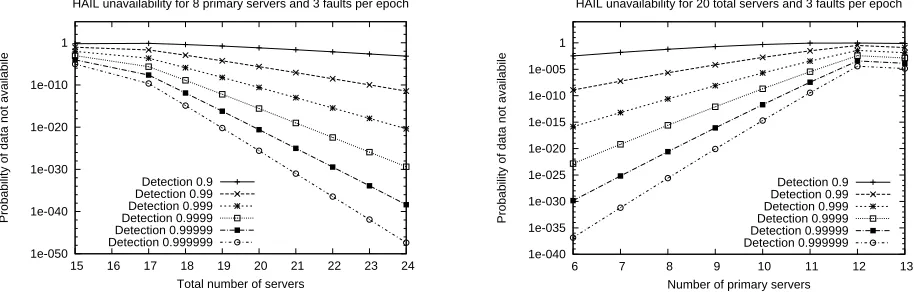
Aparticipates in the two-phase experiment in Figure 2. In the test phase, A outputs a file F, which is encoded and distributed to servers. The second phase is a challenge phase that runs forT time intervals. In each time interval,
Ais allowed to corrupt the code base and storage system of at mostbout of thenservers. Each server is challenged
nq times in each interval, andAresponds to the challenges sent to the corrupted servers. If more than a fraction²q of a server’s responses are incorrect, theredistributealgorithm is invoked.
After the experiment runs forT time intervals, a decod-ing of the file is attempted and the experiment outputs 1 if the file can not be correctly recovered. We define theHAIL -advantage ofAas: AdvHAILA (π) = Pr[ExpHAILA (π) = 1]. We denote byAdvHAIL(π, q1, q2, t)the maximum advantage of all adversaries makingq1 queries toencode,q2 queries toverify, and running in time at mostt.
Remark. In the POR security definition, by analogy with zero-knowledge proofs, the same interface used for challenge-response interactions between the client and server is also available for file extraction. In the POR model, the (single) server is permanently controlled by the adversary. In contrast, in HAIL only at mostbout of then
con-ExperimentExpHAIL
A (π):
κ= (sk, pk)←keygen(1λ)
F← A(“test”, pk, π) /* output fileF*/ {F0(i)}ni=1←encode(κ, F, `, n, b) /* compute file shares */
fort= 0toTdo
At← A(“corrupt servers”) /* set of corrupted servers */
fori= 1tondo
Vi←0 /* number of correct replies forSi*/
fora= 1tonqdo /* generatenqchallenges */
C= (C1, . . . , Cn)←challenge(κ)
forj= 1tondo /* challenge all servers */ ifj∈Atthen /*Aresponds for
Rj← A(“respond”, Cj,Fˆt(j)) corrupted servers */
elseRj←respond(j, Cj,Fˆt(j))
forj= 1tondo /* verify all responses */ ifverify(κ, j,{Ci, Ri}ni=1) = 1then
Vj←Vj+ 1 /*Sjreplied correctly */ Scorr←Φ /* servers with small fraction of incorrect replies */
forj= 1tondo /* compute fraction of correct replies */ if Vj
nc ≥1−²qthen
Scorr←Scorr∪ {j} /*Sj’s incorrect replies below²q*/
ifScorr={1,2, . . . , n}then
{Ft(+1i)}n i=1← {Fˆ
(i)
t }ni=1 /* shares remain the same */
else{Ft(+1i)}n
i=1←redistribute(κ, t,{Fˆ (i)
t }ni=1)
ifdecode(κ, T,{FˆT(i)}ni=1) =Foutput 0 /*Fcan be recovered */
else output 1 /*Fis corrupted */
Figure 2. HAIL security experiment.
struct a stronger security model for HAIL in which the file could be extracted through the challenge-response protocol if decoding fails. However, the stronger model might only benefit extraction of file fragments for thosebservers cor-rupted by an adversary in an epoch (the othern−bservers have a correct code base). We do not investigate this model further in the paper due to its complexity.
5 Building Blocks
5.1
UHFs and Reed-Solomon codes
LetIdenote a field with operations(+,×). For exam-ple, in our prototype implementation, we work withGF[2α] forα= 256.
A UHF [9] is an algebraic functionh:K ×I`→Ithat compresses a message or file elementm ∈ I`into a com-pact digest or “hash” based on a keyκ∈ K. We denote the output ofhashκ(m). A UHF has the property that given two inputsx6=y, with overwhelming probability over keys
κ, it is the case thathκ(x) 6= hκ(y). In other words, a UHF is collision-resistant when the message pair(x, y)is selected independently of the keyκ. A related notion is that of almost exclusive-or universal (AXU) hash functions that have the property that given three input messages, the prob-ability that the XOR of the hashes of the first two inputs matches the third input is small. Formally:
Definition 1 his an²-universal hash function family if for anyx6=y∈I`:P r
κ←K[hκ(x) =hκ(y)]≤².
his an²-AXU family if for anyx6=y ∈I`, and for any
z∈I:P rκ←K[hκ(x)⊕hκ(y) =z]≤².
Many common UHFs are also linear, meaning that for any message pair (m1, m2), it is the case thathκ(m1) +
hκ(m2) =hκ(m1+m2). In fact, it is possible to construct a UHF based on a linear error-correcting code (ECC). An
(n, `, d)ECC encodes messages of length`into codewords of sizensuch that the minimum distance between any two codewords isd. An(n, `, d)code can correct up tod−1
errors andbd−1
2 cerasures.
For example, as we assume for convenience in our work here, a UHF may be based on a (n, `, d = n−`+ 1) -Reed-Solomon code overI. Letm~ = (m1, m2, . . . , m`), wheremi ∈I.m~ may be viewed in terms of a polynomial representation of the formpm~(x) =m`x`−1+m`−1x`−2+ . . .+m1. A Reed-Solomon code, then, may be defined in terms of a fixed vector~a= (a1, . . . , an). The codeword of a messagem~ is the evaluation of polynomialpm~ at points (a1, . . . , an):(pm~(a1), pm~(a2), . . . , pm~(an)).
A UHF of interest, then, is simplyhκ(m) =pm~(κ)with key spaceK = I. It is well known that this construction, which we refer to asRS-UHF(but is typically referred as the polynomial evaluationUHF), is indeed a good UHF [38]:
Fact 1 RS-UHF is a `−1
2α -universal hash family (and, as such, a `−1
2α -AXU family).
5.2
MACs obtained from UHFs
A UHF, however, is not a cryptographically secure prim-itive. That is, it is not generally collision-resistant against an adversary that can choose messages after selection ofκ. Given a digest y = hκ(m), an adversary may be able to construct a new messagem0such thath
κ(m0) =y. Thus a UHF is not in general a securemessage-authentication code (MAC). A MAC is formally defined as follows:
Definition 2 A Message Authentication Code (MAC) MA= (MGen,MTag,MVer)is given by three algorithms:
κ←MGen(1λ)generates a secret key given a security pa-rameter;τ ←MTagκ(m)computes a MAC on a message
m with keyκ; andMVerκ(m, τ)outputs 1 if τ is a valid MAC on m, and 0 otherwise. Consider an adversary A
with access to theMTagandMVeroracles, whose goal is to output a valid MAC on a message not queried toMTag. We define:
AdvufMA-mac(A) = Pr[κ ← MGen(1λ); (m, τ) ←
AMTagκ(·),MVerκ(·,·) : MVer
κ(m, τ) = 1 ∧
We denote byAdvufMA-mac(q1, q2, t)the maximum advan-tage of all adversaries making q1 queries to MTag, q2
queries toMVerand running in time at mostt.
It is well known that a MAC may be constructed as the straightforward composition of a UHF with a pseudoran-dom function (PRF) [39, 25, 34, 38]. A PRF is a keyed family of functionsg:KPRF×D→Rthat maps messages
from domainDto rangeRsuch that, intuitively, a random function from the PRF family is indistinguishable from a true random function fromDtoR.
More formally, consider an adversary algorithmAthat participates in two experiments: one in which she has ac-cess to a function chosen randomly from familygand the second in which she has access to a random function from
DtoR. The goal of the adversary is to distinguish the two worlds: she outputs 1 if she believes the oracle is a function from the PRF family, and 0 otherwise.
We define the prf-advantage of A for family g as Advprfg (A) = |Pr[κ ← KPRF : Agκ(·) = 1]−Pr[f ←
FD→R :Af(·) = 1]|, whereFD→Ris the set of all
func-tions fromDtoR. We denote byAdvprfg (q, t)the maximum prf-advantage of an adversary makingqqueries to its oracle and running in timet.
Given a UHF family h : KUHF × I` → I and a
PRF family g : KPRF× L → I, we construct the MAC UMAC = (UGen,UTag,UVer)such as: UGen(1λ) gener-ates key(κ, κ0)uniformly at random fromK
UHF× KPRF; UTag : KUHF × KPRF ×I` → L ×I is defined as UTagκ,κ0(m) = (r, hκ(m) + gκ0(r)); UVer : KUHF × KPRF×I`× L ×Iis defined asUVerκ,κ0(m,(c1, c2)) = 1
if and only ifhκ(m) +gκ0(c1) =c2. The tagging algorithm
of UMACoutputs, in addition to the composition of UHF and PRF, a unique counterr∈ Lthat is incremented by the algorithm at each invocation. Thus, the MAC algorithm is stateful and its properties are as follows [38].
Fact 2 Assume thathis an²UHF-AXU family of hash
func-tions andgis a PRF family. ThenUMACis a stateful MAC with advantage:AdvufUMAC-mac(q1, q2, t)≤Advprfg (q1+q2, t) +
²UHFq2.
Remark. For the composition of a UHF and PRF to be a MAC, it is important that the nonces used as input into the PRF beunique. One possible implementation that we have adopted in our definition above, described by Shoup [38], is to make the MAC algorithm stateful and use a counter incremented at each operation as the nonce into the PRF. In our HAIL implementation, we choose to use as the nonce input to the PRF a hash of the file name and the block offset in the file, instead of a strictly monotonic counter.
5.3
Aggregating MACs
In our HAIL protocol, we need to aggregate or compose MACs on individual file blocks into a MAC on a vector of blocks. We show in this section how we can generically compose tags computed with the same MAC algorithm. The definition of composite MAC here applies to any MAC that outputs tags in a field, not just theUMACconstruction. Let MTag : K ×J → N be the tagging algorithm of a MAC MA = (MGen,MTag,MVer)defined on mes-sages from field J that outputs tags in a field N. Let
~
M = (m1, . . . , mv) ∈ Jv be a vector of messages and let A~ = (α1, . . . , αv) ∈ Jv be a vector of scalar val-ues with αi 6= 0. We defineτ =
Pv
i=1αiMTagκ(mi) as the composite MAC ofM~ for coefficientsα1, . . . , αv. If τ is a valid composite MAC of {mi}vi=1 for
coeffi-cients{αi}vi=1, the composite MAC verification algorithm
CMVerκ({mi, αi}vi=1, τ)outputs 1.
Consider an adversary that has access to MTag and CMVeroracles. Intuitively, acomposite MAChas the prop-erty that the adversary can generate a vector of messages and a composite MAC with small probability if it does not query theMTagoracle forallcomponent messages of the vector.
We give a formal definition of composite MACs below, the first in the literature to the best of our knowledge.
Definition 3 LetMA = (MGen,MTag,MVer)be a MAC algorithm andCMVerthe composite MAC verification al-gorithm defined above. Consider an adversaryAwith ac-cess toMTagandCMVeroracles whose goal is to output a set of messagesm1, . . . , mv, a set of coefficientsα1, . . . , αv and a composite MACτ. We define:
AdvcMA-mac(A) = Pr[κ ← MGen(1λ); ({m
i, αi}vi=1, τ) ← AMTagκ(·),CMVerκ(·,·):CMVerκ({mi, αi}v
i=1, τ) = 1∧∃i∈
[1, v]for whichmiwas not queried toMTagκ(·)].
We denote by AdvcMA-mac(q1, q2, t)the maximum success probability of all adversaries makingq1 queries toMTag,
q2queries toCMVerand running in timet.
Lemma 1 Given a MACMAon field J, MAextended to
Jvas above is a composite MAC with advantage:
AdvcMA-mac(q1, q2, t)≤vAdvMAuf-mac(q1+vq2+v−1,0,(v+ 1)t).
Proof: Assume that there exists an adversary Afor the composite MAC that makesq1queries to the tagging oracle,
q2 queries to the composite MAC verification oracle and runs in timet.
We build an adversaryA0that targets the MACMA. A0
runs A. For any query thatA makes to the tagging ora-cle, A0 returns the output of its own tagging oracle. For
any query ({mi, αi}vi=1, τ)that A makes to the
times, once for eachmi, i= [1, v], and outputs 1 if and only if the linear relationτ =Pvi=1αiMTagκ(mi)is verified.
Assume thatAoutputs a set of messages(m∗
1, . . . , m∗v), a set of coefficients (α∗
1, . . . , α∗v), and a valid compos-ite MAC τ∗, such that there exists i ∈ [1, v] for
which mi was not queried to MTagκ(·). Then, A0 guesses i (with probability 1
v), queries the tagging or-acle for m∗
1, m∗i−1, mi∗+1, . . . , m∗v and then outputs m∗i and its MAC computed asMTagκ(m∗i) = (α∗i)−1(τ∗ − P
j6=iα∗jMTagκ(m∗j)).
A0makesq1+vq2+ (v−1)queries to the MAC oracle
and no queries to the verification oracle. Its running time is less thanv+ 1times the running time ofA. The lemma follows.
Sometimes we do not have access to all messages
{mi}vi=1 to check a composite MAC. We define a linear
composite MAC algorithmto be such that a composite MAC can be verified from a linear combination of messages:
~
m=Pvi=1αimi.
Definition 4 A composite MAC algorithm is lin-ear if there exists an algorithm CMVer-Lin such that CMVerκ({mi, αi}vi=1, τ) = 1 if and only if
CMVer-Linκ( Pv
i=1αimi, τ) = 1.
Lemma 2 If the nonce valuesri input to the PRF in the UMACconstruction are known, the composite MAC defined fromUMACis linear.
Proof: Assume that nonces ri input to the PRF in the UMACconstruction are known. Then we can simply view the UTag algorithm in the UMAC construction as out-putting:UTagκ,κ0(m~) =RS-UHFκ(m~) +gκ0(ri).
Let m1, . . . , ~~ mv be messages in I`, α1, . . . , αv scalar values inI, andm~ = Pvi=1αim~i ∈ I`. We denotemij thej-th block inm~i.
For a tagτ, we define algorithmCMVer-Linκ,κ0(m, τ~ ) =
1if and only ifRS-UHFκ(m~) + Pv
i=1αigκ0(ri) =τ.
We can infer that for theUMACconstruction:
CMVerκ,κ0({mi, αi}vi=1, τ) = 1⇔
v X
i=1
αiUTagκ,κ0(m~i) =τ ⇔
v X
i=1
αi[RS-UHFκ(m~i) +gκ0(ri)] =τ ⇔
v X
i=1 αi[
` X
j=1
mijκj−1] + v X
i=1
αigκ0(ri) =τ ⇔
` X
j=1
( v X
i=1
αimij)κj−1+ v X
i=1
αigκ0(ri) =τ ⇔
RS-UHFκ( v X
i=1
αim~i) + v X
i=1
αigκ0(ri) =τ ⇔
CMVer-Linκ,κ0(m, τ~ ) = 1
5.4
An
integrity-protected
error-correcting code (
IP-
ECC)
Typically, a MAC is appended to a message. Our goal in this section is to define a cryptographic primitive that acts both as a MAC and an error-correcting code. Moreover, we leverage the redundancy added by the error-correcting code for constructing the MAC. Such a primitive proves to be important in our distributed HAIL protocol. It allows efficient checking of server response in our POR protocol.
Definition 5 For n ≥ `, we define an(n, `, d) -integrity-protected error-correcting code(denotedIP-ECC) as a tu-ple of algorithmsIC= (KGenECC,MTagECC,MVerECC)
such that:
- KGenECC(1λ)selects a random keyκfrom key space
K;
- MTagECC:K ×I` →Intakes as input a secret key
κand a message min I`, and outputs an integrity-protected codewordcin spaceIn that acts as an en-coding ofm, and contains an integrity tag form.
- MVerECC:K ×In→({I`∪ ⊥},{0,1})takes as in-put a secret keyκand an integrity-protected codeword
cinInand outputs a messagem∈I`(or⊥upon de-coding failure), as well as a one-bit with value 1 ifc
contains a valid integrity tag onm, and 0 otherwise.
Consider an adversary A with access to the MTagECCκ(·)and MVerECCκ(·) oracles, whose goal is to output a codewordcsuch thatMVerECCκ(c) = (m,1) andmwas not queried toMTagECCκ(·). We define: AdvufIC-ecc(A) = Pr[κ ← KGenECC(1λ);c ←
AMTagECCκ(·),MVerECCκ(·) : MVerECCκ(c) = (m,1) ∧
mnot queried toMTagECCκ(·)].
We denote by Advuf-ecc
IC (q1, q2, t)the maximum
advan-tage of all adversaries makingq1queries toMTagECC,q2
queries toMVerECCand running in time at mostt.
We give now a construction of anIP-ECCcode based on a (n, `, n−`+ 1)Reed-Solomon code, calledECCd.
Intuitively, to tag a message, we encode it under the R-S code, and then apply a PRF to the lastscode symbols (for
a MAC on each of thosescode symbols using theUMAC construction. A codeword is considered valid if at least one of its lastssymbols are valid MACs under UMACon its decodingm.
More specifically, theIP-ECC(n, `, d)code construc-tion is defined as (using notaconstruc-tion from Secconstruc-tions 5.1 and 5.2):
- KGenECC(1λ) selects keys ~κ =
{{κi}ni=1,{κ0i}ni=n−s+1} at random from space K = In × (KPRF)s. The security parameter λ specifies the size ofI, as well as the length of the keys inKPRF. The keys {κi}ni=1 define a Reed-Solomon
code as described in Section 5.1 (they define the points at which polynomials are evaluated when constructing a codeword). The keys{κ0
i}ni=n−s+1are used as PRF
keys in theUMACconstruction.
- MTagECCκ(m1, . . . , m`)outputs(c1, . . . , cn), where
ci = RS-UHFκi(m~), i = [1, n − s] and ci = UTagκi,κ0
i(m1, . . . , m`) = (ri,RS-UHFκi(m~) +
gκ0
i(ri)), i= [n−s+ 1, n]. We definedto be the min-imum (Hamming) distance between two codewords output byMTagECC.
- MVerECCκ(c1, . . . , cn) first strips off the PRF from
cn−s+1, . . . , cnas:c0i=ci−gκ0
i(ri), i= [n−s+1, n], and then decodes (c1, . . . , cn−s, cn0−s+1, . . . , c0n) us-ing the decodus-ing algorithm of Reed-Solomon codes to obtain messagem~ = (m1, . . . , m`). If the decoding algorithm of the R-S code defined by points{κi}ni=1
fails, then theMVerECCalgorithm outputs(⊥,0)(we assume that the decoding algorithm of R-S codes fails if the number of corruptions in a codeword is beyond
bd−21c). If one of the lastssymbols of(c1, . . . , cn)is a valid MAC onm~ underUMAC, theMVerECC algo-rithm outputs(m,~ 1); otherwise it outputs(m,~ 0).
Error resilience of ECCd. The MVerECC algorithm in
the above construction needs at least one correct MAC block in order to decode and verify the message correctly. This implies that, even if the minimum distance of the un-derlying code is d = n−` + 1, the construction is re-silient to at most E−1 erasures, and bE−1
2 cerrors, for E= min(d, s).
Lemma 3 IfRS-UHFis constructed from a(n, `, n−`+ 1)-Reed-Solomon code and g is a PRF family, then the IP-ECC code ECCd defined above has the following
ad-vantage:
Advuf-ecc
ECCd(q1, q2, t)≤2
£
Advuf-mac
UMAC(q1, q2, t) ¤
.
Proof:
LetAbe a successful adversary algorithm for codeECCd
that makesq1 queries to the tagging oracleMTagECC,q2
queries to the verification oracleMVerECCand runs in time
t. It outputs a codeword(c1, . . . , cn)that decodes to mes-sagem~ = (m1, . . . , m`)such that at least one of the lasts symbols in the codeword is a valid MAC on m~ computed with algorithmUMACdefined in Section 5.2.
We build an adversaryA0 for theUMAC construction. A0 is given access to a tagging oracle UTag
κ,κ0(·) and a
verification oracleUVerκ,κ0(·,·)and needs to output a new
message and tag pair.
A0chooses a positionj∈[n−s+ 1, n]at random, and
generates keys{κi}ni=1and{κ0i}ni=n−s+1fori6=j.A0runs A.
WhenAmakes a query to taggingm~ = (m1, . . . , m`),
A0 computesc
i ← RS-UHFκi(m~)fori = [1, n−s], and
ci =UTagκi,κ0i(m~)fori = [n−s+ 1, n], i6=j. A
0calls
the UTagoracle to computecj = UTagκ,κ0(m~). A0 then
responds toAwith~c←(c1, . . . , cn).
WhenAmakes a query~c= (c1, . . . , cn)to the verifica-tion oracle,A0tries to decode(c1, . . . , c
j−1, cj+1, . . . , cn) into message m~. If decoding fails (there are more than
bE−1
2 cerrors in the codeword), thenA0responds toAwith
(⊥,0). Otherwise, letm~ be the decoded message.A0makes
a query to the verification oraclea←UVerκ,κ0(m, c~ j)and
returns(m, a~ )toA.
Assume thatAoutputs an encoding~c= (c1, . . . , cn) un-derECCdthat can be decoded tom~, such thatm~ was not an
input to the tagging oracle and at least one of the lasts sym-bols in~cis a valid MAC form~. ThenA0 outputs(m, c~
j). Since the codeword~ccan be decoded, at least a majority of its parity blocks are correct. Then, with probability at least
1/2,cjis a correct MAC onm~. It follows thatA0succeeds in outputting a correct message and MAC pair(m, c~ j)with probability at least half the success probability ofA.
Aggregating MACs forIP-ECCcodes. The techniques we developed in Section 5.3 for aggregating MACs, i.e., for composite MAC verification, apply in a natural way to IP-ECC codes. Consider the linear combination of IP-ECC codewords ~c1, . . . , ~cv as a composite codeword
~c=Pvi=1αi~ci. Implicit in~care composite MACs, i.e., lin-ear combinations of MACs from the individual, contribut-ing codewords. So we can apply MVerECC directly to~c, thereby verifying the correctness of~c1, . . . , ~cv.
de-gree`−1 evaluated on each of the points of~a: CRS =
{(f(a1), . . . , f(an))|deg(f) ≤`−1}. A systematic code is one in which a message is mapped to a codeword whose first`symbols match the message (given a message m~ = (m1, . . . , m`), a polynomialf of degree `−1 for which
f(ai) =mi, i= [1, `]can be determined by solving a lin-ear system).
TheIP-ECCconstruction can be adapted for systematic Reed-Solomon codes as follows: we encode a message un-der a systematic code, and then apply the PRF only to the parity blocks. Our results in Lemma 3 still hold for this sys-tematic encoding fors=n−`. We employ this systematic code that can recover fromn−`−1erasures andbn−`−1
2 c
errors in our HAIL protocols.
5.5
Adversarial codes
Adversarial ECCs [6, 24] are codes resistant to a large fraction of adversarial corruptions. While a standard ECC is designed to provide information-theoretic properties, an adversarial ECC uses cryptography to achieve otherwise in-efficient (or impossible) levels of resilience against a com-putationally bounded adversary. Lipton [27] first proposed a model of computationally bounded channels for error-correcting codes. Subsequent papers (e.g., [19, 29]) have proposed specific constructions and analyzed their error re-silience asymptotically with respect to the code rate. Ostro-vsky et al. [32] construct locally decodable codes against computationally bounded noisy channels. In our work, we use cryptography to construct more practical error-correcting codes within classical error-error-correcting bounds.
An(n, `, d)-error-correcting code corrects up tobd−1 2 c
errors, and thus it supports a fraction of d−1
2n adversarial corruption. But it is challenging to construct efficiently computable codes with large message sizes and strong er-ror tolerance against an adversary. A standard technique for building ECCs with large message sizes isstriping, an ap-proach that encodes consecutive message chunks and then interleaves them to achieve heightened protection against, e.g., burst errors. But striping doesn’t offer heightened pro-tection against adversarial corruption: An adversary that knows the stripe structure can work around it. And while several classes of very efficient XOR erasure codes (e.g., Tornado, LT, Fountain and Raptor codes) tolerate a large fraction of randomly distributed errors, their behavior to ad-versarial corruptions is not understood.
BJO [6] define adversarial codes formally and give the first systematic construction based on cryptographically protected, striped Reed-Solomon codes. In their construc-tion, the file is permuted first with a secret key and then divided into stripes. Parity blocks are computed for each stripe and appended to the unmodified file. To hide stripe boundaries, parity blocks are encrypted and permuted with
another secret key. The encoding of the file consists of the original file followed by the permuted and encrypted parity blocks, and is systematic. The same construction (without rigorous formalization, though) has been proposed indepen-dently by Curtmola et al. [11]. We employ this construction for the server code in the HAIL protocol.
BJO define an adversarial ECC as follows. An(n, `, d) -adversarial error-correcting codeAECCconsists of a pub-lic key space KP K, private key space KSK, an alphabet Σ, and a triple of functions: (1) a probabilistic function KGenECC(1λ) → (pk, sk) ∈ K
P K × KSK; (2) a func-tionEncode:KP K× KSK×Σ`→Σn; and (3) a function Decode:KP K × KSK×Σn → {Σ`∪ ⊥}.
WhileEncodeandDecodemay be deterministic or prob-abilistic, we assume for our purposes that they are determin-istic. Asecret-keyECC is one in whichKP K =φ. We shall consider only secret-key ECCs here.
Consider an adversaryAwith access to theEncodeand Decodeoracles, whose goal is to output a pair of codewords at small Hamming distance that decode to different mes-sages. We define the advantage ofAas:
Definition 6 Let AdvA,AECC(ρ, δ) = Pr[κ ← KGenECC(1λ); (c, c0) ← ADecodeκ(·),Encodeκ(·) : Decodeκ(c) 6= Decodeκ(c0) ∧ Decodeκ(c0) 6=⊥] − δ, whereAoutputs(c, c0) ∈(Σn,Σn)such that: (1)cis the output of an oracle callEncodeκ(·)(cis a valid codeword) and (2)|c−c0| ≤ρn.
The definition can be easily extended to erasure codes. It is easy to show that an (n, `, d)-ECC that is an(ρ, δ) -adversarial ECC withρ≤ d−1
2n , is also a(2ρ, δ)-adversarial erasure code.
6 HAIL: Protocol Specification
Using the technical building blocks defined in the previ-ous section, in this section we give full details on the HAIL protocol.
6.1
Key Generation
Let`be the number of primary servers, andnthe total number of servers. The client generates the following sets of keys:
• Dispersal-code keys: These are n−` pairs of keys
{κj, κ0j}j=[`+1,n], whereκj andκ0jare secret keys for the UHF and for the PRF in theUMACconstruction, respectively;
• Challenge / aggregation keys: These are keys used to generate challenges—and applied, of course, to seed inputs to the aggregation code for responses. These keys can be generated from a master secret key that the client stores locally.
6.2
Encoding Files
The encoding of files in our protocols has been depicted graphically in Figure 1. We aim at obtaining a distributed, systematic encoding Fd of a file F. First, we partition
F into ` distinct segments F(1), . . . , F(`) and distribute
these segments across the primary servers S1, . . . , S` re-spectively. This distributed cleartext representation of the file remains untouched by our subsequent encoding steps.
We then encode each segmentF(j)under the server code
(implemented with the adversarial erasure code construc-tion of BJO [6] described in Secconstruc-tion 5.5) to protect against small corruption at each server. The effect of the server code is to extend the “columns” ofFd by adding parity blocks. Next, we apply the dispersal code to create the parity blocks that reside on the secondary servers S`+1, . . . , Sn. It ex-tends the “rows” ofFdacross the full set ofnservers. (The dispersal code and server code commute, so we can swap these two encoding steps, if desired.) To embed the disper-sal code in a full-blownIP-ECC, we also add PRF values on the parity blocks for each row, i.e., on the blocks con-tained in secondary serversS`+1, . . . , Sn. Viewed another way, we “encrypt” columns`+1throughn, thereby turning them into cryptographic MAC values.
Finally, we compute a MAC over the full fileF, and store this MAC value on the server. This full-file MAC allows the client to confirm when it has successfully downloaded the fileF.
The steps ofencodeare detailed below:
1. [File partitioning] Partition the file into`segments and store segmentF(j) on serverj, forj = [1, `]. Denote by mF =|F|/`the number of symbols in each segment. We have thus obtained a (mF, `)matrix{Fij}i=[1,mF],j=[1,`] containing the original file blocks.
2. [Server code application] Encode each file seg-ment F(j) under the server systematic server code as
de-fined in Section 5.5 (viewed as an erasure code), and ob-tain a segment of mblocks at each server (where blocks
mF + 1, . . . , mare parity blocks for the server code). 3. [Dispersal code application] Apply the systematic dis-persal codeECCdas defined in Section 5.4 to the rows of
the encoded matrix obtained in step 2. We determine thus the segmentsF(`+1), . . . , F(n).
If we denote byFd ={Fijd}i=[1,m],j=[1,n] the encoded
representation ofF at the end of this step, thenFd ij =Fij (i.e., blockiinF(j)), fori= [1, m
F], j= [1, `].Fijdfori= [mF+1, m], j= [1, `]are the parity blocks under the server
code. The columns`+ 1, . . . , nare obtained through the application of theECCdconstruction to columns1, . . . , `as
follows:Fd
ij =RS-UHFκj(Fi1. . . Fi`) +gκ0j(τij), fori=
[1, m], j= [`+ 1, n].τijis a position index that depends on the file handle, as well as the block indexiand the server positionj, e.g., hash of the file name concatenated with i
andj.
4. [Whole-file MAC computation] Lastly, a crypto-graphic MAC of the file (and its handle) is computed and stored with the file.
The initial share at time 0 for each serverSj isF0(j) = {Fd
ij}i=[1,m].
6.3
Decoding Files
For decoding the encoded matrix, we proceed into two steps. First, we decode each row of the matrix and check the MACs embedded into the parity blocks of the dispersal code. If a row can not be correctly decoded or if none of the MACs in the parity blocks of a row verifies, then we mark all blocks in that row as erasures. In the second step, we apply the server code to each column and try to recover from the erasures in the first step. If the number of erasures exceeds the correction capability of the server code, then decoding fails.
Since the exact positions of erasures are known from the first level of decoding, the adversarial server code can be an erasure code. The dispersal code can be either an erasure code or an error-correcting code. However, each choice im-poses a different requirement on the maximum numberbof corrupted servers in an epoch. We present decoding algo-rithms for both cases.
The details of the algorithm to recover the original file from the encoded matrixFdare as follows:
1. Decode rows from the dispersal code. As discussed above, we consider two cases:
• If the dispersal code is an error-correcting code, then up to bn−`−1
2 c errors can be corrected in
each row. This choice imposes the requirement that the number of servers corrupted in each epoch be bounded byb≤ bn−`−1
2 c. (Otherwise,
the adversary could corrupt all rows in an epoch, obliteratingF).