Public-Key Encryption with Fuzzy Keyword
Search: A Provably Secure Scheme under
Keyword Guessing Attack
Peng Xu and Hai Jin,
Senior Member, IEEE
Abstract—A lot of interest has been drawn recently into key encryption with keyword search (PEKS), which keeps public-key encrypted documents amendable to secure public-keyword search. However, PEKS resist against public-keyword guessing attack by assuming that the size of the keyword space is beyond the polynomial level. But this assumption is ineffective in practice. PEKS are insecure under keyword guessing attack. As we observe, the key to defend such attack is to avoid the availability of the exact search trapdoor to adversaries. Accordingly, we compromise the exactness of search trapdoor by mapping at least two different keywords into a fuzzy search trapdoor. We propose a novel concept called public-key encryption with fuzzy keyword search (PEFKS), by which the un-trusted server only obtains the fuzzy search trapdoor instead of the exact search trapdoor, and define its semantic security under chosen keyword attack (SS-CKA) and indistinguishability of keywords under non-adaptively chosen keywords and keyword guessing attack (IK-NCK-KGA). For the keyword space with and without uniform distribution, we respectively present two universal transformations from anonymous identity-based encryption to PEFKS, and prove their SS-CKA and IK-NCK-KGA securities. To our knowledge, PEFKS is the first scheme to resist against keyword guessing attack on condition that the keyword space is not more than the polynomial level.
Index Terms—Public-key encryption with keyword search, keyword guessing attack, public-key encryption with fuzzy keyword search, anonymous identity-based encryption
F
1
I
NTRODUCTIONP
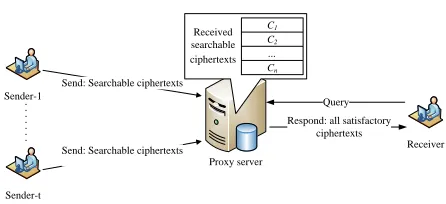
UBLIC-KEY encryption with keyword search (PEKS) [1] is the first keyword searchable encryp-tion based on a probabilistic public key system. It is more convenient to search ciphertexts for multiple users, compared with previous schemes based on a symmetric key system, such as [2, 3, 4, 5]. Figure 1 presents a classic scenario, in which t senders send searchable ciphertexts to the proxy server of the re-ceiver. When we employ PEKS in this scenario, all the senders produce searchable ciphertexts with the public key of the receiver. So PEKS does not need any coordination between the receiver and any sender when the sender first joins in, which is opposite to previous schemes [2, 3, 4, 5]. In addition, PEKS achieves semantic security under an adaptive chosen keyword attack (SS-CKA), which can not be achieved in previous schemes.So far, all of proposed PEKS schemes and their ex-pansions had proved their SS-CKA security. However under keyword guessing attack (KGA), their provable securities rely on an implicit assumption that the size of keyword space must be beyond the polyno-mial level. Therefore, any adversary with the limited computational ability fails to exhaustively search the
• P. Xu and H. Jin are with Services Computing Technology and System Lab, Cluster and Grid Computing Lab, School of Computer Science and Technology, Huazhong University of Science and Technology, Wuhan, 430074, China. E-Mail:{xupeng, hjin}@mail.hust.edu.cn.
Proxy server
Receiver C1
C2 ... Cn
Query Respond: all satisfactory
ciphertexts Sender-1
Sender-t
Send: Searchable ciphertexts
Send: Searchable ciphertexts Received searchable ciphertexts
Fig. 1. A classic scenario with searchable encryption
keyword space to guess the correct keyword in PEKS. Nevertheless, we confirm that the implicit assumption is obviously unreasonable:
• In practice, keywords are mostly semantical and indexable in any dictionary. Moreover, some key-words are used in high frequency, such as ‘Ur-gency’. Therefore keywords are non-uniformly employed. In addition, the keyword space should be carefully determined when establishing a cryptosystem [6], because for the keywords hav-ing the same meanhav-ing, like ‘urgent’ and ‘impera-tive’, a searcher needs different search trapdoors for the same meaning, and the time cost of search will be multiplied. Hence, when determining the keyword space, the basic rule is that its size should not be more than the polynomial level. • In theory, let we provide a counter example that
the size of keyword space is2k, andE
the keyword Ki has the probability E
Ki to be
used. We trivially have
2k
X
i=1
EKi= 1 (1)
Let P oly() denote any polynomial. If all key-words have EKi ≥ P oly−1(k), it obviously has
P2k
i=1EKi 1, which is contrary with Equation 1.
So just a part of keywords haveEKi ≥P oly−1(k).
Moreover, the number of this kind of keywords is not more thanP oly(k). In other words, the num-ber of keywords having a practical probability to be used is not more thanP oly(k), even if the keyword space is the exponential level.
On the practical condition that the size of keyword space is not more than the polynomial level, Byun et al. first proposed keyword guessing attack [7], and attacks a PEKS scheme and a PECKS scheme [8] successfully in 2006. On the same condition, Jeong et al. proved that any PEKS scheme satisfying at least computationally indistinguishable consistency implies successful KGA [9] necessarily. Moreover, since it is necessary to satisfy at least computationally indistinguishable consistency for any efficient PEKS, to defend KGA seems impossible on the practical condition.
1.1 The Motivation
Referring to PEKS, we notice that a search trapdoor of a keyword is necessary for an adversary to imple-ment KGA. Moreover, he can efficiently guesses this keyword when the size of the keyword space is not beyond polynomial level. Therefore, the key to defend KGA is to avoid to leak the the exact search trapdoor of any keyword.
We heuristically conceived an opposite scheme that is public-key encryption without keyword search (called O-PEKS). Obviously, no search trapdoor of any keyword is needed in O-PEKS scheme. Moreover, keywords encrypted using the existing cryptosystem can keep their privacy. Therefore, no adversary can successfully guess any keyword in O-PEKS scheme. In other words, O-PEKS is secure under KGA, but it is not a keyword searchable encryption. When improving O-PEKS to support keyword searchabil-ity, it is necessary to provide the search trapdoors of keywords. But when providing the exact search trapdoor of any keyword, O-PEKS also will leak the contents of keywords under KGA. In summary, we either achieve the exact keyword searchability, or maintain the privacy of keywords under KGA. So we were motivated to propose an approach to tradeoff searchability and privacy, such that searchability can be achieved as well as possible without losing the privacy of keywords.
We were motivated to propose a fuzzy keyword search, which may be the first scheme to defend
KGA in PEKS as far as we know. In the fuzzy keyword search, adversaries only know the fuzzy search trapdoor of any keyword. So even if under KGA, they just know there are at least two keywords can generate the fuzzy search trapdoor, but they can not deterministically guess which one of them is the correct one. Furthermore, beyond the consideration of cryptosystem, they may have a biased advantage to guess the correct keyword according to the probability distribution of the keyword space. But we will reduce it in our best effort. Formally speaking, we think that a fuzzy keyword search is secure under KGA, if no adversary can distinguish the two keywords, which can generate the same fuzzy search trapdoor. Correspondingly, we formally propose a new security definition called indistinguishability of keywords un-der non-adaptively chosen keywords and KGA (IK-NCK-KGA).
1.2 IK-NCK-KGA Security
In this subsection, we further discuss IK-NCK-KGA security and illuminate its rationality. In general, the security of a cryptosystem often is a relative concept, because a cryptosystem with perfect security should be inefficient in practice, such as the encryption with one-time key. Therefore the security of a cryptosystem often has several definitions for different strength. For example, indistinguishability under chosen plaintext attack (IND-CPA) [10] is a popular security definition of public-key encryption, and it has a more secure improved version that is indistinguishability under chosen ciphertext attack (IND-CCA) [10].
Analogously, when considering the security of keyword-searchable encryption under KGA, it is in-tuitive to define the security as indistinguishability of keywords under KGA (IK-KGA). However the security contradicts to the searchability of encryption, and would be un-achievable in theory. Because KGA allows an adversary to know the search trapdoor of a keyword which he wants to challenge, the adversary can distinguish the keyword with any adaptively cho-sen keyword, which can not be searched by the search trapdoor. By this reason, we restrain the choice of the challenging keywords and propose IK-NCK-KGA security, which will be achieved by our proposed keyword-searchable encryption.
In addition, PEKS is not IK-NCK-KGA secure. An efficient PEKS scheme necessarily satisfies the con-sistency [11] mentioned in Subsection 2.2. It means that if an adversary knows a search trapdoor of a challenging keyword in PEKS, he can distinguish the keyword with any other keyword. Therefore, IK-NCK-KGA security can not be achieved by PEKS, no matter what NCK defined.
IK-NCK-KGA secure searchable encryption is more secure than PEKS under KGA.
1.3 Our Contributions
Public-Key encryption with fuzzy keyword search (PEFKS) and its IK-NCK-KGA security are novelly defined in our paper. Furthermore, we propose two universal transformations from identity-based encryp-tion (IBE) to PEFKS respectively under different con-ditions, and prove their SS-CKA and IK-NCK-KGA securities. Specifically, we first present a universal transformation for the keyword space with the uni-form distribution (called PEFKS-UD). We also propose an instance of PEFKS-UD based on the anonymous IBE scheme proposed by Boneh in 2001 [12]. Sec-ondly, we propose another universal transformation for the keyword space with the non-uniform distri-bution (called PEFKS-ND). In addition, we cite two methods to sort keywords, which is the key to realize PEFKS-ND. Beyond the perspective of cryptosystem, we discuss the biased advantage of KGA on PEFKS-ND, which is caused by the non-uniform distribution of the keyword space, and illuminate that we have reduced the biased advantage as much as possible.
1.4 Related Works on PEKS
As Boneh et al. first proposed PEKS, he also proposed a universal transformation from anonymous IBE 1
[12, 13, 14, 15, 16] to PEKS [1]. Hereafter, PEKS has been given a lot of attention. Furthermore, Abdalla et al. completed the foundations of PEKS, presented an improved universal transformation from anonymous IBE to PEKS, and a novel expansion of PEKS, that is public-key encryption with temporary keyword search (PETKS) in 2005. To achieve combinable multi-keyword search, two public-key encryption with con-junctive keyword search (PECKS) schemes [8, 17] were respectively proposed in 2004 and 2007. Conclu-sively, the aforementioned schemes have a common character that they only succeeded on the equality search, rather than achieved range search and so on. Hence, Bethencourt et al. succeeded on public-key encryption with conjunctive keyword range search [18] by anonymous hierarchical IBE (HIBE) [13] in 2006, and further updated their work in 2007 [19]. In TCC’2007 , Boneh et al. proposed a novel technique called hidden vector encryption (HVE) to achieve con-junctive, range and subset searches [20]. In addition, an improved trapdoor generation of keywords was
1. The first anonymous IBE scheme was proposed by Boneh et al. in 2001 and proved its security in the random oracle (RO) model [12]. In 2006, Boyen et al. proposed an anonymous IBE scheme [13], which for the first time obtain the provable security in the standard model. In the same year, Gentry proposed the most efficient anonymous IBE scheme in [14]. Ducas proposed an anonymous IBE scheme first based on the asymmetric bilinear map in 2010 [15]. In 2010, Fan et al. proposed the first anonymous multi-receiver IBE [16].
proposed by Camenisch et al. [21], who employed the committed two-part computation protocol and achieved the invisibility of keyword to generator. The scheme was called public-key encryption with oblivious keyword search (PEOKS). Although several efficiently conjunctive keyword search over encrypted datum were proposed [22, 23], they need to share a secret among users. So they are not convenient for multiple users, compared with aforementioned scheme. Conclusively, all researches on PEKS focused on the various functions of search in recent years rather than its security under KGA.
1.5 Organization
The rest of this paper is organized as follows. In Section 2, some definitions about IBE and PEKS will be given. In Section 3, we will define PEFKS and its SS-CKA and IK-NCK-KGA securities. In Section 4, we will propose PEFKS-UD, prove its SS-CKA and IK-NCK-KGA securities and give an instance of it. In Sec-tion 5, we will propose PEFKS-ND, prove its SS-CKA and IK-NCK-KGA securities and discuss the biased advantage of KGA on PEFKS-ND, which is caused by the non-uniform distribution of the keyword space. In Section 7, we will conclude our works and propose an interesting idea for a future work.
2
P
RELIMINARIESThroughout this paper we employ P oly() to denote any polynomial. The symbolr←$ R means randomly choosing r from the space R or outputting r by the randomized algorithm R. (Note that unless stated otherwise, all symbols have the same meaning as when they first appear in this paper.)
2.1 IBE and Anon-ID-CPA Security
IBE [12] and its anonymity under adaptive-ID and chosen plaintext attack (Anon-ID-CPA)[13] are rede-fined as follows.
Definition 1(IBE). An IBE scheme consists of following polynomial time algorithms:
• Setup(k, r1): Take as input a security parameter k and a random taper1, and produce a pair of public-and-private system parameters {P ubIBE, P riIBE}, in whichP ubIBE includes the message spaceMand the identity spaceID.
• Extract(P riIBE, r2, ID): Take as input P riIBE, a
random tape r2 and an identity ID ∈ ID, and
produce the private keyP riKID ofID.
• Encrypt(P ubIBE, r3, ID, M): Take as input
P ubIBE, an identity ID ∈ ID, a random tape r3 and a messageM ∈ M, and produce a ciphertextC. • Decrypt(P ubIBE, P riKID, C): Take as input
Moreover, it satisfies the consistency that for any ciphertext
C = Encrypt(P ubIBE, r3, ID0, M), M = Decrypt(
P ubIBE, P riKID, C) holds if and only if ID = ID0, where ID← ID$ .
Definition 2 (Anon-ID-CPA Security of IBE [24, 13]). An IBE schemeIBE= (Setup, Extract, Encrypt, Decrypt) is Anon-ID-CPA secure, if any adversary A, associated to the experiment EXPAnon-ID-CPA-IBE,A b(k) in Fig-ure 2 (where b ∈ {0,1}), has a negligible advantage AdvAnon-ID-CPAIBE,A , where
AdvAnon-ID-CPAIBE,A =Pr(EXP
Anon-ID-CPA-1
IBE,A (k) = 1)
−Pr(EXPAnon-ID-CPA-IBE,A 0(k) = 1)
Experiment EXPAnon-ID-CPA-IBE,A b(k)
IDSet← ∅;{r1, r3} $
← {0,1}P oly(k);
{P ubIBE, P riIBE} ←Setup(k, r1);
{ID0, ID1, M,state}←$ AT rap(·)(find, P ub
IBE);
C←Encrypt(P ubIBE, r3, IDb, M);
b0←$ AT rap(·)(guess, C,state);
if{ID0, ID1}T
IDSet=∅then returnb0 else return 0;
OracleT rap(ID) IDSet=IDSetS
{ID};r2 $
← {0,1}P oly(k);
P riKID←Extract(P riIBE, r2, ID);
returnP riKID;
Fig. 2. Experiment on Attacking Anon-ID-CPA Secu-rity.
2.2 PEKS and Its Insecurity under KGA
We redefine PEKS [1] and illuminate its insecurity under KGA [7] as follows.
Definition 3(PEKS). A PEKS scheme consists of follow-ing polynomial time algorithms:
• SysG(k, r1): Take as input a security parameterkand a random tape r1, and produce a pair of public-and-private system parameters{P ubP EKS, P riP EKS}, in whichP ubP EKS includes the keyword spaceK. • T rapdoor(P riP EKS, r2, K): Take as input
P riP EKS, a random tape r2 and a keyword
K∈ K, and produce a search trapdoorTK.
• CipherG(P ubP EKS, r3, K): Take as input
P ubP EKS, a random tape r3 and a keyword
K∈ K, and produce a searchable ciphertextC ofK. • ExactT est(P ubP EKS, TK, C): Take as input
P ubP EKS, a search trapdoor TK and a searchable ciphertext C = CipherG(P ubP EKS, r3, K0), and return
(
1 if K0=K;
0 otherwise.
Moreover, it satisfies the consistency that for any keyword searchable ciphertext C0 = CipherG(P ub
P EKS, r3, K0),
ExactT est(P ubP EKS, TK, C0) returns 1 if and only if
K=K0, where K← K$ .
KGA is a brute force way to guessing the correct keyword. In PEKS, an adverse searcher, who knows the search trapdoors of keywords, can efficiently find out these keywords by KGA on condition that|K| ≤
P oly(k) (in which k is the security parameter of PEKS). The details of KGA on PEKS is defined as follows:
Definition 4 (KGA on PEKS). Given a public system parameters P ubP EKS and a valid search trapdoor TK of a keyword K, an adversary indexes all keywords in the keyword spaceK as {K1, K2, . . . , K|K|} and implements keyword guessing attack as follows:
1) Leti= 1.
2) Generate a keyword searchable ciphertext C of Ki, where C=CipherG(P ubP EKS, r3, Ki).
3) If ExactT est(P ubP EKS, TK, C) = 1, then return
Ki;
4) If i 6= |K|, compute i = i+ 1 and go to step 2; otherwise it returns ’⊥’ (it means the abortion).
Insecurity of PEKS under KGA According to the
consistency of PEKS2, the outputKi of the adversary equals toKwith at most negligible error probability. In addition, when |K| ≤ P loy(k), the adversary can efficiently and exhaustively search all keywords. Con-sequently, the adversary can deterministically guess the correct keyword, which is used to generate the search trapdoor.
3
PEFKS
In this section, we define PEFKS and its SS-CKA and IK-NCK-KGA security.
3.1 The Definition of PEFKS
PEFKS novelly contains two test algorithms: the fuzzy test algorithmF uzzT estand the exact test algorithm
ExactT est, which is the main difference with PEKS. When receiving a query, F uzzT est is used to filter out most of ineffective keyword searchable cipher-texts. But the remainders still contain the keyword searchable ciphertexts which do not satisfy the query.
ExactT est is used to find out the correct keyword searchable ciphertexts from these remainders. In prac-tice, a proxy server implementsF uzzT estto respond the query of a receiver. The receiver implements
ExactT est to find out the correct searchable cipher-texts from the responses.
Definition 5 (PEFKS). PEFKS consists of following polynomial time algorithms:
• SysG(k, r1): Take as input a security parameter
k and a random tape r1, and produce a pair of
public-and-private system parameters {P ubP EF KS,
P riP EF KS}, in whichP ubP EF KS includes the key-word space K and a deterministic function F uz(K,
K). F uz(K,K) deterministically returns a fuzzy value for an inputted keywordKand there are at least two different keywords have the same fuzzy value. • DT rapdoor(P riP EF KS, r2, K): Take as input
P riP EF KS, a random tapes r2, and a keyword K ∈
K, and produce a fuzzy search trapdoorF TK for the fuzzy value F K =F uz(K,K), and an exact search trapdoor ETK forK.
• CipherG(P ubP EF KS, r3, K): Take as input
P ubP EF KS, a random tape r3 and a keyword
K ∈ K, and produce a fuzzy keyword searchable
ciphertextC ofK.
• F uzzT est(P ubP EF KS, F TK, C): Take as input
P ubP EF KS, a fuzzy search trapdoor F TK of the keywordKand a fuzzy keyword searchable ciphertext
C=CipherG(P ubP EF KS, r3, K0), and return
(
1 if F uz(K0,K) =F uz(K,K);
0 otherwise.
• ExactT est(P ubP EF KS, ETK, C): Take as input a
public system parameters P ubP EF KS, an exact
search trapdoor ETK of the keyword K and a
fuzzy keyword searchable ciphertext C =CipherG(
P ubP EF KS, r3, K0), and return
(
1 if K0=K;
0 otherwise.
Moreover, for any fuzzy keyword searchable ciphertext
C0 = CipherG(P ubP EF KS, r3, K0), it satisfies the fol-lowing consistencies:
1) F uzzT est(P ubP EF KS, F TK, C0)returns 1, if and only if F uz(K0,K) =F uz(K,K);
2) ExactT est(P ubP EF KS, ETK, C0)returns 1, if and only if K=K0.
3.2 SS-CKA and IK-NCK-KGA security definitions of PEFKS
SS-CKA security is a conventional security definition of PEKS, and used to prove the privacy of keywords under chosen keyword attack. Referring to PEFKS, we define the SS-CKA security of PEFKS as follows:
Definition 6 (SS-CKA Security of PEFKS). A
PE-FKS scheme P EF KS = (SysG, DT rapdoor, CipherG,
F uzzT est, ExactT est) is SS-CKA secure, if any adver-saryA, associated to the experiment EXPSS-CKA-P EF KS,Ab (k)in Figure 3 (where b ← {0$ ,1}), has a negligible advantage AdvSS-CKAP EF KS,A, where
AdvSS-CKAP EF KS,A=Pr(EXP
SS-CKA-1
P EF KS,A(k) = 1)
−Pr(EXPSS-CKA-P EF KS,A0 (k) = 1)
Experiment EXPSS-CKA-P EF KS,Ab (k)
KSet← ∅;{r1, r3} $
← {0,1}P oly(k);
{P ubP EF KS, P riP EF KS} ←SysG(k, r1);
{K0, K1,state}←$ ADT rap(·)(find, P ub
P EF KS);
C←CipherG(P ubP EF KS, r3, Kb);
b0 $
←ADT rap(·)(guess, C,state);
if{K0, K1}T
KSet=∅then returnb0
else return 0;
OracleDT rap(K) KSet=KSetS
{K};r2 $
← {0,1}P oly(k);
{F TK, ETK}
$
←DT rapdoor(P riP EF KS, r2, K);
return{F TK, ETK};
Fig. 3. Experiment on Attacking SS-CKA Security.
SS-CKA security of PEFKS defines the indistin-guishability of any two keywords under chosen key-word attack. It does not consider whether these two keywords have the same output of F uz(). In con-trast, IK-NCK-KGA security of PEFKS defines the indistinguishability of the two keywords, which have the same output ofF uz(), under KGA. So these two security definitions are different, and do not have any trivial relationship.
Definition 7 (IK-NCK-KGA Security of PEFKS).
A PEFKS scheme P EF KS = (SysG, DT rapdoor,
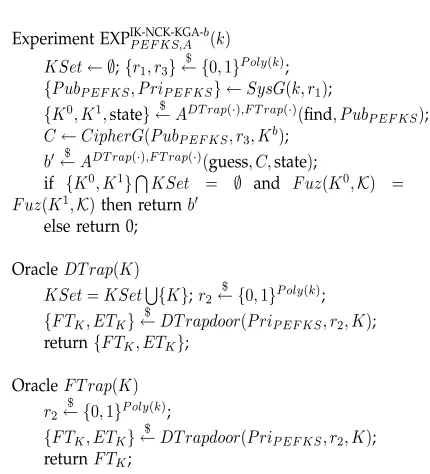
CipherG, F uzzT est, ExactT est) is IK-NCK-KGA se-cure, if any adversary A, associated to the experiment EXPIK-NCK-KGA-P EF KS,A b(k) in Figure 4 (where b
$
← {0,1}), has a negligible advantage AdvIK-NCK-KGAP EF KS,A, where
AdvIK-NCK-KGAP EF KS,A =Pr(EXP IK-NCK-KGA-1
P EF KS,A (k) = 1)
−Pr(EXPIK-NCK-KGA-P EF KS,A 0(k) = 1)
Experiment EXPIK-NCK-KGA-P EF KS,A b(k)
KSet← ∅;{r1, r3} $
← {0,1}P oly(k);
{P ubP EF KS, P riP EF KS} ←SysG(k, r1);
{K0, K1,state}←$ ADT rap(·),F T rap(·)(find, P ubP EF KS);
C←CipherG(P ubP EF KS, r3, Kb);
b0←$ ADT rap(·),F T rap(·)(guess, C,state);
if {K0, K1}T
KSet = ∅ and F uz(K0,K) =
F uz(K1,K)then returnb0
else return 0;
OracleDT rap(K) KSet=KSetS{
K};r2 $
← {0,1}P oly(k);
{F TK, ETK}
$
←DT rapdoor(P riP EF KS, r2, K);
return{F TK, ETK};
OracleF T rap(K) r2
$
← {0,1}P oly(k);
{F TK, ETK}
$
←DT rapdoor(P riP EF KS, r2, K);
returnF TK;
Fig. 4. Experiment on Attacking IK-NCK-KGA Security.
transformations from IBE to PEFKS, when the key-word space of PEFKS respectively has uniform and non-uniform distributions.
4
PEFKS-UD
Letk be a security parameter,P
be an alphabet and the keyword space K = Pn
, where |K| ≤ P loy(k). Moreover, K has the uniform distribution that each
symbol of P
has the identical or computationally indistinguishable probability to be used. The function
F uz(K,K)of PEFKS-UD works as follows:
1) Take as input a keyword K ∈ K, and parse K
asK=K1||. . .||Kn whereKi∈Pfori∈[1, n]. 2) Finally returnF K =K1||. . .||K(n−1).
The complete description of PEFKS-UD is as follows.
4.1 A Universal Transformation from IBE to PEFKS-UD
Let IBE = (Setup, Extract, Encrypt, Decrypt) be an IBE scheme. Let H1 : F KVK → ID be a collision resistant function. PEFKS-UD consists of following algorithms:
• SysG(k, r1): Take as input a security parameterk and a random taper1, and run algorithmSetup(
k, r1) of IBE to generate a pair of public-and-private system parameters that
P ubP EF KS-U D=hP ubIBE, F uz, H1,Ki
P riP EF KS-U D =P riIBE
• DT rapdoor(P riP EF KS-U D, r2, r02, K): Take as in-putP riP EF KS-U D, two random tapes r2 andr20, and a keyword K ∈ K, and generate a fuzzy search trapdoor F TK and an exact search trap-door ETK, where
F TK =Extract(P riIBE, r02, H1(F uz(K,K)))
ETK =Extract(P riIBE, r2, H1(K))
• CipherG(P ubP EF KS-U D, r3, r03, K): Take as input
P ubP EF KS-U D, two random tapesr3andr03, and
a keyword K ∈ K, choose M ← M$ , and
generate a fuzzy keyword searchable ciphertext hM, CF, CEi, where
CF =Encrypt(P ubIBE, r30, H1(F uz(K,K)), M)
CE=Encrypt(P ubIBE, r3, H1(K), M)
• F uzzT est(P ubP EF KS-U D, F TK,hM, CF, CEi): Take as input P ubP EF KS-U D, a fuzzy search trapdoor F TK and a fuzzy keyword searchable ciphertext hM, CF, CEi, and return
(
1 if M =Decrypt(P ubIBE, F TK, CF);
0 otherwise.
• ExactT est(P ubP EF KS-U D, ETK,hM, CF, CEi): Take as input P ubP EF KS-U D, an exact search
trapdoor ETK and a fuzzy keyword searchable ciphertexthM, CF, CEi, and return
(
1 if M =Decrypt(P ubIBE, ETK, CE);
0 otherwise.
The consistency of PEFKS-UDAccording to Theorem 4.2 in [11], it is easy to find that PEFKS-UD is consis-tent, when the anonymous IBE schemeIBE satisfies the semantic security.
4.2 Provable SS-CKA Security of PEFKS-UD
Theorem 1. For a PEFKS-UD scheme P EF KS-U D = (SysG, DT rapdoor, CipherG, F uzzT est, ExactT est)
based on an IBE scheme IBE = (Setup, Extract,
Encrypt, Decrypt), ifIBE is Anon-ID-CPA secure, then
P EF KS-U Dis SS-CKA secure.
Proof:Assuming that there is an adversaryAwith non-negligible advantage AdvSS-CKAP EF KS-U D,A to break
P EF KS-U D, we prove this theorem by inducing a contradiction with the Anon-ID-CPA securiry ofIBE. Therefore, we construct an adversaryBwho employs adversary A to break the Anon-ID-CPA security of
IBE.
AdversaryBT rap(·)(find, P ubIBE)
configureF uz, H1,K;
P ubP EF KS-U D=hP ubIBE, F uz, H1,Ki;
{K0, K1,state}←$ ADT rap(·)(find, P ub
P EF KS-U D);
M← M$ ;ID0=H
1(K0),ID1=H1(K1);
return{ID0, ID1, M,state};
AdversaryBT rap(·)(guess, C,state))
CE=C;r30 $
← {0,1}P oly(k);
CF =Encrypt(P ubIBE, r03, H1(F uz(K0,K)), M);
b0 $
←ADT rap(·)(guess,hM, C
F, CEi,state);
returnb0;
OracleDT rap(K)
F TK=T rap(H1(F uz(K,K)));
ETK=T rap(H1(K));
return{F TK, ETK};
Fig. 5. Adversary B Employs Adversary A of SS-CKA Security ofP EF KS-U D to Break Anon-ID-CPA Security ofIBE.
Figure 5 presents the construction of adversaryB. In it, AdversaryBemploys the oracleT rap(·)and the public keyP ubIBE of IBE to simulate a PEFKS-UD scheme with P ubP EF KS-U D = hP ubIBE, F uz, H1,Ki. Moreover, he simulates the challenging ciphertext hM, CF, CEi of P ubP EF KS-U D by concatenating the challenging ciphertext C of IBE with his produced
CF = Encrypt(P ubIBE, r30, H1(F uz(K0,K)), M), in which CE = C. It is obvious that hM, CF, CEi is effective, if both CE and CF were generated by
K0. In other word, hM, C
ciphertext of P ubP EF KS-U D with 12 probability. Ex-cept the challenging ciphertext, adversaryBsimulates
P ubP EF KS-U D as a real PEFKS-UD scheme. Conse-quently, we have
AdvAnon-ID-CPAIBE,B ≥
1
2 ·Adv
SS-CKA
P ubP EF KS-U D,A
But it contradicts to the Anon-ID-CPA security of
IBE, when AdvSS-CKAP ubP EF KS-U D,A is non-negligible. So if
IBE is Anon-ID-CPA secure, then P ubP EF KS-U D is SS-CKA secure.
4.3 Provable IK-NCK-KGA Security of PEFKS-UD Theorem 2. For a PEFKS-UD schemeP EF KS-U D = (SysG, DT rapdoor, CipherG, F uzzT est, ExactT est)
based on an IBE scheme IBE = (Setup, Extract,
Encrypt, Decrypt), ifIBEis Anon-ID-CPA secure, then
P EF KS-U D is IK-NCK-KGA secure.
Proof:Assuming that there is an adversaryAwith non-negligible advantage AdvIK-NCK-KGAP EF KS-U D,A to break
P EF KS-U D, we prove this theorem by inducing a contradiction with the Anon-ID-CPA security of
IBE. So we construct an adversaryB who employs adversaryA to break Anon-ID-CPA security ofIBE.
AdversaryBT rap(·)(find, P ubIBE)
configureF uz, H1,K;
P ubP EF KS-U D=hP ubIBE, F uz, H1,Ki;
{K0, K1,state}←$ ADT rap(·),F T rap(·)(find, P ub
P EF KS-U D);
M← M$ ;ID0=H
1(K0),ID1=H1(K1);
return{ID0, ID1, M,state};
AdversaryBT rap(·)(guess, C,state))
CE=C;r03 $
← {0,1}P oly(k);
CF=Encrypt(P ubIBE, r30, H1(F uz(K0,K)), M);
b0 $
←ADT rap(·),F T rap(·)(guess,hM, C
F, CEi,state);
returnb0;
OracleDT rap(K)
F TK=T rap(H1(F uz(K,K)));
ETK=T rap(H1(K));
return{F TK, ETK};
OracleF T rap(K)
F TK=T rap(H1(F uz(K,K)));
returnF TK;
Fig. 6. AdversaryBEmploys AdversaryAof IK-NCK-KGA Security ofP EF KS-U D to Break Anon-ID-CPA Security ofIBE.
Figure 6 presents the construction of adversary B. In it, AdversaryB employs the oracleT rap(·)and the public key P ubIBE of IBE to simulate a PEFKS-UD scheme with P ubP EF KS-U D =hP ubIBE, F uz, H1,Ki. Moreover he simulates the challenging ciphertext hM, CF, CEi of P ubP EF KS-U D by concatenating the challenging ciphertext C of IBE with his produced
CF = Encrypt(P ubIBE, r03, H1(F uz(K0,K)), M), in
whichCE=C. AndhM, CF, CEiis effective, because it has F uz(K0,K) = F uz(K1,K) according to the definition of IK-NCK-KGA security. So adversary B
simulatesP ubP EF KS-U Das a real PEFKS-UD scheme. Consequently, we have
AdvAnon-ID-CPAIBE,B ≥Adv
IK-NCK-KGA
P ubP EF KS-U D,A
But it contradicts to the Anon-ID-CPA security of
IBE, when AdvIK-NCK-KGAP ubP EF KS-U D,A is non-negligible. So if
IBE is Anon-ID-CPA secure, then P ubP EF KS-U D is IK-NCK-KGA secure.
4.4 An Instance of PEFKS-UD
According to the above universal transformation, we construct an instance of PEFKS-UD based on the anonymous IBE scheme BF01 in [12].
LetG and Gt denote two multiplicative groups of prime order q, and g be a generator of G. Let the bilinear map e : G×G → Gt [12, 25, 26] be an efficiently computable and non-degenerate function with the bilinearity that e(ga, gb) = e(g, g)ab, where {a, b} ←$ Z∗q. e(g, g) is the generator of Gt. Let the bilinear map generatorBGen(1k)be an efficient algo-rithm that returnshq,G,Gt, g, eiwith a given security parameterk.
• SysG(k, r1): It takes as input a security parameter
kand a random taper1, and works as follows: 1) RunBGen(1k)to generatehq,
G,Gt, g, ei. 2) Setgpub =gs, wheres
$
←Z∗ q.
3) Choose a collision resistance function H1 :
Pn−1WK →
G.
4) Choose a pseudo-random function H2 : Gt
→ M.
5) Return a pair of public-and-private system parameter
P ubP EF KS-U D=hq,G,Gt, g, e, gpub, F uz, H1,
H2,K,Mi
P riP EF KS-U D=s where K=Pn
and M={0,1}k1.
• DT rapdoor(P riP EF KS-U D, K): It takes as input
P riP EF KS-U Dand K∈ K, and works as follows: 1) Compute gF K = H1(F uz(K,K)) and the
fuzzy search trapdoor F TK =gsF K.
2) ComputegEK =H1(K)and the exact search trapdoorETK=gEKs .
3) Return{F TK, ETK}
• CipherG(P ubP EF KS-U D, K): It takes as input
P ubP EF KS-U D andK∈ K, and works as follows: 1) ChooseM ← M$ and {t, t0}←$ Z∗q.
2) ComputegF K=H1(F uz(K,K))andgEK =
H1(K).
3) Return a fuzzy keyword searchable cipher-texthM, CF, CEi, where
CF =hgt 0
, H2(e(gF K, gpub)t 0
)⊕Mi
• F uzzT est(P ubP EF KS-U D, F TK,hM, CF, CEi): It takes as input P ubP EF KS-U D,F TK and hM, CF,
CEi, and works as follows: 1) Parse CF ashCF1, CF2i.
2) Return 1 if M = CF2 ⊕H2(e(F TK, CF1)); otherwise return 0.
• ExactT est(P ubP EF KS-U D, ETK,hM, CF, CEi): It takes as input P ubP EF KS-U D,ETK and hM, CF,
CEi, and works as follows: 1) Parse CE ashCE1, CE2i.
2) Return 1 if M = CE2⊕H2(e(ETK, CE1)); otherwise return 0.
The consistency of the instance of PEFKS-UD Ac-cording to the IND-ID-CPA (indistinguishability un-der adaptive-ID and chosen plaintext attacks) secu-rity of BF01 scheme, it is easy to deduce that the instance has the computationally indistinguishable consistency.
5
PEFKS-ND
Let k be a security parameter. Let EK denote the probability of the event that the keyword K ∈ K is employed in practice, where |K| ≤ P loy(k). We partition all keywords into several subsets as follows: 1) Sort all keywords in descending order of their probabilities and denote them by {K1, K2, . . . ,
K|K|}.
2) Partition {K1, K2, . . . , K|K|} intoP, where P =
{{K1, K2},{K3, K4}, . . . ,{K|K|−1, K|K|}}
if |K|is even;
{{K1, K2}, . . . ,{K|K|−4, K|K|−3},{K|K|−2, K|K|−1, K|K|}}
if |K|is odd.
Let H1 : {0,1}∗ → {0,1}k2 be a collision resistance function. The function F uz(Ki,K) of PEFKS-ND is redefined as follows:
1) If |K|is even, then return
(
H1(Ki−1||Ki) if i is even;
H1(Ki||Ki+1) if i is odd.
2) Otherwise, return
H1(K|K|−2||K|K|−1||K|K|) if i≥ |K| −2;
H1(Ki−1||Ki) if i is even;
H1(Ki||Ki+1) if i is odd.
Referring to the functionF uz, we can easily verify the following properties:
• For any subset {Ki, Ki+1} in P, F uz(Ki,K) =
F uz(Ki+1,K)holds.
• For any two subsets {Ki, Ki+1}and {Kj, Kj+1} in P (i6=j), F uz(Ki,K)6=F uz(Kj,K) holds by the collision resistance ofH1.
The complete description of PEFKS-ND is as follows.
5.1 A Universal Transformation From IBE to PEFKS-ND
Let IBE = (Setup, Extract, Encrypt, Decrypt) be an IBE scheme. LetH2:{0,1}k2WK → IDbe a collision resistant function. PEFKS-ND consists of following polynomial time algorithms:
• SysG(k, r1): Take as input a security parameter
k and a random tape r1, and run Setup(k, r1) of IBE to generate a pair of public-and-private system parameters that
P ubP EF KS-N D=hP ubIBE, F uz, H1, H2,Ki
P riP EF KS-N D=P riIBE
• DT rapdoor(P riP EF KS-N D, r2, r02, Ki): Take as in-putP riP EF KS-N D, two random tapesr2 and r02, and a keyword Ki ∈ K, and generate a fuzzy search trapdoorF TKi and an exact search
trap-doorETKi, where
F TKi=Extract(P riIBE, r20, H2(F uz(Ki,K))
ETKi=Extract(P riIBE, r2, H2(Ki)) • CipherG(P ubP EF KS-N D, r3, r03, K
i): Take as input
P ubP EF KS-N D, two random tapesr3andr03and a keywordKi∈ K, choose a messageM ← M$ , and generate a fuzzy keyword searchable ciphertext hM, CF, CEi, where
CF =Encrypt(P ubIBE, r30, H2(F uz(Ki,K)), M)
CE =Encrypt(P ubIBE, r3, H2(Ki), M)
• F uzzT est(P ubP EF KS-N D, F TKi,hM, CF, CEi):
Take as input P ubP EF KS-N D, a fuzzy search trapdoorF TKi and a fuzzy keyword searchable
ciphertexthM, CF, CEi, and return
(
1 if M =Decrypt(P ubIBE, F TKi, CF);
0 otherwise.
• ExactT est(P ubP EF KS-N D, ETKi,hM, CF, CEi):
Take as input P ubP EF KS-N D, an exact search trapdoorETKi and a fuzzy keyword searchable
ciphertexthM, CF, CEi, and return
(
1 if M =Decrypt(P ubIBE, ETKi, CE);
0 otherwise.
The consistency of PEFKS-ND According to
Theo-rem 4.2 in [11], it is easy to find that PEFKS-ND has the consistency, when the IBE scheme IBE satisfies the semantic security.
5.2 How To Evaluate The Probability Distributions of Keywords
No. States (million)Results 1 New York 2430 2 California 1750 3 Washington 1440
4 Texas 1370
5 Florida 1200 6 Wisconsin 1190 7 Georgia 930 8 Virginia 760
9 Ohio 715
10 Michigan 672 11 Colorado 638 12 Arizona 610 13 Illinois 597
No. States (million)Results 14 Indiana 545 15 New Jersey 536 16 Pennsylvania 525 17 Oregon 512 18 Kansas 401 19 Hawaii 399 20 Minnesota 382 21 Massachusetts 375 22 Maryland 369 23 Montana 365 24 Tennessee 362 25 North Carolina 361 26 Oklahoma 358
No. States (million)Results 27 Missouri 353 28 Alabama 351 29 Alaska 343 30 Kentucky 324
31 Maine 324
32 Nevada 318
33 Iowa 305
34 Utah 305
35 Connecticut 302 36 Louisiana 294 37 Mississippi 261 38 Arkansas 252 39 South Carolina 251
No. States (million)Results 40 Delaware 230 41 Nebraska 219
42 Idaho 214
43 New Mexico 214 44 Vermont 201 45 New Hampshire 186 46 Rhode Island 179 47 West Virginia 179 48 Wyoming 177 49 North Dakota 156 50 South Carolina 152
TABLE 1
The Search Results of 50 States of America by Internet Search Engine Google.
results can be downloaded on webpage [28]. So it can be used to sort the keywords, which consist of a single word. But it is ineffective for the keywords consisted of more than one word. For this case, we recommend to estimate their frequencies by internet search engine Google (this method was proposed in [29]).
For example, let the keyword space K of PEFKS-ND consist of 50 states of America. We search them by the exact search of Google, and sort them in descending order of their frequencies in Table 1. So we can partition them as the description of PEFKS-ND, and realize a PEFKS-ND scheme based on an anonymous IBE scheme, such as BF01 scheme [12].
In this subsection, we proposed two basic methods to sort keywords. But they do not consider any special application. So in practice, it is better to choose an improved sort method according to the speciality of applications. For example, when the American government employs PEFKS-ND to provide a public service, and its keyword space also isK, every Amer-ican people should applies the service with the same probability. So the state names inKare used with the frequencies linear with their population, andKshould be sorted in descending order of their population in this application.
5.3 Provable SS-CKA Security of PEFKS-ND Theorem 3. For a PEFKS-ND scheme P EF KS-N D= (SysG, DT rapdoor, CipherG, F uzzT est, ExactT est)
based on an IBE scheme IBE = (Setup, Extract,
Encrypt, Decrypt), ifIBEis Anon-ID-CPA secure, then
P EF KS-N D is SS-CKA secure.
Proof:Assuming that there is an adversaryAwith non-negligible advantage AdvSS-CKAP EF KS-N D,A to break
P EF KS-N D, we prove this theorem by inducing a contradiction with the Anon-ID-CPA security of
IBE. So we construct an adversaryB who employs adversaryA to break Anon-ID-CPA security ofIBE. Figure 7 presents the construction of adversary
B. In it, adversary B employs the oracle T rap(·)
and the public key P ubIBE of IBE to
simu-late a PEFKS-ND scheme with P ubP EF KS-N D =
AdversaryBT rap(·)(find, P ub
IBE)
configureF uz, H1, H2,K;
P ubP EF KS-N D=hP ubIBE, F uz, H1, H2,Ki;
{K0, K1,state}←$ ADT rap(·)(find, P ub
P EF KS-N D);
M← M$ ;ID0=H
2(K0);ID1=H2(K1);
return{ID0, ID1, M,state};
AdversaryBT rap(·)(guess, C,state))
CE=C;r30 $
← {0,1}P oly(k);
CF =Encrypt(P ubIBE, r03, H2(F uz(K0,K)), M);
b0←$ ADT rap(·)(guess,hM, C
F, CEi,state);
returnb0;
OracleDT rap(K)
F TK=T rap(H2(F uz(K,K)));
ETK=T rap(H2(K));
return{F TK, ETK};
Note:K0andK1is not relative to the sort of keywords.
They can denote any two keywords.
Fig. 7. Adversary B Employs Adversary A of SS-CKA Security ofP EF KS-N D to Break Anon-ID-CPA Security ofIBE.
hP ubIBE, F uz, H1, H2,Ki. Moreover he simulates the challenging ciphertexthM, CF, CEiof P ubP EF KS-N D by concatenating the challenging ciphertext C of
IBE with his produced CF = Encrypt(P ubIBE, r30,
H2(F uz(K0,K)), M), in whichCE =C. It is obvious thathM, CF, CEiis effective, if bothCEandCF were generated byK0. In other word,hM, C
F, CEiis a real challenging ciphertext ofP ubP EF KS-N D with 12 prob-ability. Except the challenging ciphertext, adversaryB
simulatesP ubP EF KS-N D as a real PEFKS-ND scheme. Consequently, we have
AdvAnon-ID-CPAIBE,B ≥
1
2·Adv
SS-CKA
P ubP EF KS-N D,A
But it contradicts to the Anon-ID-CPA security of
IBE, when AdvSS-CKAP ubP EF KS-N D,A is non-negligible. So if
5.4 Provable IK-NCK-KGA Security of PEFKS-ND Theorem 4. For a PEFKS-ND scheme P EF KS-N D= (SysG, DT rapdoor, CipherG, F uzzT est, ExactT est)
based on an IBE scheme IBE = (Setup, Extract,
Encrypt, Decrypt), ifIBEis Anon-ID-CPA secure, then
P EF KS-N D is IK-NCK-KGA secure.
Proof:Assuming that there is an adversaryAwith non-negligible advantage AdvIK-NCK-KGAP EF KS-N D,A to break
P EF KS-U D, we prove this theorem by inducing a contradiction with the Anon-ID-CPA security of
IBE. So we construct an adversaryB who employs adversaryA to break Anon-ID-CPA security ofIBE.
AdversaryBT rap(·)(find, P ub
IBE)
configureF uz, H1, H2,K;
P ubP EF KS-N D=hP ubIBE, F uz, H1, H2,Ki;
{K0, K1,state} $
←ADT rap(·),F T rap(·)(find, P ub
P EF KS-N D);
M← M$ ;ID0=H
2(K0),ID1=H2(K1);
return{ID0, ID1, M,state};
AdversaryBT rap(·)(guess, C,state))
CE=C;r03 $
← {0,1}P oly(k);
CF=Encrypt(P ubIBE, r30, H2(F uz(K0,K)), M);
b0←$ ADT rap(·),F T rap(·)(guess,hM, C
F, CEi,state);
returnb0;
OracleDT rap(K)
F TK=T rap(H2(F uz(K,K)));
ETK=T rap(H2(K));
return{F TK, ETK};
OracleF T rap(K)
F TK=T rap(H2(F uz(K,K)));
returnF TK;
Note:K0andK1is not relative to the sort of keywords.
They can denote any two keywords.
Fig. 8. AdversaryBEmploys AdversaryAof IK-NCK-KGA Security ofP EF KS-N D to Break Anon-ID-CPA Security ofIBE.
Figure 8 presents the construction of adversary
B. In it, Adversary B employs the oracle T rap(·)
and the public key P ubIBE of IBE to
simu-late a PEFKS-ND scheme with P ubP EF KS-N D =
hP ubIBE, F uz, H1, H2,Ki. Moreover he simulates the challenging ciphertext hM, CF, CEi of P ubP EF KS-N D by concatenating the challenging ciphertext C of
IBE with his produced CF = Encrypt(P ubIBE, r03,
H2(F uz(K0,K)), M), in whichCE=C. AndhM, CF,
CEi is effective, because it has F uz(K0,K) =
F uz(K1,K) according to the definition of
IK-NCK-KGA security. So adversary B simulates
P ubP EF KS-N D as a real PEFKS-ND scheme. Conse-quently, we have
AdvAnon-ID-CPAIBE,B ≥Adv
IK-NCK-KGA
P ubP EF KS-N D,A
But it contradicts to Anon-ID-CPA security of IBE, when AdvIK-NCK-KGAP ubP EF KS-N D,A is non-negligible. So if IBE
is Anon-ID-CPA secure, then P ubP EF KS-N D is IK-NCK-KGA secure.
5.5 The Essence of Sorting Keywords
Recall that the keyword space K of PEFKS-ND has non-uniform distribution. It means that the keywords of K are non-uniformly used. But referring to the definitions of SS-CKA and IK-NCK-KGA securities, we can find that the challenging keywords{K0, K1} are uniformly chosen to generate the challenging ci-phertext. So it seems that these security definitions is not suitable for PEFKS-ND. But the fact is inverse. Roughly speaking, a secure cryptosystem means that no adversary can learn anything from the cryptosys-tem. So the security of a cryptosystem does not consider what an adversary can learn beyond the cryptosystem, such as the non-uniform distribution of keywords.
Specifically, an adversary can find two candidate keywords under KGA on PEFKS-ND, which are de-noted by {Ki, Ki+1} ∈ P without loss of generality. And without considering any others, the adversary practically has the biased advantage |EKi− EKi+1|to
decide which one of them is the correct one. Moreover, the biased advantage is caused only by the non-uniform distribution of keywords, so it can not be avoided by any keyword searchable encryption. But PEFKS-ND has decreased the biased advantage by sorting and sequentially partitioning keywords. By this method, the candidate keywords Ki and Ki+1 have the similar distribution as much as possible. Correspondingly, the biased advantage|EKi− EKi+1|
can be much decreased.
Partitions ProbabilityDifference Partitions ProbabilityDifference Partitions ProbabilityDifference
{1, 2} 0.163 {11, 12} 0.022 {21, 22} 0.008
{17, 18} 0.122 {19, 20} 0.022 {47, 48} 0.006
{7, 8} 0.101 {45, 46} 0.019 {5, 6} 0.004
{13, 14} 0.046 {37, 38} 0.018 {23, 24} 0.004
{39, 40} 0.044 {35, 36} 0.013 {25, 26} 0.004
{9, 10} 0.031 {49, 50} 0.013 {27, 28} 0.003
{43, 44} 0.031 {41, 42} 0.012 {33, 34} 0.000
{29, 30} 0.028 {15, 16} 0.010
{3, 4} 0.025 {31, 32} 0.009
Note: all states in Table 1 are denoted by their numbers in this table. TABLE 2
The Partitions of The Keyword Space in Table 1 and Their Probability Differences.
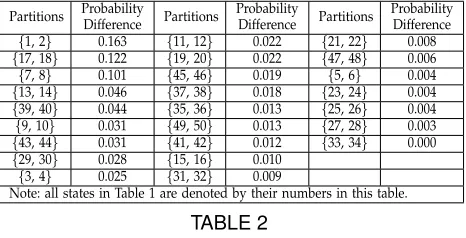
For example, we partition the keywords listed in Table 1 according to PEFKS-ND, and compute the biased advantage (probability difference) of each pair of keywords in Table 2. In theory, except{33, 34}, the others have the non-negligibly biased advantage. But all of them are much smaller than 1.
on PEFKS-ND, which is caused only by the non-uniform distribution of keywords. In next subsection, we will illuminate why the biased advantage has been decreased as much as possible.
5.6 The Insecurity of A Further Decrease in The Biased Advantage
At the end of Subsection 5.5, we stated that we have decreased the biased advantage as much as possible. To prove it, we will propose a method, which is the only one method that can further decrease the biased advantage, and illuminate that it is not an secure universal method.
Referring to the partition P of K at the begin-ning of this section, we sorted all keywords in de-scending order of their probabilities and sequentially partitioned them. Therefore, we did not consider to combine a keyword with one of its two neighbor-ing keywords, which has the minimum probability difference with it. When partitioning keywords ac-cording to this rule, however this partition method is not an secure universal method. For example, let K = {K1, K2, K3, K4} denote the sorted key-words in descending order of their probabilities. We sequently combine each keyword with one of its two neighboring keywords, which has the min-imum probability difference with them. Assuming |EK1 − EK2| > |EK2 − EK3|, therefore we result the
partition {{K1, K2},{K2, K3},{K3, K4}}. By imple-menting KGA on PEFKS-ND, an adversary can easily find out {K1, K2} when he knows the fuzzy search trapdoor generated by {{K1, K2}. Furthermore, he can deterministically guess K1 rather than with any biased advantage, because a fuzzy search trapdoor of
K2 should be generated by {K2, K3}. Hence, if an adversary finds out{K1, K2}under KGA on PEFKS-ND, he can deterministically decide that the fuzzy search trapdoor was generated byK1rather thanK2. Consequently, this improved method is not a secure universal method. However, it obviously is the only one method that has chance to further decrease the biased advantage. So we think there is not any other secure universal method can further decrease the biased advantage.
6
P
ERFORMANCEC
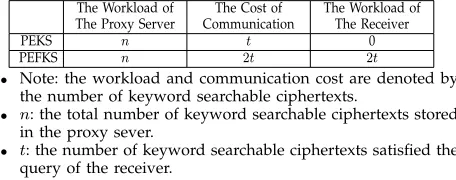
OMPARISONGenerally speaking, PEFKS divides a query from a receiver into two processes: first, a proxy server im-plements a fuzzy keyword search over all its stored ciphertexts, and returns the results to the receiver; secondly, the receiver implements an exact keyword search over these results. In contrast, PEKS only has an exact keyword search over all stored ciphertexts, which is implemented by a proxy server. So in order to achieve IK-NCK-KGA security, PEFKS increases the workload of the receiver and the communication cost. In Table 3, we compare the performance of PEFKS and PEKS when they receive a query.
The Workload of The Proxy Server
The Cost of Communication
The Workload of The Receiver
PEKS n t 0
PEFKS n 2t 2t
• Note: the workload and communication cost are denoted by the number of keyword searchable ciphertexts.
• n: the total number of keyword searchable ciphertexts stored in the proxy sever.
• t: the number of keyword searchable ciphertexts satisfied the query of the receiver.
TABLE 3
The Performance Comparison between PEKS and PEFKS.
7
C
ONCLUSION ANDF
UTUREW
ORKIn PEKS, a proxy sever, who responds the keyword queries of a receiver, can know the content of key-words by implementing KGA. Moreover, it is effi-cient under the practical condition that the size of the keyword space is not more than the polynomial level. In order to resist against KGA, we novelly defined public-key encryption with fuzzy keyword search (PEFKS) and its IK-NCK-KGA security. And we proposed two universal transformations from IBE to PEFKS under different conditions. Under the condi-tion that the keyword space has uniform distribucondi-tion, we proposed a SS-CKA and IK-NCK-KGA secure transformation PEFKS-UD, and provided an instance based on BF01 scheme [12]. Under the condition that the keyword space has non-uniform distribution, we proposed another SS-CKA and IK-NCK-KGA secure transformation PEFKS-ND, and provided two meth-ods to sort keywords, which is the key to realize PEFKS-ND. Beyond the perspective of cryptosystem, we discussed the biased advantage of KGA on PEFKS-ND, which is caused only by the non-uniform dis-tribution of the keyword space. We illuminate that the biased advantage has been decreased as much as possible. So we made PEFKS-ND secure in a broad sense.
The future work Both in PEKS and PEFKS, their searches take time linear in the number of ciphertexts. Hence it is a crucial problem of performance that how to build indexes in PEKS and PEFKS. More-over, it is more useful to improve the performance of PEFKS than PEKS. But it is a challenging work, because the SS-CKA securities of PEKS and PEFKS are contradictive to establish indexes. So a tradeoff between security and search performance should be a basic idea. Moreover, we think that a dynamic tradeoff controlled by the owner of datum is a promising method.
R
EFERENCES[1] D. Boneh, G. D. Crescenzo, and R. O. et al., “Public key encyrption with keyword search,”
LNCS, C. Cachin and J. Camenisch, Eds., vol. 3027. Springer-Verlag, 2004, pp. 506–522. [2] D. X. Song, D. Wagner, and A. Perrig, “Practical
techniques for searches on encrypted data,” in Proceedings of the 2000 IEEE Symposium on Security and Privacy, Berkeley, CA , USA, 2000, pp. 44–55.
[3] E.-J. Goh, “Secure indexes,” 2003,
http://eprint.iacr.org/2003/216.pdf.
[4] R. Agrawal, J. Kiernan, and R. S. et al., “Order preserving encryption for numeric data,” in Pro-ceedings of the 2004 ACM SIGMOD international
conference on Management of data. Paris, France:
ACM, 2004, pp. 563–574.
[5] R. Curtmola, J. Garay, and S. K. et al., “Searchable symmetric encryption: Improved definitions and efficient constructions,” in Proceedings of the 13th ACM conference on Computer and communications
security. ACM, 2006, pp. 79–88.
[6] W. Harrower, “Searching encrypted data,” De-partment of Computing, Imperial College Lon-don, Tech. Rep., 2009.
[7] J. W. Byun, H. S. Rhee, and H.-A. P. et al., “Off-line keyword guessing attacks on recent key-word search schemes over encrypted data,” in Secure Data Management, ser. LNCS, W. Jonker and M. Petkovic, Eds., vol. 4165. Springer-Verlag, 2006, pp. 75–83.
[8] D. J. Park, K. Kim, and P. J. Lee, “Public key en-cryption with conjunctive field keyword search,”
in WISA 2004, ser. LNCS, C. Lim and M. Yung,
Eds., vol. 3325. Spring-Verlag, 2004, pp. 73–86. [9] I. R. Jeong, J. O. Kwon, and D. H. et al.,
“Con-structing peks schemes secure against keyword guessing attacks is possible?” Computer Commu-nications, vol. 32, no. 2, pp. 394–396, 2009. [10] S. Goldwasser and S. Micali, “Probabilistic
en-cyrption,” in Proceedings of the fourteenth annual
ACM symposium on Theory of computing. San
Francisco, California, United States: ACM, 1982, pp. 365–377.
[11] M. Abdalla, M. Bellare, and D. C. et al., “Search-able encryption revisited: Consistency properties, relation to anonymous ibe, and extensions,” in Advances in Cryptology-CRYPTO 2005, ser. LNCS, V. Shoup, Ed., vol. 3621. Santa Barbara, Cali-fornia, United States: Springer-Verlag, 2005, pp. 205–222.
[12] D. Boneh and M. Franklin, “Identity-based en-cryption from the weil pairing,” in Advances in Cryptology-CRYPTO 2001, ser. LNCS, J. Kilian, Ed., vol. 2139. Santa Barbara, California, United States: Springer-Verlag, 2001, pp. 213–239. [13] X. Boyen and B. Waters, “Anonymous
hierar-chical identity-based encryption (without ran-dom oracles),” inAdvances in Cryptology-CRYPTO 2006, ser. LNCS, C. Dwork, Ed., vol. 4117. Santa Barbara, California, United States: Springer-Verlag, 2006, pp. 290–307.
[14] C. Gentry, “Practical identity-based encyrp-tion without random oracles,” in Advances in Cryptology-EUROCRYPT 2006, ser. LNCS, S. Vau-denay, Ed., vol. 4004. Russia: Springer-Verlag, 2006, pp. 445–464.
[15] L. Ducas, “Anonymity from asymmetry: New constructions for anonymous hibe,” inThe Cryp-tographers’ Track at the RSA Conference 2010, ser. LNCS, J. Pieprzyk, Ed., vol. 5985. San Francisco, CA, USA: Springer Berlin, 2010, pp. 148–164.
[16] C.-I. Fan, L.-Y. Huang, and P.-H. Ho,
“Anonymous multireceiver identity-based
encryption,” IEEE TRANSACTIONS ON
COMPUTERS, vol. 59, no. 9, pp. 1239–1249, 2010.
[17] Y. H. Hwang and P. J. Lee, “Public key encryption with conjunctive keyword search and its exten-sion to a multi-user system,” inPairing 2007, ser. LNCS, T. Takagi, Ed., vol. 4575. Springer-Verlag, 2007, pp. 2–22.
[18] J. Bethencourt, T.-H. H. Chan, and A. P. et al., “Anonymous multi-attribute encryption with range query and conditional decryption,” Carnegie Mellon University, Tech. Rep. CMU-CS-06-135, 2006.
[19] E. Shi, J. Bethencourt, and T.-H. H. C. et al., “Multi-dimensional range query over encrypted data,” Carnegie Mellon University, Tech. Rep. CMU-CS-06-135, 2007.
[20] D. Boneh and B. Waters, “conjunctive, subset, and range queries on ecrypted data,” in proceed-ings of TCC’07, ser. LNCS, S. P. Vadhan, Ed., vol. 4392. Springer-Verlag, 2007, pp. 535–554. [21] J. Camenisch, M. Kohlweiss, and A. R. et al.,
“Blind and anonymous identity-based encryp-tion and authorised private searches on public key encrypted data,” in Proceedings of the 12th International Conference on Practice and Theory in Public Key Cryptography: PKC ’09, ser. LNCS, vol. 5443. CA: Springer-Verlag, 2009, pp. 196–214. [22] L. Ballard, S. Kamara, and F. Monrose,
“Achiev-ing efficient conjunctive keyword searches over encrypted data,” in ICICS 2005, ser. LNCS, S. et al., Ed., vol. 3783. Springer-Verlag, 2005, pp. 414–426.
[23] E.-K. Ryu and T. Takagi, “Efficient conjunctive keyword-searchable encryption,” inAdvanced In-formation Networking and Applications Workshops, 2007, AINAW ’07. 21st International Conference on. Niagara Falls, Ontario, Canada: IEEE Computer Society, 2007, pp. 409 – 414.
[24] M. Bellare, A. Boldyreva, and A. D. et al., “Key-privacy in public-key encryption,” inAdvances in Cryptology-ASIACRYPT 2001, ser. LNCS, C. Boyd, Ed., vol. 2248. Australia: Springer-Verlag, 2001, pp. 566–582.
log-arithms in a finite field,” IEEE TRANSACTIONS ON INFORMATION THEORY, vol. 39, no. 5, pp. 1639–1646, 1993.
[26] G. Frey, M. Muller, and H.-G. Ruck, “The tate pairing and the discrete logarithm applied to elliptic curve cryptosystems,” IEEE TRANSAC-TIONS ON INFORMATION THEORY, vol. 45, no. 5, pp. 1717–1719, 1999.
[27] M. Brysbaert and B. New, “Moving beyond kucera and francis: A critical evaluation of cur-rent word frequency norms and the introduction of a new and improved word frequency measure for american english,”Behavior Research Methods, vol. 49, no. 4, pp. 977–990, 2009.
[28] ——, “Subtlexus: American word frequencies,” http://subtlexus.lexique.org/, 2009.