TABLE OF CONTENTS:
Vol. 37, No. 5, September 1984
ARTICLES387
392
J&g
402
406
43
415
420
423
Effects of Fire on Texas Wintergrass Communities by S.G. Whisenant, D.N. Ueckert, and C.J. Scifres
Long-term Effects of Annual Burning at Different Dates in Ungrazed Kansas Tallgrass Prairie by Gene Towne and Clenton Owensby
Burning of Northern Mixed Prairie during Drought by D.M. Engle and P.M. Bultsma
Fire Effects on Nitrogen Mineralization and Fixation in Mountain Shrub and Grassland Communities by N. Thompson Hobbs and David S. Schimel
Shoot Growth and Development of Alamo Switchgrass as Influenced by Mowing and Fertilization by M.R. Haferkamp and T.D. Copeland
Chemically Thinning Blue Grama Range for Increased Forage and Seed Produc- tion by William J. McGinnies
Some Aspects of Rangeland Improvement in a Derived Savanna Ecosystem by C.P.E. Omaliko, O.A. Mammah, and A.M. Agbakoba
Ozone-treated Mesquite for Supplementing Steers in West Texas by Fred C. Bryant, Thomas Mills, John S. Pitts, Mike Carrigan, and Ernie P. Wiggers Circumstances Associated with Predation Rates on Sheep and Goats by Roger D. Nass,
\
Greg Lynch, and John Theade
Theories and a Recommendation for Vegetation Classification-A View- point by Donald 0. Meeker, Jr., and Daniel L. Merkel
J30
438
442
447
451
ai
1,462
465
Livestock Impacts on Riparian Ecosystems and Streamside Management Implica- tions. . . A Review by J. Boone Kauffman and W.C. Krueger
Impact of Small Mammals on the Vegetation of Reclaimed Land in the Northern Great Plains by Terrence M. Hingtgen and William R. Clark
Grazing Management Impacts on Quail during Drought in the Northern Rio Grande Plain, Texas by Linda Campbell-Kissock, Lytle H. Blankenship, and Larry D. White
The Effect of Phytophagous Nematode Grazing on Blue Grama Die-off by Nancy L. Stanton, Dennis Morrison, and William A. Laycock
Spatial and Seasonal Variability and Field Measured Infiltration Rates on a Rangeland Site in Utah by Moujahed Achouri and Gerald F. Gifford
Vegetation of Two Relict Mesas in Zion National Park by Michael H. Madany and Neil E. West
Effects of Temporary Dehydration on Growth of Green Needlegrass (stipa viridula
Trin.) Seedlings by Timothy E. Fulbright, A.M. Wilson, and E.F. Redente Seasonal Variation in Total Nonstructural Carbohydrate Levels in Nebraska Sedge
Published bimonthly-January, March, May, July, September, November
Copyright 1984 by the Society for Range Manage- ment
INDIVIDUAL SUBSCRIPTION is by membership in the Society for Range Management.
LIBRARY or other INSTITUTIONAL SUBSCRIP- TIONS on a calendar year basis are $56.00 for the United States postpaid and $66.00 for other coun- tries, postpaid. Payment from outside the United States should be remitted in US dollars by interna- tional money order or draft on a New York bank. BUSINESSCORRESPONDENCE. concerning sub- scriptions, advertising, reprints, back issues, and related matters, should be addressed to the Manag- ing Editor, 2760 West Fifth Avenue, Denver, Colo. 60204.
EDlTORIALCORRESPONDENCE,concerning manu- scriptsorothereditorial mattersshould beaddressed to the Editor, 2760 West Fifth Avenue, Denver, Colo. 80204.
INSTRUCTIONS FOR AUTHORS appear on the inside back cover of each issue. A Style Manual is also available from the Society for Range Manage- ment at theabovsaddress@$1,25for singlecopies; $1.00 each for 2 or more.
THE JOURNALOF RANGE MANAGEMENT (ISSN 0022-409X) is published six times yearly for $56.00 per year by the Society for Range Management, 2760 West Fifth Avenue, Denver, Colo. 80204. SECOND CLASS POSTAGE paid at Denver, Colo. POSTMASTER: Return entire journal with address change-RETURN POSTAGE GUARANTEED-to Society for Range Management, 2760 West Fifth Avenue, Denver, Colo. 80204.
The Journal of Range Management serves as a forum for the presentation and discus- sion of facts, ideas, and philosophies pertain- ing to the study, management, and use of rangelandsand theirseveral resources. Accord- ingly, all material published herein is signed and reflects the individual views of the authors and is not necessarily an official position of the Society. Manuscripts from any source- nonmembers as well as members-are wel- come and will be given every consideration by the editors. Submissions need not be of a technical nature, but should be germane to the broad field of range management. Editor- ial comment by an individual is also welcome and subject to acceptance by the editor, will be published as a “Viewpoint.”
468
471
Reliability of Captive Deer and Cow In Vitro Digestion Values in Predicting Wild Deer Digestion Levels by Henry Campa, III, David K. Woodyard, and Jonathan B. Haufler
Estimating Grazingland Yield from Commonly Available Data by Karin Wisiol
TECHNICAL NOTES
476 An Improved Esophageal Fistula Bag for Sheep by D.M. Center and M.B. Jones
BOOK REVIEWS
478 Management of Pastoral Development in the Third World by Stephen Sandford; Oklahoma Beef Cattle Manual by Keith Lusby et al.; New Mexico Grasses: A Vegetative Key by Carolyn M. Barnard and Loren D. Potter.
Managing Editor PETER V. JACKSON I I I
2760 West Fifth Avenue Denver, Colo. 80204 Editor
PATRICIA G. SMITH
Society for Range Management 2760 West Fifth Avenue Denver, CO 80204 Book Review Editor RICHARD E. FRANCIS
Rocky Mountain Forest and Range Experiment Station 2205 Columbia SE.
Albuquerque, New Mexico 87106 ASSOCIATE EDITORS
E. TOM BARTLETT Dept. of Range Science Colorado State University Fort Collins, CO 80523 GARY FRASIER
780 West Cool Drive Tucson, AZ 85704 G. FRED GIFFORD
Dept. of Range Wildlife, and Forestry University of Nevada
Reno, Nev. 89506 W.K. LAUENROTH
Department of Range Science Colorado State University Fort Collins, CO 60523 LYMAN MCDONALD
Statistics Department
College of Commerce and Industry University of Wyoming
Laramie, WY 62071
ROBERT MURRAY
US Sheep Experiment Station Dubois, ID 63423
KIETH SEVERSON Forest Hydrology
Laboratory
Arizona State University Tempe, AZ 85281 DARREL UECKERT
Texas Agricultural Experiment Station 7887 N. Highway 87
San Angelo, TX 76901 BRUCE WELCH
Shrub Science Laboratory 735 N 500 E
Provo, UT 84701 LARRY M. WHITE
USDA ARS
S. Plains Range Research Station 200 18th St.
Woodward, OK 73801 KARL WOOD
Dept. of Animial and Range Sciences Box 3-l
Las Cruces, NM 88001 JAMES YOUNG
USDA ARS
Effects of Fire on Texas Wintergrass
Communities
S.G. WHISENANT, D.N. UECKERT, AND C.J. SCIFRES
The effect of season of burning on standing crop, point fre- quency, density, and reproductive vigor of Texas wintergrass @@%I leucotikha Trin. & Rupr.) communities was measured in this study. Additional information on the effects of fire on Texas wintergrass will aid resource managers plan the use of fire in these communities. Burning or clipping Texas wintergrassdid not signif- icantly affect the number of reproductive cubns per plant in the northern Edwards Plateau region of Texas. Burning, regardless of season, reduced standing crops for 1 year and burning in January or March reduced Texas wintergrass point frequency for 1 year. Burning where annual cool-season grasses were abundant in the southern Roiling Plains tended to increase Texas wintergrass den- sity, point frequency, and standing crop, apparently a result of reduced competition from annual plants. Increases in Texas win- tcrgrass point frequency and standing crop were greater following burning in the fail than following burning in the spring. Prescribed burning in Texas wintergrass communities generally killed annual grasses and forbs if burning occurred subsequent to seedling emer- gence. However, soil reserves of seed and/or subsequent seed immigration into burned areas appeared to be sufficient to reestab- lish populations of annual plants during the second year following burning. Annual grass populations consistently tended to be higher in the second year after burning than on unburned rangeland.
Texas wintergrass (Stipa leucotricha Trin. & Rupr.) is an erect, tufted, cool-season perennial that commonly occurs on fine- textured, calcareous soils in the Edwards Plateau, Rolling Plains, Cross Timbers and Prairies, and other land resource areas of Texas (Correll and Johnston 1970). On the western Edwards Plateau, Texas wintergrass is representative of sites with relatively deep soils (Smeins et al. 1976).
Texas wintergrass is one of the most important grasses in the diets of domestic livestock and wildlife in Texas (Drawe and Box 1968, Ramsey and Anderegg 1972, Sanders 1975, Bryant et al. 1979, Taylor et al. 1980). Texas wintergrass may contain green foliage at any time of the year, but usually provides an adequate forage supply from October through June in years with at least average rainfall and relatively warm winters. Texas wintergrass has some characteristics objectionable to sheep and hair-goat produc- ers because the sharp-pointed, densely hairy callus of the floret, and the stout, twisted awn of the lemma enable the floret to easily penetrate the fleece and skin of sheep and hair-goats. This can result in decreased value of wool (Bell 1973) and mohair, loss of weight, decreased carcass quality, and occasional death losses.
Attitudes among resource managers are mixed relative to the values of Texas wintergrass. There is an abundance of cool-season forages in many areas and a corresponding shortage of warm- season forages so that producers are interested in shifting the forage balance toward the warm-season species. When cool-season
The authors are at present assistant professor, Department of Botany and Range Science, Brigham Young University, Provo, Utah 84602; professor, Texas Agricultu- ral Experiment Station, Rt. 2, Box950, San Angelo 76901;and Thomas M. O’Connor professor, Department of Range Science, Texas A&M University, College Station 77843. Published with the approval of the Director, Agricultural Experiment Station, as TA-I 8668.
The authors wish to thank J.D. Brotherson, J.F. Vallentine, and H.A. Wright for their helpful suggestions concerning this manuscript.
Manuscript accepted March 21, 1984.
forage is limiting and warm-season forage is plentiful, a shift in vegetative composition toward the cool-season species may be desirable. Several species of warm-season grasses occur in many Texas wintergrass communities while cool-season, annual grasses are codominants in others.
Fire can change the species composition of plant stands. Burning in the fall minimizes potential damage to cool-season perennial plants (Wright 1974). Results of 17 years of burning research in the Kansas Flint Hills showed that cool-season species were reduced and warm-season species favored by spring burning (Anderson et al. 1970). Burns early in the growing season were lethal to more plants than burns late in the season. Similar results were obtained in Alberta with western porcupinegrass (Sripa spartea var. cur- risetu Trin.) (Bailey and Anderson 1978). Texas wintergrass is reported to be severely harmed by intense fires (Dahl and Goen
1973) but it increased following spring fires of low intensity (Bean et al. 1975). Production of Texas wintergrass increased for 2 grow- ing seasons after burning in late-winter in the southern Rolling Plains (Ueckert and Whisenant 1980). Box et al. (1967) reported that standing crop of Texas wintergrass was not affected by burn- ing in the fall on the Coastal Prairie region of Texas.
Burning after seedling emergence is usually detrimental to annual plants (Daubenmire 1968, Wright 1974). Seeds of annual grasses are seldom damaged by the flames of grassland fires unless they are in the upper parts of the inflorescence. Seeds in or on the soil surface are seldom damaged by grassland fires (Daubenmire 1968, Vogl 1974).
Two distinctly different responses of annual grasses to litter removal have been reported. Most annual grasses are pioneers requiring bare ground and sunlight, conditions common on post- burn sites (Curtis and Partch 1950, Ehrenreich and Aikman 1957, Daubenmire 1968, Wright 1974). However, other annual grasses require a certain amount of mulch on the soil surface for their seeds to germinate. This requirement for mulched seedbeds has been demonstrated for prairie threeawn (Aristidu oliguntha Michx.) (Owensby and Launchbaugh 1977); soft brome (Bromus mollis L.); and downy brome (Bromus tectorum L.) (Heady 1956, Smith 1970).
The purpose of this study was to determine the effect that season of burning has on standing crop, point frequency, density, and reproductive vigor of Texas wintergrass and associated species in central and northcentral Texas. An appropriate burning prescrip- tion could potentially enable resource managers to manipulate the quantity of Texas wintergrass with fire as needed to achieve a more desirable balance in the yearlong forage base.
Study Areas and Methods
Research was conducted on 6.5 ha in McCulloch County and on 7.5 ha in Coleman County, Texas. These areas typically have dry winters and hot summers with precipitation peaks in April, May, September, and October. Mean annual precipitation is 59 and 69 cm for McCulloch and Coleman Counties, respectively (Bynum and Coker 1974, Botts et al. 1974). Study areas at both locations were fenced to exclude livestock.
The McCulloch County study area has Tobosa clay (fine, montmorillonitic, thermic, Typic Chromustert) on lower areas and
Valera clay (fine, montomorillonitic, thermic, Petro Calciustoll) and oven-dried at 60°C for 48 hr before weighing. Frequency was on higher areas. The Coleman County study area contains both determined on each 0.3-ha plot along 2 permanently marked 61-m Rowena clay loam (fine, mixed, thermic Vertic Calciustoll) and lines with 200 points spaced 30.5-cm apart per line. Evaluation Kavett silty clay (clayey, montmorillonitic, thermic, shallow dates were June 3, 1980; October 10, 1980; June 2, 1981; and
Petrocalcic Calciustoll). October 23, 1981.
The McCulloch County study area is located in the northcentral Edwards Plateau and is in the Oak Savannah floristic association of McCulloch County (Whisenant 1981). The Coleman County study area is located in the mesquite (Prosopis glandulosa Torr. var. glandulosa) grassland floristic association of the Rolling Plains.
The Coleman County experiment contained eight 0.8-ha plots arranged in a randomized complete block design. Soil type was used as criterion for the 2 blocks. Two of these were not burned, and two each were burned on October 9, 1979; January 25, 1980; and March 21, 1980.
Fine fuel loads and fuel-water contents were determined before each burn by clipping fifteen, 0.25-m* sampling areas to a 2.5-cm stubble height, drying at 60°C for 48 hr, and weighing. Air temper- ature, relative humidity, and instantaneous wind speed were mea- sured with a mercury thermometer, sling psychrometer, and a hand-held wind meter immediately before, during, and after each burn.
One experiment at the McCulloch County location was designed as completely random and arranged as a split-plot (hereafter called small plots), with season of treatment as the main-plot effect and treatment as the sub-plot effect. Treatments and seasons were each replicated 4 times and applied to 3- by 3-m subplots. Treatments used were (I) burn, (2) clip and remove all vegetation and mulch, and (3) no treatment. Treatments were conducted during fall (Sep- tember 28, 1979); winter (January 24,198O); and spring (March 19, 1980). Each subplot was separated from the others by a I-m buffer.
Frequency was determined on each 0.8-ha plot along 2 perman- ently marked 91-m lines with 200 points spaced 45.7-cm apart per line. Evaluation dates were June 12, 1980; October 10, 1980; May 22, 1981; and November 6, 1981. Plant density was measured in four 13-by 192-cm (0.25-m*) quadrats at each of four, permanently marked sampling areas in each 0.8-ha plot. Standing crops were determined on June 12, 1980; May 22, 1981; and November 6, 198 1, by harvesting to a 2.5-cm stubble height in I5 to 25,0.25-m* quadrats in each plot.
Plant density and numbers of reproductive culms per plant were determined on June 3, 1980, and June 4, 1981, in two, 13- by 192cm (0.25-m*) quadrats placed on a permanently marked diag- onal across each plot. Point frequency (hereafter referred to as frequency) was determined (based on foliar hits) on June 3, 1980, and June 2, 1981, using 10 placements of an inclined IO-point frame on each plot. Statistical comparisons of numbers of repro- ductive culms were conducted on a per plant basis.
Treatment effects on frequency, plant density, and the numbers of reproductive culms per plant were determined for the split-plot experiment using analyses of variance of plot means. Differences in frequency among treatments on the randomized complete block experiments were determined with analyses of variance using data from each transect as a subsample. Differences in standing crop among treatments with the randomized complete block experi- ments were determined with analysis of variance using quadrat data as subsamples. Treatment means from the large plot experi- ments were separated with Duncan’s multiple range test (B.05) when appropriate. Orthogonal comparisons were made of untreated vs. treated plots (clipped and burned) and clipped vs. burned plots on the small plot experiment.
Results and Discussion Weather at Time of Burns
The second experiment at the McCulloch County study site contained ten, 0.3-ha plots arranged as a randomized complete block design (hereafter called large plots). Soil type was used as the criterion for the 2 blocks. Two of these were not burned and 2 each were burned on September 27, 1979; January 24, 1980; March 19,
1980; and November 21, 1980.
Environmental and fuel variables during fires installed in Texas wintergrass stands during 1979-1980, at both study sites, are listed in Table 1.
Texas Wintergrass
Standing crops were determined using fifteen to twenty-five, 0.25-m* quadrats in each plot. Standing crops were determined on June 3, 1980; June 2, 198 1; and October 23, 198 I. Green herbace- ous vegetation was clipped, by species, to a 2.5-cm stubble height
At the McCulIoch County site in June 1980, Texas wintergrass densities on treated plots were significantly higher after September treatments and lower following January treatments compared to untreated plots (Table 2). In June 198 1, Texas wintergrass densities were higher on plots treated in September, 1979, January 1980, or March 1980 when compared to untreated plots. No significant
Table 1. Environmental and fuel variables during fues installed in Texas wintergrass stands during 1979-1980, McCullocb County and Coleman County, Texas.
Date burned Experiment’
Ambient
temperature (“Cl
Wind
speed (kmihr)
Relative
humidity (%I
McCulloch Countv
Fuel water (%I
Fine fuel (kg/ ha)
Sep. 1979
Jan. 1980
Mar. 1980
Nov. 1980
LP SP LP SP LP SP LP
Oct. 1979 Jan. 1980 Mar. 1980
32 1-5
35 IO-13
18 IO-16
16 IO-13
20 18-24
22 13-23
I2 o-5
23 8-16
18 IO-14
21 14-18
I9 IS 42 44 30 33 54
Coleman County
24 35 23
14 2,700
16 2,680
14 3,700
I3 3,650
I8 3,000
I8 3,000
22 3,300
13 3,000
12 3,100
9 2,500
ILP = Large plots. SP = Small plots.
Table 2. Live plant densities (no./m*) in June 1980 and 1981 after burning or clipping at several dates in 1979-1980, for small plots, McCullocb County, Texas.1
Treatment date
September January March Treatment
Treatment 1979 1980 1980 means
Texas Wintergrass, June 1980
No treatment 170 * 133 *
vs Treated’ 224 78 ;;; NS ;;; NS
Clipped vs.
Burned ;i; NS ;; NS 1;: NS ;g NS
Texas Wintergrass, June 1981 No treatment
vs Treated 1;: ** 1:: ** 1:; ** 1:; **
Clipped vs.
Burned ;;; NS 1;; NS 12 NS f; NS
Ozarkgrass, June 1980 No treatment
vs Treated 2’: NS ‘; NS 24 8 * :: NS
Clipped vs.
Burned ;; NS 12 * 3 16 I t 1; NS
INS means Ihe contrast is not significantly different, * means significant at the 5% error level, and ** means significant at the I% error level using an F-test for comparison. *Treated category includes both clipped and burned treatments.
differences in Texas wintergrass densities were found between burned and clipped plots regardless of treatment date or evalua tion date. Comparison of densities on the untreated plots indicated decreases from June 1980 to June 1981. There were no obvious reasons for this apparent natural mortality on untreated plots; it may have been related to excessive litter accumulation on those plots. Untreated plots had not been grazed for almost 2 years before the June 198 1 evaluation.
Texas wintergrass densities on the Coleman County site were not significantly affected (PrO.05) during the first spring after burning, regardless of season of burning (Whisenant 1982). How- ever, there was a strong (yet not significant) trend toward increased Texas wintergrass densities following burning, especially following burns installed in October or January. Plant densities on plots burned in October, January, or March increased by 66, 75, and 53%, respectively, by the first spring subsequent to burning com- pared to densities on adjacent unburned rangeland.
Average numbers of reproductive culms per Texas wintergrass plant were not affected by burning or clipping, regardless of season of treatment or location (Whisenant 1982). Frequencies of Texas wintergrass on the treated small plots in June 1980 were reduced
(Table 3), but did not differ at the end of the second growing season. No significant differences in Texas wintergrass frequency were found between burned or clipped plots, regardless of treat- ment date or evaluation date.
Reduction in Texas wintergrass frequency attributable to clip- ping or burning appeared to be related to the amount of green tissue removed. Treatments in September 1979 were applied when the Texas wintergrass plants were dormant. Extremely small amounts of green tissue were removed, and treatments did not reduce Texas wintergrass frequencies. Large amounts of green tissue were removed by burning or clipping during January or March.
The length of time between treatment and evaluation is another important consideration in assessing reduction of Texas winter- grass frequency. The September treatments had the longest post- treatment growth period and reflected the least treatment effect. The January and March treatments had shorter post-treatment growth periods prior to evaluation and relatively large reductions in Texas wintergrass frequencies.
Texas wintergrass frequencies on the large plots burned in October or January, had increased by June 1980 compared to
Table 3. Texas wintergrass frequencies (%) after burning or clipping at several dates in 1979-1980, for small plots, McCullocb County, Texas.’
Treatment
September 1979
Treatment date January
1980
March 1980
Treatment means June 1980
No treatment vs. Treated* Clipped vs. Burned
:z NS
;; NS
:: * ;; NS
June 1981
68 ** 66 **
44 47
;; NS ;; NS
No treatment vs. Treated Clipped Burned
‘NS means the contrasl is not significantly different, * means significant at the 5% error level, and ** means significant at the I% error level using an F test for comparison. *Treated category includes both clipped and burned treatments.
Table 4. Frequencies ($) and standing crops (kg/ha) after burning in Table 5.
1979-1980, Coleman County, Texas.1 McCulloch County, Texas.’ Standing crops(kg/ha)after burning in 1979-1980, for large plots,
June October May November
Date burned 1980 1980 1981 1981
Texas Wintergrass Frequency (%)
Unburned 24c 22 a 30 a 38 a
Oct. 1979 48 a 26 a 44 a 42a
Jan. 1980 44 ab 26a 43 a 44a
Mar. 1980 29 bc 19a 37 a 40a
Texas Wintergrass Standing Crop (kg/ ha)
Unburned 339a - 523 a 538 b
Oct. 1979 5OOa - 943 a 689 a
Jan. 1980 400a _ 743 a 539 b
Mar. 1980 402a _ 1264 a 545 b
Japanese Brome Standing Crop (kg/ ha)
Unburned 212a _ 726a _
Oct. 1979 130a - 660 a -
Jan. 1980 357a __ 447a -
Mar. 1980 31b - 375 a -
IMeans withinacolumn withinanevaluationdate,followed by thesame letter,arenor significantly different (PSO.05) according to Duncan’s multiple mnge test.
Evaluation date
Date burned June 1980 June 1981 October 1981
Texas Wintergrass Unburned
Sep. 1979 Jan. 1980 Mar. 1980 Nov. 1980
893 a 334 b 396 b 320 b
2028 a 1206a 2268 a 1492 a 1736a Ozarkgrass
1964a 1753 a 1715 a 1247 a 1883 a
Unburned 36 b 251 a
Sep. 1979 138a 433 a
Jan. 1980 6b 257 a
Mar. 1980 2b 51 b
Nov. 1980 122a
1 Means within a column within an evaluation date. followed by the same letter. are not significantly different (EO.05) according to DuncanS multiple range test.
growing conditions did not hurt Texas wintergrass during the first growing season.
the unburned plots at the Coleman County study site (Table 4). Texas wintergrass frequencies on plots burned in March 1980 were not different (KO.05) from frequencies on unburned plots when evaluated in June 1980. Although no differences in Texas winter- grass frequencies occurred in October 1980, May I98 I, or Novem- ber 1981, frequencies on untreated and on plots burned in March 1980 tended to be less than on plots burned in October or January. This trend is consistent with observations of Daubenmire (1968), Wright (1974), and Wright and Bailey (1982) that fall burns benefit cool-season plants.
Texas wintergrass standing crops on the Coleman County study site during June 1980 and May 1981 did not differ significantly between burned and unburned plots (Table 4). However, there were trends toward greater standing crops on burned plots during both years. Standing crops of Texas wintergrass in May 1981 on plots burned in October, January, or March tended to be greater than on unburned plots. Standing crops of Texas wintergrass in November 1981 were significantly greater (m.05) on plots burned in October 1979 than on unburned plots or on plots burned on other dates (Table 4).
Cool-season Annual Grasses
Texas wintergrass standing crops on the McCulloch County study site were reduced during the first spring subsequent to burn- ing in September 1979, January 1980, or March 1980 (Table 5). However, burning in November 1980 reduced standing crops dur- ing the first growing season. Texas wintergrass standing crops on burned rangeland were equal to those on unburned rangeland during the second growing season when rainfall was slightly below average (1980 evaluation) and during the first growing season when it was above average (see 198 1 evaluations of November 1980 burn in Table 5).
Ozarkgrass [fimnodea arkansana (Nutt.) Engelm.] plant den- sity was significantly reduced during the first growing season at the McCulloch County study area by treatments conducted in March after seedlingestabishment (Table 2). However, ozarkgrass density on clipped plots was significantly greater than on plots burned in January or March, indicating that mortality resulted from heat damage and not simply from removal of above-ground vegetative
material (Table 2).
Texas wintergrass standing crops demonstrated variable re- sponses to fall burning in different years. Burns in September 1979 were conducted under relatively hot, dry conditions (Table 1); most of the ground mulch was consumed. Plots burned in November 1980 were burned under relatively cool and humid conditions (Table 1); little ground mulch was consumed and 3 to 6 cm of green leaf material was left relatively undamaged. Standing crop data indicated that “cool” fall burns followed by excellent
Standing crops of ozarkgrass at the McCulloch County study area increased during the first growing season following burning in September (Table 5). At the Coleman County study area there were nonsignificant trends toward reductions in frequency of Jap- anese brome (Bromus juponicus Thun.) following March burns, and increases following burning in October or January (Whisenant
1982). Standing crops of Japanese brome were reduced (KO.05) for the first growing season following burning in March (Table 4). Plots burned in March 1980 supported only 52% of the unburned Japanese brome standing crop during the second growing season
Table 6. Reproductive culms per red threeawn plant in June 1980 after burning or clipping at several dates in 1979-1980, for small plots, McCullo~h County, Texas.’
Treatment date
Treatment
September 1979
January 1980
March
1980 Treatment means
No treatment vs. treated* Clipped vs. burned
1; NS 1: NS 1; * 1: NS
;; NS 18’ NS ;; NS f; NS
‘NS means the contrast is not significantly different, * means significant at the 5% error level, and ** means significant at the I% error level using an F test for comparison. Treated category includes both clipped and burned treatments.
after burning. However, this difference was not statistically significant.
Warm-season Perennial Grasses
growth of Texas wintergrass begins and while warm-season peren- nial grasses are still actively growing. If management objectives demand favoring warm-season, perennial grasses, and reducing
Red threeawn (Aristidu longiseta Steud.) density, frequencies and standing crop at the McCulloch County study area were not affected by burning or clipping, regardless of season (Whisenant
1982). However, the March treated plots had significantly more reproductive culms per plant than the untreated plots in June 1980 (Table 6). No significant differences in the number of reproductive culms were found between clipped and burned plots.
Texas wintergrass, the Texas wintergrass should be burned when it is actively growing and before initiation of warm-season perennial grass growth. However, the detrimental effect of fire on Texas wintergrass may last only 1 year.
Literature Cited
Anderson, K.L., E.F. Smith, and C.E. Owensby. 1970. Burning bluestem range. J. Range Manage. 23:81-92.
Conclusions
Response of Texas wintergrass to burning is largely a function of environmental conditions during the fire, growing conditions fol- lowing burning, and interspecific competitive interactions. Graz- ing by domestic livestock may also be a critical regulatory influ- ence, but was eliminated as a factor in this study. Responses of Texas wintergrass to burning or clipping were similar for all attri- butes measured in this study, indicating that most of the responses brought about by burning or clipping result from mulch removal and associated indirect influences rather than direct heat effects.
Bailey, A.W., and M.L. Anderson. 1978. Prescribed burning of a Fesruca- Sripa grassland. J. Range Manage. 31:446-449.
Bean, W.E., J.P. Goen, and B.E. Dahl. 1975. Livestock response to mechanical brush control and seeding on tobosa ranges. In:-Noxious Brush and Weed Control Research Hinhliehts. H.A. Wright and R.E.
Sosebee (Eds.) Texas Tech. Univ., Vol.-6. _
Bell, H.M. 1973. Rangeland management for livestock production. Univ. Oklahoma Press, Norman.
Burning Texas wintergrass in dense homogeneous stands during January or March reduced Texas wintergrass standing crops and frequencies. Low intensity fall burns that did not consume the surface mulch and were followed by several months of average or above-average rainfall allowed plants to recover from any poten- tially detrimental effects during the first growing season. Fire- induced changes in Texas wintergrass were relatively short-lived (<I year).
Botts, O.L., B. Hailey, and W.D. Mitehell. 1974. Soil survey of Coleman County, Texas. USDA, Soil Conserv. Serv.
Box, T.W., J. Powell, and D.L. Drawe. 1967. Influence of tire on south Texas chaparral communities. Ecology 48:955-961.
Bryant, F.C., M.M. Kothmann, and L.B. Merrill. 1979. Diets of sheep, Angora goats, Spanish goats and white-tailed deer under excellent range condition. J. Range Manage. 32:412-417.
Bynum, O.W., and J.L. Coker. 1974. Soil Survey of McCulloch County, Texas. USDA. Soil Conserv. Serv.
Correll, D.S., ad M.C. Johnston. 1970. Manual of the vascular plants of Texas. Tex. Res. Found., Renner, Tex.
The pattern of Texas wintergrass response to burning was differ- ent in plant communities in which cool-season, annual grasses were major components of the vegetation. Consistent trends indicated that Texas wintergrass density, frequency, and standing crop may increase following burning in these communities. Increases in Texas wintergrass were more pronounced following burning in the fall and less pronounced following burning in the spring. These increases in Texas wintergrass appear to be a result of reduced interspecific competition following removal of annual plants by fire.
Curtis, J.T.,and M.L. Partch. 1950. Some factorsaffecting flower produc- tion in Andropogon gerardi. Ecology 3 1:488489.
Dnhl, B.E., and J.P. Goen. 1973. 2,4,5-T plus fire for management of tobosa grasslands. In: Noxious Brush and Weed Control Research High- lights. H.A. Wright and R.E. Sosebee (Eds.) Texas Tech Univ., Vol. 4.
Daubenmire, R. 1968. Ecology of fire in grasslands. Advan. Ecol. Res. 5:209-266.
Plant density is probably a better long-term indicator of com- munity response to burning than frequency or standing crop. Using this assumption, Texas wintergrass was benefited by burn- ing, particularly when burning reduced interspecific competition. Texas wintergrass may increase its density to partially fill the resulting void when competition is reduced. Some evidence sug- gested.that excessive litter accumulation may reduce Texas winter- grass density on unburned rangeland. Grazing or periodic burning will probably prevent excess litter accumulation.
Drawe, D.L.,nnd T.W. Box. 1968. Forage ratings for deer and cattle on the Welder Wildlife Refuge. J. Range Manage. 21:225-228.
Ehrenreich, J.H., and J.M. Aikmsn. 1957. Effect of burning on seedstalk production of native prairie grasses. Iowa Acad. Sci. Proc. 64:205-212.
Heady, H.F. 1956. Changes in a California annual plant community induced by manipulation of natural mulch. Ecology 37:798-812.
Owensby, C.E., and J.L. Launehbaugh. 1977. Controlline orairie threeawn
(A&da oligunrhu Michx.) in central and eastern-Kansas with fall burning. J. Range Manage. 30~337-339. _..
Ramsey,?.W.,and M.J. Aideregg. 1972. Food habits of anaoudad sheep,
Ammorragus Iervia (Bovidae) in the Edwards Plateau of Texas. Southw. Natur. 16:267-280.
Sanders, K.D. 1975. Continuous vs. short duration grazing on northcentral Texas rangeland. Ph.D. Diss. Texas Tech. Univ., Lubbock.
Smeins, F.E., T.W. Taylor,and L.B. Merrill. 1976. Vegetation of a 25-year exclosure on the Edwards Plateau, Texas. J. Range Manage. 29:24-29.
Smith, T.A. 1970. Effects of disturbance on seed germination in some annual plants. Ecology 51:1106-l 108.
Cool-season, annual grasses and forbs were generally killed when burning occurred after emergence. However, seed reserves in the soil and/or subsequent seed immigration into burned areas allowed annual plant populations to reestablish in the second year. Seed immigration into large areas would probably be less than in the small plots treated in this experiment. Clipping did not reduce ozarkgrass frequency as much as burning, indicating that mortality resulted from heat damage and not simply from removal of above- ground vegetative material. Annual grass frequencies and standing crops on plots burned in September-October were greater than on unburned plots whereas burning in March decreased annual grass density, frequency, and standing crop. Burning in January was less detrimental to annual grasses, than burning in March. Annual grasses and forbs tended to be more abundant in the second year after burning than on unburned rangeland.
A fire designed to benefit Texas wintergrass at the expense of warm-season, perennial grasses should be applied in the fall before
Taylor, C.A., M.M. Kothmann, L.B. Merrill, and D. Elledge. 1980. Diet selection by cattle under high-intensity low-frequency, short duration, and Merrill grazing systems. J. Range Manage. 33:428-434.
Ueckert, D.N., and S.G. Whisenant. 1980. Chaining/prescribed burning systems for improvement of rangeland infested with mesquite and other undesirable plants. p. 25. In: Rangeland Resources Research. Texas Agr. Exp. Sta. Consol. Prog. Rep.
Vogl, R.J. 1974. Effects of fire on grasslands. p. 139-194. In: Fire and Ecosystems. T.T. Kozlowski (Ed.). Academic Press, New York.
Whisenant, S.G. 1981. The vascular flora of McC&ch County, Texas. Tex. J. Science 33: 197-220.
Whisenant, S.G. 1982. Ecological effects of fire on Texas wintergrass @ripe leucorricha) communities. Ph.D. Diss. Texas A&M Univ., College Station.
Wright, H.A., and A.W. Bailey. 1982. Fire Ecology. John Wiley and Sons, New York.
Long-term Effects of Annual Burning at Dif-
ferent Dates in Ungrazed Kansas Tallgrass
Prairie
-
GENE TOWNE AND CLENTON OWENSBY
Abstract
Ungrazed tallgrass prairie plots in the Kansas Flint Hills have been burned annually at 4 different dates since 1928. Time of burning markedly altered the physiognomy and was the crucial factor effecting vegetation change. Late-spring burning, coinciding with emergence of the warm-season perennial grasses, increased grass production and favored Andropogon gerardii and Sorghas- trum nutans. Burning in winter, early-spring, or mid-spring reduced herbage production and shifted vegetational composition by differentially favoring other species. Andropogon scoparius
increased with mid- and early-spring burning, while perennial forbs and sedges increased with early-spring and winter burning.
Amorpha canescens was favored by all burning treatments. Mulch buildup in unburned, undisturbed plots increased Poa pratensis
and tree species and eventually reduced grass production. The long-term effects of annual late-spring burning, even in dry years, was not detrimental to herbage production, species composition,
or total basal cover in tallgrass prairie.
Tallgrass prairie is fire-derived and fire-maintained (Stewart 1951). Historically, fires were intermittent and occurred at nearly any time of the year (Jackson 1965). In the 1880’s, cattlemen observed that transient steers gained more weight on burned than on unburned range, and as a result, grazing leases later mandated annual burning (Kollmorgen and Simonett 1965). Time of burn- ing, however, was of little concern, and most pastures were burned in January or February to stimulate earlier greenup.
Although voluminous literature exists on vegetational effects from fire, few studies have acknowledged the importance of time of burning. Aldous (1934) initiated preliminary research on burning ungrazed tallgrass prairie at different dates. Subsequent reports on herbage production (McMurphy and Anderson 1963) and botani- cal composition (McMurphy and Anderson 1965) were nonrepli- cated, short-term studies in which the unburned control was mowed and raked annually, and included data from years when the plots were not burned. This paper compiles earlier research and adds recent data from undisturbed control plots to evaluate the importance of time of burning on herbage production and species composition in ungrazed tallgrass prairie over the past 56 years.
Study Area and Methods
The experimental site is located on a level ridge top in the Kansas Flint Hills north of Manhattan. From the early 1900’s, the area had been moderately grazed by cattle and routinely burned in late winter. Soil at the site is a loessial-derived Smolan silt loam classi- fied as a Pachic Argiustoll. It has a dark-gray surface layer about 20 cm thick overlying a deep silty clay loam subsoil. Vegetation at the beginning of the study was predominantly little bluestem
Authors are research assistant and range research scientist, Department of Agron- omv. Kansas State Universitv. Manhattan 66506. The voluntarv efforts of Doreen ToLne in manuscript word p&essing are greatly appreciated. .
Additional graphs of yearly fluctuations for the major plant species under different burning treatments are available from the authors on request.
This report is Contribution No. 83-135-J, Department of Agronomy. Kansas Agricultural Experiment Station, Manhattan 66506.
Manuscript accepted December 29, 1983.
(Andropogon scoparius Michx.)‘, with prairie junegrass [Koeleriu pyrumidutu (Lam.) Beauv.], big bluestem (A. gerurdii Vitman), and indiangrass [Sorghustrum nutuns (L.) Nash] also prevalent (Table I). Mean annual precipitation for Manhattan since 1928 is Table 1. Percent botanical composition based on actual stem numbers in 1926 on Kansas Flint Hills study site before date of burning treatments began.
%
Andropogon scoparius Michx. 32.6
Koeleria pyramidara (Lam.) Beauv. 20.2
Andropogon gerardii Vitman 16.7
Sorghasrrum nurans (L.) Nash II.0
Poa pratensis L. 1.0
Panicum virgarum L. 0.2
Other perennial grasses 8.9
Annual grasses 0.0
Sedges 3.1
Perennial forbs 6.1
Annual and biennial forbs 0.2
Woody plants 0.0
82.8 cm, ranging from 39.2cm in 1966 to 153.4cm in 1951. Rainfall generally is highest in spring and then declines through the summer. Average frost-free period is 178 days, extending from April 22 to October 17.
To study the effects of burning tallgrass prairie on different dates, a 0.4-ha area was fenced in 1926. Surrounding pasture land has been continuously grazed and annually supports dense stands of Japanese brome (Bromusjuponicus Thunb.), common ragweed (Ambrosia urtemisiifoliu L.), woolly verbena (Verbena strictu Vent.), and numerous other forbs, but no trees are in close proxim- ity. The enclosed site was partitioned into ten 20 X 10-m plots separated by 0.9-m alleys. Treatments were winter burn (December
1), early-spring burn (March 20), mid-spring burn (April IO), late-spring burn (May I), and unburned. Actual dates of burning varied throughout the years depending upon seasonal weather conditions. Initially, 1 set of 4 plots was burned annually beginning in December 1926, and another set biennially burned. Starting in
1950, however, the plots formerly burned in alternate years were burned yearly to provide 2 replications for each treatment. Burning was discontinued from 1935-1937 and from 1945-1949. But for48 of the past 56 years the research plots have been burned, represent- ing, to our knowledge, the longest extent of burning studies in existence.
Initially, unburned control plots were mowed and the cut mate- rial removed every year before spring growth to prevent excess mulch accumulations. That practice, however, obscured differen- ces between burned and unburned treatments and was stopped in
1968. Both unburned plots were accidentally burned by wildlifes in January 1951 and again in March 1966.
‘Scientific names follow McGregor and Barkley (1977).
9000
I
R UNBURNEDm L#TE-SPRING BURNED a NIO-SPRING BURNEO B EARLY -SPRING BURNEO
m WINTER BURNED a
;SOOO
1928 1929 1930 1931 1932 1933 1934 1938 1939 1940 1941 19112 19u3 19UY RVERFIGE
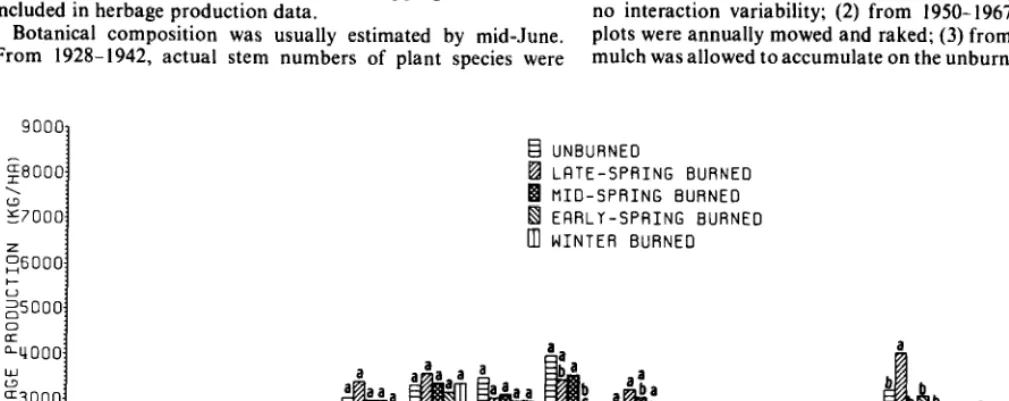
Fig. 1. Totalannual herbageproducrion (kg/ha oven-dry weight)from 1928-1944 under differem burning dates. One replication per treatment. Unburned plots were mowed and raked annually in late-spring. Means wirhin each year having rhe same letter are not significantly differem (P>.O5).
Total herbage production for each plot was measured annually at the end of the growing season, normally in early-October. Cur- rent year’s biomass was harvested by mowing swaths to a S-cm stubble height from 1928- 197 1, and by clipping four 0.4-m* quad- rats per plot to ground level beginning in 1972. Prior to 1965, yields had been on an air-dry basis and were converted to approximate oven-dry weights by reducing the yields 10%. Plots were not har- vested from 1945- 1952. Yearly herbage yields were excluded from statistical analysis when plots were not burned (1935-1937) when all plots accidentally burned (1966) and in 197 1, when erroneous sampling inflated production. Beginning in 1973, clipped herbage was segregated into grasses (including sedges) and forbs (including woody species). Mulch and old standing dead in unburned plots were removed from each quadrat prior to clipping and were not included in herbage production data.
Botanical composition was usually estimated by mid-June. From 1928-1942, actual stem numbers of plant species were
9000
E8OOO 5 a 57000
counted in 2 permanent meter-square quadrats in each plot. No plant census was taken from 1943-1949. From 1950-1974, basal cover and species composition were estimated by randomized line transects (Anderson 1942). Beginning in 1975, relative percentages of plant species and basal cover were determined by the modified step-point technique (Owensby 1973). To analyze the vegetational response from date of burning treatments, we segregated out 5 primary perennial grass species, and grouped other grasses, forbs, and woody species into appropriate categories.
All data were statistically analyzed by standard analysis of var- iance and treatment means separated by Duncan’s multiple range test (X.05). Because of variations in data collection, herbage yields were analyzed separately for 3 time periods: (I) from 192% 1944 when there was only one treatment replication and thus no interaction variability; (2) from 1950-1967 when unburned plots were annually mowed and raked; (3) from 1968-1982 when mulch was allowed to accumulate on the unburned plots. Herbage
UNBURNEO
LRTE-SPRING BURNEO RIO-SPRING BURNED ERRLY-SPRING BURNEO WINTER BURNED
1953 1954 1955 1956 1957 1958 1959 1960 1961 1962 1963 1964 1965 1967 FIVERQGE
Fig. 2. Toral annual herbage producrion (kg/ha oven-dry weight) from 1953-1967 under different burning dates. Two replications per treatment. Unburnedplots were mowed and raked annually in late-spring. Means within each year having the same letter are noz significantly different (P>.O5).
Table 2. Correlation coefficients (c) of total berbrge yields from 1928-1982 for date of burning treatments and independent precipitation variables.
Precipitation Unburned
Yearly total .28*
Previous years total .31*
January-April .03
May-June .17
May-September .24
Late-spring burn
.37* .23 .24* .30* .28*
Mid-spring bum
.32* .23 .I9 .25* .23
Early-spring burn
.35* .29* .24 .29* .26+
Winter burn
.36* .26* .I7 .36* .31*
9fK.05
production and species composition from the burning treatments were correlated with 5 selected combinations of precipitation: yearly total; previous year’s total; amount prior to growing season (January-April); amount during early portion of growing season (May-June); and amount during entire growing season (May- September).
Results and Discussion
Herbage ProductionHerbage yields fluctuated greatly throughout the years, ranging from 8,455 kg/ ha in 198 1 mid-spring burned plots to 0 kg/ ha in 1934 winter burned plots. Total herbage production in all burning treatments was highest in 1981 and second highest the following year, indicating that long-term annual burning does not decrease prairie productivity.
In the first phase of the study, average herbage production was significantly reduced by burning at any time compared to not burning (Fig. 1). However, the effects were not uniform over time. In only 3 of the 14 years did unburned plots produce significantly more biomass than any burned plot.
A significant interaction between burning and year of treatment in both the second and third phase of the study indicated total herbage yields were affected by date of burning more in some years than in others (Fig. 2 and 3). McMurphy and Anderson (1963) speculated that the greatest reduction in herbage yields from burn- ing occurred in the driest seasons. However, correlation coeffi- cients disclosed a weak relationship between herbage yields and time of burning over all precipitation variables (Table 2). Although most of the independent variables were significant, the low coeffi- cient values indicate that only a small portion of the variation in herbage yields can be attributed to precipitation factors. In years with annual precipitation at least 10% below normal, late-spring
burning never significantly reduced herbage production compared to unburned plots. Thus, contrary to rumored opinion, burning tallgrass prairie at the proper time, even in dry years, does not adversely affect herbage yields.
In other geographic regions, studies of vegetational response to wildfires or prescribed bums occurring at inopportune times often have neglected to take into account the time of burning. Although fire intensity, fuel source, and soil moisture are all potentially important in influencing vegetational response to fire, time of burning is the proxy for these factors, and in this study was the crucial factor ultimately affecting herbage production. Since 1928, burning in winter and early-spring has reduced total herbage yields an average of 15% and 16%, respectively, over plots burned in late-spring. Anderson (1965) attributed that to a reduction in soil moisture due to decreased infiltration and increased evaporation. Bieber and Anderson (1961) found progressively lower soil mois- ture the earlier an area was burned in relation to initiation of spring growth; however, there was no significant difference between unburned and late-spring burned plots. Burning at a time to min- imize surface exposure will thus curtail soil moisture loss and prevent concomitant herbage reduction.
Differences in herbage yields between burned and unburned plots prior to 1968 are misleading because the unburned plots were mowed and raked annually. Mechanical mulch removal increases total biomass production in tallgrass prairie (Penfound 1964). Higher soil temperatures on areas denuded early in the growing season by either clipping or burning are responsible for the increased productivity (Hulbert 1969, Rice and Parenti 1978, Adams and Anderson 1978). Mulch accumulations in undisturbed prairie eventually depress herbage yields and reduce the number of plant species (Weaver and Rowland 1952). After mulch removal was halted in 1968, unburned plots continued to yield more her-
UNBURNED
LRTE-SPRING BURNED MID-SPRING BURNED EARLY-SPRING BURNED WINTER BURNEO
aa a
1968 1969 1970 1972 1973 19711 1975 1976 1977 1978 1979 1980 1981 1982 RVERRGE
Fig. 3. Total annual herbageproduction (kg/ha oven-dry weight)from 1968-1982 under different burning dates. Two replications per treatment. Mulch allowed to accumulate on unburned plots, but was excluded from yearly production data. Means within each year having the same letter are not significrrntly difSerent (P>.OS).
bage than burned plots for another 4 years (Fig. 3), but biomass from unburned plots undoubtedly was inflated in some years due to inadvertent harvesting of litter and old standing dead.
Total herbage production, however, may not be the most impor- tant criterion in assessing benefits from burning. Analysis of indi- vidual herbage components from 1973-1982 indicated that late- spring burning significantly increased grass production and lowered forb production compared to any other treatment (Fig. 4).
5
,
~3000. u 22uoo- Z e ,1800- 2 21200.
W i!z
600.
q
UNBURNEO aLRTE-SPRING BURNEO MID-SPRING BURNED
q
EARLY-SPRING BURNEDq
WINTER BURNEDFORBS TOTAL
OJ-
Fig. 4. Average grass, forb, and totalproduction (kg]ha oven-dry weight) from 1973-1982 under different burning dates. Litter and old standing dead in unburned plots were excluded from production data. Means within each component having the same letter are not signtfkantly dgferent (FQ.05).
Unburned plots had the lowest grass and highest forb yields of any treatment. Burning in late-spring reduced forb production because most species were actively growing and at a low point in their carbohydrate reserves (Anderson et al. 1970). Grass yields increased from late-spring burning because fire at that time coincided with emergence of the dominant warm-season perennial grasses (Owensby and Anderson 1967).
Botanical Census
Long-term annual burning at various dates differentially affected plant species and shifted botanical composition from that prior to initiation of the study. Phenological development of a species at the time of burning largely determines its response to fire. Plants actively growing when burning occurs are more susceptible to fire injury than dormant species or those just initiating growth (Ander- son et al. 1970).
Andropogon gerardii
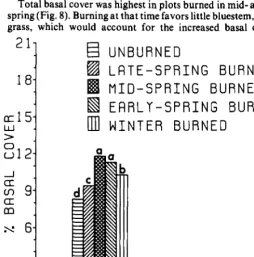
VitmanLate-spring burning significantly increased big bluestem a- mounts compared to other treatments (Fig. 5). Since 1961, big bluestem consistently accounted for over 50% of the total vegeta- tion in late-spring burned plots, indicating that it responds favora- bly to fire, particularly when burning occurs at the onset of spring growth. Unburned plots prior to 1968 contained lower amounts of big bluestem than other treatments; however, once yearly mulch removal was halted, relative density of big bluestem began increas- ing. Nearly pure stands of big bluestem eventually develop in ungrazed, heavily mulched prairie (Weaver and Rowland 1952, Hulbert 1969). Apparently, big bluestem is not adversely affected by fire exclusion when mulch accumulations inhibit competition from other species.
70
q
UNBURNEDGO &i LRTE-SPRING BURNED MID-SPRING BURNED
z50
q
EARLY-SPRING BURNED0
l-i
q
WINTER BURNEDBLUESTEM GRRSS BLUESTEM
Fig. 5. Average % composition of big bluestem, indiangrass, and little bluestem, indiangrass. and little bluestem from 1928-1982 under dif/er- ent burning dates. Means wirhin each year having the same letter are not signtficantly different (P>.O5).
Sorghastrum nutans
(L.) NashLate-spring burning significantly increased indiangrass, while winter and early-spring burning reduced amounts compared to those of unburned plots (Fig. 5). Since 1976, big bluestem and indiangrass together have comprised over 90% of the total vegeta- tion in late-spring burned plots. In unburned plots, indiangrass density began declining after 1973. Because indiangrass, unlike big bluestem, has indeterminant tillering (McKendrick et al. 1975) mulch accumulations likely inhibited tiller development.
Andropogon scoparius
Michx.Winter and late-spring burning adversely affected little blue- stem, but mid- and early-spring burning significantly increased amounts compared to not burning (Fig. 5). Hensel (1923) and Aldous (1934)also noted that little bluestem was favored by early- spring burning. In grazed pastures, however, Anderson et al. (1970) reported that little bluestem was reduced by early-spring, but not by late-spring burning. McMurphy and Anderson (1965) concluded that burning at any time was detrimental. Because little bluestem is a bunchgrass, the plant crown is susceptible to fire injury unless conditions are moist. Thus, discrepancies in the response of little bluestem to time of burning may reflect short- term fluctuations in prevailing environmental conditions at igni- tion time.
Little bluestem often accounted for over 50% of the total vegeta- tion, culminating at 75.8% in 1974 mid-spring burned plots. But the average percentage for all treatments fell from 43.6% in 1974 to
14.3% in 1975. At that time, the randomized line transect method for determining vegetation composition was abandoned in favor of the modified step-point. Increased amounts of big bluestem, indi- angrass, sedges, and perennial forbs offset little bluestem reduction in winter, early- and mid-spring burned plots. However, in unburned and late-spring burned plots, no species increases were associated with the changeover in sampling technique.
Poa pratensis
L.
Kentucky bluegrass, a cool-season perennial with low drought tolerance and inherently low productive capacity in Kansas, was effectively reduced by burning on all dates (Fig. 6). Fire essentially eliminated bluegrass because the plant was actively growing and susceptible to injury.
Fluctuation of Kentucky bluegrass in unburned plots was responsible for a significant interaction among years. That effect, however, was not correlated with precipitation (r<. 12 for all inde-
21
H UNBURNED
18 LRTE-SPRING BURNED
MIO-SPRING BURNEU
z15 ERRLY-SPRING BURNED
0
H •l WINTER BURNED
=112 u-l
0 n-
x9
0 0
SG
0
GRRSS GRRSS GRQSSES
Fig. 6. Average % composition of Kentucky bluegrass, prairie junegrass, and other perennial grasses from 1928-1982 under dfferent burning dates. Means within each block having the same letter are not signify- cantiy different (p>.OS).
pendent variables). Apparently, there was an interaction with mulch thickness because bluegrass began increasing in unburned plots 3 years after annual top growth removal ceased. Bluegrass peaked in 1979 at 34.8% of the total vegetation and then began progressively declining, probably because of dense mulch accumu- lations. Weaver and Rowland (1952) observed an absence of Ken- tucky bluegrass in heavily mulched tallgrass prairie undisturbed by fire, grazing, or mowing.
Koeleria pyramidata (Lam.) Beauv.
Prairie junegrass, another cool-season perennial, is not a domi- nant species in the tallgrass prairie, but was segregated out because it accounted for 20-30% of the total vegetation in the 1920’s. Unlike bluegrass, prairie junegrass was adversely affected by pro- tection from fire but was favored by winter and early-spring burn- ing (Fig. 6). That explains the high amount ofjunegrass present at the beginning of the study when it was common practice to burn in January or February.
Other Perennial Grasses
The remaining aggregate of perennial grass species decreased under late- and mid-spring burning (Fig. 6). Fire at that time favored big bluestem and indiangrass, which displaced other per- ennial grass species. Predominant recurring species in all plots included sideoats grama [ Bouteloua curtipendula (Michx.) Torr.], tall dropseed [Sporobolus asper (Michx.) Kunth var. asper], prairie dropseed [S. heterolepis (Gray) Gray] and Scribner’s pani- cum [Panicum oligosanthes Schult. var. scribnerianum (Nash) Fern.]. Following the 1930’s and 1950’s drought, sideoats grama significantly increased, particularly in plots burned in winter, early-, and mid-spring. Otherwise, average composition of all the species remained relatively stable throughout the years, indicating their persistence as subdominants in the tallgrass prairie.
Switchgrass (Panicurn virgutum L.), considered a dominant in many parts of the tallgrass prairie, was not abundant enough for statistical evaluation and was analyzed with the other perennial grasses. Highest amounts of switchgrass were in unburned plots that were mowed and raked annually. However, after mulch remo- val was stopped, switchgrass stands declined. Under all burning treatments, switchgrass generally maintained a relative composi- tion of less than 1%.
Sedges
Early-spring and winter burning significantly increased the
amount of sedges compared to not burning (Fig. 7). Late-spring burning essentially eliminated sedges, because growing season of the dominant genus, Carex, began in late March, making it sus- ceptible to fire injury.
18
1
ii/ UNBURNED
q
LQTE-SPRING
BURNED
MID-SPRING
BURNED
q
EARLY-SPRING
BURNED
•] WINTER
BURNED
Fig. I. Average % composition of sedges andperennialforbs from 1928- 1982 under different burning dates. Means within each block having rhe same letter are not signtficantly dtfferent (P>.OS).
Annual
Grasses and Annual Forbs
Annual grasses have been virtually nonexistent in any treatment since inception of the study. Although they never exceeded trace amounts, average percentage of annual grasses was highest in unburned plots and lowest in plots burned in late-spring. Sporadi- cally appearing species included common witchgrass (Panicurn capillare L.) and poverty dropseed [Sporobolus vagintjlorus (Torr.) Wood].
Annual forb populations also were insignificant, accounting for less than 1% of the vegetation in any treatment since 1950. There was no significant difference among treatments (p>. 14). During the drought of the 1930’s, however, a few species, primarily daisy fleabane (Erigeron strigosus Muhl.) and rough falsepennyroyal (Hedeoma hispida Pursh), flourished for a short period in all burned plots. Small amounts of snow-on-the-mountain (Euphor- bia marginata Pursh) have occurred most years in unburned plots.
Perennial Forbs
Compared to other treatments, late-spring burning significantly reduced perennial forbs while burning in winter and early-spring favored them (Fig. 7). Throughout the years, perennial forb popu- lations have remained relatively stable in each of the respective treatments. Predominant species that have survived repeated burn- ings include heath aster (Aster ericoides L.), showy goldenrod (Solidago speciosa Nutt.), and pitcher sage (Salviapitcherii Torr.). In unburned plots, the dominant perennial forbs included Louisi- ana sagewort (Artemisia ludoviciana Nutt. var. ludoviciana) and western ragweed (Ambrosia psilostachya DC.).
Woody Species
Burning had a diverse effect on woody species, but composition in any treatment rarely exceeded 1% of the total vegetation. Plots burned in winter, early-, and mid-spring contained significantly higher amounts of woody plants than late-spring or unburned plots. That was because leadplant (Amorpha canescens Pursh), the

![Fig. 4. Average grass, forb, and totalproduction (kg]ha oven-dry weight) from 1973-1982 under different burning dates](https://thumb-us.123doks.com/thumbv2/123dok_us/1868297.1242999/13.635.17.268.102.321/fig-average-grass-totalproduction-weight-different-burning-dates.webp)