SRR Superstrate for Gain and Bandwidth Enhancement
of Microstrip Patch Antenna Array
Chirag Arora1, *, Shyam S. Pattnaik2, and Rudra N. Baral3
Abstract—This article presents a microstrip fed patch antenna array, loaded with metamaterial superstrate. An unloaded antenna array resonates at IEEE 802.16a 5.8 GHz Wi-MAX band with gain of 4.3 dBi and bandwidth of 425 MHz. However, when the same array is loaded with a metamaterial superstrate, composed of a pair of Split Ring Resonators (SRR), there is simultaneous gain and bandwidth improvement to 8 dBi and 680 MHz, respectively, which corresponds to gain improvement by 86% and bandwidth enhancement of 60%. The fabrication of this proposed antenna array is done, and its simulated and measured results are compared. Equivalent circuit model of this composite structure has been developed and analyzed. The electrical dimension of the patch is 0.23λ×0.3λ.
1. INTRODUCTION
Present mobile and satellite communication systems require very high data transfer rates. Antennas required to achieve such data rates should have certain extraordinary features such as high gain, wide bandwidth, light weight, compact size and ease of integration with microwave circuits. Microstrip patch antennas generally meet the requirements of light weight and compact size, but their use in certain systems is limited, as a single microstrip patch antenna has relatively low gain and narrow bandwidth with low efficiency.
A lot of studies have been published on performance improvement of patch antennas, such as (i) use of large number of patch antennas in array configuration [1] (ii) increasing the substrate thickness [2] (iii) optimizing the impedance matching of microstrip patch antenna by the use of shorting pins, plates, posts, etc. [3] (iv) using high permittivity substrates [4] (v) using multiple substrates [5] (vi) loading conventional patch antenna by artificial materials [6, 7]. In [1], Islam and Karmakar designed a 4×4 array of patch antennas for RFID reader. The designed array produced a considerable gain of 16 dBi but did not obtain any improvement in bandwidth. In [2], Kovitz and Samii used a thick substrate to enhance the bandwidth of a microstrip patch antenna. Similarly, in [3], Chow and Wan tried to miniaturize the antenna by using shorting pins near the feed probe. In [4], Tang et al. enhanced the axial ratio bandwidth of the patch antenna by using high permittivity substrate. In [5], Prasad et al. used a multilayer substrate for bandwidth enhancement of a patch antenna.
However, most of the research is limited to the upliftment of either gain or bandwidth of a single element patch antenna, and comparatively less attention has been paid towards simultaneously increment of their gain and bandwidth [8–11]. Moreover, as per the best knowledge of the authors, the techniques followed by these researchers are limited to single patch element, and no attention has been paid to incorporating these techniques for performance improvement of patch antenna arrays. Also, most of these techniques make the antenna bulky and even difficult to fabricate. For example, in [8], Rao and Dinesh used a multilayer dielectric substrate for gain and bandwidth enhancement. However,
Received 14 April 2017, Accepted 26 May 2017, Scheduled 19 June 2017 * Corresponding author: Chirag Arora (c [email protected]).
1 Krishna Institute of Engineering & Technology, Ghaziabad (UP), India. 2 National Institute of Technical Teachers’ Training and
great efforts are required to fabricate such structures. In [9], Attia and Ramahi simultaneously increased the gain and bandwidth of a patch antenna by using a cross stacked EBG substrate, but use of stacked EBG makes the antenna bulky and tedious to fabricate. In [10], Nishiyama et al. stacked a microstrip patch antenna, but the size of the ground plane of this stacked patch antenna is twice that of patch size. Honari et al. in [11], used a slotted, ring-shaped patch antenna to improve its gain and bandwidth, but slotting of this ring requires a very precise control, and hence, it is very difficult to design.
Recently, due to controllable electric and magnetic response of single/double negative metamaterials [12], antenna researchers worldwide have been attracted by them, as their novel properties are capable not only to squeeze the antenna size, but also improve various performance parameters of the antenna effectively such as return loss, VSWR, bandwidth, gain, and directivity. Moreover, they have easy physical realization and can be comfortably incorporated with conventional antennas as compared to other engineered materials. In [13], Smith et al. were the first to experimentally demonstrate these materials. Since then, due to their novel properties, they have been deeply studied as potential artificial materials for large number of applications in the microwave and optical region [14, 15]. Several configurations of metamaterial have been used by different researchers [16–23]. In [17], Joshi et al. deigned a MSRR loaded dual-band microstrip patch antenna to obtain size reduction. In [19], Chaimool et al. covered a conventional patch antenna with metamaterial superstrate, but dimensions of the ground plane used in this antenna is approximately seven times the size of radiating patch, thus making the size of loaded patch antenna quite large. Moreover, all the research discussed in [16–20] is limited to single radiating patch only.
As per the best knowledge of authors, for the very first time, the authors have extended the application of metamaterial loading to the array of conventional microstrip patch antennas, for their performance improvement, and analyzed the equivalent circuit of the composite structure. In [21], the authors loaded the feed line of a conventional patch antenna array with a pair of Split Ring Resonators (SRR), as a result of which, significant improvement in gain as well as bandwidth is obtained. In order to improve the performance of conventional patch antenna array further, Arora et al. in [22], replaced the ground plane of a conventional antenna array with a metamaterial ground plane and observed that the proposed antenna presented better performance than [21]. In [23], the authors, again for the very first time, covered conventional patch antenna array with a metamaterial superstrate layer, composed of a pair of SRRs and observed that there was drastic improvement in bandwidth and gain, simultaneously. Further in this communication, the authors have extended the work of [23] by (i) Testing the loaded antenna array and validating the simulated and experimental return loss characteristics and radiation patterns (ii) Theoretically analyzing the loaded antenna array (iii) Applying effective medium theory to metamaterial unit cell (iv) Developing, discussing and validating equivalent circuit of the composite structure.
The novelty of this work lies in the fact that for the very first time metamaterial superstrate layer has been used for simultaneous gain and bandwidth enhancement of a microstrip patch antenna array, along with the design, analysis and validation of equivalent circuit of the proposed composite structure. Moreover, the designing of a superstrate layer has been done in such a manner that the dimensions of this proposed metamaterial layer and ground plane of a conventional antenna array are exactly identical, thus making the composite structure compact in size and light in weight. Also, the dimension of ground plane of the proposed antenna is 1.75 times the size of radiating patch, which is much smaller than the antenna designed in [19], where the dimension of ground plane is seven times the size of radiating patch. Gain enhancement of 86% and bandwidth improvement of 60% are obtained, which is much higher than their counterparts designed in [8–11, 19], with respect to their overall aspect ratios.
2. ANTENNA ARRAY DESIGN AND METAMATERIAL SUPERSTRATE ANALYSIS
2.1. Antenna Array Design
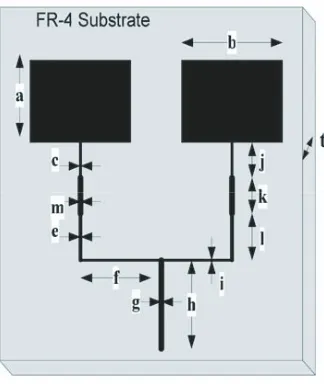
Figure 1 depicts the geometrical structure of a two-element conventional microstrip patch antenna array, and Fig. 2(a) presents the perspective view of a conventional patch antenna array covered with the designed metamaterial superstrate. The side view of the proposed antenna array is presented in Fig. 2(b). Both, conventional patch antenna array and metamaterial superstrate, are designed on FR-4 substrate of thickness (t) = 1.48 mm, dielectric constant (εr) = 4.3 and loss tangent = 0.01. 50 ohm SMA coaxial connector is used to feed the antenna array, and simulations are done using Mentor Graphics IE3D, a method of moment based full wave electromagnetic simulator.
Figure 1. Geometrical sketch of 2-element conventional microstrip patch antenna array.
(a) (b)
Figure 2. Geometrical sketch of proposed microstrip patch antenna array loaded with metamaterial superstrate. (a) Perspective view. (b) Side view.
Table 1. Dimensions of antenna array.
Parameters Dimensions (mm)
a 11.95
b 0.5237
c 2.8758
e 1.38
f 7.55
i 15.88
j 7.55
t 1.48
m 0.5237
2.2. Metamaterial Superstrate Analysis
Figure 3 presents the structure of SRR unit cell, and the geometric sketch of metamaterial superstrate consisting of a pair of this SRR is depicted in Fig. 4. The designed metamaterial superstrate is used to cover the patches of the conventional antenna array in such a way that it does not increase the overall size of the proposed antenna, i.e., the dimensions of loaded and unloaded antennas remain almost the same. The geometrical dimensions of the SRR unit cell are: length of outer split ring (Ls) = 3.9 mm, width of rings (w) = 0.1 mm, gap at split of rings (g) = 0.2 mm, and separation between inner and outer split rings (s) is set to 0.9 mm. The dimensions of SRR are chosen in such a way that its overall length is shorter than λ/10, so that the particle behaves as subwavelength element. The overall dimensions of the metamaterial superstrate layer are 52.5 mm×19 mm, and it is placed at a distance (d) of 8 mm from the ground plane of the conventional patch antenna array. This distance of superstrate layer, from the ground plane of the conventional patch antenna array, is found to be the optimum position for the best performance of the proposed array. A method of moment based IE3D full wave electromagnetic simulator is used to simulate this proposed antenna array, and its equivalent circuit model is developed and analyzed. The antenna measurements are done to validate the experimental and simulated results.
Figure 3. Geometrical structure of SRR unit cell. Figure 4. Geometrical structure of metamaterial superstrate.
Figure 5. Unit cell of metamaterial superstrate placed in a waveguide.
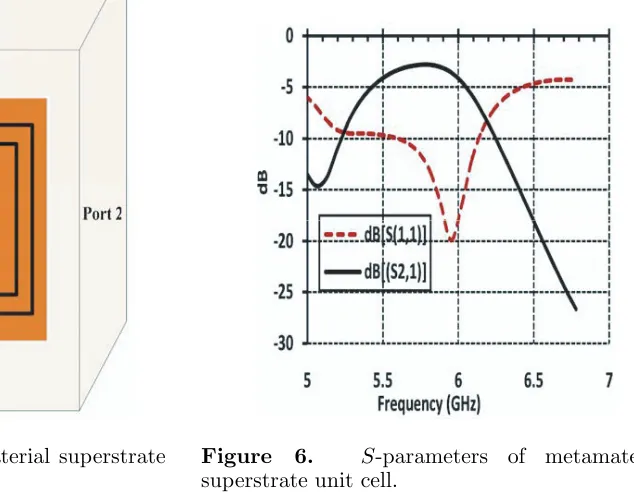
Figure 6. S-parameters of metamaterial superstrate unit cell.
the wave guide is shown in Fig. 5, and the simulated S-parameters retrieved from it are presented in Fig. 6.
Nicolson-Ross-Weir (NRW) technique [27] has been used to attain the effective magnetic permeability of SRR unit cell, since this approach provides an easy and simple calculation method as compared to other methods such as NIST iterative technique and free-space method. The expressions of Equations (1) and (2) are used to determine these effective medium parameters.
μr = 2 jkod
1−V2 1 +V2
(1)
εr = 2
jkod
1−V1 1 +V1
(2)
wherek0 is the wave number; dis the thickness of substrate; V1 andV2 are the composite terms which represent the addition and subtraction of S-parameters. The values of V1 and V2 are estimated using Equations (3) and (4) [27].
V1 = S21+S11 (3)
V2 = S21−S11 (4)
By using the obtained S-parameters, above mathematical equations and MATLAB code, the metamaterial characteristics of SRR unit cell are verified. From Fig. 7(a) it is observed that the magnetic permeability of the SRR unit cell is negative from 5.58 GHz to 5.9 GHz, implying that the structure exhibits metamaterial characteristics at the frequency of interest. However, no negative value of permittivity is obtained, as shown in Fig. 7(b). Fig. 8(a), Fig. 8(b) and Fig. 8(c) present the photographs of the unloaded antenna array, zoomed view of metamaterial superstrate and perspective view of the fabricated loaded antenna array, respectively.
3. RESULTS (SIMULATED & MEASURED) AND PARAMETRIC ANALYSIS
(a) (b)
Figure 7. (a) Magnetic permeability characteristics. (b) Electric permittivity characteristics of SRR unit cell.
(a) (b)
(c)
Figure 8. Photograph of (a) fabricated unloaded antenna array, (b) 4×zoomed view of metamaterial superstrate, (c) metamaterial superstrate loaded microstrip patch antenna array (perspective view).
confirming the validity of the design. Parametric study of the composite structure is done to show the effects of various antenna design parameters on performance indices of the antenna.
3.1. Results (Simulated & Measured)
(a) (b)
Figure 9. Return loss characteristics of (a) unloaded antenna array, (b) loaded antenna array (measured and simulated).
(a) (b)
Figure 10. Measured and simulated elevation plane radiation pattern characteristics of (a) unloaded, (b) loaded proposed antenna array.
resonates at 5.8 GHz with bandwidth of 425 MHz, whereas when the patches of conventional patch antenna array are covered with metamaterial superstrate, bandwidth reaches 680 MHz at the same resonant frequency, corresponding to the bandwidth improvement of 60%.
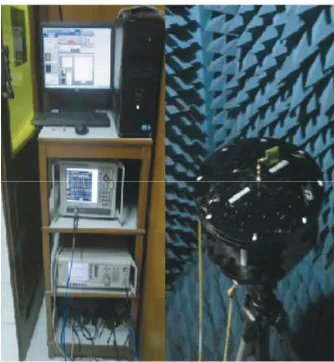
Figures 11(a) and 11(b) present the simulated 3-D radiation patterns of unloaded and loaded microstrip patch antenna arrays at 5.8 GHz, respectively. Fig. 12 presents an inset photograph of experimental setup to measure return loss characteristics of the fabricated metamaterial superstrate loaded antenna array. Anritsu Vector Network Analyzer, model no. MS2028C, frequency range 5 kHz to 20 GHz, is used to measure the return loss of this proposed antenna array. Radiation patterns are measured with spectrum analyzer, model no. Anritsu MS2719B, operating over the frequency range of 9 kHz to 20 GHz. The experimental setup to measure the radiation patterns in an anechoic chamber is shown in Fig. 13.
From Fig. 9(b), it is observed that the fabricated antenna array resonates at 5.8 GHz with bandwidth
(a) (b)
Figure 11. 3-D Radiation patterns of (a) unloaded microstrip patch antenna array, (b) superstrate loaded microstrip patch antenna array.
Figure 12. Inset photograph of experimental set up to measure S11 characteristics of fabricated metamaterial superstrate loaded antenna array.
of about 600 MHz, showing that the two results are in good agreement with each other. However, some change in the shapes of the two curves is due to the inaccuracy occurring while fabricating the proposed antenna array and the use of the FR-4 substrate, which is lossy in nature but quite cheap, and hence, suitable for making such prototypes.
3.2. Parametric Analysis
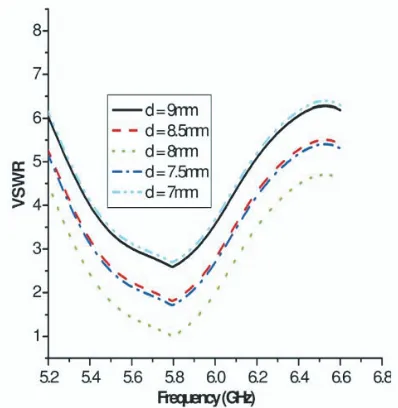
The height (d) between the proposed metamaterial superstrate and the ground plane of traditional antenna array is an important parameter to decide the gain and bandwidth of the proposed array. To determine the optimized value of this height, so as to obtain the maximum improvement in gain and bandwidth of the proposed array, its parametric analysis is performed. Fig. 14 and Fig. 15 show the variation of gain and VSWR at 5.8 GHz, respectively, of the proposed antenna array with the change ind. It is observed that ford= 8 mm, maximum improvement in gain and VSWR is obtained. Occurrence of maximum improvement in the performance indices of the proposed antenna array, at this particular height, can be explained on the basis of increased coupling of metamaterial superstrate with the traditional patch antenna array.
Figure 14. Variation in gain of proposed antenna array as a function of height between superstrate layer and ground plane.
Figure 15. Variation in VSWR of proposed antenna array as a function of height between superstrate layer and ground plane.
4. ANALYTICAL ANALYSIS AND EQUIVALENT CIRCUIT MODEL
Behavior mechanism and the equivalent circuit of the proposed metamaterial superstrate are discussed in this section. Various design equations of the equivalent circuit are also presented.
4.1. Analytical Analysis
comes in existence when the superstrate layer forms the cover of the antenna patches. As per the Snell’s Law of refraction, the medium with low refractive index moves the electromagnetic waves away from the primary source and in the direction parallel to the normal of this surface. This property results in directivity enhancement of the proposed antenna array. Moreover, at the resonant frequency, the calculated reflection coefficient is approximately 0.79, showing that the metamaterial superstrate acts as a highly reflective surface, thus making the antenna highly directive. The presence of metamaterial superstrate also makes the field distribution of the patch antenna more uniform, thus improving the overall gain of the proposed antenna array. Thus it is concluded that the metamaterial superstrate acts as a parasitic load that enhances the bandwidth, and the cavity effect improves the gain of the proposed antenna array.
4.2. Equivalent Circuit Model
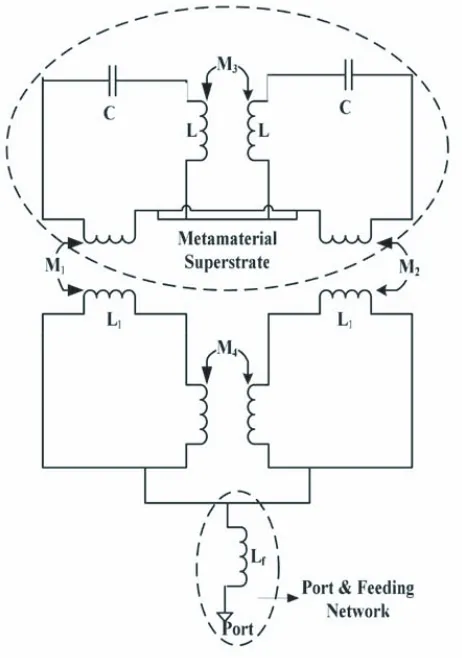
Figure 16 shows the equivalent circuit of the microstrip patch antenna array loaded with a superstrate layer formed by split ring resonators. L and C represent the equivalent inductance and capacitance, respectively, of the split ring resonator, whereas L1 represents the equivalent inductance of microstrip patch. The resultant inductance of the port and feeding network is represented byLf.
Figure 16. Equivalent circuit of proposed antenna array.
As per the principle of equivalent circuit theory, the modeling of split ring resonator can be done as a LC resonant circuit, such that the values of equivalent inductance of SRR (L) and equivalent capacitance of SRR (C) are calculated using Equations (5) and (6) [27].
L= μ0 2
Lsavg
4 4.86
ln0.98
ρ + 1.84ρ
where, μ0 is the permeability of free space, ρ the filling ratio, Lsavg the average length of the square SRR, which is given asLsavg = 4[Ls−(N−1)(w+s)], andN the number of split rings. The equivalent
capacitance (C) of SRR is given as [27]
C=ε0
N−1 2
2Ls−(2N −1) (w+s)K
1−k21 K(k1)
(6)
where, ε0 is the permittivity of free space, K the complete elliptic integral of first kind, and k1 the argument of integral expressed as (s/2)/(w+s/2).
When the metamaterial superstrate is placed close to the patch, the SRRs get inductively coupled with the patch antenna because there exists some mutual inductance (M1 andM2) between them. This mutual inductance between SRRs and the patch antenna is calculated using Equation (7), and its value is 1.11 nH.
M1 =M2 =
μ0Ls 2π
0.467 + 0.059(w+W) 2
L2
s
(7)
There also exists some mutual inductance between the neighboring SRRs (M3) and neighboring patches (M4), whose magnitudes are calculated using Equations (8) and (9) [28], and are found to be 0.943 nH and 1.589 nH, respectively.
M3 =
μ0Ls 2π
0.467 + 0.059(w) 2
L2
s
(8)
M4 = −
μL
2π
ln(1 +√2) + 1−√2 +w2√2/24L2
(9)
Due to the conducting nature of patches and split rings, they also possess some self inductance. The self inductance (Ms) of the rectangular patch antenna is given by Equation (10) [28].
Ms= μL
2π
ln 2L
w
+ 0.5 + w 3L−
w2
24L2
(10)
The inductance of the microstrip patch antenna array, with the capacitance of SRRs and mutual inductances, makes the loaded antenna behave as LC resonant circuit. This capacitance compensates the inductance of the microstrip patch array, and thus, under loaded conditions, good matching is obtained at the resonant frequency.
5. CONCLUSIONS
A metamaterial superstrate loaded microstrip patch antenna array for IEEE 802.16a 5.8 GHz Wi-MAX applications has been developed. The proposed composite structure enhances the gain of a conventional patch antenna array by 86% and improves the bandwidth by 60% while maintaining almost same profile and cost. The equivalent circuit of the proposed antenna array is designed and analyzed. The proposed antenna array is fabricated and tested to support the simulated results. The performance comparison of the conventional unloaded antenna array and proposed metamaterial superstrate loaded antenna array shows that the metamaterials have good potential to improve the performance of antennas.
REFERENCES
1. Islam, M. A. and N. C. Karmakar, “A 4×4 dual polarized mm-wave ACMPA array for a universal mm-wave chipless RFID tag reader,” IEEE Trans. Antennas Propag., Vol. 63, No. 4, 1633–1640, 2015.
2. Kovitz, J. M. and Y. R. Samii, “Using thick substrates and capacitive probe compensation to enhance the bandwidth of traditional CP patch antennas,”IEEE Trans. Antennas Propag.,Vol. 62, No. 8, 4970–4979, 2014.
4. Tang, X., H. Wong, Y. Long, Q. Xue, and K. L. Lau, “Circularly polarized shorted patch antenna on high permittivity substrate with wideband,” IEEE Trans. Antennas Propag., Vol. 60, No. 3, 1588–1592, 2012.
5. Prasad, R. R., B. Srinu, and C. D. Raj, “Design and analysis of multi substrate microstrip patch antenna, microelectronics, electromagnetics and telecommunications,” Lecture Notes in Electrical Engineering, Vol. 372, 733-739, Springer, India, 2016.
6. Mittra, R., Y. Li, and K. Yoo, “A comparative study of directivity enhancement of microstrip patch antennas with using three different superstrates,”Microw. Optical Technology Lett., Vol. 52, No. 2, 327–331, 2010.
7. Foroozesh, A. and L. Shafai, “Investigation into the effects of the patch type FSS superstrate on the high-gain cavity resonance antenna design,” IEEE Trans. Antennas Propag., Vol. 58, No. 2, 258–270, 2010.
8. Rao, N. and K. V. Dinesh, “Gain and bandwidth enhancement of a microstrip antenna using partial substrate removal in multiple-layer dielectric substrate,” Proc. of Progress In Electromagnetics Research Symposium,PIERS Proceedings, 1285–1289, Suzhou, China, September 12–16, 2011. 9. Attia, H. and O. M. Ramahi, “EBG superstrate for gain and bandwidth enhancement of microstrip
array antennas,”Proc. of IEEE International Symposium on Antennas and Propagation AP-S 2008, 1–4, Canada, 2008.
10. Nishiyama, E., M. Aikawa, and S. Egashira, “Stacked microstrip antenna for wideband and high gain,”IEE Proc. Microw. Antennas Propag., Vol. 151, No. 2, 143–148, 2004.
11. Honari, M. M., A. Abdipour, and G. Moradi, “Bandwidth and gain enhancement of an aperture antenna with modified ring patch,”IEEE Antennas Wirel. Propag. Lett., Vol. 10, 1413–1416, 2011. 12. Lapine, M. and S. Tretyakov, “Contemporary notes on metamaterials,” IET Microw., Antennas
and Propag., Vol. 1, No. 1, 3–11, 2007.
13. Smith, D. R., W. J. Padilla, D. C. Vier, S. C. N. Nasser, and S. Schultz, “Composite medium with simultaneous negative permeability and permittivity,” Physical Review Lett., Vol. 84, No. 18, 4184–4187, 2000.
14. Engheta, N. and R. W. Ziolkowski, “A positive future for double negative metamaterials,” IEEE Trans. Microw. Theory Tech., Vol. 53, No. 4, 1535–1556, 2005.
15. Alu, A., N. Engheta, A. Erentok, and R. W. Ziolkowski, “Single negative, double-negative, and low-index metamaterials and their electromagnetic applications,” IEEE Antennas and Propag. Magazine, Vol. 49, No. 1, 23–36, 2007.
16. Joshi, J. G., S. S. Pattnaik, and S. Devi, “Metamaterial embedded wearable rectangular microstrip patch antenna,” Hindawi Int. J. of Antennas and Propag., Vol. 2012, 1–9, 2012.
17. Joshi, J. G., S. S. Pattnaik, and S. Devi, “Metamaterial loaded square slotted dual band microstrip patch antenna,” Proc. of IEEE Applied Electromagnetics Conference (AEMC-2011), 1–4, India, 2011.
18. Ferdous, S., A. Hossain, S. M. H. Chowdhury, and M. R. C. Mahdy, “Reduced and conventional size multi-band circular patch antennas loaded with metamaterials,”IET J. Micro., Antennas Propag., Vol. 7, No. 7, 768–776, 2013.
19. Chaimool, S., K. L. Chung, and P. Akkaraekthalin, “Simultaneous gain and bandwidths enhancement of a single-feed circularly polarized microstrip patch antenna using a metamaterial reflective surface,” Progress In Electromagnetics Research B, Vol. 22, 23–37, 2010.
20. Chung, K. L. and S. Chaimool, “Broadside gain and bandwidth enhancement of microstrip patch antenna using a MNZ-metasurface,” Microw. Optical Technology Lett., Vol. 54, No. 2, 529–532, 2012.
21. Arora, C., S. S. Pattnaik, and R. N. Baral, “SRR inspired microstrip patch antenna array,”Progress In Electromagnetics Research C, Vol. 58, No. 8, 89–96, 2015.
23. Arora, C., S. S. Pattnaik, and R. N. Baral, “Metamaterial superstrate for performance enhancement of microstrip patch antenna array,” 3rd International Conference on Signal Processing and Integrated Networks (SPIN-2016), 775–779, India, 2016.
24. Garg, R., P. Bhartia, I. Bhal, and A. Ittipiboon, Microstrip Antenna Design Handbook, Artech House, Boston, UK, 2001.
25. Balanis, C. A.,Modern Antenna Handbook, John Wiley & Sons, New York, USA, 2011. 26. Pozar, D. M., Microwave Engineering, John Wiley & Sons, New York, USA, 2008.
27. Joshi, J. G., S. S. Pattnaik, S. Devi, and M. R. Lohokare, “Frequency switching of electrically small patch antenna using metamaterial loading,” Indian J. Radio Sp. Phys., Vol. 40, No. 3, 159–165, 2011.