Available Online atwww.ijcsmc.com
International Journal of Computer Science and Mobile Computing
A Monthly Journal of Computer Science and Information Technology
ISSN 2320–088X
IMPACT FACTOR: 6.199
IJCSMC, Vol. 8, Issue. 12, December 2019, pg.109 – 116
Multimodality User Interface in
Mobile Technology: Increase
Learning Performance for
Dyslexic Students in Sudan
Tumadir Badawi
Computer Science
& Sudan University of Science and Technology, Sudan
Abstract— Multimodal user interface (MUI) plays a key role in the future of mobile technology. After having a comprehensive review of the previous researches to determine the research problem, the researcher collected the relevant data by face to face interview with dyslexia students, teachers and experts from learning difficulty domain. This research developed a multimodal user interface in mobile learning application, for dyslexic students. The Researcher implement an Arabic letter mobile application to taught dyslexic students in a Sudanese primary school. Firstly, the application was developed on android platforms. Secondly, the application implemented in students sampling of size 30 students. Finally, the application was evaluated in two stages. The first one is to evaluate the enhancement of student who was taught a multimodal user interface; the second stage is an evaluation by using the technology acceptance model (TAM). The evaluation stage show increasing in education level for dyslexia students in significant degrees. Multi-mode learning has a good effect in dyslexia students on this study, there was a significant difference between student’s marks after using the mobile application in teaching alphabet letters and the student’s degrees before using the mobile application, which means the multimode user interface improved the reading skills for most dyslexic students who are involved in our study.
Keywords— dyslexic students, multimode, Arabic letters, mobile learning, mobile application.
I. INTRODUCTION
―any item, piece of equipment or product system, whether acquired commercially off the shelf, modified, or customized, that is used to increase, maintain, or improve the functional capabilities of a child with a disability[5]. AT is used to help create opportunities and promote independence for students with disabilities. It also helps empower students with disabilities to take the lead in their education and can help to develop self-determination when students can pick their own apps[6]. Mobile devices are powerful and assistive technologies that may be facilitating the learning process of disabled people, there are many types of research asserts that they can help students with disabilities [7]. A research study about the amount of educational apps available on mobile found that 2 out of every 5 apps could be used to support students’ needs in school and the community [8]. One of the major benefits of using mobile devices in the classroom is the ease of use for students and teachers. Many teachers struggle with adapting to assistive technology devices they may be unfamiliar with them. However, most teachers have some type of Smartphone or tablet that operates in the same way as an iPad. Since many teachers already knew how to use the mobile, it makes training professionals use the equipment as AT or instructional technology much easier.[9]
II. MULTIMODAL INTERFACE
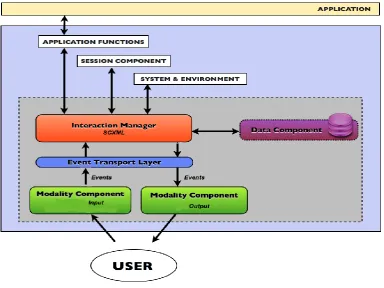
Mode means the manner of using the human sensory system to interact in an outer environment; the interaction with one sensory organ is called single-mode and the interaction with more than one sensory organ is called multi-mod [10]. A multimodal interface refers to: ―Applications or systems that combine multiple modalities of input and output‖ [11]. A multimodal human-computer interface is important because the user can choose the method of interaction that is suitable for him [12]. Notably, a system with multiple keys is not multimodal, but a system with a keyboard and mouse input is [13]. Multimodal has three main components figure 1 show the multimodal components:
1) The user: is a person or automated user who enters input into the system and receives information presented by the system.
2) Input: input modes that will be used in multimodal implementation such as audio, speech, handwriting, and keyboarding, and touch screen.
3) Output: is the output modes that will be used in the multimodal implementation such as speech, text, graphics, audio files, and animation
4) Interaction manager: It is the conceptual part that coordinates data and manages execution flow from input and output modality components interface objects.
5) Session component: It produces an interface for the interaction manager to support state management and constant sessions for multimodal applications.
6) System and environment: It enable the interaction manager to find out and respond to changes in device capabilities, such as user preferences and environmental conditions.
III. RELATED WORK
As a result of investigating of comprehensive previous research, below are the related studies which covered using multimodal in a mobile application in the education process with dyslexia students:
Ting-Feng [14]. The author designed a questionnaire to find the effect of information and communication technology (ICT) access and ICT competency. The research covers elementary school students to collect data. The study sample was 117 students with learning disabilities (LD) and compared by 117 students without learning disabilities were recruited in this investigation and were conducted with the questionnaire. The results of the research highlighted that, there was no significant difference to access computers and the Internet at home and at school between children with and without learning disabilities. However, there was a significant difference between children with and without LD in ICT efficiently.
Nicole Quick [15]. The author investigated the literature review in recent years by examined the effectiveness of the use of the assistant device like iPads to support developing and improve achievement for students with disabilities. The analysis covers both sides’ benefits and difficulties of using iPads in the classroom. The research concluded that the iPads devices could be improved special education services for students. The result of this research confirmed that assistive devices like iPads were effective technology in the classroom. However, there is a lack of application that best meet the student’s needs.
Nisha Sharan [16] English as a second language in learning. The research proved that computer assistance motivated dyslexic students to achieve their goals. The research found that the school and the home environments affect dyslexic students who have Swedish as a second language. The author takes a sample that consisted of four dyslexia students, 13 to 15-year-olds who have Swedish as a second language. Also, the sample contained two Swedish teachers. The author collected the data using semi-structured interviews and analyzed using content analysis. After transcribing the interviews’ six themes: and choose the computer as a tool, inclusion, motivation and environment were identified. The research results were that computers are effective tools for dyslexic students who have Swedish as a second language. Assistance devices make these students more independent to find ways to support themselves. It motivates the students to learn more. It was very clear that the students were more efficient in computers compared to the teachers. Maybe, both the teachers and students should be given the same competence and education. Motivation is the most important aspect of learning was very noticeable in all the six interviews. However, the solution did not consider the student’s and teacher’s background.
Helena Song Sook Yee [17]. The author found that among mobile features there were flexible multimedia content and storage, portability, mobility and affordability. The author investigated previous researches to show the significant role of these devices and proved that it could be enhancing the quality of life of the children with learning disabilities and their families. The study found that there was a lack of published research studies on the use of mobile technologies with children those how had learning disabilities. However, the solution ignores the parents and school whom are assists these individuals.
TABLE I RELATED WORKS
No Author Approach Adv+ Limitation
1 Ting-Feng Investigated and Analysis
No difference to access computers between LD and non LD
Lack of specific designed ICT instruction programs for LD
2 Nicole Quick Investigated and Analysis
covers both sides benefits and difficulties
A lack of application that meet student’s needs
3 Nisha Sharan Investigated and Analysis
the computer assistance motivated dyslectic students
did not consider the student’s and teacher’s background
4 Helena Song Investigated and Analysis
Show the significant role of mobile devices
Ignores the parent and school
5 SamartJabjone System Tool using Thai sign language video
A need to expand the scope of the curriculum
IV. Experimental Implementation
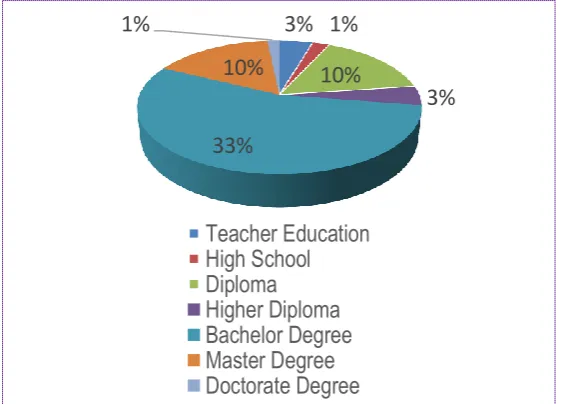
Data collection: Figure 2 highlights the scientific qualification of the sample member that collected the data from them. To cover all the stockholders of the dyslexic education the researcher has to cover the entire member that effected in the dyslexic education. The researcher collected the relevant data from 100 people in related fields such as Faculty of Education Special Education Department., ministry of education at Khartoum province, and teachers of Arabic language in special needs school at Khartoum province. Figure 2 highlighted the related experts.
Fig 2: The education qualification of the sample member
V. Analysis
the results showed that the greatest percentages of the stakeholders which they are represent 61% of the sample are agreed that the content of lessons should be rich (more than one data type) than the textbook contents. Figure 3 showed that the greatest percentages of the participants which they are represent 83% agreed that the scientific content should include sound, image and text.
3% 1%
10%
3%
33%
10%
1%
Fig 3: The scientific content is processed with sound, image and text all together.
VI. Design
Design the proposed solution based on mobile learning on the private cloud computing, This solution solved the most important problems of the existing researches. Moreover, this solution take into consideration the most important parts of reading disabilities based on education system in Sudan.
VII. Development and Implementation
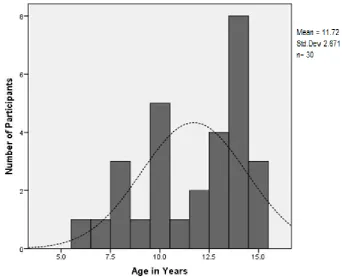
The mobile app developed by adopting android platform (Open Source) and PHP, android studio, MySQL. Then the application interfaces and lessons are designed according to the survey results. The mobile app implemented in a private cloud computing environment and used this app in teaching dyslexic students sample size (30 students). The teachers of dyslexic students taught the students for one semester (4 months) using the proposed mobile application. Figure 4 is demonstrating the age distribution curve of the study participants, where the mean age was 11.72 ± 2.6 leading to a curve skewed to the left. This negative skewed is due to the presence of extreme of ages among the participants (15 at grade 8).
Figure 4: The distribution of participants according to age(n=30)
83%
15%
1%
VIII. Evaluation
The study authors used SPSS to analysis the results table II present the Wilcoxon signed-rank test for the whole group and it shows that there is a highly significant difference between degrees after using the mobile application in teaching alphabet letters and degrees before using the mobile application.
TABLEII
WILCOXON SIGNED RANK TEST OF STUDY PARTICIPANTS (N=30).
n Mean Rank Sum of Ranks P-value Degrees After - Degrees
Before
Positive
Ranks 29b 15 435 0.000
Table II presents Wilcoxon signed Rank test of study Participants by Gender the p-value for both males and females is less than 0.05 and that indicate there a significant difference between students degrees after using the mobile application in teaching alphabet letters and the students degrees before using mobile application which mean the application improve reading skills for most students.
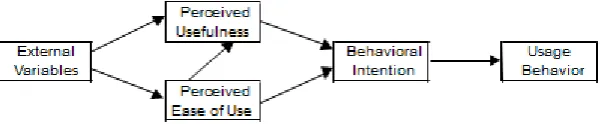
Evaluate the proposed solution and get feedback from the partner of this proposed solution. Sample size (14 teachers, 25 students and 6 educational experts). The researcher used a technology acceptance model (TAM) developed by Davis [19]. The researcher used the last version of TAM to evaluate the ease of use, the usefulness and the behavioural intention of the application figure 4 highlighted that.
Fig 4: Evaluation model for the mobile application derived from TAM.
Most of the dyslexic students found the Application easy to use although more than half of them were not owned a mobile device. The author noticed that 96% said the application helps them to remember the lesson and this was noticed because the evaluation took place after school holidays (approximately after four months from the experiment finished) when the researcher met them to evaluate most of them were remember the letters they were read by the application and remember the pictures included in the lesson. Table III shows the result of the evaluation tool (The Questioner).
TABLEIII
FONT GENERAL INFORMATION OF TEACHERS AND EXPERTS.
Variable Number %
Gender(n=20)
Female 16 80
Male 4 20
Age (n= 20)
20-29 8 40
30-39 4 20
40-49 6 30
50-59 2 10
Education Level(n=20)
Diploma 1 5
PHD 5 25
Professor 1 5
Experience in using the computer(n=20)
Excellent 3 15
Very Good 10 50
Good 3 15
Weak 3 15
No Experience 1 5
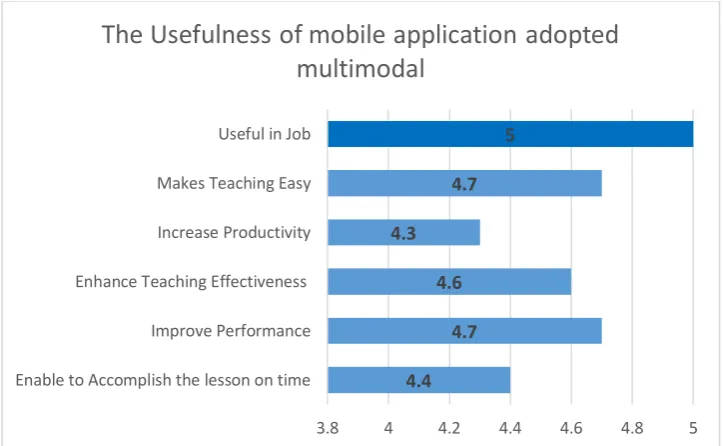
Table II shows the conclusion of the evaluation stage. Approximately 75% of the teachers and expert extremely agreed that using the multimodal interface in mobile application increase dyslexia students learning level and the rest of the sample agreed also. Figure 5 highlighted the effect of using multimodal in learning dyslexia students by mobile application in Sudan.
Fig 5: The average of the usefulness
IX. Conclusion and Future Works
Humans interact with multimodal to learn something better and faster. After having a comprehensive review of the previous studies to determine the research problem this study the author collects the relevant data using a number of methods, Firstly, face to face interviews with teachers, dyslexia students and experts, in different dyslexia student’s domain as a direct result of the questioner, secondly. the author adopted multimodal (image, sound and voice) interface then the mobile application was developed to learning different dyslexia students by developed Arabic letter mobile application to teach dyslexic students, the application was developed on android platforms and after that used the application to teach dyslexic students at Khartoum Omnia centre for difficulty learning. Finally, the application was evaluated on two stages first evaluate the enhancement of student who was taught through the multimodal interface application and the second evaluation by using technology acceptance model (TAM) which proved that the students learning level increased in a higher rate. In addition, Multi-mode learning has a good effect in dyslexia students in a primary school in Sudan there is a significant difference between student’s marks after using the mobile application in teaching alphabet letters and the student’s degrees before using mobile application which mean the multimode user interface improve reading skills for all dyslexic students in Sudan. The author highly recommended for future works to the developed multimodal user interface for OSI platform.
4.4 4.7 4.6 4.3
4.7 5
3.8 4 4.2 4.4 4.6 4.8 5
Enable to Accomplish the lesson on time Improve Performance Enhance Teaching Effectiveness
Increase Productivity Makes Teaching Easy Useful in Job
REFERENCES
[1] Ted S. ]Hasselbring and Candyce H. Williams Glaser The Future of Children, Vol. 10, No. 2, Children and Computer Technology (Autumn - Winter, 2000), pp. 102-122, Published by: Princeton University DOI: 10.2307/1602691, https://www.jstor.org/stable/1602691].
[2] Álvaro Fernández-Lópeza, Mobile learning technology based on iOS devices to support students with special education needs, Computers & Education 61 (2013) 77–90, 2013.
[3] Simon Hayhoe, A Literature Review on the Use of Inclusive Mobile Devices by People with Disabilities with particular reference to educational uses in the countries of the Cooperation Council of the Arab states of the Gulf(GCC), 2013.
[4] Nicole Quick, Using iPads in the Classroom to Help Improve Academic Gains for Students with Disabilities, 2012.
[5] Julius T. Nganji, Designing Disability-Aware E-Learning Systems: Student with disability’ Recommendations, International Journal of Advanced Science and Technology Vol. 48, November, 2012. [6] Simon Hayhoe, A Literature Review on the Use of Inclusive Mobile Devices by People with Disabilities
with particular reference to educational uses in the countries of the Cooperation Council of the Arab states of the Gulf(GCC), 2013.
[7] Nicole Quick, Using iPads in the Classroom to Help Improve Academic Gains for Students with Disabilities, 2012.
[8] Dell, Assistive Technology in Classroom, 2011.
[9] Sharon Oviatt ,The Handbook of Multimodal-Multisensor Interfaces, Volume 1, Series ISSN: 2374-6769 print 2374-6777 electronic, 2017.
[10] C. Kouroupetroglou, A Semantic-Web based Framework for Developing Applications to Improve Accessibility in the WWW, in 2006 international cross-disciplinary workshop on Web accessibility (W4A): Building the mobile web: rediscovering accessibility?, Edingburgh, UK, pp. 98-108, 2006.
[11] K. Kvale and N. D. Warakagoda, Multimodal Interfaces to Mobile Terminals-A Design-For-All Approach. INTECH Open Access Publisher, 2010.
[12] N. Sebe, ―Multimodal Interfaces: Challenges and Perspectives,‖ J. Ambient Intell. Smart Environ., vol. 1, no. 1, pp. 23–30, Jan. 2009.
[13] S. Kurkovsky, Multimodality in Mobile Computing and Mobile Devices: Methods for Adaptable Usability. Hershey, New York: IGI Global, 2009].
[14] Ting-Feng Wu, Is digital divide an issue for students with learning disabilities?, Computers in Human Behavior (Elsevier), 2014.
[15] Nicole Quick, Using iPads in the Classroom to Help Improve Academic Gains for Students with Disabilities, 2012.
[16] Nisha Sharan, Computer: A tool for Assisting Students Having Dyslexia, 2014
[17] Helena Song Sook Yee, Mobile Technology for Children with Autism Spectrum Disorder: Major Trends and Issues, E-Learning, E-Management and E-Services (IS3e), 2012 IEEE Symposium on 2012, Kuala Lumpur, 2012.
[18] SamartJabjone, M-Learning for Teaching in Molding and Casting with Plaster by Using QR Codes, International Journal of Information and Education Technology, Vol. 4, No. 2, April 2014.