Western University Western University
Scholarship@Western
Scholarship@Western
Electronic Thesis and Dissertation Repository
4-24-2019 10:30 AM
Orchestration of machine learning workflows on Internet of
Orchestration of machine learning workflows on Internet of
Things data
Things data
Jose Miguel Alves
The University of Western Ontario
Supervisor
Dr. Miriam A. M. Capretz
The University of Western Ontario
Graduate Program in Electrical and Computer Engineering
A thesis submitted in partial fulfillment of the requirements for the degree in Master of Engineering Science
© Jose Miguel Alves 2019
Follow this and additional works at: https://ir.lib.uwo.ca/etd
Recommended Citation Recommended Citation
Alves, Jose Miguel, "Orchestration of machine learning workflows on Internet of Things data" (2019). Electronic Thesis and Dissertation Repository. 6150.
https://ir.lib.uwo.ca/etd/6150
This Dissertation/Thesis is brought to you for free and open access by Scholarship@Western. It has been accepted for inclusion in Electronic Thesis and Dissertation Repository by an authorized administrator of
Applications empowered by machine learning (ML) and the Internet of Things (IoT) are
changing the way people live and impacting a broad range of industries. However, creating and
automating ML workflows at scale using real-world IoT data often leads to complex systems
integration and production issues. Examples of challenges faced during the development of
these ML applications include glue code, hidden dependencies, and data pipeline jungles.
This research proposes the Machine Learning Framework for IoT data (ML4IoT), which is
designed to orchestrate ML workflows to perform training and enable inference by ML models
on IoT data. In the proposed framework, containerized microservices are used to automate the
execution of tasks specified in ML workflows, which are defined through REST APIs.
To address the problem of integrating big data tools and machine learning into a unified
platform, the proposed framework enables the definition and execution of end-to-end ML
workflows on large volumes of IoT data. In addition, to address the challenges of running
multiple ML workflows in parallel, the ML4IoT has been designed to use container-based
components that provide a convenient mechanism to enable the training and deployment of
numerous ML models in parallel. Finally, to address the common production issues faced during
the development of ML applications, the proposed framework used microservices architecture
to bring flexibility, reusability, and extensibility to the framework.
Through the experiments, we demonstrated the feasibility of the (ML4IoT), which managed
to train and deploy predictive ML models in two types of IoT data. The obtained results
suggested that the proposed framework can manage real-world IoT data, by providing elasticity
to execute 32 ML workflows in parallel, which were used to train 128 ML models simultaneously.
Also, results demonstrated that in theML4IoT, the performance of rendering online predictions
is not affected when 64 ML models are deployed concurrently to infer new information using
online IoT data.
Keywords: IoT, Machine Learning, Big Data, Machine Learning Workflow Automation,
Orchestration, Time-series Forecasting, Container-based Virtualization, Microservices
Acknowledgements
First, I would like to thank my supervisor, Dr. Miriam Capretz. Dr. Capretz believed in my
potential and gave me the opportunity to study under her guidance. I will always be thankful
for the opportunities she gave me and for entrusting me with the freedom to pursue my own
research interests.
This thesis would also not have been possible without the support of my wife, Carla Alves,
who left everything behind to join me in this challenge. Thank you for being with me and for
guiding me during these years. I love you.
Infinite thanks to my mother, Vilma Alves. Thank you for your hard work to support our
family. Thanks to my sisters, my friends, my niece Isabella, and my nephew Antenor, who have
provided me with numerous moments of laughter and joy.
I would also like to extend my heartfelt appreciation to my fantastic research team for helping
me throughout my research: Wander Queiroz, Norman Tasfi, Willamos Aguiar, Alexandra
LHeureux, and Santiago Gomez. Special thanks to Dr. Hany ElYamany and Dr. Mahmoud
ElGayyar for lending their expertise to my research and for all the time they spent helping me.
Thank you.
Lastly, I would also like to thank members of the industry I worked in the past, especially
Icaro Technologies. Thank you for giving me a chance to work with an outstanding team who
inspired me to pursue my dreams and accept new challenges.
Abstract ii
Acknowledgements iii
List of Figures vii
List of Tables ix
List of Listings x
1 Introduction 1
1.1 Motivation . . . 1
1.2 Contribution . . . 3
1.3 Organization of the Thesis . . . 5
2 Background and Literature Review 7 2.1 Background . . . 7
2.1.1 Internet of Things . . . 7
2.1.2 Machine Learning . . . 9
2.1.3 Time-series Forecasting . . . 16
2.1.4 Microservices . . . 17
2.1.5 Container-based Virtualization . . . 18
2.2 Literature Review . . . 19
2.2.1 Machine Learning Platforms . . . 19
2.2.2 Data Processing Frameworks . . . 21
2.2.3 Big Data and Machine Learning in IoT . . . 22
2.3 Summary . . . 25
3 ML4IoT Framework 26 3.1 Introduction . . . 26
3.2 ML4IoT Components . . . 28
3.2.1 ML4IoT User Interface . . . 29
3.2.2 ML4IoT Core . . . 32
3.2.3 ML4IoT Data Management . . . 43
3.3 ML4IoT Design . . . 44
3.3.1 Batch ML Workflow Orchestration . . . 45
3.3.2 Online ML Workflow Orchestration . . . 47
3.4 Summary . . . 50
4 Evaluation 51 4.1 Implementation Details . . . 51
4.2 IoT Data . . . 52
4.2.1 Energy Data . . . 53
4.2.2 Traffic Data . . . 54
4.3 Experimental Setup . . . 55
4.4 Machine Learning Orchestration Evaluation . . . 56
4.4.1 Experiment . . . 56
4.4.2 Results and Discussion . . . 60
4.5 Elasticity Evaluation . . . 64
4.5.1 Results and Discussion . . . 64
4.6 Performance Evaluation . . . 68
4.6.1 Results and Discussion . . . 69
5 Conclusions and Future Work 72
5.1 Conclusions . . . 72
5.2 Future Work . . . 74
Bibliography 76
Curriculum Vitae 89
List of Figures
2.1 Random Forest structure [1]. . . 13
2.2 Long Short-Term Memory Neuron [2]. . . 14
2.3 Example of a generic machine learning workflow/pipeline. . . 15
2.4 Time-series forecasting strategies and their relationship [3]. . . 16
2.5 Comparison of virtualization architectures: hypervisor-based versus container-based [4]. . . 18
3.1 Machine Learning Framework for IoT data - ML4IoT. . . 27
3.2 Prototype of the ML4IoT User Interface. . . 29
3.3 Steps performed during the creation of batch ML workflows. . . 30
3.4 Steps performed during the creation of online ML workflows. . . 31
3.5 Conceptual data model for the ML4IoT. . . 34
3.6 Orchestration steps of batch ML workflows. . . 37
3.7 Orchestration steps of online ML workflows. . . 37
3.8 Simplified lifecycle of a Docker Container. . . 42
3.9 Sequence diagram: execution of batch ML workflows. . . 46
3.10 Sequence diagram: execution of online ML workflows. . . 49
4.1 Average rate of IoT data ingestion. . . 56
4.2 Results of RF models predicting traffic data. . . 62
4.3 Results of LSTM models predicting traffic data. . . 62
4.4 Results of RF models predicting energy data. . . 63
4.5 Results of LSTM models predicting energy data. . . 63
of 16 ML models. . . 66
4.7 Workload 2 - Containers, CPU and memory allocation during parallel training
of 32 ML models. . . 66
4.8 Workload 3 - Containers, CPU and memory allocation during parallel training
of 64 ML models. . . 67
4.9 Workload 4 - Containers, CPU and memory allocation during parallel training
of 128 ML models. . . 67
4.10 Latency of online ML workflows in different workloads. . . 70
4.11 Latency time of model inference step during the execution of online ML workflows. 70
List of Tables
2.1 Comparison betweenML4IoT and existing platforms. . . 21
4.1 Containers images and services implemented in each image. . . 52
4.2 Features and description of the energy data. . . 54
4.3 Features and description of the traffic data. . . 55
4.4 Hardware environment used in the experiments. . . 55
4.5 Clusters configuration of big data tools used in the prototye system. . . 56
4.6 Minutes ahead defined in each batch ML workflow. . . 57
4.7 Description of the energy and traffic datasets. . . 57
4.8 Prediction accuracy of ML models rendering prediction using online IoT data. . 61
4.9 Description of workloads used in the elasticity evaluation. . . 65
4.10 Description of workloads used in the performance evaluation. . . 69
3.1 Batch ML workflow represented in a JSON file. . . 36
3.2 Example of a Dockerfile that is used to define Docker images. . . 40
4.1 Sample of IoT energy raw data. . . 53
4.2 Sample of IoT traffic raw data. . . 54
Chapter 1
Introduction
1.1
Motivation
Gartner [5], predicts that the Internet of Things (IoT) will reach 26 billion internet-connected
devices by 2020, impacting a wide range of industries. The Internet of Things (IoT) is about
connecting any device to the Internet, enabling the digitization of devices, vehicles, and other
elements of the real world. Machine learning (ML) has been increasingly used with IoT data to
create new applications, such as smart cities [6], smart homes [7], and smart grids [8].
Machine Learning is an approach used to convert data into applications by obtaining models
that generalize to new data [9]. In real-world IoT applications, ML development is divided into
two phases: training and inference. The training phase typically begins with ingestion, storage,
and preprocessing of IoT data. After this, ML models are trained using the preprocessed IoT
data. The inference phase is also referred to in the literature as prediction serving, model score,
or model prediction [9]. In IoT scenarios, the inference phase involves the deployment of trained
ML models to infer information using online IoT data that were not used previously to train the
models.
IoT devices produce massive amounts of data, at high speed, and from a vast variety of
sources [10]. The high volume, high velocity, and high variety of the data require the use of
several Big Data-enabling tools to ingest, store, and preprocess the IoT data before they are
used for training of and inference by ML models. In addition, depending on the goals of the ML
application being developed, different frameworks and libraries must be used. For example, a
company may need to use three different ML frameworks if they want to train deep learning,
tree-based, and linear models. Big data enabling tools such as messaging brokers [11–13],
distributed file systems [14,15], NoSQL databases [16–20], and data processing engines [21–25]
have been used to support the ingestion, storage, and processing of IoT data. Libraries and
frameworks such as TensorFlow [26], MLlib [27], Pytorch [28], Deeplearning4j [29], and
Keras [30] have also been used to apply machine learning to IoT data.
However, integrating Big Data enabling tools with ML software to create end-to-end
work-flows to train and infer IoT data is a time-consuming task that requires specialized skills, and
code that is repetitive and complex to manage. Given the heterogeneity of tools, many are
incompatible with each other. The advances in software for IoT data have not yet converged on
standard formats and interfaces across Big Data tools and ML frameworks. In this way, creating
ML applications using large volumes of historical and online IoT data can be prohibitively
complex and expensive.
For example, the development of typical ML applications using IoT data usually involves
three steps. First, data engineers code data workflows that produce training data using Big
Data tools. Second, data scientists downsample data and use ML frameworks in notebook
environments [31, 32] to develop and experiment with new models. Finally, software engineers
work to deploy trained models in production systems. The hand-offbetween these steps leads to
bottlenecks and production issues such ashard-to-maintain glue code,hidden dependencies,
feedback loops, and pipeline jungles, which are signs of many of the machine learning
anti-patterns described by Sculleyet al.[33]. Moreover, applying machine learning to real IoT data
includes challenges such as keeping models updated and running multiple ML workflows in
parallel.
1.2. Contribution 3
problems internally with their own platforms. For example, Uber has built its ML orchestration
platform called Michelangelo [34], Airbnb has Bighead [35], Netflix has developed the Meson
platform [36], Google has introduced TensorFlow Extended (TFX) [37], and Facebook has
implemented its data pipeline platform for generating and predicting models [38]. These are
all in-house proprietary platforms to make sure that their time and money are not wasted on
developing repetitive ML workflows and management tools. Nevertheless, not every company
has the capabilities to invest in ML orchestration, and many large corporations still fail to
see the significant impact it will have on their business. Furthermore, Cloud providers like
Amazon (AWS) [39], Google [40], and Microsoft (Azure) [41] have built services on their cloud
platforms that cover IoT data ingestion and preprocessing as well as, training and deployment of
ML models, but none provides services to do all of the above using integrated and orchestrated
solutions.
The primary goal of this research is to overcome the challenges of integrating Big Data
enabling tools and machine learning software to provide a unified platform where end-to-end
ML workflows can be orchestrated for both training of and inference by ML models on IoT
data.
1.2
Contribution
The main contribution of this thesis is the Machine Learning Framework for IoT data (ML4IoT),
which is designed to orchestrate machine learning workflows to perform training and enable
inference by ML models on IoT data.
To address the problem of integrating big data tools and machine learning into a unified
platform, the proposed framework enables the definition and execution of end-to-end ML
workflows using REST APIs. The definition of ML workflows using high-level APIs abstracts
from users and developers the complexities of creating complex and repetitive code to integrate
created in this framework: batch and online ML workflows. These workflows are composed
of a set of configurations that define the sequential tasks and parameters required to train and
deploy ML models to infer online IoT data.
Moreover, to address the challenges of running multiple ML workflows in parallel, the
ML4IoT was designed to use container-based components that provide a convenient mechanism
for horizontally and independently scaling theML4IoT to execute multiple ML workflows in
parallel. The automated execution of the ML workflows is orchestrated by backend services
provided by theML4IoT, which uses containerized microservices to execute the tasks defined
in the workflows. Packaging software code into portable containerized microservices enables
ML4IoT to run ML workflows with different software and hardware specifications in parallel.
For example, ML workflows can use models provided by different frameworks (e.g., TensorFlow
[26], MLlib [27]) running on a mix of CPUs and GPUs. Furthermore, the use of containers
provides process isolation between different ML workflows and ensures that a single workflow
failure does not affect the execution of other workflows running in parallel.
Finally, to address the common production issues faced during the development of ML
appli-cations, the proposed framework used microservices architecture to bring flexibility, reusability,
and extensibility to the framework. For example, machine learning is evolving at a rapid
pace, and ML libraries and frameworks can become outdated quickly. In theML4IoT, these
frameworks and libraries used to build ML models can be added, replaced, or updated without
affecting the other components of the framework. Also, splitting the design of ML workflows
into small and specialized microservices facilitates the reuse of these software components.
Lastly, it contributes to the extensibility of the ML4IoT, because when the design of ML
work-flows is divided into well-defined components, it creates natural points of extension for new
functionalities.
ML4IoT was evaluated in three experiments using two types of real-world IoT data from the
energy and traffic domains. The first experiment investigated the feasibility of the framework by
1.3. Organization of theThesis 5
results achieved in this evaluation demonstrated thatML4IoTmanaged to automate the execution
of ML workflows, which were used to perform short-term prediction of energy consumption
and traffic flow using two ML models, Random Forest (RF) and LSTM.
The framework elasticity was evaluated in the second experiment by studying its ability
to scale to support the execution of multiple ML workflows in parallel. The obtained results
suggested that the proposed framework can manage real-world IoT data, by providing elasticity
to execute 32 ML workflows in parallel, which were used to train 128 ML models simultaneously.
Finally, the third experiment investigated the performance of the framework by analyzing
the latency of the execution of ML workflows deployed to render prediction using online IoT
data. Also, results demonstrated that the performance of rendering online predictions is not
affected when 64 models are deployed in parallel to infer new information using online IoT
data.
1.3
Organization of the Thesis
The remainder of this thesis is organized as follows:
• Chapter 2 provides background information that is useful in understanding this work as well as a literature review of related studies. This chapter first provides an introduction to
the technical terms and concepts that are used throughout this thesis. Second, this chapter
presents a review of current research that addresses the application of machine learning to
IoT data. Finally, it contrasts the contribution of this thesis with existing practice.
• Chapter 3 presents the components of theML4IoT. Besides providing an overview of the function of each component, this chapter also describes how each part interacts with the
others.
experimental set-up and the IoT data used in the experiments. Finally, the experiments
and a discussion of the preliminary results are presented.
Chapter 2
Background and Literature Review
This chapter serves a dual purpose: first, it introduces various terms related to the topics
discussed in this thesis, and second, it provides an overview of existing research on topics
related to the application of machine learning to IoT data.
2.1
Background
2.1.1
Internet of Things
The Internet of Things (IoT) is a network of internet-connected devices, including sensors,
machines, vehicles, and other elements of the real world. Gartner [5] predicts that the IoT will
reach 26 billion units by 2020, impacting a wide range of industries. The availability of IoT
data produced by this giant network of devices has created new opportunities for innovative
applications, for example, smart cities [6], smart agriculture [42], and smart grids [8].
IoT data
The actual value of the IoT for companies can be fully realized when valuable business
informa-tion is extracted from the data produced by IoT devices. However, the high volume, high speed,
and high variety of IoT data sources pose challenges to retrieving relevant information from
these data. Dealing with IoT data usually involves the steps of ingesting [43], storing [44], and
processing historical and online data [45]. These steps are discussed below.
• Ingesting IoT datais a usual step required to manage IoT data [25]. It involves ingesting the data into a platform where they are processed and analyzed. For example, in a smart
city traffic scenario where thousands of sensors are deployed to collect measures of the
traffic flow,congestion on a highway is detected by correlating information produced by
different sensors spread over the city. Therefore, the data generated by IoT devices need
to be ingested into a centralized platform where they can be analyzed and correlated.
Tools such as message brokers [11–13], data ingestion tools [46], extract-transform-load
solutions [47], and machine-to-machine communication frameworks [48] have been used
to create interfaces where IoT data can be ingested for later processing.
• Storing IoT datais challenging because of the large volume of data produced by IoT devices. However, a broad range of ML algorithms can use past data to build models that
are applied later to both historical and online IoT data. Even in scenarios where the data
distribution changes with time, past data are useful to help create evolving ML models
that can adapt to drift in data patterns. Distributed File Systems [14, 15] and NoSQL
databases [16–20] are examples of technologies that have been used for historical storage
of IoT data.
• Processing IoT datawhen they are still in motion is critical because the detection of patterns and anomalies in real time can have a considerable impact on event outcomes. In
addition, IoT sensors are a valuable source of online data. For example, during building
operation, a significant amount of energy may be wasted due to equipment and human
faults, but ML models can be used to detect abnormal consumption patterns using online
data collected from IoT sensors. In this case, energy waste is reduced if appropriate
energy-saving procedures are adopted based on information provided by the online data.
2.1. Background 9
used to process historical and online IoT data.
2.1.2
Machine Learning
Machine Learning (ML) is a technique that uses algorithms to learn complex patterns
auto-matically from the data [49]. Because of the enormous potential of automating tasks that do
not require human intervention, machine learning has become a ubiquitous technology. The
development of ML applications is divided into two phases: training and inference. The training
phase involves optimizing the parameters of a function, called the loss or cost function, which
generates a trained ML model. The inference phase of machine learning is also referred to in
the literature as prediction serving, models score, or model prediction [9]. This phase involves
the deployment of trained ML models to infer information using new data. The quality of data
impacts the results in both the training and inference phases of machine learning. For this reason,
data preprocessing tasks are often used to improve the overall quality of the data used in ML
applications.
First, this section introduces the data preprocessing techniques used to prepare data before
training of and inference by ML models. Then, an overview is provided of how ML applications
are classified according to their training type. Next, two ML algorithms used in the evaluation
section of this research are discussed. Finally, the concept of ML workflow is discussed.
Data Preprocessing
Data preprocessing techniques are applied to outliers, noisy data, and missing data because
these can affect the results of the ML model [50]. Preprocessing the data helps to improve
the data quality, for example, by removing null and duplicate values of the data. Moreover,
preprocessing a dataset prepares the data for the application of ML algorithms. For instance,
new features can be created in the datasets, helping the algorithms to achieve better and more
accurate results. Data preprocessing tasks can be grouped into four categories: data integration,
• Data Integrationseeks to merge the data from disparate data sources. The application of ML generally involves the use of datasets that are stored in different places. In addition,
most of the data are produced by heterogeneous data sources and have various data
structures. In these cases, data integration methods help to assure the data quality when
datasets are merged.
• Data Reductionis used to obtain a smaller representation of the original dataset. In this way, it contributes to increasing the efficiency of ML algorithms because fewer resources
are necessary to process the smaller datasets. The datasets produced after the application
of data reduction methods yield results similar to the original dataset.
• Data Cleaningreplaces or corrects incomplete, noisy, and inconsistent data. Incomplete data contain missing attributes or just aggregate data; noisy data present errors or values
that are not expected; inconsistent data include corrupt values. Data cleaning methods are
focussed on solving these three problems by filling in incomplete data, smoothing out or
removing noisy data, and fixing data inconsistencies.
• Data Transformationis used to transform data into other formats that can improve the performance of ML models. Methods for data transformation include:
– Normalization rescales the values of the attributes to lie within a smaller range.
Normalization is required by some ML algorithms because attributes with larger
values can have more influence than smaller ones during model training. One
common method to normalize the data is to rescale the dataset attributes to range
within [0 1] using Eq. (2.1), whereXis the dataset andnis the number of dataset
samples:
˜
xn=
xn−min(X)
max(X)−min(X) (2.1)
2.1. Background 11
sensors periodically sense data and transmit them in short intervals, such as seconds
or minutes. Depending on the ML model goal, the data may need to be made to
represent longer ranges using data aggregation methods.
– Discretizationreplaces numeric attributes by mapping values to intervals or labels.
For example, if an attribute is used to represent the amount of time that an equipment
or sensor was faulty, instead of serving the exact numeric value of each fault, this
attribute can store discrete values, for example, less than 30 minutes, more than 30
minutes or less than one hour, more than one hour and so on.
– Feature engineeringis used to rearrange or create new attributes that can help
train ML models. For instance, a popular feature engineering technique used in
time-series data involves rearranging data by representing each input instance using
a sliding data window instead of a single input value.
Machine Learning Types
The algorithms used in machine learning are classified according to how the learning process
is conducted. Four common classes are used to group ML algorithms: supervised learning,
unsupervised learning, semi-supervised learning, and reinforcement learning [49].
• Supervised learninguses a set of labelled data to train an algorithm. Labelled data imply that each input data point in the training dataset has a defined output, which is called
a label value. At the end of the training process, for each input data point, the trained
algorithm should come up with an output similar to the label value. Supervised learning is
applied to solve two types of problems: classification problems and regression problems.
In classification problems, algorithms are used to infer a discrete value by classifying
the input data as part of a category or group. Regression problems involve inferring a
continuous value from each input data point.
Hence, there is no correct answer or output for each input data point. The algorithms
try to find useful patterns and structure in the data. However, because there are no data
labels, it is challenging to evaluate the accuracy of algorithms trained using unsupervised
learning.
• Semi-supervised learningtrains ML models using datasets that contains both labelled and unlabelled data. In some cases, labelling all the input data points is a prohibitive task
because of the volume and velocity of the data, which require the use of semi-supervised
learning. In semi-supervised learning, data labels are still needed to validate algorithm
accuracy.
• Reinforcement learningfinds an optimal way to accomplish a particular goal or improve performance on a specific task. If the algorithm takes action that moves toward the goal,
it receives a reward; otherwise, it is given a punishment. The overall goal of the algorithm
is to predict the best next step to take to earn the biggest final reward. Training algorithms
using reinforcement learning is an iterative process in which the more rounds of feedback
are used, the better the agents strategy becomes.
Machine Learning Algorithms
The two ML algorithms used in this thesis are described below.
• Random Forest (RF), an algorithm proposed by Breiman [51], is an ensemble algorithm that joins multiple decision trees to decrease the chance of overfitting. The algorithm
introduces randomness into the training process so that, in the set of decision trees, each
one is a little different. Combining the predictions from each tree reduces the variance of
the predictions, improving the performance of test data. The training of an RF involves a
technique calledbagging[52], which uses an ensemble of C trees{T1(X),...,TC(X)}to
produce C outputs{Y1=T1(X),...,YC=TC(X)}, whereX={x1,...,xn}is an n-dimensional
2.1. Background 13
Y is obtained by averaging the predictions from all the individual regression trees or by
taking a majority vote when the algorithm is applied to classification problems, as shown
in Figure 2.1.
Figure 2.1: Random Forest structure [1].
• Long Short-Term Memory (LSTM)is the most popular type of recurrent neural net-works, which are algorithms that can perform parallel and sequential computation.
Be-cause of its capacity to learn long sequences and deal with the vanishing gradient
prob-lem [53], this algorithm is widely used in domain-specific applications such as time-series
prediction [54], speech recognition [55], and robot control [56]. As illustrated in Figure
2.2, each neuron of a long short-term memory (LSTM) networks has four components
called thecell,input gate,output gate, andforget gate. The cell is the memory component,
and the gates (input, forget, output) controls how the information flows inside the LSTM
neuron. LSTM networks can retain errors across time steps and layers, which enables
them to learn even when a large number of time steps are represented in the input data.
Machine Learning Workflow
The termsmachine learning workflowormachine learning pipelineare commonly used
Figure 2.2: Long Short-Term Memory Neuron [2].
applications. Although there is no official definition of these terms, research published by
crucial players in machine learning such as Google [37], Facebook [38], and Twitter [57]
has used these terms in their publications.
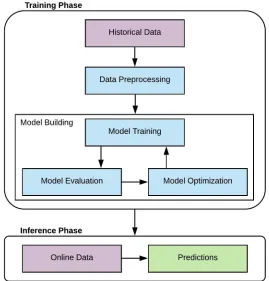
The development of ML applications involves two distinct phases, a training phase, and
an inference phase [9], which are discussed below:
– The training phasetypically begins with collecting and preprocessing a training
dataset. The attributes of the dataset are used as criteria for choosing from a wide
range of model designs (e.g., linear regression, random forest, LSTM, etc.) and
their corresponding training algorithms (e.g., supervised learning, unsupervised
learning, semi-supervised learning, reinforcement learning). After a model and
training algorithm have been selected, there are often additional hyper-parameters
that must be tuned by repeatedly training and evaluating the model.
– The inference phaseis also referred to in the literature as prediction serving, models
score, or model prediction. In this phase, a new dataset is also collected and
preprocessed, and the ML models trained previously in the training phase are
deployed to take data as input and emit predictions. The inference phase requires
integrating ML software with other systems, for example, user interface applications,
2.1. Background 15
In the development of ML applications, a sequence of steps performed during the training,
or the inference, or both phases is called a machine learning workflow or a machine
learning pipeline. Figure 2.3 depicts an example of a genericmachine learning
work-flow/pipeline.
Figure 2.3: Example of a generic machine learning workflow/pipeline.
The steps that compose these workflows or pipelines depends on several aspects, for
example, the use case, data domain, type of machine learning tasks, etc. Although the
terms workflow and pipeline are used interchangeably, this research has adopted the
termmachine learning workflowbecause, in software engineering, the term workflow
is closely related to automation [58], which is one of the topics explored in this work.
Moreover, the termmachine learning workflowis broadly defined in the industry, and it
also encompasses the termmachine learning pipeline. In addition, in this research, the
termsbatch machine learning workflowandonline machine learningare used to define
learning applications, respectively.
2.1.3
Time-series Forecasting
Time-series forecasting is a growing field of interest because of the large amount of
data produced daily by IoT devices can be classified as time-series data. A time series
is a chain of historical measuresyt of an observable variabley at regular periods. For
example, an IoT sensor measuring the traffic conditions on a road produces data at specific
intervals, which constitute a time series. Time-series forecasting can be performed for
both single and multiple periods. Forecasting a single period, which is also known as
one-step-ahead, means forecasting the next value of the time-series sequence.
Multi-step-ahead forecasting consists of predicting the nextHvalues [yN+1,...,yN+H] composed of
N observations, whereH >1 denotes the forecasting horizon. Unlike one-step-ahead
forecasting, multistep-ahead forecasting tasks are more difficult [59], because this type of
forecasting must deal with additional complexities, such as accumulated errors, reduced
accuracy, and increased uncertainty [60].
Figure 2.4 shows the five strategies that have been proposed in the literature [3] to tackle
multi-step ahead forecasting tasks: Recursive, Direct, Multi-input Multi-output (MIMO),
Recursive and Direct (DirREC), and Direct and Multi-input Multi-output (DirMO).
Figure 2.4: Time-series forecasting strategies and their relationship [3].
– Recursivestarts by predicting a value, which is then used for forecasting the
2.1. Background 17
– Directpredicts each step independently of the others, using specific models for each
step ahead.
– Multi-input Multi-Output (MIMO)differs from Recursive and Direct strategies
because it returns multiple outputs, where a value is predicted for each attribute of
the input data.
– Recursive and Direct (DirRec)is a combination of the Direct and Recursive
strate-gies.
– Direct and Multi-input Multi-output (DIRMO)is a combination of the Direct
and MIMO strategies.
2.1.4
Microservices
A microservices architecture is a software architecture composed of small and independent
services that work together [61]. Each service supports a specific function and uses a simple,
well-defined interface to communicate with other sets of services. A microservices architecture
is the opposite of the traditional monolithic architecture in which, although different components
or modules are used, the application is developed and deployed as one. A short discussion of
some of the vital differences between microservices and monolithic architecture is presented
next.
• Technology heterogeneity. Because the services are independent in a microservices architecture, each component can adopt a different technology or framework. This also
enables new technologies to be adopted more quickly. With a monolithic architecture, any
change in one of the architectures components impacts a large part of the system. On the
other hand, in a microservices architecture, replacing a service does not affect the other
architectural components, enabling easy integration and adoption of new technologies.
is easier to scale just those services that need scaling.
• Ease of deployment.Usually, changes in software implemented using monolithic archi-tectures require the redeployment of the whole application to release the new software
version. In a microservices architecture, a modification can be made to a single service.
Then the changed service is deployed independently of the rest of the system.
2.1.5
Container-based Virtualization
Resource virtualization is a technique which uses an intermediary software layer on top of an
underlying host server in order to provide abstractions of multiple virtual resources. In general,
virtualized resources are called virtual machines (VM). Hypervisor-based virtualization and
container-based virtualization are the two most popular types of virtualization used in cloud
computing [62]. In hypervisor-based virtualization, a set of virtual machines (VM) is created to
share physical hardware resources, but each VM executes distinct operating systems [63]. On the
other hand, in container-based virtualization, the virtual instances created to share the physical
resources of the host server are called containers. Each container executes as a standalone
operating system, but they share a single operating system kernel. Because the containers share
the kernel of the host operating system, container-based virtualization leads to lower overhead,
and instantiating, relocating, and optimizing hardware resources is far easier [64].
2.2. LiteratureReview 19
Figure 2.5 shows the contrast between hypervisor-based and container-based virtualization.
Hypervisor-based virtualization provides an abstraction for the guest operating systems (one per
virtual machine). On the contrary, container-based virtualization works at the operating system
level, providing abstractions directly for guest processes.
Microservices architecture does not require containers to deploy the software components
[65]. Nevertheless, because containers are smaller, faster to instantiate, and faster to scale
than traditional virtual machines, containers have become a popular approach to combine
microservices architecture and container-based virtualization.
2.2
Literature Review
This section presents research related to this thesis divided into three categories: Machine
Learn-ing Platforms, Data ProcessLearn-ing Frameworks, and Machine LearnLearn-ing and Big Data Frameworks
applied to IoT.
2.2.1
Machine Learning Platforms
This section presents a review of ML platforms that have been proposed to address challenges
in developing and deploying ML models.
Wang et al. [66] introduced Rafiki, which is a system to provide both the training and
inference services for ML models. In their work, users are exempted from constructing the ML
models, tuning the hyper-parameters, and optimizing the prediction accuracy and speed. Instead,
they upload their datasets, and configure the service to conduct training and then deploy the
model for inference. Docker containers are used to implement ML workflows.
Lee et al. [67] presented PRETZEL, a prediction serving system designed for serving
predictions over trained pipelines originally developed in ML.Net [68]. Their work explored
multi-pipeline optimization techniques to reduce resource utilization and improve performance.
serving system. Their work provided a model abstraction layer and a common prediction
interface that isolates applications from variability in ML frameworks and simplifies the process
of deploying a new model or framework to a running application. In their work, models are
encapsulated in containers to achieve process isolation.
Studies [66, 67, 69] have been focussed on providing generic ML platforms, which are in
turn focussed on achieving better efficiency during training and deployment of ML models.
Unlike this work, these studies do not address the challenges posed by IoT data, such as high
volume, high variety, and high velocity. This research extends previously cited approaches by
providing a framework designed to orchestrate and automate the execution of ML workflows
with IoT data.
Zhaoet al.[70] proposed a ML platform to support the sharing of ML models developed
across various ML libraries. Their platform packs pre-trained ML models into Docker images,
which can be deployed to an appropriate run-time environment. Besides packaging ML models
in Docker images, the work described in this thesis enables training and deployment of models
using container-based virtualization.
Predict I/O [71] is an-open source project that breaks down the ML workflows into four
components: Data Source and Data Preparator, Algorithm, Serving, and Evaluation Metrics.
It deploys models as Web services and makes REST APIs available for prediction queries. In
its current implementation, only Spark MLlib is supported as a model engine. The framework
proposed in this thesis provides generic support for ML frameworks, which avoids being tied to
a specific library or implementation.
Cloud providers, like Amazon AWS [39], Microsoft Azure [41], and IBM Watson [72] have
already included services to train and deploy ML models on IoT data. However, their services
require integration of diverse components to preprocess the data and to train and deploy the
models to infer online IoT data. This research proposes an approach in which the components
required to apply ML models to IoT data are already integrated into a unified framework, which
2.2. LiteratureReview 21
Uber [34], Airbnb [35], Netflix [36], Google [37], and Facebook [38], which are some of
the key players in ML have implemented their own ML orchestration platforms. Unfortunately,
their platforms are proprietary or not entirely publicly available.
To summarize the differences and similarities betweenML4IoTand existing platforms, a
comparison is presented in Table 2.1.
Features ML4IoT Rafiki PRETZEL Clipper Acumos Predict I/O
AWS IoT Azure IoT IBM IoT
Easy cloud
deployment Yes Yes Yes No Yes No Yes
Training of
ML models Yes Yes No No No Yes Yes
Deployment of
ML models Yes Yes Yes Yes Yes No Yes
Integrated platform
for ML on IoT data Yes No No No No No No
Data preprocessing
tasks sharing Yes No No No No No No
ML model
sharing Yes No No No Yes No No
Support multiple
ML libraries Yes Yes No Yes Yes No Yes
Table 2.1: Comparison betweenML4IoT and existing platforms.
2.2.2
Data Processing Frameworks
This section presents a review of data processing frameworks which have been used to apply
ML to IoT data.
Moraleset al.[73] proposed the Scalable Advanced Massive Online Analysis (SAMOA)
framework, which enables standard ML algorithms to execute on top of distributed stream
processing engines. It provides a set of distributed streaming algorithms for the most popular
ML tasks such as classification, clustering, and regression. SAMOA also offers programming
abstractions that support the development of new algorithms.
Hido et al.[74] presented a generic computational framework called Jubatus for online
servers, rather than data. Their framework can achieve high throughput for both online training
and prediction on Big Data streams.
Apache Spark [75] is a project proposed in 2009 by a group at the University of California,
Berkeley. Apache Spark has a programming model comparable to MapReduce [76], but extends
it with a data-sharing abstraction called Resilient Distributed Datasets (RDD). Spark can work
with a broad range of data processing workloads that previously required different engines, such
as SQL, streaming, machine learning, and graph processing [77].
These studies [73–75] provided generic computational processing frameworks that can be
used as the data processing engine for large amounts of data. Because the previously cited
works were designed to be generic, they required adaptation and additional architecture layers to
create effective and efficient solutions for IoT data. In contrast, this work focusses on providing
an end-to-end solution for ML orchestration of IoT data that can be flexibly applied to different
IoT use cases. The framework proposed in this work does not require adaptation and extra
components for use with IoT data.
2.2.3
Big Data and Machine Learning in IoT
This section presents a review of research that addressed the use of big data enabling tools and
ML frameworks with IoT data.
Cecchinelet al.[78] presented an approach using machine learning to provide an optimal
configuration that extended the battery lifetime of IoT sensors. In their work, middleware
generates an energy-efficient sensor configuration based on live data observations, which
dynamically optimizes sensors sampling frequency and network usage.
Yang et al. proposed a semi-supervised method in association with a generative
adver-sarial network [79] for supporting medical decision-making in an IoT-based health service
system. Their approach was designed to solve problems involving both lack of labelled sets and
imbalanced classes, which are common in medical datasets collected from IoT-based platforms.
2.2. LiteratureReview 23
data and identify the most significant clinical parameters for patients to get heart disease. In
their work, the first tier focussed on collection of IoT data, the second tier stored the data, and
finally, the third tier applied a regression-based prediction model for heart disease.
Chouet al.[80] introduced a data-driven framework for fault detection in cellular-assisted
IoT networks. Their framework uses ML techniques to analyze crowd-sourced measurements
uploaded from several IoT devices. Then ML models are used to construct a global view of a
radio environment, namely, the radio environment map (REM) for diagnosis and management
purposes.
Shenet al.[81] presented a privacy-preserving SVM training scheme called secureSVM.
Their approach tackled the challenges of data privacy and data integrity by using blockchain
techniques to build a secure SVM training algorithm in multi-part scenarios where IoT data are
collected from multiple data providers.
Sunet al.[82] outlined a framework for modelling and clustering attacker activity patterns
based on IoT data collected from honeypots [83] deployed on a global scale. Their work
combines a ML model and a graph-based clustering algorithm for analyzing attacker patterns
without advanced feature engineering.
Wan et al. [48] designed an architecture focussed on manufacturing Big Data for active
preventive maintenance. They used an Industry 4.0 designed solution called UPC UA [84] to
ingest the data produced by IoT sensors. In addition, they proposed methods for collecting data
and applying ML algorithms to both historical and online manufacturing data.
Javedet al.[85] presented a machine-learning-based smart controller for HVAC (heating,
ventilation, and air conditioning systems) in commercial buildings. Data collected from IoT
sensors were used to train a recurrent neural network model that could recognize when a room
was unoccupied and switch offthe HVAC, decreasing energy consumption.
The studies cited above aimed to use ML techniques to solve specific problems in IoT
environments, for example, IoT sensors efficiency [78], fault-detection [80], medical decisions
Unlike these studies, this research proposes a general-purpose framework that supports machine
learning on various IoT datasets using different ML algorithms.
Preuveneers et al. [87] proposed the SAMURAI solution, which is a batch and online
data processing framework based on the Lambda architecture [88]. Their work integrates
components for complex event processing, machine learning, and knowledge representation.
Horizontal scalability is achieved with Big Data enabling technologies such as Spark and Apache
Storm [89].
Ta-Shmaet al.[25] presented an architecture for extracting valuable historical insights and
actionable knowledge from IoT data streams. Their architecture supports both real-time and
historical data analytics using a hybrid data processing model. The main components used in
their architecture instance (Node-Red, Apache Kafka, Apache Spark, and OpenStack Swift)
were implemented using the microservices approach.
Strohbachet al.[90] proposed a framework for addressing the volume and velocity
chal-lenges [91] of the IoT data. The components of their framework were organized according to the
Lambda architecture design. However, they extended the Lambda architecture by supporting the
creation of statistical and machine-learning models using historical data that were later applied
to the online IoT data.
Mishraet al.[92] outlined a cognitive-oriented framework for IoT Big Data. Their
frame-work was designed for effective data management and knowledge discovery over IoT data
by applying the principles of data-centric architecture. A set of subsystems was combined to
construct their final framework, which provided a real-time platform for IoT Big Data and ML
capabilities for large-scale automation.
Sezeret al.[93] proposed a framework that provides support for storing IoT data, performing
semantic rule reasoning, and applying ML methods. The goal of their work was to provide better
management features for IoT sensors by means of data semantics. In addition, their framework
explores interoperability issues among existing platforms designed to deal with IoT data.
2.3. Summary 25
Data analytics. Their framework collects and analyzes data for IoT services using existing
components such as M2M gateways [94], message brokers, and Big Data enabling tools such as
Apache Storm and Cassandra.
In contrast to previous studies [25, 87, 90, 92, 93], this research focusses on providing
methods to enable efficient development of ML applications with IoT data. Unlike the studies
mentioned previously, this research examines the orchestration and automation of end-to-end
ML workflows to support parallel training and deployment of multiple ML models with IoT
data.
2.3
Summary
This chapter has provided an overview of the concepts related to various topics that assist in
understanding the framework proposed in this research. More specifically, an introduction to
IoT, machine learning, microservices, and container-based virtualization terminologies has been
presented. In addition, current studies on various topics related to the application of machine
learning to IoT data were discussed and contrasted with the methods used in this work. The
ML4IoT Framework
This chapter describes the Machine Learning Framework for IoT data (ML4IoT). First, an
introduction of the goals of the framework is presented in Section 3.1, followed by an overview of
its components and sub-components in Section 3.2. Finally, the orchestration of ML workflows
is discussed in Section 3.3.
3.1
Introduction
IoT devices produce massive amounts of data, at high speed, and from and from a vast variety
of sources. The high volume, high velocity, and high variety of data require several Big Data
enabling tools to ingest, store, and preprocess the IoT data before the training and inference
of ML models can take place. Moreover, depending on the goals of the IoT application being
developed, different ML frameworks must be used. However, creating and automating ML
workflows at scale to train and infer real-world IoT data are challenging tasks, often leading to
bottlenecks, production issues, and complex and repetitive code to manage. Also, applying ML
to real-world IoT data includes challenges such as keeping ML models updated and running
multiple ML workflows in parallel.
This thesis proposes the Machine Learning Framework for IoT data (ML4IoT), which is
designed to orchestrate ML workflows to perform training and to enable inference by machine
3.1. Introduction 27
learning models on IoT data. TheML4IoT uses containerized microservices to automate the
execution of tasks specified in ML workflows, which are defined through REST APIs. The
ML4IoT is generally implementation-agnostic, and therefore can be easily expanded to support
new components such as data preprocessing tasks, algorithm types, and ML frameworks.
The overview of the framework is shown in Figure 3.1. In theML4IoT User Interface, two
types of ML workflows can be defined: batch and online machine learning workflows. These
workflows are composed of a set of configurations, which define sequential tasks and parameters
required to train and to deploy ML models using IoT data.
Figure 3.1: Machine Learning Framework for IoT data - ML4IoT.
To support the definition, orchestration, and scheduling of ML workflows, two key software
container-based virtualization. The microservices architecture enables the decoupling ofML4IoTsoftware
components into small and specialized services, bringing flexibility, reusability, and extensibility
to the framework. In addition, container-based virtualization and microservices are combined
to deal with challenges such as the multitude of ML frameworks available and the parallel
execution of ML workflows.
In Figure 3.1, theWorkflow Designer,Workflow Orchestrator, andWorkflow Scheduler, are
three microservices that are used to define, orchestrate, and schedule ML workflows, respectively.
To orchestrate the execution of ML workflows, theWorkflow Orchestratorcommunicates with
theContainer Management System(CMS) to create containerized microservices that perform
the required data processing tasks. The software code needed to run these tasks is packaged
in Workflow Images (Docker images), which are used by the CMS to deploy the Workflow
Containers(Docker containers). The containerized microservices created by the CMS run the
tasks defined in the ML workflows by themselves or using the Distributed Data Processing
Engine.
The IoT data used during the execution of ML workflows are ingested and stored in the
ML4IoT Data Managementcomponent, which is composed of three sub-components: a
Mes-saging System, aDistributed File System, and aNoSQLdatabase.ML4IoT Data Management
also supports the storage of trained models and predicted data, and provides temporary storage
for preprocessed data produced during ML workflow orchestration. The following sub-sections
detail the components and sub-components of theML4IoT framework.
3.2
ML4IoT Components
The following sub-sections detail the components and sub-components of theML4IoT
3.2. ML4IoT Components 29
3.2.1
ML4IoT User Interface
The ML4IoT User Interface is a front-end component that provides users with a graphical
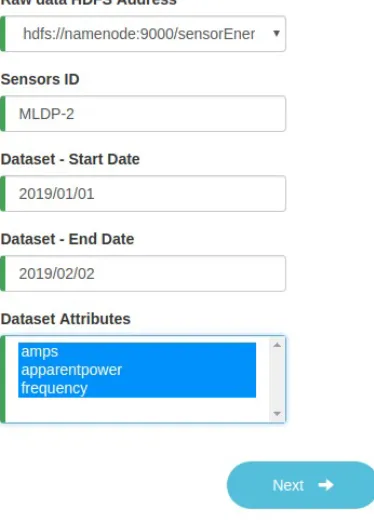
interface to define ML workflows. Figure 3.2 shows an example of an implementation of the
ML4IoT User Interface.
Figure 3.2: Prototype of the ML4IoT User Interface.
This component simplifies the tasks of creating these workflows because all the steps and
parameters are defined in a simplified user interface. For example, to create an ML application
to predict energy consumption, first ML models need to be trained, and then, these models
need to be deployed to predict new information using online IoT data. The training of ML
it is preprocessed to remove inconsistencies, and finally, ML models are trained using the
preprocessed data. The deployment of models also requires the execution of sequential steps,
such as selecting online data, applying preprocessing tasks to these data, and using trained
ML models to predict new values. Creating custom software code to execute these steps often
leads to duplicate and hard-to-maintain glue code. In this way, defining ML workflows using a
graphical interface helps to avoid unnecessary duplication of code and produces standardized
representations of these workflows. The ML workflows defined in theML4IoT User Interface
are persisted in aNoSQLdatabase and executed according to user requests. The steps performed
during the definition of batch and online ML workflows are detailed in the next sub-sections.
Batch Machine Learning Workflow
Batch machine learning workflowis a logical representation of a set of sequential tasks and
parameters required to build ML models. The execution of this type of workflow produces
models, which can be used in online ML workflows.
The definition of a batch ML workflow involves the selection and configuration of historical
datasets, preprocessing tasks, and ML algorithms. These tasks are executed in three steps shown
in Figure 3.3 and discussed below.
Figure 3.3: Steps performed during the creation of batch ML workflows.
• Batch Data Selection defines the parameters used to create historical datasets during execution of batch ML workflows. For instance, when this type of workflow is executed,
historical datasets are created using IoT data and are stored in theDistributed File System
(DFS). Examples of these parameters include the date range, the location in the DFS, and
3.2. ML4IoT Components 31
• Data Preprocessing Definition specifies the preprocessing tasks to be applied to the datasets defined in the previous step. These tasks are defined for each dataset along with
their parameters. For example, data aggregation is a common preprocessing task used for
IoT data and can be specified in this step.
• Model Definitiondefines the ML algorithms along with their parameters to be used to train ML models. For example, the type of algorithm (e.g., LSTM, Linear Regression),
specific algorithm configurations, and how the datasets are split between training and
testing are some of the parameters defined in this step.
Online Machine Learning Workflow
Online machine learning workflowis a logical representation of a set of sequential tasks and
parameters required to deploy trained ML models to infer new information using online IoT
data. The definition of an online ML workflow involves the selection and configuration of
online datasets, trained ML models, and deployment parameters required to execute this type of
workflow. These tasks are performed in three steps shown in Figure 3.4 and discussed below.
Figure 3.4: Steps performed during the creation of online ML workflows.
• Online Data Selectiondefines the parameters used to create datasets composed of online data during execution of online ML workflows. These online datasets are created using
the IoT data that are ingested in theMessaging System.
• Trained Model Selectionis the step where a trained ML model, built by executing a batch ML workflow, is selected for use to infer new information. The chosen model uses the
previously created online datasets as input to issue predictions during execution of online
• Trained Model Deploymentdefines the parameters related to deployment of a trained ML model. For example, execution of online ML workflows uses a micro-batch approach
in which the steps defined in this type of workflow are executed repeatedly at a specific
pre-defined interval, such as every 30 seconds, every minute, every 30 minutes, and so on.
This interval is one of the parameters configured in this step. The micro-batch approach
was chosen because IoT sensors have different duty cycles and intermittent connectivity,
meaning that data are often delayed or misaligned. Executing the online ML workflows at
small intervals helps to deal with these issues and is also useful for data preprocessing
tasks where a sample data point needs to be correlated with previous values, such as the
sliding window technique.
3.2.2
ML4IoT Core
The ML4IoT Core uses the microservices architecture and container-based virtualization to
support the definition, orchestration, and scheduling of ML workflows. The microservices
architecture is an approach used in theML4IoT that improves the flexibility of the framework.
For example, machine learning is evolving at a rapid pace, and ML libraries and frameworks
can appear and become outdated quickly. InML4IoT, these frameworks and libraries used to
build ML models can be added, replaced, or updated without affecting the other components
of the framework. Moreover, splitting the design of ML workflows into small, specialized
microservices facilitates the reuse of these software components. Lastly, it contributes to the
extensibility ofML4IoTbecause when the design of ML workflows is divided into well-defined
components, this creates natural points of extension for new functionalities.
Moreover, the combined use of container-based virtualization and microservices addresses
common issues found during the development of ML applications in real-world scenarios. For
instance, packaging software code into portable containerized microservices enables theML4IoT
to run ML workflows with conflicting software and hardware requirements concurrently. For
3.2. ML4IoT Components 33
[95], MLlib [96], Scikit-learn [97]) running on a mix of CPUs and GPUs. It also provides
process isolation between different ML workflows and ensures that a single failure does not affect
the parallel execution of other workflows. Ultimately, the use of containerized microservices
provides a convenient mechanism for horizontally and independently scaling the ML4IoT
framework to execute multiple ML workflows in parallel. In the next subsections, the
sub-components of theML4IoT Coreare described in detail.
Workflow Designer
This component is a microservice that provides a REST API service to store logical
repre-sentations of ML workflows in aNoSQL database that stores the data in documents. These
documents use a JSON (JavaScript Object Notation) structure and provide an intuitive and
natural way to model ML workflows that is closely aligned with object-oriented design. In the
document-orientedNoSQLdatabase, the notion of a schema is dynamic: each ML workflow
can contain different fields. This flexibility is particularly helpful for modeling the various
workflows that can be created in the ML4IoT. Moreover, having a representation of the ML
workflows stored in unified and hierarchical documents adds an audit trail to these workflows
and facilitates versioning and debugging. For instance, by using JSON documents to represent
ML workflows, users can record executions and keep track of model parameters, code, and
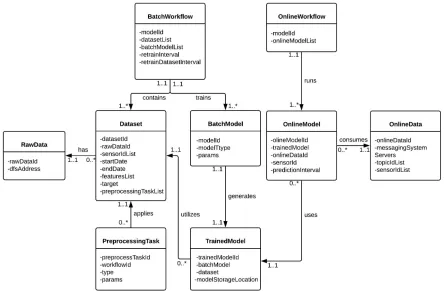
datasets for each ML workflow. Figure 3.5 shows an entity-relationship (ER) diagram that
illustrates the conceptual data model used to store the ML workflows in theNoSQLdatabase.
The description of the entity types depicted in Figure 3.5 is given below:
• BatchWorkflowcontains a list of theDatasetentities, a list ofBatchModelsentities, and and scheduling parameters for batch ML workflows.
• RawDatadescribes the metadata of the IoT data stored in the distributed file system.
Figure 3.5: Conceptual data model for the ML4IoT.
• PreprocessingTaskdescribes a preprocessing task associated with aDataset.
• Batch Modeldescribes a ML algorithm and its parameters in a batch ML workflow.
• TrainedModeldescribes a trained ML model generated after the execution of a batch ML workflow.
• OnlineDatadescribes the metadata of online IoT data ingested in theMessaging System.
• OnlineModelcontains a TrainedModel entity, an OnlineData entity, and deployment parameters for each trained model.
• OnlineWorkflowcontains a list ofOnlineModelentities.
3.2. ML4IoT Components 35
• Contains. ABatchWorkflowcontains one or moreDatasetentities, and eachDatasetcan be associate to only oneBatchWorkflow.
• Has. ADatasethas oneRawData, and eachRawDatacan be associated to manyDataset
entities.
• Trains.ABatchWorkflowtrains one or moreBatchModel, and eachBatchModelis trained by only oneBatchWorkflow.
• Applies.APreprocessingTaskis applied to only oneDataset, and eachDatasetcan be applied manyPreprocessingTaskentities.
• Generates. A BatchModel generates only one TrainedModel, and a TrainedModel is generated by oneBatchModel.
• Utilizes. ATrainedModelutilizes one only oneDataset, and aDatasetcan be utilized by manyTrainedModelentities.
• Runs. An OnlineWorkflow runs one or moreOnlineModel, and each OnlineModelis executed by only oneOnlineWorkflow.
• Uses. AnOnlineModeluses only oneTrainedModel, and eachTrainedModelcan be used by manyOnlineModelentities.
• Consumes. AnOnlineModelconsumes only oneOnlineData, and eachOnlineDatacan be consumed by manyOnlineModelentities.
In relational databases, a table contains data about just one entity, while in the
document-orientedNoSQLdatabase, a document can contain one or more of the entities depicted in Figure
1 {” id”:”1”,
2 ”datasets”:[{
3 ” id”:”1”,
4 ”rawData”:{” id”:”1”,
5 ”hdfsAddress”:”hdfs://namenode:9000/sensorData/year=2019”},
6 ”sensorsId”:[”ML−2”],”startDate”:”1546300800”,”endDate”:”1551398399”,
7 ”features”:[”amps”,”apparentpower”,”humidity”,”volts”,”temp”,”z”],
8 ”targets”:[”power”],
9 ”preprocessingTasks”:[
10 {” id”:”1”,
11 ”type”:”remove−repeated−values”,”serviceId”:”2”},
12 {” id”:”2”,
13 ”type”:”normalization”,”serviceId”:”4”},
14 {” id”:”3”,
15 ”type”:”sliding−window”,”params”:{”timeWindow”:”3”}, ”serviceId”:”5”}]
16 }],
17 ”batchModels”:[
18 {
19 ” id”:”1”,
20 ”type”:”random−forest”,
21 ”params”:{”datasetSplit”:”0.95,0.05”,”maxDepth”:”5”,”numTrees”:”20”},
22 ”serviceId”:”6”}
23 ]
24 }
Listing 3.1: Batch ML workflow represented in a JSON file.
Workflow Orchestrator
This component is a microservice that provides orchestration capabilities in the framework
described here. TheWorkflow Orchestrator automates execution, which accelerates ML
3.2. ML4IoT Components 37
optimizes the computational power required to execute these workflows. In addition, automating
ML workflow execution can help users build and evaluate more models more rapidly, which
can improve the quality of the trained ML models. By taking advantage of the conceptual data
model used to store the ML workflows, theWorkflow Orchestratormodels the workflows as a
sequence of steps, where each step can be executed by a containerized microservice. Figures 3.6
and 3.7 shows the steps performed during the orchestration of batch and online ML workflows,
respectively.
Figure 3.6: Orchestration steps of batch ML workflows.
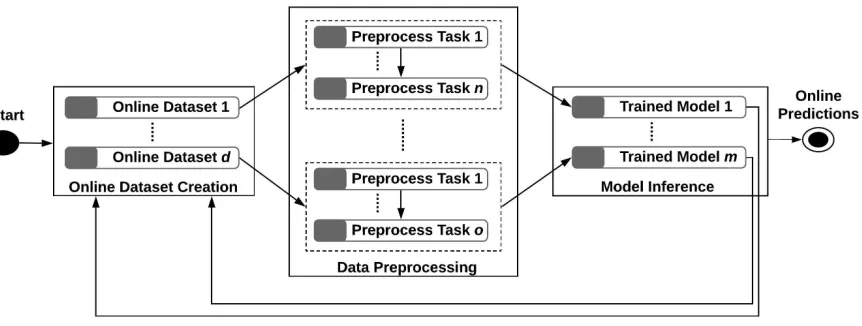
Figure 3.7: Orchestration steps of online ML workflows.
The orchestration of batch ML workflows involves the execution of three steps: batch dataset
creation, data preprocessing, and model building. In addition, the data preprocessing step can
![Figure 2.1: Random Forest structure [1].](https://thumb-us.123doks.com/thumbv2/123dok_us/1889204.1246867/23.612.164.471.153.316/figure-random-forest-structure.webp)
![Figure 2.2: Long Short-Term Memory Neuron [2].](https://thumb-us.123doks.com/thumbv2/123dok_us/1889204.1246867/24.612.199.395.68.219/figure-long-short-term-memory-neuron.webp)
![Figure 2.4: Time-series forecasting strategies and their relationship [3].](https://thumb-us.123doks.com/thumbv2/123dok_us/1889204.1246867/26.612.206.388.527.627/figure-time-series-forecasting-strategies-relationship.webp)