Available Online atwww.ijcsmc.com
International Journal of Computer Science and Mobile Computing
A Monthly Journal of Computer Science and Information Technology
ISSN 2320–088X
IMPACT FACTOR: 6.199
IJCSMC, Vol. 8, Issue. 11, November 2019, pg.76 – 80
AUTONOMOUS FIREFIGHTNG ROBOT
Dr. Zamin Ali Khan
1; Syed Rizwan
2 Department of Computer Science, IQRA UNIVERSITY, Pakistan1
Abstract— This paper defines an ―Autonomous Fire Fighting Robot‖ which recognizes and quenches the fire automatically. It detects the fire by using IR Flame sensor and Ultrasonic sensor is utilized for obstacles dodging. First as it moves near to the flame, then it detects the fire automatically and pumps motor to spray extinguisher which is controlled through motor driver circuit. Arduino Mega is used as microcontroller to program all the autonomous AI code and performing all the major functionalities. It is also connected to the local server by using Wi-Fi module. Our robot can help in all the organizations like banks, industries, factories, bakeries etc.
Keywords— Robotics, Firefighting, Sensors, Autonomous, Detection.
I. INTRODUCTION
In engineering, one of the quickest development fields is robotics which is intended to expel the human factors from risky or laborious work and furthermore to act in a distant situation [1].
Robots become very common as the technology is advanced. Now they are not only exclusive utilized by the big organization but also by small. But a robots’ performance is not same as human. It is a technology that reduces the risk of human.
A firefighter robot is capable of detecting fire, it is a critical operation that is currently performed by humans. It aides the human in suppressing the fire and provide the situation awareness. The use of firefighting robot is to analyse the rescue condition of fire on its own with in no time which was not available in past years. By this innovation, individuals and properties can be protected with minimal harm brought by the fire.
In this paper, we discuss the designing of a prototype of firefighting robot which rotates while actively scanning for fire. Flam IR sensor perform the scanning for fire which are placed on each side of robot. When it detects a fire, it moves towards flame or fire and after reaching in front of it, it stops and activate the extinguisher to turn out the fire. The robot work autonomously, it also provides the real time footage to end user (Android Device). Live streaming video footage is also recorded on local server instead of Android device because of enough memory. It is not be self-destructive. The system first upload the complete information and details to the device and then records or stores to the local server i.e. video, data, time and place name. The server is operated only by admin user.
II. SYSTEM WORKING
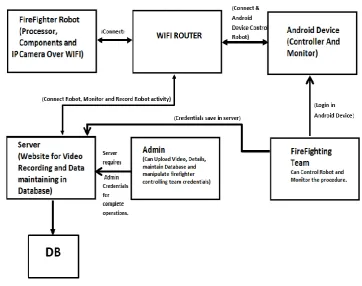
The working of our system is explained by the block diagram which is shown in figure 1.
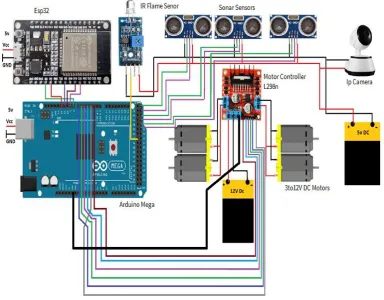
The first component is Arduino mega which is programmed for autonomous working, it receives analog signals from Ultra Sonic Sonar and IR Flame sensor, convert these signals into values then the instructions are passed to DC Motor Controller which set the speed to motor as per the instructions and that’s how the movement of robot in autonomous is done.
Second component is ESP32 which is connected to the server through WIFI medium, it receives the movement instructions from the android app through the HTTP request (Android Application connected to Robot through Wi-Fi). It forwards the request to the Arduino mega in the form of high-low signals which are further sent to DC Motor Controller for the motors movement.
Beside these two components there are two supportive applications playing a vital role in the system working, android application for the fire fighters through which they can monitor the fire location through IP Camera located on robot, and operate the robot from remote location to extinguish the fire,
Another application is a desktop based application which supports the admin as well as fighter login. Admin can manage the records of previous tasks, users and add new operations with location details beside that it can view all the fighters’ operations videos and download them into their system. Firefighter can only edit their information and view the tasks’ videos performed by their ID.
Fig. 1 Block diagram for autonomous firefighting robot
III. METHODOLOGY
Fig. 2 Circuit diagram for autonomous firefighting robot
A. Obstacle Avoidance
Obstacle avoidance is the important aspects of this project. Without any movement of the robot, the system become restricted and fragile. Ultrasonic sensor provides an easy method for the measurements of distance. This sensor used for obstacle avoidance applications that allow you to measure path between moving or stationary objects. For the echo return pulse ultrasonic sensors are used and measure the time as well, and returns the result to the microcontroller as a variable-width pulse from the same I/O pin. Ultrasonic sensor can work with in 3m to 3cm range with any lighting condition.
B. Flame Detection
The detection is based on the number of properties like smoke emission, the increasing level of temperature and the detection of heat and flame. The most rapid technique or method is to identifying or sense the fire in the particular area or environment, and move in that direction and extinguish it within less time. It triggered when the temperature increases. It utilizes the Flame Sensors to identify the source of fire or other resources of the wavelength. It works with in 760nm - 1100 nm.
In our system, sensors have a major concerned, as sensor is utilized as a robot eye to find the source of fire, then the robot moves toward the affected area and after that robot starts working autonomously to find the flame. When the flame is detected, it automatically releases the extinguishing agent. But if the robot is unable to find the flames autonomously, manual mode will be turned on by the user through smart device, then user can see the real time video footage and have a full control over the movement of robot.
C. Minimize Risk
IV. ALGORITHM
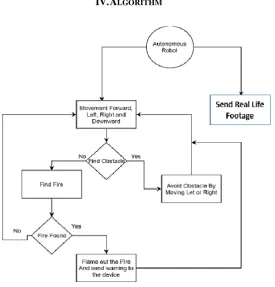
Fig. 3 Algorithm for autonomous firefighting robot
Algorithm is designed for the Autonomous mode of robot which is shown in figure 3. It follows the concept of simple reflex agent which perceives from its environment & perform actions according to the instructions set for those perceptions, i.e. when operating autonomously robot continuously collects the information about operating environment through Sonar Sensors (Obstacles detection) and IR-Flame Sensor (Flame detection) on the behalf of their readings it decides to whether move left, right, forward or backward and at what speed it should operate when the flame or obstacle is at certain distance from it. All the operation coverage is sent to the applications over the server through IP camera. Once the robot reaches at maximum distance from flame it automatically execute the extinguisher and doesn’t stop it until the IR-Flame sensors stop getting the readings for flame after which it moves away from there and notify the fighter to direct the robot to exit by switching to manual mode.
V. COMPARISON WITH PREVIOUS DEVICES
TABLEI COMPARISON
Features Snorkel Fire Sprinkler Fire Extinguisher Firefighting Robot
Human Efforts Requires on every moment
Initially doesn’t require but needs after short duration
Requires on every moment
Doesn’t require at all, can be manually operated from remote location
Limitation
Cannot reach
everywhere, has limited access to buildings
Limited resource and range of sprinkle
Limited extinguisher and requires human being there
Robot may stuck in perplexed obstacles or some sensors may stop working
Overcome
Snorkel cannot breach in entire area of fire place, fighters have to walk into the building
It can be placed to some other location so covering area is not small or limited
Extinguisher Tank size can be increased and some alternate way can be used to release the extinguishing agent
Failure’s solution to robot sensors is its manual control from remote location through android app
Cost
under $1000,000, whereas a ladder truck
VI. FUTURE WORK
In the present condition, it extinguishes the fire only in one particular area, cannot work in the larger scope. We need to focus on some of the important aspects to make this system work in the larger aspect.
i. A better fire extinguisher material can replace the water spray for extinguishing fire. ii. Firefighting robot can modified in a way that it can help in war situations.
iii. It can be enhanced to operate on multiple surfaces (Rough & Oily) and can be made to move on stairs as well.
iv. It can be reformed into humanoid robot in order increase its functionalities.
v. Initially this is built with a single robot but it future no. of robots can be increased and integrated with system.
VII. CONCLUSIONS
In this paper, an autonomous firefighting robot has been designed using Arduino Mega, ESP 8266 Node MCU in support of Sonar & IR Flame sensors. The proposed robot uses the RTSP (Real Time Streaming Protocol) through WIFI IP Camera to provide live operation coverage on android & desktop applications on remote locations. In addition robot is equipped with motor controller to control the movement of motors, 12 to 5V variable regulator providing different voltages to circuit & Water Spray motor performing the extinguishing spray.
ACKNOWLEDGEMENT
This research work was supported and granted by Prof. Engr. Dr. M. Zamin Ali Khan, the Head of Computer Science Department in IQRA University, Karachi.
BIBLIOGRAPHY
[1] David J. Ahlgren, Fire-Fighting Robots And First-Year Engineering Design: Trinity College Experience. 31st ASEE/IEEE Frontiers in Education Conference S2E-6 October 10 - 13, 2001
[2] Taiser T. T. Barros, Walter Fetter Lages Development of a Firefighting Robot for Educational Competitions 3rd International Conference on Robotics in Education (2003), Brazil
[3] Sharavanan.S Automotive Fire Fighting Robot, International Journal of Innovative Research in Science, Engineering and Technology. Volume 6, Special Issue 7, April 2017
[4] B.Deepak, S.P.Naveenkumar, Autonomous Fire Fighting Robot, International Journal of Modern Trends in Engineering and Science, Volume 3, 12 2016
[5] S Efendi1, Fire Extinguisher Robot Using Ultrasonic Camera and Wifi Network Controlled with Android Smartphone,1st Annual Applied Science and Engineering Conference, IOP Conference Series: Material and Science Engineering, Bandung, Indonesia