A Group Testing Approach to Improved Corruption
Localizing Hashing
Annalisa De Bonis1and Giovanni Di Crescenzo2
1 Universit`a di Salerno, Fisciano, Salerno, Italy. E-mail: [email protected] 2 Telcordia Technologies, Piscataway, NJ, USA. E-mail: [email protected]
Abstract. Efficient detection of integrity violations is crucial for the reliabil-ity of both data at rest and data in transit. While ideally one would want to al-ways find all changes in the input data, in practice this capability may be ex-pensive, and one may be content with localizing or finding a superset of any changes. Corruption-localizing hashing [5] is a cryptographic primitive that en-hances collision-intractable hash functions thus improving the detection property of these functions into a suitable localization property. Corruption localizing hash schemes obtain some superset of the changes location, where the accuracy of this superset with respect to the actual changes is a metric of special interest, called localization factor. In this paper we consider the problem of designing corruption localizing hash schemes with reduced localization factor. In [2], combinatorial group testing techniques have been exploited to construct the first corruption-localizing hash scheme withconstantlocalization factor and sublinear storage and time complexity. In this paper we continue the approach of [2] and present schemes that improve on previous constructions in that they achieve an arbitrarily small localization factor while insuring the same time and storage complexity of the schemes in [2].
Keywords:Algorithms, Cryptography, Corruption Localizing Hashing, Group Testing, Superimposed Codes.
1 Introduction
1.1 Previous work and related areas
In [5, 6] it has been shown that collision-intractable hash functions can be used not only to detect unexpected modifications in data but also to localize the corrupted area in the modified data. To this aim, the authors of [6] have introduced virus-localizing schemes based on cryptographic hashing. In their model, virus-localizing schemes work under the hypothesis that all corrupted blocks occur within a single segment of the given data. The ideas put forward in [6] have been further developed by the authors of [5] who have formally defined corruption-localizing hash schemes as an extension of collision intractable hash schemes, and generalized the concept of virus-localization to the case of an arbitrary number of corrupted segments. In [12] a similar problem of localiza-tion via randomized techniques was studied in conjunclocaliza-tion with popular data structures and associated space restrictions. In all three mentioned papers, there is an extensive discussion of the differences of these problems with related but distinct research areas, including coding theory, digital watermarking, software download, program checking, memory correctness checking, combinatorial group testing and authenticated data struc-tures. These papers also discuss the conceptual relationships between the notion of lo-calization, with respect to the notions of detection and correction.
The paper [2] continued the research approach of [5, 6, 12]. In particular, that paper addresses the problem of localizing multiple corruptions by only paying a very small performance price, and obtain a scheme with a constant localization factor and stor-age and time complexity proportional toO(v(logv) logn+v(logβ) log(n/v)), where n is the length of the input message,v is anupper bound on the number of
corrup-tions, andβis anupper boundon length of the longest corrupted segment. The closest
previous results include: [6], presenting a scheme based on conventional (non-keyed) hash functions that localizes a single corrupted segment with constant localization fac-tor and sfac-torage and time complexity proportional to O(logn), and [5], presenting a
scheme based on conventional hash functions that, whenvis constant (as a function of n), achievesO(nd)localization factor and storage and time complexity proportional to O(log2n), for any0 < d <1. The paper [5] also presents a scheme based on keyed
hash functions that achievesO(v3)localization factor and storage and time complexity proportional toO(v2(log1+�n) log
vn), for any� >0.
1.2 Summary of Results
Our schemes are based on a notion of localizing codes recently introduced in [2]. Localizing codes are used in conjunction with collision-intractable hashing to obtain corruption-localizing hashing. We present constructions of localizing codes based on efficient solutions for a variant of group testing, targeting the localization (rather than exact determination) of multiple arbitrary-length (rather than length-1) corruptions.
The analysis of corruption-localizing hash schemes is based on two conflicting met-rics: the localization factor that measures the accuracy of localization, and the tag length that captures the efficiency of the scheme in terms of storage and time complexity. Our goal is to design localizing codes that achieve the smallest possible localization factor and tag length, while keeping an arbitraryβ =O(n)and an unboundedv.
In Section 5 we present a construction that results in a localizing-corruption hash scheme that can be instantiated to achieve a localization factor arbitrarily close to
in Section 6 as a building block to design an improved localizing code with local-ization factorarbitrarily closeto 1, and storage and time complexity proportional to
O(v(logv) logn+v(logβ) log(n/v)). We remark that we assume that the exact
num-ber of corruptions as well as the maximum length of corruptions is not given, in thatv
andβare only upper bounds on the number and length of corruptions.
Our scheme is the first scheme with sublinear storage and time complexity that achieves a localization factor arbitrarily close to 1. Previous efficient schemes with con-stant localization include the scheme in [2] that achieves a concon-stant localization factor larger than 6. Other than this, previously known schemes achieve constant localization factor only under the following model restrictions: in the caseβ= 1andv=O(1)[4], in the caseβ = 1andvbounded by some polynomial inn[12], in the casev = 1by [6], and whenv=O(1)[5].
2 Model and Preliminaries
In this section we review formal notions and definitions of interest in the rest of the paper; specifically: collision-intractable hashing, corruption-localizing hashing, combi-natorial group testing and superimposed codes.
2.1 Collision-intractable Hashing.
Informally speaking, a family of collision-intractable hash functions is a family of func-tions that satisfy the following properties: there exists an efficient algorithm sampling a function from the family; there exists an efficient algorithm computing the output of each function sampled from the family; and no efficient algorithm can find two preim-ages that are mapped to the same image by any function sampled from the family, unless with small probability. Interestingly, this latter property, also called collision-intractability, holds even when inputs are much longer than (typically, constant-size) outputs. We now proceed more formally.
LetH={Hλ}λ∈N, withHλbeing a set of functionshλ :{0,1}p(λ) → {0,1}σ, whereλis a security parameter, pis a polynomial and σis constant with respect to λ. Afamily of hash functionsH, is a family of polynomial-time (inλ) samplable and
computable functionshλthat take ap(λ)-bitmessageas input and return aσ-bittag.
We denote astn(H)the running time of hash functions inHλon inputs of lengthn. We now recall the formal definition of collision intractability.
Definition 1. LetH ={Hλ}λ∈N be a family of hash functions. For anyt, � > 0, we
say thatHis(t, �)-collision-intractableif for any algorithmArunning in timet,
Prob[hλ←Hλ; (x1, x2)←A(1λ, hλ) : x1�=x2 ∧ hλ(x1) =hλ(x2) ] ≤ �,
where the notation←denotes a random process (e.g., randomly choosing from a fixed set, or from the set of outputs of an algorithm on a given input).
2.2 Corruption-Localizing Hashing.
Informally speaking, a corruption-localizing hash scheme is a pair of algorithms, a hashing algorithm and a localizer that satisfy the following properties: both algorithms run in deterministic polynomial time; the hashing algorithm can be seen as a collision-intractable hash function; the localizer, when given as input the hash tag for the original input string, the corrupted input and the tolerated number of errors, returns a superset of these errors that is larger than the number of errors by a given multiplicative fac-tor, called the localization facfac-tor, unless with small probability. We now proceed more formally, building on the model from [6, 5].
Data model. Letxdenote an n-bit message (extending our results to messages con-sisting ofnblocks of multiple bits as atomic components is immediate). For any two block indicesi, j ∈ {1. . . , n}withi ≤j, we denote byx[i]thei-th block ofxand by x[i, j] the sequence of consecutive bits x[i], x[i+ 1], . . . , x[j −1], x[j] with in-dices in the interval[i, j]. A sequence of consecutive bits of a message xwill be re-ferred to as a segment of x. A sequence of segments {[xi1, xj1], . . .[xik, xjk]}, with
i1≤j1≤i2≤j2, . . .≤ik≤jk, will be referred to assegment list.
Adversary model.Given twon-bit messagesxandx�, we measure their difference using
functionDiffv[x, x�] = min�vr=1|Sr|, where eachSr, forr= 1, . . . , v, is an interval
in[0, n−1], and the minimum is taken over allS1, . . . , Sv such thatx[�vr=1Sr] =
x�[�vr=1Sr]3. Notice thatSrmight be empty for somer ∈ {1, . . . , v}. IfS1, . . . , Sv are v intervals in[0, n−1]such that Diffv[x, x�] = �vr=1|Sr| andx[�vr=1Sr] = x�[�vr=1Sr]then we say that S1, . . . , Sv achieveDiffv[x, x�]. Intuitively,Diffv[x, x�]
represents the minimum total size of up tovsegments that an adversary has to modify
in order to changexintox�. We say that ann-bit vectoreis a(β, v)-corruption vector if there exists|Si| ≤β, fori= 1, . . . , v, whereS1, . . . , SvachieveDiffv[0n, e]. Note
thatDiffv[x, x�] =Diffv[0n, e], wheree=x⊕x�,0ndenotes then-bit zero vector and
⊕denotes the logical XOR operation. We can then characterize the adversary’s attack as issuing two messagesx, x� such thate = x⊕x� is a(β, v)-corruption vector and formally define corruption-localizing hash schemes as follows.
Definition 2. Ahash schemeis a pair of algorithmsHS = (clH, Loc), with the fol-lowing syntax. On input ann-bit stringx, algorithmclHreturns a stringtag. On input a positive integerv, ann-bit stringx�and a stringtag, algorithmLocreturns a set of
indicesT ⊆ {0,· · ·, n−1}. Both algorithms are deterministic and run in time poly-nomial in some security parameterλ. We say that the hash schemeHSis(t, �, α, β, v )-corruption-localizing if for any algorithmArunning in time tand returning distinct x, x�, it holds thatp(Succ1(A;HS;α, v))≤�, where probabilityp(Succ1(A;HS;α, v))
is formally defined asPr�(x, x�)←A(1λ) :clH(x) =clH(x�)�,and if whenevere=
x⊕x�is a(β, v)-corruption vector, thenp(Succ2(A;HS;α, v))≤�, where probability p(Succ2(A;HS;α, v))is formally defined as
Pr�(x, x�)←A(1λ);T
←Loc(v, x�, clH(x)) : (x[T]�=x�[T])∨� |T|
Diffv[x,x�] > α ��
.
3We note that our constructions do not require an efficient algorithm for computingDiff
We note that the adversary is successful if it either finds a collision to the hashing algorithm clH or preventseffective localization (i.e., one of the modified bits is not
included in T, and thus x[T] �= x�[T]), or forces the scheme to exceed the expected
localization factor (i.e.,|T|> α·Diffv[x, x�]). We use the following metrics to design
and analyze corruption-localizing hash schemes: the hashing algorithm and localizer’s
running times; thelocalization factorα, defined as|T|/Diffv[x, x�]; and thetag length,
defined as the length of the outputtag from algorithmclH. In [5] it was also noted
that two trivial schemes exist that achieve (1)α= n/v, or (2)α = 1and tag length
O(n), thus moving the scheme design target to achievingα=o(n/v)and tag length
o(n). As in our schemes, the outputtagfrom algorithmclHcan be split into message-independent components (i.e., the description of a binary code and the description of a collision-intractable hash function) and message-dependent components (i.e., the hash tags), we define the length of these two quantities as the off-line tag length and the
on-line tag length, respectively. Furthermore, we simplify the on-line tag length metric by using instead the number of hash tags, defined as the number of hash tags from a collision-intractable hash function contained in the message-dependent component of
tag. In our constructions both the hashing algorithm and localizer’s running times are
efficient, and the off-line tag length is sublinear inn; thus, the main metrics of interest
will be the localization factor and the number of hash tags.
2.3 Group Testing and Superimposed Codes
Combinatorial group testing [7] is the problem of searching thepositiveelements of a given setOofnelements by posing queries of the form “DoesQcontain any positive element?”, withQbeing a subset ofO. Search strategies where all queries are decided in advance are callednon-adaptive strategies, as opposed toadaptive strategieswhere the queried subsets can be chosen after looking at the answers to the previous queries. Typically, non-adaptive strategies are far more costly than adaptive strategies. With re-spect to combinatorial group testing, it is well known that the best adaptive strategies attain theΩ(log�nq�)information theoretic lower bound, withqbeing an upper bound on the number of positive items. On the other hand, the number of queries needed to determine up to qpositive elements by a non-adaptive strategy is lower bounded by
Ω(logq2qlog(n/q)). Indeed, it is well known that the cost of non-adaptive strategies for
group testing corresponds to the length of(1, q)-superimposed codes [10, 13]. In the
following, we recall a more general definition of superimposed codes.
Abinary codeof sizenand length N is anN ×n matrixC = {C(i, j)} with
C(i, j)∈ {0,1}, whose columns are calledcodewords. Given two equal-length binary vectorx, y, we say thatxiscoveredbyyifx(i) = 1impliesy(i) = 1, for all indicesi. The following definition is due to Dyachkov and Rykov [10].
Definition 3. [10] Letd, q, nbe integers>0withd+q≤nand letM={M(i, j)}
be a binary code of sizen. We say thatMis a(d, q)-superimposed codeif for anyd+q
codewordsM(·, j1), . . . , M(·, jd+q), there exists a row indexisuch that∨dh=1M(i, jh) = 1 and∨dk=+dq+1M(i, jk) = 0, where∨denotes boolean OR. The minimal length of a (d, q)-superimposed code of sizenis denoted byN(d, q, n).
The codes in the above definition have the property that the boolean sum of any d
Ford= 1,(d, q)-superimposed codes correspond to classical superimposed codes
[13], or equivalently to cover free families [11].
The following asymptotic lower and upper bounds [3, 10] on the minimum length
N(d, q, n)of a(d, q)-superimposed code of sizenhold:
N(d, q, n) =O
�q2
d log n q
�
; N(d, q, n) =
Ω�dlogq2qlognq� ifq≥2d,
Ω(qlognd) ifq <2d.
The best constructions for(d, q)-superimposed codes achieve the above upper bound with the constant hidden in the big-O notation being smaller than three. We refer the interested readers to [8] for an account on the theory of superimposed codes.
3 Using Group Testing to Perform Corruption Localization
The basic idea of corruption-localizing hash schemes is to define a collection L of segment lists of the original stringxin such a way that the output setT(recall thatTis a superset of the indices corresponding to corrupted bits) is determined by comparing the hash tag of each segment list inLwith the hash tag of the corresponding segment list of
x�, each hash tag being produced using a collision-intractable hash function. Notice that if the hash tag of a segment list ofxis equal to the hash tag of the corresponding segment
list ofx�then no segment in the segment list has been corrupted (unless collisions were
found in the collision-intractable hash function), whereas if those two tags are different then at least one segment in the segment list has been corrupted.
Testing whether a collision-resistant hash function maps two segment lists to the same tag corresponds to posing a YES/NO query of the form “Does the tested segment list contain at least one corrupted segment?” thus implying that the problem of deter-mining the corrupted segments in x� by a corruption-localizing hash scheme can be
regarded as a particular instance of the group testing problem.
The authors of [5] pointed out that strategies for group testing cannot be used to solve our problem in that those strategies search for atomic elements, whereas we are interested in searching segments that may have lengths that are potentially > 1 and different among each other. One approach to overcome this objection is to focus on corrupted bits rather than corrupted segments. Hence, we state our problem as that of searching for corrupted bits given that these bits occur in at mostv segments each of which has length at mostβ. Having rephrased the problem in these terms, one has to cope with a more specific version of combinatorial group testing where some additional information is known on how positive elements are distributed. Notice that, in order to retrieve the original message from its corrupted version, one has to precompute the hash tag for each segment list ofxthat belongs toL. In group testing this corresponds to the situation where each query must be decided beforehand without looking at the responses to the previous queries; in other words, a non-adaptive search strategy is needed. The best constructions for(1, q)-superimposed codes imply anO(q2log(n/q)) upper bound on the cost of non adaptive group testing strategies that search for up to
qpositive elements. Therefore, determining the exact location of all corrupted bits by
obtained on the tag length is not satisfactory as it can be linear or super-linear in n
wheneverβ=Ω(√n). (Note that in generalβ =O(n)and that our goal was to obtain a corruption-localizing hash scheme with tag length smaller thano(n); e.g.
polylog-arithmic in n.) Alternatively, one might use a(d, vβ)-superimposed code to obtain a
superset of all corrupted bits that contains less thandbits incorrectly classified as
cor-rupted, thus obtaining a localization factor smaller than or equal to1 + (d−1)/p, where p < vβis theunknownexact number of corrupted bits. Sincepmight be as small as 1
then the localization factor might be as large asd. This localizing strategy would cost O(((vβ)2/d) log(n/(vβ))), thus achieving a constant localization factor at the same cost incurred by the algorithm that exactly determines all corrupted bits. To improve on the above bound on the tag length, we have to specifically target corruption localization (as opposed to search) and exploit the additional information that corrupted bits occur in segments of length at mostβ. In Sections 5 and 6 we propose two non-trivial uses of superimposed codes that achieve desirable combinations of efficiency and localization properties.
4 Localizing Codes
In this section we recall the definition of localizing codes [2]. Such codes are used in conjunction with collision-intractable hashing to obtain corruption-localizing hash schemes. Localizing codes are formally defined as binary codes for which there exists an efficient algorithm that, given the output of a matrix product between the code ma-trix and a corruption vector, returns a superset of the corrupted bits, that is larger by a bounded factor. We use matrix product in the 2-value Boolean algebra; that is, the semir-ing({0,1},∨,∧), where matrix product is then a sequence of∨’s (i.e., boolean ORs) of∧’s (i.e., boolean ANDs). The weight of a binary vectore, defined as the number of nonzero vector components, is denoted asw(e).
Definition 4. LetM = {M(i, j)} be a binary code of sizenand lengthN. We say
thatMis a(β, v, α)-localizing codeif there exists an efficient algorithmLMsuch that
for any(β, v)-corruption vectore, given as input the matrix productM·e,LMreturns
a vectorusuch thatucoverseandw(u) =αDiffv[0n, e].
Corruption Localization from Localizing Codes.The following result [2] shows that any localizing code can be used to construct a corruption-localizing hash scheme from a family of collision-intractable hash functions.
Theorem 1. LetH={Hλ}λ∈Nbe a family of hash functions, and letM={M(i, j)}
be a binary code of sizenand lengthN. IfHis(t, �)-collision-intractable andMis a(β, v, α)-localizing code, then there exists a hash schemeHSM = (clHM, LocM)
that is (t�, ��, β, v, α�)-corruption-localizing, where�� = �,t� = t+O(tn(H)·N).
Moreover, HSM has localization factor α� = α, number of hash tags O(N), and
runtime complexityO(tn(H)·N).
A sketch of the construction of the schemeHSMis as follows. The hashing algorithm
anN-bit vectorzsuch that z[i] = 1if and only if the hash tag computed on thei-th
execution ofHλonx�is different from the one returned byclH
Mas the tag computed by thei-the execution ofHλonx. Finally,LocMruns the algorithmLMon vectorzto obtain vectoru, and outputs this vector. The main observation in the proof of Theorem 1
is that, either collisions are found inHλor the vectorzcan be shown to be equal to the
matrix product between matrixM of the localizing codeMand the(β, v)-corruption
vectore, and therefore the localization property ofLMimplies an analogue localization property forLocM.
Theorem 1 unifies previous results (in particular, a result in [6] can be restated as a(β,1, O(1))-localizing code, and a result in [5] can be re-stated as a(β, v, O(v3 ))-localizing code) and simplifies the problem of constructing efficient corruption-))-localizing hash schemes to the problem of constructing efficient localizing codes.
To make the paper self-contained, we report the proof of Thorem 1 in Appendix.
4.1 Using Superimposed Codes to Construct Localizing Codes
In Section 3 we discussed the relationship between group testing and corruption local-ization. In that section we pointed out that achieving constant localization factor by a trivial application of group testing would costO((vβ)2logn)in terms of number of tags, which is not satisfactory as it is at least linear innwhenevervβ=Ω(�n/logn).
We observed that, to improve on the latter bound on the tag length, we have to specif-ically target corruption localization (as opposed to search) and exploit the additional information that corrupted bits occur in segments of length at mostβ. In the next two
sections we propose two non-trivial uses of superimposed codes to construct localizing codes with desirable combinations of efficiency and localization properties.
Towards this goal, a crucial idea is to group the bits ofxand those of its corrupted versionx� into consecutive segments of a fixed number h ≤ β of bits and to search among these segments for those containing one or more corrupted bits. If the corrupted bits occur in at most a certain numberqof these segments, then a group testing strategy
for up toqpositive elements can be used to compute a solution of sizerh, wherer≤qis
the number of segments returned by the algorithm. Accordingly, we use a superimposed of size �n/h�, whose columns are associated with segments of length h. The main
difficulty consists in choosing the integerhso that the corrupted bits can be confined
into up to a certain numberqof segments of lengthh, and at the same time it is possible
to prove that the total size of these segments is not too far fromDiffv[x, x�]. Notice that
the upper boundβ on the length of the largest corrupted segment might be very loose and not indicative of the real length of corrupted segments.
5 A First Scheme
In this section we present a localizing code that results in a localizing-corruption hash scheme that can be instantiated to achieve a localization factor arbitrarily close to
β and storage and time complexityO(v2log(n/(βv))). This localizing code is used in Section 6 as a building block to design an improved localizing code with local-ization factorarbitrarily closeto 1, and storage and time complexity proportional to
O(v(logv) logn+v(logβ) log(n/v)), for any number of corruptions and any
An informal discussion. Intuitively, we partition the input messagexinto consecutive
segments of lengthh, for someh ≤β, (with the eventual exception of the rightmost
segment that might have smaller length). We search among these segments for those containing one or more corrupted bits. Accordingly, we start with a binary codeCof size �n/h�, whose columns are associated with these segments. This code is then expanded into a binary codeDof sizenby replicating each row entryhtimes, so that the resulting
code essentially operates over bits directly. As already observed in the previous section, it is crucial to choose the integerhso that the corruptions can be confined into up to
a certain number of segments of lengthh, and at the same time the total size of these segments is not too far from Diffv[x, x�]. Towards this goal, a first difficulty is that
the lengths of corruptions, although known to be at mostβ, can actually vary widely between 1 andβ. We deal with this difficulty by adding a parameterb ≤ β to the code, which intuitively denotes a close upper bound on the maximum length of allv
corruptions. Accordingly, the input message x is partitioned into segments of some lengthh≤b. In the following, we seth=�b/��, for some�≥1.
The codeDand its properties.LetC = {C(i, j)}be a binary code of size�n/h�,
withh =�b/��for some positive integerb ≤β and an arbitrary constant� ≥1, and letN denote the length ofC. We define the binary codeD={D(i, j)}of sizenand
lengthN, as the code returned by the following procedure.
1. Fori= 1, . . . , N,
2. forj= 1, . . . ,�n/h�, 3. letsb
jdenote the interval[h(j−1),min{hj−1, n−1}];
4. for allj�in intervalsb j,
5. setD(i, j�) =C(i, j).
6. Return:D={D(i, j)}.
CodeDsatisfies the following theorem.
Theorem 2. Letb, n, β, vbe given positive integers such thatv≤nand2≤b≤β ≤ n, and let C be a binary code of size�n/�b/���, for some constant� ≥ 1. If C is a (d,(�+ 1)v)-superimposed code, for an arbitrary positive integerd≤n−(�+ 1)v,
thenDis a(b, v, α)-localizing binary code of sizen, withα≤(d+�)�b/��. Moreover, the output vectoruhas weightw(u)≤ �b/��((�+ 1)v+d−1).
Proof. We formally describe an algorithmLD that localizes up tovcorruptions from the(β, v)-corruption vectore, and satisfies the stated bound on the localization factor
α. LetS1, . . . , Svbevintervals of length≤βthat achieveDiffv[x, x�]. In fact, we prove
the stronger inequalityα≤ �b/��((�+ 1) + (d−1)/p), wherep≤vis the unknown
number of non-empty corrupted segments; that is,pis the number of intervalsSr�=∅. We define the locator algorithmLDso that, on input the matrix productzbetween the codeD’s matrix and a corruption vectore, it returns a set of input indices associated
withzaccording to a natural vector coverage notion. Then, we prove thatDandLD satisfy the definition of localizing codes with α≤ �b/��((�+ 1) + (d−1)/p). One
The algorithm LD. On input the response vectorz = D ·e, algorithm LD goes as follows:
1. setu= 0n
2. forj= 1, . . . ,�n/h�, 3. letsb
jdenote the interval[h(j−1),min{hj−1, n−1];
4. if columnC(·, j)is covered byzthen 5. setu[j�] = 1for allj� ∈sb
j
6. return:u
We now prove that for any(b, v)-corruption vectore, it holds thatw(u)≤αDiffv[0n, e]
for α ≤ b+b/�+ (d−1)b/(�p). In the following, we say that an interval sbj ∈
{sb
1, . . . , sb�n/h�}iscorruptedif it intersects one or moreSr’s.
First we show that the returned vectoruhas nonzero elements in correspondence of ≤(�+1)p+d−1intervals from{sb
1, . . . , sb�n/h�}, and consequentlyw(u)≤((�+1)p+
d−1)h. To see this, observe that eachSrhas size≤b, and thus eachSrintersects at most�+1adjacent intervals amongsb
1, . . . , sb�n/h�. Since there arepintervalsSr’s such thatSr�=∅, then there are at most(�+ 1)pcorrupted intervals in{sb
1, . . . , sb�n/h�}. Let
sb j1, . . . , s
b
jm, for somem ≤ (�+ 1)p, be the corrupted intervals in{s
b
1, . . . , sb�n/h�}. The response vector zis the bitwiseOR of columnsC(·, j1), . . . , C(·, jm). By
def-inition of (d,(�+ 1)v)-superimposed code, one has that, for any d column indices
h1, . . . , hd ∈ {/ j1, . . . , jm}, the bitwise OR of columnsC(·, h1), . . . , C(·, hd)is not covered byz, and consequently, there might be at mostd−1columns, in addition to
C(·, j1), . . . , C(·, jm), that are covered byz. LetC(·, r1), . . . , C(·, rg), for someg < d, denote these columns. One has thatu[j�] = 0ifj�∈sb
jwithj�∈ {j1, . . . , jm, r1, . . . , rg}, andu[j�] = 1ifj�∈sb
jwithj∈ {j1, . . . , jm, r1, . . . , rg}.
Observe thatDiffv[0n, e]might be as small aspsince each non-empty intervalSr
might consist of a single bit. Hence,α=w(u)/Diffv[0n, e] = (m+g)h/Diffv[x, x�]≤
((�+ 1)p+d−1)�b/��.Sincep≥1, thenα≤(d+�)�b/��.
The next corollary follows from Theorems 1 and 2.
Corollary 1. Letb, n, β, vbe given positive integers such thatv≤nand2≤b≤β ≤ n, and letN=N(d,(�+1)v,�n�/b�), for an arbitrary constant�≥1and an arbitrary positive integerd≤n−(�+1)v. IfH={Hλ}λ∈N is a(t, �)-collision-intractable
fam-ily of hash functions, then there exists a(t�, ��, b, v)-corruption-localizing hash scheme
with��=�,t�=t+O(tn(H)·N), localization factorα≤(d+�)�b/��, and number
of tagsO(N).
We minimize the localization factor by settingd = 1, and apply the upper bound on
N(1,(�+ 1)v,�n�/b�) so as to obtain a hash scheme with localization factor (1 +
�)�b/�� (constant inv) and number of tags O(v2log(n/(bv)))(sublinear whenv =
o(�n/logn)), where the hidden constant is smaller than3(�+ 1)2.
An informal description.The basic idea behind our construction is that we need to learn a good estimatebof the length of the largest corrupted segment. As already
ob-served, this parameter highly affects the efficiency and localization capabilities of local-izing codes. With respect to the scheme in Section 5, we observe that ifbis chosen too
large then upper bound(d+�)�b/��on the localization factor achieved by the scheme is also large. On the other hand, if the chosen value is too small then the number of cor-rupted segments might be larger than the parameterq= (�+ 1)vof the superimposed
codeC, and consequently, the number of columns ofCcovered by the response vector might be much larger than(�+ 1)v, in which casew(u)would be very large as well. In order to learn a good estimate of the length of the largest corrupted segment, we apply the scheme of Section 5 with decreasing values ofb, ranging fromβto 1.
We construct the localizing codeEand the related localizing algorithmLE as fol-lows. Letq > 1and� ≥ 1be arbitrarily chosen constants. Fork = 0, . . . ,�logqβ�,
we denote byCk a binary code of size�n/hk�, whereβk =�β/qk�andhk=�βk/��.
CodeCk is expanded into a binary codeDk by replicating each row entryhk times.
Notice that codeDkcorresponds to codeDof Section 5 with the parameterbset equal
toβk. Intuitively,Dk obtains a good localization factor if the maximum length of a
corrupted segment ranges in the interval(�β/qk+1
�,�β/qk
�].
Given codesCk andDk, we construct a localizing algorithmLk as in the proof
of Theorem 2, and use that theorem to conclude that the n-bit vector uk returned by Lk satisfies the following properties: (a) uk covers the (β, v)-corruption vector
e, and (b) if all corrupted segments have length ≤ βk = �β/qk
� then w(uk) ≤ �βk�−1
�((� + 1)v +�v�/c�+d−1). The idea of our localizing algorithm LE is to run algorithms L0, . . . , Lf, wheref = min{k ∈ {1, . . . ,�logqβ�} : w(uk) >
�βf�−1
�((�+ 1)v+�v�/c�+d−1)}. A crucial difficulty consists in proving that, by stopping atk = f, the algorithmLE achieves the desired localization factor. It is also possible that the localizing algorithm never finds such anf, in which case it is not
possible to prove that one of vectoruk’s attains the desired localization factor. In order
to achieve the desired localization factor, we exploit the fact that, in this case, the total number of corrupted bits is at mostw(u�logβ�) ≤ �−1((�+ 1)v+�v�/c�+d−1), and consequently, it is convenient to localize all corruptions by a group testing strat-egy that directly searches for the single corrupted bits, rather than searching for cor-rupted intervals of some maximum length. Observe that a trivial use of non-adaptive group testing would allow to exactly detect the corrupted bits but would incur an over-head of O((v +d)2log(n/(v+d))). Alternatively, if we knew a good estimate of the exact number of corrupted bits then we would be able to build a localizing code with a small localization factor. Hence, we need to guess a good estimate of the num-ber of corrupted bits and, to this aim, we add a parameter vr to the localizing code, which intuitively denotes a close upper bound on the number of corrupted bits. We set
v0 = (�+ 1)v+�v�/c�+d−1, that isv0is the known upper bound on the number of corrupted bits, andvr =�v0/mr�for an arbitrary constantm >1. Notice that, for some integerr∈[0,�logmv0�],vris a close upper bound on the exact number of cor-rupted bits. Forr= 0, . . . ,�logmv0�, we denote byGra localizing code that localizes
up tovrcorrupted bits. The codeEis obtained by concatenating the rows of codesDk’s
The codeE and its properties.Letc > 0,� ≥1,q > 1,m > 1be arbitrarily chosen constants. For k = 0, . . . ,�logqβ�, letβk = �β/qk�andhk = �βk/��, and letCk
be a binary code of size�n/hk�whose length is denoted byNk. Moreover, forr = 0, . . . ,�logm((�+ 1)v+�v�/c�+d−1)�, letGrdenote a binary code of sizenwhose
length is denoted byNrˆ . CodeEis formally defined as follows: 1. Seth= 0
2. Fork= 0, . . . ,�logqβ�,
3. fori= 1, . . . , Nk,
4. forj= 1, . . . ,�n/βk�, 5. letsβk
j denote the interval[�βk�−1�(j−1),min{�βk�−1�j−1, n−1}],
6. for allj�in intervalsβk
j ,
7. setDk(i, j�) =Ck(i, j)andE(h+i, j�) =Dk(i, j�) 8. seth=h+Nk
9. Forr=�logm((�+ 1)v+�v�/c�+d−1)�, . . . ,0,
10. fori= 1, . . . ,Nrˆ ,
11. forj= 1, . . . , n,
12. setE(h+i, j) =Gr(i, j) 13. h=h+ ˆNr.
14. Return:E={E(i, j)}.
If codesCk’s are(d,(�+ 1)v+�v�/c�)-superimposed codes of size�n/hk�for an
arbitraryd ≤n−(�+ 1)v− �v�/c�, and codesGr’s are(�vr/c��, vr)-superimposed
codes of sizen, withvr = �((�+ 1)v+�v�/c�+d−1)/mr�andc� ≥1being an arbitrary constant, then it is possible to prove that codeE achieves localization factor
α≤max{q(1+c+c/�+c(d−1)/(v�)), m+m/c�}. The number of tags of the related scheme is the sum of the lengths ofC0, . . . ,C�logβ�,G0, . . . ,G�logm((�+1)v+�v�/c�+d−1)�. This leads to the main results of the paper .
Theorem 3. Letn, β, vbe given positive integers such thatβ ≤nandv ≤n, and let c > 0,c� ≥ 1,� ≥ 1,m > 1,q > 1be arbitrarily chosen constants. Moreover, let
N =��logqβ�
k=0 N(d,(�+ 1)v+�v�/c�,�n/�βk/���) +
��logmv0�
r=0 N(�vr/c��, vr, n),
with βk = �β/qk�,vr = �((�+ 1)v+�v�/c�+d−1)/mr�, and withd ≤ n−
(�+ 1)v − �v/c�being an arbitrary positive integer. If H = {Hλ}λ∈N is a(t, �)
-collision-intractable family of hash functions then there exists a(t�, ��, β, v)
-corruption-localizing hash scheme, with�� =�,t� =t+O(tn(H)·N), localization factorα≤ max{q(1 +c+c/�+c(d−1)/(v�)), m+m/c�}and number of tagsO(N).
Observe that the upper bound on the minimum length of (d, q)-superimposed codes
implies that the minimum length of a (d,(� + 1)v +�v/c�)-superimposed code of size �n/�βk/��� is O((v2/d) log(nqk/(βv))), where the hidden constant is smaller
than3(�+ 1)2. Moreover, by the same bound, the minimum length of a(
�vr/c��, vr )-superimposed code of sizenisO(vrlog(n/vr), where the hidden constant is smaller than3c�. These bounds imply that the number of hash tags of the scheme of Theorem 3 is upper bounded byO((v+d) logn+ (v2/d)(logβ) log(n/v))), with the hidden con-stant being<max{3(�+ 1)2/logq,3c�(�+ 1 +�/c)/logm}.
When settingd = v in Theorem 3, the scheme achieves localization factorα ≤
Corollary 2. Let n, β, v be given positive integers such that β ≤ n and v ≤ n.
There exists a corruption-localizing hash scheme with number of tags O(vlogn +
vlogβlog(n/v))and localization factorα≤max{q(1 +c+ 2c/�), m+m/c�}, where
m >1,q >1,c >0andc�≥1are arbitrary constants.
We remark that the constantc > 0,c� ≥1,� ≥ 1,m > 1andq >1 can be chosen arbitrarily so as to obtain a localization factor arbitrarily close to 1.
Proof of Theorem 3. We formally describe an algorithm LE that localizes up tov corruptions. We denote byethe(β, v)-corruption vector that transformsxintox�. For k = 0, . . . ,�logqβ�,Ck andDk are the binary codes used to define the first rows of
codeE, andLk denotes the algorithm obtained by replacingCwithCkandDwithDk
in the algorithmLDdescribed in Section 4. Moreover, forr= 0, . . . ,�logm((�+ 1)v+ �v�/c�+d−1)�,Gris the binary code used to define the last rows of codeE.
The algorithmLE.On input the response vectorz=E ·e,LE does the following: 1. Setuk = 0n, fork= 0, . . . ,
�logqβ�.
2. Fork= 0, . . . ,�logqβ�,
3. setuk=the vector returned byLk,
4. ifw(uk)>�βk�−1
�((�+ 1)v+�v�/c�+d−1),
5. then return:u=uk−1, 6. setk=k+ 1.
7. Seturˆ = 0n, forr= 0, . . . ,�log
m((�+ 1)v+�v�/c�+d−1)�.
8. Forr=�logm((�+ 1)v+�v�/c�+d−1)�, . . . ,0,
9. forj= 1, . . . , n,
10. if columnGr(·, j)is covered byz
11. then seturˆ [j] = 1 12. ifw(ˆur)< vr+�vr/c�� 13. then return:u= ˆur
14. setr=r−1.
It is immediate to see that the vectorureturned byLE covers the corruption vectore. To prove Theorem 3, we need to show that, by an appropriate choice of codesCk’s and Gr’s, the vectoruachieves the claimed upper bound on α. The proof of Theorem 3
relies on the following two lemmas.
Lemma 1. Letn, β, v be given positive integers such thatβ ≤ n and v ≤ n, and let c > 0,� ≥ 1,q > 1 be arbitrarily chosen constants. Fork = 0, . . . ,�logqβ�,
letβk = �β/qk
�, and letCk be a(d,(�+ 1)v+�v�/c�)-superimposed code of size
�n/�βk/���, where d ≤ n−(�+ 1)v− �v�/c� is an arbitrary positive integer. If algorithmLE terminates at line 5, then it achieves localization factorα < q(1 +c+
c/�+c(d−1)/(v�)).
Proof. For the sake of simplicity, we will assume thatv�/c is an integer (the more
general case being proved similarly).
AlgorithmLE terminates at line 5 if and only if there is an integerk∈[0,�logqβ�]
such thatw(uk)>�βk�−1�((�+ 1)v+v�/c+d−1). In this case algorithmL
E returns the vectoruf−1, wheref = min{k ∈ {1, . . . ,�logqβ�} : w(uk) > �βf�−1�((�+
implies that there exists anh∈ {0, . . . , n−1}such that|Sh|> βf =�βq−f
�. Indeed, any(d,(�+ 1)v+v�/c)-superimposed code is also a(d,(�+ 1)v)-superimposed code
and consequentlyCf satisfies the hypothesis of Theorem 2. By that theorem, one has
that if|Sr| ≤βf, for allr= 1, . . . , v, thenw(uf)≤ �βf�−1�((�+ 1)v+d−1). Since we have chosenfas the smallest integer such thatw(uf)>�βf�−1�((�+ 1)v+v�/c+
d−1)then at least one ofS1, . . . , Svshould have cardinality larger thanβf.
Now we show thatDiffv[x, x�] > βq−fv/c. Let us assume by contradiction that
Diffv[x, x�] ≤ βq−fv/cand let us consider the partition of [0, n−1]into the
inter-valssβf 1 , . . . , s
βf
�n/�βf/��� of length�βf/��(with the eventual exception of the right-most interval that might have smaller length). Forr = 1, . . . , v, we denote byIβf
r the
set of (consecutive) corrupted intervals sβf
j ’s that intersectSr. Notice that for some r < v,Iβf
r andIrβ+1f might intersect since the rightmost corrupted interval inI
βf
r might
be the leftmost in Iβf
r+1. LetI
βf
h1, . . . , I
βf
hg, for someg ≤ v, denote those sets among
Iβf 1 , . . . , I
βf
v with cardinality larger than or equal to�+ 2. We have thatDiffv[x, x�] =
�v
r=1|Sr| ≥ �g
j=1|Shj|> �g
j=1(|I
βf
hj| −2)�βf� −1
�. Indeed, forj = 1, . . . , g,Shj entirely contains all intervals in Iβf
hj, with the eventual exception of the leftmost and rightmost segments that are not taken into account by the summation in the last term of the above inequality. This inequality and the contradiction hypothesis imply that �g
j=1(|I
βf
hj|−2)�βf� −1
�< βfv/cfrom which it follows that�gj=1|I
βf
hj|< v�/c+2g. On the other hand the number of corrupted intervalssβf
j ’s is at most
�v r=1|I
βf
r | ≤
�g j=1|I
βf
hj|+(�+1)(v−g), in view of the fact that|I
βf
r | ≤�+1forr /∈ {h1, . . . , hg}. The last two inequalities imply that the number of corrupted intervalssβf
j ’s is at most
(�+ 1)v+v�/c, and consequently, the response vector zf = Df ·eis the boolean
sum of up to(�+ 1)v+v�/ccolumns ofCf. SinceCf is a (d,(�+ 1)v+v�/c)
su-perimposed code then the only columns covered byzf are those associated with the
corrupted intervals plus an additional subset of at mostd−1columns. It follows that
w(uf)≤ �βf�−1
�((�+ 1)v+v�/c+d−1), from which we have a contradiction. We are ready to show thatw(uf−1)/Diffv[x, x�]< q(1 +c+c/�+c(d−1)/(v�)).
To see this, observe thatf is the smallest index such thatw(uf)>�βf�−1
�((�+ 1)v+
v�/c+d−1)and consequently it must holdw(uf−1)≤ �βf−1�−1�((�+ 1)v+v�/c+
d−1). On the other hand, we proved thatDiffv[x, x�]> βq−fv/cfrom which we have
thatw(uf−1)/Diffv[x, x�]< q(1 +c+c/�+c(d−1)/(v�)). �� Lemma 2. Letn, β, v be given positive integers such thatβ ≤ n and v ≤ n, and let c > 0,c� ≥ 1,� ≥ 1,m > 1,q > 1 being arbitrarily chosen constants. For
k= 0, . . . ,�logqβ�, letβkandCkbe defined as in the statement of Lemma 1, and for r= 0, . . . ,�logm((�+1)v+�v�/c�+d−1)�, letvr=�((�+1)v+�v�/c�+d−1)/mr�
andGrbe a(�vr/c��, vr)-superimposed code of sizen. If algorithmLE terminates at
line 13, then it achieves localization factorα≤m+m/c�.
Proof. AlgorithmLEterminates at line 13 only ifw(uk)≤ �βk�−1�((�+ 1)v+v�/c+
d−1), for allk = 0, . . . ,�logqβ�. In this case the algorithm outputs the vectorugˆ ,
corrupted bits. Since p ≤ w(uk), fork = 0, . . . ,�logqβ�, and β�logqβ� = 1, then
p ≤ (�+ 1)v+v�/c+d−1. Let us definev0 = (�+ 1)v+�v�/c�+d−1. We denote byathe integer in{0, . . . ,�logmv0�}such thatv0/ma+1 < p≤v0/ma. Let
Ga(·, j1), . . . , Ga(·, jp)be thepcolumns ofGa associated with thepcorrupted bits. The response vectorˆza=Ga·eis the bitwiseORof columnsGa(·, j1), . . . , Ga(·, jp).
By definition of(�va/c��, va)-superimposed code, one has that the bitwiseORof any �va/c��columns is not covered by the union of up tova other columns. Therefore, for any �va/c��column indices h
1, . . . , h�va/c�� ∈ {/ j1, . . . , jp}, the bitwise OR of columns Ga(·, h1), . . . , Ga(·, h�va/c��)is not covered byˆz, and consequently, there might be at most�va/c�� −1columns, in addition toGa(·, j1), . . . , Ga(·, jp), that are covered by z. This guarantees, that algorithm LE will return a vector uˆ = ˆug (for someg ≥ a) such thatw(ˆug) < vg +�vg/c�� ≤ va +�va/c��, and therefore, the algorithm achieves localization factor α = w(u)/Diffv[0n, e] < (va +�va/c��)/p.
Sincep > v0/ma+1=va/m, it follows thatα <(mp+mp/c�)/p=m(1 + 1/c�). � � Lemmas 1 and 2 imply thatEis a(β, v, α)-localizing code withα≤max{q(1 +c+
c/�+c(d−1)/(v�)), m+m/c�}. Therefore, Theorem 3 is a consequence of Theorem 1 and of the above two lemmas.
References
1. I. Damgard, “Collision Free Hash Functions and Public Key Signature Schemes”, in Ad-vances in Cryptology - EUROCRYPT’ 87, pages 203-216, LNCS, Springer-Verlag. 2. A. De Bonis, G. Di Crescenzo, “Combinatorial Group Testing for Corruption Localizing
Hashing”, to appear inProceedings of The 17th Annual International Computing and Com-binatorics Conference - COCOON’11, LNCS, Springer Verlag.
3. A. De Bonis, L. Gasieniec and U. Vaccaro, “Optimal Two-Stage Algorithms for Group Test-ing Problems”,SIAM Journal on Computing, vol.34, No. 5, pp. 1253-1270, 2005.
4. G. Di Crescenzo, R. Ge and G. Arce, “Design and Analysis of DBMAC: an Error-Localizing Message Authentication Code”,Proceedings of IEEE GLOBECOM ’04.
5. G. Di Crescenzo, S. Jiang, and R. Safavi-Naini, “Corruption-localizing hashing”, Proceed-ings of Computer Security - ESORICS 2009, LNCS5789, Springer Verlag, 489-504, 2009. 6. G. Di Crescenzo and F. Vakil, “Cryptographic hashing for virus localization”,Proceedings
of the 2006 ACM CCS Workshop on Rapid Malcode - WORM’06, 41-48, 2006.
7. R. Dorfman, “The detection of defective members of large populations”,Ann. Math. Statist., 14, 436–440, 1943.
8. D.Z. Du and F.K. Hwang,Pooling Designs and Nonadaptive Group Testing, World Scientific, 2006.
9. D.Z. Du and F.K. Hwang,Combinatorial Group Testing and its Applications, World Scien-tific, 2000.
10. A.G. Dyachkov, V.V. Rykov, “A survey of superimposed code theory”,Problems Control & Inform. Theory,12, No. 4, 1–13, 1983.
11. P. Erd¨os, P. Frankl, and Z. F¨uredi, “Families of finite sets in which no set is covered by the union ofrothers”,Israel J. of Math.,51, 75–89, 1985.
12. M. Goodrich, M. Atallah, and R. Tamassia, “Indexing information for data forensics”, Ap-plied Cryptography and Network Security Conference (ACNS 2005), 206–221, 2005. 13. W.H. Kautz and R.R. Singleton, “Nonrandom binary superimposed codes”,IEEE Trans. on
Inform. Theory,10, 363–377, 1964.
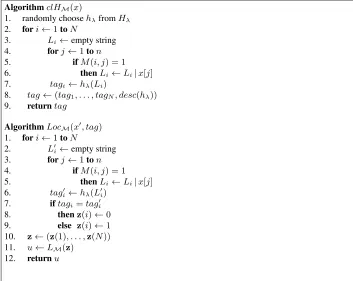
Proof of Theorem 1
We start the proof with a formal description of schemeHSM = (clHM, LocM)and then prove the claimed values on localization factor, number of tags and runtime com-plexity. The formal description of schemeHSM can be found in Figure 1 (here, the symbol|denotes string concatenation anddesc(hλ)denotes the description ofhλ).
AlgorithmclHM(x)
1. randomly choosehλfromHλ
2. fori←1toN
3. Li←empty string
4. forj←1ton 5. ifM(i, j) = 1 6. thenLi←Li|x[j]
7. tagi←hλ(Li)
8. tag←(tag1, . . . , tagN, desc(hλ))
9. returntag
AlgorithmLocM(x�, tag)
1. fori←1toN
2. L�i←empty string
3. forj←1ton 4. ifM(i, j) = 1 5. thenLi←Li|x[j]
6. tag�
i←hλ(L�i)
7. iftagi=tagi�
8. thenz(i)←0 9. else z(i)←1 10. z←(z(1), . . . ,z(N)) 11. u←LM(z)
12. returnu
Fig. 1:Our corruption localizing hash schemeHSM.
We observe that the storage complexity and runtime complexity ofHSMclaimed in the theorem can be checked by inspection, and concentrate on proving the collision intractability and corruption localization property, and, in particular, the values for
��, t�, α� claimed in the theorem. We start the rest of the proof by rewriting the
prob-abilities Prob[Succ1(A;HSM;α�, v) = 1 ]and Prob[Succ2(A;HSM;α�, v) = 1 ], and then show that both quantities are smaller than��=�by proving that (1) an
adver-sary preventing effective localization (i.e., an index of a modified block is not included inu) can be used to violate the collision intractability of familyH; (2) the adversary cannot force the scheme to exceed the localization factorαstated in the theorem.
runningCLHMon inputx, x�returned byA, respectively.” We can then write
Prob[Succ1(A;HSM;α�, v) = 1 ]≤Prob[Coll(A) ],and Prob[Succ2(A;HSM;α�, v) = 1 ]≤Prob[Coll(A) ] +
Prob[Succ2(A;HSM;α�, v) = 1|Coll(A) ],
and then analyze the two probabilities Prob[Coll(A) ]and Prob[Succ2(A;HSM;α�, v) = 1|Coll(A) ]via the following two lemmas. The first lemma also proves the value in the theorem for the claimedt�and one term of the value for the claimed�� by computing an upper bound on Prob[Coll(A) ], as follows.
Lemma 3. If the familyHof hash functions is(t, �)-collision-resistant, then for any algorithmArunning in timet�, it holds that
Prob[Coll(A) ]≤�,
wheret� =t+O(N·tn(H)).
Proof. We use algorithmAto obtain an algorithmA�such that, if eventColl(A) hap-pens then A� violates the collision-intractability of H. On input a hash function hλ
randomly chosen fromHλ, algorithmA�, runs the following steps:
1. Let(x, x�) =A(1λ)
2. Fori= 1, . . . , N,
letLi= empty string andL�i= empty string;
forj= 1, . . . , n,
ifM(i, j) = 1then letLi=Li|x[j]andL�i=L�i|x�[j];
settagi=hλ(Li)andtagi�=hλ(L�i);
iftagi=tagi�then return:(Li, L�i).
3. return:⊥.
We see thatA�obtainsA’s output and then runs the same steps asAon inputx(resp.,x�)
to obtain stringsLi(resp.,L�i). Thus, we obtain that��=�andt�=t+O(N·tn(H)),
wheretn(H)is the max running time of any functionHλonn-block inputs. ��
The second lemma proves the value claimed forα�and one term for the value claimed for�� by proving that when he finds no collisions inHλ, the adversary succeeds with
probability 0 for the value ofαstated in the theorem.
Lemma 4. IfMis a(β, v, α)-localizing code andα� = α, for any algorithm A, it
holds that
Prob[Succ2(A;HSM;α�, v) = 1|Coll(A) ] = 0.
Proof. If eventColl(A)does not happen, for alli∈ {1, . . . , N}, the conditionLi�=L�
i
impliesHλ(Li)�=Hλ(L�i), whereLi, L�iare two strings obtained when runningclHM on input x, x� returned byA, respectively. In this case algorithmLocM does not add any block to the outputuin corresponding of any equalityHλ(Li) = Hλ(L�i). This
Thus, the only way thatAcan make Prob[Succ2(A;HS;α, v) = 1|Coll(A) ] > 0is by forcing the locatorLocM’s outpututo satisfy a larger localization factor than the
α�claimed in the lemma. In the rest of the proof, we show that this is not possible for
any algorithm A; that is, the localization factorα� is equal to the parameterαof the
(β, v, α)-localizing code.
We see that algorithmLocMreturns then-bit vectoruthat is output by algorithm
LMon input theN-bit vectorz. Then we observe that, by construction ofLocM, each component z[i]of vectorzis equal to 1 iftagi �= tagi�, which always happens when Hλ(Li) �= Hλ(L�
i) (as we are assuming that Coll(A) is false). Now, the inequality Hλ(Li)�=Hλ(L�
i)only holds whenLi�=L�i, which implies that thej-th bit of vector eis equal to1for at least one valuejsuch thatM(i, j) = 1. Thus, we have thatzcan be written asM·e, this matrix product being over the semiring({0,1},∨,∧). We can then apply the property of localizing codeM, as from Definition 4, which implies that
w(u)≤αDiffv[0n, e], which proves the lemma. ��
Given these two lemmas, the theorem then follows by further observing that algorithm
LocMin HSMadds to the outputT all but those blocks that appear in some segment
Lifor which it holdshλ(Li) = hλ(L�
i). Therefore, if eventColl(A)does not happen