Efficient Attribute-Based Signatures for
Non-Monotone Predicates in the Standard Model
∗Tatsuaki Okamoto NTT
Katsuyuki Takashima Mitsubishi Electric
August 29, 2014
Abstract
This paper presents afullysecure (adaptive-predicate unforgeable and private) attribute-based signature (ABS) scheme in the standard model. The security of the proposed ABS scheme is proven under standard assumptions, the decisional linear (DLIN) assumption and the existence of collision resistant (CR) hash functions. The admissible predicates of the proposed ABS scheme are more general than those of the existing ABS schemes, i.e., the proposed ABS scheme is the first to support general non-monotonepredicates, which can be expressed usingNOTgates as well as AND, OR, and Threshold gates, while the existing ABS schemes only supportmonotonepredicates. The proposed ABS scheme is comparably as efficient as (several times worse than) one of the most efficient ABS schemes, which is proven to be secure in the generic group model.
Contents
1 Introduction 3
1.1 Background . . . 3
1.2 Our Results . . . 4
1.3 Key Techniques . . . 6
1.4 Related Works . . . 7
1.5 Notations . . . 7
2 Preliminaries 8 2.1 Dual Pairing Vector Spaces by Direct Product of Symmetric Pairing Groups . . . 8
2.2 Decisional Linear (DLIN) Assumption . . . 8
2.3 Collision Resistant (CR) Hash Functions . . . 9
3 ABS for Non-monotone Predicates 9 3.1 Span Programs and Non-monotone Access Structures . . . 9
3.2 Definitions and Security of ABS . . . 10
4 Proposed ABS Scheme 12 4.1 Construction Ideas . . . 12
4.2 Construction . . . 12
4.3 Security . . . 14
4.4 Performance . . . 14
5 Multi-Authority ABS (MA-ABS) 15 5.1 Definitions and Security of MA-ABS . . . 15
5.2 Construction . . . 17
5.3 Security . . . 18
A Dual Pairing Vector Spaces (DPVS) 21 A.1 Summary . . . 21
A.2 Dual Pairing Vector Spaces by Direct Product of Asymmetric Pairing Groups . . 22
B Anonymous Credentials 23 C General Form of the Proposed ABS Scheme 23 D Proof of Theorem 1 25 E Proof of Theorem 2 27 E.1 Key Techniques . . . 27
E.2 Proof Outline . . . 28
E.3 Main Part of the Proof . . . 31
E.4 Problems 1–3 and Their Security . . . 35
E.5 Lemmas for Evaluating Advantage Gaps . . . 39
1
Introduction
1.1 Background
The concept of digital signatures was introduced in the seminal paper by Diffie and Hellman in 1976. In this concept, a pair comprising a secret signing key, sk, and public verification key,
pk, is generated for a signer, and signature σ of message m generated using sk is verified by the corresponding pk. Hence, the signer of (m, σ) usingsk is identified through pk. Although it is one of the requirements of signatures, there is no flexibility or privacy in the relationship between signers and claims attested by signatures due to the tight relation between sk and pk. Recently, versatile and privacy-enhanced variants of digital signatures have been studied, where the relation between a signing key and verification key is more flexible or sophisticated. In this class of signatures, the signing key and verification key are parameterized by attribute
x and predicate v, respectively, and signed message (m, σ) generated by the signing key with parameterx,skx, is correctly verified by public-keypkand parameterv, (pk,v), iff predicatev
accepts attribute x, i.e., v(x) holds. The privacy of signers in this class of signatures requires that a signature (for predicate v) generated byskx (where v(x) holds) release no information regarding attributexexcept that v(x) holds.
When predicate v is the equality with parameterv (i.e.,v(x) holds iffx =v), the class of signatures for this predicate is identity-based signatures (IBS) [33]. Here note that there is no room for privacy in IBS, since predicate v uniquely identifies attribute x of the signer’s secret key, skx, such thatx=v.
This class of signatures with more sophisticated predicates,attribute-based signatures(ABS), has been studied [13, 18, 17, 22, 23, 24, 25, 32, 37], where x for signing key skx is a tuple of attributes (x1, . . . , xi), and v for verification is a threshold or access structure predicate. The widest class of predicates in the existing ABS schemes are monotone access structures [24, 25]. An example of such monotone access structure predicate v for ABS is (Institute = Univ. A) AND (TH2( (Department = Biology), (Gender = Female), (Age = 50’s)) OR (Position = Professor)), where TH2 means the threshold gate with threshold value 2. Attribute xA of Alice is ((Institute := Univ. A), (Department := Biology), (Position := Postdoc), (Age := 30), (Gender := Female))), and attribute xB of Bob is ((Institute := Univ. A), (Department := Mathematics), (Position := Professor), (Age := 45) (Gender := Male))). Although their attributes,xAandxB, are quite different, it is clear thatv(xA) andv(xB) hold, and that there are many other attributes that satisfyv. Hence Alice and Bob can generate a signature on this predicate, and due to the privacy requirement of ABS, a signature forv releases no information regarding the attribute or identity of the signer, i.e., Alice or Bob (or other), except that the attribute of the signer satisfies v.
There are many applications of ABS such as based messaging (ABM), attribute-based authentication, trust-negotiation and leaking secrets (see [24, 25] for more details).
The security conditions for ABS are given hereafter (see Section 3.2 for the formal defini-tions).
Unforgeability: A valid signature should be produced only by asingle signer whose attribute
We can also define a weaker class of unforgeability, ‘selective-predicate unforgeability,’ where an adversary should choose predicate v for the forgery signature before executing secret-key and signing oracle attacks.
Privacy: A signature for predicate v generated using secret key skx releases no information regarding attributexexcept that v(x) holds.
More formally, for any pair of attributes (x1,x2), predicate v and message m, for which
v(x1) andv(x2) hold simultaneously, the distributions of two valid signaturesσ(m,v,skx1) and σ(m,v,skx2) are equivalent, whereσ(m,v,skx) is a correctly generated signature for (m,v) using correct secret keyskx with attribute x (We simply call this condition “ pri-vacy”).
Full Security: We say that an ABS scheme is fully secure if it satisfies adaptive-predicate unforgeability andprivacy.
Maji et al. [24, 25] presented ABS schemes for the widest class of predicates among the existing ABS schemes, monotone access structure predicates, which cover threshold predicates as special cases. The scheme shown in [24] is an efficient and practical ABS scheme, but the security was only proven in the generic group model. The schemes in [25] and by Escala et al.[11] are the only existing ABS schemes that were proven to be fully secure in the standard model. They are, however, much less efficient and more complicated than the scheme in [24] since it employs the Groth-Sahai NIZK protocols [12] as building blocks.
Herranz et al.[15], Li et al.[22], Li et al.[23], and Shahandashti et al.[32] presented ABS schemes that are proven to be secure in the standard model. However, the proven security is not the full security, but a weaker level of security withselective-predicate unforgeability. Moreover, the admissible predicates in [23] are limited to conjunction or (n, n)-threshold predicates, and those of [22, 32] are limited to (k, n)-threshold predicates. Guo et al.[13] and Yang et al.[37] presented ABS schemes for threshold predicates, but their security definitions do not include theprivacycondition of ABS.
Khader [18, 17] presented ABS schemes for monotone access structure predicates. These schemes, however, do not satisfy the privacy condition of ABS, since they only conceal the identity of the signer. They also reveal the attributes that the signer used to generate the signature. In addition, the security is proven in a non-standard model, the random oracle model.
Based on this background, there are two major problems in the existing ABS schemes.
1. No ABS scheme for non-monotone predicates, which can be expressed using NOT gates as well as AND, OR and Threshold gates, has been proposed (even in a weaker security notion or a non-standard model).
2. The only fully secure ABS schemes in the standard model [11, 25] are much less efficient than the ABS scheme in the generic group model [24].
Non-monotone predicates should be used in many ABS applications. For example, annual review reports in the Mathematics Department of University A are submitted by reviewers, and these reports are anonymously signed by the reviewers through ABS with some predicates. The predicates may be selected freely by them (signers) except that it should be in the following form: NOT((Institute = Univ. A) AND (Department = Mathematics)) AND (· · ·).
1.2 Our Results
• This paper proposes the first fully secure (i.e., adaptive-predicate unforgeable and perfectly private) ABS scheme for a wide class of predicates,non-monotoneaccess structures, where
x for signing key skx is a tuple of attributes (x1, . . . , xi), non-monotone predicate v is specified by aspan program(SP) (M, ρ) along with a tuple of attributes (v1, . . . , vj), and
v(x) holds iff SP (M, ρ) accepts the truth-value vector of (T(xi1 =v1), . . . ,T(xij =vj)). Here,T(ψ) := 1 ifψ is true, andT(ψ) := 0 if ψis false.
Our scheme can be generalized using non-monotone access structures combined with inner-product relations(see Definition 5 and the remark). More precisely, attributexfor signing keyskx is a tuple of attribute vectors (e.g., (x1, . . . , xi)∈Fn1+···+ni
q ), and predicatev for
verification is a non-monotone access structure or span program (SP) (M, ρ) along with a tuple of attribute vectors (e.g., (v1, . . . , vj)∈Fn1+···+nj
q ), where the component-wise
inner-product relations for attribute vectors (e.g.,{xiι·vι = 0 or not}ι∈{1,...,j}) are input to SP (M, ρ). Namely,v(x) holds iff the truth-value vector of (T(xi1·v1= 0), . . . ,T(xij·vj = 0)) is accepted by SP (M, ρ).
Remark: In our scheme (Section 4), attribute xis expressed by the form Γ := {(t, xt)|
t ∈ T ⊆ {1, . . . , d}} in place of just an attribute tuple (x1, . . . , xi), where t identifies a sub-universe or category of attributes, andxt is an attribute in sub-universe t (examples of (t, xt) are (Name, Alice) and (Age, 38)). Predicatevis expressed byS:= (M, ρ), where
ρ is abused as ρ (defined by SP) combined with {(ti, vi) |i= 1, . . . , } (see Definitions 4 and 5 for the difference regarding ρ in SP andS).
• The proposed ABS scheme is proven to be fully secure under standard assumptions, the decisional linear (DLIN)assumption (over prime order pairing groups) and the existence of collision resistant (CR) hashfunctions, in the standardmodel.
• In contrast to the ABS schemes in [11, 25] that employ the Groth-Sahai NIZK protocols, our ABS scheme is more directly constructed without using any general subprotocols like NIZK. Our construction is based on the dual pairing vector spaces (DPVS) proposed by Okamoto and Takashima [26, 27, 20, 28], which can be realized from any type of (e.g., symmetric or asymmetric) prime order bilinear pairing groups. See Section 2.1 for the concept and actual construction of DPVS.
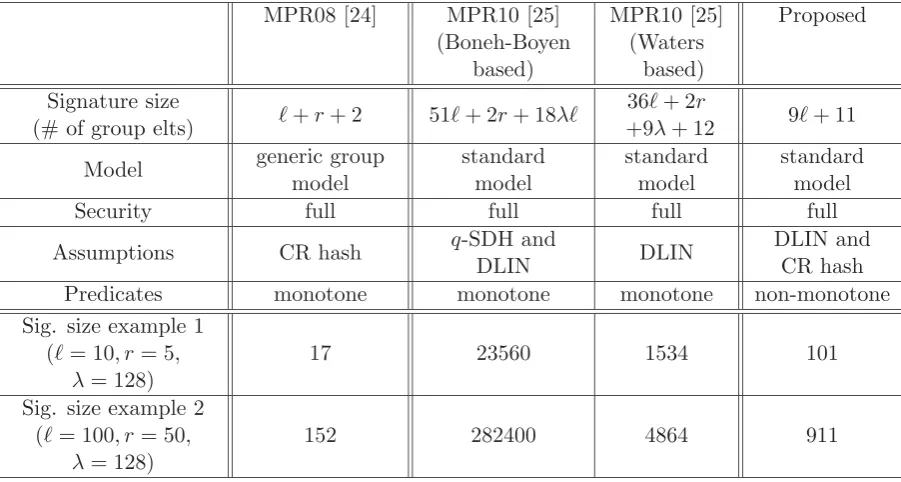
• The efficiency of the proposed ABS scheme is comparable to that of the most efficient ABS scheme in the generic group model [24], and better than those of the existing fully secure ABS schemes in the standard model [11, 25]. See Section 4.4 for a comparison.
• This paper also presents an extension, multi-authority (MA) setting, of the proposed ABS scheme. One of the merits of our MA-ABS scheme is that it is seamlessly extended from the original (single-authority (SA)) setting, in which the signing and verification algorithms of the MA-ABS scheme are essentially the same as those of the original ABS (SA-ABS) scheme.
In MA-ABS, each authority called an attribute authority is responsible for a single (or multiple) category of attributes, and a user obtains a part of secret key for each attribute from an attribute authority responsible for the category of the attribute. In our MA-ABS model, a central trustee in addition to attribute authorities is required but no interac-tion among attribute authorities (and the trustee) is necessary, and different attribute authorities may not trust each other, nor even be aware of each other.
1.3 Key Techniques
The top level strategy of constructing the proposed ABS scheme is based on Naor’s paradigm of converting IBE to signatures. Our ABS scheme is converted from a ciphertext policy (CP) functional encryption (FE) scheme [28], which is adaptively payload-hiding. The description of the CP-FE scheme is given in the full version of [28].
Roughly speaking, in the conversion, a secret signing key, skΓ, with attribute set Γ and a verification text, c, with access structure S (for signature verification) in our ABS scheme correspond to a secret decryption key, skΓ, with Γ and a ciphertext, c, with S in the CP-FE scheme, respectively.
Our construction, however, is not straightforward, or still a challenging task, since no coun-terpart of a signature,s∗, in the ABS exists in the CP-FE, and the privacy property for signature
s∗ is specific in ABS.
To tackle the issue, we develop a new technique,re-randomization with specialized delegation, where signature s∗ in ABS can be interpreted to be a decryption key specialized to decrypt a ciphertext with access structure S, that is delegated and re-randomized from secret keyskΓ.
As for the security proof, roughly speaking, theadaptive-predicate unforgeability of the ABS under theKeyGenoracle attacks can be guaranteed by thenon-adaptivepayload-hiding security of the CP-FE1. This is because, in the security game, a forged signature implies a decryption key specified for the challenge ciphertext to break the payload-hiding, and all secret key and signing queries are made by an adversary before giving a forged signature in the adaptive-predicate unforgeability of ABS, where all secret key queries are made by an adversarybefore requesting a challenge ciphertext in the non-adaptive payload-hiding of FE.
Note that there are many subtleties in the proof of unforgeability for the ABS, e.g., the unforgeability should be ensured in the ABS even when publishing{B∗t}t=1,...,d+1for the privacy requirement, while they are secret in the CP-FE. We develop a novel technique to resolve the difficulty. See Section E for more details.
We now describe a new key technique in this paper, which was not employed in the prelim-inary version [29] of this paper.
A key technique of proving the (non-)adaptive payload-hiding security of the CP-FE scheme [28] ispairwise independence lemma(Lemma 3 in [28]) in the dual system encryption methodol-ogy. A drawback of this technique is that it is directly applicable only when there is a one-to-one correspondence (so-called “one-use”) between a pair of secret key and ciphertext parts through a mapρof policy (access structuresS), but in general a ciphertext part corresponds to multiple secret key parts (so-called “use”). [28] introduced a technique to treat such a multi-use case by using a generalized pairwise independence lemma, but it costs longer secret keys and ciphertexts than those in one-use, and the public parameter bounds the maximum degree of multi-use. The security (unforgeability) proof of the preliminary version [29] is based on the (generalized) pairwise independence lemma technique and inherits the drawback of this technique. In this paper, to address the issue we introduce a new technique, one-dimensional localization of inner-product values, where an unbounded (by the public parameter) number of inner-product values in multi-use are localized into a certain one-dimensional subspace and the other subspaces include no information of the inner-product values, while no information but only a single inner-product value is ensured to be released for a pair of corresponding se-cret key and ciphertext subspaces in one-use by the pairwise independence lemma. Note that this techique is available for proving the adaptive-predicate unforgeability of the ABS and the non-adaptive payload-hiding security of the CP-FE (but not for the adaptive payload-hiding
1Non-adaptive security of CP-FE means that the adversary’s key queries may not depend on the challenge
security of the CP-FE). For more details, see Section E.
1.4 Related Works
• Ring and mesh signatures: Ring and mesh signatures [31, 6] are related to ABS. In the ring signatures, the claimed predicate on a signature of message m is that m is endorsed by one of the users identified by the list of public keys (pk1,pk2, . . .), or the predicate is a disjunction of a list of public keys. A valid ring signature can be generated by one of the listed users.
The mesh signatures are an extension of ring signatures, where the predicate is an access structure on a list of pairs comprising a message and public key (mi,pki), and a valid mesh signature can be generated by a person who has enough standard signatures σi on
mi, each valid under pki, to satisfy the given access structure.
A crucial difference between mesh signatures and ABS is the security against the collusion of users. In mesh signatures, several users can collude by pooling their signatures together and create signatures that none of them could produce individually. That is, such collusion is considered to be legitimate in mesh signatures. In contrast, the security against collusion attacks is one of the basic requirements in ABS and MA-ABS, as described in Section 1.1.
• Anonymous credentials (ACs): Another related concept is ACs [3, 4, 7, 8, 9, 10]. The notion of ACs also provides a functionality for users to demonstrate anonymously possession of attributes, but the goals of ACs and ABS differ in several points.
As mentioned in [25], ACs and ABS aim at different goals: ACs target very strong anonymity even in the registration phase, whereas under less demanding anonymity re-quirements in the registration phase, ABS aims to achieve more expressive functionalities, more efficient constructions and new applications. In addition, ABS is a signature scheme and a simpler primitive compared with ACs.
1.5 Notations
When A is a random variable or distribution, y←R A denotes that y is randomly selected from
A according to its distribution. When A is a set, y ←U A denotes that y is uniformly selected from A. y := z denotes that y is set, defined or substituted by z. When a is a fixed value,
A(x) → a (e.g., A(x) → 1) denotes the event that machine (algorithm) A outputs aon input
x. A function f :N→Ris negligible inλ, if for every constant c >0, there exists an integern
such thatf(λ)< λ−c for all λ > n.
We denote the finite field of order q by Fq, and Fq\ {0} by F×q. A vector symbol denotes a vector representation overFq, e.g.,xdenotes (x1, . . . , xn)∈Fn
q. For two vectorsx= (x1, . . . , xn)
and v = (v1, . . . , vn), x·v denotes the inner-product ni=1xivi. The vector0 is abused as the zero vector inFqnfor anyn. XTdenotes the transpose of matrixX. A bold face letter denotes an element of vector space V, e.g., x∈V. When bi ∈V (i= 1, . . . , n),spanb1, . . . ,bn ⊆V(resp.
spanx1, . . . , xn) denotes the subspace generated by b1, . . . ,bn (resp. x1, . . . , xn). For bases
B := (b1, . . . ,bN) and B∗ := (b∗1, . . . ,b∗N), (x1, . . . , xN)B := Ni=1xibi and (y1, . . . , yN)B∗ :=
N
i=1yib∗i. For a format of attribute vectors n := (d;n1, . . . , nd) that indicates dimensions of
vector spaces,et,j denotes the canonical basis vector (
j−1
0· · ·0,1,
nt−j
0· · ·0)∈Fnt
q fort= 1, . . . , dand
2
Preliminaries
2.1 Dual Pairing Vector Spaces by Direct Product of Symmetric Pairing Groups
In this paper, for simplicity of description, we will present the proposed schemes on the symmet-ric version of dual pairing vector spaces (DPVS) [26, 27] constructed using symmetsymmet-ric bilinear pairing groups given in Definition 1. Owing to the abstraction of DPVS, the presentation and the security proof of the proposed schemes are essentially the same as those on the asymmetric version of DPVS, (q,V,V∗,GT,A,A∗, e), for which see Appendix A.2. The symmetric version is a specific (self-dual) case of the asymmetric version, where V=V∗ and A=A∗.
Definition 1 “Symmetric bilinear pairing groups” (q,G,GT, G, e) are a tuple of a prime q, cyclic additive group Gand multiplicative group GT of order q, G= 0∈G, and a polynomial-time computable nondegenerate bilinear pairing e:G×G→GT i.e.,e(sG, tG) =e(G, G)st and
e(G, G)= 1.
Let Gbpg be an algorithm that takes input 1λ and outputs a description of bilinear pairing groups (q,G,GT, G, e) with security parameterλ.
Definition 2 “Dual pairing vector spaces (DPVS)”(q,V,GT,A, e) by a direct product of sym-metric pairing groups (q,G,GT, G, e) are a tuple of prime q, N-dimensional vector space V:=
N
G× · · · ×Gover Fq, cyclic groupGT of orderq, canonical basis A:= (a1, . . . ,aN) of V, where
ai := (
i−1
0, . . . ,0, G,
N−i
0, . . . ,0), and pairing e:V×V→GT.
The pairing is defined by e(x,y) := Ni=1e(Gi, Hi) ∈ GT where x := (G1, . . . , GN) ∈ V and y := (H1, . . . , HN) ∈ V. This is nondegenerate bilinear i.e., e(sx, ty) = e(x,y)st and if
e(x,y) = 1 for all y∈V, then x=0. For alli and j, e(ai,aj) =e(G, G)δi,j where δ
i,j = 1 if
i=j, and 0 otherwise, and e(G, G)= 1∈GT.
DPVS generation algorithm Gdpvs takes input1λ (λ∈N) andN ∈N, and outputs a descrip-tion of paramV := (q,V,GT,A, e) with security parameter λ and N-dimensional V. It can be constructed by usingGbpg.
Remark 1 For matrix W := (wi,j)i,j=1,...,N ∈ FqN×N and element g := (G1, . . . , GN) in N -dimensionalV,gW denotes (Ni=1Giwi,1, . . . ,Ni=1Giwi,N) = (Ni=1wi,1Gi, . . . ,Ni=1wi,NGi) by a natural multiplication of aN-dim. row vector and aN×N matrix. Thus it holds an associa-tive law as (gW)W−1 =g(W W−1) =g and a pairing invariance property e(gW,h(W−1)T) =
e(g,h) for any g,h∈V.
2.2 Decisional Linear (DLIN) Assumption
Definition 3 (DLIN Assumption) The DLIN problem is to guessβ ∈ {0,1}, given(paramG,
G, ξG, κG, δξG, σκG, Yβ)← GR βDLIN(1λ), where
GDLIN
β (1λ) :paramG := (q,G,GT, G, e)
R
← Gbpg(1λ),
κ, δ, ξ, σ←UFq, Y0 := (δ+σ)G, Y1←UG,
return (paramG, G, ξG, κG, δξG, σκG, Yβ),
for β ← {U 0,1}. For a probabilistic machineE, we define the advantage ofE for the DLIN
prob-lem as: AdvDLINE (λ) := Pr
E(1λ, )→1 ←GR 0DLIN(1λ)
−Pr
The DLIN assumption is: For any probabilistic polynomial-time adversary E, the advantage
AdvDLINE (λ) is negligible in λ.
2.3 Collision Resistant (CR) Hash Functions
Letλ∈Nbe a security parameter. A collision resistant (CR) hash function family,H, associated withGbpg and a polynomial,poly(·), specifies two items:
• A family of key spaces indexed by λ. Each such key space is a probability space on bit strings denoted by KHλ. There must exist a probabilistic polynomial-time algorithm whose output distribution on input 1λ is equal to KHλ.
• A family of hash functions indexed by λ, hk ←R KHλ and D := {0,1}poly(λ). Each such hash function Hλ,hkD maps an element of D to an element of F×q with q that is the first element of output paramG of Gbpg(1λ). There must exist a deterministic polynomial-time algorithm that on input 1λ,hk and∈D, outputsHλ,hkD().
Let E be a probabilistic polynomial-time machine. For allλ, we define
AdvHE,CR(λ) := Pr[(1, 2)∈D2∧1=2∧Hλ,hkD(1) =Hλ,hkD(2)], where D:={0,1}poly(λ),hk←R
KHλ, and (1, 2)← ER (1λ,hk,D). His a collision resistant (CR) hash function family if for any
probabilistic polynomial-time adversary E,AdvHE,CR(λ) is negligible inλ.
3
ABS for Non-monotone Predicates
3.1 Span Programs and Non-monotone Access Structures
Definition 4 (Span Programs [2]) Let {p1, . . . , pn} be a set of variables. A span program overFq is a labeled matrix,Mˆ := (M, ρ), whereM is a (×r) matrix overFq andρis a labeling of the rows ofM by literals from{p1, . . . , pn,¬p1, . . . ,¬pn}(every row is labeled by one literal), i.e., ρ:{1, . . . , } → {p1, . . . , pn,¬p1, . . . ,¬pn}.
A span program accepts or rejects an input by the following criterion. For every input sequence δ ∈ {0,1}n define submatrix M
δ of M consisting of those rows whose labels are set
to 1 by the input δ, i.e., either rows labeled by some pi such that δi = 1 or rows labeled by some by some ¬pi such that δi = 0. (i.e., γ : {1, . . . , } → {0,1} is defined by γ(j) = 1 if [ρ(j) =pi]∧[δi = 1]or [ρ(j) =¬pi]∧[δi = 0], andγ(j) = 0 otherwise. Mδ:= (Mj)γ(j)=1, where
Mj is the j-th row of M.)
Span program Mˆ acceptsδ if and only if1∈spanMδ, i.e., some linear combination of the rows of Mδ gives the all one vector,1. (The row vector has the value 1 in each coordinate.) A span program computes boolean function f if it accepts exactly those inputs δ where f(δ) = 1.
A span program is called monotone if the labels of the rows are only the positive literals {p1, . . . , pn}. Monotone span programs compute monotone functions. (So, a span program in general is “non”-monotone.)
Definition 5 (Inner-Products of Attribute Vectors and Access Structures) Ut(t= 1, . . . , dandUt⊂ {0,1}∗) is a sub-universe, a set of attributes, each of which is expressed by a pair of sub-universe id and nt-dimensional vector, i.e.,(t, v), wheret∈ {1, . . . , d} andv∈Fnt
q \ {0}.
We now define such an attribute to be a variable, p, of span program Mˆ := (M, ρ) i.e.,
p:= (t, v). Access structureSis span programMˆ := (M, ρ)along with variablesp:= (t, v), p := (t, v), . . ., i.e., S:= (M, ρ) such that ρ:{1, . . . , } → {(t, v),(t, v), . . ., ¬(t, v),¬(t, v), . . .}.
Let Γ be a set of attributes, i.e.,Γ :={(t, xt)|xt∈Fnt
q \ {0},1≤t≤d}.
When Γ is given to access structure S, map γ :{1, . . . , } → {0,1} for span program Mˆ := (M, ρ) is defined as follows: For i = 1, . . . , , set γ(i) = 1 if [ρ(i) = (t, vi)] ∧[(t, xt) ∈ Γ] ∧[vi·xt= 0]or [ρ(i) =¬(t, vi)] ∧[(t, xt)∈Γ] ∧[vi·xt= 0]. Set γ(i) = 0 otherwise.
Access structure S:= (M, ρ) accepts Γ iff1∈span(Mi)γ(i)=1.
Remark 2 The simplest form of the inner-product relations in the above-mentioned access structures, that is for ABS in Section 4.2, is a special case when nt = 2 for all t ∈ {1, . . . , d}, and x := (1, x) andv:= (v,−1). Hence, (t, xt) := (t,(1, xt)) and (t, vi) := (t,(vi,−1)), but we often denote them shortly by (t, xt) and (t, vi). Then, S := (M, ρ) such that ρ :{1, . . . , } →
{(t, v),(t, v), . . . ¬(t, v),¬(t, v), . . .} (v, v, . . .∈Fq), and Γ :={(t, xt)|xt∈Fq,1≤t≤d}. When Γ is given to access structure S, map γ : {1, . . . , } → {0,1} for span program ˆ
M := (M, ρ) is defined as follows: Fori= 1, . . . , , setγ(i) = 1 if [ρ(i) = (t, vi)] ∧[(t, xt) ∈Γ] ∧[vi =xt] or [ρ(i) =¬(t, vi)]∧[(t, xt)∈Γ]∧[vi=xt]. Set γ(i) = 0 otherwise.
Remark 3 When a user has multiple attributes in a sub-universe (category)t, we can employ dimension nt>2. For instance, a professor (say Alice) in the science faculty of a university is also a professor in the engineering faculty of this university. If the attribute authority of this university manages sub-universet:= “faculties of this university”, Alice obtains a secret key for (t, xt:= (1,−(a+b), ab)∈Fq3) witha:= “science” andb:= “engineering” from the authority. When a user verifies a signature for an access structure with a single negative attribute ¬(t, “science”), the verification text is encoded as ¬(t, vi := (a2, a,1)) with a:= “science”. Since
xt·vi = 0, Alice cannot make a valid signature for an access structure with the negative attribute ¬(t, “science”). For such a case with nt > 2, see Section C with a general form of our ABS scheme.
We now construct a secret-sharing scheme for a (non-monotone) access structure (span program).
Definition 6 A secret-sharing scheme for access structure S:= (M, ρ) is:
1. Let M be an ×r matrix, and column vector fT := (f1, . . . , fr)T ←U Fqr. Then, s0 :=
1·fT=r
k=1fk is the secret to be shared, andsT:= (s1, . . . , s)T:=M·fT is the vector
of shares of secrets0 and share si belongs to ρ(i).
2. If access structure S:= (M, ρ) accepts Γ, i.e.,1∈ span(Mi)γ(i)=1 with γ :{1, . . . , } →
{0,1}, then there exist constants {αi ∈ Fq | i ∈ I} such that I ⊆ {i ∈ {1, . . . , } | γ(i) = 1} and i∈Iαisi = s0. Furthermore, these constants {αi} can be computed in time polynomial in the size of matrixM.
3.2 Definitions and Security of ABS
Setup This is a randomized algorithm that takes as input security parameter and format n := (d;n1, . . . , nd) of attributes. It outputs public parameters pk and master key sk.
KeyGen This is a randomized algorithm that takes as input a set of attributes, Γ :={(t, xt)|xt
∈Fnt
q \ {0},1≤t≤d}, pk and sk. It outputs signature generation key skΓ.
Sig This is a randomized algorithm that takes as input messagem, access structureS:= (M, ρ), signature generation key skΓ, and public parameters pk such that S accepts Γ. It outputs signatureσ.
Ver This takes as input message m, access structure S, signature σ and public parameters pk. It outputs boolean valueaccept:= 1 or reject:= 0.
An ABS scheme should have the following correctness property: for all (sk,pk)←R Setup(1λ,
n), all messages m, all attribute sets Γ, all signing keys skΓ ←R KeyGen(pk,sk,Γ), all access
structures S such that S accepts Γ, and all signatures σ ←R Sig(pk,skΓ, m,S), it holds that
Ver(pk, m,S, σ) = 1 with probability 1.
Definition 8 (Perfect Privacy) An ABS scheme is perfectly private, if, for all (sk,pk) ←R
Setup(1λ, n), all messages m, all attribute sets Γ1 and Γ2, all signing keysskΓ1 ←R KeyGen(pk,
sk,Γ1) and skΓ2 ←R KeyGen(pk,sk,Γ2), all access structures S such that S accepts Γ1 and S accepts Γ2, distributions Sig(pk,skΓ1, m, S) and Sig(pk,skΓ2, m,S) are equal.
Since the correct distribution on signatures can be perfectly simulated without depending on any specific private information, signatures must not leak any such private information of the signer.
Definition 9 (Unforgeability) For an adversary, A, we define AdvABSA ,UF(λ) to be the suc-cess probability in the following experiment for any security parameter λ. An ABS scheme is existentially unforgeable if the success probability of any polynomial-time adversary is negligible:
1. Run (sk,pk)←R Setup(1λ, n) and give pk to the adversary.
2. A may adaptively makes a polynomial number of queries of the following type:
• [ Create key ] A asks the challenger to create a signing key for an attribute set Γ. The challenger creates a key for Γ without giving it to A.
• [ Create signature ] A specifies a key for predicate Γ that has already been created, and asks the challenger to perform a signing operation to create a signature for a message m and an access structure S that accepts Γ. The challenger computes the signature without giving it to the adversary.
• [ Reveal key or signature ] Aasks the challenger to reveal an already-created key for an attribute set Γ, or an already-created signature for an access structure S.
Note that when key or signature creation requests are made, Adoes not automatically see the created key or signature. A sees it only when it makes a reveal query.
3. At the end, the adversary outputs (m,S, σ).
We say the adversary succeeds if a correctly-created signature for (m,S) was never revealed to the adversary, S does not accept any Γ queried to the create key and reveal (key) oracles, and
Remark 4 Since a signing query in the unforgeability definition in [25, 29] is made only with an access structureS, the challenger shouldfindan attribute set Γ that satisfiesS, and generate a key skΓ with Γ and a signature with S using (Γ,skΓ). In general, however, the challenger may not always find a suitable Γ from S in a polynomial time since it includes the problem of solving the satisfiability for any DNF and CNF formulas with polynomial sizes. In this sense, the definition of unforgeability in [25, 29] is problematic.
To address this issue, our definition of unforgeability introduces four types of queries, create and reveal queries for keys and signatures, in a manner similar to the security definition for key-delegation by Shi and Waters [34]. Here, to obtain a signature for S from the challenger, the adversary is required to give an attribute set Γ that satisfies Sto the challenger in advance (i.e., the challenger has no need to find a suitable Γ by itself.)
4
Proposed ABS Scheme
4.1 Construction Ideas
As mentioned in Section 1.3, our ABS scheme is constructed on a ciphertext policy (CP) func-tional encryption (FE) scheme [28]. Therefore, the algorithms of the proposed ABS scheme can be described in the light of such correspondence to the CP-FE scheme:
Setup Almost the same as that in the CP-FE scheme except that {B∗t}t=1,...,d+1 are revealed as apublic parameter in our ABS, while they are secret in the CP-FE scheme. They are published in our ABS for the signature generation procedure Sig to meet the privacy of signers (for randomization). This implies an important gap between CP-FE and ABS.
KeyGen Almost the same as that in the CP-FE scheme except that a (7 dimensional) space with basisB∗d+1is additionally introduced in our ABS and two elementskd∗+1,1andk∗d+1,2in this space are included in a secret signing key in order to embed the hash value,Hλ,hkD(m||S), of message mand access structure Sin signatures∗.
Sig Specific in ABS. To meet the privacy condition for s∗, a novel technique is employed to randomly generate a signature fromskΓ and{B∗t}t=1,...,d+1.
Ver Signature s∗ in the ABS is an endorsement to message m by a signer with attributes accepted by access structure S. The signature verification in our ABS checks whether signature (or specific decryption key)s∗works as a decryption key to decrypt a verification text (or a ciphertext) associated withS and Hλ,hkD(m||S).
4.2 Construction
For simplicity, here, we describe our ABS scheme for a specific parametern:= (d; 2, . . . ,2) (see the remark of Definition 5). A general form of our ABS scheme is given in Section C.
Setup(1λ, n:= (d; 2, . . . ,2)) : paramG := (q,G,GT, G, e)← GbpgR (1λ),
hk←R KHλ, ψ←UF×q, N0:= 4, Nt:= 9 for t= 1, . . . , d+ 1,
fort= 0, . . . , d+ 1, paramVt := (q,Vt,GT,At, e) :=Gdpvs(1λ, Nt,paramG), Xt:= (χt,i,j)i,j ←U GL(Nt,Fq), (ϑt,i,j)i,j :=ψ·(Xt−1)T,
bt,i:= (χt,i,1, . . . , χt,i,Nt)At, Bt:= (bt,1, . . . ,bt,Nt), b∗t,i:= (ϑt,i,1, . . . , ϑt,i,Nt)At, B∗t := (b∗t,1, . . . ,b∗t,N
gT :=e(G, G)ψ, param n:= ({paramVt}t=0,...,d+1, gT),
B0:= (b0,1,b0,4), Bt:= (bt,1,bt,2,bt,8,bt,9) fort= 1, . . . , d,
Bd+1 := (bd+1,1,bd+1,2,bd+1,7),
B∗
t := (b∗t,1,b∗t,2,b∗t,6,b∗t,7) for t= 1, . . . , d, B∗d+1 := (b∗d+1,1,b∗d+1,2,b∗d+1,5,b∗d+1,6), sk:=b∗0,1, pk:= (1λ,hk,param n,{Bt}t=0,...,d+1,{B∗t}t=1,...,d+1,b∗0,3).
return sk, pk.
KeyGen(pk, sk, Γ :={(t, xt)|1≤t≤d}) :
δ←UF×q, ϕ0, ϕt,ι, ϕd+1,1,ι, ϕd+1,2,ι←UFq fort= 1, . . . , d; ι= 1,2;
k∗0 := (δ, 0, ϕ0, 0 )B∗
0,
k∗t := (δ( 1, xt ), 0, 0, 0, ϕt,1, ϕt,2, 0, 0 )B∗
t for (t, xt)∈Γ,
k∗d+1,1 := (δ( 1, 0 ), 0, 0, ϕd+1,1,1, ϕd+1,1,2, 0 )B∗ d+1, k∗d+1,2 := (δ( 0, 1 ), 0, 0, ϕd+1,2,1, ϕd+1,2,2, 0 )B∗
d+1,
T :={0,(d+ 1,1),(d+ 1,2)} ∪ {t | 1≤t≤d, (t, xt)∈Γ},
return skΓ:= (Γ,{k∗t}t∈T).
Sig(pk, skΓ, m, S:= (M, ρ)) : IfS:= (M, ρ) accepts Γ :={(t, xt)}, then computeI and {αi}i∈I such thati∈IαiMi =1,
and I ⊆ {i∈ {1, . . . , }| [ρ(i) = (t, vi) ∧ (t, xt)∈Γ ∧ vi =xt] ∨ [ρ(i) =¬(t, vi) ∧ (t, xt)∈Γ ∧ vi=xt]}, ξ←UF×q, (βi)← {U (β1, . . . , β) | i=1βiMi =0},
Remark : If detM = 0, the set contains only 0, i.e., allβi= 0 fori= 1, . . . , .
s∗0 :=ξk∗0+r∗0, wherer0∗←Uspanb∗0,3,
s∗i :=γi·ξk∗t +2ι=1yi,ι·b∗t,ι+ri∗ for 1≤i≤,
wherer∗i ←U spanb∗t,5,b∗t,6, and γi, yi:= (yi,1, yi,2) are defined as if i∈I ∧ ρ(i) = (t, vi), γi:=αi, yi :=βi(1, vi),
if i∈I ∧ ρ(i) =¬(t, vi), γi:= αi
vi−xt, yi:= βi
vi−yi(1, yi),
whereyi ←U Fq\{vi},
if i ∈I ∧ ρ(i) = (t, vi), γi:= 0, yi:=βi(1, vi),
if i ∈I ∧ ρ(i) =¬(t, vi), γi:= 0, yi := βi
vi−yi(1, yi),
whereyi ←U Fq\{vi}, s∗+1:=ξ(kd∗+1,1+Hλ,hkD(m||S)·kd∗+1,2) +r∗+1,
wherer∗+1 ←U spanb∗d+1,5,b∗d+1,6,
return s∗ := (s∗0, . . . ,s∗+1).
Ver(pk, m, S:= (M, ρ), s∗) : f←UFqr, sT:= (s1, . . . , s)T:=M·fT, s0 :=1·fT, η0, η+1, θ+1, s+1 ←U Fq,
c0 := (−s0−s+1, 0, 0, η0 )B0,
if ρ(i) = (t, vi), return 0 if s∗i ∈Vt, else
ci:= ( si+θivi, −θi, 0, 0, 0, 0, 0, ηi,1, ηi,2 )Bt, whereθi, ηi,1, ηi,2 ←UFq,
if ρ(i) =¬(t, vi), return 0 if s∗i ∈Vt, else
ci:= ( si(vi, −1 ), 0, 0, 0, 0, 0, ηi,1, ηi,2 )Bt, whereηi,1, ηi,2←UFq, c+1 := ( s+1−θ+1·Hλ,hkD(m||S), θ+1, 0, 0, 0, 0, η+1 )Bd+1,
return 0 if e(b0,1,s∗0) = 1,
return 1 if i=0+1e(ci,s∗i) = 1, return 0 otherwise.
[Correctness]
+1
i=0e(ci,s∗i) =e(c0,k∗0)ξ·
i∈Ie(ci,k∗t)γiξ·
i=1
2
ι=1e(ci,b∗t,ι)yi,ι·e(c+1,s∗+1)
=gξδ(−s0−s+1)
T ·
i∈IgTξδαisi·
i=1gTβisi ·g ξδs+1
T
=gξδ(−s0−s+1)
T ·gξδsT 0 ·g ξδs+1
T = 1.
4.3 Security
Theorem 1 The proposed ABS scheme is perfectly private.
Theorem 2 The proposed ABS scheme is unforgeable (adaptive-predicate unforgeable) under the DLIN assumption and the existence of collision resistant hash functions.
For any adversary A, there exist probabilistic machines E1,E2,E3-1, . . . ,E3-4,E5,E6, whose running times are essentially the same as that of A, such that for any security parameterλ,
AdvABSA ,UF(λ)≤2i=1AdvDLINE1-i (λ) +AdvDLINE2-i (λ)
+νh1=1
AdvDLINE3-h-1(λ) +i2=1AdvDLINE3-h-2-i(λ) +AdvDLINE3-h-3-i(λ)+AdvDLINE3-h-4(λ)
+νh2=1
AdvDLINE
5-h (λ) +Adv
H,CR
E6-h (λ)
+,
where Eι-i(·) := Eι(i,·) for ι = 1,2 (i = 1,2), Eι-h(·) := Eι(h,·) for ι = 5,6 (h = 1, . . . , ν2), E3-h-ι(·) := E3-ι(h,·) for ι = 1,4, E3-h-ι-i(·) := E3-ι(h, i,·) for ι = 2,3 (h = 1, . . . , ν1;i = 1,2),
ν1 is the maximum number of A’s reveal key queries,ν2 is the maximum number ofA’s reveal signature queries, and := ((2d+ 16)ν1+ 8ν2+ 2d+ 11)/q.
The proofs of Theorems 1 and 2 (for a general form of our ABS) are given in Appendices D and E, respectively.
4.4 Performance
Table 1: Comparison with the Existing ABS Schemes
MPR08 [24] MPR10 [25] MPR10 [25] Proposed (Boneh-Boyen
based)
(Waters based) Signature size
(# of group elts) +r+ 2 51+ 2r+ 18λ
36+ 2r
+9λ+ 12 9+ 11
Model generic group
model
standard model
standard model
standard model
Security full full full full
Assumptions CR hash q-SDH and
DLIN DLIN
DLIN and CR hash
Predicates monotone monotone monotone non-monotone
Sig. size example 1 (= 10, r= 5,
λ= 128)
17 23560 1534 101
Sig. size example 2 (= 100, r= 50,
λ= 128)
152 282400 4864 911
5
Multi-Authority ABS (MA-ABS)
5.1 Definitions and Security of MA-ABS
Definition 10 (Multi-Authority ABS : MA-ABS) A multi-authority ABS scheme con-sists of the following algorithms/protocols.
TSetup This is a randomized algorithm. The signature trustee runs algorithmTSetup(1λ)which outputs trustee public key tpk and trustee secret key tsk.
UserReg This is a randomized algorithm. When a user with user id uid registers with the signature trustee, the trustee runs UserReg(tpk,tsk,uid) which outputs public user-token
tokenuid. The trustee gives tokenuid to the user.
ASetup This is a randomized algorithm. Attribute authority t (1 ≤ t ≤ d) who wishes to issue attributes runs ASetup(tpk) which outputs attribute-authority public key apkt and attribute-authority secret key askt. The attribute authority, t, publishes apkt and stores
askt.
AttrGen This is a randomized algorithm. When attribute authoritytissues user uida secret key associated with attribute xt, first it obtains (from the user) her user-token tokenuid, and runs token verification algorithm TokenVerify(tpk, uid,tokenuid). If the token is verified, then it runs AttrGen(tpk, t,askt,tokenuid, xt) that outputs attribute secret key uskt. The
attribute authority gives uskt to the user.
has obtained a set of keys {uskt | (t, xt) ∈ Γ} from the attribute authorities. Then sig-nature σ can be generated using Sig(tpk,tokenuid,{apkt,uskt | (t, xt) ∈ Γ}, m,S), where
uskt←R AttrGen(tpk, t,askt,tokenuid, xt).
Ver To verify signature σ on message m with claim-predicate (access structure) S, a user runs
Ver(tpk,{apkt}, m,S, σ) which outputs boolean value accept:= 1 or reject:= 0.
Definition 11 (Perfect Privacy of MA-ABS) A MA-ABS scheme is perfectly private, if,
for all (tsk,tpk) ←R TSetup(1λ), all uidι (ι = 1,2), all tokenuidι
R
← UserReg(tpk,tsk,uidι) (ι = 1,2), all (askt,apkt) ←R ASetup(tpk) (1 ≤t ≤ d), all messages m, all attribute sets Γι associ-ated with uidι (ι= 1,2), all signing keys {uskt,ι←R AttrGen(tpk, t,askt,tokenuidι, xt,ι)}(t,xt,ι)∈Γι}
(ι = 1,2), all access structures S such that S accepts Γ1 and S accepts Γ2, the distribu-tions Sig(tpk,tokenuid1,{apkt,uskt,1 | (t, xt,1) ∈ Γ1}, m,S) and Sig(tpk,tokenuid2,{apkt,uskt,2 |
(t, xt,2)∈Γ2}, m,S) are equal.
Let T be the set of authorities. We assume each attribute is assigned to one authority.
Definition 12 (Unforgeability of MA-ABS) For an adversary, we defineAdvMAA -ABS,UF(λ) to be the success probability in the following experiment for any security parameter λ. A MA-ABS scheme is existentially unforgeable if the success probability of any polynomial-time adver-sary is negligible:
1. The challenger gives a trustee public keytpkto adversaryA, where(tpk,tsk)←R TSetup(1λ). Adversary A specifies a set Tbad ⊆ T := {1, . . . , d} of corrupt attribute authorities (and good (non-corrupt) authorities Tgood := T \ Tbad). For good authorities t ∈ Tgood, The
challenger runs (askt,apkt)←R ASetup(tpk) for authority t∈ Tgood and gives {apkt}t∈Tgood
to A.
2. A may adaptively makes a polynomial number of queries of the following type:
• [ Create and reveal token ] A asks the challenger to create a token for user id, uid. The challenger creates a token tokenuid
R
←UserReg(tpk,tsk,uid) and gives it toA. • [ Create key ] A sends a token tokenuid that has already been created for uid (which
is correctly verified), and asks the challenger to create a signing key for an attribute,
(t, xt), for goodt∈ Tgood. The challenger creates an attribute secret keyuskuid,(t,xt)
R ←
AttrGen(tpk, t,askt, tokenuid, xt) without giving it to A.
• [ Create signature ] A asks the challenger to perform a signing operation to create a signature for a message m, user id uid, and an access structure S that accepts Γ: For that, A sends a token tokenuid and keys uskuid,(t,xt) that has already been
created for uid and attributes (t, xt) with good t ∈ Tgood ∧ (t, xt) ∈ Γ, and provides corrupted authority public keys apkt and attribute secret keys uskuid,(t,xt) for corrupt
t ∈ Tbad ∧ (t, xt) ∈ Γ. Using the above key {uskuid,(t,xt)}(t,xt)∈Γ, the challenger
computes the signature σ ←R Sig(tpk,tokenuid,{apkt,uskuid,(t,xt)}(t,xt)∈Γ, m,S) without
giving it to the adversary.
• [ Reveal key or signature ] Aasks the challenger to reveal an already-created key for a user id uid and an attribute (t, xt), or an already-created signature for a user id