Scholarship@Western
Scholarship@Western
Electronic Thesis and Dissertation Repository
8-15-2018 10:30 AM
INSecS: An Intelligent Network Security System
INSecS: An Intelligent Network Security System
Nadun Rajasinghe
The University of Western Ontario
Supervisor
Samarabandu Jagath
The University of Western Ontario Co-Supervisor Wang Xianbin
The University of Western Ontario
Graduate Program in Electrical and Computer Engineering
A thesis submitted in partial fulfillment of the requirements for the degree in Master of Engineering Science
© Nadun Rajasinghe 2018
Follow this and additional works at: https://ir.lib.uwo.ca/etd
Part of the Computer Engineering Commons
Recommended Citation Recommended Citation
Rajasinghe, Nadun, "INSecS: An Intelligent Network Security System" (2018). Electronic Thesis and Dissertation Repository. 5628.
https://ir.lib.uwo.ca/etd/5628
This Dissertation/Thesis is brought to you for free and open access by Scholarship@Western. It has been accepted for inclusion in Electronic Thesis and Dissertation Repository by an authorized administrator of
There are new challenges in network security, introduced by the nature of modern networks like IoT systems, Cloud systems, and other distributed systems. System resource limitations in IoT, delays in processing the large stream of data from Cloud and distributed system, incapabil-ity to handle multi-step attacks due to delay in updates, limited datasets used for Intrusion De-tection System (IDS) training which impacts the system performance are some of the pressing issues. To address these challenges, the author proposes Intelligent Network Security Systems, a framework that can handle these issues and also be as accurate as a commercial grade IDS. The proposed framework consists of three components: a Dataset Creation Software (DCS), an Intrusion Detection System and a Learning module. This thesis presents implementation details and validation results for DCS and IDS.
The first component is a highly customizable software framework capable of generating labeled network intrusion datasets on demand. This software is able to collect data from a live network as well as from a pre-recorded packet capture file. The output can be either Raw packet capture (PCAP) with selected attributes per packet or a processed dataset with customized attributes related to both individual packet features and overall traffic behavior within a time window. The abilities of this component are compared with a state-of-the-art dataset creation system through a feature comparison.
The proposed Intrusion Detection System is a novel, distributed IDS that is able to perform in real-time in a distributed system. Hierarchical decision making is used to reduce traffic overhead on the IDS and allow faster Intrusion Detection. The IDS also detects multi-step attacks faster by updating the system rules when a reconnaissance attack is detected, without any human intervention. Internal attacks are also detected easily because of the distributed nature of the IDS. The performance tests show that the IDS performs 8 times faster on averages with the hierarchical decision-making structure and still maintains the same level of accuracy as Snort.
The work presented in thesis is mainly possible due to the help, support and guidance from quite a number of people. I thank my Supervisor, Dr. Jagath Samarabandu, who provided me with the opportunity to work under him with constant guidance and support in many situations connected to my work and in my life. My Co-Supervisor, Dr. Xianbin Wang, was always help-ful in providing great ideas and feedback in addition to the support provided for my graduate studies. It was a great privilege to work with both of them.
I am thankful to my group mates, Gobi and Wafaa, with whom I shared some wonderful times at the lab. I would like to specially thank Gobi for providing me some timely and valuable help when my project was going through a rough patch.
I also thank Professors at Western including, Dr. Serguei Primak, Dr. Olga Veksler, Dr. Aleksander Essex, Dr. Vijay Parsa and Dr. Pirathayini Srikantha for sharing their knowledge in multiple domains and providing me with a graduate level learning experience.
My Wife, Achini Abayakoon, has been a great partner in life without whom I would not have had the same ability to dedicate my time for work. I thank her for all the support and companionship given to me while completing graduate studies herself. My parents and sister, Chandra Rajasinghe, Ranjith Rajasinghe and Nirmi Rajasinghe, made me into who I am today and none of this would have been possible without them.
I have always considered myself lucky to have known friends from London, who made my time at Western much more interesting. The list is too long to mention but they will always have my utmost gratitude.
Acknowlegements i
Abstract ii
List of Figures viii
List of Tables ix
List of Appendices x
List of Abbreviations xi
1 Introduction 1
1.1 Motivation . . . 1
1.2 Contributions . . . 4
1.3 Document Structure . . . 6
2 Background and Related work 8 2.1 Intrusion Detection Systems . . . 8
2.1.1 Common IDS taxonomies . . . 10
2.1.2 Evaluation Metrics . . . 15
2.1.3 Widely used Intrusion Detection Systems . . . 16
2.2 Background and Related work of INSecS-Dataset Creation Software . . . 17
Proper labeling of dataset . . . 17
Accuracy of normal traffic . . . 18
Customizability of dataset . . . 18
Payload availability . . . 18
Freedom to choose input . . . 18
Freedom to select format of output dataset . . . 19
2.2.2 Related work . . . 19
2.3 Background and related work of INSecS-Intrusion Detection System . . . 20
2.3.1 Security of Distributed systems, IoT and Cloud . . . 20
Distributed systems . . . 20
IoT . . . 21
Cloud Setups . . . 22
2.3.2 Related Work . . . 24
3 INSecS-Framework 26 3.1 INSecS-Dataset Creation Software . . . 26
3.1.1 Dataset creation . . . 26
Packet capturing . . . 27
Packet pre-processing . . . 27
Collecting individual packet features . . . 29
Dividing the individual traffic flow into time windows and collecting overall features . . . 29
3.1.2 The processed dataset . . . 29
The attributes in the processed dataset . . . 30
3.1.3 The raw dataset . . . 30
3.2 INSecS-Intrusion Detection System . . . 30
3.2.2 Logical Architecture . . . 33
3.2.3 Physical Architecture . . . 34
IDS Controller . . . 36
Packet Handler . . . 36
Primary Decision Node & Complex Decision Engine . . . 36
Storage and Buffer units . . . 37
3.2.4 Primary Decision Nodes . . . 38
Reduce traffic overhead on IDS . . . 39
Support provided for Distributed IDS . . . 39
Structure of PDN . . . 41
Data Transfer from PDN to CDE . . . 42
3.2.5 Complex Decision Engine . . . 42
Structure of CDE . . . 43
4 Results and Comparison 47 4.1 INSecS-Dataset Creation Sotware . . . 47
4.2 INSecS-Intrusion Detection System . . . 47
Experiment 1 (Validate effectiveness of hierarchical decision making): test case 1 . . . 48
Results of Experiment 1: test case 1 . . . 49
Experiment 1: test case 2 . . . 50
Results of Experiment 1: test case 2 . . . 53
Experiment 2 ((Validate effectiveness of hierarchical decision making with a CEP instead of CDE): test case 1 . . . 54
Results of Experiment 2: test case 1 . . . 54
Experiment 2: test case 2 . . . 55
5 Conclusions and Future work 59
5.1 INSecS-Dataset Creation Software . . . 59
5.2 INSecS-Intrusion Detection System . . . 59
5.2.1 IoT system . . . 60
5.2.2 Cloud computing setup . . . 61
5.2.3 Future work . . . 61
Bibliography 63 A Primary Decision Nodes selected for Initial Deployment 74 B Operating instructions of INSecS-DCS 75 B.1 Requirements . . . 76
B.2 Making datasets from local traffic . . . 76
B.2.1 Setting a timer to capture files . . . 76
B.2.2 Setting time window for processed attributes (attributes that correspond to overall behavior within a time window) . . . 76
B.3 Making datasets from Captured PCAP . . . 77
C Intrusion Detection Logs for INSecS-IDS 78 C.1 Attack Detection Log . . . 78
Curriculum Vitae 80
1.1 Design and Architecture of INSecS Intrusion Detection Framework (INSecS-IDF) with one device in the network. . . 5 2.1 Taxonomy of some of the common Network-based attacks . . . 9 3.1 Architecture of INSecS-DCS . . . 27 3.2 Architecture and workflow of INSecS-IDS for an example setup with 3 PDNs
placed in a single network node working with the CDE placed in a central server. 35 3.3 Hierarchical decision-making setup . . . 38 3.4 A typical network setup . . . 40 3.5 Structure of Complex Decision Engine for an example scenario . . . 44 4.1 Variation of the percentage decrease in detection time with percentage of
po-tential threats in Experiment 1: test case 1 . . . 51 4.2 Comparison of average detection time without and with hierarchical decision
making in Experiment 1: test case 1 . . . 52 4.3 Comparison of average detection time with and without hierarchical decision
making in Experiment 1: test case 1 . . . 55
3.1 Overall attributes for time window . . . 28
3.2 Buffer and Data Storage units placement . . . 37
4.1 Capabilities of dataset creators . . . 48
4.2 Dataset details for experiment 1:test case 1 . . . 49
4.3 Results of hierarchical decision making performance experiment 1: Test case 1 49 4.4 Results of hierarchical decision making performance experiment 1: Test case 2 53 4.5 Results of hierarchical decision making performance experiment: Test case 1 with Wisdom . . . 54
4.6 Results of hierarchical decision making performance experiment with 3 at-tacks: Test case 2 with Wisdom . . . 56
Appendix A Primary Decision Nodes selected for Initial Deployment . . . 74 Appendix B Operating instructions of INSecS-DCS . . . 75 Appendix C Intrusion Detection Logs for INSecS-IDS . . . 78
IDS- Intrusion Detection System
IPS- Intrusion Prevention System
NIDS- Network Intrusion Detection System
HIDS- Host Intrusion Detection System
DCS- Dataset Creation Software
PCAP- Packet Capture
IoT- Internet of Things
DARPA- Defense Advanced Research Projects Agency
KDD- Knowledge Discovery and Data Mining
INSecS- Intelligent Network Security Systems
INSecS-IDF- Intelligent Network Security Systems Intrusion Detection Framework
INSecS-DCS- Intelligent Network Security Systems Dataset Creation Software
INSecS-IDS- Intelligent Network Security Systems Intrusion Detection System
MIT- Massachusetts Institute of Technology
CSV- Comma-Separated Values
JSON- JavaScript Object Notation format
PDN- Primary Decision Node
CDE- Complex Decision Engine
RNN- Recurrent Neural Network
NIDES- Next generation real-time Intrusion Detection Expert System
DNS- Domain Name Service
ARP- Address Resolution Protocol
TCP- Transmission Control Protocal
UDP- User Datagram Protocol
SQL- Structured Query Language
OS- Operating System
CPU- Central Processing Unit
ML- Machine Learning
HTTP- Hyper Text Transfer Protocol
SMTP- Simple Mail Transfer Protocol
SSH- Secure Shell
IMAP- Internet Message Access Protocol
POP- Post Office Protocol
FTP- File Transfer Protocol
SSL- Secure Socket Layer
DHCP- Dynamic Host Configuration Protocol
CIA- Confidentiality Integrity Availability
SVM- Support Vector Machines
GUI- Graphical User Interface
PPS- Packets Per Second
CEP- Complex Event Processor
Introduction
1.1
Motivation
Intrusion detection and prevention has become an important part of cybersecurity in recent times due to the increase in network-based attacks and intrusions happening on computer sys-tems across the world. Syssys-tems that have been thought of as being very secure have ended up being hacked by intruders whose identity, in some cases, is just limited to a country name. [74].
Network intrusion techniques are continuously evolving and intrusion detection algorithms must evolve alongside to keep pace. Network Intrusion Detection System (NIDS) community builds and tests security algorithms based on standard datasets. A common problem with standard datasets is that they are a snapshot (often simulated) of intrusion and normal traffic at the time of creation and quickly becomes outdated when newer types of network intrusions occur [69]. Another issue with datasets is the limitation of the attacks that are presented in them [69, 12].
Intrusion Detection Systems (IDS) encounter different types of traffic depending on the type of network and the nature of services offered. However, standard datasets are created on a specific network under a specific scenario. For example in the case of DARPA dataset,
they created their own network and collected intrusion traffic for the attacks they simulated [10]. The other popular datasets that were derived from DARPA were KDD 99 and NSL-KDD which also suffer from the same drawback [40].
There have been attempts to create more recent datasets by different researchers with im-provements in the number and quantity of attacks, the quality of networks where data is cap-tured from, attack simulation methods etc. [9]. Still, when a user tries to train their IDS with these newer datasets, they will be training on a subset of scenarios the creator of the data set faced even though the user of the IDS will not be facing the same threats locally [20]. It is also likely that the user runs different versions of software and services than what was used by the dataset creators, causing the user to have a different set of vulnerabilities.
Another factor to consider is the security features that were present in the network that hosted the platforms used for creating the data sets. Firewalls and encrypted communication channels are common security features in a network and traffic from such a network is different from traffic from a network without those features. This acts as further justification for the need of a method to create custom data sets that are specialized for local traffic.
One factor affecting the intrusion prevention efforts is that the volume of data that needs to be protected has increased exponentially. Thus, network traffic, which is generated as a result of people accessing all that data, has also increased. This increase in traffic is responsible for causing delays in the intrusion detection/prevention efforts due to its volume per unit time [65]. Some systems drop packets as a solution to this while others use distributed approaches to optimize intrusion detection.
has introduced new challenges that did not exist with in-house computing resources and thus, intrusion detection/prevention has to improve to keep up [42, 7].
Internet of Things (IoT) is another field that has emerged as an important part of modern technology in this age of connectivity. Traditional systems are being replaced by smart devices that are networked together to be more efficient and work without human intervention. This is a distributed computing challenge that requires new levels of security because of the inherent problems with system resources and communication in most IoT devices [47],[56]. In recent times, many IoT systems have been under attack from DoS and Botnet attacks, which makes them a liability and often renders them useless in many cases. This has prompted new security research directions such as vehicular security, smart home security, smart-grid security, etc.
Traditional intrusion detection/prevention systems are particularly vulnerable in today’s en-vironment because of the speed at which threat models and attack strategies are changing. The attack that was used today is not an attack that a system would face tomorrow. The traditional IDS/IPS needs to be updated by a system admin to keep up with the challenges introduced by constantly improving hacking tools, attack scripts and knowledge about the latest vulnerabili-ties. This whole process of manual updating causes a delay that makes the production systems (systems protected by the Intrusion Detection Systems) vulnerable to complex attack patterns (multi-step attacks). Detecting the reconnaissance attacks first and then, preparing for more harmful attacks to immediately follow them is absolutely crucial in defending against such attacks.
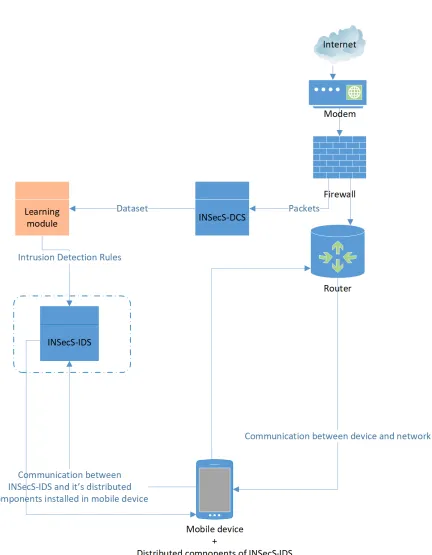
Intru-sion Detection. Figure 1.1 shows how the proposed framework work in an example situation where one mobile device is connected to the network. Even with multiple devices connected to the network, the intrusion detection process would be the same.
INSecS Intrusion Detection System (INSecS-IDS) is one of the three components of the proposed Intrusion Detection Framework. The other two components- INSecS Dataset Cre-ation Software (INSecS-DCS) [53] and the Learning module add critical functionality to the IDS, thus completing the INSecS Intrusion Detection Framework collectively. INSecS-IDF is to be deployed in a network in such a way that INSecS-DCS creates datasets at regular intervals, the learning module extracts rules out of the datasets using an unsupervised learning technique and finally, INSecS-IDS performs intrusion detection based on both the newly generated and existing rules.
1.2
Contributions
In this document, the author is presenting Dataset Creation Software and INSecS-Intrusion Detection System while claiming the following contributions,
1. INSecS-DCS, an on-demand dataset creation software that can be run on a network of choice and gives the user the ability to fully customize the dataset according to their requirements. This includes the ability to make a dataset with new attributes, make attributes with temporal properties and collective properties, change attributes, etc. This provides a solution for the weakness in intrusion detection research related to inadequate or unsuitable datasets. This software is available under MIT1license so that the research
community is able to create many new and relevant data sets by customizing every aspect of the dataset.
2. INSecS-IDS, a distributed IDS fit for modern networks due to the design and architec-ture, which is aimed at supporting IoT, Cloud and distributed systems. It detects
sions faster by using a hierarchical decision making process, works in distributed setups, detects complex attacks (multi-step) faster due to the system being ready for the second attack, updates intruder information automatically enabling IDS to detect attacks from known intruders faster and accurately and detect internal and external attacks. This ap-proach is different from the conventional IDS approach and results show that compared to the conventional approach, the proposed IDS performs 8 times faster on average in a test scenario.
3. In the absence of a single survey covering security of all modern distributed systems, this thesis provides a survey of network attacks and existing IDS solutions in the context of IoT, Cloud and distributed computing setups.
4. Provide flexibility within the IDS enabling users to replace the proposed Complex Deci-sion Engine (CDE) with their choice of DeciDeci-sion Engines.
5. A comparison of the performance of INSecS-IDs compared to Snort2. 6. Possible example setups for INSecS-IDS in IoT and Cloud applications.
A dataset generated by the proposed software framework includes not only the raw PCAP
3files for each packet but also a processed dataset file in CSV4or JSON5, that can be fed into
a machine learning tool easily.
1.3
Document Structure
The remainder of this thesis consists of the following chapters. Chapter 2 provides an overview and details of related work on Intrusion Detection Systems and Intrusion datasets. Chap-ter 3 explains the implementation details of Dataset Creation Software and
INSecS-2A popular intrusion detection system. More information is provided in section 2.1.3 under Chapter 2 3Packet Capture
4comma-separated values
Background and Related work
2.1
Intrusion Detection Systems
Intrusions affecting computer systems are quite numerous and their attack strategies, behavior and consequences are different from one another. Due to this, different defense techniques need to be employed by security personnel for comprehensive protection.
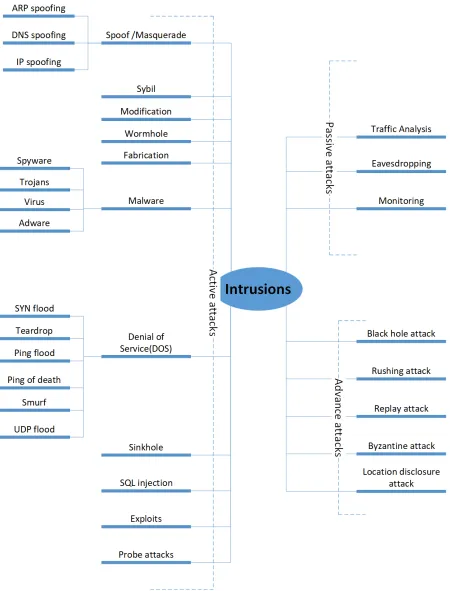
The most common network-based attacks are given in Figure 2.1. Active attacks are where an intruder would use the attack as a means to change private information. In passive attacks, the intruder is observing to either learn more about the system, to steal private information or even to plan the next attack. Advance attacks are mostly done on routers or on neighboring nodes of the real target in order to make an attack possible. Given these different types of attacks, the most popular defense techniques are,
1. Firewalls
2. Intrusion Detection/Prevention Systems (IDS/IPS) 3. Encryption Techniques
4. Anti-virus software
Not all of the above-mentioned defenses are suitable for all situations and attacks. With the advancements in the field of cyber-security, anti-virus and host-based IDSs have developed very similar characteristics and have quite a bit of overlap. Some anti-virus software now comes with inbuilt IDS/IPS systems.
Intrusion detection systems have different classifications based on different qualities such as detection strategy, function and capabilities, the location of IDS, etc. There are different ideas expressed by different researchers on proper classification. However, Some of the popular classifications are given in subsection 2.1.1. Subsection 2.1.2 describes evaluation metrics used in IDS literature and subsection 2.1.3 gives a brief overview of some of the widely used Intrusion Detection Systems. There have also been attempts at addressing the challenges faced by modern intrusion detection systems in different forms.
2.1.1
Common IDS taxonomies
Intrusion detection systems are classified into the following categories based on the detection strategy [34].
Anomaly-based detection
is that in case of a misidentification, an unknown or new attack will be considered as normal traffic, which will increase the risk to the entire network unless there are additional security measures in place for such a situation.
To implement anomaly detection, several techniques are widely used.
• Machine Learning - By using labeled data for normal behavior and training a model, anomalous traffic can be identified using machine learning techniques[43]. K-Nearest Neighbor, Bayesian networks, Neural networks, Decision trees and support vector ma-chines are some of the machine learning techniques found in the literature [49]. Cur-rently, Recurrent Neural Networks (RNN) are quite popular among researchers for this purpose and they produce good results in identifying previously unknown attack se-quences [64, 18].
• Statistical Models - Statistical methods are among some of the earliest methods to be used in intrusion detection and possibly triggered the move towards machine learning techniques. In this technique, statistical models are made for normal behavior and deci-sions are made under the assumption that intruder behavior is noticeably different from that of a normal user. Examples of effective statistical models in anomaly-based intrusion detection are,
1. Stanford Research Institute’s next-generation real-time intrusion detection expert system statistical component (NIDES/STAT) which collects data in the host over time and adaptively creates a profile for normal behavior [46].
Signature-based detection (Misuse detection)
In signature-based detection, knowledge about attacks is used to detect intrusions. Each attack would have its own signature [5]. A port scan, an IP sweep, a DoS would have a unique signa-ture, which can be used to detect it. This attack is also known as misuse detection in security literature. This method can only be used for known attacks and would fail if confronted with a new attack because of its reliance on prior knowledge about the attack. Common techniques used to implement a signature based intrusion detection system are listed below.
• Rule-based approach - This is the most widely used approach for misuse detection be-cause it is quite straightforward and requires no training due to the fact that all infor-mation about the attack is known [24]. Implementation is simpler compared to machine learning and detection is faster overall because there is no training involved [17].
• Machine learning - Use of machine learning for misuse detection has proven to be ef-fective according to most researchers [54], while misuse detection on KDD dataset has been reported to be unsuccessful based on tests [57]. Although popular algorithms used in anomaly detection are also popular in misuse detection, there are differences in the implementation. Traffic containing known attacks are used to train the model for various attacks, and test data are classified into different classes based on how close they are to a specific attack in comparison to the model.
Most practical intrusion detection methodologies use a hybrid model involving both anomaly detection and misuse detection combined, due to the fact that they complement each other. Anomaly detection would identify a behavior that is different from normal usage behavior and when attack signatures are used to match that anomalous behavior, an intrusion can be detected with much more precision and ease.
Network-based Intrusion Detection Systems (NIDS)
In Network-based Intrusion Detection Systems, intrusion detection is done based on the data collected about network traffic [52]. To get network data, network traffic is mirrored to the IDS by a router or some other device with the capability to capture network traffic. NIDS can be placed at different locations in a network.
1. Between the Border Firewall and the Internet. This allows the IDS to listen to all in-coming and outgoing traffic. This placement usually results in data overload conditions which most likely leads to delays in intrusion detection.
2. Between the Border Firewall and the Internal Network. This is a better placement be-cause the firewall will block some traffic that is already known to be harmful. This allows the IDS to focus on traffic that truly needs to be checked.
3. Inside the Local Network. Placing the IDS at crucial points within the network is a strat-egy that would work well if the servers or systems which are most likely to be attacked are known. This will ensure that intrusion detection is faster than the previous two setups and that any internal attacks would be detected as well.
The main drawback of basing intrusion detection only on network data is that it would not work very well with encrypted traffic. Since encryption can be done at any layer, information required for an IDS to make a decision (regardless of detection strategy) would be inaccessible, if the traffic is encrypted.
Host-based Intrusion Detection Systems (HIDS)
of all the additional data from the host activity. A host-based IDS would collect information under the following three categories.
1. Protocol Stack monitoring - This is similar to having an NIDS on a single host.
2. Operating System monitoring - OS monitoring gives access to information like login attempts, system calls and commands, unusual file creations, system registry modifica-tions, file delemodifica-tions, unusual communication attempts, etc.
3. Application monitoring - In this monitoring, the IDS looks at logs generated by individ-ual applications.
Information collected under all three categories are used together to detect attacks. The main problem with these is that if the host is compromised, all the logs may be changed or deleted and thus make it impossible to detect the intrusion anymore.
Distributed Intrusion Detection Systems
2.1.2
Evaluation Metrics
To analyze the performance of intrusion detection several metrics are used and the most com-monly used evaluation metrics given below [30].
1. True positive rate (TP) - Percentage of traffic identified as intrusions and are actual in-trusions.
2. True negative rate (TN) - Percentage of traffic identified as non-intrusion (normal) and are actual non-intrusion (normal).
3. False positive rate (FP) - Percentage of traffic identified as intrusions but are actually non-intrusion (normal) traffic.
4. False negative rate (FN) - Percentage of traffic identified as non-intrusion (normal) but are actually intrusion traffic.
5. Precision - The number of true positives divided by the total of true positives and false positives (see equation 2.1).
6. Sensitivity - The number of true positives divided by the total of true positives and false negatives (see equation 2.2).
7. accuracy - The number of true positives and true negatives divided by all 4 possibilities (see equation 2.3).
8. Processing speed which is the amount of time it takes an IDS to classify all of the attacks in a dataset.
9. System utilization: the amount of memory and CPU required to run the IDS. Precision, Sensitivity and Accuracy are defined in the following manner,
S ensitivity= T P/(T P+FN) (2.2)
Accuracy= (T P+T N)/(T P+FP+T N +FN) (2.3)
Positive and Negative indicate the verdict of the IDS while the terms True and False indicate whether the verdict is right or wrong. Not all of them are used to evaluate a single IDS because different IDS have different purposes.
2.1.3
Widely used Intrusion Detection Systems
There are multiple intrusion detection systems that are freely available with some of them even being open source. The most popular ones and their features are given below.
• Snort: A free, widely used Intrusion Detection/Intrusion Prevention System (IDS/IPS) [29]. It is a rule-based IDS/IPS which relies on the Snort company to provide the latest rules. It also has a set of community updated rules. Some of the advanced rules are only offered for paid subscribers. A comparison of Snort vs INSecS-IDS is given in section 4.2.1.
• Bro: An open-source, passive, Unix based network intrusion detection system that works well with large traffic loads [50]. A key advantage Bro has is its deep analysis involving a broad range of protocols. It has its own script which is used to write new rules if required.
• Suricta: Considered to be a close competitor to Snort, with an advantage over Snort in detection speed [60]. According to literature, Suricta supports Snort rules which makes it a strong performer as Snort is the most widely supported IDS.
2.2
Background and Related work of INSecS-Dataset
Cre-ation Software
This section provides a background into intrusion dataset creation and related work. Section 2.2.1 explains the key factors to be considered in dataset creation together with comparisons on various strategies used in the standard datasets.
2.2.1
Dataset requirements
A dataset should possess certain qualities to be deemed fit to be used in the field of network intrusion detection and these have been identified and verified by researchers [79]. This sec-tion highlights several key requirements and their importance, along with details on how the requirements have been addressed.
Realistic nature of Data
Simulated attacks, generated using intrusion tools, are used to create intrusion traffic in most standard datasets [10][44]. The exception is datasets created using honeypots where the traffic you get at the honeypot is always intrusion traffic [63]. Both approaches produce realistic intrusion data and thus users are allowed to pick either option. This is achieved by operating the software package at any suitable network node and a honeypot, respectively.
Proper labeling of dataset
Accuracy of normal traffic
When collecting data to be included in the normal traffic portion of the dataset, there is a possibility that intrusion traffic may get included in it, unknown to the dataset creators. This is due to undetected attacks present in traffic that is assumed to be normal. This is avoided by generating normal traffic through simulation or getting a trustworthy group of volunteers to generate the normal traffic by interacting with the network habitually.
Customizability of dataset
This is a novel and yet indispensable property of the output from INSecS-DCS, as compared to other dataset creation methods and tools discussed above. What is offered in INSecS-DCS is the chance for the software user to be able to add more protocols to be tracked, filter out the undesired traffic, decide on where the data collection should happen inside the network, decide which attributes to have in the dataset, change the time window for average traffic analysis and the ability to run the software inside the user’s network, server or personal computer to see what the traffic looks like and use that data to find what the possible threats are.
Payload availability
This is a debatable topic due to the loss of privacy of the original owners of the captured traffic [39]. There are anonymizing techniques to hide this information [13]. However, it is not a service provided with the software. The ability to get the payload in the raw dataset format is allowed by design but the author leaves it up to the users to anonymize the data they capture when creating datasets inside networks.
Freedom to choose input
[38]) dataset based on captured traffic (see figure 3.1). The other option is to use raw PCAPs provided by other dataset providers and feed it to the software and generate a raw dataset or processed dataset.
Freedom to select format of output dataset
The dataset generated from our software can be in two forms. The raw form which only allows attributes related to individual packets to be present. The alternative is the processed format which allows attributes to represent individual packets as well as average properties of network traffic for a specific time window. The added advantage of this processed dataset is that it can be fed directly into ML algorithms without any preprocessing, which in turn saves a lot of time and effort.
2.2.2
Related work
Although tools that can create custom data sets have been proposed, they can only insert attack packets into the network traffic capture files and create a Raw dataset [69][12]. A key feature of the proposed dataset creation software (INSecS-DCS) is the ability to process the data captured from the PCAP files in order to construct customized and meaningful attributes in a logical manner. The output is similar to the KDD 99 and NSL-KDD datasets in presentation style, where the dataset can be directly fed into a learning algorithm with no preprocessing because of its tabular form.
2.3
Background and related work of INSecS-Intrusion
De-tection System
Intrusion Detection Systems have existed as a solution to intrusions for a considerable amount of time. Different IDS solutions have been proposed for various applications and scenarios. When an existing solution does not adequately provide protection from intrusions, new features have to be introduced into the Intrusion Detection Systems. This section is divided into two subsections. Subsection 2.3.1 on Security of Distributed networks, IoT and Cloud gives an overview of the security needs of those networks, existing security solutions and how those systems can benefit from an IDS, while subsection 2.3.2 on Related work provides a brief introduction to similar IDS implementations while .
2.3.1
Security of Distributed systems, IoT and Cloud
With the development of Distributed systems, IoT and Cloud systems, the need for their secu-rity has become new areas of research as people tend to rely on them more and more. With the expanding need for data storage, Cloud and distributed systems host a lot of personal and sensitive data, which makes them obvious targets of intruders.
Distributed systems
rule-based approach to detecting attacks but details of rule generation are not explained. Snort has also been proposed to be used in a distributed setup because of its ability in general in-trusion detection. By running different instances of Snort in a distributed manner, at different nodes across the network, researchers have controlled the load on each of them by careful resources usage observation [76]. However, due to processing all the traffic instances with multiple Snort instances, the researchers were not able to complete the experiment because of resource insufficiency.
IoT
More and more devices with multiple capabilities are being connected to the internet today and this has introduced the concept of Internet of Things (IoT). These IoT devices have computing and networking power embedded in them, enabling different software operations to take place without proper monitoring. This is why IoT devices are found to be part of Botnets, without being detected by the system administrators who use these devices [8]. Due to the system resource limitations, these IoT devices do not have the ability to deploy the defenses used in other computing systems. The main vulnerabilities in IoT can be listed in the following manner [33].
• Insecure web interface - Using the default password and having an insecure password recovery method are some examples of insecure web interface problems in many IoT devices.
• Insufficient or non-existent authentication/authorization
• Insecure network services - Open ports are used for communication and if the services using those ports have known vulnerabilities they will be exploited by hackers.
• Insecure software/firmware - The authenticity of software that is installed in the device has to be verified by signatures. If not, an intruder can intercept the connection and send software with malicious code in them.
• Poor physical security - If the device is physically accessible and the data storage is not secure, an intruder can access, modify or delete the data.
Given this background, there is a clear need for suitable IoT security frameworks that work well in IoT system restrictions. Noorman et al. [47] has proposed an embedded security system with a separate microprocessor that relies on knowing each node in the IoT system. The isolation capabilities ensure that even if one node is compromised, intruders will not be able to hack into the other nodes using the compromised node. Traditional IDS would not work well with IoT systems because of the system resource issues in the IoT devices. There have been multiple approaches suggested to overcome this issue by having the IDS outside the IoT device[58],[41].
Lee et al. [32] proposed a distributed IDS solution based on analyzing the energy con-sumption at each node, to detect anomalies. Snort attack signatures have also been used in signature-based IDS implementations because they are easily accessible [48]. Junet al. [28] proposed a centralized IDS based on a Complex Event Processor, which resulted in an IDS that was CPU intensive but consumed less memory.
Cloud Setups
Cloud service providers offer resources and services to consumers, who use them for various applications. With the continuous expansion of Cloud usage, the Cloud services and resources have become targets of attacks. Some of the security issues identified in Cloud computing setups have been identified by Mishraet al. [42].
companies. There have been some well known examples of this happening, during the past few years [11], [51].
• Account or Service Hijacking - By getting access to user credentials, intruders can gain access to the Cloud user accounts. This would enable intruders to see all the personal data associated with the compromised accounts and also initiate new data exchanges.
• Malicious Insiders - This is a human factor rather than a technical loophole in Cloud computing. Loss of security due to malicious insiders can occur easily if the people given access to the Cloud resources by the Cloud Service Provider are not properly filtered. Even then, there is no guarantee that there will be no malicious insiders.
• Hypervisor Vulnerabilities - Hackers ca figure out vulnerabilities in a hypervisor and exploit that to gain access to it. By gaining access to the hypervisor, intruders can change system resources, change access privileges and gain total control of the virtual machines connected to the hypervisor.
• Denial of Service - Legitimate users are denied access to their accounts and resources due to Denial or Distributed Denial of Service attacks.
Different techniques and methods have been proposed for Cloud security which can be categorized under Confidentiality, Integrity, and Availability (CIA triad) [7].
Confidentiality
Protection of confidentiality of virtual machines in Cloud servers is as important as protect-ing data confidentiality. Proposed methods for this include algorithms and rules to be used by Cloud service providers in virtual machine hosting, virtual machine migration and maintenance [19].
Integrity
Data integrity solutions include using Tree Signature scheme [59] and Public key based ho-momorphic authenticator with random masking [72] and other similar techniques to ensure the integrity of the data in Cloud setups. Virtualization integrity issues are handled by using hash-ing, private and public key encryption [78] and activity log checks within the Cloud servers [37].
Availability
The main issue concerning the availability of data and virtual machines is Denial of Service and Distributed Denial of Service attacks and Intrusion Detection System have been used ef-fectively to provide protection.
Similar to a local computer system, an intrusion detection system can be used in the Cloud server to detect intrusions [6]. An IDS that can identify the reconnaissance attacks can even alert the client that a possible hack or system compromise might take place. Depending on the Cloud service, the IDS can be a Host-based IDS [73] or a Network-based IDS [38].
2.3.2
Related Work
The concept of multi stage intrusion detection has been explored by multiple researchers. A binary SVM classifier identifying anomalous traffic in the first step, followed by a self or-ganized map for identifying the attack class is proposed in [67]. Multi Stage attack detection strategies are designed based on the argument that an attack can be broken down into multiple stages. For the attack to be complete, it needs to complete the different stages in a certain order. Herwonoet al. [25] have proposed a multi-stage intrusion detection system which uses a Hidden Markov Model to predict the probability of an attack. Each prediction is done in the form of a state transition and the transition probabilities are calculated within a training phase. An attack is defined to have a certain set of states. A similar argument has been used in the design of an intrusion detection system which uses various machine learning techniques to detect states [68]. The authors have used a resource expensive methods for the second stage of the attack detection because they manage to reduce the traffic load by a resource inexpensive classifier in the first stage.
INSecS-Framework
3.1
INSecS-Dataset Creation Software
INSecS-DCS was proposed with the aim of creating Network Intrusion datasets specific to individual networks, where the network managers can specify their own attributes [53]. There are very few datasets that have proper documentation and can be used effectively to train and test an IDS. Although considerably old, NSL-KDD [27] is one such example. INSecS-DCS allows network managers to create a custom dataset, with attributes they feel are the most important for their network.
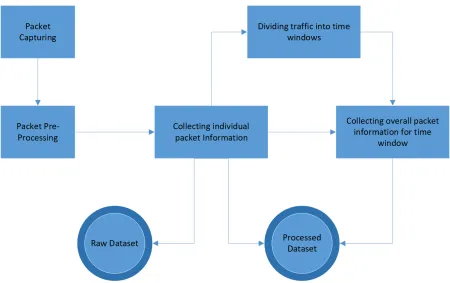
The workflow used in the dataset creation process is shown in figure 3.1. In this section, the procedure is described in detail. This software was developed in Python due to the availability of many libraries related to network packet processing. This also allowed this software to work easily with our future developments.
3.1.1
Dataset creation
The steps involved in the dataset creation is given in the following subsections of the thesis. Each step has its own software component available for public use under an MIT license. Instructions on using the software are provided in Appendix B.
Figure 3.1: Architecture of INSecS-DCS
Packet capturing
The first step in dataset creation is capturing network packets. After evaluating several packet capture tools, Tshark 1 was selected as the packet capturing tool as it provides a great GUI
to view the captured packets with custom filters. No filtering is done at this stage and all the information available on each packet is captured.
Packet pre-processing
Captured packets are in PCAP format and preprocessing involves converting these PCAP files to JSON format for easier processing. The rationale behind this is to connect future projects with this software without the need for type conversions. The pre-processing is done by the packet pre-processor, which converts the data in a packet into key-value pairs, where the key
Table 3.1: Overall attributes for time window Feature name Feature description
c o n n e c t i o n p a i r s the number of different source and destination pairs. I P a d d r e s s e s the different IP addresses used in the connections n u m p o r t s number of different port numbers used
n u m p a c k e t s total number of packets sent and received s r c b y t e s the total amount of source traffic
d s t b y t e s the total amount of destination traffic
t c p f r a m e l e n g t h the total amount of frame bytes for TCP traffic t c p i p l e n g t h the total amount of IP data for TCP traffic t c p l e n g t h the total amount of TCP data
u d p f r a m e l e n g t h the total amount of frame bytes for UDP traffic u d p i p l e n g t h the total amount of IP data for UDP traffic u d p l e n g t h the total amount of UDP data
a r p f r a m e l e n g t h the total amount of frame bytes for ARP traffic n u m t c p total number of tcp packets sent and received num udp total number of udp packets sent and received n u m a r p total number of arp packets sent and received n u m s s l total number of packets containing SSL traffic
n u m h t t p total number of http requests that were sent and received n u m f t p total number of ftp packets sent and received
n u m s s h total number of packets containing SSH traffic num smtp total number packets containing SMTP traffic num dhcp total number packets containing DHCP traffic num dns total number packets using DNS traffic
Note 1:The data type is Discreet Integer in all of the listed attributes.
Note 2:Feature name column shows the attribute names given in the code.
Collecting individual packet features
During the next step, the features related to individual packets are collected by selecting key-value pairs of interest. These features include the protocols used (such as TCP, UDP, IP, FTP, SMTP, SSH, SSL, ARP, DHCP, HTTP etc), the source and destination addresses (IP address) and port numbers used etc. The software comes with a list of preselected attributes but the user can customize this.
Dividing the individual traffic flow into time windows and collecting overall features
An important step in creating a processed dataset involves selecting a time window and ana-lyzing the traffic flow during that time [3]. This will give information about the overall traffic behavior during given time interval and identify common trends in traffic; as opposed to con-sidering information from individual packets only. For example, if both TCP and UDP packets are used in an exploit, analyzing the TCP stream alone or the UDP stream alone would not suffice. With that taken into consideration, parameters about total traffic flow, such as total length of TCP packets sent, total length of UDP packets sent etc. are collected. This is done for a time window, where the length is chosen by the user. Descriptions on setting the time window are given in related Appendix section.
3.1.2
The processed dataset
creating the processed dataset are depicted in figure 3.1.
The attributes in the processed dataset
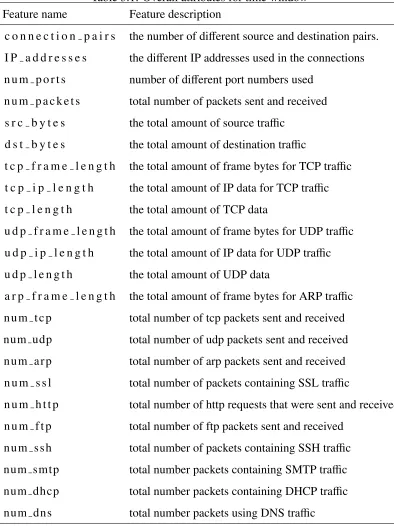
The inbuilt attributes in the processed data set that are related to overall traffic behavior within a time window, are given in the table 3.1. It should be noted that these attributes were picked as examples of possible attributes that capture overall information for a specific time. The purpose of presenting these attributes is to show the capability to extract important attributes for specific conditions that might serve the research efforts better than attributes from already available datasets. Attributes related to individual packets include protocols used, flags set, source and destination information etc. Since the main objective of INSecS-DCS is to provide customizability in intrusion datasets, I do not believe in dictating which attributes are to be included in the dataset. So a key factor to be considered here is the ability for the user to add more features or remove features in their dataset creation.
3.1.3
The raw dataset
The unprocessed or raw dataset is a dataset that presents data in a raw PCAP format. Each record contains attributes related to a single packet which has been preprocessed. The attributes include all the data related to the packet, including payload. This may introduce privacy con-cerns with encrypted traffic, as the payload may contain sensitive information. The author expects users to use this feature responsibly. Figure 3.1 shows the steps involved in creating the raw dataset.
3.2
INSecS-Intrusion Detection System
re-sponses is a challenge on many fronts. Several major issues faced in developing such a system have been addressed in a novel manner fitting an industry standard IDS. In the remainder of this section, the author will present the overall architecture of INSecS-IDS and the features introduced that makes it better suited as a standalone IDS for any setting.
INSecS-IDS was designed after a careful study of commonly available IDS and their strengths an weaknesses. What I gathered from that study enabled me to fuse what was learned from the existing IDS technology, with real-time stream data handling. The latest literature on new trends in IDS focuses on IDS designed for Cloud and Internet Of Things (IoT) systems, which have different requirements than the traditional IDS [77],[61]. Traditional Intrusion Detection Systems are not flexible enough to change according to these requirements. This situation has introduced a need for an IDS that would work across multiple platforms and applications, in-cluding traditional networks, Cloud environments, IoT systems and other modern distributed computing setups [22]. This subsection gives an overview of INSecS-IDS and where it stands in IDS classification.
3.2.1
Overview and capabilities of INSecS-IDS
The design of INSecS-IDS involved several important decisions that were aimed at addressing the challenges identified, in comparison to the competition.
is further validated by surveys done on possible strategies and technologies for IoT and Cloud, where a distributed strategy has the least overhead and faster, localized detection [77].
• Intrusion detection strategy used in INSecS-IDS is an adaptive strategy that learns from already detected attacks and updates the rules by itself. This allows the proposed IDS to function as an Intrusion Detection System that has adaptive learning capabilities, allow-ing it to function for an extended period of time without an operator updatallow-ing the rules. This also allows faster intrusion detection of attacks from known intruders.
• Another built-in capability that gives INSecS-IDS the edge, is its ability to face complex attacks (multi-step attacks). It is the usual practice of an intruder to scan for potential targets to attack before launching many of the attacks. They look for vulnerable systems, databases, useful web servers, etc, and finding the ports open for communication is an important piece of information [70]. Also, knowing which machine hosts the services inside a network makes it easier for an intruder to target attacks. Because of this, Port scans and IP sweeps act as reconnaissance attacks, leading way for more dangerous attacks like DoS, SQL injection, exploits, botnets, etc. This sort of attack pattern is considered a multi-step attack or complex attack pattern.
• Ability to detect internal attacks is a key characteristic of distributed intrusion detection systems. It is impossible for NIDS with a central architecture, to detect internal or local attacks such as ARP spoofing, spreading of botnets inside the network and man in the middle attack.
• HTTP is used as the communication protocol between the components of the IDS, mak-ing the IDS simpler to be implemented anywhere without the need for additional hard-ware or softhard-ware.
packet capturing in INSecS-IDS. This ensures that the IDS works irrespective of the OS and enables the usage of Wireshark’s advanced packet analyzing features.
Classification
IDS classification has different forms, as shown in Section 2.1 on Intrusion Detection Systems. INSecS-IDS is a signature based (Misuse) detection system in terms of detection strategy and a distributed intrusion detection system based on the scope of protection. Although a part of the IDS is hosted on each node, it does not use host information like systems logs and relies only on network information.
3.2.2
Logical Architecture
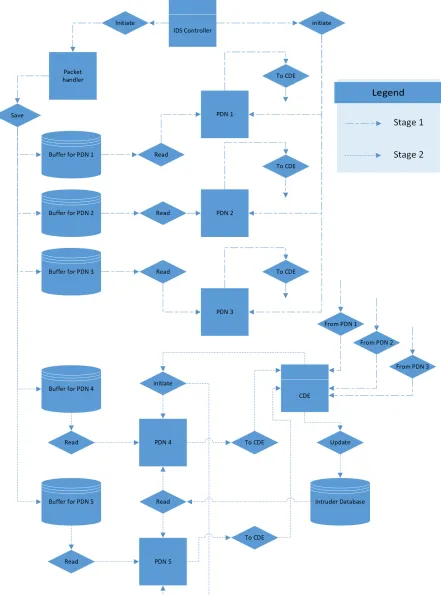
A major challenge in having a real-time IDS is handling the large volume of traffic. A typical IDS would have to process each and every packet to effectively provide security and protection. Hence, the time it takes the IDS to process all the traffic generates a considerable delay in the intrusion detection process. The proposed IDS architecture handles this problem by using a hierarchical architecture. The argument behind this design is that running each and every packet through a complex filtering process consumes too much time and resources. By having a logical hierarchy in the decision-making, resource and time usage were optimized. This enables quicker intrusion detection and less resource usage. The logical hierarchy is shown in figure 3.3. Primary decision-making module is allowed to pass judgment on the oncoming stream of packets and let the complex decision maker spend it’s resources only if there is a possible threat. Doing so ensures that the full intrusion detection capabilities are spent, in the form of complex event processing, only on traffic that has a probability of being associated with an intrusion. In figure 3.2, these two logical stages are shown as stage 1 and stage 2.
with known attacks. The process of selecting and deciding on these conditions is given in section 3.2.4. If the traffic satisfies the conditions, there is reason to suspect that the traffic is involved in an intrusion or attack. PDNs then generate a data unit with selected information about the suspected packet, which is then forwarded to a more complex decision maker. This generates a stream of Data from each of the PDNs placed within the network.
INSecS-CDE (INSecS-Complex Decision Engine) is the complex decision maker intro-duced in INSecS-IDS. This decision engine has the capability to receive incoming streams of data and make a decision on whether the related packets are involved in an intrusion or not. The CDE is capable of analyzing all the packets in a defined time window and checking for com-plex conditions. The implementation of time windows and the process of applying comcom-plex conditions is given in detail under section 3.2.5. Once the CDE detects an attack, it updates the IDS with information which allows the IDS to form new rules and conditions. This allows the IDS to update itself and to detect multi-stage attacks with the fastest possible detection time.
Multi-step attack detection allows the IDS to deploy new PDNs in the network node which faced the original attack. These new PDNs detect known attack sequences like Port scans and IP sweeps followed by DoS, Botnets, vulnerability exploits, SQL injection, etc. CDEs that are necessary to these second stage attacks are already in place so that no additional effort is required by the system admins to deploy new CDEs.
3.2.3
Physical Architecture
The physical architecture and workflow of INSecS-IDS are given in figure 3.2. The diagram relates to an example scenario as is is practically impossible to draw a generic diagram for an entire network. Different symbols used in the diagram shows different types of functional blocks. They can be listed in the following manner.
3. Primary Decision Node (PDN) 4. Complex Decision Engine (CDE) 5. Storage and Buffer units
There are two types of storage and buffer units used in the setup. See Storage and Buffer units under subsection 3.2.3 for more details.
The objective of each functional block can be described in the following manner.
IDS Controller
IDS controller is the unit placed inside each network node and is responsible for initiating the Packet handler and the initial Primary Decision Nodes. This gives the IDS user the ability to use the IDS controller unit to select which PDNs are to be deployed in which network nodes.
Packet Handler
Packet handler is a unit initiated by the IDS Controller and does a few crucial tasks in handling the packet stream. There is one packet handler at each network node that needs the IDS. As soon as the packet handler is initiated, it runs Tshark, which captures the stream of packets going in and out of the node and generates a JSON object with all the packet attributes and values for each and every packet. This JSON object is then pre-processed in order to generate a Python dictionary, which is broadcast to all the active buffers in a network node. There is a buffer for each active PDN and the corresponding PDN reads the stream of dictionaries continuously.
Primary Decision Node & Complex Decision Engine
Table 3.2: Buffer and Data Storage units placement Unit type task Using entity
Buffers Act as a data buffer Primary Decision Node Act as a data buffer Complex Decision Engine Data Storage Store Possible Intruder IDs Primary Decision Nodes
that are most suitable to be used in the initial deployment are listed in appendix A. Details on the architecture, functionality and design procedure of Primary Decision Nodes and Complex Decision Engines are discussed in detail in section 3.2.4 and section 3.2.5 respectively.
Storage and Buffer units
Data buffers and data storage units are required when handling the streams of data involved in several units of INSecS-IDS. Table 3.2 lists the type of unit, the expected task and where the unit is used. As illustrated in figure 3.2, the packet handler sends multiple copies of the same data stream onto data buffers. Each primary decision node then reads from the buffer that is allocated for that specific PDN. The reason for having the buffer here is to prevent the processing of the PDNs from interfering with the data flow within the IDS. If the buffer was not used, the packet handler would have to wait until the condition checking is completed for one packet by the PDN, before sending the next packet. This will slow down the packet handler, and consequently hinder the productivity of the IDS. Once the PDN suspects any traffic to be involved in an intrusion it would generate an event, which is then forwarded to the Complex Decision Engine. Inside the CDE, complex condition checks are done on the events sent from the PDNs to identify real intrusions. In some cases, this requires the CDE to break the event stream into chunks of events for specified time windows and perform condition checks on all events included in that time window. In order to stop this process affecting the event stream flow, a buffer is used here to store the events received by the CDE until the CDE is ready to process them. The data buffers used in both cases are Queues, operating on first in, first out
Figure 3.3: Hierarchical decision-making setup
3.2.4
Primary Decision Nodes
The idea of network event detectors in our implementation is based on the concept of hierar-chical decision making. In hierarhierar-chical decision-making, there is less stress on the Primary Decision Nodes (PDN), which transfers the complex decision making workload onto a ded-icated Complex Decision-making Engine (CDE). See figure 3.3. The nature of the Primary Decision Node in a hierarchical decision model would vary depending on the objective and placement.
The Primary Decision Node assumes the role of a simple event detector, in the proposed architecture. It looks for a pre-defined simple event and triggers complex action once the event is detected. The pre-defined events are the simplest possible conditions that can alert the Complex Decision Engine of a possible attack/intrusion. PDNs are placed at each of the network end-nodes including servers, personal computers, tablets etc. There are 2 main reasons behind the placement of the PDNs at each of the network end-nodes.
1. They help reduce the amount of traffic being inspected by IDS.
Reduce traffic overhead on IDS
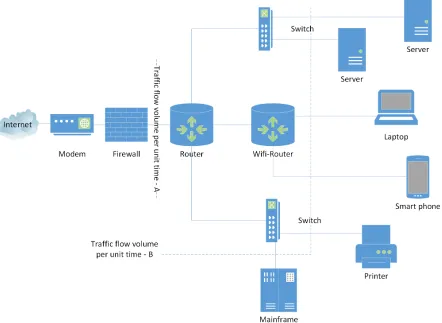
Network traffic flow in and out of a network can be analyzed using different metrics. Packets Per Second (PPS) is one such metric used to measure traffic flow volume per unit time[31]. This number can vary depending on factors like the number of users, the number of servers, the nature of services hosted on the servers, type of company the network belongs to etc. The average number of packets per second is the fairer metric to generalize traffic flow volume over a larger period of time like a day. For a typical server, this value would be stable, with circumstantial fluctuations. However, the traffic flow volume inside the network would be different from what is observed at the Gateway. As shown in figure 3.4, if we consider traffic flow volume per unit time at A and B, the two values would be different with B recording a higher value. A is just after the gateway to the network and B is inside the network covering all nodes inside the network. The difference between the PPS values is due to the local traffic that does not cross the gateway.
Given this background, one major drawback of having the IDS immediately after the fire-wall (at A in figure 3.4) is that the IDS needs to process each and every packet that enters the network. This is a considerable overhead for large networks which in some cases handles over a million packets per second. Under these conditions, an IDS would take a considerable amount of resources to process all packets and in the process cause a delay in producing a classification. This will cause the delay to increase with increasing traffic volume per unit time even if the IDS has dedicated hardware.
The PDNs are capable of filtering normal traffic and forwarding only suspicious traffic onto the CDEs. The performance advantage of this is verified under Chapter 4 on Results and Comparison.
Support provided for Distributed IDS
under section 2.1.1. The architecture and implementation of PDNs that allow the distributed IDS will be discussed in this section.
The primary decision nodes are responsible for the detection of simple events and forward-ing the detected traffic to a complex decision engine, as described earlier in this section. To detect these simple events, the PDNs use a pre-defined set of conditions pertaining to net-work attacks or intrusions and expert knowledge is required to identify these conditions. The INSecS-IDS comes with a set of PDNs for the most common attacks. Creation of additional PDNs, as required by users, is supported by the architecture.
Structure of PDN
An example PDN algorithm is shown in algorithm 1, which is used for the detection of potential Port scan packets. In this example, the PDN checks the incoming packet stream for packets with SYN flag set to 1. The identified packets are considered for potential threats and are sent to the CDE for further processing. The other PDNs follow a similar algorithmic pattern but have different condition checks based on the specific attacks they detect. Each and every PDN is implemented as a different thread so that there will be minimal interference between the functional blocks shown in figure 3.2.
Algorithm 1:Port scan Primary Decision Node
Input: Input and output Packet stream in the network.
Output: PDN events in the form of a JSON object consisting of predefined attributes.
1 S tartT ime=timestamp when packet receiving starts; 2 whilePort scan PDN is ondo
3 Data=get packet fromPortsQ
4 if EndO f T ransmission==Truethen
5 EndT ime=timestamp when packet receiving stops;
6 T ime=EndT ime-S tartT ime
7 end
8 timestamp=timestamp on packet;
9 ifprevious timestamp<=current timestampandtcp.syn.f lag==1then
10 Request=sendhtt prequest with selected attributes 11 end
12 end
Data Transfer from PDN to CDE
Our architecture supports a distributed IDS architecture, as described earlier. This means that the PDNs at each network node needs to send their selection of suspicious traffic onto the complex decision engine. The implementation of this step is shown on algorithm 1 in the line where an HTTP request is sent, given that the TCP syn flag condition and timestamp conditions are true. For the purpose of this communication, a simple HTTP client-server connection was chosen because of the wide availability of the protocol and ease of use, as opposed to developing our own communication standard. When a PDN communicates with the CDE it uses a port number unique to each attack. For example, all Portscan PDNs in the network use the same destination port number (a port number on the server hosting CDE) .
3.2.5
Complex Decision Engine
with considerable computing power at its disposal. This is in contrast to the PDN, which is designed for computing devices with low computing power and memory. Doing so ensures that the hardware usage is optimized throughout our IDS implementation.
Structure of CDE
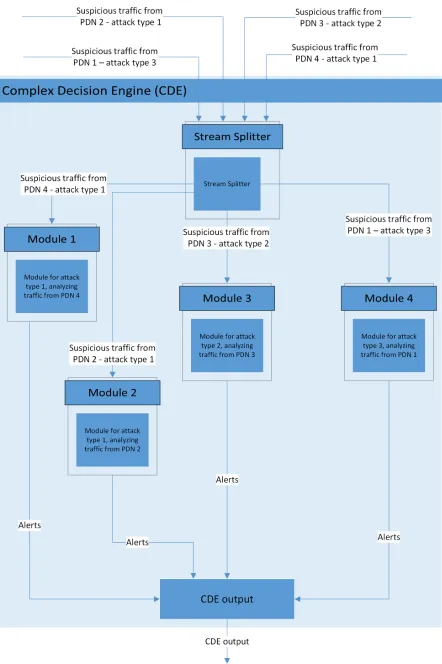
Each attack type (like Portscan, Smurf, DoS, etc.) has its own complex decision making al-gorithm defined as a class, in the CDE. (The CDE class definition for Portscan is based offof algorithm 3). For each PDN in the network, there is a CDE module (object made using the class definition). Refer figure 3.5 for an example scenario involving three attack types and 4 PDNs. The module 1 and module 2 are made from the class definition for attack type 1. Module 3 is made from the class definition for attack type 2. Module 4 is made from the class definition for attack type 3.
The CDE is designed to act as a central decision maker, as described earlier in this section. When the CDE gets a packet from a PDN, it sends the packet to the correct CDE module. Since all PDNs belonging to the same attack type uses the same port number to communicate with CDE (example: all portscan PDNs in the network would send packets to port 8081 of the server hosting CDE) the CDE knows that all traffic on a certain port is from all the PDNs in the network related to one attack. So in order to send the packet to the correct module, the Stream Splitter (see figure 3.5) checks the incoming HTTP requests from a certain port to determine which PDN it is coming from. The HTTP request comes with a tag indicating the PDN. Using this information, the packet is sent to the correct CDE module. Algorithm 2 is used to implement the process described above.
Algorithm 2:Directing traffic to the correct module
Input: Data stream from Primary Decision Nodes
1 PostData=readhtt prequest;
2 data=convertPostDatato JSON object; 3 PDNno=get the PDN identity;
4 PDNno.window(data)
Algorithm 3: module functionality
Input: Data stream directed to the module
Output: Final verdict on traffic (Intrusion or not)
1 data=get data sent to the module;window=initializedQueue;icmp=object
containing already known destination, port number pairs ;
2 packetcount= packetcount+1; 3 if packetcount==1then
4 startT ime=Timestamp of current packet;
5 endT ime=startT ime+1000 (milliseconds);window.put(data) 6 else if endT ime<Timestamp of current packetthen
7 startT ime=Timestamp of current packet;
8 endT ime=startT ime+1000 (milliseconds);
9 whilewindow is not emptydo
10 packet=window.get();
11 key=”destination-IP” of packet; 12 port=”destination-port” of packet;
13 ifkeyinicmpand portnotin icmp[key]then
14 append.icmp[key](port);
15 else
16 ports=initialize list;
17 append.ports(port);
18 icmp[key]= ports;
19 end
20 end
21 for key,valuesinicmpdo
22 ifvalues>50then
23 Port scan is detected;
24 end
25 end
26 Initializeicmp; 27 else
Results and Comparison
4.1
INSecS-Dataset Creation Sotware
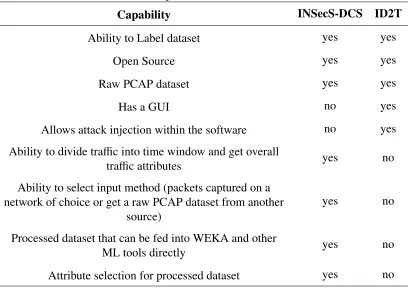
The tool or software that is closest to the proposed dataset creation software (INSecS-DCS) is the ID2T toolkit developed by Vasilomanolakiset al. [69]. In order to evaluate INSecS-DCS, compared to ID2T toolkit, key advantages of INSecS-DCS are highlighted in table 4.1.
The attack generation to capture intrusion traffic is built into the software in ID2T imple-mentation. This is done by attack scripts and PCAP modification. However, network attack generation softwares are already highly advanced and the hacker community keeps on devel-oping better versions. Thus, I felt no need to include attack generation as an inbuilt software feature.
4.2
INSecS-Intrusion Detection System
Experiments
The following Experiments were designed to validate the detection speed improvement from hierarchical decision making and to compare intrusion detection abilities of INSecS-IDS with snort.