A Practical-Time Attack on the A5/3
Cryptosystem Used in Third Generation GSM
Telephony
Orr Dunkelman, Nathan Keller, and Adi Shamir
Faculty of Mathematics and Computer Science Weizmann Institute of Science P.O. Box 26, Rehovot 76100, Israel
{orr.dunkelman,nathan.keller,adi.shamir}@weizmann.ac.il
Abstract. The privacy of most GSM phone conversations is currently protected by the 20+ years old A5/1 and A5/2 stream ciphers, which were repeatedly shown to be cryptographically weak. They will soon be replaced in third generation networks by a new A5/3 block cipher called KASUMI, which is a modified version of the MISTY cryptosystem. In this paper we describe a new type of attack called asandwich attack, and use it to construct a simple distinguisher for 7 of the 8 rounds of KASUMI with an amazingly high probability of 2−14
. By using this distinguisher and analyzing the single remaining round, we can derive the complete 128 bit key of the full KASUMI by using only 4 related keys, 226
data, 230
bytes of memory, and 232
time. These complexities are so small that we have actually simulated the attack in less than two hours on a single PC, and experimentally verified its correctness and complexity. Interestingly, neither our technique nor any other published attack can break MISTY in less than the 2128
complexity of exhaustive search, which indicates that the changes made by the GSM Association in moving from MISTY to KASUMI resulted in a much weaker cryptosystem.
1
Introduction
The privacy and security of GSM cellular telephony is protected by the A5 family of cryptosystems. The first two members of this family, A5/1 (developed primar-ily for European markets) and A5/2 (developed primarprimar-ily for export markets) were designed in the late 1980’s in an opaque process and were kept secret until they were reverse engineered in 1999 from actual handsets [13]. Once published, it became clear that A5/2 provided almost no security, and A5/1 could be at-tacked with practical complexity by a variety of techniques (e.g., [2, 11, 15]). The most recent attack was announced in December 2009, when a team of cryptog-raphers led by Karsten Nohl [1] published a 2 terabyte rainbow table for A5/1, which makes it easy to derive the session key of any particular conversation with minimal hardware support.
they plan to discuss this matter in a meeting that will be held in February 2010. The A5/3 algorithm was developed for third generation GSM telephony in 2002, and its specifications were published in 2003 [21]. It is already implemented in about 40% of the three billion available handsets, but very few of the 800 mobile carriers in more than 200 countries which currently use GSM cellular telephony have switched so far to the new standard. Once adopted, A5/3 will become one of the most widely used cryptosystems in the world, and its security will become one of the most important practical issues in cryptography.
The A5/3 cryptosystem is based on the MISTY block cipher which was pub-lished at FSE 1997 by Matsui [20]. It has 64 bit blocks, 128 bit keys, and a complex recursive Feistel structure with 8 rounds, each one of which consists of 3 rounds, each one of which has 3 rounds of nonlinear SBox operations. MISTY has provable security properties against various types of attacks, and no attack is known on its full version. The best published attack can be applied to a 6-round reduced variant of the 8-round MISTY, and has a completely impractical time complexity of more than 2123 [14]. However, the designers of A5/3 decided to make MISTY faster and more hardware-friendly by simplifying its key schedule and modifying some of its components, calling the new variantKASUMI. In [22], the designers provide a rational for each one of these changes, and in particular they analyze the resistance of KASUMI against related key attacks by stating that “removing all the FI functions in the key scheduling part makes the hard-ware smaller and/or reduces the key set-up time. We expect that related key attacks do not work for this structure”. The best attack found by the designers and external evaluators of KASUMI is described as follows: “There are chosen plaintext and/or related key attacks against KASUMI reduced to 5 rounds. We believe that with further analysis it might be possible to extend some attacks to 6 rounds, but not to the full 8 round KASUMI”.
The existence of better related key attacks on the full KASUMI was already shown in [7, 19]. Their attack had a data complexity of 254.6and time complexity of 276.1, which are impractical but better than exhaustive search. In this paper we develop a new attack, which requires only 4 related keys, 226data, 230 bytes of memory, and 232 time. Since these complexities are so low, we could verify our attack experimentally, and our unoptimized implementation on a single PC recovered about 96 key bits in a few minutes, and the complete 128 bit key in less than two hours. Careful analysis of our attack technique indicates that it can not be applied against the original MISTY, since it exploits a sequence of coincidences and lucky strikes which were created when MISTY was changed to KASUMI by the GSM Association. This calls into question both the design of KASUMI and its security evaluation against related key attacks.
standard boomerang technique. However, in our case they are separated by the additional middle slice, which can significantly reduce the probability of the resulting boomerang structure. Nevertheless, as we show in this paper, careful analysis of the dependence between the top and bottom differentials allows us in some cases to combine the two properties above and below the middle slice with an enhanced probability. In particular, we show that in the case of KASUMI we can use top and bottom 3-round differential characteristics with an extremely high probability of 2−2 each, and combine them via a middle 1-round slice in such a way that the “price in probability” of the combination is 2−6, instead of the 2−32 we would expect from a naive analysis. This increases the proba-bility of our 7-round distinguisher from 2−40 to 2−14, and has an even bigger impact on the amount of data and the time complexity of the attack due to the quadratic dependence of the number of cases we have to sample on the distin-guishing probability. Such a three level structure was used in several previous attacks such as [9, 10] (where it was called the “Feistel switch” or the “middle round S-box trick”), but to the best of our knowledge it was always used in the past in simpler situations in which the transition probability through the mid-dle layer (in at least one direction) was 1 due to the structural properties of a single Feistel round, or due to the particular construction of a given SBox. Our sandwich attack is the first nontrivial application of such a structure, and the delicacy of the required probabilistic analysis is demonstrated by the fact that a tiny change in the key schedule of KASUMI (which has no effect on the dif-ferential probabilities of the top and bottom layers) can change the probability of the combined distinguisher from the surprisingly high value of 2−14to 0.
This paper is organized as follows: Section 2 describes the new sandwich attack, and discusses the transition between the top and bottom parts of the cipher through the middle slice of the sandwich. Section 3 describes the KASUMI block cipher. Section 4 describes our new 7-round distinguisher for KASUMI which has a probability of 2−14, and demonstrates its extreme sensitivity to tiny structural modifications. In Section 5 we use the new distinguisher to develop a practical-time key recovery attack on the full A5/3 cryptosystem.
2
Sandwich Attacks
2.1 The Basic Related-Key Boomerang Attack
The related-key boomerang attack was introduced by Kim et al. [18, 16], and independently by Biham et al. [6], as a combination of the boomerang attack [24] and the related-key differential attack [17]. In this attack, the cipher is treated as a cascade of two sub-ciphersE=E1◦E0, and related-key differentials ofE0and E1 are combined into an adaptive chosen plaintext and ciphertext distinguisher forE.
Let us assume that there exists a related-key differentialα→β forE0under key difference∆Kabwith probabilityp. (i.e.,Pr[E0(K)(P)⊕E0(K⊕Kab)(P⊕α) =
β] =p, whereE0(K)denotes encryption throughE0under the keyK). Similarly, we assume that there exists a related-key differential γ → δ for E1 under key difference ∆Kac with probability q. The related-key boomerang distinguisher
requires encryption/decryption under the secret keyKa, and under the
related-keysKb=Ka⊕∆Kab,Kc =Ka⊕∆Kac, andKd=Kc⊕∆Kab=Kb⊕∆Kac.
The algorithm of the distinguisher is extremely simple:
1. ChooseM plaintexts at random, and initialize a counterCto zero. For each plaintextPa, perform the following:
(a) Ask for the ciphertexts Ca =EKa(Pa) and Cb =EKb(Pb) wherePb =
Pa⊕α.
(b) Ask for the plaintextsPc = EK−1c(Cc) and Pd =E
−1
Kd(Cd) where Cc =
Ca⊕δandCd=Cb⊕δ.
(c) IfPc⊕Pd =α, increment the counterC by 1.
2. IfC > T hreshold, output “E”. Otherwise, output “Random Permutation”.
A quartet constructed by the boomerang attack is depicted on the left side of Figure 1.
For a random permutation the probability that the last condition is satisfied is 2−n, wheren is the block size. For E, the probability that the pair (P
a, Pb)
is a right pair with respect to the first differential (i.e., the probability that the intermediate difference after E0 equals β, as predicted by the differential) isp. Assuming independence, the probability that both pairs (Ca, Cc) and (Cb, Cd)
are right pairs with respect to the second differential is q2. If all these are right pairs, thenE1−1(Cc)⊕E1−1(Cd) =β =E0(Pc)⊕E0(Pd). Thus, with probabilityp,
Pc ⊕Pd = α. Hence, the total probability of this quartet of plaintexts and
ciphertexts to satisfy the condition Pc⊕Pd = α is at least (pq)2. Therefore,
if pq ≫ 2−n/2, the algorithm above allows to distinguish E from a random permutation givenO((pq)−2) adaptively chosen plaintexts and ciphertexts.
The standard way to use the related-key boomerang distinguisher in a key-recovery attack is to add a round before the distinguisher and retrieve key ma-terial in the first round. We use the dual technique of adding a round after the distinguisher, applying the attack in a chosen ciphertext/adaptive chosen plaintext manner, and retrieving key material in the last round.
2.2 Related-Key Sandwich Attacks
In this framework we consider the cipher as a cascade of three sub-ciphers: E = E1◦M ◦E0. Our assumptions are the same as in the basic attack: We assume that there exists a related-key differential α → β for E0 under key difference ∆Kab with probability p, and a related-key differential γ → δ for
E1 under key difference ∆Kac with probability q. The attack algorithm is also
exactly the same as in the basic attack (ignoring the middle sub-cipher M). However, the analysis is more delicate and requires great care in analyzing the dependence between the various distributions.
The main idea behind the sandwich attack is the transition in the middle. In the basic boomerang attack, if the pair (Pa, Pb) is a right pair with respect to
the first differential, and both pairs (Ca, Cc) and (Cb, Cd) are right pairs with
respect to the second differential, then we have
(Xa⊕Xb=β)∧(Xa⊕Xc=γ)∧(Xb⊕Xd=γ), (1)
whereXi is the intermediate encryption value ofPi, and thus
Xc⊕Xd= (Xc⊕Xa)⊕(Xa⊕Xb)⊕(Xb⊕Xd) =β⊕γ⊕γ=β, (2)
resulting inPc⊕Pd=αwith probabilityp(see Figure 1).
In the new sandwich framework, instead of condition (1), we get
(Xa⊕Xb=β)∧(Ya⊕Yc=γ)∧(Yb⊕Yd=γ). (3)
Therefore, the probability of the three-layer related-key boomerang distinguisher isp2q2r, where
r=Prh(Xc⊕Xd=β)
(Xa⊕Xb=β)∧(Ya⊕Yc=γ)∧(Yb⊕Yd =γ) i
. (4)
Without further assumptions onM,ris expected to be very low (close to 2−n),
and thus the distinguisher is expected to fail. However, as observed in [9, 10, 24], in some cases the differentials in E0 and E1 can be chosen such that the probability penalty r in going through the middle sub-cipher (in at least one direction) is 1, which is much higher than expected.
Pa Pb Xa Xb Ya Yb Ca Cb Pc Pd Xc Xd Yc Yd Cc Cd
α
β
α
β
γ
γ
δ
δ
E0 E1 M E0 E1 MKa Kc
Kb Kd
A Related-Key Sandwich Quartet Pa Pb Xa Xb Ca Cb Pc Pd Xc Xd Cc Cd
α
β
α
β
γ
γ
δ
δ
E0 E1 E0 E1Ka Kc
Kb Kd
A Related-Key Boomerang Quartet
Fig. 1.Related-Key Boomerang and Sandwich Quartets
F
- - i
F
i
F
- - i
O XR
YR XL
YL
}
M
Fig. 2.A Feistel construction.M is the second round.
no key difference (i.e., ∆Kab=∆Kac= 0), and satisfyβR =γL (i.e., the right
half ofβ equals the left half ofγ). We would like to compute the value ofr. Assume that condition (3) holds. In this case, by the Feistel construction, XR
i =YiL for alli, we have
XR
a ⊕XbR=βR=γL=XaR⊕XcR=XbR⊕XdR, (5)
and thus,
(XR
Therefore, the output values of the F-function in the Feistel round represented byM, denoted by (Oa, Ob, Oc, Od), satisfy
(Oa =Od) and (Ob=Oc).
Since by the Feistel construction,XL
i =YiR⊕Oiand by condition (3),Ya⊕Yb⊕
Yc⊕Yd= 0 , it follows that
Xa⊕Xb⊕Xc⊕Xd= 0,
which by condition (3) impliesXc⊕Xd=β. Thus, in this case we get
r=Prh(Xc⊕Xd=β)
(Xa⊕Xb=β)∧(Ya⊕Yc=γ)∧(Yb⊕Yd=γ) i
= 1,
independently of the choice of the F-function used.
Other examples of the same phenomenon are considered in [9] (under the name “middle round S-box trick”), and in [10] (under the names “ladder switch” and “S-box switch”).
Our attack on KASUMI is the first non-trivial example of this phenomenon in which a careful analysis shows thatris smaller than 1, but much larger than its expected value under the standard independence assumptions. In our attack, the cipherE (7-round KASUMI) is a Feistel construction,M consists of a single round, and β = γ. However, the argument presented above cannot be applied directly since there is a non-zero key difference in M, and thus a zero input difference to the F-function does not imply zero output difference. Instead, we analyze the F-function thoroughly and show that in this case,r= 2−6(instead of 2−32, which is the expected value for a random Feistel round in a 64-bit cipher).
Remark 1. We note that our treatment of the sandwich distinguisher allows us to specify the precise independence assumptions we rely upon. Sinceris defined as a conditional probability, the only independence assumptions we use are between the differentials ofE0 andE1, and thus the formulap2q2rrelies on exactly the same assumptions as the ordinary boomerang attack. Moreover, in our case the assumptions seem more likely to hold since the insertion of M in the middle decreases the potential dependencies between the differentials for E0 and the differentials forE1. In [9, 10, 24], this situation was treated as a “trick” allowing to increase the probability of the distinguisher, or in other words, as a failure of the formulap2q2in favor of the attacker. This approach is problematic since once we claim that the entire formula does not hold due to dependencies, we cannot rely on independence assumptions in other places where such dependencies were not found yet.
2.3 A Rectangle-Like Sandwich Attack
boomerang distinguisher. The key idea behind the transformation is to encrypt many plaintext pairs with input difference α, and to look for quartets (i.e., pairs of pairs) that happen to conform to the requirements of the boomerang process. In other words, the adversary considers quartets of plaintexts of the form ((Pa, Pb = Pa ⊕α),(Pc, Pd = Pc⊕α)) encrypted under the related-keys
Ka, Kb, Kc,andKd, respectively, and a quartet is called a “right quartet” if the
following conditions are satisfied:
1. E0(Ka)(Pa)⊕E0(Kb)(Pb) =β=E0(Kc)(Pc)⊕E0(Kd)(Pd).
2. E0(Ka)(Pa)⊕E0(Ka)(Pc) =γ (which leads to E0(Kb)(Pb)⊕E0(Kd)(Pd) =γ
if this condition holds along with the previous one). 3. Ca⊕Cc =δ=Cb⊕Cd.
The probability of a quartet to be a right quartet is a lower bound on the probability of the event
Ca⊕Cc=δ=Cb⊕Cd. (7)
The usual assumption is that each of the above conditions is independent of the rest, and hence the probability that a given quartet ((P1, P2),(P3, P4)) is a right quartet is p2·2−n·q2. Since for a random permutation, the probability of condition (7) is 2−2n, the rectangle process can be used to distinguish E
from a random permutation ifpq ≫ 2−n/2 (the same value as in the standard boomerang distinguisher).
However, the data complexity of the distinguisher isO(2n/2(pq)−1), which is much higher than the complexity of the boomerang distinguisher. The higher data complexity follows from the fact that the eventE0(Ka)(Pa)⊕E0(Kc)(Pc) =γ
occurs with a “random” probability of 2−n(in fact, this is the birthday-paradox
argument behind the construction). The identification of right quartets is also more complicated than in the boomerang case, as instead of checking a condi-tion on pairs, the adversary has to go over all the possible quartets. At the same time, the chosen plaintext nature allows using stronger key recovery techniques. An optimized method of finding the right rectangle quartets is presented in [5]. The transformation of the key) sandwich framework into the (related-key) rectangle-like sandwich framework is performed similarly. The algorithm of the distinguisher remains the same, and the probability of a quartet to be a right quartet isp2·2−n·r′·q2, where
r′ =Prh(Y
b⊕Yd=γ)
(Xa⊕Xb=β)∧(Xc⊕Xd=β)∧(Ya⊕Yc =γ) i
. (8)
3
The KASUMI Block Cipher
KASUMI [21] is a 64-bit block cipher with 128-bit keys. It has a recursive Feistel structure, following its ancestor MISTY. The cipher has eight Feistel rounds, where each round is composed of two functions: the F O function which is in itself a 3-round 32-bit Feistel construction, and the F L function that mixes a 32-bit subkey with the data in a linear way. The order of the two functions depends on the round number: in the even rounds the F O function is applied first, and in the odd rounds theF Lfunction is applied first.
TheF Ofunction also has a recursive structure: itsF-function, calledF I, is a four-round Feistel construction. TheF I function uses two non-linear S-boxes S7 and S9 (whereS7 is a 7-bit to 7-bit permutation andS9 is a 9-bit to 9-bit permutation), and accepts an additional 16-bit subkey, which is mixed with the data. In total, a 96-bit subkey entersF O in each round — 48 subkey bits are used in theF I functions and 48 subkey bits are used in the key mixing stages.
TheF L function accepts a 32-bit input and two 16-bit subkey words. One subkey word affects the data using the OR operation, while the second one affects the data using the AND operation. We outline the structure of KASUMI and its parts in Fig. 3.
The key schedule of KASUMI is much simpler than the original key schedule of MISTY, and the subkeys are linearly derived from the key. The 128-bit keyK is divided into eight 16-bit words:K1, K2, . . . , K8. EachKi is used to compute
K′
i=Ki⊕Ci, where theCi’s are fixed constants (we omit these from the paper,
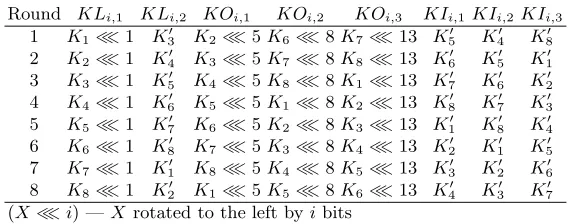
and refer the intrigued reader to [21]). In each round, eight words are used as the round subkey (up to some in-word rotations). Hence, each 128-bit round subkey is a linearly modified version of the secret key. We summarize the details of the key schedule of KASUMI in Table 1.
Round KLi,1 KLi,2 KOi,1 KOi,2 KOi,3 KIi,1KIi,2 KIi,3
1 K1≪1 K3′ K2≪5K6≪8K7≪13 K′5 K4′ K8′
2 K2≪1 K4′ K3≪5K7≪8K8≪13 K′6 K5′ K1′
3 K3≪1 K5′ K4≪5K8≪8K1≪13 K′7 K6′ K2′
4 K4≪1 K6′ K5≪5K1≪8K2≪13 K′8 K7′ K3′
5 K5≪1 K7′ K6≪5K2≪8K3≪13 K′1 K8′ K4′
6 K6≪1 K8′ K7≪5K3≪8K4≪13 K′2 K1′ K5′
7 K7≪1 K1′ K8≪5K4≪8K5≪13 K′3 K2′ K6′
8 K8≪1 K2′ K1≪5K5≪8K6≪13 K′4 K3′ K7′
(X ≪i) —X rotated to the left byibits
? ? KASUMI F O8 F L8 i ?
KL8 KO8, KI8
?
-F L7 -F O7 - i
?
KL7 KO7, KI7
? F O6 F L6 i ?
KL6 KO6, KI6
?
-F L5 -F O5 - i
?
KL5 KO5, KI5
? F O4 F L4 i ?
KL4 KO4, KI4
?
-F L3 -F O3 - i
?
KL3 KO3, KI3
? F O2 F L2 i ?
KL2 KO2, KI2
?
-F L1 -F O1 - i
?
KL1 KO1, KI1
?
? F Lfunction
<<< ∪
i ?
KLi,2
-<<<
-∩? i
KLi,1
? ? F Ofunction
i ` ` ` ` ` ` ` ? i
F Ii,3
? ? KIi,3 KOi,3 i ` ` ` ` ` ` ` ? i
F Ii,2
? ? KIi,2 KOi,2 i ` ` ` ` ` ` ` ? i
F Ii,1
? ? KIi,1 KOi,1 ? ? ? S9 ? i ```` ``` ? S7 ? i
? KIi,j,2 - i
i KI
i,j,1 ```` ``` ? S9 ? i ```` ``` ? S7 ? i ? F Ifunction
∩
bitwise AND
∪
bitwise OR <<< rotate left by one bit
Fig. 3.Outline of KASUMI
4
A Related-Key Sandwich Distinguisher for 7-Round
KASUMI
4.1 The New Distinguisher
In our distinguisher, we treat rounds 1–7 of KASUMI as a cascadeE=E1◦M◦ E0, whereE0 consists of rounds 1–3,M consists of round 4, and E1 consists of rounds 5–7. The related-key differential we use forE0is a slight modification of the differential characteristic presented in [12], in which
α= (0x,0010 0000x)→(0x,0010 0000x) =β.
The corresponding key difference is ∆Kab = (0,0,8000x,0,0,0,0,0), i.e., only
the third key word has the single bit difference∆K3= 8000x. This related-key
? ?
-F L3 -F O3 - i
?
KL3 KO3, KI3
?
F O2 F L2
i
?
KL2 KO2, KI2
?
-F L1 -F O1 - i
?
KL1 KO1, KI1
?
0 0010 0000x
0 0
0010 0000x 0
0 0
0 0010 0000x
p= 1/2
p= 1
p= 1/2
Fig. 4.3-Round Related-Key Differential Characteristic of KASUMI
the same differential shifted by four rounds, in which the data difference is the same, but the key difference is ∆Kac = (0,0,0,0,0,0,8000x,0) (to handle the
different subkeys used in these rounds).
As shown in [12], the probability of each one of of these 3-round differential characteristics is 1/4. In order to find the probability of the related-key sandwich distinguisher, we have to compute the probability
Prh(Xc⊕Xd=β)
(Xa⊕Xb=β)∧(Ya⊕Yc=γ)∧(Yb⊕Yd=γ) i
, (9)
where (Xa, Xb, Xc, Xd) and (Ya, Yb, Yc, Yd) are the intermediate values before
and after the middle slice of the sandwich during the encryption/decryption of the quartet (Pa, Pb, Pc, Pd) (see the right side of Figure 1). This computation,
which is a bit complicated, spans the rest of this subsection. Consider a quartet (Pa, Pb, Pc, Pd) for which the condition
(Xa⊕Xb=β)∧(Ya⊕Yc=γ)∧(Yb⊕Yd=γ) (10)
is satisfied. As explained in Section 2, since M is a single Feistel round, this implies that
(XaR=XdR)∧(XbR=XcR), (11)
whereXR
i denotes the right half ofXi that enters the functionF O4. Moreover,
as the right half of the differencesβ =γ is zero, we have
XaRR=XbRR=XcRR=XdRR, (12)
whereXRR
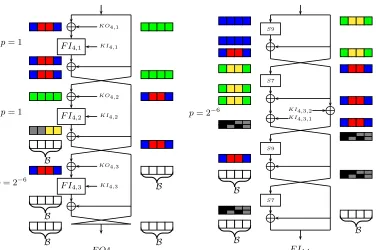
Consider now the computation depicted in Figure 5. The functionF O4 is a 3-round Feistel construction whose 32-bit values after round j are denoted by (Xaj, X
j b, Xcj, X
j
d), and the function F I is a 4-round Feistel construction whose
16-bit values after round j are denoted by (Ij a, I
j b, Icj, I
j
d). Note that the key
differences ∆Kab and ∆Kac affect in round 4 the subkeys KI4,3 and KI4,2,
respectively, and in particular, there is no key difference in the first round of F O4. As a result, Equation (11) implies that
(Xa1=Xd1)∧(Xb1=Xc1). (13)
Furthermore, there is no key difference in the pairs corresponding to (Pa, Pb)
and (Pc, Pd) in the second round ofF O4, and thus Equation (12) implies
(Ia2=Ib2)∧(Ic2=Id2). (14)
Combining equations (13) and (14), we get the following relation in the right half of the intermediate values after round 3 ofF O4:
Xa3R⊕Xb3R⊕Xc3R⊕Xd3R= 0. (15)
In the F-function of round 3 of F O4 we consider the pairs corresponding to (Pa, Pd) and (Pb, Pc). Since the key difference in these pairs (that equalsKab⊕
Kac) affects only the subkeyKI4,3,1, Equation (13) implies
Ia3R⊕Ib3R⊕Ic3R⊕Id3R= 0 (16)
in the right hand side of the output. In the left hand side of the output, the XOR of the four values is not necessarily equal to zero, due to the subkey difference that affects the inputs to the secondS7 inF I4,3. However, if these 7-bit inputs,
denoted by (Ja, Jb, Jc, Jd), satisfy one of the conditions:
((Ja =Jb)∧(Jc =Jd)) or ((Ja =Jc)∧(Jb=Jd)), (17)
then Equation (16) implies
I3L
a ⊕Ib3L⊕Ic3L⊕Id3L = 0. (18)
Since we have Ja ⊕Jd = Jb⊕Jc (both are equal to the subkey difference in
KI4,3,1), each one of the two conditions in Equation (17) is expected to hold1
with probability 2−7. Therefore, combining Equations (15), (16), and (18) we get that the condition
Xa3⊕Xb3⊕Xc3⊕Xd3= 0 (19)
holds with probability 2−6.
1
Finally, since theF L function is linear for a given key and there is no key difference in F L4, we can conclude that whenever Equation (19) holds, the outputs of the F-function in round 4 (denoted by (Oa4, O4b, O4c, O4d)) satisfy
O4a⊕O4b⊕Oc4⊕O4d= 0 (20)
with probability 2−6. Since by condition (10),
YaL⊕YbL⊕YcL⊕YdL= 0,
it follows that
XL
a ⊕XbL⊕XcL⊕XdL= 0 (21)
also holds with probability 2−6. Combining it with Equation (11) yields
Prh(Xc⊕Xd=β)
(Xa⊕Xb=β)∧(Ya⊕Yc=γ)∧(Yb⊕Yd=γ) i
= 2−6. (22) Therefore, the overall probability of the related-key sandwich distinguisher is
(1/4)2·(1/4)2·2−6= 2−14, (23)
which is much higher than the probability of (1/4)2·(1/4)2·2−32= 2−40which is expected by the naive analysis of the sandwich structure.
4.2 Experimental Verification
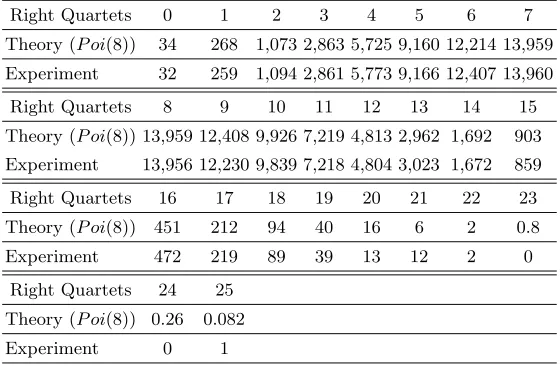
To verify the properties of the new distinguisher, we used the official code avail-able as an appendix in [21]. The verification experiment was set up as follows: In each test we randomly chose a key quartet satisfying the required key differences. We then generated 216quartets by following the boomerang procedure described above. We utilized a slight improvement of the first differential suggested in [12] that increases its probability in the encryption direction by a factor of 2 by fixing the value of two plaintext bits. Hence, we expect the number of right quartets in each test to be distributed according to a Poisson distribution with a mean value of 216·2−14·2 = 8. We repeated the test 100,000 times, and obtained a distribution which is extremely close to the expected distribution. The full results are summarized in Table 2.
4.3 A Counter Example
In this subsection we present an example which demonstrates the extremely delicate nature of such probability estimations. In this example, we make a tiny change in the key schedule of KASUMI, which does not seem to have any effect on the differential probabilities of any one of its three sub-ciphers. However, for this example, the probability of the distinguisher is zero!
The only change we make in KASUMI is that in the first subkey, the roles of the key words K′
L KO 4,1
F I4,1 KI4,1
L
L KO
4,2
F I4,2 KI4,2
L
L KO
4,3
F I4,3 KI4,3
L
B
B
B
B B
p= 2−6 p= 1 p= 1
F O4
S9 L
S7 L
L
KI4,3,2 L KI
4,3,1
S9 L
S7 L
B
B B
p= 2−6
F I4,1
Values marked by the same color are equal. Values marked byBare balanced (i.e., the XOR of all four values is 0). The values inF I4,3which are either gray or black suggest
one of two possible cases.
Fig. 5.The Development of Differences inF O4 and inF I4,3
modified according to the rule of the original KASUMI, i.e., the key words are rotated cyclically in each round (e.g.,KI2,1=K1′, KI3,3=K7′).
Since our change affects only the subkeys used in KIi,1 and KIi,3 in each round, the differentials used in our distinguisher on KASUMI remain exactly the same for the new variant (with the same input/output differences, the same key differences and the same probabilities). However, we claim that in this case,
r=Prh(Xc⊕Xd=β)
(Xa⊕Xb=β)∧(Ya⊕Yc=γ)∧(Yb⊕Yd=γ) i
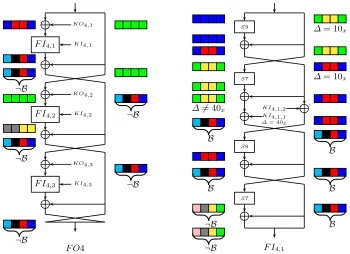
= 0, (24) and thus the probability of the distinguisher is zero. In all the computations below, the notations are the same as in the original distinguisher above. The impossible transition is depicted in Figure 6.
Since the differentials are the same as in the original distinguisher, we have
(XaR=XdR)∧(XbR=XcR)
and
XRR
Right Quartets 0 1 2 3 4 5 6 7
Theory (P oi(8)) 34 268 1,073 2,863 5,725 9,160 12,214 13,959
Experiment 32 259 1,094 2,861 5,773 9,166 12,407 13,960
Right Quartets 8 9 10 11 12 13 14 15
Theory (P oi(8)) 13,959 12,408 9,926 7,219 4,813 2,962 1,692 903
Experiment 13,956 12,230 9,839 7,218 4,804 3,023 1,672 859
Right Quartets 16 17 18 19 20 21 22 23
Theory (P oi(8)) 451 212 94 40 16 6 2 0.8
Experiment 472 219 89 39 13 12 2 0
Right Quartets 24 25 Theory (P oi(8)) 0.26 0.082
Experiment 0 1
Table 2.The Number of Right Quartets in 100,000 Experiments
Also, since the second round ofF O4 is unchanged, we have
(Ia2=Ib2)∧(Ic2=Id2).
Therefore,
Xa3R⊕Xb3R⊕Xc3R⊕Xd3R=Ia1⊕Ib1⊕Ic1⊕Id1.
In the first round ofF O4 we have a difference between the modified variant and the original KASUMI, as in the modified variant there is subkey difference in the pairs corresponding to (Pa, Pb) and to (Pc, Pd) in the MSB of the subkey
KI4,1,1. Let us analyze the functionF I4,1.
By the structure of the differential, its inputs are of the form
(XaR⊕KO4,1, XbR⊕KO4,1, XcR⊕KO4,1, XdR⊕KO4,1) = (t, t⊕0010x, t⊕0010x, t).
After the first round ofF I4,1 the values remain in the form (t′, t′⊕0010x, t′⊕
0010x, t′). After the second round the values are of the formu, v, v, u. We claim
that u⊕v6=M SB. Indeed, if we hadu⊕v=M SB, then the 7-bit outputs of the S-boxS7 had to be of the form (u′, u′⊕10000002⊕00100002, u′⊕10000002⊕ 00100002, u′). However, the differential (00100002→10100002) is impossible for S7, and thus this event cannot occur.
We now claim that the four 7-bit intermediate values after the XOR with the subkeyKI4,1,1 are different. Indeed, these values are of the form (u⊕k, v⊕ k⊕M SB, v⊕k, u⊕k⊕M SB), and these are all different since u 6= v and u6=v⊕M SB.
Finally, we consider the S-boxS7 in the fourth round ofF I4,1. Its four inputs
L KO 4,1
F I4,1 KI4,1
L
L KO
4,2
F I4,2 KI4,2
L
L KO
4,3
F I4,3 KI4,3
L
¬B
¬B
¬B
¬B
¬B
F O4
S9 L
S7 L
L
KI4,1,2 L KI
4,1,1
∆= 40x
S9 L
S7 L
∆= 10x
∆= 10x
∆6= 40x
B
B
B B
B ¬B
¬B F I4,1
Values marked by the same color are equal. Values marked by ¬B are not balanced (i.e., the XOR of all four values is not 0). The values in F I4,1 with difference ∆=??
below them suggest the difference. Note that in S7 of KASUMI, 10x6→50x.
Fig. 6.The Development of Differences inF O4and inF I4,1in the Modified KASUMI
(v⊕k, u⊕k⊕M SB) with the same difference. SinceS7 is analmost perfect non-linear permutation, this implies that the two corresponding pairs of outputs have distinct differences, and thus, the XOR of the four output values is necessarily non-zero. Since the XOR of the output values in the right half is zero, we have
Ia1⊕Ib1⊕Ic1⊕Id16= 0,
and hence,
Xa3R⊕Xb3R⊕Xc3R⊕Xd3R6= 0.
Therefore, the XOR of the four outputs ofF O4 is non-zero with probability 1, and since F Lis linear, this implies that the XOR of the four outputs of F Lis non-zero with probability 1. This proves that
Prh(Xc⊕Xd =β)
(Xa⊕Xb =β)∧(Ya⊕Yc=γ)∧(Yb⊕Yd=γ) i
= 0,
-F L7 -F O7 - i ?
KL7 KO7, KI7
?
F O6 F L6
i
?
KL6 KO6, KI6
?
-F L5 -F O5 - i
?
KL5 KO5, KI5
?
F O4 F L4
i
?
KL4 KO4, KI4
?
-F L3 -F O3 - i
?
KL3 KO3, KI3
?
F O2 F L2
i
?
KL2 KO2, KI2
?
-F L1 -F O1 - i
?
KL1 KO1, KI1
?
? ?
0 0010 0000x
0 0
0010 0000x 0
0 0
0 0010 0000x
0 0010 0000x
0 0
0010 0000x 0
0 0
0 0010 0000x
Fig. 7.The 7-Round Related-Key Sandwich Distinguisher of KASUMI
For the sake of completeness, we also implemented this variant of KASUMI, and verified experimentally that the number of right quartets with the desired sandwich property was always zero.2
5
Related-Key Sandwich Attack on the Full KASUMI
Our attack on the full KASUMI (depicted in Figure 7) applies the distinguisher presented in Section 4 to rounds 1–7, and retrieves subkey material in round 8. Let ∆Kab = (0,0,8000x,0,0,0,0,0) and ∆Kac = (0,0,0,0,0,0,8000x,0), and
let Ka, Kb = Ka ⊕∆Kab, Kc = Ka ⊕∆Kac, and Kd = Kc⊕∆Kab be the
unknown related keys we wish to retrieve. The attack algorithm is as follows:
1. Data Collection Phase:
2
We used 100 keys, and for each of them we generated 224
(a) Choose a structure of 224 ciphertexts of the formC
a = (Xa, A), where
A is fixed and Xa assumes 224 arbitrary different values. Ask for the
decryption of all the ciphertexts under the keyKaand denote the
plain-text corresponding to Ca byPa. For eachPa, ask for the encryption of
Pb =Pa⊕(0x,0010 0000x) under the keyKb and denote the resulting
ciphertext byCb. Store the pairs (Ca, Cb) in a hash table indexed by the
32-bit valueCR
b (i.e., the right half ofCb).
(b) Choose a structure of 224ciphertexts of the formC
c = (Yc, A⊕0010 0000x),
where A is the same constant as before, and Yc assumes 224 arbitrary
different values. Ask for the decryption of the ciphertexts under the key Kcand denote the plaintext corresponding toCc byPc. For eachPc, ask
for the encryption ofPd =Pc⊕(0x,0010 0000x) under the keyKd and
denote the resulting ciphertext byCd. Then, access the hash table in the
entry corresponding to the valueCR
d ⊕(0x,0010 0000x), and for each pair
(Ca, Cb) found in this entry, apply Step 2 on the quartet (Ca, Cb, Cc, Cd).
In the first step described above, the (224)2= 248possible quartets are filtered according to a condition on the 32 difference bits which are known (due to the output difference δof the distinguisher), which leaves about 216 quartets with the required differences.
In Step 2 we can identify the right quartets instantly using an extremely lucky property of the KASUMI structure. We note that a pair (Ca, Cc) can be
a right quartet if and only if
CaL⊕F L8(F O8(CaR)) =CcL⊕F L8(F O8(CcR)), (25)
since by the Feistel structure, this is the only case of which the difference af-ter round 7 is the output difference of the sandwich distinguisher (i.e., δ = (0x,0010 0000x)). However, the valuesCaR and CcR are fixed for all the
consid-ered ciphertexts, and hence Equation (25) yields
CaL⊕CcL=F L8(F O8(A))⊕F L8(F O8(A⊕(0x,0010 0000x))) =const. (26)
Thus, the value CL
a ⊕CcL is equal for all the right quartets. This allows us to
perform the following simple filtering:
2. Identifying the Right Quartets:
(a) Insert the approximately 216 remaining quartets (C
a, Cb, Cc, Cd) into a
hash table indexed by the 32-bit valueCL
a ⊕CcL, and apply Step 3 only
to bins which contain at least three quartets.
Since the probability of a 3-collision in a list of 216 random 32-bit values is lower than 2163
·2−64≤2−18, with very high probability only the right quartets remain after this filtering.
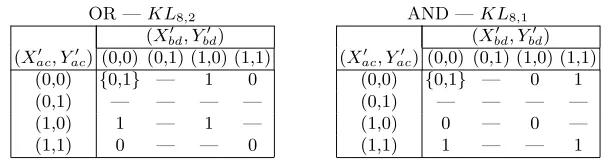
OR —KL8,2 AND —KL8,1
(X′
bd, Ybd′ ) (Xbd′ , Ybd′) (X′
ac, Yac) (0,0) (0,1) (1,0) (1,1)′ (Xac′ , Yac) (0,0) (0,1) (1,0) (1,1)′
(0,0) {0,1} — 1 0 (0,0) {0,1} — 0 1
(0,1) — — — — (0,1) — — — —
(1,0) 1 — 1 — (1,0) 0 — 0 —
(1,1) 0 — — 0 (1,1) 1 — — 1
∗ The two bits of the differences are denoted by (input difference, output difference):
(X′
1, Y1′) for one pair and (X2′, Y2′) for the other pair.
Table 3.Possible Values ofKL8,2 andKL8,1
3. Analyzing Right Quartets:
(a) For each remaining quartet (Ca, Cb, Cc, Cd), guess the 32-bit value of
KO8,1andKI8,1. For the two pairs (Ca, Cc) and (Cb, Cd) use the value
of the guessed key to compute the input and output differences of the OR operation in the last round of both pairs. For each bit of this 16-bit OR operation of F L8, the possible values of the corresponding bit of KL8,2 are given in Table 3. On average (8/16)16 = 2−16 values of KL8,2 are suggested by each quartet and guess ofKO8,1 and KI8,1.3
Since all the right quartets suggest the same key, all the wrong keys are discarded with overwhelming probability, and the attacker obtains the correct value of (KO8,1, KI8,1, KL8,2).
(b) Guess the 32-bit value of KO8,3 and KI8,3, and use this information
to compute the input and output differences of the AND operation in both pairs of each quartet. For each bit of the 16-bit AND operation of F L8, the possible values of the corresponding bit ofKL8,1 are given in Table 3. On average (8/16)16 = 2−16 values of KL
8,1 are suggested by each quartet and guess of KO8,3, KI8,3, and thus the attacker obtains
the correct value of (KO8,3, KI8,3, KL8,1).
4. Finding the Right Key:For each value of the 96 bits of (KO8,1,KI8,1,
KO8,3, KI8,3, KL8,1 ,KL8,2) suggested in Step 3, guess the remaining 32
bits of the key, and perform a trial encryption.
The data complexity of the attack is 225 chosen ciphertexts and 225 adap-tively chosen plaintexts encrypted/decrypted under one of four keys. The time complexity is dominated by the trial encryptions performed in step 4 to find the last 32 bits of the key, and thus it is approximately equal to 232encryptions. The probability of success is approximately 76% (this is the probability of having at least three right pairs in the data pool).
The memory complexity of the attack is also very moderate. We just need to store 226 plaintext/ciphertext pairs, where each pair takes 16 bytes. Hence, the total amount of memory used in the attack is 230bytes, i.e., 1 GByte of memory.
3
5.1 Experimental Verification
We performed two types of experiments to verify our attack. In the first experi-ment, we just generated the required data, and located the right quartets (thus verifying the correctness of our randomness assumptions). The second experi-ment was the application of the full attack (both with and without the final exhaustive search over the remaining 32 key bits). All our experiments were car-ried out on an Intel Core Duo 2 machine with a T7200 CPU (2 GHz, 4 MB L2 Cache, 2 GB RAM, Linux-2.6.27 kernel, with gcc 4.3.2 and standard optimiza-tion flags (-O3, -fomit-frame-pointers,-funroll-loops), single core, single thread).
The first experiment was conducted 1,000 times. In each test, we generated the data and found candidate quartets according to Steps 1 and 2 of the at-tack algorithm. Once these were found, we partially decrypted the quartets, and checked how many quartets were right ones. Table 4 details the outcome of these experiments, which follow the expected distribution.
Right Quartets 0/1/2 3 4 5 6 7 8 9 10 11 12
Theory (P oi(4)) 238 195 195 156 104 60 30 13 5 2 0.6
Experiment 247 197 180 167 112 52 30 7 4 3 1
Table 4.The Number of Identified Right Quartets in 1,000 tests
The second experiment simulated the full attack. We repeated it 100 times, and counted in each case how many times the final exhaustive search over 232 possible keys would have been evoked. In 78 out of these 100 experiments, the key was found when 3 or more quartets were identified to be right ones (the expected number was 76.1).
About 50% of the tests were able to identify the right key by invoking either 2 or 4 exhaustive searches. As the first part of the attack (which identifies candidate quartets) takes about 8 minutes, and each exhaustive search (using the official KASUMI source code) takes about 26 minutes, we could find the full 128 bit key in about 50% of our tests in less than 112 minutes (using a single core). It is important to note that by increasing the running time, one can increase the success rate of the attack without increasing its data requirements.
5.2 Related-Key Rectangle-Like Sandwich Attack on the Full
KASUMI
plaintext manner, one can ensure that the first round of the differential char-acteristic for E0 is followed with probability 1 rather than 1/2, and hence the actual probability is 2−76. This distinguisher can be used to mount a related-key rectangle-like sandwich attack on the full KASUMI. The attack is very similar to the attack presented in detail in [7], and hence we omit the full description here, and just mention the changes.
Instead of starting with 251 plaintexts in each structure, the attacker can take 239plaintexts. These plaintexts contain 278possible quartets, and after the first filtering step only 214 quartets remain. Then in Step 2(a) of the attack the attacker gets 230 suggestions for 48 key bits (instead of 254 as in [7]), and thus all the wrong suggestions can be discarded (since the right pairs suggest the same value). As a result, the time complexity of the following steps becomes negligible, and the overall time complexity is dominated by the time required to encrypt the 241chosen plaintexts. This is worse than the 232time complexity of our sandwich attack but still practical, and has the important advantage that it only requires chosen plaintexts rather than the chosen ciphertexts/adaptive chosen plaintexts of the sandwich attack.
As in the ordinary sandwich attack, the memory used during the rectangle-like sandwich attack is dominated by the storage of the plaintexts and the ci-phertexts. By first encrypting the data under keys Ka and Kb, storing it in a
sorted table, and then encrypting the data under Kc and Kd in a pair-by-pair
manner, we have to store only 240 plaintext/ciphertext pairs. Hence, the total memory complexity of the attack is about 16 terabytes (244bytes). Fortunately, this memory is accessed sequentially and can be relatively slow, so we only need a few hard disks to keep this data.
6
Summary
In this paper we develop a new sandwich attack on iterated block ciphers, and use it to reduce the time complexity of the best known attack on the full KASUMI from an impractical 276to the very practical 232. However, the new attack uses both related keys and chosen messages, and thus it might not be applicable to the specific way in which KASUMI is used as the A5/3 encryption algorithm in third generation GSM telephony. Our main point was to show that contrary to the assurances of its designers, the transition from MISTY to KASUMI led to a much weaker cryptosystem, which should be avoided in any application in which related key attacks can be mounted.
References
1. A5/1 Security Project, Creating A5/1 Rainbow Tables, 2009. Available online at
http://reflextor.com/trac/a51.
3. Eli Biham, New Types of Cryptanalytic Attacks Using Related Keys, Journal of Cryptology, Vol. 7, No. 4, pp. 229–246, Springer, 1994.
4. Eli Biham, Orr Dunkelman, and Nathan Keller, The Rectangle Attack — Rect-angling the Serpent, Advances in Cryptology, proceedings of EUROCRYPT 2001, Lecture Notes in Computer Science 2045, pp. 340–357, Springer, 2001.
5. Eli Biham, Orr Dunkelman, and Nathan Keller,New Results on Boomerang and Rectangle Attacks, proceedings of Fast Software Encryption 2002, Lecture Notes in Computer Science 2365, pp. 1–16, Springer 2002.
6. Eli Biham, Orr Dunkelman, and Nathan Keller,Related-Key Boomerang and Rect-angle Attacks, Advances in Cryptology, proceedings of EUROCRYPT 2005, Lec-ture Notes in Computer Science 3494, pp. 507–525, Springer, 2005.
7. Eli Biham, Orr Dunkelman, and Nathan Keller,A Related-Key Rectangle Attack on the Full KASUMI, Advances in Cryptology, proceedings of ASIACRYPT 2005, Lecture Notes in Computer Science 3788, pp. 443–461, Springer, 2005.
8. Alex Biryukov,The Boomerang Attack on 5 and 6-Round Reduced AES, proceed-ings of AES 2004, Lecture Notes in Computer Science 3373, pp. 11–15, Springer, 2005.
9. Alex Biryukov, Christophe De Canni`ere, and Gustaf Dellkrantz,Cryptanalysis of SAFER++, Advances in Cryptology, proceedings of CRYPTO 2003, Lecture Notes in Computer Science 2729, pp. 195–211, Springer, 2003.
10. Alex Biryukov and Dmitry Khovratovich, Related-key Cryptanalysis of the Full AES-192 and AES-256, Advances in Cryptology, proceedings of ASIACRYPT 2009, Lecture Notes in Computer Science 5912, pp. 1–18, Springer, 2009.
11. Alex Biryukov, Adi Shamir, and David Wagner,Real Time Cryptanalysis of A5/1 on a PC, proceedings of Fast Software Encryption 2000, Lecture Notes in Computer Science 1978, pp. 1–18, Springer, 2001.
12. Mark Blunden and Adrian Escott, Related Key Attacks on Reduced Round KA-SUMI, proceedings of Fast Software Encryption 2001, Lecture Notes in Computer Science 2355, pp. 277–285, Springer, 2002.
13. Marc Briceno, Ian Goldverg, and David Wagner,A Pedagogical Implementation of the GSM A5/1 and A5/2 ”voice privacy” encryption algorithms, 1999. Available online athttp://cryptome.org/gsm-a512.htm.
14. Orr Dunkelman and Nathan Keller, An Improved Impossible Differential Attack on MISTY1, Advances in Cryptology, proceedings of ASIACRYPT 2008, Lecture Notes in Computer Science 5350, pp. 441–454, Springer, 2008.
15. Patrik Ekdahl and Thomas Johansson, Another Attack on A5/1, IEEE Transac-tions on Information Theory Vol. 49, No. 1, pp. 284–289, IEEE, 2003.
16. Seokhie Hong, Jongsung Kim, Guil Kim, Sangjin Lee, and Bart Preneel, Related-Key Rectangle Attacks on Reduced Versions of SHACAL-1 and AES-192, proceed-ings of Fast Software Encryption 1999, Lecture Notes in Computer Science 3557, pp. 368–383, Springer, 2005.
17. John Kelsey, Bruce Schneier, and David Wagner, Key Schedule Cryptanalysis of IDEA, G-DES, GOST, SAFER, and Triple-DES, Advances in Cryptology, pro-ceedings of CRYPTO 1996, Lecture Notes in Computer Science 1109, pp. 237–251, Springer, 1996.
18. Jongsung Kim, Guil Kim, Seokhie Hong, and Dowon Hong,The Related-Key Rect-angle Attack — Application to SHACAL-1, proceedings of Australasian Confer-ence on Information Security and Privacy 2004, Lecture Notes in Computer Sci-ence 3108, pp. 123–136, Springer, 2004.
20. Mitsuru Matsui,Block encryption algorithm MISTY, proceedings of Fast Software Encryption 1997, Lecture Notes in Computer Science 1267, pp. 64–74, Springer, 1997.
21. 3rd Generation Partnership Project, Technical Specification Group Services and System Aspects, 3G Security, Specification of the 3GPP Confidentiality and In-tegrity Algorithms; Document 2: KASUMI Specification, V3.1.1, 2001.
22. 3rd Generation Partnership Project, Technical Specification Group Services and System Aspects, 3G Security,Specification of the A5/3 Encryption Algorithms for GSM and ECSD, and the GEA3 Encryption Algorithm for GPRS; Document 4: Design and evaluation report, V6.1.0, 2002.
23. TECHNEWSWORLD, Hackers Jimmy GSM Cellphone Encryption, published 29/12/2009. Available online athttp://www.technewsworld.com/rsstory/68997. html.