Available Online atwww.ijcsmc.com
International Journal of Computer Science and Mobile Computing
A Monthly Journal of Computer Science and Information Technology
ISSN 2320–088X
IMPACT FACTOR: 6.017
IJCSMC, Vol. 7, Issue. 8, August 2018, pg.147 – 158
DESIGN AND EVALUATION
OF AN ONLINE GRADE
EVALUATION SYSTEM
Unife O. Cagas
1, Renz M. Buctuan
2¹Associate Professor IV, Engineering and Information Technology, SSCT, Philippines 2
Instructor I, Engineering and Information Technology, SSCT, Philippines 1
[email protected]; 2 [email protected]
Abstract— Evaluation is a process of assessing grades and assigning subjects in the next level of enrolment. The study aimed to Design and Develop an Online Grade Evaluation System on evaluator’s modules, as follows: student registration; program; curriculum; subject; grade; and report generation module. Likewise, determine the evaluator’s acceptability level on functionality and usability. The system's study observed developmental design with the concepts behind the System Development Life Cycle (SDLC), particularly, Agile methodology. Additionally, the system had employed statistical tools: the frequency; percentage; and weighted mean to determine the evaluator’s acceptability level. Generally, the system was perceived functional as designed and usable in the institution. It functions correctly on defined evaluator’s modules. In like manner, it is usable particularly, the generation of reports. It provides much speedy process during enrolment. For the use of other HEIs, the system requires customization, to conform to their own process as with the grade evaluation.
Keywords— design and development, developmental design, functionality, online grade evaluation, usability
I. INTRODUCTION
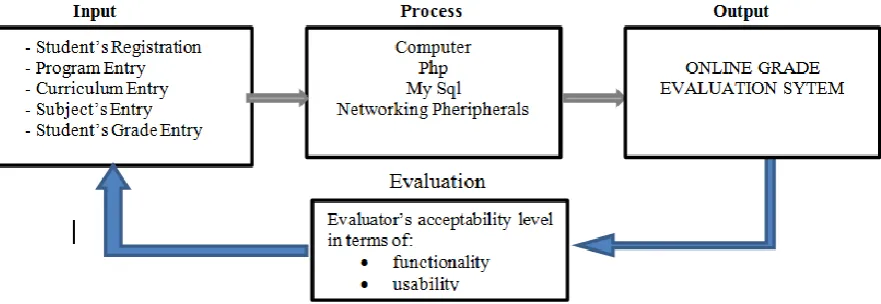
In the Philippines, in particular, Higher Education Institutions (HEIs), create a process in the evaluation of the grade of the students for the next level of enrolment. This process could be traditionally manual or automated. Majority of these institutions are still on its manual process of evaluation. Evaluation is a process of identification of its value. It is a collection, analysis, and determination of the possible outcome of its value. In the study, online grade evaluation is students’ registration, program and curriculum specification, grade entry and subject generation for the next level of enrolment.
These days, some institutions have problems with students’ grade evaluation. Commonly, the process used is manual, consuming much of time to check out the grades and difficulty to find out the subjects the students to enrol. Surigao State College of Technology (SSCT), Information Technology (IT) division, in particular, has reached the highest number of populations in the college which met difficulty in its manual pre-enrolment process, particularly, grade evaluation. The process gave much difficulty to the evaluator to find out which of the subjects of its curriculum the students possibly enrol or not. There had been observed cases when subjects enrolled did not pass its pre-requisite. Likewise, complaints had been raised by the students for not credited the previous passing grade.
With specified concerns, there is a necessity in the Design and Development of an Online Grade Evaluation System to design and develop the evaluator’s modules to accept the student’s registration, program’s entry, curriculum’s entry, subject’s entry, student’s grade entry and generates printable reports. Likewise, determine the evaluator’s acceptability level on functionality and usability. With this, the IT division of the college ensures readiness to respond to the changing needs of the society as it envisions to gradually digitize the academic transactions for simplest and fastest transactions' delivery.
Statement of the Problem
The design and development of an Online Grade Evaluation System is a tool used to evaluate the grades of the students for the next level of enrolment. The manual evaluation system consumed much of time to evaluate the grades and difficulty to find the subjects to take.
General Objective
The system is designed and developed with evaluator’s modules and determined the evaluator’s acceptability level.
Specific Objectives
Specifically, the study intended to: (1) Design and develop an evaluator’s modules such as: student registration; program entry; curriculum entry; subject entry; student’s grade entry; and report generation and (2) Determine the acceptability level of the system in terms of: functionality; and usability.
II. CONCEPTUAL FRAMEWORK
In the study of [3], stressed out that the use of the Internet in the educational environment has enabled easy access to many resources, and information sharing has, therefore, much increased. The study anchored on the idea of [4], who had discussed that enrollment has to fulfill a number of requirements for approval. These requirements are found from the business rules. For example, a student would not be able to enroll for a subject if he has not passed the pre-requisite subject(s) in semesters preceding the semester into which he wants to enroll. The study of [5], emphasized that with the development of the Online Registration and Grade Evaluation System for the pre-enrollment procedure, the University further promote its vision, mission statement and goals of contributing to the development of the society.
III. METHODOLOGY
This part presents analysis, design, evaluation, and implementation of the study. Each part observed sequentially to conform to the institutional requirements.
Analysis
This stage is where the researchers do the analysis. The Use Case diagram (Figure 2), used to identify, clarify and organize system requirements.
Figure 2. Use Case Diagram of the Design and Development of an Online Grade Evaluation System
Figure 2 shows the Use Case diagram of an Online Grade Evaluation System. It shows how the evaluator interacts into different records like the program, curriculum, subject, student’s evaluation and report.
The curriculum module is where the evaluator enters curriculum information and manages curriculum’s records. It consists of adding, updating, modifying and deleting curriculum.
The subject module is where the evaluator registered subjects for a particular curriculum and manages the inputted data.
The student module is where the evaluator enters student’s information as well the grades of every subject taken by the student.
The evaluation module is where the grade evaluation could be executed and the Report module in generating of reports as required by the office and students.
Design
The system's study observed the developmental design to design and develop an evaluator’s defined modules for grade evaluation. The study determined the evaluator’s acceptability level through the researcher made questionnaire accompanied with an unstructured interview to validate the responses of the respondents who were the group of division deans, IT program heads and IT professional.
During its development, the researcher applied the concept of System Development Life Cycle (SDLC), particularly Agile model. Agile model is characterized by short iterative cycles and extensive testing, active involvement of users for establishing, prioritizing, and verifying requirements [6].
Implementation
The researcher developed this Online Grade Evaluation System because of its need especially during enrollment period wherein student’s grade evaluation responsibly done by human effort that leads sometimes to human error. During the implementation, the Local Area Network (LAN) facilities were prepared and installed with the two personal computer units and XAMMP software.
Evaluation
The designed questionnaire answered by the selected personnel of the college. Before the facilitation, the IT dean and program heads validated first the questionnaire. Statistical tools used for the presentation, analysis, and interpretation of data were frequency and percentage distribution in identifying the respondents as the evaluators; and weighted mean in determining the level of the system’s acceptability on functionality and usability.
To help understand the responses, the upper and the lower limit of a scale used the 5-point Likert scale as shown below:
Table 1. Numerical Rating with Descriptive Interpretation
The researcher used the following formulas to analyse and interpret the collected data.
1. ∑fx) = X1(F1) +X2(F2)…ln) Where:
f = Frequency x = Respondents 2. Mean (M) = (∑fx)/N Where:
N = total number of respondents
M = represents the total numerical value of the squared mean 3. Weighted Mean (WM) = M/NA
Where:
NA = total number of items
M = represents the total numerical value of the squared mean
Numerical Rating Descriptive Interpretation
4.50 - 5.00 3.50 – 4.49 2.50 – 3.49 1.50 – 2.49 1.00 – 1.49
As shown in Table 2, there are two (2) deans, three (3) IT program coordinators, thirty- five (35) IT professionals were asked to evaluate the developed system. Percentage distribution of respondents was presented in Table 2. There are forty (40) total respondents, served as evaluators, 2 or 5.00% of which were the Deans, 3 or 7.50% were the IT program coordinators and 35 or 85.50 % were the IT professionals. They were chosen as evaluators because they were the right personalities to do the evaluation as responsible during students’ grade evaluation.
Table 2. Percentage Distribution of Respondents
Respondents Frequency(N) Percentage (%)
Deans 2 5.00 IT program
Coordinators
3 7.50
IT professionals 35 87.50 Total 40 100.00
IV. RESULTS AND DISCUSSIONS
This part presents results from its two (2) defined specific objectives with its corresponding discussions as portrayed in Figures 3-12 and Tables 3-4.
Objective 1: Designed and Development of an Evaluator’s Module
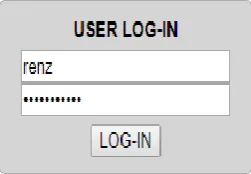
Figure 3. Log-in Box for Evaluator
Figure 3 shows the log-in box for the evaluator. It provides username and password. The system could be accessed by providing a valid username and password. Once incorrect either username or password has entered the system gives an error message which prompts the user to enter a valid entry.
Figure 4 shows the student entry module serves as the main window of an online grade evaluation system. At its left, displays the lists of adding buttons for different modules like student, program, curriculum, and subject. Once the evaluator clicked the student module, it allows adding of student and requires student ID, last name, first name, middle initial, program, and curriculum where the student belongs.
Figure 5. Program Entry Module
Figure 5 shows the program entry of the system. Once the evaluator clicked the program module, it allows adding of the newly offered program which requires corresponding code and description.
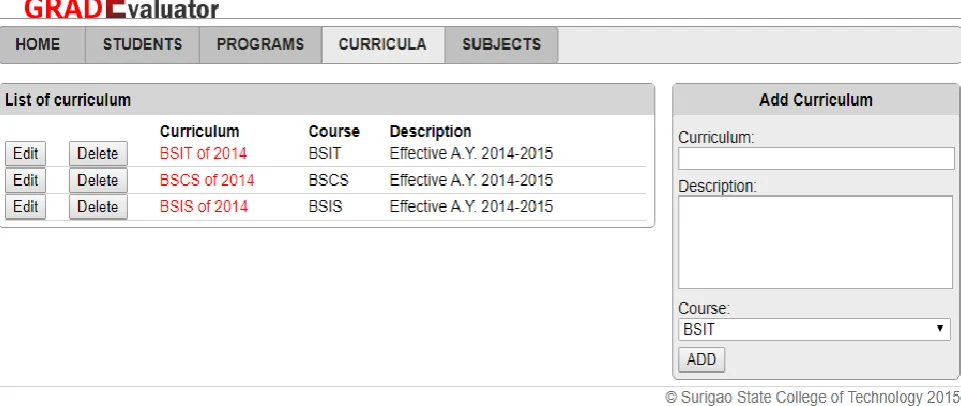
Figure 6. Curriculum Entry Module
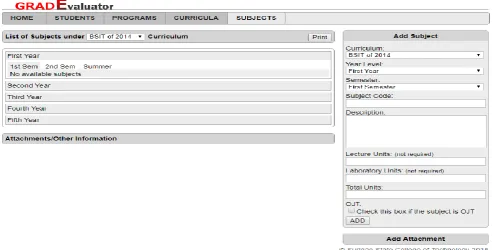
Figure 7. Subject Entry Module
Figure 7 shows the subject entry. It is where the evaluator can enter subject information. As it left, it shows the list of subjects under a certain curriculum at all levels that is ready for printing anytime. In adding of the subject, as shown to its right, the evaluator would select first the curriculum, year, then the subject code, description of the subject, the units for lecture and laboratory if it has, then the total units.
Figure 8. Evaluation Module
Figure 9. Report Module – Prospectus
Figure 10. Report Module - Prospectus
Figure 11. Report Module - List of Suggested Subjects for Enrolment Report
Figure 11 shows the list of suggested subjects for enrolment report. It shows the qualified subject for enrolment by the individual student.
Objective 2: Evaluation and acceptability level as perceived by the Respondents
Table 3. Perception of Evaluators in terms of Functionality
Functionality: The evaluators perceived that the system: f(5) f(4) f(3) f(2) f(1) fx Mean
1 functions correctly on student registration, course,
curriculum, subject and student grade entries. 40 0 0 0 0 200 5.00 2 produces correct print-outs of an individual
prospectus. 40 0 0 0 0 200 5.00
3 generates summary results of the grade every enrolled
semester. 40 0 0 0 0 200 5.00
4
generates subjects taken in the previous semester. 40 0 0 0 0 200 5.00
5
produces correct print-outs of the subjects to enroll.
40 0 0 0 0 200 5.00
Weighted Mean
5.00
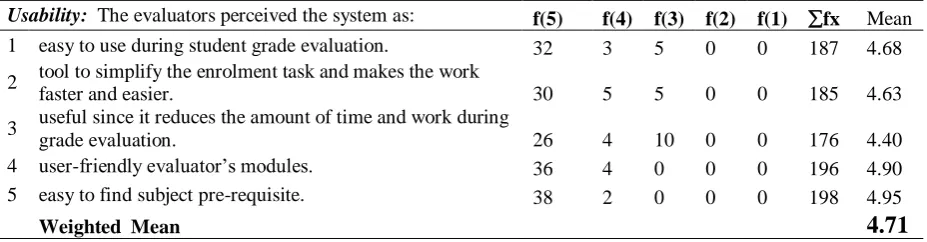
As depicted in Table 4, the perception of evaluators on usability. It shows the usability weighted mean of 4.71, as Excellent. It connotes that the system is easy to use during student grade evaluation; a tool to simplify the enrolment task and makes the work faster and easier; useful since it reduces the amount of time and works during grade evaluation; user-friendly evaluator’s modules; and easy to identify subject pre-requisites. Usability refers to the ease of use for a given function [8].
In detail, the system is easy to find the subject pre-requisite garnered the highest mean of 4.95, as
Excellent. Identification of subject pre-requisite is the major concern in the design because this is an observed difficulty during enrolment. In the system, the suggested subjects for enrolment in all year levels considered already the pre-requisite subjects. It means once the pre-requisite subject is not yet taken/passed, the next subject could not be part of the list of the subjects for enrolment. On the other hand, the system as “useful since it reduces the amount of time and works during grade evaluation” got the lowest mean of 4.40, but still a Very Good rating. The system shows justifiable, possibly because the evaluators considered the time consumed during grade entry. This case sometimes is done at once when the students attempted to enroll and presented by the grades of the last semester enrolled.
Table 4. Perception of Evaluators in terms of Usability
Usability: The evaluators perceived the system as: f(5) f(4) f(3) f(2) f(1) fx Mean 1 easy to use during student grade evaluation. 32 3 5 0 0 187 4.68
2 tool to simplify the enrolment task and makes the work
faster and easier. 30 5 5 0 0 185 4.63
3 useful since it reduces the amount of time and work during
grade evaluation. 26 4 10 0 0 176 4.40
4 user-friendly evaluator’s modules. 36 4 0 0 0 196 4.90 5 easy to find subject pre-requisite. 38 2 0 0 0 198 4.95
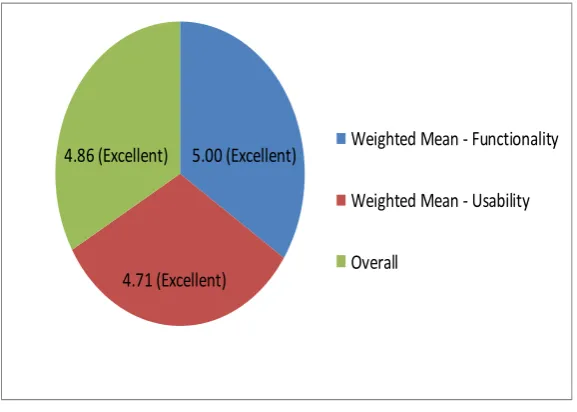
Figure 12. Summary of Evaluation Result
Figure 12 presents the summary of the developed system’s performance evaluation. Functionality gained the highest weighted mean of 5.00, described as Excellent followed by the Usability got the weighted mean of 4.71, still Excellent as construed. The overall system performance gained an average rating of 4.86 which indicates that the system is Excellent. It means that the Design and Development of an Online Grade Evaluation System function as designed and usable in the institution.
V. CONCLUSION AND RECOMMENDATIONS
The system observed functionality and usability. It functions according to the institutional requirements and usable in the institution. Hence, ensures readiness to respond to the changing needs of the society. The system provides much speedy process during enrolment. For the use of other HEIs, the system requires customization, to conform to their own process as with the grade evaluation.
REFERENCES
[1].G. Lalas and D. Marcial, Developing a Grading and Monitoring System: Towards an Effective Academic Evaluation. International Conference on Research in Social Sciences, Humanities and Education (SSHE-2016) May 20-21, 2016 Cebu (Philippines).
[2].R. Capada , N. Casillano , and J. Quiloña, Student Profiling and Grade Evaluation System (SPGES). Imperial Journal of Interdisciplinary Research (IJIR) Vol-2, Issue-12, 2016 ISSN: 2454-1362, http://www.onlinejournal.
[3].[Y. Sahin, S. Balta and T. Ercan, The Use of Internet Resources by University Students During their Course Projects Elicitation: A Case Study,” The Turkish Online Journal of Educational Technology,
vol. 9, no. 2.
[4].P. Then, Online Student Enrolment System. Retrieved from http://dl.acm.org/citation.cfm?id=1181300.
[5].E. Custodio and M. Castro, Advancing Pre-Enrollment Procedure through Online Registration and Grade Evaluation System. International Journal of Signal Processing Systems Vol. 4, No. 5, October 2016.
[6].J. Valacich , J. George, and J. Hoffer, Essentials of Sytems Analysis & Design , 2012.
[7].S. Farooq , and S. Quadri, Quality Practices in Open Source Software Development Affecting Quality Dimensions, 2011. [Online]. Available:
https://pdfs.semanticscholar.org/b2fc/d160cd139cfad76f5fd81ff8ff78e263e98e.pdf on May 01, 2018. [8].IEEE Standard Glossary of Software Engineering terminology, IEEE Std 610.12-1990.
5.00 (Excellent)
4.71 (Excellent)
4.86 (Excellent) Weighted Mean - Functionality
Weighted Mean - Usability