Available Online at www.ijcsmc.com
International Journal of Computer Science and Mobile Computing
A Monthly Journal of Computer Science and Information Technology
ISSN 2320–088X
IMPACT FACTOR: 6.017IJCSMC, Vol. 7, Issue. 11, November 2018, pg.231 – 248
Technology Innovation of MLearning as an
Administrative Largesse: The Moderating
Role of Experience
Muhideen Sayibu1, Zhao Suiling1, Saad Abdullah Alammash2, Arslan A. Ahmed1
1. University of Science and Technology of China, No 96 Jinzhai Street 230026, Anhui-Hefei, China. 2. Shanghai International Studies University, 550 Dalian Road (W), Shanghai 200083, China.
1. [email protected], 1. [email protected], 2. [email protected], 1. [email protected]
Abstract: The educational technology innovation of MLearning breaks through clearly from the web-based search to the social media interactivity and connectivity for communication and information. In recent times, the high interest of MLearning in the administration of most institutions is undeniable. This study proposed the TPB with an expanded construct of administrative environment and experience, explored and investigate among learners, lecturers, and administrators from universities in China (N=255). The PLS-SEM v.3.0 used in the analysis with all constructs statistically satisfactory to the model of the study. The results indicated the mobility and portability of MLearning technology, in the digital age is a decision-making tool through distance social interactivity to manage time and facilitate convenience and advancement of technology.
Keywords: Technology Innovation, MLearning, Administrative Largesse, Experience.
I.
Introduction
The educational technology innovation is influencing significantly on major decisions in
organizations since its inception until the MLearning an optimum value of reality set in [1]. The
institutions of learning of late utilize the SMS system of alert in admitting students, information,
communications, decisions, process, and programs, in many parts of the globe, especially in
supported by the UNESCO agenda of achieving technology development a long-term goal [2]. A
common practice of most educational organization hook-up on a platform for discussions of
common purpose or interest [3]. Which allow for exchanges of administrative discourse, an
innovation behavior by many due to inclined use of technology [4]. The utilization of technology
of SMS, WeChat, and WhatsApp platforms for discussions in schools, among students-lecturers,
as organizations now addictive mobile device. The administrator makes a decision via social
media, MLearning technology has reduced notice board communication, an intended technology
innovation that enhances internally generated discourse with ease [5].
Generally, education is a multi-cultural task moderated by many factors the internal and
external activities; society, economy, culture, environment, belief systems, technology etc. [6].
The formulation of educational administrative activities been motivated by technology
innovation is the hottest subject of many institutions and organizations. The present digital age of
educational administration performs effectively on feedback in the behavior and attitude of
people use of mobile interactive media [5]. The values and attitudes of many administrators
developed with ICT age, the capabilities and experiences with cloud technology in human;
overall influences the technology innovation, of their environment, making way for MLearning
[7].
The acceptance of MLearning collaborative tact is clearer to all technology elite, due to
the attitudes exhibited by administrators, which fosters diversity and innovation means of social
network convenience [8]. The focus of technology innovation on MLearning in the
administration is due to accessibility, flexibility, mobility, motivation in the use of the
technology. The social environment has given rise and concern for MLearning [9]. The friendly
nature of the technology, liberate social acceptance of MLearning in most administrations and
organizations [10]. Research has found that about 75% of tertiary institutions are undertaken
admissions online as well as distance education [11]. The aim of this research is to investigate
the technology of MLearning as an administrative tool in organizations and institutions of
learning.
A. Literature Review
educational learning tool to have existed [12]. Research showed a bigger number of Americans
assessing the web via mobile shoot up by 107% as at last year. This growth is by 15-20%
monthly, compared to users of PC computer and Laptops in recent times [13]. In another
development, a report by EDUCAUSE (2017), showed; 83 percent of adults between the ages of
18 and 29 own a smartphone,mobile device ownership among college students is even higher
[14]. 86 percent of undergraduates owned a smartphone as of last year, and nearly half (47
percent) owned a tablet. The study outlined a pattern of usage relative to the addition of mobile
device among learners.
As mobile device becomes an integral part of human daily lives, mobile technology has
transformed the day-to-day communications and information and allocate more potentially
dynamics to learning [15]. The mobile learning platforms have the ability of; connectivity,
cameras, sensors, and GPS in potentially enriching an innovative academic experience [16]. In
the formal and informal makeup, learners are no longer limited to geographical boundaries in
search for information, the more mobile social network site are populace for administrative work
[17]. Furthermore, mobile technology platforms allow most administrators to resort to
discussions and issues with their colleagues at any time and day without considering official
hours. The ever-growing mobile landscape thus represents new opportunities for office activities
inside be monitored that is affordable and convenient, to check attendance at the workplace [18].
The ambiance of the mobile technology argued by Yousef M, and Hamideh Z; (2013),
that the system is pushing aside the establishment of time and structures that often undermined
social organizations. To this extend most organizations often held a meeting in the social
medium by approximating schedules for all to stick and contribute. The existence of time
negotiations outdated by mobile technology records keeping; minutes of meetings and video
meetings, location web-search, personalized the events of administration [13].
II. Theoretical Framework
A. The Theory of Plan Behavior (TPB)
Theory of Planned Behavior (TPB) originated and evolved from the theory of reasoned
action TRA [19]. It predicts an individual instinct to engage in a particular behavior [20].
Psychologically, in the social sciences models to predict behavior as employed in the study?
(Attb), the Perceived Behavioral Control (PBC), and the Subjective Norms (SN) [20]. Attitude
towards Behavior (Attb): is the degree to which an individual has positive or negative instinctive
feelings of a behavior or interest; which give rise to the outcome of such behavior [20]. The
attitude of administrators in the setting of an institution postulates a strong interest of MLearning.
Subjective Norms (SNS): refers to users’ belief of the significance in performing the task and
perception of the social environment that determine its acceptance, MLearning in an organization
[20].Perceived Behavior Control (PBC): is the perceptive anticipation of if the technology will
be easier or not as an administrative tool. The belief of the amount of bearing in use of
technology with enormous high resources and confidence (iSALT Team, 2014)[20]. Behavior
Intention (BI): is the individual motivational decision to do or not to do a particular instinct,
generally, the more strongly the intention, the viability to perform the intended actions [21].
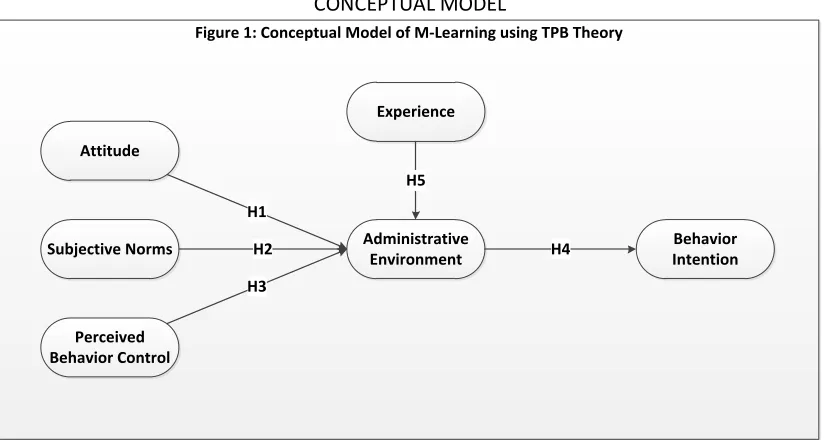
The researcher has expanded variables; Experience (Exp) and Administrative
Environment (ADE). Experience is the skills and ability of individual in use of the mobile
technology as a device whiles the Administrative Environment (ADE) is the in or out of an
institution or organization settings that allow the easy communication and information with the
MLearning technology [22]. Therefore, MLearning adoption intention regulated by the
theoretical constructs based on the positive influences to the mediation of (ADE) and the
moderating role of experience. Technology innovation most times affected by cultural beliefs,
which often optimized social significance of intentions.
Figure I
CONCEPTUAL MODEL
Figure 1: Conceptual Model of M-Learning using TPB Theory
Attitude
Subjective Norms Administrative Environment
Perceived Behavior Control
Behavior Intention Experience
H2
H3 H1
H5
B. The Hypothesis of the Concepts
H1= attitude towards behavior the use of the technology positively influences behavior intention in the institutional setting.
H2= subjective norms positively influence the institution's behavior intention.
H3= perceived control behavior positively influence the behavior intention.
H4= experience moderates on the administrative environment to enhance behavior intention in the use of technology.
H5= administrative environment influences the behavior intention to adopt the MLearning technology.
Generally, the study has outlined the review of related literature fused with the theory of the study after a brief introduction of the subject matter. The methodology of the study is following, then data results quantitatively analysis, using PLS-SEM finally discussions and conclusion.
III. The Methodology of the Study
The research study employed triangulated mix method to explore and investigate main
question “Can MLearning be a good administrative tool” using the randomized sampling of data
from participants of masters of foreign students of the University of Science and Technology of
China (USTC). The sample size of the study is 255 participants from the university in China.
These students were enrolled to study Technology Innovation on Public Policy, and other social
sciences, the author found them useful out of which 145 participated in answering the
questionnaire and the other 110 from a sister university thus, Anhui University of Technology
(ANUT), about 89% responded to the questionnaire online. The sampling size got male at 80
(31.4%) and female 175 (68.4%) all respondents using the medium of WeChat due to its
common nature in China. Most university administrators and students who actively used social
network stood at 95% and the rest used their laptops. All the participants had a different kind of
mobile smartphones ranging from iPhones, Samsung, Vivo, others.
The data instruments were made of 42 items across all variables, adapted from previous
studies. The measurements of behavior used the 5-score Likert scale ranging from, strongly
disagreed to strongly agreed (Disagree & Agree 2014). Some of the data were collected via
online (1/01/2018-1/29/2018), using a social network like; WeChat and WhatsApp and
network type) and the main variables measures of TPB and the expanded variable of the
administrative environment and experience.
A. Measurement Model
In the general analysis and assessment of the structural equation model, the Partial Least
Square SEM-PLS [24] to behavior intention to the endogenous constructs capability fitness. The
author took the validity and reliability; composite reliability (CR), convergent validity and
discriminant validity [25]. The CR varies between 0 and 1 whereas its consistent validity
between 0.7 and 0.9 can be assumed satisfactorily [24], the convergent validity and reliability
and an average variance extracted (AVE). The reliability of the loading in line with constructs,
higher than 0.70 indicating an affiliation with the corresponding constructs [25]. The value of
AVE should be ≥ .5 [26] means; a latent variable should be able to capture at least 50% of each
indicator's variance [24]. The Cronbach's α that measures the internal consistency reliability
should be ≤ .70 for each latent variable. The discriminant validity according to Fornell-Lacker's
criterion also confirm a latent variable that was distinctly different from other latent variables
[25].
B. Structural Models
In measuring the structural model, to determine the values of R-square (R²), effect size
(f²), path coefficients (t-value), Q² predictive relevance-called Blindfolding and collinearity [27].
According to Wu et al (2016) indicated that R²= 0.19-0.33, 0.33-0.67, and ≥0.67 mean low,
moderate and strong explanatory power [28]. Explain the effect size (f²): 0.02, 0.15, 0.35 for
weak, moderate, and strong effects (Hair et al., 2013) while Chin et al. (2010) emphasize
principles, Q² > 0 indicates that the path model's predictive accuracy is acceptable [27]. In
calculating the Q², the researcher intends to adopt the cross-validated redundancy approach in
this regard. The collinearity is assessed with the variance inflation factor (VIF) it's significant
because the [29] estimation of the path coefficients may be biased if the collinearity is present. A
value of VIF ≥5 implies a potential collinearity issue [25].
C. Data Analysis
The descriptive statistical analyses using IBM SPSS v.23.0 [30], for the demographic
information of behavior intention of MLearning into institutions. The reliability and validity of
principles to validate the Cronbach’s Alpha. The coefficient [31] of 0.70 or higher is principally
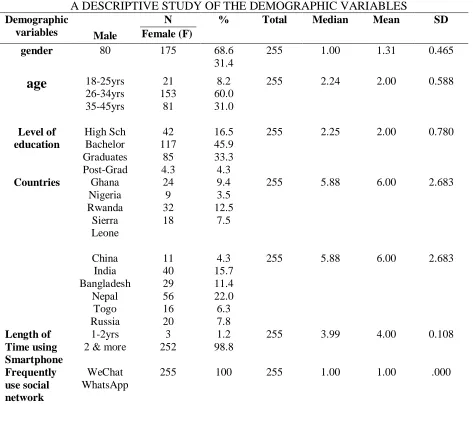
acceptable for the Cronbach’s Alpha [30], in some analysis relative to TPB, [32][33]. In Table 1
below, Mean, Mode, Median, Standard deviation were all employed by using SPSS in doing
comparative studies averages of sex, age, levels of education, social network type and the length
of time using mobile phones in relation to advance phones of recent technology (smartphones) of
the N (255) sample population in the entire study. The over-all Cronbach Alpha (α) stood at a
value 0.790.
Table I.
A DESCRIPTIVE STUDY OF THE DEMOGRAPHIC VARIABLES
Demographic
variables Male
N Female (F)
% Total Median Mean SD
gender 80 175 68.6 31.4
255 1.00 1.31 0.465
age
18-25yrs 26-34yrs 35-45yrs 21 153 81 8.2 60.0 31.0255 2.24 2.00 0.588
Level of education High Sch Bachelor Graduates Post-Grad 42 117 85 4.3 16.5 45.9 33.3 4.3
255 2.25 2.00 0.780
Countries Ghana Nigeria Rwanda Sierra Leone 24 9 32 18 9.4 3.5 12.5 7.5
255 5.88 6.00 2.683
China India Bangladesh Nepal Togo Russia 11 40 29 56 16 20 4.3 15.7 11.4 22.0 6.3 7.8
255 5.88 6.00 2.683
Length of Time using Smartphone
1-2yrs 2 & more
3 252
1.2 98.8
255 3.99 4.00 0.108
Frequently use social network
WeChat WhatsApp
The median age ranging from 26 - 34 years old (N=255, 60%), attained Higher education
level of graduates, there masters students came from different countries to study in China. From
table 1, the majority of the students are from the Asian continent (India, Nepal, and Bangladesh).
The most common social network used in China is WeChat that reflects the 100% of such
medium in the study.
In table 2 below, the various latent variables and observed variables are displayed to give
an in-depth understanding of how the measurements were done. In table 2, the highest rate
comes from “agreed” and “strongly agreed” 44.5 to 48.6 respectively for (BI). In addition, the
MLearning for administrative tool showed a positive attitude towards the behavior of which
“agreed” is 49.4% and “strongly agreed” is 33.5%. The perceived behavior control (PBC) showed “agreed” as 57.3% and 32.5 % for “strongly disagreed” likewise the subjective norms indicated, “Agreed” for 42.8% and “strongly disagreed” for 38.4% in all cases. The expanded variables also showed (ADE) for “agreed” for 56.8% and “strongly agreed” for 34.6%,
moderator experience was “agreed” for 58.2% and “strongly agreed” for 34.4%. this is consistent
with a previous study [34] Undeniably, most administrators have since recognized the
significance of using MLearning as an effective tool for dissemination of information and
discussions of official matters.
Table II.
MEASUREMENTS OF LATENT VARIABLES AND OBSERVED VARIABLES
Items Statements Response scheme
(1) (2) (3) (4) (5)
BI1 I use MLearning for information in the organization/institution.
BI2 I use MLearning to chat on office group. BI3 I will use MLearning in future roles. BI4 I like m-learning as a working tool. BI5 MLearning makes my work easier.
Attb1 MLearning good for administrative work. Attb2 MLearning motivates office turn up. Attb3 MLearning spread information easily. Attb4 MLearning smartest interactions at work. Attb5 Officers are addicted to social network
use.
Attitudes towards behaviors (Attb) (%) 7.4 5.1 4.6 49.4 33.5
PBC1 M-learning gives instant feedback. PBC2 MLearning is enjoyable.
PBC3 Am closer to the social network.
PBC4 Workers now use social media than notice.
Perceived Behavior Control (PBC) (%) 3.5 4.6 2.1 57.3 32.5
SN1 Workplace encourages social network chat
SN2 Workers pay more attention to group platform.
SN3 Environment is convenient for MLearning
SN4 MLearning is fun alongside learning.
Subjective Norms (SN) (%) 6.7 6.5 5.9 42.5 38.4
ADE1 Workers have group chats.
ADE2 MLearning compliments the organization computers.
ADE3 MLearning is part of our office technology.
ADE4 MLearning makes easy information flow. ADE5 MLearning regulated during working
hours.
Administrative Environment (ADE) (%) 2.3 3.2 1.9 58.2 34.4
EXP1 I play with a mobile phone every time. EXP2 MLearning opens social interactions at
work.
EXP3 Am skillful in social media now. EXP4 I have used MLearning before. EXP5 I will used MLearning for more.
Experience (EXP) (%) 4.0 4.1 1.1 56.2 34.6
Note: BI = behavior intention, Attb = attitude towards behavior, PBC= perceived behavior control, SN= subjective norms, ADE= administrative environment, EXP= experience, 1= strongly disagreed, 2 = disagreed, 3= undecided,
4=agreed, 5= strongly disagreed.
D. Analysis of PLS-SEM
i. Measurement Model
In the CR path analysis of the lowest value from 0.748 (Attb), and the highest is 0.938
(SN) which is statistically satisfactorily accepted Table 3 shows. The measurements of latent and
observed variable loadings indicated ranges between (Attb2) to the highest value of (Sn4) 0.927 respectively. On the same table 3, the lowest threshold value of AVE of the study in (Attb) is
0.415, is slightly in line with the threshold value of 0.5 by [26]. In the same vein, the Cronbach’s
Alpha (α) that measured the internal consistency reliability all exceeded 0.70 of the latent
variables [24], whereas the AVE ranges from 0.415 (Attb) to 0.790 (SN) that is a clear
manifestation of this model quality which is statistically satisfactorily valid and reliable [26].
ii. Structural Model
In Table 3 of the reliability and validity of the latent variables, administrative
environment (ADE) as a moderator (R²= 0.075) behavior intention (R²=0.016) have moderate
assessment explanatory power. [27]. In the same line, analysis of the values of the
cross-validated redundancy were all ˃ Q², 0.03 to 0.30, of the ADE, = 0.21, Attb = 0.13, BI = 0.4, PBC
= 0.13 which represented the adoptive accuracy of the latent variables in the study. The result
Table III.
RELIABILITY AND VALIDITY OF LATENT VARIABLES AND OBSERVED VARIABLES
LV
Fornell Larcker-Criterion
ADE Attb BI EXP PBC SN OV IL
α
CR AVE VIF R² Q²ADE 0.741 Ade1
Ade2 Ade3 Ade4 Ade5 0.803 0.843 0.872 0.840 0.824
0.835 0.886 0.549 1.000 0.075 .21
Attb 0.106 0.644 Attb1
Attb2 Attb3
0.862 0.663 0.761
0.878 0.748 0.415 1.022 .13
BI -0.125 0.131 0.772 Bi1
Bi2 Bi3 Bi4 0.735 0.861 0.884 0.734
0.839 0.879 0.595 0.016 .4
EXP 0.205 0.021 0.003 0.865 Exp1
Exp2 Exp3 Exp4 Exp5 0.877 0.837 0.877 0.847 0.883
0.916 0.937 0.748 1.031
.7
PBC 0.162 0.050 0.091 0.130 0.878 Pbc1
Pbc2 Pbc3 Pbc4 0.858 0.864 0.895 0.893
0.903 0.931 0.770 1.025
.12
SN 0.111 0.134 0.078 0.120 0.093 0.889 Sn1
Sn2 Sn3 Sn4 0.882 0.891 0.854 0.927
0.917 0.938 0.790 1.040
Note: L= loading of indicator, LV= latent variables, OV= observed variables, α= Cronbach’s alpha, CR= composite reliability, AVE= average variance extracted, VIF= various inflation factor, Fornell Larcker-Criterion for
Figure II
COMPOSITE RELIABILITY INDICATORS IN THE MODEL
Figure 2: Conceptual Model Loadings Indicators
Attitude
Subjective Norms
Administrative Environment
Perceived Behavior Control
Behavior Intention Experience
0.065 0.127
0.095 0.182
-0.125
0.858
0.864
0.895
0.893 0.862
0.663
0.761
0.882
0.891
0.854
0.927
0.877 0.837 0.877 0.847 0.883
0.803 0.843 0.872 0.800 0.824
0.735
0.861
0.884
0.734
Table IV
SIGNIFICANT TESTING RESULTS OF THE STRUCTURAL MODEL OF PATH COEFFICIENTS
Hypothesis M SD t-value Sig. (β) Total
Effects Inference
H1 Attb - > ADE 0.02 0.14 0.923** 0.36 0.095 0.095 Supported
H2 SN -> ADE 0.068 0.08 0.52 0.6 0.065 0.065 Unsupported
H3 PBC -> ADE 0.132 0.08 1.702** 0.09 0.127 0.127 Supported
H4 ADE - > BI -0.15 0.04 3.340* 0 -0.13 -0.125 Supported
H5 Exp - > BI 0.182 0.1 1.852** 0.07 0.182 -0.023 Supported
Table III.
PATH COEFFICIENT OF THE MODEL
Figure 3: Conceptual Model of Significance Loadings
Attitude
Subjective Norms
Administrative Environment
R2: 0.075
Perceived Behavior Control
Behavior Intention R2: 0.016 Experience
0.52
1.702** 0.923**
1.852**
3.340*
0.858
0.864
0.895
0.893 0.862
0.663
0.761
0.882
0.891
0.854
0.927
0.877 0.837 0.877 0.847 0.883
0.803 0.843 0.872 0.800 0.824
0.735
0.861
0.884
0.734
The analysis from this study reveals that four out of the five hypotheses were supported
by significant relationships at P= 0.001, in table 4 figure 3. The core variables of TPB of the
Attitude towards behavior (Attb) positively and significantly influences the behavior intention in
(H1) of the use of MLearning as an administrative tool in our institutions of academia. The path coefficient of (H4 ADE - > BI) indicated significant (β= 0.095, t= 0.923, SD= 0.139, p < is 0.356) with the total effects of 0.095 from the table 4. This analysis confirms the hypothesis H4 of this study. Subsequently, the other two constructs of TPB thus subjective norms and perceived
behavior control (H2 SN - > BI) is not significant (β= 0.065, t= 0.520, SD= 0.081, p < 0.601) with total effect of 0.065 is not supported by the study. (H3 PBC - > ADE) is significantly supported (β= 0.127, t = 1.702, SD = 0.076, p > = 0.089) with the total effect of 0.127. This
hypothesis supported this study. From this analysis, among the TPB core construct the only
attitude towards behavior and perceived behavior control significantly accepted to behavior
intention in the use of MLearning as an administrative tool in the research but subjective norm
rejected.
The other proposed constructs experience (EXP) and administrative environment (ADE)
0.182, t = 1.343, SD = 0.130, p > = none) with the total effect of 0.182, neither showed p= value
but good reflection of value analysis. These constructs supported the hypothesis of the study of
MLearning as an administrative tool for the effective flow of communication. Furthermore, the
moderating factor of experience significantly influenced administrative environment (β = 0.182, t
= 1.852, SD = 0.096, p > = 0.065), this indicates a very good behavior intention of the analysis in
the study.
The study currently found that in the state of using MLearning integrated as an
administrative tool for the effective achievement of information and communication set up. The
study again found the experience in use of the MLearning couple with technology ubiquity in the
digital age facilitates easy adoption of the technology innovation. The study confirms an
administrator who uses the MLearning technology to track work performance and transactional
activities at all times. The only obstacle is how regulation can be put in place to avoid using
technology during working hours. This study is in line with [35] considered the psychological
characteristics of individuals a good predictor of learning management systems (LMS), in that
category innovativeness and subjective norms influences strongly on MLearning adoption.
Further, H. Insook, 2016 found that, at any increases in the subjective norm, also increases the
odds of (LMS) by 6%. [35]. Again, resolve that, age (26-45) and employment status were
significant outcomes for mobile learning adoption in institutions, which is consistent with this
research.
In the study of [36], the subjective norms and attitude strongly predicted the behavior
intention in the TPB framework to express the intentions of YRPPs into the use UGSs by the
young residents of Phnom Penh. [37]. In the study ascertain if learners and educators were ready
for the adoption of MLearning technology. By taken into accounts learners and educators’
attitudes, age, gender, country, major and smartphone ownership, which is reliable to this study.
The educational technology of mobile learning adoption pattern designed according to the
administrative environment and experiences in the attitude of the beneficiaries. The findings
reveal about 81.5% leaners use their mobile devices for studies and 99% owned mobile device.
In another study evidenced from [18], to use or not to use significantly purported the digital
native's satisfaction in the use of social media for collaborative learning as MLearning
and connectivity for communication with ease. The study done on the faculty of hospitality and
tourism in Egypt, results showed faculty group discussions on social media enhances effective
academic discourses using the smartphones, where WhatsApp and LinkedIn were commonly
used however my study uses social media of WeChat.
In the work of [38] on the limits of perseverance of formal and non-formal use of
MLearning in schools. The author foresees MLearning as a tool to bridge the digital gap, and
open innovative didactic strategic designs that pathway for educational process and programs
outside the school environment to widen the learning horizon. In the utilization of TPB and TAM
for this study found the exciting significance of all constructs, the construct of facilitating
condition is in conformity with the variable administrative environment in significance level, as
well as previous experience and experience expanded in this study.
IV. Discussions
The Theory of Plan Behavior has been very significant to the study of technology
innovation of MLearning as an administrative largesse; this is because the proposal in
conformity with previous studies model fit well that will not affect the outcome of acceptance of
MLearning technology. The result indicated that behavior intention strongly influences the
administrative environment and experience in the model [21]. From the studies, the expansion of
TPB commensurate with models like; TRA, TAM, UTAUT, IDT or TAM3.
The findings of this research have strong evidence based on the physical interaction of
administrators, lecturers, and students from the University of Science and Technology of China
communicating via WeChat groups for both teaching and learning, institutional administrative
duties. Even though is very clear from the mobility and portability of MLearning technology, the
digital age with the digital naggers cannot separate or distance from social interaction through a
mobile device. Most often, those do not own such network is handicapped to learning or
administration. A research present and past facilitate the acceptance of MLearning as an
administrative largesse, due to the familiarity of the hand-held device ubiquity. However, more
investigation needed to look at how MLearning can be regulated during the official time in our
institutions of learning. The decision-making system in the institutions and organization is an
attitudes, technology skills pave way for adapting to policy in the environment of learning,
towards decision-making process in administration [11].
V. Conclusion
The developmental trends of institutional behaviors of technology are risen due to
convenience most administrators found in MLearning technology innovation. The attitudes of
model systems in technology, the liberal social environment of mobile technology effectively
enhanced office duties. Most people who interact without social network devices are
handicapped in many folds, denying them with WhatsApp, WeChat, IMO, Facebook, Instagram,
and others. The bridging of the digital divide is fast growing convenient in information and
communication technology of administration belongs to MLearning technology across all sectors.
Acknowledgements
This research is self-funded for academics purpose, am grateful to my supervisor for the support.
The authors have no conflicts of interest to declare.
References
[1] J. Sydow and G. Müller-Seitz, “Open innovation at the inter-organizational network level – Stretching practices to face technological discontinuities in the semiconductor industry,”
Technological Forecasting and Social Change, 2018.
[2] M. West and S. Vosloo, UNESCO Policy guidelines for mobile learning. 2013. [3] G. L. Camanho, “RBO on WhatsApp,” Rev. Bras. Ortop., vol. 51, no. 3, p. 245, 2016. [4] C. Montag et al., “Smartphone usage in the 21st century: Who is active on WhatsApp?,”
BMC Res. Notes, vol. 8, no. 1, 2015.
[5] S. M. Liu and Q. Yuan, “The Evolution of Information and Communication Technology in Public Administration,” Public Adm. Dev., vol. 35, no. 2, pp. 140–151, 2015.
[6] A. Iglesias, B. García, and M. C. S, “Collaborative learning and mobile devices : An educational experience in Primary Education,” Comput. Human Behav., vol. 72, pp. 664– 677, 2017.
[7] H. O. Awa, O. U. Ojiabo, and B. C. Emecheta, “Integrating TAM, TPB and TOE frameworks and expanding their characteristic constructs for e-commerce adoption by SMEs,” J. Sci. Technol. Policy Manag., vol. 6, no. 1, pp. 76–94, 2015.
[8] M. Al-Emran, H. M. Elsherif, and K. Shaalan, “Investigating attitudes towards the use of mobile learning in higher education,” Comput. Human Behav., vol. 56, pp. 93–102, 2016. [9] M. Messina, “Designing the New Digital Innovation Environment,” in CIOs and the
Digital Transformation, 2018, pp. 147–180.
[10] Z. Taleb, A. Ahmadi, and M. Musavi, “The Effect of M-learning on Mathematics Learning,” Procedia - Soc. Behav. Sci., vol. 171, pp. 83–89, 2015.
[11] M. L. Sein-Echaluce, Á. Fidalgo-Blanco, and G. Alves, “Technology behaviors in education innovation,” Comput. Human Behav., vol. 72, pp. 596–598, 2017.
[13] Y. Mehdipour and H. Zerehkafi, “Mobile Learning for Education: Benefits and Challenges,” Int. J. Comput. …, vol. 3, no. 6, p. 93–101 (251–259), 2013.
[14] R. W. Glynn, F. O’Duffy, T. P. O’Dwyer, M. P. Colreavy, and H. M. Rowley, “Patterns of Internet and smartphone use by parents of children attending a pediatric otolaryngology service,” Int. J. Pediatr. Otorhinolaryngol., vol. 77, no. 5, pp. 699–702, 2013.
[15] Y. Sung, K. Chang, and T. Liu, “The effects of integrating mobile devices with teaching and learning on students â€TM
learning performance : A meta-analysis and research synthesis,” Comput. Educ., vol. 94, pp. 252–275, 2016.
[16] L. B. and S. B. Baiyun Chen, Riyan Seilhamer, “EDUCAUSE REVIEW,” Educ. Rev. Cent. Anal. Res., 2015.
[17] B. Hao and Y. Feng, “How networks influence radical innovation: the effects of heterogeneity of network ties and crowding out,” J. Bus. Ind. Mark., vol. 31, no. 6, pp. 758–770, 2016.
[18] A. E. E. Sobaih, M. A. Moustafa, P. Ghandforoush, and M. Khan, “To use or not to use? Social media in higher education in developing countries,” Comput. Human Behav., vol. 58, pp. 296–305, 2016.
[19] I. Ajzen, R. Netemeyer, and M. Van Ryn, “The theory of planned behavior,” Organ. Behav. Hum. Decis. Process., vol. 50, no. 2, pp. 179–211, 1991.
[20] I. Ajzen, “Constructing a theory of planned behavior questionnaire,” Biofeedback and self-regulation, vol. 17, pp. 1–7, 2010.
[21] iSALT Team, “Theory of Planned Behavior,” iSALT Resour. Theor. Concepts, Meas. Pap. 1, vol. 6654, no. V, pp. 1–4, 2014.
[22] J. Osakwe, N. Dlodlo, and N. Jere, “Where learners’ and teachers’ perceptions on mobile learning meet: A case of Namibian secondary schools in the Khomas region,” Technol. Soc., vol. 49, pp. 16–30, 2017.
[23] S. Disagree and S. Agree, “Cronbach ’ s Alpha,” Real Stat. Using Excel, pp. 1–38, 2014. [24] J. F. Hair, M. Sarstedt, L. Hopkins, and V. G. Kuppelwieser, “Partial least squares
structural equation modeling (PLS-SEM): An emerging tool in business research,” Eur. Bus. Rev., vol. 26, no. 2, pp. 106–121, 2014.
[25] J. F. Hair, C. M. Ringle, and M. Sarstedt, “Partial Least Squares Structural Equation Modeling: Rigorous Applications, Better Results, and Higher Acceptance,” Long Range Plann., vol. 46, no. 1–2, pp. 1–12, 2013.
[26] C. Fornell and D. F. Larcker, “Evaluating Structural Equation Models with Unobservable Variables and Measurement Error,” vol. 18, no. 1, pp. 39–50, 2016.
[27] and B. J. M. Ringle, Christian M. Wende, S., “Smart PLS 3.0,” 2015. [28] M. C. M. Wende, S., Becker, J., “Benningsted: Smart-PLS,” 2015.
[29] J. F. Hair, M. Sarstedt, T. M. Pieper, and C. M. Ringle, “The Use of Partial Least Squares Structural Equation Modeling in Strategic Management Research: A Review of Past Practices and Recommendations for Future Applications,” Long Range Plann., vol. 45, no. 5–6, pp. 320–340, 2012.
[30] IBM, “SPSS Software,” Predict. Anal. Softw. Solut., p. 1, 2015.
[32] D. G. Bonett and T. A. Wright, “Cronbach’s alpha reliability: Interval estimation, hypothesis testing, and sample size planning,” J. Organ. Behav., vol. 36, no. 1, pp. 3–15, 2015.
[33] Q. Xie, W. Song, X. Peng, and M. Shabbir, “Predictors for e-government adoption: integrating TAM, TPB, trust and perceived risk,” Electron. Libr., vol. 35, no. 1, pp. 2–20, 2017.
[34] Y. Yen et al., “The predictors of the behavioral intention to the use of urban green spaces:
The perspectives of young residents in Phnom Penh, Cambodia,” Habitat Int., vol. 64, pp. 98–108, 2017.
[35] I. Han and W. Sug, “The use of a mobile learning management system and academic achievement of online students,” Comput. Educ., vol. 102, pp. 79–89, 2016.
[36] Y. Yen et al., “The predictors of the behavioral intention to the use of urban green spaces:
The perspectives of young residents in Phnom Penh, Cambodia,” Habitat Int., vol. 64, pp. 98–108, 2017.
[37] M. Al-Emran, H. M. Elsherif, and K. Shaalan, “Investigating attitudes towards the use of mobile learning in higher education,” Comput. Human Behav., vol. 56, pp. 93–102, 2016. [38] J. C. Sánchez-Prieto, S. Olmos-Migueláñez, and F. J. García-Peñalvo, “Informal tools in