Smart Irrigation
Atif Hussain
1, Bhuvan Shetty
2, Rohan S Anchan
3, S.C.Prabhu
4, Shobith Kumar
54 Associate Professor, Alva’s Institute of Engineering and Technology
1,2,3,5 Students, Department of Mechanical Engineering, Alva’s Institute of Engineering and Technology
Abstract— Irrigation is the method in which water is supplied to plants at regular intervals for agriculture. It is used to assist in the growing of agricultural crops, maintenance of landscapes, and revegetation of distributed soils in dry areas and during periods of inadequate rainfall. Additionally, irrigation also has a few other uses in crop production, which include protecting plants against frost, suppressing weed growth in grain fields and preventing soil consolidation. In contrast, agriculture that relies only on direct rainfall is referred to as rain-fed or dry land farming. There is an urgent need for a system that makes the agricultural process easier and burden free from the farmer’s side. With the recent advancement of technology it has become necessary to increase the annual crop production output entirely agro-centric economy. To save farmer’s effort, water and time, Irrigation management is used. It is a complex decision making process to determine when and how much water to apply to a growing crop to meet specific management objectives. If the farmer is far from the agricultural land he will not be noticed of the current conditions. So, efficient water management plays an important role in the irrigated agricultural cropping systems. By developing a Smart Wireless Sensor and Arduino-controller, we have developed an app and solar mechanical system for switching on/off of a pump. By using upcoming techniques a farmer can increase his profit by solving different problems faced by the farmer in his routine life. The primary applications for this project are for farmers and gardeners who do not have enough time to water their crops/plants. It also covers those farmers who are wasteful of water during irrigation.
Keywords- Agro-centric economy, Arduino-controller, Irrigation.
I. INTRODUCTION
Agriculture is considered as the basis of life for the human species as it is the main source of food grains and other raw materials. It also provides large ample employment opportunities to the people. Growth in agricultural sector is necessary for the development of economic condition of the country. Unfortunately, many farmers still use the traditional methods of farming which results in low yielding of crops and fruits. But wherever automation had been implemented and human beings had been replaced by automatic machineries, the yield has been improved. Hence there is need to implement modern science and technology in the agriculture sector for increasing the yield. By using the concept of modern irrigation system a farmer can save water. This concept depends on two irrigation methods those are: conventional irrigation methods like overhead sprinklers, flood type feeding systems i.e., wet the lower leaves and stem of the plants. The area between the crop rows become dry as the large amount of water is consumed by the flood type methods, in which case the farmer depends only on the incidental rainfalls. The crops are been
infected by the leaf mold fungi as the soil surface often stays wet and is saturated after irrigation is completed. Overcoming these drawbacks new techniques are been adopted in the irrigation techniques, through which small amounts of water applies to the parts of root zone of a plant. The plant soil moisture stress is prevented by providing required amount of water resources frequently or often daily by which the moisture condition of the soil will retain well. Even more precise amount of water can be supplied for plants. As far as the foliage is dry the plant damage due to disease and insects will be reduced, which further reduces the operating cost. As the world is trending towards new technologies and implementations it is a necessary goal to trend up in agriculture too. Many researches are done in the field of agriculture and most of them signify the use of wireless sensor network that collect data from different sensors deployed at various nodes and it send it through the wireless protocol. The collected data provide the information about the various environmental factors. Monitoring the environmental factors is not the complete solution to increase the yield of crops. There are number of other factors that decrease the productivity. Hence, automation must be implemented in the research level, it is not given to the farmers as a product to get benefitted from the resources. Hence, this system deals about developing smart agriculture using arduino and given to the farmers.
II. LITERATURE SURVEY
Nikhil Agrawal, Smita Singhal, “Smart Drip Irrigation
System using raspberry pi and arduino”, the commands from the user are processed at raspberry pi using python programming language. Arduino microcontrollers are used to receive the on/off commands from the raspberry pi using ZigBee protocol. Star ZigBee topology serves as a backbone for the communication between raspberry pi and end devices. Raspberry pi acts a central coordinator and end devices ast as various routers.
V.R. Balaji and M. Sudha (2016) proposed a paper in which the system derives power from sunlight through photo-voltaic cells. This system doesn’t depend on electricity. The soil moisture sensor has been used and based on the values PIC microcontrollers is used to ON/OFF the motor pump. Weather forecasting is not included in this system.
parameters. This system provides a web interface to the user to monitor and control the system remotely. Weather monitoring is not done in this system.
Archana and Priya (2016) proposed a paper in which the humidity and soil moisture sensors are placed in the root zone of the plant. Based on the sensed values the microcontroller is used to control the supply of water to the field. This system doesn’t intimate the farmer about the field status.
Karan Kansara (2015) proposed an automated irrigation system where the humidity and temperature sensors are used to sense the soil conditions and based on that microcontrollers will control the water flow. Farmers will be intimated through GSM. This system doesn’t monitor the nutrient content in the soil.
Sonali D Gainwar and Dinesh V. Rojatkar (2015) proposed a paper in which soil parameters such as pH, humidity, moisture and temperature are measured for getting high yield from soil. This system is fully automated which turns the motor pump ON/OFF as per the level of moisture in the soil. The current field status is not intimated to the farmer.
III. PROPOSEDSYSTEM
IOT based approach for planting irrigation provides a non-human intervention irrigation system. Soil moisture measurement gives the information about moisture content in the soil. Depending on the value it sends information about whether the plants needs water or it does not need. User interface for remote control provides the irrigation details about various plants. It will be helpful for the farmers who are new to the agriculture or particular crop. The user according to the information which he received in the application can decide whether to TURN ON the motor or not.
The proposed irrigation system makes the efficient use of water. Water is fed to the plant whenever there is need. There already exist irrigation systems which water plants on the basis of soil moisture and temperature. Wherever these parameters are required in big agricultural fields their productivity of the crop matters.
watering plants at regular interval matters and also the user gets the status time to time.
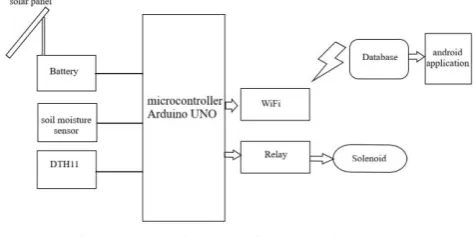
The block diagram of the proposed system as shown consists of different types of sensing unit such as soil moisture sensor to measure water content of the soil, temperature sensor detects the temperature, humanity sensor to measure the presence of water in the air.
The proposed model consists of the following important parts: Soil moisture sensor, DTH11 Sensor, YW Robot Bread Board power supply, 1 Channel Relay Board, ESP8266 AI Cloud Inside, Plunger type Solenoid Valve 12V, Arduino Microcontroller, Solar panel, battery.
A. Soil Moisture Sensor
Soil moisture sensor is used to sense the moisture content in the soil. The required value of moisture is pre-feed to the microcontroller. Soil moisture sensor works on the principle of resistance. When the soil is dry it gives high resistance for the connection of two electrodes, and when the moisture content in the soil increases the resistance given by the soil is less as water being good conductor of electricity conducts between the two electrodes. When the moisture level in the soil is below than the set value the pump gets on, and when the moisture content reached the required for different type of crops varies from crop to crop.
Fig. 2 Soil moisture sensor
B. DTH11 Sensor
Fig. 3 DTH11 sensor
C. YW Robot Bread Board Power Supply
This is an inexpensive and convinient option to convert a 7-12V wall bug into 5V and 3.3V to power a breadbaord setup. Being inexpensive, it does have some limitations. The module has 4 sets of power pins on the bottom. If after installing the module the pins are inserted, the module will be more secure but will block some of the breadboarding area. The module can be used with only 2 set of oins installed to avoid this, but the module will not be as stable.
Fig. 4 YW Robot bread board
D. 1 Channel Relay Board
Solid state relay provides fast operation with low maintenance. This relay consists of a coil of wire with a ferrous metal in the center that a small hinged and soring loaded piece of ferrous metal floats slightly above one end of the metalin the center of the coil. When energized the metal in the center of the coil becomes magnetic and draws the floating metal towards it. This inturn causes multiple contacts to make and break.
Fig. 5 1 Channel Relay board
E. ESP8266 Wi-Fi Module
ESP8266 is a chip which is a highly integrated Wi-Fi SoC solution where in the Internet of Things industry, the users oversomes the efficient power usage efficiently, designs and performance also provides networkable foundation for facilitating end-point IOT developments. The ESP8266 Wi-Fi Module is a self contained SOC with integrated TCP/IP protocol stack that can give any microcontroller access to you wi-Fi network. The ESP8266 is capable of either hosting an application offloading all Wi-Fi networking functions from another application processor. Each ESP8266 module comes pre-programmed with an AT command set firmware. The ESP8266 module is an extremely cost effective board with a huge, and ever growing community.
Fig. 6 ESP8266 Wi-Fi Module
F. Plunger type Solemoid Valve 12V
Fig. 7 Plunger type Solenoid Valve 12V
G. Arduino Microcontroller
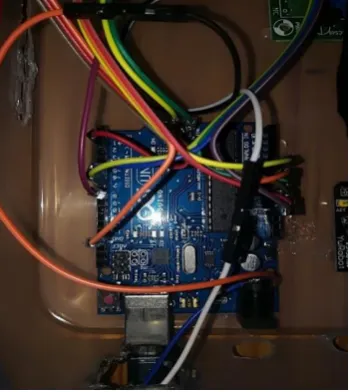
It is open source physical computing platform based on simple input/output board and a development environment that implements the processing language. Arduino can be used to develop standalone interactive objects or can be connected to software on the computer. The boards can be assembled by hand or purchased preassembled; the open source IDE (Integrated Development Environment) is used for coding. The Arduino programming language is working done on wires, a similar physical computing platform, which is based on the procesing multimedia programming environment. The same arduino Uno ATmega328 microcontroller is used in the proposed system. The hardware consists of a simple open hardware design for the arduino board with an on-board input/output support. The software consists of a standard propgramming language compiler and the boot loader that runs on the Arduino board. It has 14 digital input/output pins (of which 6 can be used as PWM outputs), 6 analog inputs, a 16 MHz crystal oscillator, a USB connection, a power jack, an ICSP header and a reset button.
H. Solar Panel
Solar panel refers to a panel designed to absorb the sun’s rays as a source of energy for generating electricity or heating. A photovoltaic module is a packaged, connected assembly of typically 6x10 solar cells. Solar photovoltaic panels constitute the solar array of a photovoltaic system that generates and supplies solar electricity in commercial and residental applications. Each module is rated by its DC output power under standard test conditions, and typically ranges from 100 to 365 Watts. Most of the automated systems use electricity but in this system solar energy which is a non-conventional source of energy is used to power the system. The maintenance cost of this system is less compared to other systems.
IV. RESULTS AND DISCUSSION
By this project, we successfully developed a system that can help farmer in saving water and maintaining moisture content of the soil moderately.
According to the research done, for one acre of arecanut farming field which has 450 trees in it. The standard humidity maintained in arecanut farm is 70%. The farm used to get 4 hours per day of water during summer season. By using smart irrigation system, the moisture content of the soil took one and half hour to reach 70%, at that instant of time the Pump was switched off. after 3 hours the moisture was reduced to 30% or less and the pump was restarted, and was able to save 25% of water each day.
V. CONCLUSION
In this paper, the agricultural field is being monitored and controlled by the android app at the user end. By this work, the wastage of water and the consumption of power by motor can be reduced so that they are conserved for future use. Using this system, one can save manpower, water to improve production and ultimately increase profit. The automated irrigation system is feasible and cost effective for optimizing water resources for agricultural production.This system provides complete monitoring action of sensors in fields and control all the the activities of the irrigation system efficiently. This smart irrigation proves to be the system which is automated for irrigation system and regulates water without any manual support. All the information is been sent to database using a Wi-Fi module.
Board”, International journal of Advanced Research in Computer Science, ISSN No. 0976-5697, volume 8, no. 5, May-June 2017.
[2] Pavankumar Naik, Arun Kumbi, Vishwanath Hiregoudar, Chaitra N K, Pavitra H K, Sushma B S, Sushmita J H, Praveen Kuntanahal, “Arduino Based Automatic Irrigation System using IoT”, International Journal of Scientific Research in Computer Science, Engineering and Information Technology, Volume 2, Issue 3, May-June 2017, ISSN: 2456-3307.
[3] Nikhil Agrawal, Smita Singhal, “Smart drip irrigation system using Raspberry Pi and Arduino”, International Conference on Computing, Communication and automation, ISSN: 928-932, 2015.
[4] A. R. Al-Ali, Murad Qasaimeh, Mamoun Al-Mardinia, Suresh Radder and I. A. Zualkernan, “Zigbee-Based Irrigation System for Home Gardens”, Department of Computer Science and Engineering, American University of SHarjah, UAE, 978-1-4799-6532-8/15/$31.00 ©2015 IEEE.
[5] Pravin B Chikankar, Deepak Mehetre, Soumitra Das, “An Automatic Irrigation System using Zigbee in Wireless Sensor Network”, 2015 International Conference on pervasive Computing (ICPC).
[6] Mohammed Imran, Chaitanya Bharathi, “Arduino Based Smart Irrigation System”, IJSRDV-5141144, Volume 5, Issue 4, 2017.