A Study on Underwater Image Processing for
Classification of Species Using Contour
Pooja Prasenan1, Dr. Suriyakala C D2, Dr. C B Saji3
Asst.Professor, SOE&UT, Kerala University of Fisheries & Ocean Studies, Kerala, India.1.
Director, SOE&UT, Kerala University of Fisheries & Ocean Studies, Kerala, India.2
Principal, Sree Narayana Gurukulam College of Engineering,Kochi, Kerala, India. 3
ABSTRACT: Studies on marine ecosystems are important for analysing the health of coastal environments. Many
works are in progress to maintain the marine ecosystem and to find higher concentration of marine species. In this paper classification of species is done based on size and contour, and the species are classified as big or small according to their size. This paper uses underwater image processing in which studies on five different species of fish is carried out using contour.
KEYWORDS: Underwater image processing, contour, marine ecosystems etc.
.
I.INTRODUCTION
To study and analyse the target species present in underwater images is a challenging field since it is difficult to detect and segment objects in underwater environment because light cannot penetrate deeper in water. In recent years there has been a rapid increase in underwater object detection and its classification. This work is motivated by the importance of underwater object detection and its classification to study marine species, underwater marine structures, underwater surveillance systems etc. Several underwater object detection and classification systems have been designed successfully. All these methods have their own advantages and disadvantages, and none of them works equally well for all kinds of images. Many object classification methods are available and cannot be completely relied on for precise object classification.
Different features for partitioning the image on the basics of size, colour, shape, brightness and texture can be used. In this paper we are using size based classification method.
II.PREVIOUS & PRESENT WORKS
Traditionally, fish recognition is processed using ordinary fish features such as weight, length and width. The fishes were either dead fishes, in conveyors or kept in constraint environments such as ponds, tanks etc. Marine biologists also dive to observe underwater environment, using photography as introduced by [Caley et al., 1996.Traditionally, marine biologists identify fish from their ichthyological characteristics such as meristics and morphometrics, scale morphology, parasites, cytogenetics etc([Begg and Waldman, 1999]).
ISSN (Print) : 2320 – 3765 ISSN (Online): 2278 – 8875
I
nternational
J
ournal of
A
dvanced
R
esearch in
E
lectrical,
E
lectronics and
I
nstrumentation
E
ngineering
(An UGC Approved Journal)
Website: www.ijareeie.com
Vol. 6, Issue 8, August 2017
Fig [2] Fish in Tank
Fig[3] Fish Conveyor
Fig[4] Fish in different backgrounds
III. PROPOSED METHOD
The algorithm is to test whether the fish image is of a small fish or of a big fish. The algorithm was applied to a system of 5 different fish types: Bodianus mesothorax, Chromis viridis, Dascyllus albisella, Dascyllus aruanus, Dascyllus reticulatus. For each fish we used 10 images. Therefore a dataset of 50 images were used for training purpose and 20 images are used for testing purpose. After testing different images taken randomly an accuracy of 100% is obtained.
IV.SIZE BASED CLASSIFICATION
For classification based on size initially in the acquired image is converted to grayscale after which edge detection is performed then morphological processing was done in which dilation of the gray image is done after which filling of holes is performed and thus a contour of the acquired image was obtained . Next step was finding the compliment which is an optional step, after dilation the holes were filled to complete the contour. Thus a completed contour is obtained. Now the number of pixels were counted and area of the obtained contour was calculated if the count was found to be above the threshold value in our case taken as 24000 it is assumed that fish is big and if it is less than 24000 the fish is classified as small.
ISSN (Print) : 2320 – 3765 ISSN (Online): 2278 – 8875
I
nternational
J
ournal of
A
dvanced
R
esearch in
E
lectrical,
E
lectronics and
I
nstrumentation
E
ngineering
(An UGC Approved Journal)
Website: www.ijareeie.com
Vol. 6, Issue 8, August 2017
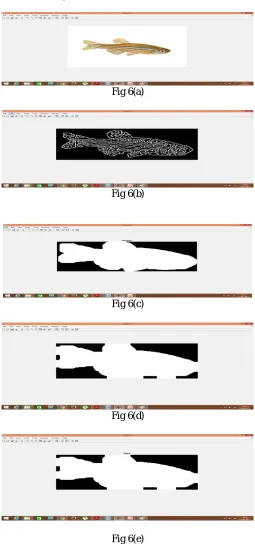
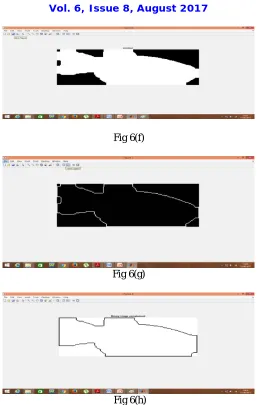
Different steps involved in size based classification of fish species and the corresponding output figure obtained for each step by using the algorithm developed is shown in the figures below:
Fig 6(a)
Fig 6(b)
Fig 6(c)
Fig 6(d)
Fig 6(f)
Fig 6(g)
Fig 6(h)
Fig.6(a) Original image; 6(b)Grayscale image; 6(c) Dilated image; 6(d)Morphologically processed image; 6(e)Filled image;6(f) Contour of image; 6(g)Extracted boundary; 6(h)Binary compliment to count area.
V.CONCLUSION
Most of the research based on species classification in marine ecosystem is done in very few and limited foreign countries. Hence usage of size based classification technique, resulting in the possibility to classify different underwater species will be beneficial for fisherman and researchers. Out of 20 test images taken we have obtained an accuracy of 100%. In future we are going to classify the species based on its texture features.
REFERENCES
[1] Zhuofu Liu and Enfang Sang Zhenpeng Liao, “Underwater Acoustic Image Segmentation Using Neural Deformable Template”, Proceedings of the IEEE International Conference on Mechatronics & Automation Niagara Falls, Canada July 2005.
[2] Yun-Heh Chen-Burger, Robert B. Fisher, Gayathri Nadarajan “Automatic Fish Classification for Underwater Species Behavior Understanding”
, ARTEMIS’10 October 29, 2010.
ISSN (Print) : 2320 – 3765 ISSN (Online): 2278 – 8875
I
nternational
J
ournal of
A
dvanced
R
esearch in
E
lectrical,
E
lectronics and
I
nstrumentation
E
ngineering
(An UGC Approved Journal)
Website: www.ijareeie.com
Vol. 6, Issue 8, August 2017
[5] Sepehr Jalali, Paul J. Seekings, Cheston Tan, Hazel Z. W. Tan, Joo-Hwee Lim and Elizabeth A. Taylor ,”Classification of Marine Organisms in Underwater Images using CQ-HMAX Biologically Inspired Color Approach”,IEEE 2013.
[6] Umar Manzoor, Mohammed A. Balubaid, Bassam Zafar, Hafsa Umar and M. Shoaib Khan,”Semantic Image Retrieval: An Ontology Based Approach”,(IJARAI) International Journal of Advanced Research in Artificial Intelligence, Vol. 4, No.4, 2015.
[7] Zeinab Abdollapour,Zahara Reaina ,M E Maghadam,”Image Classification Using Ontology Based Improved Visual Words”, 23rd ICEE 2015. [8] Jesús M. Almendrosjiménez, Luis Domene, And José A. Piedra-fernández,”A Framework For Ocean Satellite Image Classification Based On
Ontologies”, IEEE Journal Of Selected Topics In Applied Earth Observations And Remote Sensing, Vol. 6, No. 2, April 2013
[9] Jered Cartmill, Mahmood R. Azimi-Sadjadi, and Neil Wachowski,” Buried Underwater Object Classification Using a Collaborative Multi-Aspect Classifier” Proceedings of International Joint Conference on Neural Networks, Orlando, Florida, USA, August 12-17, 2007.
[10] Zeinab Abdollahpour, ZahranRiahi Samani and Mohsen Ebrahami Moghaddam”,Image Classification Using Ontology Based Improved Visual Words” 2015 23rd Iranian Conference on Elecritcal Engineering (ICEE).
[11] Lili Wang,Yong Xue And Jie Guang, “Customization Of Remote Sensing Workflow Service Based On Ontology”, IEEE 2016.
[12] Jesús M. Almendros-Jiménez, Luis Domene, and José A. Piedra-Fernández, “A Framework for Ocean Satellite Image Classification Based on Ontologies”, IEEE Journal Of Selected Topics In Applied Earth Observations And Remote Sensing, Vol. 6, NO. 2, APRIL 2013.
[13] Thomas Kuhn, Carsten R¨uhlemann, Michael Wiedicke-Hombach, Timm Schoening, and Tim Nattkemper. Application of hydro-acoustic and videodata for the exploration of manganese nodule fields. In ISOPEOMS,2013.
[14] Caley, M. J., Carr, M. H., Hixon, M. A., Hughes, T. P., Jones,G. P., and Menge, B. A. (1996). Recruitment and the local dynamics of open marinepopulations. Annual Review of Ecology and Systematics, 27:477–500.
[15] Begg, G. A. and Waldman, J. R. (1999). An holistic approachto fish stock identification. Fisheries research, 43(1):35–44.
![Fig [1] Dead Fish](https://thumb-us.123doks.com/thumbv2/123dok_us/7767163.1277425/1.595.165.433.659.754/fig-dead-fish.webp)
![Fig [2] Fish in Tank](https://thumb-us.123doks.com/thumbv2/123dok_us/7767163.1277425/2.595.174.429.580.698/fig-fish-in-tank.webp)
![Fig[4] Fish in different backgrounds](https://thumb-us.123doks.com/thumbv2/123dok_us/7767163.1277425/3.595.146.459.560.742/fig-fish-in-different-backgrounds.webp)