Robust biometric-based user authentication
scheme for wireless sensor networks
Debiao He*
School of Mathematics and Statistics, Wuhan University, Wuhan, China
Email: [email protected]
Abstract: Wireless sensor networks (WSNs) are applied widely a variety of areas such as
real-time traffic monitoring, measurement of seismic activity, wildlife monitoring and so on. User
authentication in WSNs is a critical security issue due to their unattended and hostile deployment
in the field. In 2010, Yuan et al. proposed the first biometric-based user authentication scheme for
WSNs. However, Yoon et al. pointed out that Yuan et al.’s scheme is vulnerable to the insider
attack, user impersonation attack, GW-node impersonation attack and sensor node impersonate
attack. To improve security, Yoon et al.’s proposed an improved scheme and claimed their scheme
could withstand various attacks. Unfortunately, we will show Yoon et al.’s scheme is vulnerable to
the denial-of-service attack (DoS) and the sensor node impersonation attack. To overcome the
weaknesses in Yoon et al.’s scheme, we propose a new biometric-based user authentication
scheme for WSNs. The analysis shows our scheme is more suitable for practical applications.
Key words: Security; Authentication; Biometrics; Wireless sensor networks;
Cryptography
1. Introduction
Wireless sensor networks (WSNs) are innovative ad-hoc wireless networks consisting of a large number of sensor nodes with limited power, computation, storage and communication capabilities [1]. With the development of sensor technology, microelectronic technology, network technology and wireless communication technology, WSNs are widely used in military, environmental monitoring, medical, building condition monitoring and so on. In order to guarantee secure communication, authentication schemes for WSNs have successfully drawn researchers’ attention and been studied widely.
efficient since only one-way hash functions and simple XOR operations are required in it. Unfortunately, Wong et al.’s scheme is vulnerable to many attacks such as replay attacks, forgery attacks, stolen-verifier attacks and password guessing attacks [5, 6, 7, 8]. Vaidya et al. [8] also pointed out that Tseng et al.’s scheme [5], Lee et al.’s and Ko et al.’s scheme [7] are vulnerable to replay of account-login attacks, man-in-the-middle attacks, forgery attacks and stolen-verifier attack, and node capture attacks. Vaidya et al. also proposed two improved schemes to improve the security.
In traditional authentication schemes for WSNs [4-8], the security of the authentication schemes is based on passwords. However, simple passwords are easy to break by simple dictionary attacks since they have low entropy. To solve the problem, cryptographic keys (e.g. 128bits for the advanced encryption standard, AES; [9]) are used. However, cryptographic keys are difficult to memorize since they are very long and random. Furthermore, both passwords and cryptographic keys are unable to provide non-repudiation because they can be forgotten, lost or when they are shared with other people, there is no-way to know who actual user is [10]. Therefore, biometric keys are proposed which are based on physiological and behavioral characteristics of persons such as fingerprints, faces, irises, hand geometry, and palm prints, etc. Some advantages of biometric keys are described as follows [11]:
z Biometric keys cannot be lost or forgotten.
z Biometric keys are very difficult to copy or share.
z Biometric keys are extremely hard to forge or distribute
z Biometric keys cannot be guessed easily.
z Someone’s biometrics is not easy to break than others.
As a result, biometric-based user authentications are inherently more reliable and secure than usual traditional user authentication schemes.
al.’s scheme is vulnerable to the denial-of-service attack (DoS) and the sensor node impersonation attack. We also propose an improved scheme to overcome the weaknesses in Yoon et al.’s scheme.
The rest of this paper is organized as follows. Section 2 reviews the concept of Yoon et al.’s scheme, and section 3 discusses its weakness analysis. Section 4 shows the details of our proposed scheme, while section 5 demonstrates the security analysis of our proposed scheme. Section 6 compares the performances of the related schemes. Finally, section 7 concludes this paper.
2. Review of Yoon et al.’s Scheme
In this section, we will review Yoon et al.’s scheme. For convenience, the notations used throughout this paper are summarized as follows:
z Ui: the ith user;
z IDi , PWi , Bi : Ui ’s identity, password and biometric template, respectively;
z GW−node: the gateway node of WSNs;
z Sj: the jth sensor node;
z SIDj: Sj’s identity;
z d( )⋅ : symmetric parametric function;
z τ : predetermined threshold for biometric verification;
z Ek( )⋅ : a symmetric encryption function with key k;
z Dk( )⋅ : the decryption function corresponding to Ek( )⋅ ;
z h( )⋅ : secure one-way hash function;
z ⊕:bit-wise exclusive-or(XOR) operation;
z ||: concatenation operation;
Yoon et al.’s scheme includes three phases: registration phase, login phase, and authentication phase. They are described as follows.
2.1. Registration phase
1). Ui inputs his biometrics Bi on the specific device, computes ( || )
i i i
E =h ID B , and sends IDi and Ei to the GW−node in a secure manner. 2). On receiving IDi and Ei , the GW−node computes
( || )
i i i
R =h ID x ⊕E and Wi =h ID( i || )y ⊕Ei , where secret information x is known to only GW −node and y is a secret parameter generated by
GW−node and stored in some designated sensor nodes before the nodes in the field are deployed.
3). GW −node generates a smart card with parameters IDi, Ei, Ri, Wi, ( )
h ⋅ , ( )d ⋅ and τ , where ( )d ⋅ is a symmetric parametric function and τ is a predetermined threshold [14] for biometric verification.
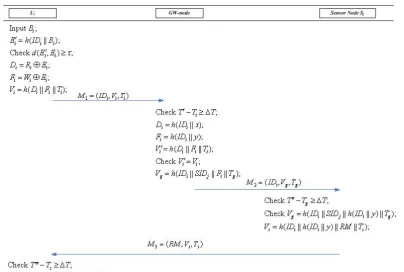
Fig. 1. Registration phase of Yoon et al.’s scheme 2.2. Login phase
When Ui enters Bi in order to deliver some query to or access data from the network, as shown Fig. 2, the smart card must perform the following steps to validate the legitimacy of Ui.
1). Ui inserts his smart card into the card reader and inputs Bi on the specific device.
2). The smart card computes Ei′ =h ID( i||Bi) and read Ei from the smart card. If d E E( i′, i)≥τ , then the smart card stops the session. Otherwise, the smart card computes Di =Ri⊕Ei, Fi =Wi⊕Ei and Vi =h D( i ||F Ti|| )i , where Ti is the current timestamp.
3) Ui sends the login message M1=(ID V Ti, , )i i to GW−node. 2.3. Authentication phase
1). GW −node checks the freshness of Ti by verifies whether the equation
i
T′ − ≥ ΔT T holds. If the equation holds, GW −node stops the session, where
T
Δ is the expected time interval for the transmission delay.
2). GW−node computes Di =h ID( i|| )x , (Fi =h IDi|| )y and ( || || )
i i i i
V′=h D F T . Then GW−node checks whether Vi′ and Vi are equal. If they are not equal, GW−node stops the session. Otherwise, GW−node
computes Vg =h ID( i||SIDj||F Ti|| g) and sends the message M2 =(ID V Ti, g, g) to Sj, where Tg is the current timestamp.
3). Upon receiving the message M2, Sj checks the freshness of Tg by verifies whether the equation T′′ − ≥ ΔTg T holds, where T′′ is the time Sj receives M2. If the equation holds, Sj stops the session, where ΔT is the expected time interval for the transmission delay.
4). Sj checks whether Vg and (h IDi ||SIDj|| (h IDi|| ) ||y Tg) are equal. If they are not equal, Sj stops the session key. Otherwise, Sj computes
( || ( || ) || || )
s i i s
V =h ID h ID y RM T and sends M3 =(RM V T, s, s) to Ui, where Ts is the current timestamp and RM is Sj’s respond.
5). Upon receiving the message M3, Ui checks the freshness of Ts by verifies whether the equation T′′′ − ≥ ΔTs T holds, where T′′′ is the time Ui receives M3. If the equation holds, Ui stops the session, where ΔT is the expected time interval for the transmission delay.
Fig. 2. Login and authentication phase of Yoon et al.’s scheme
3. Cryptanalysis of Yoon et al’s scheme
3.1. Denial-of-service attack
One of the fundamental properties of a secure one-way hash function is that the outputs are very sensitive to small perturbations in their inputs. The cryptographic hash function cannot be applied straightforwardly when the input data are with noisy such as biometrics [15]. Then the predetermined threshold for biometric verification cannot be used to measure outputs of hash functions.
In registration phase of Yoon et al.’s scheme, the user Ui computes ( || )
i i i
E =h ID B based on his identity IDi and personal biometric template Bi. The hash value Ei is stored in the smart card for purpose of authentication. However, the authentication procedure may result in serious flaws because
( i, i)
d E E′ <τ may never succeed, since the inputted biometrics belonging to the same person may differ slightly from time to time. Thus, the condition
( i, i)
3.2. Sensor node impersonation attack
Generally speaking, sensor nodes are often deployed in a hostile environment [16]. Then some sensor nodes may be captured by the adversary A . Once A capture a sensor node Sj+1, he could extract the secret key y through the differential power attack [17, 18]. Then he could impersonate any other legal sensor node Sj as follows.
1) A intercepts the message M2 =(ID V Ti, g, g) sent to Sj by
GW−node.
2) A forges a respond RM , computes Vs =h ID( i || (h IDi || ) ||y RM T|| s) and sends M3 =(RM V T, s, s) to Ui, where Ts is the current timestamp.
It is to say Vs could pass the verification of Ui. Then Ui believes that the received message is sent by Sj. Therefore, Yoon et al.’s scheme is vulnerable to the node impersonation attack.
4. Proposed scheme
To solve the weakness of Yoon et al.’s scheme, we propose a new biometric-based user authentication scheme for WSNs. In order to execute the proposed framework, we considered that the gateway is a trusted node and it hold two master keys (x and y), which are sufficiently large for the sensor network. Before starting the system, it is assumed that a long-term secret key (h SIDj|| )y generated by gateway is stored in sensor node Sj before the node is deployed, where SIDj is the identity of Sj.
4.1. Registration phase
When a user Ui wants to register and become a new legal user, as shown in Fig. 3, the following steps are performed during the user registration phase.
1). Ui generates a random number bi, freely chooses his identity IDi, password PWi, and also imprints his personal biometric impression Bi at the sensor. Ui then interactively submits {ID B h PWi, i, ( i||Bi || )}bi to GW−node
2) GW−node computes Ri =h ID( i|| )x ⊕h PW( i||Bi|| )bi , where x is a secret key maintained by GW −node. Then, GW−node writes the secure information { ,R B hi i, ( ), ( ), }⋅ d ⋅ τ to the memory of Ui’s smart card and issues it to Ui through a secure channel.
3) Upon receiving the smart card, Ui inputs the random number bi and finish the registration.
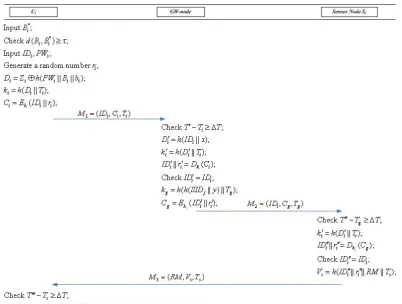
Fig. 3. Registration phase of our scheme 4.2. Login phase
When Ui enters Bi in order to deliver some query to or access data from the network, as shown Fig. 4, the smart card must perform the following steps to validate the legitimacy of Ui.
1). Ui inserts his smart card into the card reader and inputs Bi* on the specific device.
2) If d B B( ,i i*)≥τ , Ui’s smart card rejects the request. Otherwise, Ui enters his password PWi and his identity IDi, and then the smart card generates a random number ri and computes Di =Zi⊕h PW( i||Bi|| )bi , (ki =h Di||Ti),
( || ) i
i k i i
C =E ID r , where Ti is the current timestamp.
3) Ui sends the login message M1=(ID C Ti, i, )i to GW−node. 2.3. Authentication phase
1). GW −node checks the freshness of Ti by verifies whether the equation
i
T′ − ≥ ΔT T holds. If the equation holds, GW −node stops the session, where
T
Δ is the expected time interval for the transmission delay.
2). GW −node computes Di′ =h ID( i|| )x , (ki′=h Di′||Ti) and
|| ( )
i i i k i
ID′ ′=r D C′ . Then GW−node checks whether IDi′ and IDi are equal. If they are not equal, GW−node stops the session. Otherwise, GW−node
computes ( (kg =h h SIDj|| ) ||y Tg), Cg =Ekg(IDi′ ′|| )ri and sends the message
2 ( i, g, g)
M = ID C T to Sj, where Tg is the current timestamp.
3). Upon receiving the message M2, Sj checks the freshness of Tg by verifies whether the equation T′′ −Tg ≥ ΔT holds, where T′′ is the time Sj receives M2. If the equation holds, Sj stops the session, where ΔT is the expected time interval for the transmission delay.
4). Sj computes kg′ =h D( j||Tg) and || ( ) g i i k g
ID′′ ′′=r D′ C . Then Sj checks whether IDi′′ and IDi are equal. If they are not equal, Sj stops the session. Otherwise, Sj computes Vs =h ID( i′′ ′′||ri||RM T|| s) and sends
3 ( , s, s)
M = RM V T to Ui, where Ts is the current timestamp and RM is Sj’s respond.
5). Upon receiving the message M3, Ui checks the freshness of Ts by verifies whether the equation T′′′ − ≥ ΔTs T holds, where T′′′ is the time Ui receives M3. If the equation holds, Ui stops the session, where ΔT is the expected time interval for the transmission delay.
Fig. 4. Login and authentication phase of our scheme
4. Security analysis
In this section, we will discuss the security of our scheme as follows.
Denial-of-service attack. In our scheme, when the user inputs biometrics Bi*, the smart will check the validity of Bi* bye checking whether d B B( ,i i*)≥τ holds. Through the work in [15], we know that *
i
B could pass the verification of the smart card although there is some slight difference between Bi* and Bi. Therefore, our scheme could withstand denial-of service attacks.
Sensor impersonation attacks. The adversary A may capture some sensor
User impersonation attacks. Suppose an attacker want to forge a login message M1 =(ID C Ti, i, )i . However, the attacker can not forge Ci without knowing (Di =h IDi|| )x or the master key x. Therefore, our scheme could withstand user impersonation attacks.
Gateway impersonation attacks. As long as an attacker does not possess the
secret key (h SIDj|| )y , he cannot impersonate the gateway and cannot cheat the sensor node since he cannot generate legal Cg. Hence, it frustrates attackers to generate the valid message M2 =(ID C Ti, g, g) to the sensor node. Therefore, our scheme could withstand gateway impersonation attacks.
Mutual authentication. Our scheme provides mutual authentication, where
all entities (i.e., user, gateway and sensor node) are mutually authenticating each other. More specifically, when GW−node receives the message
1 ( i, i, )i
M = ID C T , it can make sure that whether the message is generated by Ui through checking whether the equation IDi′ =IDi holds. When the sensor node receives message M2 =(ID C Ti, g, g), it ensures that this message is generated by
GW−node through checking whether the equation IDi′′=IDi. Furthermore, when the user receives message M3 =(RM V T, s, s), he can also confirm that this message is generated by the sensor node by checking whether the equation
( || || || )
s i i s
V =h ID r RM T holds. Therefore, our scheme could provide mutual authentication.
Replay attacks. Our scheme is resistant to replay attacks, because the
authenticity of messages M M1, 2 and M3 are validated by checking the
Man-in-the-middle attack: Man-in-the-middle attack means that an active attacker intercepts the communication line between a legal user and the server and uses some means to successfully masquerade as both the server to the user and the user to the server. Then, the user will believe that he is talking to the intended server and vice versa. From the above discussion we know that our scheme can provide mutual authentication, then our scheme could withstand man-in-the-middle’ attacks.
Stolen-verifier attacks. An attacker who steals the password-verifier (e.g., hashed passwords) from the gateway can use the stolen-verifier to impersonate a legal user to login to the system. The proposed scheme is free from the stolen verifier attack. There is no such information stored at the server, by which an adversary can make a fabricated login request to impersonate a legal user to login the server, or can impersonate the gateway to cheat the legal user and the sensor node.
Insider attacks. It is possible in a real-time environment, when the gateway manager or system administrator can use the user password PWi (e.g., weak password) to impersonate the user Ui through any other network gateways. In this case, our scheme does not give any room for privileged insiders, since, in the registration phase, the user Ui is passing (h PWi||Bi|| )bi instead of the plain password. Thus, the insider of GW−node cannot get pwU easily. Here, bi is a sufficiently high entropy number, which is not revealed to GW −node. Furthermore, the proposed scheme does not store any verifier table and can resist the insider attacks.
5. Performance comparison
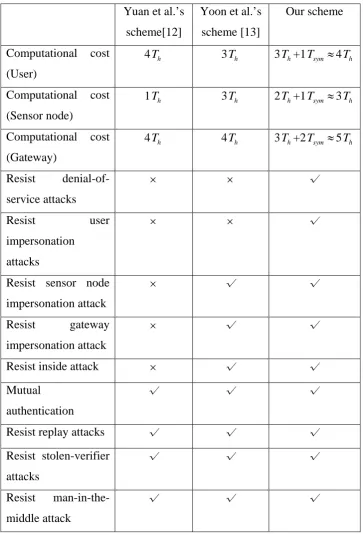
For the convenience of evaluating the computational cost, we define some notations as follows
h
T : The time of executing a one-way hash function.
sym
one-way hash function and a symmetric encryption/decryption function has almost same computational cost. Then, the computational costs of the user, the sensor node and the gate way in our scheme are slightly higher than that of Yuan et al.’s scheme and Yoon et al.’s scheme. However, Yuan et al.’s scheme cannot withstand denial-of-service attacks, insider attacks, user impersonation attacks, gateway node impersonation attacks and sensor node impersonation attacks. Besides, Yoon et al.’s scheme is vulnerable denial-of-service attacks and sensor node impersonation attacks. It is acceptable to enhance the security at the cost of increasing user’s computation cost slightly. Then our scheme is more suitable for WSNs.
6. Conclusions
The paper demonstrates that Yoon et al.’s scheme is vulnerable to the denial-of-service attack and the sensor node impersonation attack. To overcome the security vulnerability, we provides a new biometric-based user authentication scheme for WSNs. The analysis shows the proposed scheme is more suited to WSNs environments.
Reference
[1] Akyildiz I., Su W., San Y., Cayirci, E. A survey on saensor network. IEEE Comm. Mag.
2002, 40, 102-114.
[2] Benenson, Z.; Gartner, F.; Kesdogan, D. User Authentication in sensor network (extended
abstract). In Proceedings of the Informatik 2004, 34. Jahrestagung der Gesellschaft fur
Informatik, Workshop on Sensor Networks, Ulm, Germany, September 2004.
[3] Benenson, Z.; Gedicke, N.; Raivio, O. Realizing robust user authentication in sensor
networks. In Proceedings of the Workshop on Real-World Wireless Sensor Network
(REALWSN’05), Stockholm, Sweden, 20–21 June 2005.
[4] Wong, K.H.M.; Zheng, Y.; Cao, J.; Wang, S. A dynamic user authentication scheme for
wireless sensor networks. In Proceedings of the IEEE International Conference on Sensor
Networks, Ubiquitous, and Trustworthy Computing (SUTC’06), Taichung, Taiwan, 5–7 June
2006.
[5] Tseng, H.R.; Jan, R.H.; Yang, W. An improved dynamic user authentication scheme for
wireless sensor networks. In Proceedings of the IEEE Global Communications Conference
(GLOBECOM’07), Washington, DC, USA, 26–30 November 2007; pp. 986-990.
[6] Lee, T.H. Simple dynamic user authentication protocols for wireless sensor networks. In
[7] Ko, L.C. A novel dynamic user authentication scheme for wireless sensor networks. In
Proceeding of the IEEE International Symposium on Wireless Communication Systems 2008,
ISWCS'08, Reykjavik, Iceland, 21–24 October 2008; pp. 608-612.
[8] Vaidya, B.; Rodrigues, J.J.P.C.; Park, J.H. User authentication schemes with pseudonymity
for ubiquitous sensor network in NGN. International Journal Communication Systems, 2010,
23, 1201-1222.
[9] Advanced Encryption Standard /http://csrc.nist.gov/encryption/aes/S.
[10]Li, C., Hwang, M.: An efficient biometric-based remote authentication scheme using smart
cards, Journal of Network and Computer Applications 2010, 33, 1-5.
[11]Lin, C., Lai, Y.: A flexible biometric remote user authentication scheme, Comput. Standards
Interf., 2004, 27, (1), 19–23.
[12]Yuan J., Jiang C. Jiang Z., A biometric-based user authentication for wireless sensor
networks, Wuhan University Journal of Natural Sciences, vol. 15, no. 3, pp. 272-276, 2010.
[13]Yoon E., Yoo K., A New Biometric-based User Authentication Scheme without using
Password for Wireless Sensor Networks, 2011 20th IEEE International Workshops on
Enabling Technologies: Infrastructure for Collaborative Enterprises, 279-284, 2011.
[14]Inuma M., Otsuka A., Imai H., Theoretical framework for constructing matching algorithms in
biometric authentication systems, In proc. of ICB 2009, LNCS 5558, pp. 806-815, 2009.
[15]Linnartz, J.-P., Tuyls, P.: New shielding functions to enhance privacy and prevent misuse of
biometric templates. Proc. Audio and Video-Based Biometric Person Authentication, 2003,
(LNCS, 2688), pp. 393–402.
[16]Perrig A, Stankovic J, Wagner D, Security in Wireless Sensor Networks. Communications of
the ACM, 2004, 47 (6):53-57.
[17]P. Kocher, J. Jaffe, B. Jun, Differential power analysis, Proceedings of Advances in
Cryptology (CRYPTO 99), 1999, pp. 388–397.
[18]T.S. Messerges, E.A. Dabbish, R.H. Sloan, Examining smart-card security under the threat of
Table 1. Performance comparisons among different schemes Yuan et al.’s
scheme[12]
Yoon et al.’s scheme [13]
Our scheme
Computational cost (User)
4Th 3Th 3Th+1Tsym ≈4Th
Computational cost (Sensor node)
1Th 3Th 2Th+1Tsym ≈3Th
Computational cost (Gateway)
4Th 4Th 3Th+2Tsym ≈5Th
Resist denial-of-service attacks
× × √
Resist user impersonation
attacks
× × √
Resist sensor node impersonation attack
× √ √
Resist gateway impersonation attack
× √ √
Resist inside attack × √ √
Mutual authentication
√ √ √
Resist replay attacks √ √ √
Resist stolen-verifier attacks
√ √ √
Resist man-in-the-middle attack