A QoS based Analysis of Disjoint Node
Multipath Routing for MANET
C. Mohammed Gulzar,Ph.D Scholar,
Dept. of CSE, MJPRU, Bareily,U.P, India
Dr. Ragini Kashyap, Faculty of Computer Science, MJPRU, Bareily, Uttar Pradesh, India
Abstract— Recently, QoS routing in wireless, dynamic
multi-hop ad hoc networks becomes a very popular research issue, and different QoS protocols are suggested and frequently used QoS routing protocols are infrequently provide multiple and unique routes. Once links or paths break due to node mobility or sudation, establishment of new paths or routes leads to huge control overhead and increased end-to-end delay. In MANETs to support and implement multimedia applications such as audio and video requires an efficient and reliable routing protocol and improved quality of service (QoS) system. Node-Disjoint Multipath Routing Protocol (NDMR) is a practical and reliable protocol in MANETs: it trim downs routing overhead drastically and attains multiple or numerous node-disjoint routing paths. In MANETs, Quality of Service support is a very important issue as best-effort routing is not proficient for supporting and implementing multimedia applications.
This paper presents a novel adaptation of NDMR, QoS facilitating NDMR, which again introduces agent-based Service Level Agreement management. This development allows for the smart selection of node-disjoint routes or paths based on network conditions and availability, so satisfying the QoS necessities of Service Level Agreements (SLAs).
Keywords- MANET; multipath; Node-disjoint; Agent-based
Service Level Agreement management; QoS.
I. INTRODUCTION
Popularity of wireless technology and the ongoing continuous developments in this field has made mobile ad hoc networks (MANETs) a popular area of research. Nowadays, real-time and multimedia applications in MANETs require QoS supports. The success of Mobile ad hoc networks can be attributed to its rapid deployment features and its infrastructure less-ness. These are characterized by multihop wireless connectivity, frequently changing network topology and the need for efficient dynamic routing protocols [1]. Static nodes such as base stations are not there in the network. Each mobile node has the capability to operate both as a host as well as a router, forwarding packets to other mobile nodes in the network that may not be within direct wireless transmission range of each other. The design and development of reliable and efficient routing protocols in such a network is, therefore, a challenging issue.
As compared to the proactive protocols [2], On-demand routing protocols use much lower routing load and are therefore, widely used. Ad Hoc on-demand Distance Vector (AODV) [3] and Dynamic Source Routing (DSR)
[4] are the two most extensively studied on-demand ad hoc routing protocols.
The limitation of both of them is that they build and rely on a unipath route for each data transmission.
Whenever there is a link break on the route, each of the two protocols needs to initiate a new route discovery process. In single-path routing protocols, route maintenance may be performed after routes fail therefore, data transmission will be stopped while the new route is getting established. On the other hand, multipath routing protocols perform the route maintenance process even if one route fails among the multiple routes. To perform the route maintenance process before all routes fail, the network must always maintain multiple routes. This can help in the reduction of data transmission delays caused by link failure [10]. But, on the other hand, this also results in a high routing load. Ondemand multipath routing protocols can alleviate this problem by establishing multiple routes between the source and the destination node during one route discovery process. A new route discovery is initiated only when all the paths failed or only one path is available. This paper presents an approach built on the Node-Disjoint Multipath Routing Protocol (NDMR). NDMR has two novel aspects compared to the other on-demand multipath protocols: it reduces routing overhead dramatically and achieves multiple node-disjoint routing paths [5].
2. RELATED WORKS
Recently, a lot of research has been done in QoS based, multi-path and node disjoint routing. Lately, the upcoming concern is the energy issues in mobile ad hoc networks (MANETs). The recent studies extensively focus on the multipath, discovering extension of the on- demand routing protocols in order to alleviate single-path problems
like AODV[6 ] and DSR[5]. High route discovery latency, Frequent route discovery attempts and possible improvement of data transfer throughput are the parameters which need to be addressed.
The AODVM (AODV Multipath) [11], is a multipath extension to AODV. These provide link-disjoint and loop free paths in AODV. Cross-layered multipath AODV (CM-AODV) [12] selects multiple routes on demand, based on the signal-to-interference plus noise ratio (SINR) measured at the physical layer. The Multipath Source Routing (MSR) protocol [13], a multipath extension to DSR, uses weighted round robin packet distribution to improve the delay and throughput. Split Multipath Routing (SMR) [14] is another DSR extension, which selects hop count limited and maximally disjoints multiple routes. Node-Disjoint Multipath Routing (NDMR) [24] provides with node-disjoint multiple paths. Other energy aware multipath protocols which give disjoint paths are Grid-based Energy Aware Node-Disjoint Multipath Routing Algorithm GEANDMRA) [16], Energy Aware Source Routing (EASR) [I7] and Energy Aware Node Disjoint multipath Routing (ENDMR) [I8]. The Lifetime- Aware Multipath Optimized Routing (LAMOR) [19] is based on the lifetime of a node which is related to its residual energy and current traffic conditions.
Cost- effective Lifetime Prediction based Routing (CLPR) [20], combines cost efficient and lifetime predictions based routing, Minimum Transmission Power Routing (MTPR) [21], and Power-aware Source Routing (PSR) [22].
3. QOS ROUTING CHALLENGES IN MANETS
Because of the inherent properties of MANETs, establishing a stable path which can adhere to the QoS requirement is a challenging issue. The stability issues of a data transmission system in a MANET can be studied under following aspects:
Existence of mobile nodes (Mobility factor): A MANET consists of mobile nodes. Nodes form the network only when they are in the communication range of each other. Link between two nodes is broken if they move out of range. At times, a single link breakage can lead to a major network partitioning. Hence, mobility of the nodes is a major challenging issue for a stable network. Also, breakdown of certain links results in routing decisions to be made again.
Limited battery /energy factor: Mobile nodes are battery driven. Thus, the energy resources for such networks are limited. Also, the battery power of a mobile node depletes not only due to data transmission but also because of interference from the neighboring nodes. Thus, a node loses its energy at a specific rate even if it is not transferring any data packet. Hence the lifetime of a network largely depends on the energy levels of its nodes. Higher the energy level, higher is the link stability and hence, network lifetime and lower is the routing cost.
Multiple paths: To send data from a source to destination, a path has to be found before hand. If a single path is established, sending all the traffic on it will deplete all the nodes faster. Also, in case of path failure, there will be no alternate path to act as a backup path.
Thus, establishing multiple paths aids not only in traffic engineering but also prevents faster network degradation
Node-disjoint paths: Multiple paths between two nodes can be either link-disjoint or node disjoint. Multiple linkdisjoint paths may have one node common among more than one path. Thus, traffic load on this node will be much higher than the other nodes of the paths. As a result, this node tends to die much earlier than the other nodes, leading to the paths to break down much earlier. Thus, the presence of node disjoint paths prolongs the network lifetime by reducing the energy depletion rate of a specific node.
4.NODE-DISJOINT MULTIPATH ROUTING PROTOCOL (NDMR)
Node-disjoint multipath routing protocol
(NDMR) is a new protocol developed by Xuefei Li [5], modifying and extending AODV to enable the path accumulation feature of DSR in route request packets. It is efficient in discovering multiple paths between source and destination nodes with low broadcast redundancy and minimal routing latency.
In the route discovery process, the source creates a route request packet (RREQ) containing message type, source address, current sequence number of source, destination address, the broadcast ID and route path. Then the source node broadcasts the packet to its neighbouring nodes. The broadcast ID is incremented every time when the source node initiates a RREQ, forming a unique identifier with the source node address for the RREQ. Finding node-disjoint multiple paths with low overhead is not straightforward when the network topology changes dynamically. NDMR routing computation has three key features that help it to achieve low broadcast redundancy and avoid introducing a broadcast flood in MANETs:
Path accumulation
Decreasing multipath broadcast routing packets (using shortest routing hops)
In NDMR, AODV is modified to include path accumulation in RREQ packets. When the packets are broadcast in the network, each intermediate node appends its own address to the RREQ packet. When a RREQ packet finally arrives at its destination, the destination is responsible for judging whether or not the route path is a node-disjoint path. If it is a node disjoint path, the destination will create a route reply packet (RREP) which contains the node list of whole route path and unicast it back to the source that generated the RREQ packet along the reverse route path. When an intermediate node receives a RREP packet, it updates the routing table and reverse routing table using the node list of the whole route path contained in the RREP packet.
But if all of the duplicate RREQ packets are broadcast, this will generate a broadcast storm and dramatically decrease the performance. In order to avoid this problem, a novel approach is introduced in NDMR which records the shortest routing hops to keep loop-free paths and decrease routing broadcast overhead. When a node receives a RREQ packet for the first time, it checks the node list of the route path, calculates the number of hops from the source node to itself and records the number as the shortest number of hops in its reverse routing table. If the node receives a duplicate RREQ packet again, it computes the number of hops and compare it with the shortest number of hops in its reverse routing table.
If the number of hops is larger than the shortest number of hops in the reverse routing table, the RREQ packet is dropped. When receiving a duplicate RREQ, the possibility of finding node-disjoint multiple paths is zero if it is dropped, for it may come from another path. Only when it is less than or equal to the shortest number of hops, the node appends it own address to the node list of the route path in a RREQ packet and broadcasts it to neighbouring nodes again.
The destination node is responsible for selecting and recording multiple node-disjoint paths. When receiving the first RREQ packet, the destination records the list of node IDs of the entire route path in its reverse route table and sends a RREP packet along the reverse route path. When the destination receives a duplicate RREQ, it compares the whole node IDs of the entire route path in the RREQ to all of the existing node-disjoint paths in its reverse routing table. If there is no common node (excepting the source and destination node) between the node IDs from the RREQ and node IDs of any node-disjoint path in the destination’s reverse table, the route path in current RREQ is a nodedisjoint path and is recorded in the reverse routing table of the destination. Otherwise, the current RREQ is discarded.
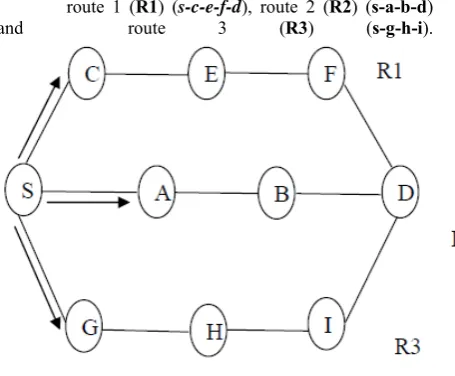
Fig. 1 shows a possible result of multiple node-disjoint paths between source node s and destination node d. There are three paths between them:
route 1 (R1) (s-c-e-f-d), route 2 (R2) (s-a-b-d)
and route 3 (R3) (s-g-h-i).
Figure: 1. Multiple node-disjoint paths
5. QUALITY OF SERVICE (QOS) IN NDMR
Figure: 2. Queue length in multiple node disjoint paths
Fig. 2 shows queue length along the multiple paths. Assume source node S first receives the RREP from
route 2 (R2) (s-ab-d). In standard NDMR, S will always
transmit data on that route so long as no link break happens, even though route 3 (R3) (s-g-h-i-d) has a
smaller queue length and hence a lower rate of delay. With the introduction of the queue_length” field in RREP, S
will initially choose route 2 (R2) (s-a-b-d) to transmit data
as it receives an RREP from that route first. But after it has received the RREP from route 3(R3) (s-g-h-i-d), it will
compare the queue lengths of the existing routes, and then will change to route 3(R3) (s-g-h-i-d) to continue
transmitting data. Using this approach, transmission delay rate can be reduced and the SLA requirements can be met. As an RREP is generated only in the route discovery process, the protocol cannot frequently refresh the queue length of each path. As part of the enhancement to NDMR, the need for a similar packet, RREU (route update packet) that performs more frequent updates and contains the “queue_length” field used in an RREP packet, has been identified. The destination node will periodically unicast RREU packet containing up-to-date queue length to the source node. The source will be able to choose the best path according to the change of queue length in real time.
6. RESULT &DISCUSSION
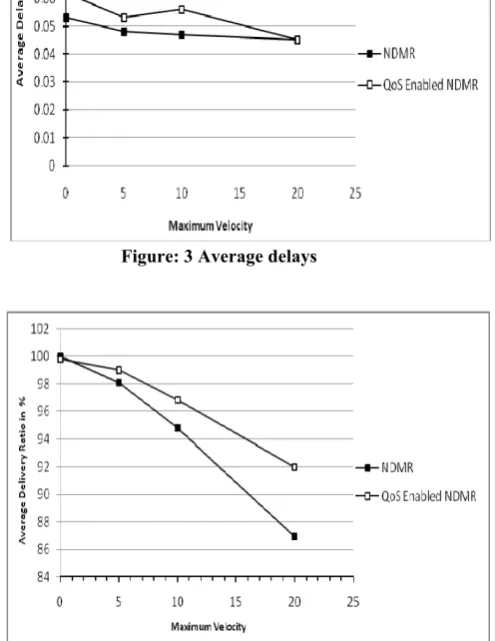
The Qualnet network simulator [24] is used to analyze the parametric performance of Node-disjoint Multipath Routing (NDMR) [5] and Quality of Service Enabled NDMR [10] routing protocols. The performance is analyzed with different variation of traffic load. These are applied on different source to destination nodes. The results are shown in figures 3 and 4.
Figure: 3 Average delays
Figure: 4. Packet delivery ratio
Fig. 3 shows that simulation results of packet average delay for QoS enabled NDMR give better performance than that of NDMR. The delay time for all mobile velocities trends to be equal. The reason is that with RREP packets carrying realtime delay back and route update packets, the data packets will always be transmitted along the lowest congestion path.
It can be seen from Fig. 4 that QoS enabled NDMR has a little lower packet delivery ratio than NDMR. The reason is that the introduction of route update packets slightly increases packet collision in the network. Nevertheless, the packet delivery ratio is still above 86% for all mobile velocities.
7. AGENT-BASED SLAMANAGEMENT
the dynamic nature MANETs. This flexibility will allow the system to meet the QoS requirements agreed in SLAs.
Figure: 5 NDMR agent structure
Queue length and buffer length are very important parameters in queue management and should be taken into consideration to meet the requirements of any SLAs. Considering the importance, these parameters only have been used to calculate the delay time for each path. A technique to keep the queue length short in a long buffer is necessary. It is proposed that this technique be under the control of an intelligent agent.
General agent uses three layers – reactive, local planning and co-operative planning – which allow it to take action and make decisions in different timescales. The reactive layer is designed for quick response in real time.
More complex and slower acting functions are implemented in the two planning layers. Generally the local planning layer is concerned with long-term actions within its own node and the co-operative planning layer is concerned with long-term actions with other agents. Future work is intended tol develop the communication and cooperation with agents in other nodes. In QoS enhanced NDMR, the co-operative planning layer is used for deciding whether to change path or not (according to the queue length of this node and other nodes); the local planning layer is for choosing which path to transmit data (according to the queue length of this node). As illustrated in Fig. 5, the packet is transmitted on the reactive layer and the parameters critical to decision making (such as queue length) are passed up to the planning layers. After calculating delay and choosing the appropriate path, the packet will be routed out along the chosen path.
8. LIMITATIONS OF NDMR
NDMR and QoS enabled NDMR show better performance, but they are all in the scenario with a dense node network – 50 nodes in 1000 m * 1000 m fields. In a different situation of sparse node network with 25 nodes in 1000 m * 1000 m fields, the average delay time of NDMR and QoS NDMR will increase. The main reason is that with the lower number of nodes, the possibility of finding node-disjoint route decrease. For one source and destination pair, there may be only one route.
9. CONCLUSION
This paper has presented architecture for guaranteeing QoS based on Node-Disjoint Multipath Routing Protocol (NDMR) in mobile ad hoc networks. The issue of QoS provision is highly challenging for MANETs and necessarily different from traditional fixed networks. Due to the growth in demand for diverse multimedia applications, fulfilling the QoS guarantees in SLAs, requires solutions that are responsive to network state. The use of multiple node-disjoint paths gives the opportunity for allocating packets to paths in an optimum way to meet instantaneous constraints. This paper has presented a means of developing NDMR – through the queue length field and additional route update packets – to allow QoS measurement along such node-disjoint paths. By using intelligent agents it will be possible to distribute this optimization at the planning layer, to allow very fast processing to occur at the reactive layer while still taking into account the needs of all nodes.
REFERENCES
[1]. Szu-Lin Su, Yi-Wen Su, Chien-Sheng Chen and Wen-Hsiung Liu “A Novel Design of Node-disjoint
[2]. Multi-path QoS Routing in Multi-hop Ad Hoc Networks” Proceedings of IEEE 2011.
[3]. Shunli Ding and Liping Liu “A node-disjoint multipath routing protocol based on AODV” Ninth International Symposium on Distributed Computing and Applications to Business, Engineering and Science, 2010.
[4]. Charles E. Perkings, Elizabeth M. Belding-Royer, Samir R.Das, Ad Hoc On-Demand Distance Vector (AODV)Routing,
[5]. J.Broch, D.Johnson, and D. Maltz, The Dynamic Source Protocol for MobileAd hoc Networks.
[6]. Xuefei Li and Laurie Cuthbert, On-demand Node-Disjoint
Multipath Routing in Wireless Ad hoc Networks, In Proceedings of
the 29th Annual IEEE Conference on Local Computer Networks, LCN
2004, Tampa, Florida, U.S.A., November 16-18, 2004.
[7]. Alex Hayzelden & John Bigham Heterogeneous Multi-Agent Architecture for ATM Virtual Path Network Resource Configuration, in Intelligent Agents for Telecommunications Applications (IATA ’98), LANAI 1437, S.Albayrak & F.J.Garijo (eds), Springer-Verlag,
1998, ISBN 3-540-64720-1.
[8]. L.G. Cuthbert, D. Ryan, L. Tokarchuk, J. Bigam and E. Bodanese, Using intelligent agents to manage resource in 3G Networks, Journal of IBTE, 2(4), 2001.
[9]. M.Wooldridge & N.R. Jennings, Agent Theories, Architectures and Languages: a Survey in Wooldridge & Jennings eds. Intelligent Agents, Springer-Verlag, Berlin, 1995.
[10]. Soamsiri Chantaraskul, An Intelligent-Agent Approach for
Managing Congestion in W-CDMA Networks, PhD thesis, University
[11]. Zheniqiang Ye, Strikanth V. Krishnamurthy and Satish K. Tripathi, “A Framework for Reliable Routing in Mobile Ad Hoc
Networks”, IEEE INFOCOM, 2003.
[12]. M. K. Marina and S. R. Das, "On-Demand MultiPath Distance Vector Routing in Ad hoc Networks", Proceedings of the Ninth International Conference on Network Protocols (ICNP}, IEEE Computer Society Press, 2001, pp. 14-23.
[13]. J.Park, S.Moht and I.Chung ” Multipath AODV Routing Protocol in Mobile Ad Hoc Networks with SINR-Based Route Selection”, International Symposium on Wireless Communication Systems, IEEE , 2008, pp:682-688.
[14]. L.Wang, L.Zhang, Y.Shu and M.Dong,” Multipath source routing in wireless ad hoc networks”, Proceedings of Canadian Conference on Electrical and Computer Engineering, 2000, Vol 1, pp. 479-483. S. J. Lee and M. Gerla, "Split Multipath Routing with Maximally Disjoint Paths in Ad hoc Networks”, Proceedings of the IEEE International Conference on Communications (ICC), 2001, Vol 10, pp. 3201- 3205.
[15]. Luo Liu and Laurie Cuthbert “QoS in Node-Disjoint Routing for Ad Hoc Networks” ICC Workshops '08. IEEE International Conference on Communications, 2008.
[16]. W. Zhengyu, D. Xiangjun and C. Lin, " A Grid-Based Energy Aware Node-Disjoint Multipath Routing Algorithm for MANETs", Proceedings of International Conference on Natural Computation, 2007, Vol. 5, pp. 244-248.
[17]. D.Youn H, K Eui-Hyeok and L. Jae-Sung, “ An Energy Aware Source Routing with Disjoint Multipath Selection for Energy- Efficient Multihop Wireless Ad hoc Networks”, Proceedings of International Federation for Information Processing, 2006, pp. 41-50. [18]. M. Bheemalingaiah, M. M. Naidu, D. Sreenivasa Rao and G. Varaprasad, " Energy Aware Node-Disjoint Routing in Mobile Ad Hoc Networks", Journal of Theoretical and Applied Information Technology, 2009, pp 416-431.
[19]. T. Liansheng, X Ling, T.K King, M.Lei and Zukennan, "LAMOR: Lifetime-Aware Multipath Optimized Routing Algorithm for Video Transmission over Ad hoc Networks", Proceedings of IEEE Vehicular Technology Conference, 2006, Vol. 2, pp. 623-627. [20]. W.Su, S.Ju Lee and M.Gerla , ” Mobility Prediction in Wireless Networks”.,MILCOM 2000, Vol l, pp.491-495.
[21]. M. Maleki, K. Dantu and M. Pedram, "Power-aware source routing protocol for mobile ad hoc networks", Proceedings of the IEEE international symposium on low power electronics and design, 2002, pp.72-75.
[22]. D.Kim, Garcia-Luna-Aceves, J.J. Obraczka, K. Cano and J.-C. Manzoni,"Routing mechanisms for Mobile Ad hoc Networks Based on Energy Drain Rate", Mobile Computing, Vo12, 2003, pp 161- 173. [23]. X.Li, Ph.D thesis on "Multipath Routing and QoS Provisioning in Mobile Ad hoc Networks", Queen Mary University of London, 2006.