
Reducing Communication Overhead of the Subset Difference Scheme
Sanjay Bhattacherjee and Palash Sarkar Applied Statistics Unit
Indian Statistical Institute
203, B.T.Road, Kolkata, India - 700108. {sanjayb r,palash}@isical.ac.in
Abstract
In Broadcast Encryption (BE) systems like Pay-TV, AACS, online content sharing and broadcasting, reduc-ing the header length (communication overhead per session) is of practical interest. The Subset Difference (SD) scheme due to Naor-Naor-Lotspiech (NNL) is the most popularly used BE scheme. It assumes an underlying full binary tree to assign keys to subsets of users. In this work, we associate short tree structures of height
a to nodes in the binary tree to assign keys to more subsets. This ensures that for any set of revoked users, the header length is in general less and never more than the NNL-SD scheme. Experimental studies show that the average header length is always less than that of the NNL-SD scheme and decreases asaincreases. User storage in the new scheme is more than that of the NNL-SD scheme but is not prohibitively expensive. By choosing a suitable value ofa, it is possible to obtain substantial reduction in the communication overhead at the cost of a tolerable increase in the user storage.
Keywords: Broadcast encryption; subset difference; trees; augmented structure; general arity; probabilistic analysis; expectation; header length; transmission overhead.
1
Introduction
Content protection in systems like Pay-TV, online media broadcasting and digital rights management [DRM] in optical discs, are based on broadcast encryption (BE) schemes. A symmetric key BE scheme assumes a broadcasting center and a set N of users who can receive the encrypted broadcast. At the outset, the users are provided long-lived keys which are stored on the user devices. Blocks of data are broadcast in sessions. For a given broadcast, a non-empty subset of users are identified as privileged and the other users are said to be revoked. Each session is encrypted with a fresh random session key. The session key in turn is encrypted a number of times using a subset of long-lived keys such that each privileged user has access to one of these keys and no revoked user can access any of these keys. These encryptions of the session key are sent with the encrypted data block as theheader. The number of times the session key is encrypted is called theheader length. The communication overhead due to the scheme is measured by the header length.
The Advanced Access Content System [AAC] standard for digital rights management [DRM] in optical discs suggest the use of the Subset Difference (SD) scheme proposed in 2001 by Naor, Naor and Lotspiech [NNL01]. The SD scheme has thus become the most popularly used BE scheme. In this scheme, long-lived keys are assigned to some subsets of N. A user is provided some secret information from which it can derive the keys of only those subsets to which it belongs. At the time of the broadcast, the center computes the subset cover containing subsets of privileged users. Each privileged user for a session is in some subset of the cover for that session. In the header, the session key is encrypted using the long-lived keys of subsets in the cover. A privileged user can
1 INTRODUCTION 2
decrypt the session key from the part of the header intended for the subset in the cover to which it belongs. It can thus decrypt the data block of the session.
For a system with n users, the NNL-SD scheme requires each user to store O(log2n) secret key material. Further, for a broadcast havingr revoked users, the worst case header length is 2r−1.
1.1 Our Contributions
There are two main parameters of a BE scheme – the header length which determines the communication bandwidth requirement and the user storage. In applications like the Advanced Access Content System [AAC] for digital rights management [DRM] in optical discs, reducing the header length implies the system will be able to tolerate more number of revocations. There are applications like Pay-TV where the communication bandwidth is more important than the user storage. Our goal in this work is to explore methods to reduce the communication bandwidth in the NNL-SD scheme.
The starting point of our work is the NNL-SD scheme. For a system withn= 2`0 users, the NNL-SD scheme
uses a full binary tree of height`0. The scheme identifies certain subsets of users and employs a clever strategy
for assigning keys to these subsets. In any broadcast, the set of privileged users are covered using these subsets. A basic combinatorial intuition is that if we can somehow manage to increase the number of allowed subsets, then it may become easier to cover the privileged users using a smaller number of subsets. We follow up on this intuition.
Reducing the communication bandwidth can trivially be done if there is no restriction on the user storage. This, however, is an unrealistic scenario. We consider the issue of reducing communication bandwidth while at the same time ensuring that the increase in the user storage is not prohibitively expensive. The new scheme that we introduce still usesT0 as the underlying framework and all the subsets considered in the NNL-SD scheme are
also present in the new scheme. Additionally, we use small trees of height a rooted at internal nodes ofT0 to
identify additional subsets which are to be assigned keys. In the scheme,ais a parameter whose value is greater than or equal to 1. Accordingly, the new scheme is called as the a-augmented binary tree subset difference (a-ABTSD) scheme. Fora= 1, the new scheme is the same as the NNL-SD scheme. For a >1, the flexibility of having additional subsets arises. As a result, the new scheme is a proper generalization of the NNL-SD scheme. For a scheme with n users, the user storage is still O(log2n). The difference with the NNL-SD scheme is that the constant in the big-oh notation is proportional to 2k−1 where k= 2a. So, for a fixedn, the a-ABTSD scheme is meaningful only if a is small. Later we consider the values of a to be from 1 to 4. The worst case header length of the a-ABTSD scheme is 2r−1 (irrespective of the value of a) as in the case of the NNL-SD scheme. It can be shown though that for any particular set of revoked users, the header size of the new scheme is never more than that of the NNL-SD scheme. Further, compared to the NNL-SD scheme, in the a-ABTSD scheme, the maximum header size of 2r−1 is attained for a larger values ofn.
The main gain in using thea-ABTSD scheme is the reduction in the average header length. We have carried out experiments to study this. It turns out that for all values of r, the average header length of the new scheme for a > 1 is lower than that of the NNL-SD scheme. The lowering effect of the header length becomes more pronounced as either r increases or as a increases. Our results show that in scenarios where reducing communication bandwidth is a major concern, the new scheme provides an attractive alternative to the NNL-SD scheme.
1.2 Previous And Related Works
2 SUBSET COVER FRAMEWORK 3
The subset cover framework for BE was proposed in [NNL01] that modelled almost all previously known BE schemes. The subset difference scheme, its formal security analysis and traitor tracing technique were all proposed in this same work. Halevy and Shamir introduced the concept of layering in the underlying tree of the SD scheme and reduced the user storage [HS02]. The number of users in these tree-based schemes NNL-SD [NNL01] and the HS-LNNL-SD [HS02] was assumed to be a power of two. The NNL-NNL-SD scheme was extended to accommodate arbitrary number of users in [BS13a]. Detailed combinatorial and probabilistic analysis of the scheme was also done. In [BS13b] the idea of layering was further generalized to obtain different optimizations of the user storage and the expected header length.
A ternary tree based subset difference technique was proposed in [FKTS08]. More recently, [BS13c] introduced a generalization of the NNL-SD scheme to work for k-ary trees for anyk≥2 and studied its properties.
The trade-off between a given upper bound on the user storage and the consequent lower bound on the header length was given by [LS98]. BE schemes for low-memory stateless and low-state devices was considered in [LS98]. The header length was brought down belowr for the first time in [JHC+05] with a one-way chain based scheme, where the user storage increased considerably.
The header length being the most important parameter affecting the cost of implementation of BE schemes, most of the analysis of these schemes are towards it. Analysis of the expected header length of tree-based schemes in [NNL01, HS02] was done in [PB06]. It was shown in [EOPR08] that the standard deviations of the header lengths for these schemes are small compared to the means as the number of users gets large. Hence, the expected header length is a good estimate of the overall communication overhead per session. Efficient algorithms to compute the expected header lengths for these schemes were proposed in [BS13a, BS13b]. Lower bounds on the header length for subset cover algorithms over different ranges of r were found in [AKI03]. Detailed worst case header length analysis for the tree-based schemes of [NNL01] have been done in [MMW09].
2
Subset Cover Framework
Most known symmetric key BE schemes fall under the subset cover framework [NNL01]. In this framework, the broadcast center defines a collection S of subsets of the set of usersN and keys are assigned to each subset in S. For a user u, let Su denote the subsets in S which contain u, i.e., Su ={S :S ∈ S and u ∈ S}. A user
u gets secret information Iu from which it can derive the keys for all subsets inSu. This secret information Iu need not be the actual keys, instead it can consist of sufficient information which allows u to derive the key for any subset inS to which it belongs.
The message to be broadcast by the center in each session is encrypted with a randomsession key Ks. For each session, the center knows the set of revoked users R. It forms a partition Sc of the set of privileged users N \ R using subsets inS, i.e., Sc⊆ S; for S1, S2 ∈ Sc,S1∩S2=∅; and∪S∈ScS =N \ R.
This set of subsetsSc is called the subset cover and the algorithm to findSc is called the cover generation or cover finding algorithm. The session key is further encrypted for each subsetS ∈ Sc, using the key associated withS. These encryptions of the session key are sent as the header with the encrypted data. The number,h, of subsets in the coverSc, i.e.,h=|Sc|is called the header length.
For decryption, a privileged user first determines the subsetS inScto which it belongs. Then it uses the key corresponding toS to decrypt the portion of the header intended forS to obtain the session keyKs. Finally, it uses Ks to decrypt the message.
2.1 The Naor-Naor-Lotspiech Subset Difference Scheme
The subset difference scheme introduced by Naor, Naor and Lotspiech (NNL-SD) [NNL01] falls under the subset cover framework. The number of usersn(n=|N |) is assumed to be a power of two, i.e.,n= 2`0 for some
2 SUBSET COVER FRAMEWORK 4
Afull binary tree T0 of height`
0 forms the underlying structure for the scheme. Each user is associated with
a unique leaf of T0. The nodes in the tree are numbered as follows. The root node is numbered 0. The left
(resp. right) child of an internal nodei is numbered 2i+ 1 (resp. 2i+ 2). For any node iinT0, the full binary
tree rooted atiis denoted as Ti.
There are a total of `0+ 1 levels in the tree T0. The leaf nodes are at level 0; any internal node is at level
`+ 1 if its children are at level`. So, the root node is at level `0. By level(i) we denote the level number of the
node iin the treeT0. IfJ is a set of nodes all of which are at the same level, we will denote this common level
by level(J).
Letibe a non-leaf node in T0 and jbe a non-root node inTi. ByTi\ Tj we denote the subgraph obtained by taking awayTj from Ti. LetS
i,j be the set of leaf nodes ofTi\ Tj.
The Collection NNL-S. For the NNL-SD scheme, let us denote the collection of subsets which are assigned keys by NNL-S. Then
NNL-S = {N } ∪ {Si,j:iis a non-leaf node ofT0 and j is a non-root node ofTi}. (1)
The size of the collectionNNL-S is 1 +`02`0+1−2`0 + 1 = 2 +`02`0+1−2`0.
Key Assignment To Subsets. A keyK0is assigned to the subsetN. For key assignment to the other subsets
inS, a cryptographic hash function
G:{0,1,2} × {0,1}m → {0,1}m (2)
is chosen by the center and is made available to all users in the system. Herem is the key-size of the underlying symmetric cipher. For t= 0,1,2, let Gt(·)
∆
=G(t,·). Each subsetSi,j ∈ S is assigned a key as follows.
• Every internal nodeiinT0 is assigned a uniform randomm-bit seedL
i.
• All non-root nodesj in the subtreeTi derive seeds fromL
i in the following manner. Letj=t0, . . . , tp=i be the sequence of nodes in the path fromj toi. Then forı=p−1, . . . ,0,tı= 2tı+1+sı wheresı∈ {1,2}.
Define the labelLi,j associated to Si,j to be Li,j
∆
=Gs0(· · ·Gsp−2(Gsp−1(Li))· · ·).
• The keyKi,j associated to the subsetSi,j is defined to beKi,j
∆
=G0(Li,j).
The Set Iu For A User u. For a useru consider the setNNL-Su of subsets inNNL-S which containu. IfSi,j is such a subset, theniis an ancestor of the leaf nodeuand jis not an ancestor ofu. The useru should be able to generate the keys of all such subsets and no more. User u is at level 0 and suppose i is at level `. Further suppose u = i0, i1, . . . , i` = i be the path from u to i. Let j1, . . . , j` be the siblings of i1, . . . , i` respectively. Corresponding to the ancestor i at level `, user u is given the ` seeds Li,j1, . . . , Li,j`. Since u has `0 ancestors,
the total number of seeds given tou is`0(`0+ 1)/2 plus the keyK0 assigned to the setN. Denote the set of all
seeds given to u byNNL-Iu, i.e.,
NNL-Iu
= {K0} ∪ {Li,j:iis an ancestor ofu and j is the sibling of some node in the path from u toi}. (3)
3 THEA-AUGMENTED BINARY TREE SUBSET DIFFERENCE SCHEME 5
3
The
a
-Augmented Binary Tree Subset Difference Scheme
Thea-Augmented Binary Tree Subset Difference (a-ABTSD) scheme is a generalization of the NNL-SD scheme. It assumes an underlying full binary treeT0as in the case of the NNL-SD scheme and imposes additional structure
on this tree. The size of the structure is determined by a parameter a. For a = 1, the scheme turns out to be the same as the NNL-SD scheme.
Underlying Structure. As in the case of the NNL-SD scheme, there are n = 2`0 users associated with the
leaves of the underlying full binary treeT0. The nodes and levels are also numbered as in the NNL-SD scheme.
For ease of later description, we introduce a few notions. SupposeJ1 and J2 are two sets of nodes ofT0 such
that there is a nodej∈J1 and nodes j1, j2 ∈J2 such thatJ1\ {j}=J2\ {j1, j2} andj1, j2 are the two children
of j. Then the set J2 can be thought of as being obtained fromJ1 by replacing {j1, j2}by j. Call the operation
of replacing j1, j2 by their parentj to be a moving-upstep.
Given a setJ, it is possible to repeatedly apply the moving-up operation to get a setJ0such that the moving-up operation can no longer be applied on J. We call J0 to be a reduced set. Given a set J, there is a unique reduced set which can be obtained by repeatedly applying the moving-up step.
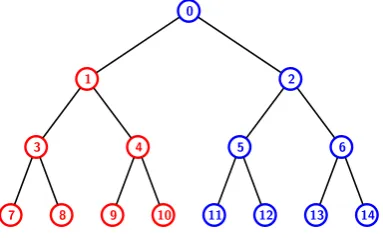
LetT be a full binary tree and J be a non-empty subset of the leaf nodes of T. If J is either singleton, or, J can be reduced to a singleton set using moving-up operation, thenJ is called asimplesubset ofT; otherwise, J is called a non-simple subset of T. Figure 1 and Figure 2 show examples of simple and non-simple subsets respectively. By Js(T) we denote the set of all simple subsets of T. Similarly, Jns(T) denotes the set of all non-simple subsets ofT. Note that both Js(T) and Jns(T) consist of subsets of the set of leaf nodes ofT.
0
1
3
7 8
4
9 10
2
5
11 12
6
13 14
Figure 1: A full binary tree T with the set J1 =
{7,8,9,10} of leaf nodes that can be reduced to a singleton set J10 ={1}. Hence, J1 is a simple subset
of T.
0
1
3
7 8
4
9 10
2
5
11 12
6
13 14
Figure 2: A full binary tree T where the set J2 =
{7,9,10,12} of leaf nodes may be reduced to J20 = {7,4,12} which is not singleton. Hence,J2 is a
non-simple subset of T.
For the new scheme, additional structure is endowed toT0 in the following manner. Define an a-tree Aj a to be a subgraph of T0 which is the full binary tree rooted at node j and of height a. So, the number of nodes in
an a-tree is 1 + 2 +. . .+ 2a= 2a+1−1.The scheme is parameterized by the numbera.
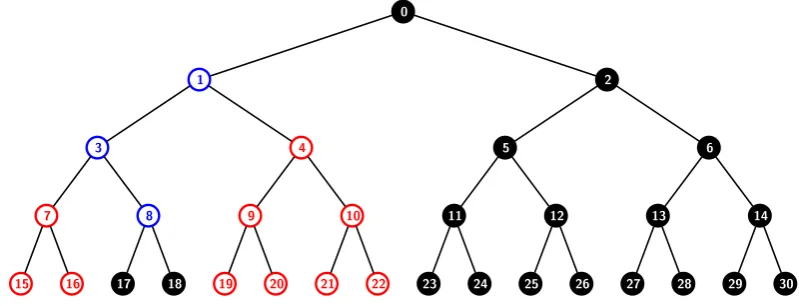
We provide an example to illustrate this notion. In Figure 3 wherea= 2, the subtree rooted at node 4 is the a-treeA4
2 containing the nodes{4,9,10,19,20,21,22}. Another a-tree A12 is the subgraph containing the nodes
{1,3,4,7,8,9,10}.
For a fixed value ofa inT0, eacha-tree is uniquely identified by its root node. Alternatively, suppose J is a
3 THEA-AUGMENTED BINARY TREE SUBSET DIFFERENCE SCHEME 6
The level number of the root node of anya-tree in T0 is at leasta. Hence, for a full binary tree withn= 2`0
leaves, the number of distinct a-trees is the number of internal nodes at levels between`0 anda. Since there are
2`0−` nodes at level` inT0, hence the number of a-trees is
1 + 2 +. . .+ 2`0−a= 2`0−a+1−1.
For any internal node i of T0 and any non-root node j in Ti, Ti \ Tj is the subgraph of Ti obtained by taking away Tj. We generalize this notion in the following manner. As before, let i be a non-leaf node in T0
and let J = {j1, . . . , jc} be a non-empty subset of non-root nodes in Ti. Define Ti,J to be the subgraph of Ti formed by taking away all of Tj1, . . . ,Tjc from Ti. In other words,
Ti,J =Ti\ Tj1 ∪ · · · ∪ Tjc
.
LetSi,J denote the set of leaf nodes of the subgraphTi,J.
SupposeJ1 and J2 are two sets of nodes in Ti such that J2 is obtained from J1 by a moving-up step. Then
it is easy to see that the set of leaf nodes ofTi,J1 is the same as the set of leaf nodes ofTi,J2 and soSi,J1 =Si,J2.
We say (i, J1) and (i, J2) are two representations of the set Si,J1 = Si,J2. If J
0 is a reduced set obtained by
successively applying the moving-up operation to a set J, then Si,J =Si,J0. By an extension of terminology, we
will call the representation (i, J0) to be the reduced form representation of the set Si,J.
The Collection S. Leti be an internal node ofT0 and J be a non-simple subset of Aj
a where j is a node of Ti. We call such a pair (i, J) to be allowed.
Suppose (i, J) is an allowed pair where the nodes in J are at level `. Then the level of the a-pivot j of J is `+aand so the level ofiis at least`+a. This shows that there cannot be an allowed pair (i, J) where the level of iis less than a.
The collectionS consists of the following subsets:
• all NNL-SD subsets Si,j; and
• Si,J for all allowed pairs (i, J).
In other words,
S = NNL-S ∪ A-S (4)
whereA-S =∆{Si,J : (i, J) is allowed}.
ForSi,J ∈ A-S,J is non-simple and soJ cannot be reduced to a singleton set using moving-up operations. As a result,Si,J is not equal to any NNL-SD subset. So, the collectionsNNL-S and A-S are disjoint.
If a = 1, then any J which is a non-empty subset of the leaf nodes of an a-tree is necessarily simple. So, there are no allowed pairs (i, J) showing that A-S =∅. As a consequence, in this case, the a-ABTSD scheme collapses to the NNL-SD scheme.
As an example, let us consider the tree T0 in Figure 3 with 16 users. It shows the subset that has been
formed by excluding the users in T7, T9 and T10 from the users in T0. The subset is denoted as S
0,{7,9,10}.
Nodes{7,9,10}are leaves of thea-treeA1
2. Note that the set{7,4}can be obtained from the set {7,9,10} by a
moving-up operation. So, S0,{7,9,10}=S0,{7,4}.
Key Assignment To Subsets In S. The key assignment strategy is an extension of the strategy for the NNL-SD scheme. The collection S consists of two sub-collections NNL-S and A-S. We assume as in the case of the NNL-SD scheme that each internal nodeiofT0 is assigned an independent and uniform randomm-bit seed
3 THEA-AUGMENTED BINARY TREE SUBSET DIFFERENCE SCHEME 7
0
1
3
7
15 16
8
17 18
4
9
19 20
10
21 22
2
5
11
23 24
12
25 26
6
13
27 28
14
29 30
Figure 3: The binary treeT0 that is the underlying structure of thea-ABTSD scheme forn= 16 users is shown
here. The red leaf nodes denote revoked users while the black ones denote privileged users. Here we assume a= 2. The subsetS0,{7,9,10} ={17,18,23,24, . . . ,30} from the collectionS (A-S in particular) is also shown. It
has all users in the subtreeT0 but not inT7∪ T9∪ T10. SinceJ ={7,9,10}is a non-simple subset of thea-tree
A1
2, (1, J) is an allowed pair. Using the moving up operation, the subsetJ may also be represented as S0,{7,4}.
key for the NNL-SD subset Si,j is Ki,j =G0(Li,j). In other words, keys to the subsets inNNL-S are assigned as
in the NNL-SD scheme. For convenience of notation, we define Li,i
∆
=Li.
LetT be a full binary tree of heightaand as defined earlierJns(T) is the set of all non-simple subsets of T. We define a cryptographic hash function
H[T] :Jns(T)× {0,1}m→ {0,1}m. (5)
Keys to the subsets in A-S are defined using the hash function H. Note that H is defined with respect to the tree T. This is because the domain of H depends on T. On the other hand, we expect H to act on any full binary tree of height ain the same manner. So, when T is clear from the context, we will write H instead of H[T].
Let k = 2a which is the number of leaf nodes in any a-tree. Suppose Si,J is in the collection A-S. Then (i, J) is an allowed pair and suppose the a-pivot of J is j. Then J is necessarily a non-simple subset ofAja, i.e.,
J ∈ Jns(Aja). The key Ki,J assigned to Si,J is
Ki,J
∆
=H[Aja](J, Li,j). (6)
Note thatj can be equal to iand in that caseLi,i is simply Li.
Number Of Subsets In The Collection. As mentioned earlier, the count of the number of NNL-SD subsets is 2 +`02`0+1−2`0. We now consider the number of subsets in A-S. The following result gives the number of
simple and non-simple subsets of a full binary tree of height a.
Lemma 1. Let T be a full binary tree of height a and k = 2a. Then the number of simple subsets of T, i.e. |Js(T)| equals 2k−1. Consequently, the number of non-simple subsets of T, i.e. |Jns(T)|, equals 2k−2k.
3 THEA-AUGMENTED BINARY TREE SUBSET DIFFERENCE SCHEME 8
Fix a node i of T0 with level(i) = `. Out of the 2`+1−1 nodes in Ti, 2`−a+1+. . .+ 2` nodes are at the bottom-most alevels. These nodes cannot be thea-pivot for any setJ such that the pair (i, J) is allowed. Each of the remaining 2`−a+1−1 nodes in Ti will be the root of ana-tree that generate subsets. For a node i, each such a-tree will generate 2k −2k subsets of the form Si,J where J is non-simple. Thus, the total number of subsets of the formSi,J in A-S is
`0 X
`=a
2`0−`(2`−a+1−1)(2k−2k−2) = (2k−2k)((`
0−a)2`0−a+1−2`0−a+1+ 1).
Hence, the total number of subsets in the collectionS is
|S| = |NNL-S|+|A-S|
= 2 +`02`0+1−2`0 + (2k−2k)((`0−a)2`0−a+1−2`0−a+1+ 1). (7)
Iu Per User u. Letu be a user, i.e. a leaf node ofT0. The information provided tou consists of two disjoint subsets which we call Iu(1) andIu(2).
The Subset Iu(1). The first part is the same as that in the NNL-SD scheme, i.e., Iu(1) =NNL-Iu. Recall that
NNL-Iu consists of seeds Li,j whereiis an ancestor of u andj is the sibling of some node in the path fromu to
i. As mentioned earlier, the number of m-bit seeds in Iu(1) is|Iu(1)|= 1 +`0(`0+ 1)/2. From the seeds inIu(1),u can derive keys of the following type:
• key Ki,j corresponding to any NNL-SD subset Si,j containingu;
• key Ki,J corresponding to any subsetSi,J containingu such that the a-pivot ofJ is in the subtree rooted at the sibling of some node in the path fromu toi.
The seeds in Iu(1) are not actual keys for subsets. These actual keys have to be derived from the seeds by one or more applications of the hash functions Gand/or H.
The Subset Iu(2). Let T be a full binary tree of height aand v be a leaf node of T. Let Jns,v(T) denote the set of all non-simple sets of T not containing v. In other words, J is in Jns,v(T) if J is a non-empty subset of the leaf nodes ofT,J cannot be reduced to singleton subset andv /∈J.
Lemma 2. Let T be a full binary tree of heightaandvbe a leaf node of T. Then|Jns,v(T)|= 2k−1−2k+a+ 1.
Proof. Consider a non-empty subset of the leaf nodes of T not containingv. SinceT haskleaf nodes, there are a total of 2k−1−1 possibilities forJ. FurtherJ cannot be reduced to any of the ancestors of v inT.
DefineSu(2) to be collection of subsetsSi,J inA-S satisfying the following conditions:
• iis an ancestor of uand thea-pivotj ofJ is also an ancestor of u;
• the ancestor v of uatlevel(J) is not in J.
Define
Iu(2) = {Ki,J :Si,J is inSu(2)}. (8)
The size of Iu(2) is calculated as follows. If i is at level `, then the possible levels for the a-pivot j of J are
4 COVER FINDING ALGORITHM 9
conditions. There arek= 2a leaf nodes ofAja. The ancestorv ofu at level`0 is a leaf node of Aja. By the above condition,v should not be inJ and so there are k−1 leaf nodes ofAjawhich can be inJ. Any subset J0 of the leaf nodes ofAja which does not containvcannot be reduced to any of the singleton nodes in the path fromv to
j (both inclusive). There are a total of (2k−1)−(a+ 1) nodes inAjato which it may be possible to reduceJ0 by applying moving-up operations. So, the number ofJ satisfying the required conditions is 2k−1−1−(2k−a−2). For a node i at level `, there are (`−a+ 1) possible choices for j and for each j there are 2k−1−2k+a+ 1 choices forJ. So, the number of keys in Iu(2) is
|Iu(2)| = `0 X
`=a
(`−a+ 1)(2k−1−2k+a+ 1) = 1 2 ×(2
k−1−2k+a+ 1)(`
0−a+ 2)(`0−a+ 1). (9)
Recall that for a user u, Su denotes the collection of subsets in S which contain u. Also, NNL-Su denotes the collection of all NNL-SD subsets which contain u. Define A-Su to be the collection of all subsets from A-S which containu. ThenSu is the disjoint union ofNNL-Su andA-Su. The setIu(1) providesuwith information to generate keys for any subset inNNL-Su. Similarly, the setIu(2) provides u with information to generate keys for any subset in A-Su. Further, the two sets Iu(1) and Iu(2) are disjoint and their union is the setIu which provides
u with information to generate keys for any subset inSu. The total number ofm-bit seeds thatu needs to store is the cardinality ofIu and is given by the following.
|Iu| = |Iu(1)|+|Iu(2)|= 1 +
`0(`0+ 1)
2 +
(2k−1−2k+a+ 1)(`0−a+ 2)(`0−a+ 1)
2 . (10)
For a fixedkand asngrows, the expression in (10) isO(log2n) which is the same as that of the NNL-SD scheme. This is much better than the number of keys being proportional to n. On the other hand, for a fixed n as k increases, the number of keys also increases. The set Iu(2) consists of actual keys for the subsets in Su(2). Later we show how to define the hash functionH such that the definition ofIu(2) can be altered to provide information using which seeds in Su(2) can be derived. This results in decreasing the factor (2k−1−2k+a+ 1) in the above expression.
4
Cover Finding Algorithm
The algorithm takes as input the set R of revoked users and outputs the subset coverSc. If R=∅ then the only set in the subset cover is the setN of all users. IfR 6=∅, then the subset cover consists of NNL-SD subsets Si,j orSi,J for allowed pairs (i, J). The subset cover algorithm that we describe below identifies NNL-SD subsets
Si,j withSi,{j}. For any allowed pair (i, J), the algorithm obtains Si,J0 whereJ0 is the reduced form of J.
The algorithm runs iteratively and maintains a listL of nodes on the paths joining revoked leaf nodes with the root. The listLis initially populated with the revoked leaf nodes, all marked ascovered. The algorithm runs from left to right on this list and keeps adding the parent nodes of each node in the list until the root. Each node jin the list has an associated listSDnodes[j] of its descendant nodes. For a nodejat levellevel(j)≥a, the nodes
inSDnodes[j] are in an a-tree rooted at j or at some descendant of j. For a nodej at levellevel(j)< a, the list
SDnodes[j] will have nodes from the subtree Tj. While investigating the child nodes ofi in the list, SDnodes[i]
and the status ofiare updated. The algorithm works as follows.
Algorithm C. Takes as input the set R 6=∅ of revoked users and outputs the subset coverSc. Each subset in Sc is in reduced form.
1. Form the initial listLwith all revoked leaf nodes ofT0. Mark each nodej ascoveredand setSDnodes[j] =
4 COVER FINDING ALGORITHM 10
2. Process nodes in L from left to right. LetL[t] be the node that is processed at the tth iteration. IfL[t] is the root node, go to step 3. Letibe the parent of L[t]. At the tth iteration:
(a) IfL[t] and L[t+ 1] have the same parent, proceed to the next iteration for L[t+ 1].
(b) Else, appenditoL. Nodeican have at most two children inL. Let the children ofiinL be{j1, jc} where (1≤c≤2). The following mutually exclusive cases occur:
i. Case when all c children of iarecovered:
A. If c= 1, mark iasintermediate and setSDnodes[i] ={j1}.
B. For c= 2, mark iascoveredand set SDnodes[i] ={i}. ii. Case when c= 1 and j1 is intermediate:
Markias intermediateand copySDnodes[j1] toSDnodes[i].
iii. Case when c= 2 and at least one node in {j1, j2} isintermediate:
A. If for some j ∈ {j1, j2}, there is a j0 ∈ SDnodes[j] such that level(j)−level(j0) ≥a, then for
each j ∈ {j1, j2}that is marked as intermediate, addSj,SDnodes[j] toSc. Subsequently, mark i
as coveredand setSDnodes[i] ={i}.
B. Otherwise, mark iasintermediateand set SDnodes[i] toSDnodes[j1]∪SDnodes[j2].
3. If the root node is marked as intermediate, add S0,SDnodes[0] to the coverSc.
The subset coverSc output by the algorithm is a collection of subsets of the form Si,SDnodes[i].
0 1 3 7 15 31 32 16 33 34 8 17 35 36 18 37 38 4 9 19 39 40 20 41 42 10 21 43 44 22 45 46 2 5 11 23 47 48 24 49 50 12 25 51 52 26 53 54 6 13 27 55 56 28 57 58 14 29 59 60 30 61 62
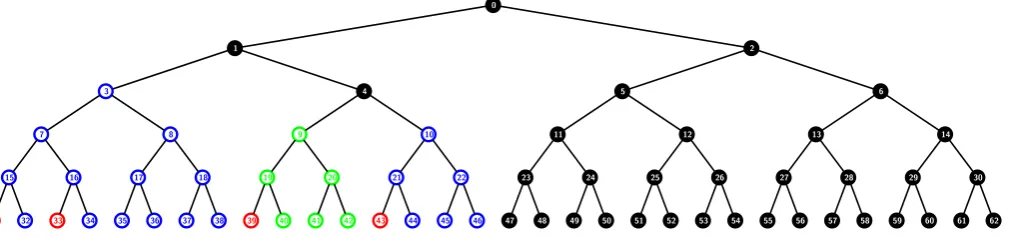
Figure 4: Example of a subset cover for R = {31,33,39,43} in the a-ABTSD scheme with a= 2 and n = 32 users. The subsets in the cover are S3,{31,33},S9,{39},S10,{43} and S0,{1}.
Figure 4 shows an example wherea= 2, n= 32 and R={31,33,39,43}. Hence, the list L eventually gets populated with the nodes {31,33,39,43,15,16,19,21,7,9,10,3,4,1,0} that lie on the paths joining the revoked leaves with the root node. The subsets generated by the algorithm working on the above list areS9,{39},S10,{43},
S3,{31,33} and S0,{1}.
The cover generation algorithm outputs sets of the typeSj,SDnodes[j]. To show the correctness of the algorithm
we need to argue two things.
1. Each subset produced by Algorithm C is inS.
2. The subsets that are produced form a partition of the set of privileged users.
4 COVER FINDING ALGORITHM 11
Proof. J is of the formSDnodes[j] for some node j. Further, all nodes in SDnodes[j] are marked covered. This can be seen from the manner in which theSDnodes[j] is built up. Nodes enterSDnodes[j] either in Step 1 or in Step 2(b)(i) and in both cases they are markedcovered; the setSDnodes[j] grows in Step 2(b)(iii)(B) through the union of two other sets of the same type and hence the property of having onlycoverednodes is preserved.
Lemma 4. If a subset Si,J is produced by Algorithm C, then J is a reduced set.
Proof. All nodes in J are marked covered. Let if possible j1 and j2 be siblings inJ and i is their parent. Then
both j1 and j2 are marked covered. When the nodeiis considered in Step 2(b), then cis 2 and Step 2(b)(i)(B)
is executed which results in SDnodes[i] being set to {i} and j1, j2 do not enter any SDnode[i]. So, they cannot
be members of anyJ such that Si,J is produced by AlgorithmC at a later point of time.
Lemma 5. For any set SDnodes[j], if i1, i2 ∈ SDnodes[j], then level(i1)−level(i2) < a. Further, all nodes of
SDnodes[j] belong to some a-tree.
Proof. LetJ =SDnodes[j]. IfJ is a singleton set, then this is clearly true; if J contains more than one element, thenJ must have been formed by the merger of twoSDnodesset in Step 2(b)(iii)(B). Such merger can take place only if the maximum of the differences in the levels of the nodes in the resulting set is less than a.
For the last statement, again it is easy to see this if J is a singleton set. On the other hand, if J has been formed by merger (one or more times), then each such merger is a union of the SDnodes of two siblings. Consequently, this corresponds to a moving-up operation within the samea-tree.
Lemma 6. Any subset produced by Algorithm C is in the collection S.
Proof. Suppose Sj,SDnodes[j] is produced. Then all the nodes in J =SDnodes[j] are in the subtree rooted at j.
By Lemma 5, the nodes in J are in some a-tree and by the previous statement, the root of this a-tree is also in Tj. So,S
j,J is inS.
Lemma 7. If u is a leaf node corresponding to a revoked user, then Algorithm C visits all ancestors of u.
Proof. Whenever a node i is processed by Algorithm C, its parent is added to L. Further, every node in L is processed before the algorithm terminates. Since the initial list L contains the node u, every ancestor of u is processed by Algorithm C.
Lemma 8. Any privileged (i.e., non-revoked) user is in one of the subsets produced by Algorithm C.
Proof. Let v be a privileged user. Since there is at least one revoked user, there is a minimal subtree Ti of T0
which contains both v and some revoked user u. Let j1 and j2 be the two children ofi and suppose v is a leaf
node ofTj2. By the minimality ofTi, it follows thatu is necessarily inTj1 and further all leaf nodes ofTj2 are
privileged.
Since i is an ancestor of the revoked node u, by the previous lemma, Algorithm C will process both nodes i1 and i. The node i is added to L when node i1 is processed. Since all nodes in Ti2 are privileged, node i2
does not enter L. So,ihas exactly one child in L and either by Step 2(b)(i)(A) or by Step 2(b)(ii),iis marked
intermediate and SDnodes[i] is set to either {j1} or toSDnodes[j1]. In both cases, v is in Si,SDnodes[i]. From this
point onwards, Algorithm C ensures the following. If i0 is an ancestor of i, then either the set Si0,SDnodes[i0] is
produced, or,Si0,SDnodes[i0]containsv. Since, the second case cannot continue indefinitely, at some point of time,
Algorithm C will produce a setSi0,SDnodes[i0]for some ancestor i0 of iand so v will be in this subset.
From Lemmas 7 and 8, we get the following result on the correctness of AlgorithmC.
5 OTHER ISSUES 12
The complexity of AlgorithmC is given by the following result.
Theorem 10. AlgorithmC requires O(rlogn) time wherer is the number of revoked nodes.
Proof. As proved in Lemma 7, the algorithm processes every ancestor of any revoked node. There are O(logn) such ancestors and so the total time taken by the algorithm is proportional torlogn.
It has already been remarked that for a= 1, the a-ABTSD scheme collapses to the NNL-SD scheme. The following result shows that for a >1 and any revocation pattern, the header length of the a-ABTSD scheme is never more than that of the NNL-SD scheme.
Theorem 11. For a given R (revocation pattern) the header length due to the NNL-SD scheme is at least as large as that of the a-ABTSD scheme.
Proof. For a given value of a, let Ja be the collection of all nodes j in T0 such that Sj,SDnodes[j] ∈ Sc. Let us consider a nodeiinT0 that have both children{j
1, j2}inL and at least one of them is marked asintermediate.
When a = 1, for every intermediate child j of i, there is a j0 ∈ SDnodes[j] such that `j −`j0 ≥ 1. Hence,
Sj,SDnodes[j] ∈ Sc and hence j ∈ Ja=1. For a > 1, if for some j ∈ {j1, j2}, there is a j0 ∈ SDnodes[j] such that
`j−`j0 ≥a, only then all intermediate children ofigenerate SD subsets. Otherwise,iis marked as intermediate
and SDnodes[j] is included in SDnodes[i] and is carried upwards. Hence, Ja=1⊆ Ja>1. Thus, the header length
due to a revocation pattern for the a-ABTSD scheme will be at most that of the NNL-SD scheme.
It follows from Theorem 11 above that the worst case header length for the a-ABTSD scheme will be less than or equal to that of the NNL-SD scheme. From [NNL01] we know that for a given r, the worst case header length of the NNL-SD scheme is 2r−1. Hence we get the following theorem.
Theorem 12. For a given r in thea-ABTSD scheme, the maximum header length that can be achieved for any n, is2r−1.
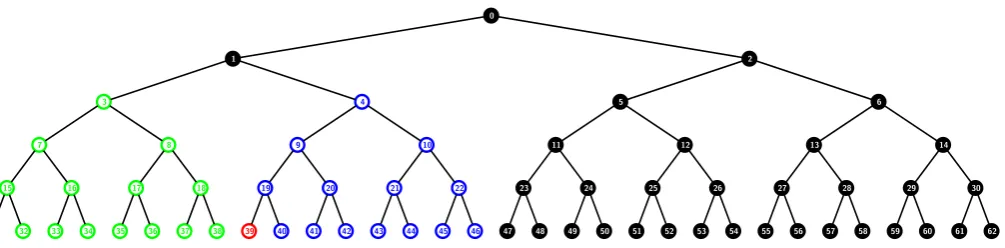
To show that this upper bound is tight, we consider the a-ABTSD scheme with a = 2 for n = 32 users in Figure 5 where R = {31,39}. The subset cover for this revocation pattern is Sc = {S3,{31}, S4,{39}, S0,{1}}.
Hence, the header length is 2|R| −1 = 3. A similar example can be constructed to show the tightness of this upper bound for any general value of a with larger values of n. The subtrees rooted at nodes 3,4,5 and 6 in Figure 5 wherea= 2, are of heighta+ 1 = 3 each. For any general a, these subtrees should be full subtrees of height a+ 1 each. It is to be noted that the treeT0 in such a case will be of heighta+ 3 and the total number
of users will be 2a+3. There will be two revoked users, one in each of the subtrees rooted at nodes 3 and 4. The subset cover will have three subsets. Two of these subsets will be rooted at nodes 3 and 4. The third subset will beS0,{3,4} =S0,{1}. Hence, the upper bound given by Theorem 12 is tight for anya≥1.
5
Other Issues
In this section, we consider two issues. The first one is the ability to extend the scheme to handle arbitrary number of users and the second one is the issue of traitor tracing.
5.1 Accommodating Arbitrary Number Of Users
The NNL-SD [NNL01] scheme assumes the number of users n to be a power of two. The a-ABTSD scheme retains this assumption and hence assumes an underlying full binary tree. In practice this may be restrictive. We extend the a-ABTSD scheme for arbitrary number of users by assuming a complete binary tree instead of full. A complete binary tree with 2`0−1 < n≤2`0 leaves is formed by adding child nodes to the leaf nodes of a
5 OTHER ISSUES 13 0 1 3 7 15 31 32 16 33 34 8 17 35 36 18 37 38 4 9 19 39 40 20 41 42 10 21 43 44 22 45 46 2 5 11 23 47 48 24 49 50 12 25 51 52 26 53 54 6 13 27 55 56 28 57 58 14 29 59 60 30 61 62
Figure 5: Example to show that the upper bound 2r−1 of the header length in thea-ABTSD scheme witha= 2 is tight. The subset cover for R={31,39} in the binary treeT0 withn= 32 users contains the subsetsS
3,{31},
S4,{39} andS0,{1}.
leaves are at level 1. The newly constructed complete tree has nleaves, some of which are filled from the left of level 0 and the others (if 2`0−1 < n <2`0) are on the right at level 1.
Since the underlying tree T0 is a complete tree (that may not be full) and hence an a-tree may also be a
non-full complete binary tree. Thus, an a-treeAi
a is a complete tree rooted at nodei inT0 and is of height a. Let us call the path joining the root node and the right-most internal node at level 1 to be thedividing path. Any subtree of T0 rooted at a node other than the dividing path, is full. Hence, only thea-tree rooted at the node
on the dividing path at levelamay be non-full. The subsets that are included in the collection S are formed as before. A subset Si,J ∈ S is such that all nodes inJ are within a single (possibly non-full but complete)a-tree.
The user storage requirement of the a-ABTSD scheme assuming n = 2`0 is given by (10) where `
0 is the
height of the underlying tree. Let us denote this storage requirement as usa(2`0). Then the user storage of the scheme assuming the complete tree structure will be at leastusa(2`0−1) and at mostusa(2`0), depending on where a user is placed in the tree with respect to the dividing path. All users are attached to some node on the dividing path. Users that are to the left (respectively right) of the dividing path and are attached to it at nodes on or above level a, receiveusa(2`0) seeds (respectively usa(2`0−1) seeds). For the users that are attached to the dividing path at a level less thana, the number of seeds can be easily calculated from the number of users attached to the dividing path at those levels.
The cover generation algorithm for the complete tree version of the scheme would have an additional pre-processing step for the leaf nodes at level 0. First, all the revoked leaf nodes at level 0 are inserted into the list L in left-to-right order. These nodes are processed one after another as in the cover generation algorithm. The parent of each leaf inLgets appended to it and their respective data structures are appropriately updated. Once all revoked leaves at level 0 have been processed, all their parents at level 1 are in the list. The remaining revoked leaf nodes that are at level 1 in T0, are then appended to L. Then onwards, the cover generation algorithm
proceeds exactly as it did for full trees. The worst-case header length remains 2r−1 for the complete tree version of the scheme. We have implemented this algorithm and results are reported later.
5.2 Traitor Tracing
6 REDUCING USER STORAGE 14
of the set itself. For the BE schemes of [HS02, BS13a, BS13b], the subsets used in these schemes all belong to the collectionS for the NNL-SD scheme with the same number of users. Hence, their respective traitor tracing mechanisms are almost the same as the NNL-SD scheme.
For the a-ABTSD scheme that we have proposed in this work, keys are assigned to subsets that are in general different from those in the NNL-SD scheme. Hence, the traitor tracing for these schemes do not directly follow from the NNL-SD traitor tracing algorithm. However, the subsets of this scheme do follow the bifurcation property. Here we state very briefly how these subsets can be split into roughly equal sized subsets from their respective collection S.
In thea-ABTSD scheme, the subsets in the collectionS are of the formsSi,j orSi,J. Any subset of the form
Si,j can also be written as Si,J whereJ is a simple subset of Aja. Assume that all subsets in S are of the form
Si,J where J is a non-empty subset of the leaf nodes of Aja for somej in the subtree rooted ati. Subsets where
J = {j} is a singleton set are split into two as was done in [NNL01]. The node j will be in either of the two subtrees rooted at 2i+ 1 or 2i+ 2. If j is in T2i+1, the subsets after split will be S
2i+1,j and Si,2i+1. If j is in
T2i+2, the subsets after split will be S
2i+2,j and Si,2i+2. Hence, the maximum bifurcation value in this case is
2/3.
For the subsetsSi,J where |J|>1, let us consider the a-tree Aia rooted at nodei. The a-treeA j
a containing the nodes in J is either this same a-tree (when i = j) or it is rooted at a descendant j of i. In any case, the subsets formed by the split are as follows. The subtrees rooted at leaves of Ai
a form a subset each in the split. From each of these 2a subtrees, all users under nodes in J are excluded. As a result, some of these 2a subtrees may be completely excluded. Wheni=j, the maximum bifurcation value is 1/(2a− |J|) which in the worst case would be 1/2. In casej is in the subtree ofi, the nodes inJ will be contained in at least one (but not all) of the 2a subtrees under the a-treeAi
a. The users in the subtrees ofJ are excluded from the respective subtrees at the leaves of Ai
a. Since j is in the subtree ofi, one of the child subtrees of iwould not have any node in J. There will be at least 2a−1 subtrees at the leaves of Ai
a that will not have any node in J. As a result, the bifurcation value in this case will be between 1/2a−1 and 1/2a. This goes to show that the bifurcation property also holds for subsets in the a-ABTSD scheme. Hence, traitor tracing mechanisms can be devised for the scheme introduced in this work in a manner similar to the one described in [NNL01].
The number of queries required by the traitor tracing algorithm depends on the bifurcation value. At every step of the traitor tracing algorithm, a subsetS of users that contains a traitor is divided into subsetsS1, . . . , St using the bifurcation property as mentioned above. Each subset St is tested for containment of a traitor. The ratio |St|/|S| is at most the bifurcation value. Lesser the bifurcation value, lesser is the size of the remaining subset from which the traitors have to be traced. The bifurcation value of the NNL-SD scheme is 2/3. The bifurcation value of the a-ABTSD scheme is at most 2/3 for a ≥ 2. Hence, traitor tracing in the a-ABTSD scheme will be at least as efficient as the NNL-SD scheme, if not better on an average.
6
Reducing User Storage
A useru is provided with the setIu as secret information. This set is the union of two disjoint sets Iu(1) and Iu(2) where |Iu(1)|= 1 +`0(`0+ 1)/2 and |I
(2)
u |= (2k−1−2k+a+ 1)(`0−a+ 2)(`0−a+ 1)/2. So the user storage is
|Iu|= 1 +`0(`0+ 1)/2 + (2k−1−2k+a+ 1)(`0−a+ 2)(`0−a+ 1)/2 where k= 2a (see (10)). For a given `0,
the quantity|Iu(1)|= 1 +`0(`0+ 1)/2 is fixed and does not change with the value ofa. As the value ofaincreases,
the component |Iu(2)|= (2k−1−2k+a+ 1)(`0−a+ 2)(`0−a+ 1)/2 increases. The main increase is due to the
exponential factor 2k−1 which is actually doubly exponential in a. Here we describe a technique to somewhat mitigate this increase. For small concrete values of a, the decrease in user storage is quite significant.
6 REDUCING USER STORAGE 15
II(2)u (a), which will enableu to generate keys for the subsets in A-Su.
It is to be noted that the technique for decreasing user storage described in this section does not change the definition of the collection S of subsets to which keys are assigned in the a-ABTSD scheme. Hence, the cover generation algorithm remains the same. Only the method of assigning seeds to nodes and keys to SD subsets is altered.
Suppose the number of users isn. Then as discussed earlier, the user storage is not the same for all users. Denote by usa(n) the maximum user storage with n users, i.e., usa(n) = maxu|Iu|. For 2`0−1 < n ≤ 2`0,
usa(n) =usa(2`0).
6.1 The Basic Idea
Consider a subset Si,J for an allowed pair (i, J). Let j be the a-pivot of J. Then J is a non-simple subset of the set of leaf nodes of Aja, i.e., J ∈ Jns(Aaj). The key Ki,J is assigned to Si,J using the hash function H as
Ki,J =H[Aja](J, L) wherej is thea-pivot ofJ and L=Li,j (6). Letu be a user and consider the set Iu(2). The key Ki,J is inIu(2) if the following condition holds: thea-pivot j ofJ is an ancestor ofu and the ancestor vof u
atlevel(J) is not in J.
Let T be a full binary tree of height a having k = 2a leaf nodes. Any subset J of the leaf nodes of T can be encoded by a k-bit stringstr(J) where theı-th bit from the left of str(J) is 1 if and only if theı-th leaf node of T is in J. By extension of this notation, str(Jns(T)) denotes the set ofk-bit strings encoding the non-simple subsets ofT. Define
H:str(Jns(T))× {0,1}m → {0,1}m. (11)
Forσ∈str(Jns(T)) andL∈ {0,1}m defineLσ =H(σ, L).Ifwis a leaf node ofT, definekeys[L,T](w) to be the set of all Lσ such that the w-th bit ofσ is 0.
Letibe an internal node ofT0 andj be a node ofTi. Letv be a leaf node of thea-treeAj
a. The seedLi,j is the derived seed fromLi which is assigned to the nodej. Letwa leaf node of Aja. The keys inkeys[Li,j,Aja](w) are to be made available to users in Tw. This is captured by the following definition.
Using the definition ofH in (11), the key Ki,J for the subset Si,J is defined to be
Ki,J = H(str(J), Li,j) (12)
where as before,j is the a-pivot of J. Supposeu is a user. Then the set Iu(2) is the following.
Iu(2) = [ i
[
j
keys[Li,j,Aja](v) (13)
where i is an ancestor of u; j is node on the path from u to i and level(j) ≥ a; v is the ancestor of u at level
level(j)−a.
Our basic idea of reducing key storage is that instead of directly providing keys[Li,j,Aja](v) we provide sufficient information for the keys in this set to be computed. This is achieved by defining the function H in a different manner. Note that the function H can itself be defined with respect to a full binary treeT of heighta and without reference to the treeT0. OnceH is defined, the definition ofK
i,J follows and the setkeys[Li,j,Aja](v) is also obtained from the definition of keys[L,T](w).
6 REDUCING USER STORAGE 16
6.2 The Case a= 2
For a= 2,k = 2a = 4. For a= 2, the factor 2k−1−2k+a+ 1 = 3 and so from (10) the maximum number of seeds to be stored by a user is
1 +`0(`0+ 1)/2 + 3`0(`0−1)/2. (14)
We show how to reduce the factor 3 to 2 by suitably defining the functionH.
Let T be a full binary tree of height a. Then the simple subsets of T are encoded by the 6 strings 0001,0010,0100,1000,0011,1100 and the non-simple subsets ofT are encoded by the 8 strings
0101,0110,0111,1001,1010,1011,0101,1001,1101,0110,1010,1110.
So, given anm-bit stringL and a string σ encoding a non-simple subset of T, we have to define Lσ =H(σ, L). Let the leaf nodes of T from the left be θ0, . . . , θ3. Then
keys[L,T](θ0) ={L0101, L0110, L0111}; keys[L,T](θ1) ={L1001, L1010, L1011};
keys[L,T](θ2) ={L0101, L1001, L1101}; keys[L,T](θ3) ={L0110, L1010, L1110};
Each of these sets contains 3 m-bit strings which gives the factor 3 in (14). Since L and T will be clear from the context we will drop them from the notation. We show how to define H such that any of the sets
keys(θ0), . . . ,keys(θ3) can be obtained from 2 m-bit strings.
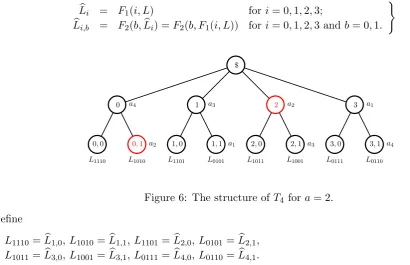
We define a new tree T4. This tree has no relation to the tree T0. It is solely used to define the function
H. The tree T4 is defined as follows. The root node has four children nodes numbered 0,1,2,3. The child node
numbered ihas two children numbered (i,0) and (i,1). The structure is shown in Figure 6.
Define, two hash functionsF1 :{0,1,2,3} × {0,1}m → {0,1}m and F2 :{0,1} × {0,1}m → {0,1}m. These
hash functions are chosen by the broadcast center and made available to the users in the system. Given anm-bit seedL, define
b
Li = F1(i, L) fori= 0,1,2,3;
b
Li,b = F2(b,Lbi) =F2(b, F1(i, L)) fori= 0,1,2,3 andb= 0,1. )
(15)
$
0 a4
0,0
L1110
0,1 a2
L1010
1 a3
1,0
L1101
1,1 a1
L0101
2 a2
2,0
L1011
2,1 a3
L1001
3 a1
3,0
L0111
3,1 a4
L0110
Figure 6: The structure ofT4 fora= 2.
Define
L1110 =Lb1,0,L1010 =Lb1,1,L1101 =Lb2,0,L0101=Lb2,1,
L1011 =Lb3,0,L1001 =Lb3,1,L0111 =Lb4,0,L0110=Lb4,1.
6 REDUCING USER STORAGE 17
keys(θ0) : Lb3 and Lb1,1;
keys(θ1) : Lb2 and Lb0,1;
keys(θ2) : Lb1 and Lb2,1;
keys(θ3) : Lb0 and Lb3,1.
It is easy to verify that the above information is sufficient to obtain any set keys(θi). For example, the users under the node 4j+ 3 inT0 will be able to get the seeds {L
0101, L0110, L0111}.
Fix a useru and an ancestoriof u at level`. For every nodej which is an ancestor of u at levels between 2 and `, the set II(2)u (2) contains twom-bit seeds. Since`can vary from 2 to `0, we have
|II(2)u (2)| = 2×`0(`0−1)
2 =`0(`0−1). (16)
Based on this we obtain the following improvement to (14).
us2(2`0) = 1 +`
0(`0+ 1)/2 +`0(`0−1). (17)
6.3 General Case
The technique for a = 2 is somewhat specific since in this case the number of non-simple subsets of an a-tree turns out to be 8 which is a power of 2. More generally, Lemma 1 shows that the number of non-simple subsets of ana-tree is 2k−2kwherek= 2a. The expression 2k−2kwill not be a power of 2 fora >2. For this case, we directly use the technique from [BS13c] which dealt with the same problem in a different context. We explain this below.
The k-ary Tree Subset Difference Scheme. The underlying structure of the NNL-SD scheme is the binary tree T0. The work [BS13c] generalizes the idea to work with k-ary trees for any k≥2. So, suppose thatT0 is
a k-ary tree. Then each internal node has k children. Let i be an internal node ofT0 and J be a non-empty
subset of nodes having a common parent j. Let Si,J denote the leaf nodes of the graph formed by taking away from T0 the subtrees whose root nodes are in J. The collection S for thek-ary tree scheme consists of all such
subsets Si,J.
Key assignment in the k-ary tree scheme is done as follows. Each node is assigned a seed Li and a hash function is iteratively used to define the seed Li,j for any node j in the subtree rooted ati. GivenLi,j and the subsetJ of children nodes ofj, a key Li,J is defined. In [BS13c] this is first defined directly and then later it is shown how to define this in a different manner so that the user storage reduces.
Coming back to the a-ABTSD scheme, we note the similarity between the subsets and the key assignment procedure of the two schemes. The relevant difference is that in thek-ary tree scheme the subsetJis a non-empty subset of the children nodes of j, whereas in the a-ABTSD scheme, the subsetJ is a non-simple subset of the leaf nodes of the a-tree rooted at j. For both cases, the key to Si,J is assigned from the seed Li,j. So, in both cases the problem is given an m-bit seed Land the subset J, how to define the key based on Land J?
A solution to this problem has been given in [BS13c] which uses the notion of cyclotomic cosets. We do not provide the solution here and instead refer the reader to [BS13c] for details. Our main observation is that the solution provided in [BS13c] also works in the present case. The difference is that the method of [BS13c] assigns keys to all non-empty subsets of the children nodes ofj, whereas in the present case, we only need to assign keys to all non-simple subsets of the leaf nodes of thea-tree rooted atj. This difference, however, is not significant. We simply ignore the keys that are assigned to the simple subsets.
7 EXPERIMENTAL STUDIES 18
Table 1: Effect of reduction of user storage. In the second row the entry for a= 2 is from (16) and the entries fora= 3 and a= 4 are from (18).
storage a= 2 a= 3 a= 4
2|Iu(2)|/(`0−a+ 2)(`0−a+ 1) from (9) 3 116 32741
2|II(2)u (a)|/(`0−a+ 2)(`0−a+ 1) 1 36 4116
These details are quite tedious and so we do not report them. Directly using the key assignment procedure from [BS13c] in the present context shows that II(2)u (a) for a useru consists of (χk−2)(`0−a+ 2)(`0−a+ 1)/2
m-bit keys whereχk is the number of cyclotomic cosets ofk-bit strings, i.e., for a >2,
II(2)u (a) = (χ2a−2)×(`0−a+ 2)(`0−a+ 1)
2 . (18)
So, fora >2,
usa(2`0) = 1 +
`0(`0+ 1)
2 +
(χ2a−2)×(`0−a+ 2)(`0−a+ 1)
2 (19)
For the case of a = 2 and k = 4, χ4 = 6. Hence, from (19) us2(2`0) would be 1 +`0(`0+ 1)/2 + 2`0(`0−1).
Previously, however, we have seen thatus2(2`0) = 1 +`0(`0+ 1)/2 +`0(`0−1). So, for the case ofa= 2, directly
using the solution from [BS13c] is sub-optimal. This is one of the reasons why we considered the case ofa= 2 as a special case.
For small value ofathe reduction that is achieved is shown in Table 1. It is clear that the reduction achieved is significant in practical terms.
6.4 Full Resilience
A user obtains secret information Iu which allows it to obtain a set of keys. Let us denote this set as Ku. It is to be noted that under certain reasonable cryptographic assumptions on the hash functions G, F1 and F2,
user u does not obtain any information about keys that are not in Ku. Further, if K is a set of keys and UK
is the set of all users such that K ∩ Ku = ∅, then ∪u∈UKu does not provide any information about K (again under reasonable cryptographic assumptions on G,F1 and F2). This can be argued formally along the lines of
the argument provided in [NNL01]. We skip the details and only remark that this can be intuitively seen by considering the hash functions to be one-way and the outputs of the hash functions to be independent.
7
Experimental Studies
The main point of this work is to reduce the header length. As we have already seen, the header length is never more than that of the NNL-SD scheme. This result, however, does not indicate what will happen on average. In this section, we report on this aspect and also compare the average header length and user storage as avaries.
In order to compute the expected header length, one may consider a situation where r users out of n are randomly revoked without replacement. Then for every non-leaf nodeiinT0, one can associate a binary valued
random variable Xi which takes the value 1 if a subset of the form Si,j orSi,J is generated and takes the value 0 otherwise. The header length is then P
Xi and by linearity of expectation, the expected header length is
P
Pr[Xi= 1].
7 EXPERIMENTAL STUDIES 19
only subtrees within the subtreeTi1 that have at least one revoked node each. Moreover, the level of the nodes
in J1 should be at least a levels below that of i1. If such a subset is generated from i1, then there has to be
at least one revoked leaf in the subtree Ti2 and a subset S
i2,J2 will be generated. Similarly, if the subsetSi2,J2
generated fromi2 is such that the sibling subtrees inJ2 are the only subtrees inTi2 with revoked users and the
level of nodes in J2 is at least alevels below i2, then Ti1 will have at least one revoked leaf and a subset Si1,J1
will be generated from i1. This gives rise to a large number of cases in the computation of Pr[Xn,ri = 1]. While in principle it is possible to exhaust all the cases, the resulting algorithm will be quite complicated. It did not seem useful to us to obtain such an algorithm.
Instead, we chose a simulation based approach to get a fair idea of the expected header length. First, we fix the parametera for the scheme. For given values of nand r, we generate random revocation patterns using Floyd’s Algorithm [BF87]. For each such revocation pattern, the cover generation algorithm finds the exact cover and hence we get the header length. The number of iterations is chosen so that the average value of the header length stabilizes. It turns out that 100 iterations are sufficient.
Table 2 shows that for different values ofr, the expected header length of the 1-ABTSD scheme (the complete tree version of the NNL-SD scheme) is always more than that of the a-ABTSD scheme witha >1. In fact, asa increases, there is a steep fall in the expected header length for fixed n and r. As an example, we see that for n= 224 and r = 0.4n= 6710886, the expected header length due to the NNL-SD scheme is 2.29 times that of
thea-ABTSD scheme witha= 3.
We compare the performance of thea-ABTSD scheme by varying the parameter a. Table 2 shows how the mean header length for a given value of a(MHLa) varies withnand r. We observe the following:
1. For a fixed n, as the parameter ais increased, the user storage increases.
2. For fixed n and a, the ratioMHLa/rdecreases steadily as r increases. This behavior is true for all a≥1 (including the NNL-SD scheme).
3. For fixed nand r, asaincreases, the ratioMHLa/rdecreases steadily. This holds for any value of r.
4. For fixed a and r/n, the value of MHLa/r is approximately the same for all values of n. Hence, these properties hold good for the full-tree versions (with n= 2`0) of the scheme too.
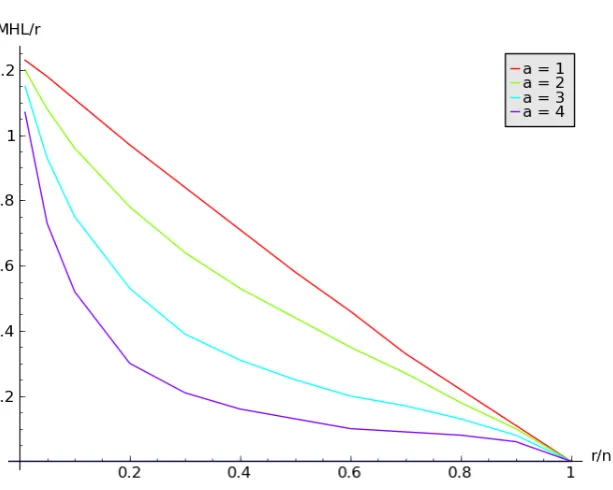
For certain values of r/n, the ratio MHLa/r is shown in Table 3. This behavior is further depicted by plotting the values of Table 3 in Figure 7.
Practical Impact. Broadcast encryption is used in paid services like cable TV, online broadcasting services (audio, video, gaming and document sharing), content protection in optical discs, etc. for implementing digital rights management [DRM]. Our scheme with a >1 would reduce the communication overhead of a system that uses the NNL-SD scheme. For any value of r/n, the mean header length for a > 1 will be lesser than a = 1 (NNL-SD scheme).
7 EXPERIMENTAL STUDIES 20
Table 2: User storage and mean header lengths in the completea-ABTSD scheme for values of abetween 1 and 4. For a fixed n, we reportMHLa/rfor three different choices ofr namely,r = (0.1n,0.2n,0.4n).
n a usa(n) MHLa/r n a usa(n) MHLa/r
103
1 55 (1.11,0.97,0.71)
104
1 105 (1.11,0.97,0.71) 2 145 (0.96,0.78,0.53) 2 287 (0.96,0.78,0.53) 3 1279 (0.75,0.53,0.31) 3 2757 (0.75,0.53,0.31) 4 115247 (0.52,0.31,0.16) 4 271629 (0.52,0.30,0.16)
105
1 153 (1.11,0.97,0.71)
106
1 210 (1.11,0.97,0.71) 2 425 (0.96,0.78,0.53) 2 590 (0.96,0.78,0.53) 3 4233 (0.75,0.53,0.31) 3 6024 (0.75,0.53,0.31) 4 432123 (0.52,0.30,0.16) 4 629652 (0.52,0.30,0.16)
107
1 300 (1.11,0.97,0.71)
108
1 378 (1.11,0.97,0.71) 2 852 (0.96,0.78,0.53) 2 1080 (0.96,0.78,0.53) 3 8902 (0.75,0.53,0.31) 3 11428 (0.75,0.53,0.31) 4 950634 (0.52,0.30,0.16) 4 1234578 (0.52,0.30,0.16)
Table 3: List of values of the ratio MHLa/r (for anyn) corresponding to the varying ratio r/n for each a. Note that as the value of a increases, the scheme performs better in terms of communication overhead as compared to a lesser value of a.
H H
H H
HH
a
r/n
(0.01, 0.05, 0.10, 0.20, 0.30, 0.40, 0.50, 0.60, 0.70, 0.80, 0.90, 1.00)
8 CONCLUSION 21
Figure 7: Plot showing how MHLa/r varies withr/n.
saving of communication bandwidth, however, comes at a cost. Assuming 128-bit key size, the storage for a= 1 is 26.25KB, whereas that of the 2-ABTSD scheme is around 73.75KB. Due to steadily falling memory prices, the benefit of savings in communication bandwidth will outweigh the cost of extra memory.
In applications like the standard for DRM in optical discs [AAC], the header is stored in a fixed portion of the optical disc. There is an allotted amount of space for the header. This amount of storage allotted for the header may be fixed and hence there would be a limit on the number of revoked users that the system will be able to tolerate. For a given value ofr, the average header length due to a >1 will always be less compared to the NNL-SD scheme (a= 1). In other words, for an instantiation of the scheme with a >1, a particular value of the expected header length will occur for larger values of r. Given nand r, the maximum header length for a >1 will be at most as much as the NNL-SD scheme and in general less. As a result of the reductions in the average as well has worst-case header lengths, the system with a > 1 will be able to tolerate more number of revoked users compared to the NNL-SD scheme.
8
Conclusion
REFERENCES 22
storage requirement for both these schemes are asymptotically the same as the NNL-SD scheme, in concrete terms they are more than the NNL-SD scheme. This is the trade-off for the decreased average communication overhead.
References
[AAC] AACS. Advanced Access Content System, http://www.aacsla.com.
[AKI03] Nuttapong Attrapadung, Kazukuni Kobara, and Hideki Imai. Sequential key derivation patterns for broadcast encryption and key predistribution schemes. In Chi-Sung Laih, editor, ASIACRYPT, volume 2894 ofLecture Notes in Computer Science, pages 374–391. Springer, 2003.
[Asa02] Tomoyuki Asano. A revocation scheme with minimal storage at receivers. In Yuliang Zheng, editor, ASIACRYPT, volume 2501 ofLecture Notes in Computer Science, pages 433–450. Springer, 2002.
[Ber91] Shimshon Berkovits. How to broadcast a secret. In Donald W. Davies, editor,EUROCRYPT, volume 547 ofLecture Notes in Computer Science, pages 535–541. Springer, 1991.
[BF87] Jon Bentley and Bob Floyd. Programming pearls: a sample of brilliance. Commun. ACM, 30(9):754– 757, September 1987.
[BS13a] Sanjay Bhattacherjee and Palash Sarkar. Complete tree subset difference broadcast encryption scheme and its analysis. Des. Codes Cryptography, 66(1-3):335–362, 2013.
[BS13b] Sanjay Bhattacherjee and Palash Sarkar. Concrete analysis and trade-offs for the (complete tree) layered subset difference broadcast encryption scheme. IEEE Transactions on Computers, 99(PrePrints):1, 2013.
[BS13c] Sanjay Bhattacherjee and Palash Sarkar. Tree based symmetric key broadcast encryption. Cryptology ePrint Archive, Report 2013/786, 2013. http://eprint.iacr.org/.
[DRM] DRM. Digital Rights Management,http://en.wikipedia.org/wiki/Digital_rights_management.
[EOPR08] Christopher Eagle, Mohamed Omar, Daniel Panario, and Bruce Richmond. Distribution of the num-ber of encryptions in revocation schemes for stateless receivers. In Uwe Roesler, Jan Spitzmann, and Marie-Christine Ceulemans, editors, Fifth Colloquium on Mathematics and Computer Science, volume AI ofDMTCS Proceedings, pages 195–206. Discrete Mathematics and Theoretical Computer Science, 2008.
[FKTS08] K. Fukushima, S. Kiyomoto, T. Tanaka, and K. Sakurai. Ternary subset difference method and its quantitative analysis. In The 9th International Workshop on Information Security Applications (WISA2008), volume 5379, pages 225–239. LNCS, 2008.
[FN93] Amos Fiat and Moni Naor. Broadcast encryption. In Douglas R. Stinson, editor,CRYPTO, volume 773 ofLecture Notes in Computer Science, pages 480–491. Springer, 1993.
[HS02] Dani Halevy and Adi Shamir. The LSD broadcast encryption scheme. In Moti Yung, editor,CRYPTO, volume 2442 ofLecture Notes in Computer Science, pages 47–60. Springer, 2002.
REFERENCES 23
[LS98] Michael Luby and Jessica Staddon. Combinatorial bounds for broadcast encryption. In Kaisa Nyberg, editor, EUROCRYPT, volume 1403 ofLecture Notes in Computer Science, pages 512–526. Springer, 1998.
[MMW09] Thomas Martin, Keith M. Martin, and Peter R. Wild. Establishing the broadcast efficiency of the subset difference revocation scheme. Des. Codes Cryptography, 51(3):315–334, 2009.
[NNL01] Dalit Naor, Moni Naor, and Jeffery Lotspiech. Revocation and tracing schemes for stateless receivers. In Joe Kilian, editor, CRYPTO, volume 2139 of Lecture Notes in Computer Science, pages 41–62. Springer, 2001.


![Construction of measures of noncompactness of \(\mathit{DC}^{n}[J,E]\) and \(C^{n} {0}[J,E]\) with application to the solvability of nth order integro differential equations in Banach spaces](data:image/gif;base64,R0lGODlhAQABAIAAAP///wAAACH5BAEAAAAALAAAAAABAAEAAAICRAEAOw==)