An Algebraic Approach to Non-Malleability
Vipul Goyal∗ Silas Richelson† Alon Rosen‡ Margarita Vald ¶
Abstract
In their seminal work on non-malleable cryptography, Dolev, Dwork and Naor, showed how to construct a non-malleable commitment with logarithmically-many "rounds"/"slots", the idea being that any adversary may successfully maul in some slots but would fail in at least one. Since then new ideas have been introduced, ultimately resulting in constant-round protocols based on any one-way function. Yet, in spite of this remarkable progress, each of the known constructions of non-malleable commitments leaves something to be desired.
In this paper we propose a new technique that allows us to construct a non-malleable protocol with only a single slot", and to improve in at least one aspect over each of the previously proposed protocols. Two direct byproducts of our new ideas are a four round non-malleable commitment and a four round non-malleable zero-knowledge argument, the latter matching the round complexity of the best known zero-knowledge argument (without the non-malleability requirement). The protocols are based on the existence of one-way functions and admit very ecient instantiations via standard homomorphic commitments and sigma protocols.
Our analysis relies on algebraic reasoning, and makes use of error correcting codes in order to ensure that committers' tags dier in many coordinates. One way of viewing our construction is as a method for combining many atomic sub-protocols in a way that simultaneously amplies soundness and non-malleability, thus requiring much weaker guarantees to begin with, and resulting in a protocol which is much trimmer in complexity compared to the existing ones.
Keywords: Non-malleability, commitments, zero-knowledge
∗Microsoft Research, Bangalore. Email: [email protected]. Part of this work done while visiting IDC Herzliya. †UCLA. Email: [email protected]. Work done while visiting IDC Herzliya. Supported by the
Euro-pean Research Council under the EuroEuro-pean Union's Seventh Framework Programme (FP/2007-2013) / ERC Grant Agreement n. 307952
‡E Arazi School of Computer Science, IDC Herzliya, Israel. Email: [email protected]. Work supported
by ISF grant no. 1255/12 and by the European Research Council under the European Union's Seventh Framework Programme (FP/2007-2013) / ERC Grant Agreement n. 307952.
The Blavatnik School of Computer Science, Tel Aviv University, Israel. Email: [email protected].
Work supported by ISF grant no. 1255/12 and by the Check Point Institute for Information Security.
1 Introduction
The notion of non-malleability is central in cryptographic protocol design. Its objective is to protect against a man-in-the-middle (MIM) attacker that has the power to intercept messages and transform them in order to harm the security in other instantiations of the protocol. Commitment is often used as the paragon example for non-malleable primitives because of its ability to almost universally secure higher-level protocols against MIM attacks.
Commitments allow one party, called the committer, to probabilistically map a messageminto a
string, Com(m;r), which can be then sent to another party, called the receiver. In the statistically
binding variant, the string Com(m;r) should be binding, in that it cannot be later opened" into
a message m0 6= m. It should also be hiding, meaning that for any pair of messages, m, m0, the
distributionsCom(m;r)and Com(m0;r0) are computationally indistinguishable.
A commitment scheme is said to be non-malleable if for every message m, no MIM adversary,
intercepting a commitmentCom(m;r)and modifying it at will, is able to eciently generate a
com-mitment Com( ˜m; ˜r) to a related messagem˜. Interest in non-malleable commitments is motivated
both by the central role that they play in securing protocols under composition (see for exam-ple [CLOS02, LPV09]) and by the unfortunate reality that many widely used commitment schemes are actually highly malleable. Indeed, man-in-the-middle (MIM) attacks occur quite naturally when multiple concurrent executions of protocols are allowed, and can be quite devastating.
Beyond protocol composition, non-malleable commitments are known to be applicable in secure multi-party computation [KOS03, Wee10, Goy11], authentication [NSS06], as well as a host of other non-malleable primitives (e.g., coin ipping, zero-knowledge, etc.), and even into applications as diverse as position based cryptography [CGMO09].
1.1 Prior Work
Since their conceptualization by Dolev, Dwork and Naor [DDN91], non-malleable commitments have been studied extensively, and with increasing success in terms of characterizing their round-eciency and the underlying assumptions required. By now, we know how to construct constant-round non-malleable commitments based on any one-way function, and moreover the constructions are fully black-box. While this might give the impression that non-malleable commitments are well understood, each of the currently known constructions leaves something to be desired.
The rst construction, due to DDN is perhaps the simplest and most ecient, mainly because it can in principle be instantiated with highly ecient cryptographic sub-protocols". This, however, comes at the cost of round-complexity that is logarithmic in the maximum overall number of possible committers. Subsequent works, due to Barak [Bar02], Pass [Pas04], and, Pass and Rosen [PR05] are constant-round, but rely on (highly inecient) non-black box techniques. Wee [Wee10] (relying on [PW10]) gives a constant-round black-box construction under the assumption that sub-exponentially hard one-way functions exist. This construction employs a generic (and costly) transformation that is designed to handle general non-synchronizing MIM adversaries.
under-lying one-way function (though not of the adversary), along with a concept called signature chains; resulting in signicant overhead. Most relevant to the current work is the work of Goyal [Goy11]. Goyal's protocol, using a later result of Goyal, Lee, Ostrovsky and Visconti [GLOV12], can be made fully black-box, with its only shortcomings being high-communication complexity and the use of the Wee transformation (or alternatively a similarly costly transformation due to Goyal [Goy11]) for handling non-synchronizing adversaries. To construct non-malleable commitments, our work follows the blueprint proposed by Goyal, and introduces new proof techniques to signicantly trim down its complexity, making various parts of the protocol of Goyal [Goy11] unnecessary.
The current state of aairs is such that in spite of all the remarkable advances, the DDN construc-tion and its analysis remain the simplest and arguably most appealing candidate for non-malleable commitments. This is both due to its black-boxness and because it does not require transformations for handling a non-synchronizing MIM (in fact, the protocol is purposefully designed to introduce asynchronicity in message scheduling, which can be then exploited in the analysis).
1.2 Our Results
In this work we introduce a new algebraic technique for obtaining non-malleability, resulting in a simple and elegant non-malleable commitment scheme. The scheme's analysis contains many fundamentally new ideas allowing us to overcome substantial obstacles without sacricing eciency. The protocol is constructed using any statistically binding commitment scheme as a building block, and hence requires the minimal assumption that one way functions exist.
Theorem. Assume the existence of one-way functions. Then there is a 4−round non-malleable commitment scheme.
Our protocol enjoys the following appealing features, each of which makes it preferable in at least one way over any of the previously proposed protocols for non malleable commitment:
Simplicity. Compared to all previous protocols, ours is signicantly simpler to describe and to instantiate (though not to analyze). The simplicity of the protocol also means that there is no need to introduce costly transformations for handling non-synchronizing adversaries. Eciency. In particular, ours is signicantly more ecient than all prior protocols both in terms
of round complexity, and in the sense that we use a surprisingly small number of sub-protocols, each of which can be instantiated in a very ecient way (e.g. using standard sigma protocols). Assumption. The assumption underlying our main protocol is the existence of one-way functions,
which is necessary for non-malleable commitments.
A direct consequence of our protocol is a 4-round non-malleable zero-knowledge argument based on any OWF. This demonstrates that for zero-knowledge, non-malleability does not necessarily come at the cost of extra rounds of interaction or complexity assumptions.
Theorem. Assume the existence of one-way functions. Then there is a 4-round black-box non-malleable zero-knowledge argument for every language in N P.
correcting codes in order to ensure that dierent committers' tags dier in many coordinates (more on that later on). Whereas prior work relied on worst-case" analysis of dierences in committers' tags, ours follows from an average-case claim.
One way of viewing our construction is as a method for combining natomic sub-protocols in a
way that simultaneously amplies their soundness and non-malleability properties, thus requiring much weaker soundness and non-malleability to begin with. We hope that this paradigm will become the norm for future work on in the area as, despite requiring more careful and strenuous analysis, it leads to pleasantly lightweight protocols. For example, this technique alone allows for an immediate linear reduction in communication complexity compared with its nearest relative, Goyal's protocol. Another payo of the algebraic techniques we employ is that our protocol only has one slot. Nearly all of the non-malleable commitment schemes in the literature use multiple slots of interaction as a way to set up imbalances between the two dierent protocol instantiations that the MIM is involved in. The well known two slot trick of [Pas04, PR05, Goy11], for example, is a way to turn an arbitrary asymmetry between the instantiations into two: one which is heavy on the right and one on the left. The inability of the MIM to align the imbalances is crucial to the proof of non-malleability. Running the two slots in parallel introduces several technical problems, most notably if the two imbalances are side by side, won't they just cancel each other out? Our analysis uses a computational version of the linear independence of polynomial evaluation mantra in order to argue that the MIM cannot combine the two imbalances and must deal with each one separately.
We stress that the use of algebra and error correcting codes does not yield such reward for free: the analysis required becomes substantially more dicult. In the next section we describe and briey discuss our new protocol and extractor. We then outline our techniques, keeping it informal but pointing out several of the challenges faced and new ideas required to overcome them.
Open Problem. Our 4-round non-malleable commitment scheme (see Section 6) only satises the notion of standalone (or one-one) non-malleability. An important problem left open by our work is getting a concurrent (or many-many) non-malleable commitment scheme in just 4-rounds (or less). We stress that in several applications of non-malleable commitments (including, e.g., round ecient secure multi-party computation), having many-many non-malleability is indeed required. The techniques in our paper do not seem to extend to the case of many-many non-malleability.
1.3 The New Protocol
Suppose that committer Cwishes to commit to messagem, and lett1, . . . , tn∈Zbe a sequence of
tags that uniquely correspond to C's identity (more on the tags later). Let Com be a statistically
binding commitment scheme, and suppose that m∈Fq whereq >maxi2ti. The protocol proceeds as follows:
1. Cchooses random r= (r1, . . . , rn)∈Fnq and sendsCom(m) and {Com(ri)}ni=1 toR; 2. RsendsCa query vectorα= (α1, . . . , αn) where eachαi is drawn randomly from
2ti⊂
Fq; 3. Csends Rthe response a= (a1, . . . , an) whereai=riαi+m;
The statistical binding property of the protocol follows directly from the binding of Com. The
hiding property follows from the hiding of Com, the zero-knowledge property of the protocol used
in step 4, and from the fact that for every i the receiverR observes only a single pair of the form (αi, ai), whereai=riαi+m.
Note the role of C's tags in the protocol: ti determines the size of the i−th coordinate's chal-lenge space. Historically, non-malleable commitment schemes have used the tags as a way for the committer to encode its identity into the protocol as a mechanism to prevent M (whose tag is
dierent from C's tag) from mauling. In our protocol the tags play the same role, albeit rather
passively. For example, though the size of the i−th challenge space depends on ti, the size of the total challenge space depends only on the sum Pn
i=1ti of the tags. In particular, our scheme leaves open the possibility that the left and right challenge spaces might have the same size (in fact this will be ensured by our choice of tags). This raises a red ag, as previous works go to great lengths to set up imbalances between the left and right challenge spaces in order to force Mto give more
information than it gets. Nevertheless, we are able to prove that any mauling attack will fail. At a very high level, our protocol can be seen as an algebraic abstraction of Goyal's protocol. However, the fundamental dierence we should emphasize from [Goy11] is that he crucially relies on the challenge space in the left interaction being much smaller than the challenge space in the right. For us, the challenge spaces in the two interactions are exactly the same size and so the techniques of [Goy11] do not apply to our setting−at least at rst. Our protocol does have small imbalances between the challenge spaces of individual coordinates, which is what we will eventually use to prove non-malleability. However, proving that the coordinates are suciently independent so that these imbalances accrue to something usable is completely new to this work.
1.4 Proving Non-Malleability
Consider a MIM adversary M that is playing the role of the receiver in a protocol using tags
t1, . . . , tn while playing the role of the committer in a protocol using tags ˜t1, . . . ,˜tn (we describe explicitly how to construct the tags from C's identity in Section 2). We refer to the former as the
left" interaction and to the latter as the right" interaction. We letm andm˜ denote the messages
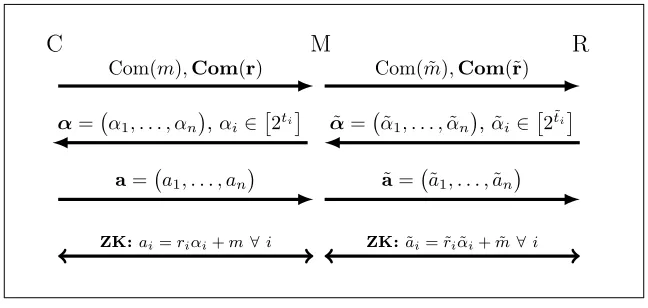
committed to in the left and right interactions respectively. One nice feature of our protocol is that it is automatically secure against a non-synchronizing adversary, simply because there are so few rounds, there is no way for the MIM to benet by changing the message order: any scheduling but the synchronous one can be dealt with trivially. So the only scheduling our proof actually needs to handle is a synchronizing one, as depicted in Figure 1 below.
Our proof of non-malleability involves demonstrating the existence of an extractor,E, who is able
to rewindMand extract m˜ without needing to rewindC in the left instantiation. Our extractor is
modeled after Goyal's extractor which: (1) rewinds M to where α˜ was sent and asks a new query ˜
β instead, and (2) responds to M's left query randomly (it cannot do better without rewinding C
as it does not knowm), hoping that Manswers correctly on the right.
In Goyal's protocol there is no way forEto know whetherManswered correctly or not, and so it
must have a verication message after the query response phase soEcan compareM's answer with
C M R Com(m),Com(r) Com( ˜m),Com(˜r)
α= α1, . . . , αn
,αi∈
2ti α˜ = ˜α
1, . . . ,α˜n
,α˜i∈
2˜ti
a= a1, . . . , an a˜= ˜a1, . . . ,˜an
ZK:ai=riαi+m ∀i ZK:˜ai= ˜riα˜i+ ˜m∀i
Figure 1: Protocol with Man-in-the-Middle
left obtaining
( ˜α,˜a),( ˜β,b˜),(˜γ,˜c) , where( ˜α,˜a)is from the main thread. Comparing both( ˜βi, bi) and(˜γi, ci)with( ˜αi, ai) will result in candidate valuesm˜i andm˜0i, but with no verication message it is not clear how E should verify which one (if either) is correct. We accomplish this with the
following collinearity test. If m˜i = ˜m0i thenE checks whether the points
( ˜αi,˜ai),( ˜βi,˜bi),(˜γi,˜ci) are collinear. If so, E deems that m˜i was the correct value. This requires proving that M cannot answer incorrectly but collinearly.
Tags in Error Corrected Form. This discussion is meant for readers who are familiar with the roles of tags in previous non-malleable commitment schemes, for a more thorough introduction see Section 2. Just as in many of the existing NMC schemes, our protocol consists of n atomic
subprotocols, one for each tag. Previous schemes use the so called DDN trick [DDN91] in order to turn C's k−bit identity into a list of n (=k) tags t1, . . . , tn, satisfying the properties: (1) each ti is of lengthlogn+ 1; and (2) if{ti}i and{˜tj}j are the tags resulting from two distinct identities then there exists someisuch thatti is completely distinct from{t˜j}j, meaning thatti6= ˜tj for allj. Previous schemes' security proofs require the extractor to be able to use any completely distinct left subprotocol (i.e., one whose tag is completely distinct from {˜tj}j) to extract M's commitment
˜
mwith high probability. This ensures that extraction is possible even in the worst case when there
is a single such subprotocol. It also introduces a good deal of redundancy into the protocol. While one would generally expect most pairs of distinct identities to result in pairs of tags such that property (2) holds for many i, all the DDN trick can guarantee in the worst case is that it
holds for a single i (sinceM is allowed to choose his identity adversarily, this worst case situation
might very well be realized). If however, one rst applies an error correcting code to C's identity
obtaining, say, a codeword inFn for suitably chosen nite eldFwith|F|=poly(n), then applying
the DDN trick to this codeword would yield tags such that (1)ti is of lengthO(logn); and (2)ti is completely distinct from{˜tj}j for a constant fraction of the i∈ {1, . . . , n}.
in an incredibly trim protocol.
Non-malleability against a copyingM. To get a sense of why we might expect our scheme to be
non-malleable, let us examine the situation against anMwho attempts to maulC's commitment by
simply copying its messages from the left interaction to the right. Letmbe the message committed
to on the left and let{ti}ni=1 and {˜ti}ni=1 be the corresponding tags.
After the rst message, M will have copied C's commitments over to the right interaction,
successfully committing to the coecients of the linear polynomialsf˜i(x) = rix+m, i= 1, . . . , n.
The hiding of Comensures it does not know the polynomials themselves, and so when it receives
the right query vectorα˜, its only hope of coming up with the correct valuationsf˜i( ˜αi)is to copyR's challenge to the left interaction and copy C's response back. However, it is unlikely that this will
be possible. Indeed, M can only copy α˜i over to the left whenα˜i ∈
2ti. If ˜t
i > ti then the i−th challenge space on the right is at least twice as big as thei−th challenge space on the left, which means that the probabilityα˜i can be copied is at most1/2. We will use a code which ensures that
˜
ti > ti for a constant fraction of thei, making the probability thatM can copy every coordinate of
R's query vectorα˜ negligible. SoMwill not be able to successfully answerR's query and complete
the proof when performing the copying attack.
Non-malleability against generalM. Establishing security against a general man-in-the-middle
adversary is signicantly more challenging, and this is where the bulk of the new ideas are required. Our proof of non-malleability will require us to delve into the full range of possibilities for M's
behavior. In each case, we will show that one of three things happen: 1. Mdoes not correctly answer its queries with good enough probability;
2. Esucceeds in extracting m˜ with sucient probability;
3. an Mwith such behavior can be used to break the hiding ofCom.
The core of our result can be seen as a reduction from a PPTMwho correctly answers its queries
with non-negligible probability and yet causes E to fail, to a machine A who breaks the hiding of
Com. The following is a very high level outline of our proof.
We dene USEFUL to be the set of transcripts which do not lead to situation 1 above; that is,
transcripts for which M has a good chance of completing the protocol given the prex. This is
important in order for Eto have any chance of successfully extracting m˜. Indeed, ifM just aborts
in every rewind, E will have no chance. From this standpoint, USEFUL is the set of transcripts
which giveEsomething to work with. We prove that most transcripts are in USEFULin Claim 3.
We then dene EXT, the set of extractable transcripts, on which E will succeed with high
probability. These are the transcripts which lead to situation 2. Intuitively, EXT is the set of
transcripts such thatMhas good probability of correctly answering a query in a rewind despite the
fact thatEprovides random answers toM's queries. We prove that indeed, if a transcript is inEXT
thenE succeeds in extractingm˜.
Finally, we dene TRB, the set of troublesome transcripts which are both useful and not
prex is such that ifMreceives correct responses to its queries on the left, it gives correct responses
to the queries on the right. At the same time however, transcripts in TRBare not extractable and
so the prex is also such that if M receives random responses to its queries on the left it answers
the right queries incorrectly. Certainly, the hiding ofComensures that Mcannot know whether it
receives correct or random responses to its queries on the left. So this dierence in behavior suggests that we may be able to useMto violate the hiding ofCom, leading to situation 3 above.
Our main claim in this part of our proof is Claim 8, which says that if the left challenge α has
a superpolynomial number of preimage right challenges α˜ then either E succeeds in extractingm˜,
or M can be used to break hiding. Such a claim has been at core of the analysis of some previous
NMC schemes. In fact, as many previous schemes (such as [Goy11], for example) use multiple slots in order to ensure that some slot has a right challenge space that is much bigger than the left, such a claim often encompasses nearly the entire analysis. In our case, we have some work still left as there is only a single slot and the right and left challenge spaces have the same size. Nevertheless, we are able to prove, using a series of combinatorial arguments, that any mauling attack will wind up with M's left query having exponentially many preimage right queries.
To see these techniques in action, dene the set S ={i∈[n] : ˜ti ≤ti}, and consider anM who simply copies the right challenges α˜i for i ∈ S over to the left but who makes sure to produce a legal query in the coordinates not in S on the left. As
2˜ti⊂2tifor all i∈S, copying α˜
i when i ∈ S is ne. If we think of M as a map sending right challenge α˜ to left challenge α, then for
any α˜S = ( ˜αi)i∈S, M sends α˜0 such that α˜0S = ˜αS to α0 such that α0S = ˜αS. In other words, M maps the set of right query vectors whose S−coordinates are xed to α˜S to the set of left query vectors whoseS−coordinates are also xed toα˜S. However, the sizes of these subsets of right and left challenges are
Y
i /∈S
2˜ti and Y
i /∈S
2ti,
respectively, and Q
i /∈S2 ˜
ti = 2Ω(n)Q
i /∈S2ti (we are using that our tags are in error-corrected form, which ensures
[n]\S
= Ω(n)). So we see that M, when restricted to the right challenges with
S−coordinates xed to α˜S, is exponentially many to one on average, and so α has exponentially many preimages with high probability.
Using the OWF in a Blackbox Fashion. The protocol described in Figure 1 makes non-blackbox use of the OWF during the ZK part of the protocol. It is often desirable for protocols to make only blackbox use of their building blocks, as the alternative tends to be vastly less ecient. To this end, the work of [GLOV12] replaces the ZK proof in the [Goy11] NMC scheme with an MPC in the head computation [IKOS07], resulting in a constant round NMC scheme which makes blackbox use of a OWF. The same transformation works for our protocol as well. We point out, however, that all the ZK argument in our protocol has to do is prove knowledge of committed values and that these values satisfy a linear equation, both of which can be proved very eciently (i.e., without resorting to costly N P−reductions), assuming DDH (or other widely used hardness assumptions). Therefore, if a statistically binding commitment scheme is available that has an ecient proof of knowledge of committed value, our protocol will be much more ecient than the generic transformation of [GLOV12], which requires Cto imagine an entire MPC in his head.
It is worth noting that directly plugging in the ideas of [GLOV12] into our protocol results in a 6-round NMC scheme. Going below 6-rounds in a black-box fashion is left as an open problem in our work.
2 Preliminaries
For positive n ∈ N, let [n] = {1, . . . , n}. A function ε : N → R+ is negligible if it tends to 0
faster than any inverse polynomial i.e., for all constants c there exists nc ∈N such that for every
n > nc it holds that ε(n) < n−c. We use negl(·) to specify a generic negligible function. We abbreviate probabilistic polynomial time with PPT. We assume familiarity with computational indistinguishability and zero-knowledge proofs (and related protocols).
2.1 Commitment schemes
Commitment schemes are protocols which enable a party, known as the committer C, to commit
himself to a value while keeping it secret from the (potentially cheating) receiver,R. This property
is known as hiding. Additionally, upon receiving the commitment fromC,Ris ensured that even if Ccheated, there is at most one value thatCcan decommit to during a later, decommitment phase
(binding). In this work, we consider commitment schemes that are statistically-binding which means that the hiding property only holds against computationally bounded adversaries.
Denition 1 (Statistically Binding Commitment Scheme). LethC,Ri be an interactive pro-tocol between C and R. We say that hC,Ri is a statistically binding commitment scheme if the following properties hold:
Correctness: IfCand Rdo not deviate from the protocol, thenRshould accept (with
prob-ability 1) during the decommit phase.
Binding: For everyC∗, there exists a negligible functionnegl(·) such thatC∗ succeeds in the
following game with probability at mostnegl(λ): On security parameter1λ: C∗rst interacts
Hiding: For every PPT receiver R∗ and every two messages m0, m1, the view of R∗ after participating in the commitment phase, where C committed to m0 is indistinguishable from its view after participating in a commitment tom1.
[Nao91] gives a 2-round, statistically binding bit commitment scheme that can be built from any OWF [HILL99].
2.2 Non-malleable commitments
We wish for our commitment scheme to be impervious to a MIM adversary, M, who takes part in
two protocol executions (in the left interaction M acts as the receiver while in the right, M plays
the role of the committer), and tries to use the left interaction to aect the right. The security property we desire can be summarized:
For any MIM adversaryM, there exists a standalone machine who plays only one
execu-tion as the committer, yet whose commitment is indistinguishable fromM's commitment
on the right.
At rst glance, non-malleability seems impossible as surely nothing can be done to protect against a MIM who simply copies messages from one protocol execution to another. For this reason, non-malleable security oers protection only against any MIM who tries to change messages in a meaningful way.
On the Existence of Identities. In this work, just as in [DDN91, PR05], we assume that the committer has an identity id ∈ {0,1}k. In order to perform a successful mauling attack, a MIM has to maul a commitment corresponding to C's identity into a commitment of his own, distinct
identity. Though this sounds like a strong assumption on the network, essentially requiring that you know who you are talking to, for our purposes, it is actually equivalent to the requirement discussed above, that the MIM do something other than simply copy messages. This is because our protocol is interactive, and the rst committer message contains a statistically binding commitment to m. This means that if we set the committer's identity to be the rst committer message, C's
and M's identities will be distinct unlessMcopied C's rst message.
Moving forward, we assume that the committer's id is externally given and we require that
non-malleability holds only in the case when C and M's identities are dierent. We also assume
for simplicity that player identities are known before the protocol begins, though strictly speaking this is not necessary, as the identities do not appear in the protocol until after the rst committer message. We point out thatMcan choose his identity adversarially, as long as it is not equal toC's.
Denition of Non-Malleable Commitments. In this work, we consider the notion of non-malleability with respect to commitment and we will frequently refer to the message committed to by a MIM adversaryMduring the commitment phase". We note that this is uniquely dened, as all
commitment schemes in this work are statistically binding, and so for all but a negligible fraction of the possible transcriptsT of the interaction betweenMand an honest receiver R, there exists at
most one messagemthat is consistent with T(i.e., for which there exist random coin tosses which
The man-in-the-middle execution. In the man-in-the-middle execution, the MIM adversary
M is simultaneously participating in two interactions called the left and the right interaction. In
the left interaction M is the receiver and interacts with a honest committer whereas in the right
interaction M is the committer and interacts with a honest receiver. We dene a random variable
MIMhC,Ri(m, z) describing( ˜m, v): the value Mcommits to in the right interaction, and M's view in the full experiment. Specically, Mhas auxiliary informationz and interacts on the left with an
honest committer Cwith input messagem and identityidand on the right with honest receiverR. M attempts to commit to a value m˜ that is related to m using an identity id˜ of its choice. If the
right commitment (as determined by the transcript) is invalid or undened, or id= ˜id its value is
set to⊥.
The simulated execution. In the simulated execution a simulator S interacts with an honest receiver R. S receives security parameter 1λ and auxiliary information z and interacts with the honest receiver R. LetSIMShC,Ri(1λ, z) denote the random variable describing ( ˜m, v): the value S commits to in the right interaction, and S's view during the entire experiment. If the commitment produced by S is invalid or undened, its value is set to ⊥.
Denition 2 (Non-Malleable Commitments). A commitment schemehC,Ri is non-malleable with respect to commitment if for every PPT MIM adversary M, there exists a PPT simulator S such that the following ensembles are indistinguishable for all m∈ {0,1}λ:
{MIMhC,Ri(m, z)}z∈{0,1}?, and {SIMShC,Ri(1λ, z)}z∈{0,1}?,id∈{0,1}k
2.3 Tags in Error Corrected Form
In this section, we describe how to derive the tags fromC's identity, highlighting the properties we
will use moving forward. Letid∈ {0,1}k beC's identity and let y∈
Fn/2 be the image ofidunder
an error correcting code with constant distance, for a suitable nite eld F. Constant distance
implies that if id,id˜ ∈ {0,1}k are distinct identities then y and y dier on a constant fraction of˜ their coordinates. Now, set
ti =
2i|F|+yi, i≤n/2
(2n+ 1)|F| −tn−i+1, i > n/2
Note that 2i|F| ≤ti <(2i+ 1)|F|for all i. The following is a list of useful properties that the tags
satisfy. Let{ti}i and{t˜i}i be the tags resulting from distinct identitiesid6= ˜id.
1. Ordered: t1 < t2 <· · ·< tn;
2. Well Spaced: t1 =ω(logλ)andti+1−ti =ω(logλ)for alli∈[n]; moreoverti+1−˜ti=ω(logλ). 3. Good Distance and Balance: if i 6= j then ti 6= ˜tj; moreover ti < t˜i holds for a constant
fraction of i∈[n](as doesti >t˜i).
Properties 1 and 2 follow immediately as long as |F| = ω(logλ). Property 3 follows from 1)
It remains to select parameters. Note that we have already touched on the role that the tags play in our protocol: the size of the challenge space in coordinate i is 2ti. This means that we
would like to make the tags as small as possible, while still allowing our security proof to go through. We make the conservative selection n = O(λ) and |F| = log2(λ) to ensure both that
the above properties hold and that all that is required of the error correcting code is that it has constant distance and constant rate. Codes with such properties are known to exist. We could use, for example polynomial based codes such as Reed-Muller codes, the multivariate generalization of Reed-Solomon codes. This results in the overall communication complexity of our non-malleable commitment scheme being O˜(λ2). Slightly better communication complexity might be available through more agressive choices of parameters or better codes. We do not press the issue further.
3 The Protocol
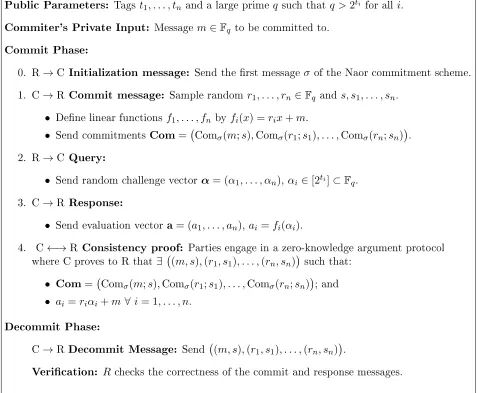
In this section, we describe our protocol given tagst1, . . . , tn in error corrected form as described in Section 2.3. We use Naor's two round, statistically binding bit commitment scheme [Nao91] as a building block.1 We use boldface to denote vectors; in particular a challenge vectorα= (α
1, . . . , αn) and a response vector a= (a1, . . . , an). We write Comfor the entire rst commitment message, so Com= Com(m),Com(r1), . . . ,Com(rn)
. Our non-malleable commitment schemehC,Ribetween a committer C trying to commit to m and a receiver R appears in Figure 2. The decommitment
phase is done by having the committerCsend mand the randomness it used during the protocol.
Proposition 1. The commitment schemehC,Riis computationally hiding and statistically binding. Proof Sketch. Statistical binding follows from the statistical binding property of the underlying commitment scheme Com. To prove computational hiding, we consider the following hybrid
exper-iments.
1. Simulate the ZK consistency proof step. Indistinguishability follows from the ZK property. 2. For each i ∈ [n], replace the commitment Com(ri) to be a commitment to random value.
Indistinguishability follows from the hiding of Com.
3. Replace the polynomials with random polynomials f¯1, . . . ,f¯n such that f¯i(αi) = fi(αi) and ¯
fi(0) = m0 for randomly sampled m0 and all i ∈ [n]. The indistinguishability follows from havingn+ 1variables and only nequations.
4. Change the commitment Com(m) to be a commitment to a random string (as opposed to a
commitment tom). Indistinguishability follows from the hiding ofCom.
In the nal hybrid, the transcript of the commitment stage contains no information about the value
m being committed to, and so no information aboutm is leaked by the protocol.
Theorem 1 (Main theorem). The commitment schemehC,Ri is non-malleable against a synchro-nizing adversary.
1Briey recall Naor's scheme: 1)Rsends random initialization messageσ, and 2)Cresponds withCom
σ(m;s),
a commitment to m ∈ {0,1} using randomness s (we will feel free to just write Com(m), surpressing σ and s
for simplicity). We comment that the same initialization message σ can be used for polynomially many parallel
instantiations of the scheme, allowing C to commit tom ∈ Zq one bit at a time (actually [Nao91] shows how to
Public Parameters: Tags t1, . . . , tn and a large primeq such thatq >2ti for all i. Commiter's Private Input: Message m∈Fq to be committed to.
Commit Phase:
0. R→C Initialization message: Send the rst messageσ of the Naor commitment scheme.
1. C→R Commit message: Sample randomr1, . . . , rn∈Fq and s, s1, . . . , sn.
• Dene linear functions f1, . . . , fn by fi(x) =rix+m.
• Send commitments Com= Comσ(m;s),Comσ(r1;s1), . . . ,Comσ(rn;sn)
. 2. R→C Query:
• Send random challenge vectorα= (α1, . . . , αn),αi∈[2ti]⊂Fq.
3. C→R Response:
• Send evaluation vector a= (a1, . . . , an),ai =fi(αi).
4. C←→R Consistency proof: Parties engage in a zero-knowledge argument protocol
whereCproves toR that∃ (m, s),(r1, s1), . . . ,(rn, sn)
such that:
• Com= Comσ(m;s),Comσ(r1;s1), . . . ,Comσ(rn;sn)
; and • ai=riαi+m∀ i= 1, . . . , n.
Decommit Phase:
C→R Decommit Message: Send (m, s),(r1, s1), . . . ,(rn, sn)
.
Verication: R checks the correctness of the commit and response messages.
Figure 2: The non-malleable commitment scheme hC,Ri.
We comment that non-malleability against a general non-synchronizing adversary actually holds in the above protocol (provided we choose a ZK with suitable properties, such as [FS90]). However, we only prove non-malleability against a synchronizing MIM (i.e., one who plays corresponding messages of the two instantiations one after the other) because the large number of messages of the protocol above make it cumbersome to examine all possibilities forM's scheduling.
We defer the proof of non-malleability against non-synchronizingMuntil after we parallelize our
4 Proof of Non-Malleability
In this section we prove Theorem 1. Recall from Denition 2 that we must show that for any PPT MIMM there exists a PPT simulatorS such that
MIMhC,Ri(m, z) m,z≈c
SIMShC,Ri(1λ, z) z,id,
where the distributions output( ˜m, v): the commitment in the right interaction and view after the
commit phases of both executions are complete in the real and ideal worlds, respectively. Our simulator is a very simple machine who runs M internally, committing honestly to 0 ∈ Zq on the left and forwardingM's messages on the right to an honest receiver R.
We prove indistinguishability of the above distributions for anyM by constructing an extractor E which takes M's view after the commit phases of the left and right executions are complete
and outputs its commitment m˜ in the right execution whp. It follows that an algorithm which
distinguishes D0 =
MIMhC,Ri(m, z) m,z from D1 =
SIMShC,Ri(1λ, z) z,id can be used to break
the hiding ofhC,Ri in the following way: 1) letv beM's view after completing the commit phases
of the left and right executions in either the real or ideal world; 2) useE to obtain the pair( ˜m, v);
3) use the distinguisher to determine whether M's interaction took place in the real or ideal world.
This breaks the hiding of the left commitment as the only dierence between the worlds is that in the real,Ccommits tom while in the ideal, S commits to0.
Formally, we assume that there exists a PPT distinguisher Dsuch that
Pr( ˜m,v)←D0 D( ˜m, v) = 1
−Pr( ˜m,v)←D1 D( ˜m, v) = 1
≥2p
for some non-negligible p =p(λ). We prove that E succeeds with probability at least 1−p. Note
this suces for proving non-malleability since it means thatEextractsm˜ AND theDwill use( ˜m, v)
to determine whether M is interacting with C committing to m, or S committing to 0. We also
assume without loss of generality that M is deterministic and thatM's probability of successfully
completing the protocol (overC's andR's random coins) is at leastp.
4.1 The Extractor E
The high level description of our extractor (described formally in Figure 3) is quite simple. Intu-itively, our protocol begins byCcommitting ton, threshold 2, Shamir secret sharings [Sha79] ofm;
Rthen asks for one random share from each sharing, which Cgives. AllE does is rewindM to the
beginning of the right session's query phase ask for a new random share. SinceE gets one share as
part of its input, this will allow Eto reconstructm˜.
The problem with this approach is that E does not know the value Chas committed to on the
left and so it does not know how to answerM's query on the left correctly. The bestEcan do is give
a random response on the left and hope that M will give a correct response on the right anyway.
On the one hand, the hiding ofCom dictates thatM cannot distinguish a correct response from a
random one. On the other hand,Mdoesn't actually need to know whether the response on the left
E from extractingm˜ because M only correctly answersE's query if given a correct response to its
own left query, which E cannot give. Of course we will prove that no M with such behavior can
exist, but this proof is highly non-trivial.
Another question which our extractor raises is how canEtell a correct response from an incorrect
one? As we have described it, the hiding of Com ensures that it cannot. However, a small
modication to the E described above xes this. Instead of asking for one new share, E rewinds
twice to the beginning of the right query phase and asks for two dierent new shares.
The key observation is that ifManswers both queries correctly then the three shares it holds (the
two it received plus the one it got as input) are collinear, whereas ifManswers at least one incorrectly
they are overwhelmingly likely to NOT be collinear. This is the rst appearance of a tangeable payo of the algebraicity of our protocol. For example, the protocol of [Goy11] (which is similar to ours, but strictly combinatorial in nature) does not have this algebraic verication technique at its disposal and must introduce use extra rounds into the protocol to ensure its extractor can reconstruct m˜.
Eis given as input a transcript of a complete commit phase in both the left and right interactions.
We denote the transcript with the letterT. Specically,
T= Com,Com˜ ,α,α˜,a,a˜, π,π˜.
SinceE will not be interested in the proofs(π,π˜), and sinceMis deterministic (and soCom˜ ,α,˜a
are uniquely determined by Com,α˜, and a) we will often just writeT= Com,α˜,a.
Denition 3 (Accepting Transcript). We say thatT∈ACCif bothπ and˜πare accepting proofs.
The soundness of the ZK ensures that if T ∈ ACC then query vectors α˜ and α are answered
correctly. We say thatMaborts ifMbehaves in such a way as to makeT∈/ ACC. Note this includes
the case whenMacts in an obviously corrupt fashion, causingC or Rto abort.
The extractor EgetsT∈ACC as input so the probabilities which arise in our analysis often are
conditioned on the event T ∈ ACC. We denote this with the convenient shorthand PrT∈ACC · · ·
instead ofPrT · · ·
T∈ACC
. For xedCom,Mcan be thought of as a deterministic map, mapping
right query vectors to left ones. We write α= M( ˜α) to be consistent with this point of view. We
assume that the transcript Egets as input is consistent with exactly one right commitment m˜. As
hC,Ri is statistically binding, this happens with overwhelming probability.
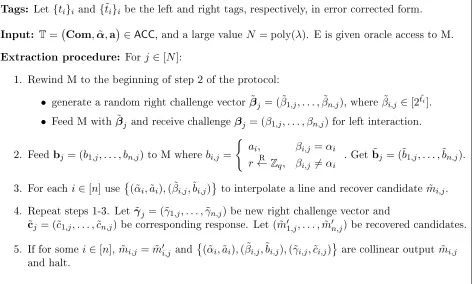
See Figure 3 below for a formal description of the extractor. Note that there are two ways for E
to fail to output m˜. The rst is ifEfails to extract any value and outputsFAIL. The other is ifE
accidentally extracts an incorrect valuem˜0 6= ˜m.
Theorem 2 (Sucient for Theorem 1). Let E be the extractor described in Figure 3, and letT
be the transcript it is given as input. Letm˜ be M's commitment in the right interaction ofT. Then
PrT∈ACC E(T)6= ˜m≤p,
Tags: Let {ti}i and{˜ti}i be the left and right tags, respectively, in error corrected form.
Input: T= Com,α˜,a∈ACC, and a large valueN =poly(λ). E is given oracle access to M.
Extraction procedure: Forj ∈[N]:
1. Rewind Mto the beginning of step 2 of the protocol:
• generate a random right challenge vector β˜j = ( ˜β1,j, . . . ,β˜n,j), whereβ˜i,j ∈[2t˜i].
• FeedM withβ˜j and receive challengeβj = (β1,j, . . . , βn,j) for left interaction.
2. Feed bj = (b1,j, . . . , bn,j) to Mwherebi,j =
(
ai, βi,j =αi
r←R Zq, βi,j 6=αi
.Getb˜j = (˜b1,j, . . . ,˜bn,j).
3. For each i∈[n]use( ˜αi,˜ai),( ˜βi,j,˜bi,j) to interpolate a line and recover candidate m˜i,j. 4. Repeat steps 1-3. Letγ˜j = (˜γ1,j, . . . ,γ˜n,j) be new right challenge vector and
˜
cj = (˜c1,j, . . . ,˜cn,j) be corresponding response. Let( ˜m01,j, . . . ,m˜0n,j) be recovered candidates.
5. If for some i∈[n],m˜i,j = ˜m0i,j and
( ˜αi,˜ai),( ˜βi,j,˜bi,j),(˜γi,j,˜ci,j) are collinear outputm˜i,j and halt.
Output: OutputFAIL.
Figure 3: The ExtractorE.
4.2 Extractable, Useful and Troublesome Transcripts
We now begin to chip away at Theorem 2 by examining special classes of transcripts on which a mauling attack will fail. This allows us to gather properties which the remaining pertinent tran-scripts must satisfy which will aid our future analysis. In this section we focus on the commitment message of the protocol.
Recall the two ways E can fail: by outputting FAIL or by outputting incorrect m˜0 6= ˜m. Note
that the second way requires M to answer a pair of queries incorrectly but in such a way so that
they yield the same candidate message and they pass the collinearity test. In this case we say that
Manswers incorrectly but collinearly.
Denition 4 (Incorrect but Collinear). Fix a main thread transcript T= (Com,α˜,a) and an
i∈ {1, . . . , n}. Let ( ˜β,b˜)and(˜γ,c˜)denote two query/response pairs arising during the execution of E while rewindingM. Suppose that interpolating( ˜βi,˜bi) and (˜γi,˜ci) against the main thread's point
( ˜αi,˜ai) produces the same candidate message m˜0. We say that M answers ( ˜βi,γ˜i) incorrectly but collinearly if:
1. m˜0 6= ˜m; and
2.
We dene the set IBCi(Com,α˜i) =
( ˜β,γ˜) : M answers( ˜βi,γ˜i) incorrectly but collinearly . Fi-nally, dene
IBC( ˜β,γ˜) =T∈ACC: ( ˜β,γ˜)∈IBCi(Com,α˜i) for somei .
Note that IBCi(Com,α˜i) is well dened given T and E's randomness. Intuitively IBC is the set
of transcripts for which E might fail because Manswers incorrectly but collinearly. The following
claim shows that these transcripts rarely occur.
Claim 1. For any ( ˜β,γ˜), PrT∈ACC T∈IBC( ˜β,γ˜)=negl(λ).
Proof. Fixi∈ {1, . . . , n}and letT,T0 ∈ACCbe main threads with the same prexCombut
dier-enti−th right queriesα˜i andα˜0i. Moreover, xE's randomness arbitrarily making it deterministic, so that the sets IBCi( ˜αi) and IBCi( ˜α0i) are dened. Note that IBC
i( ˜α
i) and IBCi( ˜α0i) are disjoint. Indeed, suppose ( ˜β,γ˜)∈IBCi( ˜αi)∩IBCi( ˜α0i). Then the four points
( ˜αi,˜ai),( ˜α0i,a˜0i),( ˜βi,˜bi),(˜γi,˜ci)
are collinear. This means that the line they all lie on is correct because ( ˜αi,a˜i) and ( ˜α0i,a˜0i) are correct (T,T0 ∈ ACC) and so ( ˜β,γ˜) ∈/ IBCi( ˜αi)∪IBCi( ˜α0i) as M answered β˜i and ˜γi correctly. Therefore, for a xed prexComand extractor queries( ˜β,γ˜), there is at most one value ofα˜i such that ( ˜β,γ˜) ∈ IBCi( ˜αi). As the set of possible α˜i is superpolynomial, the chances that R's query
˜
α in T is such that ( ˜β,γ˜) ∈ SiIBCi( ˜αi) for any extractor query ( ˜β,γ˜) is negligible. The result follows.
As our extractor only asks polynomially many pairs of new queries( ˜β,γ˜), we see thatEoutputs
the wrong messagem˜0 6= ˜mwith negligible probability. This means that ifEfails, it does so because
it does not receive correct answers to its queries. We deneEXT, the set of extractable transcripts,
on which M has a non-negligible chance of answering a query correctly even given that its queries
are answered by E.
Denition 5 (Extractable Transcripts). Fixε∗ = λ/N1/2. We dene
EXTi =
(Com,α˜) : Prβ˜ M correctly answersβ˜i
Com & M's queries answered by E
≥ε∗ .
Set EXT=T∈ACC: (Com,α˜)∈EXTi for somei .
Intuitively, EXTis the set of transcripts such thatM has good probability of providing at least
one pair of correct answers to a pair of queries asked in a rewind despite the fact that E provides
random answers to M's queries. We now prove that if a transcript is in EXT then E succeeds in
extractingm˜ whp.
Claim 2. PrT E(T) = FAILT ∈ EXT
= negl(λ), where the probability is over T and the
ran-domness of E.
Proof. LetEj be the event that there exists anisuch thatManswers bothi−th queries correctly in rewindj. SinceT∈EXTwe have thatPr(Ej)≥(ε∗)2 =λ/N for allj. As theEj are independent,
PrT E(T) =FAILT∈EXT
= Pr(notEj ∀j
T∈EXT
≤
1− λ N
N
Having looked at transcripts on which Esucceeds whp, we next examine a set of transcripts on
whichEtrivially fails. These are transcripts whichMwas lucky to complete given the commitment
phase. Indeed, if every timeE rewindsM simply aborts, Ewill have no chance of extracting m˜.
Denition 6 (Useful Transcripts). Fix non-negligible δ < 13 and (temporarily) dene W =Com: PrT T∈ACCCom
≤δp2 .
Set USEFUL:=T∈ACC:Com∈/ W .
Informally, W is the set of partial transcripts for whichM is unlikely to complete the protocol, so USEFULis the set of transcripts such that ifMis rewound and executed again on a dierent query,
the protocol will complete successfully with good probability. We note that most transcripts are indeed useful.
Claim 3. PrT∈ACC T∈/USEFUL≤δp.
Proof. We have
PrT∈ACC Com∈W
= PrT Com∈WT∈ACC
≤ PrT T∈ACC
Com∈W
PrT(T∈ACC)
≤δp,
using the denition ofW and the fact thatPrT(T∈ACC)≥p.
Transcripts in EXTare those for which Mis likely to correctly answer a right query even given
incorrect responses to its own left queries. On the other hand, USEFULcan be thought of as the
transcripts for whichManswers the right queries correctly if given correct answers to its left queries.
This leads us to the following denition.
Denition 7 (Troublesome Transcripts). We dene TRB=USEFUL\EXT.
Transcripts in TRB are troublesome as essentially, they are transcripts for which M answers the
right queries correctly if given correct answers to its left queries, but incorrectly if given incorrect answers to its left queries. Certainly, the hiding of Com ensures that M cannot know whether it
receives correct or random responses to its queries on the left. So this dierence in behavior suggests that we may be able to useMto break the hiding ofCom. However, it is not so easy. Keep in mind, M does not have to know whether it is giving a correct or incorrect answer on the left. Indeed,
almost all mauling attacks one could imagine have the property that M answers correctly on the
right if and only if it gets correct answers on the left. The following lemma comprises the heart of our analysis.
Lemma 1. IfCom is computationally hiding then there exists a constant δ0< 13 such that
PrT∈ACC T∈TRB≤δ0p.
Lemma 1 combined with Claims 1 through 3 give us
PrT∈ACC E(T)6= ˜m ≤ PrT∈ACC T∈/ USEFUL
+ PrT∈ACC T∈TRB
+ PrT E(T) =FAILT∈EXT
+ PrT∈ACC T∈IBC( ˜β,γ˜) for some ( ˜β,γ˜) asked byE
≤ δp+δ0p+negl(λ)< p,
5 Proof of Lemma 1
5.1 Proof Overview
We prove Lemma 1 by dening the notion of query dependence, and then considering the possible dierent ways in which M's left queries α can depend on right queries α˜. Intuitively, αi0 being dependent on α˜i is the result of Mperforming a mauling attack. Suppose that M mauls Com(fi0) in order to obtain Com( ˜fi). Then M does not know f˜i and so cannot hope to answer α˜i except by mauling C's answer to αi0. Therefore, if M is rewound to the beginning of step 2 and asked a dierent query vectorβ˜ such thatβ˜i = ˜αi, M will have to askβ such that β
i0 =αi0 if it wants to answer successfully. This is the idea of query dependence: ifα˜i is asked on the right, thenαi0 must be asked on the left.
Recall that in the introduction we considered a copying MIM who attempts to maulC's
commit-ment by simply copying and pasting messages between the left and right sessions. Such an attack is a very simple example of a mauling attack in which eachαi is dependent onα˜i. We saw this attack is foiled by the large number of left tags which dier from all right tags, preventing the right query
˜
αfrom being a legal left query except with negligible probability. In fact, we prove in Claim 7 that
all mauling attacks in which eachαi depends on α˜i will fail whp.
This encourages us to investigate what else can happen. We arrive at three possibilities.
• UNBAL: There existi0 > isuch thatαi0 depends on α˜i.
• 1−2: There exist(i1, i2, i0) such thatαi0 depends on bothα˜i
1 andα˜i2.
• IND: There existsisuch that each αi0 does not depend onα˜i.
In the actual proof we formalize the above possibilities using precise conditional probability state-ments. We keep it informal here, however, in order to convey as much intuition as possible.
Note that if none of the above three events occur then αi depends on α˜i for all iwhich is what we hope happens. We complete the proof by showing that each of the three events cannot happen except with very small probability. However, this is easier said than done. Consider, for example, the mauling attack which results in1−2. Intuitively, ifαi0 is dependent on bothα˜i
1 andα˜i2 thenM
is using C's responsefi0(αi0)on the left to produce bothf˜i
1( ˜αi1)and f˜i2( ˜αi2) on the right. On the
one hand it is extremely unlikely that a single polynomial evaluation on the left contains enough information to allowM to correctly give two random evaluations on the right. On the other hand,
this intuition alone isn't enough to say that1−2can't occur as the argument is information theoretic
in nature. Indeed, any statment one wishes to make about M's behavior in the query phase must
have a computational proof as an unbounded M can query however it wants to and then simply
break the hiding of the commitments in the rst message to learn the f˜i and answer correctly.
The key claim which allows us to capitalize on our information theoretic intuition is Claim 8 which states that if the left query α has a superpolynomial number of preimage right queries α˜
then either Esucceeds in extracting m˜ or Mcan be used to break the hiding of hC,Ri. The proof is technical; at this point we give only some intuition which speaks to the truth of Claim 8. Full details can be found in Section 5.3. If there are superpolynomially many α˜ such thatM( ˜α) =α,
Mmust be content to not answer most of theα˜ such thatM( ˜α) =α (the probability of which can
be bounded using a straightforward conditional probability argument) orMmust know some extra
information about thef˜i which allows him to provide a correct response toα˜. But this means that
either M will use this extra information to correctly answer α˜ even when given a random answer
to α on the left (in which caseE succeeds in extracting m˜), or M is choosing to utilize this extra
information only when Canswers correctly on the left. However, the hiding of the commitment in
the rst message ensures that M cannot know whether he receives correct responses on the left or
not, and this dierence in behavior will allow us to use Mto break hiding.
Armed with Claim 8, we can now make denitive statements about UNBAL and 1−2. For
example, ifUNBALoccurs thenαi0 is dependent onα˜i for somei0 > i, and so ifR asks a new right challenge with the samei−th query,Mwill xαi0 on the left. However, asi0 > i,αi0 is drawn from a much larger challenge space thanα˜i, and soMis wasting challenge space. Specically, the residual right challenge space with thei−th query xed to α˜i is superpolynomially larger than the residual left challenge space withαi0 xed, and so with high probability, we will nd ourselves in a situation where the left query has superpolynomially many right query preimages. By Claim 8, this must not happen except with negligible probability. This simple combinatorial argument is essentially the content of Claim 5. In Section 5.2 we prove Claims 5 through 7 which show that if eitherUNBALor 1−2or not (UNBALor 1−2 orIND) occur, then the left query will have superpolynomially many
right query preimages. The proofs of Claims 6 and 7 are more involved than that of Claim 5, but they are still purely combinatorial.
Finally, we prove in Claim 9 thatINDcannot happen using another reduction to hiding. It uses
the same framework as Claim 8 and has similar underlying intuition (again, we dier the technical discussion and formal proof to Section 5.3). Here the main point is that if IND occurs then there
exists a right query α˜i on which no αi0 on the left is dependent. Intuitively this means that M does not need any of the left challenges in order to correctly returnf˜i( ˜αi), implying that he knows
some information about the polynomial f˜i. As in the intuition for Claim 8 this means either that
extraction is successful, or thatM is breaking hiding.
5.2 Analyzing Dependencies
In Section 4.2, we looked at the commitment message of hC,Ri, and established that it suces to consider only transcripts T ∈ TRB in order to prove Theorem 1. We now consider the query
message of hC,Ri. Let R and L be the sets of right and left query vectors respectively. In this
section we will often x a commitment messageCom(implicitly xingCom˜ = M(Com)) in which
case M can be thought of as a deterministic function M : R → L mapping α˜ to α. In the rest of
this section we will frequently consider subsets of R and L. Whenever we do so, we assume that
Comis xed (even if do not mention it explicitly). This is because we are really interested in how
Mbehaves on these subsets, and Mis not dened as a function untilComis xed.
Denition 8 (Honest Queries). For xedCom, we say that a right query vectorα˜ ∈Ris honest
if M answers α˜ honestly in the right interaction given correct responses to its queries α = M( ˜α)
in the left interaction. We denote the set of honest right query vectors by HONCom, or just HON whenCom is clear from context.
Let Ri( ˜α
i) and Li
0
(αi0) denote the sets of right and left query vectors whose i−th and i0−th coordinates are xed on α˜i and αi0, respectively. We write M : Riτ( ˜αi) −→ Li
0
τ−fraction of Ri( ˜αi) to Li
0
(αi0). Similarly, dene HONi( ˜αi) := Ri( ˜αi)∩HON. Finally, we write Prα˜∈HON · · ·
as shorthand for Prα˜ · · ·
α˜ ∈HON
.
Claim 4. Let Combe the prex of a transcript T∈USEFUL. Then
1.
HON
≥δp2
R
;
2. for any i∈[n], if we (temporarily) dene Zτi =α˜i ∈
2t˜i:HONi( ˜α
i)
≤τ
Ri( ˜αi)
, then
Prα˜∈HON α˜i ∈Zτi
≤ τ δp2.
Intuitively, 2 says that with good probability, for all valuesα˜iwhich appear in an honestα˜,HONi( ˜αi) comprises at least a τ−fraction ofRi( ˜α
i).
Proof. 1 follows immediately from the denition of USEFUL. For 2, we have
Prα˜∈HON α˜i∈Zτi
≤ Prα˜ α˜ ∈HON
α˜i ∈Zτi
Prα˜ α˜ ∈HON
≤
τ δp2
Parameters. We have already introduced parameters n = O(λ), non-negligible p = p(λ),
con-stants δ, δ0 < 1/3, and ε∗ = λ/N1/2
for N = poly(λ), a yet unspecied polynomial. Shortly we
will introduce the values ε= 1/n−ε0 whereε0 = 1/2n2. We will require that ε∗ ≤σδ2p5/16 and also thatε∗ ≤nε0(ε0δδ0p3)2/2048, where σ =ε0(δ0)2p4/257n3 is dened for convenience. All in all,
setting N =ω λn10p−18
will suce. We stress that there is no reason to believe thatN must be
such a large polynomial; it arises due to our analysis, which is not concerned with minimizing N.
We now formally deneε−dependence.
Denition 9 (ε−dependence). For xedT∈ACCandi, i0 ∈ {1, . . . , n}, we sayαi0isε−dependent on α˜i ifPrβ˜∈HON βi0 =αi0β˜i = ˜αi
≥ε.
We stress that it is important to condition on the event β˜ ∈ HON because any statement about M's behavior during the query/response phase is useless unless M actually plans to successfully
complete the right protocol.
Note that if ε > ε0 and αi0 is ε−dependent on α˜i, then αi0 is automatically alsoε0−dependent on α˜i. Additionally, notice that though our denition does leave open the possibility that there could be more than one value which is ε−dependent on α˜i, there can only be polynomially many (at most ε−1 to be exact). We call these values the ε−dependencies of α˜i. This notion is dierent fromε−dependence dened above only because theε−dependencies exist regardless of what queries are asked in T, whereas we only say that αi0 is ε−dependent on α˜i if both α˜i and αi0 appear in
T. For the remainder of the proof we x non-negligible valuesεand ε0 such thatε= 1/n−ε0 and
ε0= 1/2n2.
Denition 10 (Special Sets of Transcripts). Fix (as a function of λ), ω = ω(1). Dene the
1. UNBAL:=
T∈ACC:∃ i0 > ist αi0 is ε0−dependent on α˜i ; 2. 1−2:=
T∈ACC:∃ (i1, i2, i0) st αi0 is ε0−dependent on both α˜i
1 andα˜i2 ;
3. IND:=T∈ACC:∃ ist Prβ˜∈HON βi0 6=αi0 ∀ i0β˜i = ˜αi
≥ε0n ;
4. SUPER−POLY:=
T∈ACC:#{α˜ ∈HON: M( ˜α) =α} ≥λω .
Note that ifT∈/IND then for alli, there exists ani0 such thatαi0 is ε−dependent onα˜i.
What follows is a sequence of claims which sheds light on the relationships between the special sets of transcripts dened above. The statements all resemble one another and their proofs are similar, and are in order of increasing complexity. We recommend those readers who are interested in understanding the proofs to read them in order as it will make the later ones much easier to understand. Readers who are interested in understanding the general ow of our overall proof will most likely nd reading the proof of Claim 5 and the statements of Claims 6 and 7 more than sucient.
Claim 5. Fix σ= ε0257n(δ0)23p4. IfPrT∈ACC T∈TRB∩UNBAL
≥ δ40p, then
PrT∈ACC T∈TRB∩SUPER−POLY≥σ.
Proof. We begin with the inequality PrT T ∈ TRB∩ UNBAL ≥ δ0p2/4 (using the fact that
PrT(T ∈ ACC) ≥ p). Fix a random commit message Com. With probability at least δ0p2/8
over Com, we have that Prα˜∈HON T ∈ TRB∩UNBALCom
≥ δ0p2/8. Now let i0 > i be such
thatPrα˜∈HON αi0 is ε0−dependent onα˜i &T∈TRBCom
≥δ0p2/8n2. Such(i, i0) must exist by
denition of UNBAL. Temporarily dene the sets X and Z as follows:
• X=α˜ ∈HON:αi0 is ε0−dependent onα˜i &T∈TRB ;
• Z =
˜
αi ∈
2˜ti:
HONi( ˜αi)
≤τ
Ri( ˜αi)
, whereτ = δδ
0p4
16n2.
Remark. Dening temporary sets X, Y and Z will be a recurring theme throughout the proofs
in this section (though in this rst proof we only need X and Z). X will be a set of queries which
display evidence of a particular type of query dependence; and Y and Z will be sets of queries
in a particular coordinate in the right session which display some certain bad behavior. We will lower bound the probability thatα˜ ∈X using the claim's hypotheses, and we will upper bound the
probability thatα˜i∈Z using Claim 4 (in fact,Z is the same set asZτi in the statement of Claim 4, just with the indices omitted for simplicity). Though it doesn't appear here, we will also upper bound the probability that α˜i ∈Y using simple conditional probability. We now proceed.
We have
Prα˜∈HON α˜ ∈X & ˜αi ∈/Z
≥ Prα˜∈HON α˜ ∈X
−Prα˜∈HON α˜i∈Z
≥ δ 0p2
8n2 − δ0p2
16n2 = δ0p2
16n2,
using Claim 4. However, ifα˜ ∈HON is such thatα˜ ∈X & ˜αi ∈/Z, thenT∈TRBand Mmaps an
ε0−fraction ofHONi( ˜αi) intoLi
0
(αi0). Furthermore, as
HONi( ˜αi)
≥τ
Ri( ˜αi)
≥τ2ω(logλ) Li
(using i0 > i and that the tags are well spaced), we see that M, when restricted appropriately, is
superpolynomially many to one on average. This means thatT∈TRBand that α has
superpoly-nomially many preimages in HONwhp, and so
PrT∈ACC T∈TRB∩SUPER−POLY≥ δ
0p2
8 ·
δ0p2
16n2 · 1−negl(λ)
= (δ
0)2p4
128n2 −negl(λ)> σ.
Claim 6. Fix σ= ε0257n(δ0)23p4. IfPrT∈ACC T∈TRB∩1−2≥ δ
0p
4 , then
PrT∈ACC T∈TRB∩SUPER−POLY≥σ.
Proof. Fix a commitment messageCom. With probability at least δ0p2/8over the choice of Com,
we havePrα˜∈HON T∈TRB∩1−2Com
≥δ0p2/8. Let (i1, i2, i0) be such that
Prα˜∈HON αi0 isε0−dependent on α˜i
1 andα˜i2 &T∈TRB
Com
≥ δ 0p2
8n3.
Such(i1, i2, i0)must exist by denition of 1−2. Temporarily dene setsX, Y andZ:
• X=α˜ ∈HON:αi0 is ε0−dependent on bothα˜i
1 and α˜i2 &T∈TRB ;
• Y =
˜
αi1 ∈
2˜ti1: Pr
˜
α∈HON α∈X
(Com,α˜i1)
≤ ε0δ0p2 16n3 ;
• Z =α˜i1 ∈
2t˜i1:
HONi1( ˜αi1)
≤τ
Ri1( ˜αi1)
, whereτ = ε
0δδ0p4
32n3 .
Note that with Comxed as above we have
Prα˜∈HON α˜ ∈X
≥ δ 0p2
8n3; Prα˜ α˜i1 ∈Y
α˜ ∈X
≤ ε 0
2; and Prα˜∈HON α˜i1 ∈Z
≤ ε 0δ0p2
32n3.
Now, for v ∈
2ti0, let Ev be the event α
i0 =v. Note that if Prα˜ Evα˜ ∈X
>0 thenv is an ε0−dependency ofα˜i1. LetD
i0
( ˜αi1)⊂
2ti0be the set of allε0−dependencies ofα˜i
1. Then for xed ˜
αi1, we dene a probability mass function onD
i0( ˜α
i1) by P(v) = Prα˜ Ev
α˜ ∈ X & ˜αi1
. We say that v∗ ∈Di0( ˜αi1) is maximal if P(v
∗) ≥ P(v) for allv ∈Di0( ˜α
i1). Clearly for a random α˜ ∈ X,
the resultingαi0 is maximal with probability at leastε0 asDi
0 ( ˜αi1)
≤(ε0)−1. We now lower bound
the quantityV = Prα˜∈HON α˜ ∈X & ˜αi1 ∈/ Y ∪Z &αi0 maximal
. We have
V ≥ Prα˜∈HON α˜ ∈X & ˜αi1 ∈/ Y &αi0 maximal
−Prα˜∈HON α˜i1 ∈Z
≥ Prα˜∈HON α˜ ∈X
·
Prα˜ α˜i1 ∈/ Y &αi0 maximal
α˜ ∈X
−ε 0δ0p2
32n3
≥ δ 0p2
8n3 ·
Prα˜ αi0 maximalα˜ ∈X
−Prα˜ α˜i1 ∈Y
α˜ ∈X
−ε 0δ0p2
32n3
≥ δ 0p2
8n3 · ε0
2 −
ε0δ0p2
32n3 = ε0δ0p2
32n3.
Finally we show that if α˜ is such that α˜ ∈X & ˜αi1 ∈/Y ∪Z &αi0 is maximal, thenT∈TRB