
Reviewing Information Systems Usage and
Performance Models
Francis B. Osang #1, Nchise Abinwi*2, Clive Tsuma#3 #
ICT Department, National Open University of Nigeria
*
The ICT University, Baton Rouge LA USA College of Social and Behavioral Sciences Walden University, Minneapolis, MN 55401 Abstract— Evaluating technology usage and performance
has been a major challenge in the Information Systems (IS) field. Several successful attempts have been made by information system researchers aimed at building and testing theories that explain the impacts of these technologies. The constantly changing contexts of information technology continue to throw-up deficiencies with the existing models. Through a methodological review of existing models that studies human interactions with systems, prominent IS theories like the technology acceptance model (TAM), theory of reasoned action (TRA), technology-to-performance model etc were reviewed in this study. The findings of this study showed the following deficiencies: (a) some of these theories either focuses on intention to use information systems only, usage or performance. (b) None of these theories included the construct satisfaction from the post-usage dimension. (c) None of the models used constructs such as computer self-efficacy and TAM’s external constructs as precursors of utilization. (d) The high level of unexplained variance associated with the current models. This study therefore present a hybrid IS model for evaluating key factors predicting IS usage, satisfaction and performance in a mandatory e-learning usage environment. The implications for end-users, institutions and software developers is the availability of a framework for the assessment of current and future systems in terms of attitude towards use, IT usage, end-user satisfaction and performance.
Keywords— Put your keywords here, keywords are separated by comma.
I. INTRODUCTION
The rapid growth in Information Communication Technologies (ICT) has brought remarkable improvements in the twenty-first century workplaces. In the educational sector, ICTs have been used in knowledge dissemination, effective learning, and the development of more efficient educational services. While institutions and organizations continue to focus on getting the value for their investments in terms of performance impact by setting targets and datelines, the challenge of the actual usage of these technologies (sometimes adopted through enhanced marketing strategies) and their suitability for given tasks in
order to effectively and efficiently turn out the expected results remain fundamental to the users.
In evaluating the impact of ICTs in the various sectors, several studies have continued to evaluate ICTs generally without much recourse to the fact that these technologies have varying degrees of complexities of usage and outcomes. The educational sector has not been left out of this experience. It has become increasingly necessary therefore, for educational institutions to continue to re-evaluate the impact of the various existing ICTs in their teaching, learning and assessment processes in order to fully maximize their potentials and ensure productivity in workplaces.
The evaluation of technology usage and the corresponding performance outcomes remain a major challenge to both the organizations using the technologies and Information Systems researchers. Consequently, several behavioural models have not only facilitated the identification of the barriers that can interfere with end-user adoption and usage of technology, they have also guided the approaches or solutions that have been designed to overcome them.
II. TECHNOLOGY UTILIZATION,SATISFACTION AND
PERFORMANCE MODELS
Generally, researchers have classified IS success models and constructs into researches that make use of information systems usage, performance and satisfaction as dependent variables.
Technology utilization: [7, 15, 20]; User satisfaction: [4, 6, 14]; and Performance: [3, 6, 19, 21]. A. Technology Utilization Models
Utilization has been defined as 'the behaviour of employing the technology in completing tasks' [3]. Understanding individuals’ IT usage has become a major research topic in the field of information systems IS [22, 23].
According to [3], utilization can be affected by several factors including system characteristics, task characteristics, individual characteristics, or the method of interaction between the system and the user [24].
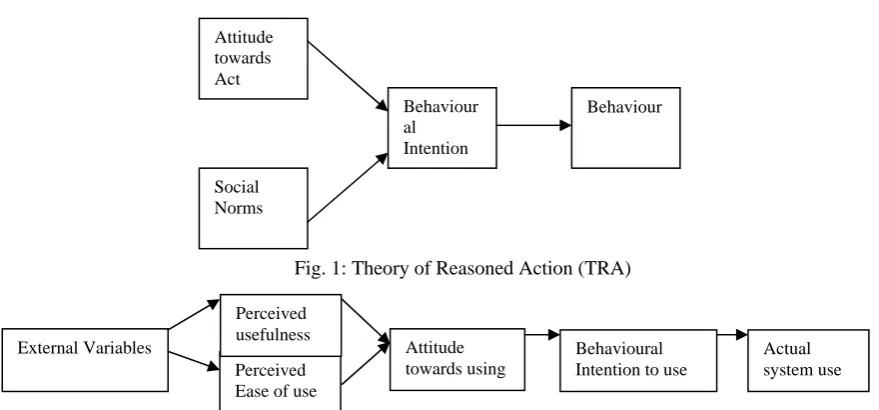
Fig. 1: Theory of Reasoned Action (TRA)
Fig. 2: Technology Acceptance Model
Theory of Reasoned Action (TRA): TRA posits that individual behavior is driven by behavioral intentions where behavioural intentions are a function of an individual's attitude toward the behaviour and subjective norms surrounding the performance of the behavior. Attitude toward the behavior is defined as the individual's positive or negative feelings about performing behaviour. It is determined through an assessment of one's beliefs regarding the consequences arising from a behavior and an evaluation of the desirability of these consequences.
The basic principle behind the theory is that human behaviours are controlled by conscious actions. TRA also suggests that a person’s attitudes are a function of their individual beliefs [7]. As explained by [24], TRA as utilized by [27] is designed to assist researchers in order to address the connections between individuals’ attitudes, beliefs and their behaviours. [24] utilized TRA to examine the specific area of technology utilization.
Technology Acceptance Model (TAM): Developed by [15], the aim of technology acceptance model was to assist explain technology users’ behaviour. Technology acceptance refers to a user’s willingness, agreement, acceptance and continuous use of information technology. It can be categorised into attitude acceptance and behaviour acceptance [36]. Attitude toward using, intention to use and actual use in TAM are indicators of technology acceptance. Ease of use and perceived usefulness are regarded as external variables.
According to [15], perceived usefulness is the level to which a person feels that the use of a particular technology would enhance his or her performance. Additionally, perceived ease of use is the level to which a person feels that the use of a particular technology is free of effort. It was found that perceived ease of use was less significant in determining actual usage than was perceived usefulness. The level of difficulty involved in using a technology was only a secondary consideration for users.
These findings suggest that technology users are willing to tolerate a certain level of difficulty if the technology is capable of performing necessary functions. However, ease of use of a technology does not make up for those technologies that do not provide the user with the desired applications.
These variables have influence over users’ attitudes, intentions to use, and actual usage. Below is the diagram showing TAM constructs and their relationships:
TAM is different from many previous IS models because it does not include subjective norms as one of its constructs in determining actual technology usage. The research of [12] shows how TAM differs from its predecessors. However, because of its widespread usage and popularity among researchers TAM is often used in research as support for many acceptance theories.
Unified theory of acceptance and use of technology (UTAUT): Developed by [26], UTAUT model was formed from the review of eight models proposed by earlier researchers attempting to explain IS usage behaviour. These models include: the theory of reasoned action, technology acceptance model, and motivational model, theory of planned behaviour, a combined theory of planned behaviour/technology acceptance model, model of PC utilization, innovation diffusion theory, and social cognitive theory.
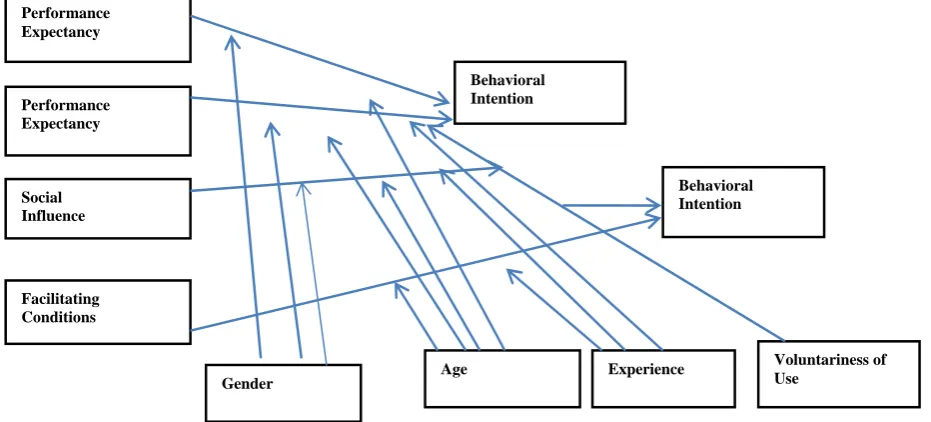
According to the theory, four key constructs (performance expectancy, effort expectancy, social influence, and facilitating conditions) determine usage intention and behaviour ([26]). It was posited that Gender, age, experience, and voluntariness of use are moderators of the impact of the four key constructs on usage intention and behaviour [26]. The relationship between the constructs in the model is represented by the UTAUT model in diagram 4 below:
Attitude towards Act
Social Norms
Behaviour al Intention
Behaviour
External Variables
Perceived Ease of use
Attitude towards using
Behavioural Intention to use
Actual system use Perceived
Fig. 3: Unified theory of acceptance and use of technology (UTAUT) Computer Self-Efficacy (CSE):Computer self-efficacy has
been identified as having a major impact on an individual’s expectations towards using computers ([1]. [1] stated that self-efficacy is an important individual trait that directly correlates to an individual's decision to use computers. [32] stated that the focus is not on the actual skills, but on the judgments one has of what one can do with whatever skills one possesses. Consequently, people who did not see themselves as competent with the computer tend not to use computer.
Perceived computer self-efficacy has been shown to impact on behaviours and outcomes such as a negative effect on computer anxiety and positive impact on performance outcome expectations, personal outcome expectations, and actual systems usage [1].
Studies conducted at the work force [33, 34] found that computer self-efficacy increases performance and reduces computer induced anxiety.
[31] has also noted that teachers' computer self-efficacy is a significant factor determining their patterns of computer use.
Teo et al (2010) examined the computer self-efficacy among pre-service teachers at a teachers training institute in Singapore. It was found that the proliferation of computer
and web-based technologies has generally improved teachers’ confidence with using Basic Computer Skills (BCS), Media-Related Skills (MRS), and Web-Based Skills (WBS) technologies in Singapore. Also a comparison of alternative models revealed that the correlated three-factor and second-order (three-factor) models had the best fits; and were adequate representations of pre-service teachers’ computer self-efficacy.
B. User Satisfaction Models
Satisfaction refers to users’ feelings about an IS either before, during and after use of such an IS. We would examine the following models: DeLone and McLean IS success model, Yield Shift Theory of Satisfaction and Cognitive dissonance theory.
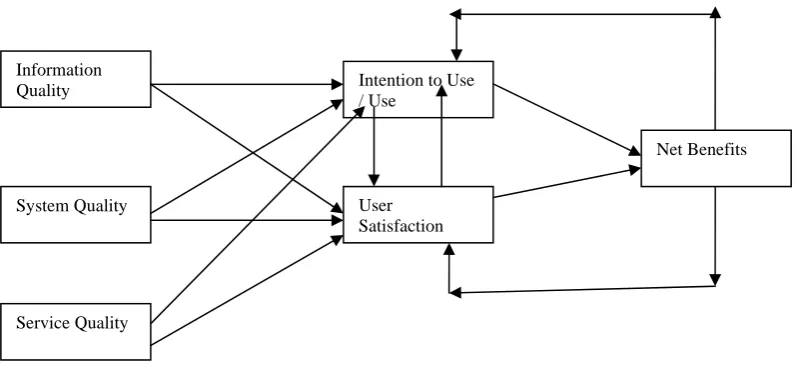
DeLone and McLean's Model of IS Success: In order to provide a general and comprehensive definition of IS success that covers different perspectives of evaluating information systems, DeLone and McLean reviewed the existing definitions of IS success and their corresponding measures, and classified them into six major categories. Thus, they created a multidimensional measuring model with interdependencies between the different success categories ([4]). The concept of the updated model consists of six interrelated dimensions of IS success: information, system and service quality, (intention to) use, user satisfaction, and net benefits [4]. The model can be interpreted as follows: A system can be evaluated in terms of information, system, and service quality; these characteristics affect the subsequent use or intention to use and user satisfaction. As a result of using the system, certain benefits will be achieved. The net benefits will (positively or negatively) influence user satisfaction and the further use of the information system.
Satisfaction with an information system is commonly measured as an indicator of information systems success [37] and has been identified as a precursor of performance impacts in [4] model of IS success.
Performance Expectancy
Social Influence
Facilitating Conditions
Behavioral Intention
Gender Experience
Voluntariness of Use
Age
Behavioral Intention
System Quality Information
Quality Intention to
Use / Use
User Satisfaction
Service Quality
Fig. 4: DeLone and McLean IS Success model (DMLSM) Rai et al. [2002], in their study to assess the validity of [4]
and [19] IS success models, found that IS user satisfaction impacts IS use: a higher level of satisfaction creates greater user dependence on the system.
[4], identified six studies out of the sixteen empirical studies that tested the IS success model with a confirmation of a positive and significant relationship between end-user satisfaction and individual performance.
Cognitive dissonance theory: Developed by Leon Festinger (1957), the theory is concerned with the relationships among cognitions. According to cognitive dissonance theory, there is a tendency for individuals to seek consistency among their cognitions (i.e., beliefs, opinions). When there is an inconsistency between attitudes or behaviors (dissonance), something must change to eliminate the dissonance. In the case of a discrepancy between attitudes and behavior, it is most likely that the attitude will change to accommodate the behavior. Two factors affect the strength of the dissonance: the number of dissonant beliefs, and the importance attached to each belief. The main variables of this theory are: User satisfaction, performance, perception, behavior, usage while the independent variables include: expectations, disconfirmation, attitude, belief.
Yield Shift Theory of Satisfaction: Individuals may hold many goals, ranging from fundamental goals like drawing breath to esoteric goals like scientific discovery or self-actualization. Human cognitive resources are limited, and so cannot assess all of an individual's goals simultaneously. The set of goals currently being processed by the subconscious is called the activity goal set. Yield Shift Theory draws on five assumptions and two propositions to argue that satisfaction responses are a function of perceived shifts in yield for the active goal set. For the logic by which the propositions of Yield Shift Theory were derived, see [38].
Proposition 1: Perceived Yield. At a given moment, the Yield an individual subconsciously perceives for a given goal is a multiplicative function of the utility ascribed to the goal and the assessed likelihood of attaining it.
Proposition 2: Satisfaction Response as a Function of Yield Shift. The magnitude of the satisfaction response is a curvilinear function with a positive but decreasing slope of the absolute value of a yield shift for the active goal set. Yield Shift Theory provides explanations for many satisfaction phenomena that manifest in the IS domain. Satisfaction Phenomena Explained by Yield Shift Theory: Goal attainment effect: Individuals feel satisfied on attainment of a desired state or outcome. They feel dissatisfied when the desired state or outcome is thwarted. Confirmation effect: Individuals feel satisfied when outcomes match expectations or desires, and feel dissatisfied when outcomes are less than expectations or desires. Disconfirmation effect: Individuals feel neutral when outcomes match expectations or desires. They feel satisfied when outcomes exceed expectations or desires; they feel dissatisfied when outcomes are lower than expectations or desires. Anticipation effect: Individuals feel satisfied or dissatisfied when thinking of future goal attainment, even though goals have not yet been attained or thwarted.
Nostalgia effect: Individuals feel satisfied or dissatisfied when thinking about past goal attainment or past failure to attain goals.
Differential effect: Multiple individuals manifest differing levels of satisfaction upon the attainment of goals to which they ascribe similar utility.
Hygiene effect: Individuals feel only neutral or negative about an IT/IS artifact, but never positive.
Mentor effect: Individuals feel more satisfied or dissatisfied after discussions with a trusted advisor, even though current conditions have not changed.
Mixed Feelings: Individuals experience both satisfaction and dissatisfaction with the same IS/IT artefact
System Quality Information
Quality Intention to Use
/ Use
User Satisfaction
Service Quality
diminish over time.
C. Performance Impacts Models
Performance is the accomplishment of a portfolio of tasks by an individual. Performance impact has to do with how well the work is performed or how much value is added/created as a result of using the system. [3] assert that performance impact is a joint function of system utilization and Task Technology Fit (TTF).
The Technology- to- Performance Chain Model (TPC): There is a connection between information technology and user performance. [3] conceptualized the task-to-performance chain (TPC) in order to investigate this link. The framework was based on two separate research angles: (a) the user acceptance and adoption research perspective which investigates user beliefs and attitudes to predict the utilization of information systems [7, 15]; and (b) the fit angle which focuses on the impact of appropriateness of the technologies used by individual IT users in the performance of their tasks [39], Vessey, 1991).
Central to this framework was the task-technology fit construct ([3]).
Task-technology fit (TTF) theory holds that IT is more likely to have a positive impact on individual performance and would be used if the capabilities of the IT match the tasks that the user must perform ([3]).
[3] developed a measure of task-technology fit that consists of 8 factors: quality, locatability, authorization, compatibility, ease of use/training, production timeliness, systems reliability, and relationship with users. Each factor is measured using between two and ten questions with responses on a seven point scale ranging from strongly disagree to strongly agree.
Fig. 5: Technology-to-Performance ([3]).
According to the diagram above, task-technology fit was predicted to influence the ‘precursors of utilization’ and also impact on the performance of the technology user. The conceptualized precursors of utilization (including expected consequences of use, affect towards using, social norms, habit and facilitating conditions) in turn impacted on
performance ([3]).
TTF is seen to be higher when the functionality of a technology and the user’s requirements are similar. Additionally, TTF is lower if the functionality of the technology is less adequate in meeting the needs of the user or when the demands of a task are increased. Individuals have a greater tendency to utilize technology if the capabilities of the technology fit the needs of the individual. Therefore, TTF can be a good predictor of technology utilization.
The basis of the TTF model is that when given more than one option technology users will use the technology that provides them with the most benefits. [3], [18] explained that it is important to note that when the construct of utilization is required, it is not necessary to consider it in the TTF model as all users will show the same outcome for this variable.
As argued by [3], system utilization is more a function of how jobs are designed than the quality or fit of the systems or the attitude of users towards using them. On the contrary, it was discovered that studies focusing on fit alone do not give sufficient attention to the fact that systems must be utilized before they can deliver performance impacts. Hence, the introduction of the technology-to-performance chain [3].
But does the TPC model sufficiently estimate the relationship between the factors playing out in such an ODL compulsory usage environment?
Several empirical studies have validated different aspects of the model [3, 19, 21, 30,].
III.METHODOLOGY
The literature that describes this area of investigation is not indexed in a single database. A strategy that involved searching across multiple databases using search terms was adopted. Most literatures were located in the following categories: Social sciences (S), Information technology (T), and Behaviour/Organization (B), IS Theories (T).
Utilization Affect towards use
Facilitating condition
Habit
Consequences of ili i
Social Norms
TTF
Performance Task Characteristics
Technology Characteristic
Databases searched were: EBSCO compendium, Google scholar, African Journal of Information Systems. The search was intended to provide focus on only studies that focused on models and theories being applied in the field of information systems.
Independent searches were made using the titles, abstracts and keywords for the phrases (‘models in information system usage”, “models in user satisfaction”, or “IT performance models” etc. As not all the database supported boolean phrases in the same way, the search was adapted as required to obtain equivalent results.
IV.DISCUSSION OF FINDINGS
The discussions organized principally into intention-usage based model, satisfaction based models and performance based models. The major aim is to assess the weaknesses of the earlier discussed models and the need for new models. A. Intention-Usage-based Models
In spite of the popularity and significant contributions of the perception-intention-usage models such as TRA, TAM and UTAUT, there is a growing concern that these traditional perception-intention-usage models are deficient in a number of important respects [39, 41].
Firstly, the framework is concentrated on behavioral intention rather than on usage [42]. This situation has resulted to a good number of IS researchers focusing on behavioral intention with comparatively little attention to technology usage and its accompanying outcomes [23, 42, 43].
Secondly, TAM is a good predictor of technology acceptance only when the users willingly choose to use the technology. In a situation where the user is provided with only one option or usage is compulsory, then TAM is not a good indicator of acceptance [13].
Thirdly, TAM offers some insights into the antecedents of user-perceived usefulness and ease of use, but they are not particularly concerned with the extent to which technology meets task-related requirements [14].
Finally, the theory was able to explain % of usage [23, 43]. Despite the key role technology usage play in information system, it has relatively been insufficiently explained [43]. In the application of models to usage of emails, word perfect, Lotus 1-2-3, and Harvard graphics, [46] framework was able to explain 15%, 4%, 35% and 30% respectively. While calling for the formulation of new theories in investing technology usage, [25] asserted, “that the fact that at least 70% of the variance of usage is unexplained suggest the deficiency of the traditional method and the need for new theories on which more robust research model can be built. While investigating personal computing acceptance factors in small firms, 25% of the variance in usage was explained in Igbaria et al (1997) framework. In using a large number of precursors of usage in their framework, [23] was able to explain 30% of usage. While suggesting the need for new models, [44] considered actual usage instead of the traditional perception-intention-usage framework. In his work, [25] showed that on the average, the traditional framework may only explain as low as 14% of the variance on usage”.
B. Satisfaction based Models
Prominent among the three models selected in this group is the DeLone and McLean IS success model. While the yield shift theory of satisfaction stated the statement of assumptions regarding satisfaction without establishing the statistical relationships between these assumptions. The cognitive dissonance theory on the other hand focuses mainly on the user behaviour without much recourse to the assessment of the quality or fit of the technology being used. According to [3], for better performance by IT users, the technology must not only fit the task, it must be used. Several researchers using the [4] model of IS success as a framework have pointed out that utilization may not be influenced by system quality and information quality [45]. The emphasis on system, information and service quality without much attention to the fundamental precursors of utilization such as habit, social norms, competence of the users etc as they affect usage and performance calls for concern ([3,19].
In addition, further identification of other factors necessary to explain constructs like satisfaction is necessary. For instance, in Perez-Mira dissertation on validating the DMIS at organizational level of analysis, the variability of satisfaction, technology use and net benefits were found to be 1%, 18% and 60% respectively. Hence, the deficiencies need to be close up in order to formulate models with higher predictive power.
C. Performance based Models
The TPC model proposed in 1995 is prominent.
However, the none inclusion of satisfaction as a key predictor of utilization and performance in the technology-to-performance model especially in the e-learning domain has been identified as a deficiency associated with this model [6, 26]. In examining the influence of satisfaction, a model exists that support the investigation of the impact of satisfaction from the pre-usage dimension [26]. However, there is a deficiency among the existing known information system models that analyses satisfaction from the post usage experiences of the end users.
Another deficiency with the TPC model is its predictive power. In the original TPC model, 16% of performance impact was explained by TTF and utilization [3]. 31% of learning management system performance was explained by TTF and utilization in [6] studies. Similarly, 58% of performance impact was explained in [19] studies in mandatory usage environment.
The absence of emerging construct such as computer self-efficacy has also been identified by [13].
D. The hybridization of IS Usage and Performance Models
computer self efficacy construct ([1].
As noted by [13], TAM and TTF by themselves are good predictors of technology adoption. However, the combination of the two models showed a better results than either TAM or TTF alone. The analyses showed that the extended model explained more variance than either TAM or TTF alone [13]. Utilization variance explained were 36% with TAM, 41% with TTF, 51% with TAM/TTF [13]. Again, in an extended TPC-related model, computer self-efficacy was added to the model which showed improved explanatory power of the original TPC model [13].
In their separate studies of the consumer e-commerce as a technology adoption process, [48]; evaluated the suitability of both TAM and TTF to understand how and why people participate in electronic commerce. To better understand online shopping activity, this study tested a modified TAM model through a web-based survey of 263 undergraduate students [48]. The results confirmed that a TTF construct was a valuable addition to the TAM model because the extended model explained more variance in the dependent variable.
[18]equally combined some constructs of TAM and TTF to determine and quantify the factors that impact hotel guests’ intentions to seek and utilize guest empowerment technologies.
Other combined models and constructs includes: TTF and Ease of Use (Mathieson and Keil, 1998), TTF and Computer Self-efficacy ([13, 49]), TTF and two (2) constructs [29], TTF and TAM [18, 48]), TTF and Satisfaction [6]).
This work therefore proposes a hybrid model that combines constructs such as ease of use and perceived usefulness from TAM, satisfaction from [4] which is considered critical in influencing usage and performance [6] and computer self-efficacy from [1], [28]; [2]).
from the TPC model as showed in figure 7 below would be used to investigate fit, IT usage, satisfaction and performance outcomes in a mandatory usage environment.
V. CONCLUSION
The increasing adoption and use of modern ICTs have continued to affect the traditional understanding and ways of carrying out our job task in work places. These therefore calls for constant review of existing models aimed at explaining these interactions. A review of the existing models on IS usage and performance, shows some identified deficiencies. For example, studies that focus on intention-usage based models or framework have been identified as models that focus on intention to use IT attitude rather than actually assisting researchers fully understand usage and its outcomes.
The huge amount of unexplained variance associated with the current models whether usage-based, satisfaction-based or performance-satisfaction-based as identified by the study explains the need for further research aimed at providing models with higher explanatory powers.
The work proposed a hybrid model that elaborately examines the key intention to use, IT usage and fit construct as well as the relationship between satisfaction and performance outcomes in a mandatory e-learning environment.
Recommendations for Future Research
Future research should test the proposed model for validity and reliability measures using appropriate statistical and quantitative tools in terms of the models predictive power, path coefficients and item loadings. Research would also be needed to investigate these relationships in mandatory usage environment both at individual and organizations levels of analysis.
Fig.6: The Proposed Technology-Utilization-Satisfaction And Performance Model (TUSPM) Task technology fit
Performance Impact
Satisfaction
Utilization Perceived ease of use
Computer Self-efficacy
Perceived usefulness Attitude towards using
Social Norms
Technology characteristics
Individual characteristics Task characteristics
Habit
REFERENCES
[1] Compeau, D. R., and Higgins, C. A, Application of social cognitive theory to training for computer skills. Information Systems Research, 1995, 6(2): 118-143.
[2] Aguirre-Urreta, Miguel I, The Internal-External Efficacy Model: Towards the Integration of Computer Self-Efficacy and Task Technology Fit into a Comprehensive View" (2011). SIGHCI 2011 Proceedings. Paper 4. http://aisel.aisnet.org/sighci2011/4 [3] Goodhue, D., and Thompson, R., Task technology fit and individual
performance. MIS Quarterly, 1995, 19 (2), 213-236.
[4] DeLone, W., and McLean, E., Information systems success: The quest for the dependent variable. Information Systems Research, 1992, 60-95.
[5] Roca, J.C,Chiub, C, Martıneza, F.J., Understanding e-learning continuance intention: An extension of the Technology Acceptance Model. Int. J. Human-Computer Studies 2006, vol. 64, 683–696.
[6] McGill, Tanya; Klobas, Jane; and Renzi, Stefano, The Relationship between LMS Use and Teacher Performance: The Role of Task-Technology Fit. ACIS 2008 Proceedings. P.82.
[7] Fishbein, M., and Ajzen, I., Belief, attitude, intention, and behaviour : An introduction to theory and research. Reading, Mass. ; Don Mills, Ontario: Addison-Wesley Pub. Co, 1975.
[8] Larsen, K. R., Allen, G., Vance, A., Eargle, D. (Eds.), Theories Used in IS Research Wiki. Retrieved [2014] from http://istheory.byu.edu. 2014.
[9] Bhattacherjee, A. and Premkumar, G., Understanding changes in belief and attitude toward information technology usage: a theoretical model and longitudinal test," MIS Quarterly, 2004, (28.2), pp. 229-254.
[10] Briggs, Robert O.; Reinig, Bruce A., and de Vreede, Gert-Jan, The Yield Shift Theory of Satisfaction and Its Application to the IS/IT Domain. Journal of the Association for Information Systems, 2008, 9(5), pp. 267-293.
[11] Limayenm, Moez; Hirt, Sabine Gabriele; and Cheung, Christy M.K., "Habit in the Context of IS Continuance: Theory Extension and Scale Development" (2003). ECIS 2003 Proceedings. Paper 90. http://aisel.aisnet.org/ecis2003/90
[12] Dishaw M.T and Strong D. M, Extending the technology acceptance model with task- technology constructs. Information & Management 1999, 36 (9-21)
[13] Dishaw, M. Strong, Diane; and Bandy, D. Brent, "The Impact of Task-Technology Fit in Technology Acceptance and Utilization Models". AMCIS 2004 Proceedings. Paper 416.
[14] Tai-Kuei Yu and Tai-Yi Yu, Modelling the factors that affect individuals’ utilization of online learning systems: An empirical study combining the task technology fit model with the theory of planned behaviour. British Journal of Educational Technology 2010, Vol.41 No 6, 1003-1017.
[15] Davis, F.D., Bagozzi, R.P., and Warshaw, P.R, User acceptance of computer technology: a comparison of two theoretical models. Management Science, 1989, 35(8), 982-1003.
[16] Teo T., Pre-service teachers' attitudes towards computer use: A Singapore survey. Australasian Journal of Educational Technology 2008, 24(4), 413-424.
[17] Mathieson, K., Predicting user intentions: comparing the technology acceptance model with the theory of planned behavior. Information Systems Research 1991, 2 (3), 173–191.
[18] Schrier, Thomas, The Utilization of a hybrid task technology fit-technology acceptance model for the evaluation of hotel Guest Empowerment Technologies usage". UNLV Theses/Dissertations/Professional Papers/Capstones. 2009, Paper 45. [19] Staples, D.S., and Seddon, P., Testing the
Technology-to-Performance Chain Model, Journal of Organizational and End User Computing 2004, (16:4), pp 17-36.
[20] Averweg R.U, Information Technology Acceptance in South Africa: An Investigation of Perceived Usefulness, Perceived Ease of Use, and Actual System Use Constructs. The African Journal of Information Systems 2008, Volume 1 | Issue 1 Article 4.
[21] Jarupathirum, S., and Zahedi, F, Exploring the Influence of Perceptual Factors in the Success of Web-Based Spatial DSS, Decision Support Systems, 2007, 43, 933-951.
[22] Rita Kukafka, Stephen B. Johnson, Allison Linfante, and John P. Allegrantec, Grounding a new information technology implementation framework in behavioral science: a systematic analysis of the literature on IT use, Journal of Biomedical Informatics 2003 36 218-227
[23] Straub, D. W., and Burton-Jones, A. Veni, Vidi, Vici: Breaking the TAM Logjam,” Journal of the Association of Information Systems (8:4), 2007, pp. 223-229.
[24] Trice, A.W, Treacy, M.E. Utilization as a dependent variable in MIS research, Data Base (19:3/4), 1988, pp. 33-41
[25] Wu, J., Du, H, A New Theory of Technology Usage," Proceedings > Proceedings of JAIS Theory Development Workshop . Sprouts: Working Papers on Information System, 2010. [26] Venkatesh, V., Morris, M.G., Davis, G.B., and Davis, F.D. (2003).
User acceptance of information technology: Toward a unified view.
Mis Quarterly, 27(3), 425-478.
[27] Ajzen, I., and Fishbein, M. Understanding Attitudes and Predicting Social Behavior, NJ, Englewood Cliffs: Prentice-Hall, 1980.
[28] Eden, D., Ganzach, Y., Granat-Flomin, R., and Zigman, T. (2010). Augmenting Means Efficacy to Improve Performance: Two Field Experiments, Journal of Management, 36, 3, 687-713.
[29] Assefa, Shimelis and Prybutok, Victor, Towards a comprehensive model to predict perceived performance impact of wireless/mobile computing in a mandatory environment AMCIS 2006 Proceedings. Paper 324. http://aisel.aisnet. org/amcis2006/324
[30] Fuller, R.M., and Dennis, A.R., Does fit matter? the impact of task-technology fit and appropriation on team performance in repeated tasks. Information Systems Research,2009, 20(1), 2-17. [31] Albion, P., & Ertmer, P. A, Beyond the foundations: The role of
vision and belief in teachers’ preparation for integration of technology. TechTrends, 2002, 46(5), 34–38.
[32] Bandura, A, Self-efficacy: Toward a unifying theory of behavioral change’’, Psychological Review, 1977, 84, 191-215.
[33] Burkhardt, M.E. & Brass, D.J, Changing patterns or patterns of change: The effects of a change in technology on social network structure and power”, Administrative Science Quarterly, 1990, vol. 35, no. 1. pp. 104-127.
[34] Harrison, A.W. & Rainer, R.R, “Testing the self-efficacy-performance linkage of social- cognitive theory”, Journal of Social Psychology, 1997, vol. 137, no. 1, pp. 79-87.
[35] Rai, A., Lang, S.S., Welker, R.B., Assessing the validity of IS success models: an empirical test and theoretical analysis. Information Systems Research, 2002, 13 (1), 50–69.
[36] Arning, K., Ziefle, M.: Understanding differences in PDA acceptance and performance. Computers in Human Behaviour 23(6), 2904–2927 (2007) 20.
[37] Hwang and ThornThe effect of user engagement on system success: a meta-analytical integration of research findings, Journal of Information and Management Vol 35 Issue 4, 1999, pages 229-336 [38] Briggs, Robert O.; Reinig, Bruce A., and de Vreede, Gert-Jan. The
Yield Shift Theory of Satisfaction and Its Application to the IS/IT Domain. Journal of the Association for Information Systems, 9(5), pp. 267-293.
[39] Benbasat, I., & Barki, H, Quo Vadis, TAM? Journal of the Association for Information Systems 2007, (8:4), pp.211-218. [40] Vessey, I, Cognitive fit: A theory-based analysis of the graphs
versus tables literature. Decision Sciences, 1991, 22(2), 219-240. [41] Bagozzi, R. P, The Legacy of the Technology Acceptance Model
and a Proposal for a Paradigm Shift, Journal of the Association for Information Systems (8:4), 2007, pp. 244-254.
[42] Taylor, S., and Todd, P. A. “Understanding Information Technology Usage: A Test of Competing Models,” Information Systems Research (6:2), 1995, pp. 144-176.
[43] Lee, Y., K. A. Kozar, and Larsen, K. R. T. “The Technology Acceptance Model: Past, Present, and Future,” Communications of t he Association for Information Systems (12) 2003, pp. 752-780. [44] King, W. R., and He, J. “A Meta-Analysis of the Technology
Acceptance Model,” Information & Management (43:6), 2006, pp. 740-755.
pp 1-17.
[46] Adams, D. A., Nelson, R. R., and Todd, P. A. “Perceived Usefulness, Ease of Use, and Usage of Information Technology: A Replication,” MIS Quarterly (16:2), 1992, pp. 227-247.
[47] Evermann, J., Tate, M, Constructs in the Mist: The Lost World of
the IT Artifact," Proceedings > Proceedings of JAIS Theory
Development Workshop . Sprouts: Working Papers on Information
Systems, 2009, 9(42). http://sprouts.aisnet.org/9-42
[48] Klopping, I. M., & McKinney, E. (2004). Extending the technology acceptance model and the task-technology fit model to consumer E-commerce. Information Technology, Learning, and Performance Journal, 22(1), 35-48.
![Fig. 5: Technology-to-Performance ([3]).](https://thumb-us.123doks.com/thumbv2/123dok_us/7849108.1301478/5.595.66.501.461.643/fig-technology-to-performance.webp)
