PRINCE
– A Low-latency Block Cipher for
Pervasive Computing Applications
Full version
Julia Borghoff1?, Anne Canteaut1,2??, Tim G¨uneysu3, Elif Bilge Kavun3, Miroslav Kneˇzevi´c4, Lars R. Knudsen1, Gregor Leander1? ? ?, Ventzislav Nikov4, Christof Paar3, Christian Rechberger1, Peter Rombouts4, Søren S.
Thomsen1, and Tolga Yal¸cın3
1
Technical University of Denmark
2 INRIA, Paris-Rocquencourt, France 3
Ruhr-University Bochum, Germany
4 NXP Semiconductors, Leuven, Belgium
Abstract. This paper presents a block cipher that is optimized with respect to latency when implemented in hardware. Such ciphers are de-sirable for many future pervasive applications with real-time security needs. Our cipher, named PRINCE, allows encryption of data within one clock cycle with a very competitive chip area compared to known solutions. The fully unrolled fashion in which such algorithms need to be implemented calls for innovative design choices. The number of rounds must be moderate and rounds must have short delays in hardware. At the same time, the traditional need that a cipher has to be iterative with very similar round functions disappears, an observation that increases the design space for the algorithm. An important further requirement is that realizing decryption and encryption results in minimum additional costs.PRINCEis designed in such a way that the overhead for decryp-tion on top of encrypdecryp-tion is negligible. More precisely for our cipher it holds that decryption for one key corresponds to encryption with a re-lated key. This property we refer to as α-reflection is of independent interest and we prove its soundness against generic attacks.
1
Introduction
The area of lightweight cryptography, i.e., ciphers with particularly low imple-mentation costs, has drawn considerable attention over the last years. Among the best studied algorithms are the block ciphers CLEFIA, Hight, KATAN, KTAN-TAN, Klein, mCrypton, LED, Piccolo and PRESENT [37, 28, 18, 25, 33, 26, 36,
?
Supported by the Danish research council for Technology and Production Sciences, Grant No.10-093667
??
Partially supported by DGA/DS under Contract 2011.60.055.
? ? ? Partially supported by the Danish-Chinese Center for Applications of Algebraic
10], as well as the stream ciphers Grain, Mickey, and Trivium [27, 2, 19]. Particu-lar interest in lightweight symmetric ciphers is coming from industry, as becom-ing evident in the adoption of CLEFIA and PRESENT in the ISO/IEC Standard 29192-2. The dominant metric according to which the majority of lightweight ciphers have been optimized is chip area, typically measured in gate equivalences (GE), i.e., the cipher area normalized to the area of a 2-input NAND gate in a given standard cell library. This is certainly a valid optimization objective in cases where there are extremely tight power or cost constraints, in particular pas-sive RFID tags. However, depending on the application, there are several other implementation parameters according to which a cipher should have lightweight characteristics. There are several important applications for which a low-latency encryption and instant response time is highly desirable, such as instant au-thentication or block-wise read/write access to memory devices, e.g., solid-state hard disks. There are also embedded applications where current block ciphers in multiple-clock architectures could be sufficiently fast, but the needed high clock rates are not supported by the system. For instance, in many FPGA designs clock rates above 200 MHz are often difficult to realize. It can also be antici-pated that given the ongoing growth of pervasive computing, there will be many more future embedded systems that require low-latency encryption, especially applications with real-time requirements, e.g., in the automotive domain. More-over, [21] as well as [29] show that low-latency goes hand in hand with energy efficiency, another crucial criterion in many (other) applications.
For all these cases, we like to have symmetric ciphers that caninstantaneously encrypt a given plaintext, i.e., the entire encryptionanddecryption should take place within the shortest possible delay. This seemingly simple problem poses a considerable challenge with today’s cryptosystems — in particular if encryption and decryption should both be available on a given platform. Software implemen-tations of virtually all strong ciphers take hundreds or thousands of clock cycles, making them ill suited for a designer aiming for low-latency cryptography. In the case of stream ciphers implemented in hardware, the high number of clock cy-cles for the initialization phase makes them not suitable for this task, especially when secret keys need to be regularly changed. Moreover, if we want to encrypt small blocks selected at random (e.g., encryption of sectors on solid-state disks), stream ciphers are not suited1. This leaves block ciphers as the remaining viable solution. However, the round-based, i.e., iterative, nature of virtually all existing block ciphers, as shown for the case of AES, makes low-latency implementation a non-trivial task. A round-based hardware architecture of the AES-128 requires ten clock cycles to output a ciphertext which we do not consider instantaneous as it is still too long for some applications. As a remedy, the ten rounds can be loop-unrolled, i.e., the circuit that realizes the single round is repeated ten times. Now, the cipher returns a ciphertext within a single clock cycle — but at the cost of a very long critical path. This yields a very slow absolute response time and clock frequencies, e.g., in the range of a few MHz. Furthermore, the unrolled architecture has a high gate count in the range of several tens of thousand GE,
1
implying a high power consumption and costs. Both features are undesirable, es-pecially if one considers that many of the applications for instantaneous ciphers are in the embedded domain. Following the same motivation and reasoning as above [21] compares several lightweight ciphers with respect to latency and as a conclusion calls for new designs that are optimized for low-latency.
Our Contribution. Based on the above discussion our goal is to design a new block cipher which is optimized with respect to the following criteria if implemented in hardware:
1. The cipher can perform instantaneous encryption, a ciphertext is computed within a single clock cycle. There is no warm-up phase.
2. If implemented in modern chip technology, low delays resulting in moderately high clock rates can be achieved.
3. The hardware costs are moderate (i.e., considerably lower than fully unrolled versions of AES or PRESENT).
4. Encryption and decryption should both be possible with low costs and over-head.
We would like to remark that existing lightweight ciphers such as PRESENT donot fulfill Criteria 2 and 3 (low delay, small area) due to their large number of rounds. In order to fulfill Criterion 4, one needs to design a cipher for which decryption and encryption use (almost) identical pieces of hardware. This is an important requirement since the unrolled nature of instantaneous ciphers leads to circuits which are large and it is thus clearly advantageous if large parts of the implementation can be used both for encryption and decryption.
Besides designing a new lightweight cipher that is for the first time optimized with respect to the goals above, PRINCE has several innovative features that we like to highlight.
First, a fully unrolled design increases the possible design choices enormously. With a fully unrolled cipher, the traditional need that a cipher has to be iterative with very similar round functions disappears. This in turn allows us to efficiently implement a cipher where decryption with one key corresponds to encryption with a related key. This property we refer to as α-reflection is of independent interest and we prove its soundness against generic attacks. As a consequence, the overhead of implementing decryption over encryption becomes negligible. Note that previous approaches to minimizing the overhead of decryption over encryption, for example in the ciphers NOEKEON and ICEBERG usually re-quire multiplexer in each round. While for a round-based implementation this does not make a difference, our approach is clearly preferable for a fully unrolled implementation, as we require multiplexer only once at the beginning of the circuit.
perform well in another technology, we propose the PRINCE-family of ciphers that allows to freely choose the Sbox within a (large) set of Sboxes fulfilling certain criteria. Our choice for the linear layer can be seen as being inbetween a bit-permutation layer PRESENT (implemented with wires only) and AES (implemented with considerable combinatorial logic). With the expense of only 2 additional XOR-gates per bit over a simple bit-permutation layer, we achieve an almost-MDS property that helps to prove much better bounds against various classes of attacks and in turn allows to significantly reduce the number of rounds and hence latency.
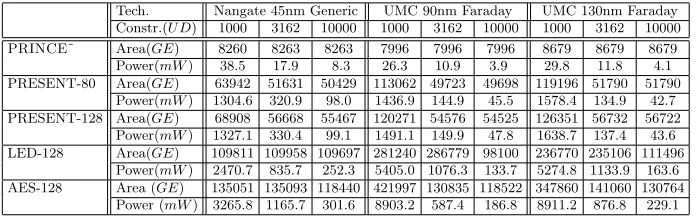
As a result, PRINCE compares very favorable to existing ciphers. For the same time constraints and technologies,PRINCEuses6-7times less area than PRESENT-80 and 14-15 times less area than AES-128. In addition to this, our design uses about 4-5times less area than other ciphers in the literature (see Section 5 and in particular Tables 1 and 2 for a detailed comparison and technology details). To facilitate further study and fairer comparisons, we also report synthesis results using the open-source standard-cell library NANGATE [34]. We also like to mention that, although this is not the main objective of the cipher,PRINCEcompares reasonably well to other lightweight ciphers when implemented in a round-based fashion.
We believe that our consideration can be of major value for industry and can at the same time stimulate the scientific community to pursue research on lightweight ciphers with different optimization goals.
Organization of the Paper. We introduce an instance ofPRINCE-family of ciphers and state our security claims in Section 2. Design decisions are discussed in Section 3 where we also describe the entirePRINCE-family. We provide secu-rity proofs and evaluations considering cryptanalytical attacks in Section 4. In Section 5 we finally present implementation results and comparisons with other lightweight ciphers for a range of hardware technologies.
2
Cipher Description
PRINCE is a 64-bit block cipher with a 128-bit key. The key is split into two parts of 64 bits each,
k=k0||k1 and extended to 192 bits by the mapping
(k0||k1)→(k0||k00||k1) := (k0||(k0≫1)⊕(k063)||k1).
PRINCEis based on the so-calledF Xconstruction [7, 30]: the first two sub-keysk0 andk00 are used as whitening keys, while the keyk1is the 64-bit key for a 12-round block cipher we refer to as PRINCEcore. We provide test vectors in
m
k0
PRINCEcore
k00
c
Specification ofPRINCEcore.
The whole encryption process ofPRINCEcore is depicted below.
S M
1
k
1
R R2 R3 R4 R5 S M’ -1
S R61 R71 R81 R91 R101
1
k k1 k1 k1 k1 k1 k1 k1 k1 k1
RC1 RC2 RC3 RC4 RC5
1
k k1
RC6 RC7 RC8 RC9 RC10
RCi
S -1
M -1
1
k RCi
RC0 RC11
Each round of PRINCEcore consist of a key addition, an Sbox-layer, a linear
layer, and the addition of a round constant.
ki-add. Here the 64-bit state is xored with the 64-bit subkey.
S-Layer. The cipher uses one 4-bit Sbox. The action of the Sbox in hexadecimal notation is given by the following table.
x 0 1 2 3 4 5 6 7 8 9 A B C D E F
S[x] B F 3 2 A C 9 1 6 7 8 0 E 5 D 4
The Matrices: M/M0-layer. In theM andM0-layer the 64-bit state is mul-tiplied with a 64×64 matrixM (resp.M0) defined in Section 3.3.
RCi-add. In theRCi-add step a 64-bit round constant is xored with the state.
We define the constants used below (in hex notation)
RC0 0000000000000000
RC1 13198a2e03707344
RC2 a4093822299f31d0
RC3 082efa98ec4e6c89
RC4 452821e638d01377
RC5 be5466cf34e90c6c
RC6 7ef84f78fd955cb1
RC7 85840851f1ac43aa
RC8 c882d32f25323c54
RC9 64a51195e0e3610d
RC10 d3b5a399ca0c2399
Note that, for all 0≤i≤11,RCi⊕RC11−iis the constantα=c0ac29b7c97c50dd,
RC0 = 0 and that RC1, . . . , RC5 and α are derived from the fraction part of
π= 3.141....
From the fact that the round constants satisfyRCi⊕RC11−i=αand that
M0 is an involution, we deduce that the core cipher is such that the inverse ofPRINCEcoreparametrized withkis equal toPRINCEcoreparametrized with
(k⊕α). We call this property ofPRINCEcoretheα-reflection property. It follows
that, for any expanded key (k0||k00||k1),
D(k0||k00||k1)(·) =E(k00||k0||k1⊕α)(·)
whereαis the 64-bit constantα=c0ac29b7c97c50dd. Thus, for decryption one only has to do a very cheap change to the master key and afterwards reuse the exact same circuit.
Security Claims. For an adversary that is able to acquire 2nplaintext/ciphertext
pairs in a model with a single fixed unknown keyk, we claim that the effort to find the key is not significantly less expensive than 2127−ncalls to the encryption
or decryption function. In Section 4.1 we give a bound matching this claim in the ideal cipher model that does consider the special relation between the en-cryption and deen-cryption operations. One way to interpret this is that any attack violating our security claim will have to use more properties of the cipher than the relation between the encryption and decryption operations.
We explicitly state that we do not have claims in related-key or known- and chosen-key models as we do not consider them to be relevant for the intended use cases. In particular, as for any cipher based on theF X construction or on the Even-Mansour scheme [22], there exists a trivial distinguisher forPRINCE in the related-key model: for any difference∆, the ciphertexts corresponding to
m and (m⊕∆) encrypted under keys (k0||k1) and ((k0⊕∆)||k1) respectively, differ from ((∆≫1)⊕(∆63)) with probability 1.
Reduced Versions. Many classes of cryptanalytic attacks become more dif-ficult with an increased number of rounds. In order to facilitate third-party cryptanalysis and estimate the security margin, reduced-round variants need to be considered. We encourage to study round-reduced variants ofPRINCEwhere the symmetry around the middle is kept, and rounds are added in an inside-out fashion, i.e. for every additional round<iits inverse is also added. Another
nat-ural way to reducePRINCEis to consider the cipher without the key whitening layer,PRINCEcore.
3
Design Decisions
number of rounds and still achieve security against linear and differential attacks, we adopted the wide-trail strategy [13]. As not all round functions have to be identical for a cipher aiming for a fully unrolled implementation asPRINCE, it is very tempting to directly use the concept of code-concatenation [16] to achieve a high number of active Sboxes over 4 rounds of the cipher. However, not only a serial implementation benefits from similar round functions. It is also very helpful for ensuring a minimum number of active Sboxes. Assume that, using the code-concatenation approach, one can ensure that roundsRitoRi+3have at least 16 active Sboxes. While this is nice, the problem is that it does not ensure that roundsRi−1 to Ri+2 or Ri+1 to Ri+4 have 16 active Sboxes as well if the individual rounds are very different in nature. We therefore decided to follow a design that on one hand allows to use the freedom given by a fully enrolled design and on the other hand still keeps the round functions similar enough to prove some bounds on the resistance against linear and differential attacks.
In this context, one of the main features of the design is that decryption can be implemented on top of encryption with a minimal overhead. This is achieved by designing a cipher which is symmetric around the middle round, a very simple key scheduling, and a special choice of round constants.
3.1 Aligning Encryption with Decryption
The use of a core cipher having the α-reflection property, with two additional whitening keys, offers a nice alternative to the usual design strategy which con-sists in using involutional components — Noekeon [14], Khazad [4], Anubis [3], Iceberg [39] or SEA [38] are some examples of such ciphers with involutional com-ponents. Actually, the general construction used in PRINCE has the following advantages:
– It allows a much larger choice of Sboxes, which may lead to a lower imple-mentation cost, since the Sbox is not required to be an involution. It is worth noticing that the fact that both the Sbox and its inverse are involved in the encryption function does not affect the cost of the fully-unrolled implemen-tations we consider;
– In ciphers with involutional components, the overhead due to the implemen-tation of the inverse key scheduling can be reduced by adding some symmetry in the subkey sequence. But this may introduce weak keys or potential slide attacks. The fact that all components are involutions may also introduce some regularities in the cyclic structure of the cipher which can be exploited in some attacks [6]. The resistance of PRINCEto this type of attacks will be extensively discussed in Section 4.2.
– It is an open problem to prove the security of ciphers with ideal, involutional components against generic attacks. We show in Section 4.1 that ciphers with theα-reflection property (for α6= 0) has a proof of security similar to that of theF X construction.
3.2 The PRINCE-Family: Choosing the Sbox
As discussed in more detail in Section 5, the cost of the Sbox, i.e., its area and critical path, is a substantial part of the overall cost. Thus, choosing an Sbox which minimizes those costs is crucial for obtaining competitive results. As the cost of an Sbox depends on various parameters, such as the technology, the synthesis tool, and the library used, one cannot expect that there is one optimal Sbox for all environments. In fact, in order to achieve optimal results it is preferable to choose your favorite Sbox. In order to ensure the security of the resulting design, an SboxS:F42→F
4
2 for thePRINCE-Family has to fulfill the following criteria.
1. The maximal probability of a differential is 1/4 2. There are exactly 15 differentials with probability 1/4. 3. The maximal absolute bias of a linear approximation is 1/4. 4. There are exactly 30 linear approximations with absolute bias 1/4. 5. Each of the 15 non-zero component functions has algebraic degree 3.
As it can be deduced for example from [32] up to affine equivalence there are only 8 Sboxes fulfilling those criteria. Thus, another way of defining an Sbox for the PRINCE-Family is to say that it has to be affine equivalent to one of the eight Sboxes Si given in Table 3 in Appendix B.
3.3 The Linear Layer
In theM and M0-layer the 64-bit state is multiplied with a 64×64 matrix M
(resp. M0) defined below. We have different requirements for the two different linear layers. The M0-layer is only used in the middle round, thus M0 has to be an involution to ensure the α-reflection property. This requirement does not apply for theM-layer used in the round functions. Here we want to ensure full diffusion after two rounds. To achieve this we combine theM0-mapping with an application of matrixSR which behaves like the AES shift rows and permutes the 16 nibbles in the following way
0 1 2 3 4 5 6 7 8 9 10 11 12 13 14 15 −→ 0 5 10 15 4 9 14 3 8 13 2 7 12 1 6 11
ThusM =SR◦M0.
Additionally the implementation costs should be minimized, meaning that the number of ones in the matrices M0 and M should be minimal, while at the same time it should be guaranteed that at least 16 Sboxes are active in 4 consecutive rounds (cf. Appendix C.1 for details). Thus, trivially each output bit of an Sbox has to influence 3 Sboxes in the next round and therefore the minimum number of ones per row and column is 3. Thus we can use the following four 4×4 matrices as building blocks for theM0-layer.
M0=
0000 0100 0010 0001
, M1=
1000 0000 0010 0001
, M2=
1000 0100 0000 0001
, M3=
In the next step we generate a 4×4 block matrix ˆM where each row and column is a permutation of the four 4×4 matricesM0, . . . , M3. The row permutations are chosen such that we obtain a symmetric block matrix. The choice of the building blocks and the symmetric structure ensures that the resulting 16×16 matrix is an involution. We define
ˆ
M(0)=
M0M1M2M3
M1M2M3M0
M2M3M0M1
M3M0M1M2
ˆ
M(1)=
M1M2M3M0
M2M3M0M1
M3M0M1M2
M0M1M2M3
.
In order to obtain a permutation for the full 64-bit state we construct a 64×64 block diagonal matrixM0with ( ˆM(0),Mˆ(1),Mˆ(1),Mˆ(0)) as diagonal blocks. The matrixM0is an involution with 232fixed points, which is average for a randomly chosen involution [24, Page 596]. The linear layerM is not an involution anymore due to the composition ofM0 and shift rows, which is not an involution.
3.4 The Key Expansion
The 128-bit key (k0||k1) is extended to a 192-bit key (k0||k00||k1) by a linear mapping of the form
(k0||k1)7→(k0||P(k0)||k1).
This expansion should be such that it makes peeling of rounds (both at the beginning and at the end) by partial key guessing difficult for the attacker. In particular, we would like that each pair of subkeys amongk1 and the quantities (k0⊕k1) and (k00⊕k1) takes all the 2128possible values when (k0||k1) varies in the set of 128-bit words. In other words, the set of all triples (k0||P(k0)||k1) should correspond to an MDS code of length 3 and size 2128overF64
2 . This equivalently means that both x7→P(x) and x7→x⊕P(x) should be permutations ofF64
2 . Note that no bit-permutationP satisfies this condition. Indeed, both the all-zero vector and the all-one vector satisfy P(x)⊕x= 0.
Thus, a hardware-optimal choice for P such that both P and P ⊕Id are permutations is
P(x) = (x≫1)⊕(x63),
i.e.,P(x63, . . . , x0) = (x0, x63, . . . , x2, x1⊕x63). Then, we can easily check that
P(x) = 0 (resp.P(x) =x) has a unique solution.
4
Security Analysis
This section investigates the security of the general construction of PRINCE. In particular, we show that the α-reflection property of the core cipher does not introduce any generic attack with complexity significantly lower than the known generic attacks against theF X construction. However, in the particular case of PRINCEcore, the α-reflection property comes from some symmetries in
we investigate in Section 4.2 whether weaknesses similar to those identified for involutional ciphers could also appear in the case of PRINCE. An evaluation of the security of PRINCE regarding more classical attacks, including linear, differential and algebraic but also to the recently introduced biclique attacks is provided in Appendix C).
4.1 On Generic Attacks: Security Proof
TheF X construction, introduced by Rivest for increasing the resistance of DES to exhaustive key-search [7], consists in deriving a block cipherEwith (2n+κ )-bit key andn-bit block from a block cipherF withκ-bit key andn-bit block by xoring the input and output ofF with a pre-whitening key and a post-whitening key:
Ek0,k1,k2(x) =Fk1(x⊕k0)⊕k2.
Kilian and Rogaway [30, 31] proved that, if the core cipherF is ideal, then this construction achieves (κ+n−1−logT)-bit security where T is the number of pairs of inputs and outputs forF known by the attacker. This result obviously does not apply in the case of PRINCEsince the core cipherF inPRINCEcan be easily distinguished from a family of random permutations due to the α -reflection property, i.e.,Fk−1 =Fk⊕α for anyk. Here, we want to quantify the
impact of this property on the generic attacks against the F X construction. For instance, it appears that a decryption oracle also gives a related-key oracle with the fixed-key relation (k0, k2, k1)→(k2, k0, k1⊕α) and it is important to determine whether an adversary can profit from this relation.
A similar question was investigated by Kilian and Rogaway for showing that the complementation property of DES decreases the security level by a single bit [30, Section 4]. In the case of theα-reflection property, we like to model the core cipherF as an ideal cipher, that is as a set of random permutations, with the (only!) additional relation thatFk⊕α(x) =Fk−1(x). Informally, this can be
seen as picking only half of the 2κpermutations independently at random, while
the second half is defined by the encryption vs decryption relation above. More precisely, we consider forF a keyed permutation with a (κ−1)-bit key, operating onn-bit blocks. Letαbe a nonzero element inFκ
2. We decompose the set ofκ-bit words into two subsets asFκ
2 =H∪(α⊕H) whereH is some linear subspace of dimension (κ−1) which does not containα,e.g., if lsb(α) = 1,H is the set of alln-bit wordsxwith lsb(x) = 0. In the following,H is identified with the set of (κ−1)-bit words. It is worth noticing that such a decomposition does not exist when α = 0, i.e., when F is an involution. Therefore, the following construction is defined for α6= 0 only. Now, we derive from F a block cipher with (2n+κ) key bits andn-bit blocks:
Ek0,k1,k2(m) =
Fk1(m⊕k0)⊕k2 ifk1∈H
Fk−1
This construction, we refer to as ˜F X-construction, corresponds to theF X con-struction applied to ˜F where ˜F is the family of 2κ permutations defined by
˜
Fk(x) =
Fk(x) ifk∈H
Fk−⊕1α(x) ifk∈(α⊕H)
The only difference with the construction considered in the case of the com-plementation property is thatF is extended by using the inverse permutations
Fk, k∈H, instead of the permutations themselves. But, we can obtain a similar
result.
More precisely, when analyzing the original F X construction, Kilian and Rogaway [30] consider the following problem. LetAbe an adversary with access to three oracles: E, F and F−1. During the game, the adversary may make queries to E, to F andF−1. Any query to theF/F−1 oracle consists of a pair (k, x) in Fκ
2 ×Fn2 and the oracle returns an element in Fn2. A query to the
E oracle consists of ann-bit element, and an n-bit value is returned. The aim of this adversary is then to guess whether theEoracle computesF Xk for some
random key k, or if it computes π for a random permutation of Fn
2. Then, a game-hoping argument leads to the following upper-bound on the advantage of any such adversary.
Theorem 1. [30] The advantage of any adversary who makesD queries to the
E oracle and T queries to the F/F−1 oracle satisfies
AdvCPAF X(A) = Pr[k
$
←Fκ2+2n, F ←$ (Pn)2 κ
: AF Xk,F,F−1 = 1]
−Pr[π← P$ n, F
$ ←(Pn)2
κ
: Aπ,F,F−1
= 1]
≤DT2
−(n+κ−1),
where x ←$ S means that x is uniformly chosen at random from a set S, Pn denotes the set of permutations ofFn
2 andF
$ ←(Pn)2
κ
means thatF is a family of 2κ independently chosen random permutations.
We deduce a similar result for theF Xe construction.
Corollary 1. The advantage of any adversary who makesDqueries to theE or-acle and T queries to the F/F−1 oracle satisfies
AdvCPA e
F X(A) = Pr[k
$
←Fκ2+2n, F ←$ (Pn)2 κ−1
: AF Xe k,F,F−1 = 1]
−Pr[π← P$ n, F
$ ←(Pn)2
κ−1
: Aπ,F,F−1
= 1]
≤DT2
Proof. We decompose
Pc= Pr[k
$
←Fκ2+2n, F ←$ (Pn)2 κ−1
: AF Xe k,F,F−1 = 1]
= Pr[k0, k2
$ ←Fn2, k1
$
←H, F ←$ (Pn)2 κ−1
: AF Xke 0,k1,k2,F,F−1 = 1]
×Pr[k1∈H] + Pr[k0, k2
$ ←Fn2, k1
$
←α⊕H, F ←$ (Pn)2 κ−1
: AF Xe k0,k1,k2,F,F −1
= 1]
×Pr[k1∈α⊕H] = 1
2Pr[k0, k2
$ ←Fn2, k1
$
←H, F ←$ (Pn)2 κ−1
: AF Xk0,k1,k2,F,F −1
= 1]
+1
2Pr[k0, k2
$ ←Fn2, k1
$
←H, F ←$ (Pn)2 κ−1
: AF−1X
k0,k1,k2,F,F −1
= 1],
since
e
F Xk0,k1,k2(x) =
F Xk0,k1,k2(x) ifk1∈H
F−1X
k0,k1⊕α,k2(x) ifk1∈α⊕H .
Obviously,
Pr[AF−1Xk0,k1,k2,F,F −1
= 1] = Pr[AF Xk0,k1,k2,F,F −1
= 1]
leading to
Pc= Pr[k0, k2
$ ←Fn2, k1
$
←H, F ←$ (P2κ−1
n ) : A
F Xk0,k1,k2,F,F −1
= 1].
It directly follows from Theorem 1 that
AdvCPA e
F X(A) =Adv CPA
F X(A)≤DT2
−(n+κ−2).
u t
As noticed in [30], this bound is still valid in a chosen-ciphertext scenario; it can also be extended to the case where the whitening keys are related, for instance ifk2=k0 ork2=P(k0) as inPRINCE. Both generalizations apply to theF Xe
construction as well.
The bound obtained for theF Xconstruction is achieved, for instance by the slide attack due to Biryukov and Wagner [8] and by its recent generalization named slidex [20]. A chosen-plaintext variant of this attack allows to exploit the
α-reflection property for reducing the security level by one bit, compared to the originalF X construction. This attack, detailed in Appendix D, has an average time complexity corresponding to 2κ+n−log2Dcomputations of the core cipherF
for any numberDof pairs of chosen plaintexts-ciphertexts.
4.2 Impact of the construction implementing the α-reflection property
As mentioned earlier, one particular feature ofPRINCEis theα-reflection prop-erty ofPRINCEcore. But, not surprisingly, the construction we used for
round, and care has to be taken when designing a cipher with such a structure. In this section we analyse the influence of this construction on the security of the cipher. In particular, we are interested in the so-called profile of the core cipher, i.e., in the sequence of the lengths of all cycles in the decomposition of
PRINCEcore.
A first strategy for exploiting some information on the profile of the core cipher is the following. If the decomposition of the core cipher is independent from the key, then this decomposition can be used as a distinguishing property for recovering some information on the whitening keys. The simplest illustration of this type of attack is when the core cipher is an involution,i.e.whenα= 0 which is the only case where Corollary 1 does not apply. Indeed, the attack presented by Dunkelmanet al.[20, Section 5.2] allows to recover the sum of the two whitening keys (k0⊕k2) in theF Xconstruction whenF is an involution. This attack uses the fact that for two plaintext-ciphertext pairs (m, c) and (m0, c0) related by
m0 =E−1
k0,k1,k2(m⊕k0⊕k2) it holds thatm⊕c=m
0⊕c0. Indeed,
m0⊕c0=Ek−1
0,k1,k2(m⊕k0⊕k2)⊕m⊕k0⊕k2
=k0⊕Fk−11(m⊕k0)⊕m⊕k0⊕k2=Fk1(m⊕k0)⊕m⊕k2
=m⊕c
where the last-but-one equality uses that Fk1 is an involution. Thus,
plaintext-ciphertext pairs (m, c) and (m0, c0) such that c0 = m⊕k0⊕k2 can be easily detected. Such a collision can be found if the attacker has access to 2n+12 known
plaintext-ciphertext pairs, and it provides the value of (k0⊕k2). Moreover, in the particular case of PRINCE, k2 is related to k0 by k2 = P(k0) where x7→
x⊕P(x) is a permutation (see Section 3.4). Therefore, the whitening key k0 can be deduced from (k0⊕k2) in this case. It follows that, when the core cipher is an involution, the whole key can then be recovered with time complexity 2κ (corresponding to an exhaustive search fork1) and data complexity 2n+12 . This
confirms that Corollary 1 does not hold forα= 0.
This type of attack can be generalized to the case where the profile of the core cipher does not depend on k1: since PRINCEcore has a reasonable block
size, its cycle structure could be precomputed and then used as a distinguishing property for (k0⊕k2). Indeed, the profile ofEk0,k1,k2 :m7→k2⊕Fk1(m⊕k0)
depends on (k0⊕k2) only. It follows that, for eachn-bit wordδ, we could compute one or a few cycles of x7→Fk1(x⊕k0⊕k2⊕δ) in a chosen-plaintext scenario
where the attacker knows a sequence of plaintext-ciphertext pairs (mi, ci) with
mi+1 =ci⊕δ. A valid candidate for (k0⊕k2) is a valueδwhich leads to a cycle having a length which appears in the precomputed profile ofFk1.
We checked whether the cycle structure ofPRINCEcorehas some peculiarities
which do not depend on its key. Based on the technique used by Biryukov for analyzing involutional ciphers [6], we can observe the profile of the reduced version ofPRINCEcore with 4 Sbox layers where we keep the symmetry around
written as
G= R5−1◦Addk1⊕α
◦ S−1◦M0◦S
◦(Addk1◦R5)
whereR5corresponds to<5 without the key addition. SinceS−1◦M0◦S is an involution, the cycle structure of Addk1⊕α◦ S
−1◦M0◦S
◦Addk1 depends onα
only and not onk1. Its profile then remains unchanged after a right composition withR5and a left composition with its inverse. However, this property does not hold anymore when an additional round is included since the next key addition Addk1⊕α◦G◦Addk1modifies the cycle structure ofGin a way which depends on
the valuesG, and not only on its profile. Therefore, it appears that the previously mentioned attack strategy does not apply ifPRINCEcore contains more than 6
Sbox layers.
In the light of the previous analysis, a more relevant attack method consists in using the fact that the core cipher may have a peculiar cycle decomposition for some weak keys. For instance, if there exists some weak keys k1 for which PRINCEcore is an involution, then this class of keys can be detected from the
knowledge of 2n+12 pairs of plaintext-ciphertext by counting the number of
colli-sions form⊕c. And the technique from [20] that we have previously described also recovers the whitening key. It is worth noticing that this attack applies to DESX and allows to detect the use of the four weak keys of DES [17] for which DES is an involution. A similar weakness would appear if, in PRINCEcore, we
have used two subkeys k1 andk01 in turn as round keys. Keeping the remaining structure ofPRINCEcoreresults in the following relation
F(−k1
1||k01)=F(k 0
1⊕α||k1⊕α).
However, this has serious – and interesting – consequences for the security of the resulting cipher. For the class of keys such thatk10 =k1⊕α, it holds that
F(−k1
1||k01)
=F(k1||k10),
that is, the core cipher is an involution. This class of weak keys can then be easily detected. It then appears that some particular related-key distinguishers for the core cipher may be exploited for detecting the corresponding class of keys. To be very clear, we do not consider related key-attacks here in the classical sense of enlarging the power of an adversary. But without a careful choice, the construction we used for implementing theα-reflection property might result in key-recovery attacks for certain weak-key classes, as soon as the core cipher is vulnerable to related key-attacks.
5
Implementation
the cost of each function was investigated and each component was carefully designed in order to get the lowest possible gate count without compromising security. One of the most critical and expensive operations of the cipher is the substitution, where we use the same Sbox 16 times (rather than having 16 differ-ent Sboxes). Therefore, the implemdiffer-entation ofPRINCEstarted with a search for the most suitable Sbox for the target design specifications. In order to achieve an implementation with low delay and gate count, we analyzed many Sbox in-stances to identify one with optimal combinational logic and propagation paths. Then, the targeted unrolled design was implemented with the resultingoptimal Sbox.
In the implementation process, Cadence NCVerilog 06.20-p001 is used for simulation andCadence Encounter RTL Compiler v10.1for synthesis. Since gate count and delay parameters are heavily technology dependent, the implementa-tions have been synthesized for three different technology libraries: 130 nm and 90 nm low-leakage Faraday libraries from UMC, and 45 nm generic NANGATE Open Cell Library. In all syntheses, typical operating conditions were assumed.
The unrolled version of PRINCE is a direct mapping to hardware of the cipher defined in Section 2. Multiplexers select encryption and decryption keys accordingly. The only costs associated with the key whitening stages are XOR gates and multiplexers used for whitening key selection. However, in practice, due to the unrolled nature of the implementation, these additions reduce to XOR operations with constants, which in turn reduce to inverters or no additional gates at all. Furthermore, these inverters are combined with the preceding or following matrix multiplications, which are implemented with cascaded XOR gates. In cases where an XOR is sourced by the output from an inverter, or is sourcing input of an inverter, it is simply replaced by an XNOR gate and the sourced/sourcing inverter is removed. Since both XOR and XNOR have the same gate count, the overall effect of the round constant addition on area reduces to zero.
compar-ison, Table 2 shows the extrapolated results (which are calculated by removing register and control logic area from the total gate count, and multiplying the rest by the number of rounds) for other unfolded cipher instances obtained from round-based cipher implementations provided by previous works. Note that all ciphers in the table include encryption and decryption functionality with 128-bit key size, however the comparison is difficult as the block size is different in some cases (also note that the ciphers having 128-bit block size are obviously much bigger and more power consuming than a 64-bit block cipher).
We also measured maximum frequencies achievable by unrolled versions of PRINCEunder two different conditions: The frequency where the area of synthe-sized design starts to deviate from the unconstrained area – 158.9, 38.4 and 35.5 MHz, and the frequencey where the timing slack becomes zero – 212.8, 71.8 and 54.3 MHz. Both figures are given for 45 nm, 90 nm, and 130 nm, respectively.
Table 1.Area/power comparison of unrolled versions ofPRINCEand other ciphers
Tech. Nangate 45nm Generic UMC 90nm Faraday UMC 130nm Faraday
Constr.(U D) 1000 3162 10000 1000 3162 10000 1000 3162 10000
PRINCE˜ Area(GE) 8260 8263 8263 7996 7996 7996 8679 8679 8679
Power(mW) 38.5 17.9 8.3 26.3 10.9 3.9 29.8 11.8 4.1
PRESENT-80 Area(GE) 63942 51631 50429 113062 49723 49698 119196 51790 51790
Power(mW) 1304.6 320.9 98.0 1436.9 144.9 45.5 1578.4 134.9 42.7
PRESENT-128 Area(GE) 68908 56668 55467 120271 54576 54525 126351 56732 56722
Power(mW) 1327.1 330.4 99.1 1491.1 149.9 47.8 1638.7 137.4 43.6
LED-128 Area(GE) 109811 109958 109697 281240 286779 98100 236770 235106 111496
Power(mW) 2470.7 835.7 252.3 5405.0 1076.3 133.7 5274.8 1133.9 163.6
AES-128 Area (GE) 135051 135093 118440 421997 130835 118522 347860 141060 130764
Power (mW) 3265.8 1165.7 301.6 8903.2 587.4 186.8 8911.2 876.8 229.1
Table 2.Extrapolated area of unrolled versions of other ciphers againstPRINCE
Technology Area* (GE)
CLEFIA-128 [1] 28035 (18 rounds unfolded, 130nm CMOS) HIGHT-128 [28] 42688 (32 rounds unfolded, 250nm CMOS) mCrypton-128 [33] 37635 (13 rounds unfolded, 130nm CMOS) Piccolo-128 [36] 25668 (31 rounds unfolded, 130nm CMOS) * Area requirements extrapolated from round-based implementations.
References
1. Toru Akishita and Harunaga Hiwatari. Very Compact Hardware Implementations of the Blockcipher CLEFIA. InSelected Areas in Cryptography - SAC 2011, volume 7118 ofLNCS. Springer, 2011.
2. Steve Babbage and Matthew Dodd. The MICKEY Stream Ciphers. In Robshaw and Billet [35], pages 191–209.
4. Paulo S.L.M. Barreto and Vincent Rijmen. The Khazad Legacy-level Block Ci-pher. Submission to the NESSIE project, 2000. http://www.larc.usp.br/ pbar-reto/KhazadPage.html.
5. Daniel J. Bernstein. The Salsa20 Family of Stream Ciphers. In Robshaw and Billet [35], pages 84–97.
6. Alex Biryukov. Analysis of Involutional Ciphers: Khazad and Anubis. In Fast Software Encryption - FSE 2003, volume 2887 ofLNCS, pages 45–53. Springer, 2003.
7. Alex Biryukov. DES-X (or DESX). InEncyclopedia of Cryptography and Security (2nd Ed.), page 331. Springer, 2011.
8. Alex Biryukov and David Wagner. Advanced Slide Attacks. InAdvances in Cryp-tology - EUROCRYPT 2000, volume 1807 ofLNCS, pages 589–606. Springer, 2000. 9. Andrey Bogdanov, Dmitry Khovratovich, and Christian Rechberger. Biclique Cryptanalysis of the Full AES. In ASIACRYPT 2011, volume 7073 of LNCS, pages 344–371. Springer, 2011.
10. Andrey Bogdanov, Lars R. Knudsen, Gregor Leander, Christof Paar, Axel Poschmann, Matthew J. B. Robshaw, Yannick Seurin, and Charlotte Vikkelsø. PRESENT: An Ultra-Lightweight Block Cipher. InCryptographic Hardware and Embedded Systems - CHES 2007, volume 4727 ofSpringer LNCS, pages 450–466, 2007.
11. Bruno Buchberger. Ein Algorithmisches Kriterium f¨ur die L¨osbarkeit Eines Alge-braischen Gleichungssystems. Aequationes Mathematicae, 4:374–383, 1970. 12. Carlos Cid, Sean Murphy, and Matt J.B Robshaw. Small Scale Variants of the
AES. In Fast Software Encryption 2005, volume 3557 of LNCS, page 145162. Springer, 2005.
13. Joan Daemen. Cipher and Hash Function Design, Strategies Based on Linear and Differential Cryptanalysis. PhD thesis, Katholieke Universiteit Leuven, 1995. 14. Joan Daemen, Michal Peeters, Gilles Van Assche, and Vincent Rijmen.
The NOEKEON Block Cipher. Submission to the NESSIE project, 2000. http://gro.noekeon.org/.
15. Joan Daemen and Vincent Rijmen. Understanding Two-Round Differentials in AES. InSCN, volume 4116 ofLNCS, pages 78–94. Springer, 2006.
16. Joan Daemen and Vincent Rijmen. Codes and Provable Security of Ciphers. In
Enhancing Cryptographic Primitives with Techniques from Error Correcting Codes, volume 1807 ofNATO Science for Peace and Security Series D - Information and Communication Security 23, pages 60–80. IOS Press, 2009.
17. Donald W. Davies. Some Regular Properties of the ‘Data Encryption Standard’ Algorithm. InAdvances in Cryptology - CRYPTO’82, pages 89–96. Plenum Press, New York, 1982.
18. Christophe De Canni`ere, Orr Dunkelman, and Miroslav Kneˇzevic. KATAN and KTANTAN - A Family of Small and Efficient Hardware-Oriented Block Ciphers. In
Cryptographic Hardware and Embedded Systems - CHES 2009, volume 5747/2009 ofLNCS, pages 272–288, 2009.
19. Christophe De Canni`ere and Bart Preneel. Trivium Specifications. eSTREAM, ECRYPT Stream Cipher Project, 2006.
20. Orr Dunkelman, Nathan Keller, and Adi Shamir. Minimalism in Cryptography: The Even-Mansour Scheme Revisited. InAdvances in Cryptology - EUROCRYPT 2012, volume 7237 ofLNCS, pages 336–354. Springer, 2012.
22. Shimon Even and Yishay Mansour. A Construction of a Cipher From a Single Pseudorandom Permutation. InAdvances in Cryptology - ASIACRYPT ’91, vol-ume 739 ofLNCS, pages 210–224. Springer, 1993.
23. Jean-Charles Faug`ere. A New Efficient Algorithm for Computing Gr¨obner Bases (F4). Journal of Pure and Applied Algebra, 139(1-3):61–88, 1999.
24. Philippe Flajolet and Robert Sedgewick. Analytic Combinatorics. Cambridge University Press, 2009.
25. Zheng Gong, Svetla Nikova, and Yee Wei Law. KLEIN: A New Family of Lightweight Block Ciphers. InRFID Security and Privacy - RFIDSec 2011, volume 7055 ofLNCS, pages 1–18. Springer, 2011.
26. Jian Guo, Thomas Peyrin, Axel Poschmann, and Matthew J. B. Robshaw. The LED Block Cipher. In Cryptographic Hardware and Embedded Systems - CHES 2011, volume 6917 ofLNCS, pages 326–341. Springer, 2011.
27. Martin Hell, Thomas Johnassen, and Willi Meier. Grain: A Stream Cipher for Con-strained Environments. International Journal of Wireless and Mobile Computing, 2(1):86 – 93, 2007.
28. Deukjo Hong, Jaechul Sung, Seokhie Hong, Jongin Lim, Sangjin Lee, Bonseok Koo, Changhoon Lee, Donghoon Chang, Jaesang Lee, Kitae Jeong, Hyun Kim, Jongsung Kim, and Seongtaek Chee. HIGHT: A New Block Cipher Suitable for Low-Resource Devices. InCryptographic Hardware and Embedded Systems - CHES 2006, volume 4249 ofLNCS, pages 46–59. Springer, 2006.
29. St´ephanie Kerckhof, Fran¸cois Durvaux, C´edric Hocquet, David Bol, and Fran¸ cois-Xavier Standaert. Towards Green Cryptography: A Comparison of Lightweight Ciphers from the Energy Viewpoint. In Cryptographic Hardware and Embedded Systems - CHES 2012, to appear.
30. Joe Kilian and Phillip Rogaway. How to Protect DES Against Exhaustive Key Search. In Advances in Cryptology - CRYPTO’96, volume 1109 of LNCS, pages 252–267. Springer, 1996.
31. Joe Kilian and Phillip Rogaway. How to Protect DES Against Exhaustive Key Search (An Analysis of DESX). J. Cryptology, 14(1):17–35, 2001.
32. Gregor Leander and Axel Poschmann. On the Classification of 4 Bit S-Boxes. In
WAIFI, volume 4547 ofLNCS, pages 159–176. Springer, 2007.
33. Chae Lim and Tymur Korkishko. mCrypton – A Lightweight Block Cipher for Se-curity of Low-Cost RFID Tags and Sensors. InInformation Security Applications, volume 3786 ofLNCS, pages 243–258. Springer, 2006.
34. NANGATE. The NanGate 45nm Opencell Library. http://www.nangate.com. 35. Matthew J. B. Robshaw and Olivier Billet, editors. New Stream Cipher Designs
-The eSTREAM Finalists, volume 4986 ofLNCS. Springer, 2008.
36. Kyoji Shibutani, Takanori Isobe, Harunaga Hiwatari, Atsushi Mitsuda, Toru Ak-ishita, and Taizo Shirai. Piccolo: An Ultra-Lightweight Blockcipher. In Crypto-graphic Hardware and Embedded Systems - CHES 2011, volume 6917 ofLNCS, pages 342–357. Springer, 2011.
37. Taizo Shirai, Kyoji Shibutani, Toru Akishita, Shiho Moriai, and Tetsu Iwata. The 128-bit Block Cipher CLEFIA (Extended Abstract). InFast Software Encryption - FSE 2007, volume 4593 of LNCS, pages 181–195. Springer, 2007.
39. Fran¸cois-Xavier Standaert, Gilles Piret, Ga¨el Rouvroy, Jean-Jacques Quisquater, and Jean-Didier Legat. ICEBERG : An Involutional Cipher Efficient for Block Encryption in Reconfigurable Hardware. InFast Software Encryption - FSE 2004, volume 3017 ofLNCS, pages 279–299. Springer, 2004.
40. Magma Computational Algebra System. Magma v2.18-3, 2012. http://magma.maths.usyd.edu.au/magma/.
A
Testvectors
plaintext k0 k1 ciphertext
0000000000000000 0000000000000000 0000000000000000 818665aa0d02dfda ffffffffffffffff 0000000000000000 0000000000000000 604ae6ca03c20ada 0000000000000000 ffffffffffffffff 0000000000000000 9fb51935fc3df524 0000000000000000 0000000000000000 ffffffffffffffff 78a54cbe737bb7ef 0123456789abcdef 0000000000000000 fedcba9876543210 ae25ad3ca8fa9ccf
B
All Sboxes for the
PRINCE-Family Up To Equivalence
In Table 3 we list all Sboxes for the PRINCE-Family, up to affine equivalence. Note thatS0is equivalent to the inverse function inF16and the Sbox ofPRINCE defined in Section 2 is equivalent toS7.
S00x0,0x1,0x2,0xD,0x4,0x7,0xF,0x6,0x8,0xC,0x5,0x3,0xA,0xE,0xB,0x9
S10x0,0x1,0x2,0xD,0x4,0x7,0xF,0x6,0x8,0xC,0x9,0xB,0xA,0xE,0x5,0x3
S20x0,0x1,0x2,0xD,0x4,0x7,0xF,0x6,0x8,0xC,0xB,0x9,0xA,0xE,0x3,0x5
S30x0,0x1,0x2,0xD,0x4,0x7,0xF,0x6,0x8,0xC,0xB,0x9,0xA,0xE,0x5,0x3
S40x0,0x1,0x2,0xD,0x4,0x7,0xF,0x6,0x8,0xC,0xE,0xB,0xA,0x9,0x3,0x5
S50x0,0x1,0x2,0xD,0x4,0x7,0xF,0x6,0x8,0xE,0xB,0xA,0x5,0x9,0xC,0x3
S60x0,0x1,0x2,0xD,0x4,0x7,0xF,0x6,0x8,0xE,0xB,0xA,0x9,0x3,0xC,0x5
S70x0,0x1,0x2,0xD,0x4,0x7,0xF,0x6,0x8,0xE,0xC,0x9,0x5,0xB,0xA,0x3
Table 3.All Sboxes for thePRINCE-family up to affine equivalence
C
Resistance to classical attacks
C.1 Linear and Differential Attacks
In comparison to AES having 25 active Sboxes in 4 consecutive rounds, we lowered the bound to 16 active Sboxes in 4 rounds. This in turn enabled us to achieve significantly better hardware performance. In terms of hardware cost our linear layer uses the minimal number of xor operations among all linear layers achieving this bound.
Theorem 2. Any differential characteristic and any linear-trail over4 consec-utive rounds ofPRINCEhas at least 16active Sboxes.
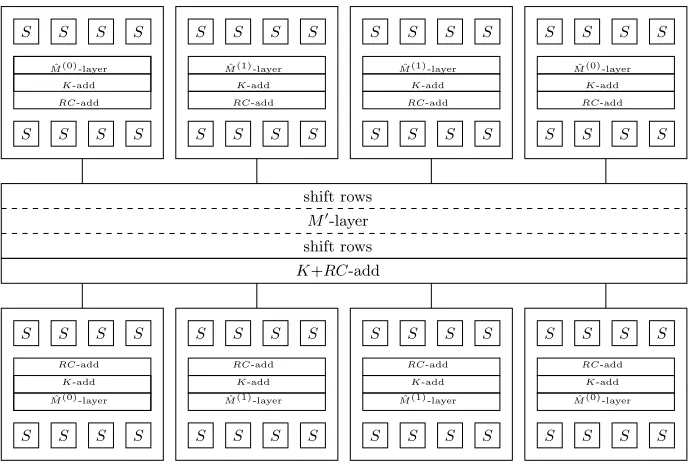
Proof. We restrict our studies to the differential case here only. The linear case follows by basically replacing the linear mappings M and M0 by their adjoint mappings. We follow an approach that is very similar to the AES SuperBox principle introduced in [15]. Using that Shift-Rows commutes with the Sbox layer, any 4 consecutive rounds can be written as shown in Figure 1.
S S S S
RC-add K-add ˆ M(0) -layer
S S S S
S S S S
RC-add K-add ˆ M(1) -layer
S S S S
S S S S
RC-add K-add ˆ M(1) -layer
S S S S
S S S S
RC-add K-add ˆ M(0) -layer
S S S S
shift rows
M0-layer
shift rows
K+RC-add
S S S S
RC-add
K-add ˆ M(0) -layer
S S S S
S S S S
RC-add
K-add ˆ M(1) -layer
S S S S
S S S S
RC-add
K-add ˆ M(1) -layer
S S S S
S S S S
RC-add
K-add ˆ M(0) -layer
S S S S
Fig. 1.Reordering of four consecutive rounds of the cipher, whereSdenotes the Sbox or its inverse and shift rows denotes the multiplication by the matrixSRorSR−1.
The theorem follows now by showing (either by tedious hand calculations or by a suitable computer algebra package) that the following codes have minimum distance 4.
– TheF2 linear codes overF162 generated by (I|SR±◦M0◦SR±).
u t
As a immediate corollary we get the following.
Corollary 2. Assuming independent round keys, the average probability (taken over the keys) of any differential-characteristic over PRINCEhas a probability of less then2−96. Similarly, the average bias for a linear trail is at most2−49. Proof. From Theorem 2 it follows that the full 12 rounds of PRINCEhave at least 48 active Sboxes. As the differential probability and the linear bias for each active Sbox is bounded by 2−2 the results follows from first principles.
Clearly,PRINCEdoes not have independent round-keys and moreover the above statement only covers the average probability. However, we are confident that the relative high number of active Sboxes ensures the resistance of PRINCE against differential and linear attacks. In particular we conjecture thatPRINCE does not exhibit any strong differential or linear-hull effects.
C.2 Reduced Versions
Many classes of cryptanalytic attacks become more difficult with an increased number of rounds. In order to facilitate third-party cryptanalysis and estimate the security margin, reduced-round variants need to be considered. We define round-reduced variants of PRINCE where we keep the symmetry around the middle, and add rounds in an inside-out fashion, i.e. for every additional round
<iwe also add its inverse. Another natural way to reducePRINCEis to consider the cipher without the key whitening layer,PRINCEcore.
C.3 Algebraic degree
We did some tests of algebraic degrees for reduced-round versions of PRINCE. First, it can be proven that, for any key, each output bit after two rounds of PRINCEcorehas algebraic degree 9 in the input bits. Similarly, the middle round
C.4 Biclique and Meet-in-the-Middle
Meet-in-the-middle attacks were recently shown to be more powerful than thought for a long time, most recently within the biclique cryptanalysis framework. This framework was recently introduced as a way to add more rounds to a MITM attack while potentially keeping the same time complexity.
To assess the reach of MITM attacks, we considerPRINCEcoreand performed
a search for good key space separations. We found this to be possible for up to 4 rounds. Independent-bicliques can be constructed for up to 2 rounds hence an independent-biclique attack as performed on full AES [9] can only cover 6 rounds in a non-exhaustive way. As 4 more rounds remain to be covered in an exhaustive way, the exhaustive part will dominate the time complexity, and hence the overall speed-up over brute-force search for the 64-bit key in PRINCEcore will not be
significantly more than a factor of 2.
C.5 Algebraic Attacks
Algebraic attacks exploit the description of a cipher as a non-linear Boolean equation system. Even though algebraic attacks have been far more successful when applied to stream cipher than to block cipher, it is important to argue that a new design can withstand such attacks. It is a well known result that for every 4-bit Sbox there are 21 quadratic relations between the input and the output bits. Introducing auxiliary variables for each output bit of the Sbox layer we obtain for the full cipher a quadratic Boolean equation system containing 4032 equations in 768 variables. Alternatively we can introduce new variables for the input and output bits of the Sbox layer, which yields as system of 4864 equations in 1536 unknowns.
As these equation systems are typically very sparse one might apply lin-earization, that means that one replaces each quadratic term by a new variable. However as the proposed equation systems contain 43264 and 5376 quadratic terms respectively, linearization will yield a highly underdetermined system and thus not pose a threat.
Another approach in algebraic cryptanalysis the application of Gr¨obner ba-sis [11]. Buchberger’s algorithm as well as the F4 algorithm [23] have been imple-mented in Magma [40]. Simulations on small-scale variants of AES showed that one quickly encounters difficulties with time and especially memory complex-ity [12]. Experiments could confirm that this is also the case forPRINCE. In our simulations we consider round-reduced variants ofPRINCEcore as described in
Sec. C.2. For the round-reduced version consisting of the 4 Sbox layers, Magma is able to find the key in less than two seconds. However, already for the variant with 6 Sbox layers, it is necessary to guess around 58 key bits2 to find the key and for some instances Magma reaches its memory limit. Furthermore, the av-erage complexity exceeds two minutes, thus we can conclude that a brute force
2 As we omitted the whitening keys we consider a cipher with a 64-bit key in the
search over the remaining 6 key bits will be faster. The fact that Magma already has difficulties to solve a round-reduced version containing 6 Sbox-layers makes us confident that the full version of the cipher which contains 12 Sbox layers will resist algebraic attacks.
D
Slidex Attack on the Bound of Corollary 1
The following modification of the slidex attack presented by Dunkelman et al. on the Even-Mansour scheme [20] shows that the propertyFk⊕α=Fk−1 can be
exploited in practice for reducing the security level by one bit, compared to the attack against the originalF X construction.
The slidex attack against the F X construction recovers the key from D
known plaintext-ciphertext pairs and an average time complexity corresponding to 2κ+n−log2D computations ofF. The attack aims at finding two of the known
plaintexts which differ from (k0⊕∆`) where∆`belongs to a fixed set ofXdistinct
values. Such a pair can be detected by using that, for any plaintext-ciphertext pair (m, c) and any∆,
H∆(m) =Fk1(m⊕∆)⊕c=Fk1(m⊕∆)⊕Fk1(m⊕k0)⊕k2.
Then, this function takes the same value for two inputs which differ from (k0⊕∆). The attack then uses D plaintext-ciphertext pairs (mi, ci), and performs an
exhaustive search fork1∈Fκ2: for each value ofk1and each`between 1 andX,
H∆`(m) =Fk1(m⊕∆`)⊕cis computed, where{∆1, . . . , ∆X}is a set of distinct
random values of size X ≥2n+1/D2. Then, the number of triples (mi, mj, ∆`)
exceeds 2n. It follows that, ifk1 is a wrong guess, it is expected to find a triple (mi, mj, ∆`) such thatH∆`(mi) =H∆`(mj), while two such triples are expected
whenk1is a right guess. For each such collision triple (mi, mj, ∆`), it must then
be checked whetherkb0=mi⊕mj⊕∆`andkb2=cj⊕Fk1(mi⊕∆`) is the right
key.
In the case of theF Xe construction, we can reduce both the data and time
complexity of this attack by a factor√2 if we consider a chosen-plaintext attack. Indeed, we can also exploit the fact that the same relation on the ciphertext, i.e.,
Fk−1
1 (c⊕∆)⊕m=F
−1
k1 (c⊕∆)⊕F
−1
k1 (c⊕k2)⊕k0
can be expressed as a relation involvingFk1⊕α:
Fk1⊕α(c⊕∆)⊕m=Fk1⊕α(c⊕∆)⊕Fk1⊕α(c⊕k2)⊕k0.
This function takes the same value for two ciphertexts with difference (k2⊕∆), and this property can be used for testing (k1⊕α). Then, we assume that the attacker knowsDpairs of chosen plaintext-ciphertext obtained by iterating the encryption function,i.e., ci+1 =E(ci), 0 ≤i < D. For each value ofk1 in Fκ2 and X values ∆1, . . . , ∆X with X ≥ 2n/D2, she computes Fk1(ci⊕∆`) and
deduces
Since there are 2n−1triples (c
i, cj, ∆`), it is then expected that one of them will
satisfy either ci⊕cj =k0⊕∆` or ci⊕cj =k2⊕∆`. Then, if Ai =Aj, we test
whetherkb0=xi⊕xj⊕∆`,kb1=k1andkb2=cj⊕Fk1(mi⊕∆`) is the right key. If
Bi =Bj, we testkb0=mi⊕Fk1(cj⊕∆`),kb1=k1⊕αandkb2=ci⊕cj⊕∆`. The
average time complexity of the attack then corresponds to 2κDX = 2κ+n−log2D
computations ofF.
E
Round-Based Implementation
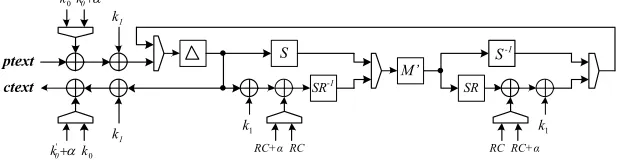
PRINCE is also synthesized as a round-based implementation to make a fair comparison with existing works in literature. Figure 2 shows the block diagram for the round-based implementation. To get a low-cost round-based implemen-tation, we tried to maximize shared use of operational blocks. This way, double use of resources can be avoided. In our case, MixLayer gave a larger gate count than both the Sbox and inverse Sbox layers; therefore by taking this layer in the middle of the round function (instead of putting Sboxes in the middle) and building the other blocks accordingly, we have achieved the smallest possible area.
-1 S
ptext
'
0 k
0
k
1
k k1
RC
S
SR-1
RC+α
M’
1
k
RC
SR
RC+α
'
0
k k0
1 k
ctext
Fig. 2.Round-based implementation ofPRINCE
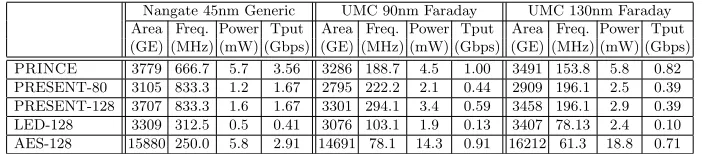
Table 4. Performance comparison of round-based versions of PRINCE with PRESENT and AES
Nangate 45nm Generic UMC 90nm Faraday UMC 130nm Faraday Area Freq. Power Tput Area Freq. Power Tput Area Freq. Power Tput (GE) (MHz) (mW) (Gbps) (GE) (MHz) (mW) (Gbps) (GE) (MHz) (mW) (Gbps)
PRINCE 3779 666.7 5.7 3.56 3286 188.7 4.5 1.00 3491 153.8 5.8 0.82 PRESENT-80 3105 833.3 1.2 1.67 2795 222.2 2.1 0.44 2909 196.1 2.5 0.39 PRESENT-128 3707 833.3 1.6 1.67 3301 294.1 3.4 0.59 3458 196.1 2.9 0.39 LED-128 3309 312.5 0.5 0.41 3076 103.1 1.9 0.13 3407 78.13 2.4 0.10 AES-128 15880 250.0 5.8 2.91 14691 78.1 14.3 0.91 16212 61.3 18.8 0.71
Table 5. Performance comparison of round-based versions of PRINCE and other ciphers in literature
Technology Area Tput @ 100KHz (µm) (GE) (Kbps)