E
ffi
cient identity-based threshold decryption scheme from bilinear
pairings
IWei Gaoa,b, Guilin Wangc, Kefei Chena, Xueli Wangd, Guoyan Zhange
aDepartment of Computer Science and Engineering, Shanghai Jiao Tong University, Shanghai 200240, China bSchool of Mathematics and Information, Ludong University, Yantai 264025, China
cSchool of Computer Science&Software Engineering, University of Wollongong, NSW 2522, Australia dSchool of Mathematics, South China Normal University, Guangzhou 510631, China eSchool of Computer Science and Technology, Shandong University, Jinan 250100, China
Abstract
Taking advantage of a technique that allows to safely distribute a private key among decryption servers we introduce a new identity-based threshold scheme, proven secure in the random oracle model. This new paring-based scheme features a lot of improvements compared to other schemes that can be found in the literature. Among them the two most noticeable ones are, the efficiency, by drasticaly reducing the number of pairing computations, and the ability for a user to generate and share a private key without requiring any access to a PKG.
Keywords:
Identity-based cryptography, Threshold cryptography, Provable security, Random oracle model, Bilinear pairing, Identity-based threshold decryption
1. Introduction
Identity based (ID-based) cryptography was proposed by Shamir in 1984 [1] to simplify key management and remove the public key certificates. In ID-based cryptography, the identity of a user, such as his/her e-mail address, is taken as the public key and so the certificate for certifying the public key is not needed. The secret key, calculated from the public key (identity of a user), is issued by a trusted authority called private key generator (PKG). The first practical ID-based encryption (IBE) scheme was proposed in 2001 by Boneh and Franklin [2], which was proved to be secure against adaptive chosen ciphertext attack in random oracle model. Since then, in the so-called identity-based cryptography field, many ID-based cryptographic schemes have been proposed [3]. Bilinear pairing [2] is the most popular tool to construct identity-based crypto-graphic primitives. Due to the various applications of bilinear pairings, the so-called pairing-based cryptography is becoming one of hot topics in cryptography.
Threshold cryptography [4, 6, 7], mainly including signature and encryption, increases the availability of the cryptographic operations which need involvement of secret keys, and at the
IThis work is partially supported by National Natural Science Foundation of China (No. 60970111, No. 60973135).
Email addresses:[email protected](Wei Gao),[email protected](Guilin Wang),
[email protected](Kefei Chen),[email protected](Xueli Wang),[email protected]
(Guoyan Zhang)
same time enhances the protection against the attacker which wants to compromise secret keys. In a threshold public-key decryption system [4, 7], the decryption key corresponding to an iden-tity is shared among a set ofnusers (or servers). In such a system, a ciphertext can be decrypted only if at leasttusers cooperate, wheretis the threshold value. However, the cooperation of less thantusers cannot leak any information about the plaintext or signature. This is crucial in all the applications where one cannot fully trust a unique person, but possibly a pool of individuals.
A combination of these two concepts will result the concept of ID-based threshold decryp-tion (IBTD) schemes. It is a very useful cryptographic primitive in practice [8]. One possible application of such a IBTD scheme can be considered in a situation where an identity denotes the name of the group whose decryption key is shared by its members. Another application of the ID-based threshold decryption scheme is to use it as a building block to construct a mediat-ed ID-basmediat-ed encryption scheme[9, 8]. The underlying idea is to split the private key associatmediat-ed with the receiver’s ID into two parts. One is given to him and the other to a Security Mediator (SEM). Then as the receiver requiers the help of the SEM in order to decrypher a given encrypt-ed message, instantaneous revocation of his privilege to perform decryption is possible only by instructing the SEM not to help him any more.
In tradtional IBC the PKG is the holder of all the private keys, implying some risk if its security is compromised. In order to prevent such a scenario to occur, Boneh and Franklin [2] suggested to introduce the threshold method, where the master key is distributed amongnPKGs. Then a user can get its private key by obtaining more thantshares from different distributed PKGs. Following this idea, Boneh et al. [10] extended the IBE scheme [11] by adding the key sharing algorithm and the key recovering algorithm. As further extensions, in [12, 13, 14], the threshold decryption function was considered. However, in these schemes, the user can not share his private key by himself, but has to ask the PKG to complete this task, since the algorithm to share the private key depends on the master key. In 2004, Baek and Zheng [8] considered the threshold decryption scheme where the shares of the identity-based private keyDIDcan be
generated by the user himself. However, the Baek-Zheng method heavily relies on a suit of secret sharing tools which involve much more pairing computation than other IBTD schemes.
In the field of pairing-based cryptography, it is known that the computation of bilinear pairing is the bottleneck of the pairing application in practice [15]. To solve this problem, we should try to use as less as possible pairings in designing pairing-based cryptographic primitives. However, all previous threshold identity-based decryption schemes involve many bilinear pairings. On the other hand, although the user can ask the PKG to share the identity-based private key for him, it is preferable for him to share it by himself. In fact, only the Baek-Zheng method enjoys this functionality. So it is an interesting issue to design an IBTD scheme which enjoys this functionality and involves only a little computation for pairings. Ideally, it is the best if the number of pairing computations in all component algorithms are constants, i.e., not variables of eithernort.
With this motivation, by introducing a new technique that indirectly shares a private key in the bilinear group through simply sharing an element in the finite field using the famous secret sharing scheme due to Shamir [16], this paper proposes a new identity-based threshold decryp-tion scheme from bilinear pairings that enjoys the following advantages. In terms of efficiency, compared with previous works, it uses much less bilinear pairings among all the algorithms. More specifically, all algorithms butSetup, which involves no pairing, need only one pairing computation. In terms of functionality, it is the holder of the private key associated with an i-dentity rather than the Private Key Generator (PKG) to share the private key. Finally, the formal proof of security is provided in the random oracle model. In a short word, we construct the first
provably secure IBTD scheme with constant pairing computations.
The rest of the paper is organized as follows. We first review some preliminaries mainly including the basic property of pairings, the computational assumption on which our scheme is (indirectly) based, and the security notion of IBTD schemes in Section 2. We then present our IBTD scheme in Section 3, prove its security in Section 4 and compare it with other IBTD schemes in Section 5. Finally, Section 6 concludes the paper.
2. Preliminaries
2.1. Bilinear Pairing and Complexity Assumption
This section briefly reviews the definition of bilinear pairings and the related complexity assumption.
Definition 1. LetGandGTbe two groups of prime order q and let P be a generator ofG, where Gis additively represented andGT is multiplicatively. A map e : G×G → GT is said to be
a bilinear pairing and the groupGis called a bilinear group, if the following three conditions
hold:
(1) e is bilinear, i.e. e(aP,bP)=e(P,P)abfor all a,b∈
Z∗q;
(2) e is non-degenerate, i.e. e(P,P),1, where1is the identity ofGT;
(3) e is efficiently computable.
Next, we review the Bilinear Diffie-Hellman (BDH) problem, which was introduced by Bone-h and Franklin [2].
Definition 2. Let GandGT be two groups of prime order q, P be a generator ofGand e : G×G→GTis an bilinear pairing. Let ABDHbe an attacker modelled as a probabilistic Turing
machine taking the security parameter k as input. Suppose that a,b,and c are uniformly chosen at random fromZqand aP,bP, and cP are computed. Given(G,GT,q,e,P,aP,bP,cP), ABDHis
required to compute e(P,P)abc. We define ABDH’s success probability by
S uccBDH
ABDH(k)=Pr [A
BDHoutputs e(P,P)abc]
The attacker ABDH is said to be a(t, )-solver for the BDH problem if the success probability S uccBDHABDH is lowerly bounded by (i.e. ≥) and the running time is bounded by t. The BDH
problem is said to be(t, )-intractable if there is no(t, )-solver for it.
2.2. Security Model
As in [8], we review the syntax and security definitions of IBTD schemes below with slight modification.
Definition 3. The identity-based (t,n)-threshold decryption scheme consists of the following algorithms.
• System initialization algorithmSetup(1k): Given a security parameter1k, this algorithm outputs the system common parameters cp and the master secret key s. cp is made public, while s is kept secret.
• Private key extraction algorithmEX(cp,s,ID): Given identity ID and master key s, this algorithm computes the private key DID. It is then secretly sent to the corresponding entity.
• Private key distribution algorithmDK(cp,ID,DID,t,n): Given a private key DID, the
number of decryption servers n and a threshold parameter t, this algorithm generates n shares{si}ni=1 of DIDand some public parameters, mainly including a set of verification
keys{Si}ni=1. The key share s1,s2, . . . ,sn are sent to the decryption serverΓ1,Γ2, . . . ,Γn
respectively. These public parameters are used to check the validity of each private key share and decryption share.
• Encryption schemeE(cp,ID,M): Given a plaintext M∈ {0,1}land an identity ID, this
al-gorithm generates a ciphertext C. Here note that, usually, the validity of the ciphertext can be publicly verified and the invalid ciphertexts will be rejected in the following algorithms.
• Decryption share generation algorithmD(cp,si,C): Given a ciphertext C and a private
key share si, this algorithm first checks the validity of the ciphertext C. If C is invalid, it
outputs ”Invalid Ciphertext”. Otherwise, it outputs the decryption shareδi.
• Decryption share verification algorithmSV(cp,{Si}ni=1,C, δi): Given a ciphertext C, a set
of verification keys{Si}ni=1, and a decryption shareδi, this algorithm first checks the validity
of the ciphertext C. If C is invalid, it outputs ”Invalid Ciphertext”. Otherwise, it outputs “Valid Share” or “Invalid Share”.
• Share combining algorithmSC(cp,C,{δi}i∈Φ): Given a ciphertext C and a set of decryp-tion shares{δi}i∈Φ (without loss of generality, we assume that there are at least t valid ciphertext sahres in{δi}i∈Φ) , this algorithm first checks the validity of the ciphertext C. If C is invalid, it outputs ”Invalid Ciphertext”. Otherwise, it then chooses t valid decryption shares by using decryption share verification algorithmSVand last outputs the plaintext M.
Following the work by Baek and Zheng, We now present the security notion for the IBTD scheme against chosen-ciphertext attack [8], which we call “IBTD-IND-CCA”.
Definition 4. Let AIBT Dbe an attacker assumed to be a probabilistic Turing machine and
con-sider the following game GIBT Dinvolving AIBT Dand its challenger CIBT D.
Phase 1. AIBT Dchooses to corrupt a fixed set of t−1out of n decryption servers.
Phase 2. The challenger CIBT Druns the PKG’s key/common parameter generation algorithm
taking a security parameter k as input, gives AIBT Dthe resulting common parameter cp and keeps
the master key s secret.
Phase 3. AIBT Dissues a number of private key extraction queries, each of which is denoted
by ID. On receiving the identity query ID, the challenger CIBT Druns the private key extraction
algorithm to compute the corresponding private key DIDfor AIBT D.
Phase 4. AIBT Dissues a target identity query ID∗. On receiving ID∗, CIBT Druns the private key extraction algorithm to obtain a private key DID∗ associated with ID∗. CIBT Dthen runs
the private key distribution algorithm on input DID∗ with parameter(t,n)and obtains a set of
private/verification key pairs{si,Si}. Next, CIBT Dgives AIBT Dthe t−1private keys of corrupted
decryption servers and the verifications keys of all the decryption servers. However, the n−t+1 private keys of uncorrupted servers are kept secret from AIBT D.
Phase 5. AIBT Dissues arbitrary private key extraction queries and arbitrary decryption share
queries by ID and(C,k)respectively. On receiving ID, the challenger CIBT Druns the private
key extraction algorithm to obtain a private key associated with ID and returns it to AIBT D. The
only restriction here is that AIBT Dis not allowed to query the target identity ID∗to the private key extraction algorithm. On receiving(C,k), the challenger CIBT Druns the decryption share
generation algorithm to get the decryption shareδkwith respect to the ciphertext C, the target
identity ID∗and the uncorrupted serversΓ
kand sends it to AIBT D.
Phase 6. AIBT D outputs two equal-length plaintexts(M
0,M1). Then the challenger CIBT D
chooses a random bitβand computes a target ciphertext C∗=E(cp,ID∗,Mβ)for AIBT D.
Phase 7. As inPhase 5, AIBT Dissues arbitrary private key extraction queries and arbitrary decryption share generation queries and the challenger CIBT Ddeals with these queries with the additional restriction that the target ciphertext C∗is not allowed to query in this phase.
Phase 8. AIBT Doutputs a guessβ∈ {0,1}. We define the attacker AIBT D’s advantage by
AdvIBT DAIBT D(k)=|Pr[β=β]− 1 2|.
AIBT D is said to be the(t,q
e,qd, )-attacker if AdvIBT DAIBT D(k)is at least when the running time,
the times of private key extraction queries and decryption share generation queries are at most t,qe,qdrespectively. The IBTD scheme is said to be IBTD-IND-CCA(t,qe,qd, )-secure if there
is no(t,qe,qd, )-attacker against it.
2.3. Non-Interactive Zero Knowledge Proof for the Equality of Two Discrete Logarithms
To make the validity of the ciphertexts and the decryption shares checkable, we shall use a non-interactive zero-knowledge proof system for the equality of two discrete logarithm [17, 7].
LetGbe a group of orderqwith generatorsg,g. Let EDLogg,g be the language of pairs
(u,u) ∈ G2 such that log
gu = loggu. Let (u,u) ∈ EDLogg,g be given, so there existsr ∈ Zq
such thatu = gr,u = gr. To construct the non-interactive zero knowledge proof (c,d) for the equality loggu=loggu, the prover randomly selectst ∈Zq, and computesw=gt,w =gt,c= H(u,u,w,w),d = t−rc, whereHis a cryptographic hash function taken as a random oracle. The verifier accepts (c,d), if and only ifc=H(u,u,gduc,gduc). In the random oracle model, this
protocol is a non-interactive zero-knowledge proof for the language EDLogg,g.
3. Construction
We now describe our ID-based threshold decryption (IBTD) scheme. We claim that our IBTD scheme is based on the ID-based encryption scheme due to Boneh and Franklin [2]. We call our IBTD scheme “IdThdBm”, meaning “ID-based threshold decryption scheme from the bilinear map”. IdThdBm consists of the following algorithms.
• Setup(k): Given a security parameterk, this algorithm performs as follows.
(1) It generates two groupsGandGTof the same prime orderq≥2k, chooses a
genera-torPofGand specifies the bilinear mape:G×G→GT.
(2) It specifies the hash functionsH1:{0,1}∗→G,H2:GT → {0,1}l,H3:G×{0,1}l→ G,H4 :G4 →ZqandH5:G4T →Zq, whereldenotes the length of a plaintext, which
is a funciton ofk.
(3) It chooses the PKG’s master keysuniformly at random fromZq, computes the PKG’s
public keyPpub=sP.
(4) It returns the common parameterscp=(G,GT,q,P,e,Ppub,H1,H2,H3,H4,H5) and
keeps the master keyssecret.
• EX(cp,s,ID): Given an identityID, this algorithm computesQID =H1(ID) and returns
the private keyDID=sQIDassociated withID.
• DK(cp,ID,DID,t,n) where 1 ≤ t ≤ n < q: Given a private key DID, the number of
decryption serversnand a threshold parametert, the algorithm sharesDIDas follows.
(1) It randomly choosesa0,a1, . . . ,at−1∈Zq, constructs the polynomial overZq
F(x)=a0+a1x+a2x2+. . .+at−1xt−1
and setss=a0.
(2) It computes two public parametersS =e(P,P),DID=DID−sQID.
(3) It computes each decryption serverΓi’s private key sharesi =F(i), and verification
keySi=Ssi for 1≤i≤n.
(4) It secretly sends the private key share si to serverΓi for 1 ≤ i ≤ nand publishes
S1,S2, . . . ,Sn,S, DID among the n decryption servers (not system-widely). Here
note that it can be easily seen thatΓiis able to check the validity of all these
parame-ters.
Remark 1. Here note that, as one of our techniques to avoid using pairing computation, e(P,P)is added in the public parameters. As a result, at many places in the following algo-rithmsDK,D,SV,SC, the complex computation for the bilinear pairing can be replaced by one simple exponentiation.
Remark 2. Here note that the private key DID ∈Gis indirectly shared through sharing
the element s∈Zpby the conventional Shamir sharing method. In other words, DIDcan
be recovered by any t shares si and the public parameter DID. Obviously, our method
is much more efficient than the Baek and Zheng’s direct sharing method which heavily involves pairing computation. The more interesting feature is that this indirect key sharing method will result in much less pairings in the following algorithms. For more details, please refer to Section 5.
• E(cp,ID,M): Given a plaintextM ∈ {0,1}l and an identity ID, this algorithm does as
follows.
(1) It chooses a random integerrfromZq, and computesQID=H1(ID),K=e(rQID,Ppub),
V=H2(K)⊕M, whereKplays the role of a temporary encryption key.
(2) It computesU=rP,P=H3(U,V),U=rP.
(3) To prove logPU = logPU, it randomly chooses t ∈ Zq and presents the
non-interactive proof (c,d):
W =tP,W =tP,c=H4(U,U,W,W),d=t−rc.
Here note the following points.
( i ) The validity of the ciphertextC = (U,V,U,c,d) can publicly verified by checking the equation:
c=H4(U,U,dP+cU,dP+cU),whereP=H3(U,V).
(ii ) Informally speaking,Uand the above zero-knowledge proof can be seen as the digital signature of the messageVunder the public keyU;
• D(cp,si,C): Given the private key si of a decryption server Γi and a ciphertext C =
(U,V,Z,U,c,d), the decryption serverΓiuses his private keysito generate a decryption
shareδias follows.
(1) It verifies the validity of the ciphertextCby checking the equationc=H4(U,U,dP+
cU,dP+cU), whereP = H3(U,V). IfC cannot pass this test, it outputs “Invalid
Ciphertext”.
(2) Otherwise,ΓicomputesZ =e(QID,U),Zi=Zsi.
(3) To show the equality of the two discrete logarithms logZZi = logSSi, it randomly
choosesti∈Zqand computes the zero knowledge proof (ci,di):
Zi=Zti,Si=Sti,ci=H5(Zi,Si,Zi,Si),di=ti−sici, .
(4) At last, it outputs the decryption shareδi=(Zi,ci,di).
• SV(C,{Si}ni=1,S, δi): Given a ciphertext C = (U,V,U,c,d), a set of verification keys {S1, . . . ,Sn}, the additional parameterS (recall thatS =e(P,P)) and a decryption shareδi,
this algorithm does as follows.
(1) It checks whetherc=H4(U,U,dP+cU,dP+cU), whereP=H3(U,V). IfCdoes
not pass the above test, then this algorithm returns “Invalid Ciphertext”.
(2) Otherwise, it parsesδias (Zi,ci,di) and checks the equality
ci=H5(Zi,Si,ZdiZici,SdiScii), whereZ =e(QID,U).
Ifδidoes not pass this test, returns “Invalid Shares”. Otherwise, it acceptδias valid
share.
• SC(cp,C,{δi}i∈Φ): Given a ciphertextC = (U,V,U,c,d) and a set of decryption shares
{δi}i∈Φwhere|Φ| ≥tandδi=(Zi,ci,di), this algorithm does as follows.
(1) It checks whetherc= H4(U,U,dP+cU,dP+cU), whereP =H3(U,V). IfChas
not passed the above test, this algorithm returns “Invalid Ciphertext”.
(2) Fori ∈ Φ, it checks the validity of each decryption shareδi ∈ Φby the equation
ci=H5(Zi,Si,ZdiZici,SdiSici), whereZ=e(QID,U), until it finds thet-th valid one.
Without loss of generality, we assume that there exist at leasttvalid ciphertext shares andΦdenotes the subset oftvalid ones.
(3) It computes the temporary keyK =e(DID,U)Q i∈Φ
Zc
Φ
0,i
i and returns the plaintextM =
H2(K)⊕V, where the Lagrange coefficientscΦ0,i= Q
j∈Φ,j,i
−j
i−jsatisfiess= P
i∈Φ cΦ0,isi.
Here note the correctness of the above IBTD scheme, since
K = e(DID,U) Y
i∈Φ Zc
Φ
0,i
i
= e(DID−sQID,rP) Y
i∈Φ
e(QID,rP)sic
Φ
0,i
= e(sQID,rP)e(QID,rP)−se(QID,rP)s
= e(sQID,rP)
= e(rQID,Ppub).
4. Security Proof
Following the proof method in [8], to prove the security of the proposed IBTD scheme IdThdBm, we derive a non-ID-based threshold decryption scheme called “ThdBm” from IdThdB-m, which will be described shortly. We then show that the TD-IND-CCA security of the scheme ThdBm, which will be defined after the description of ThdBm, implies the IBTD-IND-CCA se-curity of the scheme IdThdBm. Next, we show that the intractability of the BDH problem implies the TD-IND-CCA security of the ThdBm scheme. At last, we obtain the provable security result. Due to the similarity toDefinition3 for IBTD schemes (Essentially, A TD scheme is just a IBTD scheme without key extraction), here we shortly states the syntax of TD (threshold decryp-tion) schemes as follows. A TD scheme in the non-ID-based setting consists of a key/common parameter generation algorithmGK, an encryption algorithmE, a decryption share generation algorithmD, a decryption share verification algorithm SV, and a share combining algorithm
SC. We first simply present the following TD scheme ThdBm derived from the IBTD scheme IdThdBm as follows.
• GK(k,t,n): Given a security parameterk, the number of decryption serversnand a thresh-old parametert, the dealer does as follows.
(1) It generates two groupsGandGTof the same prime orderq≥2k, chooses a
genera-torPofGand specifies the bilinear mape:G×G→GT.
(2) It specifies the hash functionsH2:GT → {0,1}l,H3:G×{0,1}l→G,H4:G4→Zq
andH5:G4T →Zq, whereldenotes the length of a plaintext.
(3) It randomly choosessfromZqandQfromG, and then sets the private keyD=sQ,
the public keyPpub= sPand the common parameterscp =(G,GT,q,P,e,Ppub,Q,
H2,H3,H4,H5).
(4) It randomly choosesa0,a1, . . . ,at−1∈Zqand constructs the polynomial overZq
F(x)=a0+a1x+a2x2+. . .+at−1xt−1
and setss=a0.
(5) It computes two public parametersS =e(P,P),DID=DID−sQ.
(6) It computes each decryption serverΓi’s private key sharesi =F(i), verification key
Si=Ssi for 1≤i≤n.
(7) It secretly sends the distributed private keysito serverΓifor 1≤i≤nand publishes
S1,S2, . . . ,Sn, S,Dand the public parameterscp.
• E(cp,M): Given a plaintextM ∈ {0,1}l, this algorithm choosesr,tuniformly at random
fromZq, and subsequently computesK = e(rQ,Ppub) . It then computes U = rP,V =
H2(K)⊕M,P=H3(U,V),U=rP,c=H4(U,U,tP,tP),d=t−rcand returns a ciphertext
C=(U,V,U,c,d).
• D(cp,si,C): Given a private keysiof one decryption server and a ciphertextC =(U,V,
U,c,d), the decryption serverΓi uses his private key si to generate a decryption share
δi as follows. It verifies the validity of the ciphertextC by checking the equation c =
H4(U,U,dP +cU,dP +cU), where P = H3(U,V). If C is valid, then Γi computes
Zi = Zsi and generates the zero knowledge proof (ci,di,Zi,Si) for the equality of the
t-wo discrete logarithms logZZi = logSSi, where Z = e(Q,U), Zi = Zti,Si = Sti,ci =
H5(Zi,Si,Zti,Sti),di=ti−sici, andtiis randomly chosen fromZq. At last, it outputs the
decryption shareδi=(Zi,ci,di).
• SV(C,{Si}ni=1,S, δi): Given a ciphertext C = (U,V,U,c,d), a set of verification keys {S1, . . . ,Sn}, the parameterS and a decryption shareδi, this algorithm first verifies the
va-lidity ofCby checkingc=H4(U,U,dP+cU,dP+cU), whereP=H3(U,V), and then the
validity ofδi=(Zi,ci,di) by checkingci=H5(Zi,Si,ZdiZ ci
i ,S diSci
i ), whereZ=e(QID,U).
• SC(cp,C,{δi}i∈Φ): Given a ciphertextC = (U,V,U,c,d) and a set of decryption shares
{δi}i∈Φwhere|Φ| ≥ tandδi =(Zi,ci,di), this algorithm first checks the validity ofCby
checkingc = H4(U,U,dP+cU,dP+cU), whereP = H3(U,V). It then constructs the
subsetΦoftvalid ciphertext shares through the checking equationci =H5(Zi,Si,ZdiZcii,
SdiSci
i ), whereZ=e(QID,U). At last, it computes the session keyK=e(D,U)Q i∈Φ
ZcΦ0,i
i and
returns the plaintext M = H2(K)⊕V, where the Lagrange coefficients cΦ0,i = Q
j∈Φ,j,i
−j i−j
satisfiess=cΦ0,isi.
Next, we review the security notion for the threshold decryption scheme against chosen-ciphertext attack [7, 8], which we call “TD-IND-CCA”.
Definition 5. Let AT D be an attacker assumed to be a probabilistic Turing machine. Suppose
that a security parameter k is given to AT Das input. Now, consider the following game GT Din
which the attacker AT Dinteracts with the challenger CT D.
Phase 1: AT Dchooses to corrupt a fixed subset of t−1servers.
Phase 2: CT D runs the key/common parameter generation algorithm GK, and gives AT D
the resulting private key shares of the corrupted servers, the verification keys of all servers, the public key and other common parameters.
Phase 3: AT Dadaptively interacts with the uncorrupted decryption servers, submitting ci-phertexts and obtaining decryption shares.
Phase 4: AT Dchooses two equal-length plaintexts(M0,M1). Then CT Dchooses a random
bitβand returns a target ciphertext C∗=E(cp,Mβ)to AT D.
Phase 5: AT Dadaptively interacts with the uncorrupted decryption servers, submitting
ci-phertexts and obtaining decryption shares. However, the target ciphertext C∗is not allowed to query to the decryption servers.
Phase 6: AT Doutputs a guessβ∈ {0,1}.
We define the attacker AT D’s advantage by
AdvT DAT D(k)=|Pr[β=β]− 1 2|.
AT Dis said to be the(t,q
d, )-attacker if the advantage AdvT DAT D(k)is at mostwhen the running
time and the times of decryption share generation queries are at most t,qdrespectively. The TD
scheme is said to be TD-IND-CCA(t,qd, )-secure if there is no(t,qd, )-attacker against it.
Lemma 1. Suppose that AIBT Dis the(t,q
e,qd, )-attacker against the IBTD-IND-CCA security
of the IBTD scheme IdThdBm in the random oracle model, where qH1 queries to the random oracles H1 are issued. Then there exists a(t0,qd, 0)-attacker AT D against the TD-IND-CCA
security of the TD scheme ThdBm, where t0=t+(q
e+qH1)O(T1),
0> 1
qH1
, and T1denotes the
time for computing one scalar multiplication inG.
Proof.To constructAT DusingAIBT Das a subroutine, we will simulate the challengerCIBT D
ofAIBT Das in the gameGIBT Dand make use ofAIBT D’s output as follows.
Phase 1. IfAIBT Dchooses to corrupt thet−1 decryption servers during the attack, thenAT D
correspondingly chooses to corruptt−1 decryption servers forT hmBm.
Phase 2.AT Dsetscp
IBT D=(G,GT,q,P,e,Ppub,H1,H2,H3,H4,H5) as the common
parame-ters of IdThdBm and sends them toAIBT D, where (
G,GT,q,P,e,Ppub,Q,H2,H3,H4,H5) is the
ThdBm’s common parameterscpT Dobtained from the challengerCT D, and the hash functionH1
is taken as the random oracle which is controlled byAT Das follows.
AT Drandomly chooses an indexµfrom the range{1,2, . . . ,q
H1}. ByIDµ, we denote theµ-th query ofAIBT Dto the random oracleH1. We hopeIDµwould be a target identityID∗thatAIBT D
outputs in Phase 4. WheneverH1is queried atID,AT Dperforms the following:
• If the queryIDexists in the entry<(ID, τ),QID>∈ L1, returnQIDtoAIBT D. (Note that
the initially empty listL1is the “input-output” table for the simulation ofH1.)
• Otherwise, do the following.
– IfID=IDµ, setQID=Q, append<(IDµ,⊥),QIDµ >toL1and returnQIDtoAIBT D.
(Note thatQis fromAT D’s common parametercpT D.)
– ElseID,IDµ, do the following.
∗ Chooseτuniformly at random fromZq. ∗ Append<(ID, τ),QID>toL1.
∗ ComputeQID=τPand returnQIDtoAIBT D.
Phase 3. IfAIBT DissuesIDas a private key extraction query,AIDperforms the following:
• If the queryIDexists in the entry<(ID, τ),QID>∈L1, extractτfrom it, computeDID=
τPpub, and returnDIDtoAIBT D.
• Otherwise, do the following.
– IfID=IDµ, terminate the whole game.
– Else (ID,IDµ), do the following.
∗ Chooseτuniformly at random fromZq.
∗ ComputeQID=τPand save<(ID, τ),QID>intoL1.
∗ ComputeDID=τPpuband returnDIDtoAIBT D.
Phase 4. AIBT Dissues a target identity queryID∗. On receivingID∗,AT Dobtains from its
challengerCT Dthe private key shares (without loss of generality, denoted by{s
i}ti−=11) of corrupted
decryption servers, all verification keys{Si}ni=1 and the parameterS,D, and then sends them
toAIBT Das the corresponding information for the identityID∗. In other words,Qis taken as
H1(ID∗).
Phase 5.AIBT Dissues arbitrary private key extraction queries and arbitrary decryption share generation queries to the uncorrupted decryption servers.AT Danswers the key extraction queries
as inPhase 3.AT Duses its own decryption share generating oracle, provided byCT D, to answer
those decryption share generation queries.
Phase 6. IfAIBT Dsubmits a pair of two equal-length plaintexts (M
0,M1), thenAT Dprovides
(M0,M1) to its challengerCID, and obtains a target ciphertextC∗such that
C∗=(U,V,U,c,d),
whereU =rP,V =H2(e(rQID∗,Ppub))⊕Mβ, andrandβare chosen uniformly at random from
Zqand{0,1}respectively. AT Dsimply returns theC∗toAIBT Das a target ciphertext.
Phase 7.AIBT Dissues arbitrary private key extraction queries and arbitrary decryption share generation queries to the uncorrupted decryption servers.AT Danswers these queries as inPhase 5with additional restriction that AIBT D is not allowed to queryC∗ to any of the uncorrupted decryption servers.
Phase 8. Finally, ifAIBT Dsubmits its guess ¯β, thenAT Dreturns ¯βtoCT D.
Now we complete the description of the attackerAT D. Next, we show that the above
con-structed attackerAT Dperfectly simulates the challengerCIBT D, when it does not terminates the game. Firstly, due to the randomness ofτ∈ZqandQ, the above simulation of the random oracle
H1is perfect. Secondly, forID , IDµ,DIDis rightly simulated, sinceDID = τPpub =τsP =
sQID. Thirdly, the decryption shares and the target ciphertext are also perfectly simulated, since
there is no difference between the IBTD scheme IdThdBm and the TD scheme ThdBm when their public keys,IDandQrespectively, satisfy the equationH1(ID)=Q.
SinceAT Dperfectly simulates the challengerCIBT D, when it does not terminates the game. So we have that the advantage ofAT Dagainst the TD scheme ThdBm is equal to the advantage
ofAIBT Dagainst the IBTD scheme IdThdBm, whenAT Ddoes not abort. On the other hand, the
probability that the attackerAT D does not terminate is 1
qH1
, sinceµhas been uniformly chosen from [1,qH1]. So we have
0≥ 1
qH1 .
Finally, we analyze the running timet0of the TD-IND-CCA attackerAT D. Note thatt0mainly consists of the time for simulation of the random oracleH1and the private key extraction oracle EX, as well as that for the attackerAIBT D. Since the simulation ofH1andExmainly consists of
1 or 2 scalar multiplications inG, sot0is lower-bounded bytIDCCA+(qe+qH1)O(T), whereT denotes the running time for computing one scalar multiplication. The proof is complete. .
Lemma 2. Suppose that there exists a(t0,q
d, 0)-attacker AT Dagainst the TD-IND-CCA security
of the scheme ThdBm. Then there exists a(t00, 00)-solver ABDHfor the BDH problem, where
t00=t0+max{q
H2,qH3,qH4,qH5,qd}O(T2), 00 ≥ 2
qH2 .
The above T2 is the biggest one among the running time for pairing, exponentiation inGand GT.
Proof. To constructABDHusingAT Din the gameGT Das a subroutine, we will simulate the
view ofAT Dand make use of its answers as follows. Assume thatABDHobtains the parameters
G,GT,q,P,e,and problem denoted byaP,bP,cP, and is required to computee(P,P)abc.
Phase 1.AT Dchooses a fixed setΦ0oft−1 decryption servers it wants to corrupt. Without loss of generality, assumeΦ0={1,2, . . . ,t−1}.
Phase 2. In this phase,ABDHdoes as follows.
• ABDHrandomly selects ˜s∈Zqsets
Ppub=sP=bP,Q=cP,D=sQ,˜ S0=e(Ppub−sP˜ ,P).
Here note that if the unknown values−s˜is denoted bys, then we have
D=sQ−sQ,S0=e(P,P)s.
• Next, for 1≤i≤t−1,ABDHrandomly picks an elements
i∈Zqas the key share ofΓi, and
sets the verification keySi =Ssi, whereS =e(P,P). LetF(x)∈Zq[x] be the polynomial
of degree (t−1), which is implicitly defined by
F(0)=s,F(i)=sifor 1≤i≤t−1.
Hence, we have
Si=e(P,P)F(i),i=0,1,2, . . . ,t−1.
• For every integer k ∈ [t,n], ABDH simulates the k-th verification key S
k = SF(k) =
e(P,P)F(k)as follows.
– ABDHsetsΦ0={0,1, . . . ,t−1}and then computes the Lagrange coefficients
cΦk,j0 = Q s,j,0≤s≤t−1
k−s
j−s, j=0,1, . . . ,t−1.
– According to Lagrange interpolation formulaF(k) =
t−1
P
j=0
cΦk,j0F(j),ABDH then
com-putes
Sk=S cΦk,00
0 S
cΦk,10
1 . . .S
cΦk,0t−1
t−1 .
• At last,ABDHsendsD,S,S
1,S2, . . . ,Sn,s1, . . . ,st−1andcptoAT D, wherecp=(G,GT,q,
P,e,Ppub,Q,H2,H3,H4,H5) andH2,H3,H4,H5are random oracles controlled byABDH
as follows.
– H2-queries.AT Dcan issueH2queries at any time.ABDHmaintains an initially empty
listL2of tuples<Ki,Ri>. For the the queryKi,AT Ddoes as follows.
∗ If the queryKialready appears on theL2 list in a tuple< Ki,Ri >, then ABDH
responds withH2(Ki)=Ri.
∗ Otherwise,ABDHpicks a random stringR
i ∈ {0,1}l, adds the tuple<Ki,Ri>to
L2and responds toAT DwithH2(Ki)=Ri.
– H3-queries. Initially,ABDHsets
U∗=aP,V∗← {R 0,1}l,H
3(U∗,V∗)=t∗P,
where “←R” means “is randomly chosen from”, and then adds<t∗,(U∗,V∗)>to the empty listL3. For a queryH3(Ui,Vi),ABDHdoes as follows.
∗ If the queryUi,Vialready appears on theL3list in a tuple<ti,(Ui,Vi)>, then
ABDHresponds witht
iPpubin the case (Ui,Vi),(U∗,V∗), ortiPin the other case
(Ui,Vi)=(U∗,V∗).
∗ If (Ui,Vi) does not appears in L3, ABDH randomly selects ti ∈ Zq, adds <
ti,(Ui,Vi)>to theL3, and returns the answer setsH3(Ui,Vi)=tiPpub.
– H4-queries. This random oracleH4 is simulated in the same way as simulating the
random oracleH2. Roughly speaking, whenAT Dqueries the random oracleH4at a
distinct point (Ui,Ui,Wi,Wi),ABDHchooseciat random as the answer and maintains
an initially empty listL4of tuples<ci,(Ui,Ui,Wi,Wi)>.
– H5-queries. This random oracleH5 is simulated in the same way as simulating the
random oraclesH2,H4. Roughly speaking, whenAT D queries the random oracle
H5 at a distinct point (Zi,Si,Zi,Si), ABDH choose ci at random as the answer and
maintains an initially empty listL5of tuples<ci,(Zi,Si,Zi,Si))>.
Phase 3. Assume thatAT Dasks for thek-th decryption share of the ciphertextC=(U,V,U, c,d) due to the uncorrupted serverΓk, wheret≤k≤n.
• ABDHsearches the listL
3for a tuple<t0,(U,V)>containing (U,V). If it is nonexistent,
ABDHreturns “Invalid Ciphertext”.
• ABDHsearches the listL
4for a tuple<c,(U,U,W,W)>containing (U,U,dP+cU,dP+
cU), whereP=H3(U,V). If it does not appears inL4,ABDHreturns “Invalid Ciphertext”.
• Although ABDH cannot getr fromU = rP, he can assume U = rPand simulates the
decryption ofC. In fact,ABDHcan computes the temporary keyK=e(Q,U)1
t0, since
K=e(D,U)=e(sQ,rP)=e(Q,rsP)=e(Q,r(t0Ppub))
1
t0 =e(Q,rP)t10 =e(Q,U)t10.
• Just like simulating the verification keysSkinPhase 2,k∈[t,n],ABDHsimulates thek-th
decryption shareδkas follows.
– ABDHcomputes
Z=e(Q,U),Z0=KZ−s˜,Zi=Zsi =e(siQ,U),i=0,1,2. . . ,t−1.
Here note thatZ0 =Zs, since
Z0 =KZ−˜s=ZsZ−s˜=Zs−s˜=Zs.
– ABDHcomputesZ
k=ZF(k)through
Zk=Z cΦk,00
0 Z
cΦk,10
1 . . .Z
cΦk,0t−1
t−1 ,
where
cΦk,j0 = Y
s,j,0≤s≤t−1
k−s
j−s,j=0,1,2, . . . ,t−1,
F(k) =
t−1
X
j=0
cΦk,0jF(j).
– ABDHrandomly selectsck,dk∈Zq, and sets thek-th decryption shareδk=(Zk,ck,dk).
At last, ABDH appends < ck,(Zk,Sk,ZdkZkck,SdkSkck) > to the list L5, where Z =
e(Q,U). Now, it can be seen that this simulated ciphertextC can pass the validi-ty checking.
Phase 4. AT D chooses two equal-length plaintexts (M
0,M1) and provides them to ABDH.
ABDHprovides toAT Dthe target ciphertextC∗=(U∗,V∗,U∗,c∗,d∗) as below.
• U∗,V∗are defined in the initial step of simulating the random oracleH3and we have
P∗=H3(U∗,V∗)=t∗P.
• The other partsU∗,c∗,d∗is defined as:
U∗=t∗U∗,c∗←R Zq,d∗←R Zq.
• At last,ABDHappends<c∗,(U∗,U∗,d∗P+c∗U∗,d∗P∗+c∗U∗)>to the listL
4.
Here note thatU∗=aP∗, since
U∗=t∗U∗=a(t∗P)=aH
3(U∗,V∗).
Phase 5: ABDHsimulates the decryption share oracle forAT Das inPhase 3. However, the
target ciphertextC∗is not allowed to query to the decryption servers.
Phase 6: AT Doutputs a guessβ∈ {0,1}. ABDH ignoresβ, picks a tuple<Ki,Ri >fromL2
randomly, and then outputKias the solution to the given instanceaP,bP,cPof the BDH problem.
Now we complete the description of the attackerABDH. Then we show thatAT D’s view in the
above simulation is identical to its view in the real attack, as long asAT Ddoes not issue a query
forH2(e(P,P)abc).
• InPhase 2, we show the following points.
– The four random oraclesH2,H3,H4,H5are perfectly simulated, since all the
respons-es are uniform and independent in the rrespons-espective rangrespons-es.
– The parameterss,F(x) are distributed as in the real attack. Then the other parameters D,S1,S2, . . . ,Sn,s1, . . . ,st−1are also perfectly simulated, since they are defined by
s,F(x).
– Obviously, the other parameters, such asPpub,Q,S, are generated as in the real
at-tack.
• InPhase 3, observe that for the queried ciphertextC =(U,V,U,c,d), ifAT Ddoes not
queriesH3(U,V) orH4(U,U,dP+cU,dP+cU), he can not get these values by himself
and so can not make the ciphertextC valid (Here we ignore the negligeable probability thatAT Dobtains these values through purely random guess). So, ifCis valid, then these queries have been made and hence the simulation inPhase 3is obviously successful.
• InPhase 4, observe that if ABDH does not issue a query for H2(e(P,P)abc), he does not
knows any information ofH2(e(P,P)abc). In this case, the target ciphertextC∗is distributed
as in the real attack.
Then we analyze the success probability ofABDH. LetH be the event that algorithm AT D
issues a query forH2(e(P,P)abc) at some point during the simulation above (this implies that
at the end of the simulatione(P,P)abc appears in some tuple on the L2). We also study event
H in the real attack game, namely the event that AT D issues a query forH2(e(P,P)abc) when
communicating with a real challenger and a real random oracle forH2. In the real attack, if the
eventH does not occur, the decryption ofC∗ is independent ofAT D’s view and hence Pr[β = β0|Hdoes not occur]= 1
2. By definition ofA
T D, we know that in the real attack Pr[β=β0]−1
2 ≥
. We show that these two facts imply that Pr[H]≥2. To do so we first derive simple upper
and lower bounds on Pr[β=β0]:
Pr[β=β0] = Pr[β=β0|¬H] Pr[¬H]+Pr[β=β0|H] Pr[H]
≤ 1
2Pr[¬H]+Pr[H]= 1 2+
1 2Pr[H],
Pr[β=β0] ≥ Pr[β=β0|¬H] Pr[¬H]= 1 2−
1 2Pr[H].
It follows that ≤ |Pr[β= β0]−1 2| ≤
1
2Pr[H]. Therefore, in the real attack Pr[H] ≥2. On
the hand, observe that, we have showed thatAT D’s view in the above simulation is identical to its view in the real attack beforeHoccurs. Hence, we can claim that Pr[H] in the simulation above is equal to Pr[H] in the real attack. Furthermore, at the end of the simulatione(P,P)abcappears
in some tuple on theL2with probability greater than 2. So we get the last probability
Pr[ABDHoutputs e(P,P)abc]≥ 2
qH2 .
Finally, we roughly analyze the running timet00of the algorithmABDH. The running timet00 mainly consists of the timet0of the attackerAT Dand that for simulating random oracle queries
and decryption share queries. The computation for each query, random oracle query or decryp-tion share query, is a certain number of exponentiadecryp-tions inGor GT or pairings. So we have
t00=t0+max{q
H2,qH3,qH4,qH5,qd}O(T), whereT is the biggest one among the running time for pairing, exponentiation inGandGT. The proof is complete.
From Lemma 1,2, we obtain the following the theorem
Theorem 1. Under the BDH assumption, the proposed IBTD scheme is TD-IND-CCA secure in the random oracle. Concretely, suppose that AIBT D is the(t,qe,qd, )-attacker against the
IBTD-IND-CCA security of the IBTD scheme IdThdBm in the random oracle model, where qH1 queries to the random oracles H1 are issued. Then there exists a(t00, 00)-solver ABDH for the
BDH problem, where
t00=t+(q
e+qH1)O(T1)+max{qH2,qH3,qH4,qH5,qd}O(T2), 00≥ 2
qH2qH1 .
The parameters T1,T2,qH1,qH2,qH3,qH4,qH5,qe,qdare defined as in lemma 1,2.
5. Comparison
At first, we introduce some aspects which will be considered during comparing ID-based threshold decryption schemes.
• Number of pairings in all relative algorithms. There are many kinds of concrete construc-tions of bilinear pairings, using Tate pairing, Weil Pairing or their variants, on supersin-gular elliptic curves or ordinary elliptic curves such as MNT curves, Freedman curves and Barreto-Naehrig curves. Furthermore, there are appearing various new techniques on pairing implementation with all kinds of optimizations. Hence, it is impossible to simply conclude how much the speed difference is between the scalar multiplication in the group G(or the exponentiation inGT) and the bilinear pairing, since the speed difference will
get changed with the difference of the type of pairing, the security parameters, the type of underlying curves, the parameters of curves such as embedding degrees and so on. All in all, it remains reasonable to say that the scalar multiplication inG(or the exponentiation in GT) is remarkably faster than the pairing operation for most pairing-based cryptographic
schemes. So we take the number of pairings as the main efficiency index, and try to use as less pairings as possible .
• Who (PKG or the user himself) is the dealer to distribute the private key of the identity. First, note that, in many applications of IBTD schems, the object of splitting the private key of the identity is to help the user to distribute his power for decryption. In such cases, it is obviously preferable to adopt the IBTD scheme which can help the user to distribute his private key without bothering PKG. Second, note that it is trivial to transform the IBTD scheme supporting the user himeslf to distribute his private key to the one supporting the PKG to distribute the user’s private key. All in all, it is more flexible, if we can provide the function for user to distribute his private key by himself in the IBTD scheme.
• Random oracle Model or Standard model. From the purely theoretical viewpoint, it is preferable to adopt the scheme secure in the standard model. Now, the only IBTD scheme in the standard model is the one proposed by Kiltz and Galindo [18]. However, at the price of standard model, in their IBTD scheme, the public key involveskelements in the groupG, wherekis the security parameter, and the underlying mathematical assumption (BDDH) is a stronger than BDH. Additionally, it also involves more pairings and can not support the user to distribtue his private keys. Hence, it is not appropriate to simply conclude that the IBTD scheme in the standard model is better than that in random oracle model. By the way, we mention that we tried but failed to find the way for applying our technique to the identity based encryption in the standard model [19].
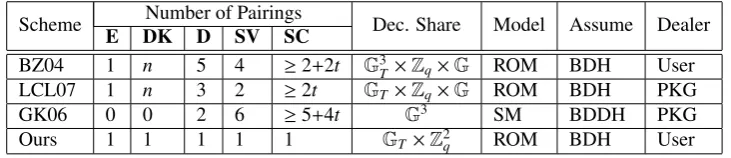
In terms of security and functionality, we compare our IBTD scheme with other schemes as follows. Like the schemes in [8, 14], our scheme is provably secure in the random oracle model (ROM) under the BDH assumption, while the IBTD scheme proposed in [18] is provably secure in the standard model (SM) under the BDDH assumption (Bilinear Decision Diffie-Hellman).
Like the scheme in [8], the user himself in our scheme can share the private key, while the user in the schemes of[14, 18] has to depend on the PKG to share the private key.
In terms of efficiency, the comparison between our IBTD scheme and other ones is as follows. In the field of pairing based cryptography, the number of involved pairings in algorithms is the most important efficiency index. As explained in Remark 1, 2, we make use of some techniques to avoid using pairings. Among these techniques, the indirect method to share the private key in group is the main one . As a result, our identity-based (t,n)-threshold decryption scheme is much more efficient than others as showed in the above table. Especially, observe that the number of pairings in the algorithmsDK,SC in [8, 18, 14] linearly increases with the parametertor n, while the number of pairings in our scheme is a constant, more exactly, 0 or 1.
At last, we present Table 1 for comparison of different IBTD schemes in terms of number of pairings, length of decryption shares, security model (Random oracle model or standard model), assumption and dealer (the one who generates the key shares, user or PKG).
Table 1: Comparison of different IBTD schemes
Scheme Number of Pairings Dec. Share Model Assume Dealer
E DK D SV SC
BZ04 1 n 5 4 ≥2+2t G3
T ×Zq×G ROM BDH User
LCL07 1 n 3 2 ≥2t GT ×Zq×G ROM BDH PKG
GK06 0 0 2 6 ≥5+4t G3 SM BDDH PKG
Ours 1 1 1 1 1 GT×Z2q ROM BDH User
6. Application and Extension
First, our IBTD scheme is very suitable, when the user wants to share his private key out among a number of decryption servers in such a way that any committee member can success-fully decrypt the ciphertext if, and only if, the committee member obtains a certain number of decryption shares from the decryption servers. In this case, unlike the IBTD schemes [14, 18], the user can perform this process without asking the PKG to do so.
Second, our IBTD scheme can be used as a building block to construct a mediated ID-based encryption scheme [8]. The idea is to split a private key associated with the receiver Bob’s ID into two parts, and give one share to Bob and the other to the Security Mediator (SEM). Accordingly, Bob can decrypt a ciphertext only with the help of the SEM. As a result, instantaneous revocation of Bob’s privilege to perform decryption is possible by instructing the SEM not to help him any more. Using Beak’s method for contructing mediated ID-based encryption scheme, a more efficient one can be similarly constructed based on our IBTD scheme.
Third, since the main compuation is the common group operations in the groupGorGT and
only very few pairings are involved during the decrypting procedure, our IBTD scheme is very efficeint and hence is suitable for some resource-restricted applications.
7. Conclusion
In this paper, we proposed a new identity-based threshold decryption (IBTD) scheme from bilinear pairings. With this scheme, the user can by himeself distribute the private key among
decryption servers, without bothering PKG in the sharing procedure. It uses much less bilinear pairings than other IBTD schemes in the involved algorithms. The advantage in efficiency make it suitable for some applications where the computation resource is limited, such as wireless net-works and smart cards. All these properties are due to our new basic technique by which the private key in the bilinear group is indirectly shared through simply sharing an element in the finite field. As the future work, it is interesting to explore further applications of this new tech-nique in threshold cryptography, such as ID-based threshold decryption in the standard model and hierarchical threshold decryption schemes.
References
[1] A. Shamir, Identity-based cryptosystems and signature schemes, in: Proceedins of Crypto 84, LNCS 196, Springer-Verlag, 1984, pp. 47-53.
[2] D. Boneh, M. Franklin, Identity-Based encryption from the Weil pairing, in: Proceedings Crypto 2001, LNCS 2139, Springer-Verlag, 2001, pp. 213-229.
[3] M. C. Gorantla, R. Gangishetti, A. Saxena, A Survey on ID-Based Cryptographic Primitives, http://eprint.iacr.org /2005/094.pdf
[4] Y. Desmedt and Y. Frankel. Threshold cryptosystems. in: Proceedings of CRYPTO’89, LNCS 435, Springer-Verlag, 1990, pp. 307-315.
[5] Y. Desmedt and T. Lange. Pairing Based Threshold Cryptography Improving on Libert-Quisquater and Baek-Zheng. In: Proceedings of Financial Cryptography and Data Security 2006, LNCS 4107, Springer-Verlag, pp.154-159.
[6] A. Santis, Y. Desmedt, Y. Frankel, and M. Yung, How to share a function securely, in: Proceedings of 26th ACM STOC, ACM Press, 1994, pp. 522-533.
[7] V. Shoup, R. Gennaro, Securing Threshold Cryptosystems against Chosen Ciphertext Attack, Journal of Cryptolo-gy, Vol. 15, Springer-Verlag, 2002, pp. 75-96.
[8] J. Baek, Y. Zheng, Identity-based threshold decryption, in: Proceedings of PKC04, LNCS 2947, Springer, 2004, pp. 262-76.
[9] D. Boneh, X. Ding, G. Tsudik, C. Wong, A Method for Fast Revocation of Public Key Certicates and Security Capabilities, in: Proceedings of the 10th USENIX Security Symposium, USENIX, 2001, pp.297-310.
[10] D. Boneh, X.Boyen, S.Halevi, Chosen ciphertext secure public key threshold encryption without random oracles, in: Proceedings of RSA-CT06, LNCS 3860, Springer-Verlag, 2006, pp. 226-43.
[11] D. Boneh, X. Boyen, Efficient selective-ID identity based encryption without random oracles, in: Proceedings of Eurocrypt 2004, volume 3027 of LNCS, Springer-Verlag, 2004, pp. 522-533.
[12] B. Libert, J. Quisquater, Efficient Revocation and Threshold Pairing Based Cryptosystems, in: Proceedings of the twenty-second annual symposium on Principles of distributed computing, ACM Press, 2003, pp.163-171. [13] Z. Chai, Z. Cao, R. Lu, ID-based threshold decryption without random oracles and its application in key escrow,
in: Proceedings of the 3rd international conference on Information security, ACM Press, 2004, pp.119-124. [14] L. Long, K. Chen, S. Liu, ID-based threshold decryption secure against adaptive chosen-ciphertext attack,
Com-puters and Electrical Engineering, 2007, 33 (3) 166-176.
[15] C. Zhao, F. Zhang, Research and Development on Efficient Pairing Computations, Journal of Software, 2009, 20 (11) 3001-3009.
[16] A. Shamir, How to Share a Secret, Communications of the ACM, 1979, 22(11) 612-613.
[17] D. Chaum, T. Pedersen, Wallet databases with observers, in: Proceedings of Advances in Cryptology-Crypto 92, LNCS 740, Springer-Verlag,1992, pp.89-105.
[18] D. Galindo and E. Kiltz, Chosen-Ciphertext Secure Threshold Identity-Based Key Encapsulation Without Random Oracles, in: Proceedinsg of Security and Cryptography for Networks, LNCS 4116, Springer-Verlag, 2006, pp.173-185.
[19] Brent Waters. Efficient identity-based encryption without random oracles. In: Proceedings of EUROCRYPT 2005, LNCS 3494, Springer-Verlag, pp.114-127.