© 2016, IJCSMC All Rights Reserved
10
Available Online atwww.ijcsmc.comInternational Journal of Computer Science and Mobile Computing
A Monthly Journal of Computer Science and Information Technology
ISSN 2320–088X
IMPACT FACTOR: 5.258
IJCSMC, Vol. 5, Issue. 5, May 2016, pg.10 – 16
ATTACKS IN WIRELESS SENSOR
NETWORKS: A SURVEY
Rupinder Singh
†, Dr. Jatinder Singh
‡, Dr. Ravinder Singh
‡†
Research Scholar, IKG PTU, Kapurthala, Punjab.
‡
IKG PTU, Kapurthala, Punjab.
†[email protected], ‡ [email protected]
Abstract - Wireless sensor network (WSN) refers to a group of spatially dispersed and dedicated sensors for monitoring and recording the physical conditions of the environment and organizing the collected data at a central location. WSNs measure environmental co nditions like temperature, sound, pollution levels, humidity, wind speed and direction, pressure, etc. The sensor nodes have extreme resource limitations, unreliable communication medium and that too in unattended environments. This makes it very difficult for the implementation of the existing security approaches to WSNs due to the complexity of the existing algorithms. In this paper we first discuss various issues and requirements concern with the security of WSNs and then we discuss in detail about layer wise attacks in WSNs. A detail study of these attacks will help in the design of robust and efficient countermeasures for attacks against WSNs.
Keywords: Wireless Sensor Network, Sensor, Security, Algorithm
.
I. INTRODUCTION
Wireless sensor network (WSN) refers to a group of spatially dispersed and dedicated sensors for monitoring and recording the physical conditions of the environment and organizing the collected data at a central location.WSNs usually measure environmental conditions like temperature, sound, pressure, pollution levels, humidity, wind speed and direction, etc.
© 2016, IJCSMC All Rights Reserved
11
Initially WSNs were designed to facilitate military operations but its application has since been extended to traffic, health, and many other industrial and consumer areas.
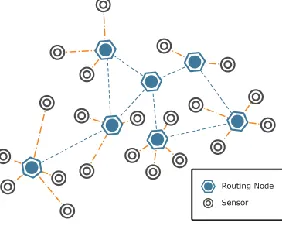
A WSN ranges from few hundreds to thousands of sensor nodes depending on the area and type of application. Sensor node equipment consists of a radio transceiver along with an antenna, an interfacing electronic circuit, a microcontroller, and an energy source (usually a battery). The size of the sensor nodes can also range from the size of a grain of dust to as large as the size of a shoe box. As such, their prices also vary depending on the functionality parameters of a sensor like computational speed rate, energy consumption, bandwidth, memory etc. A typical WSN is shown in figure 1, in which when an event is detected in the sensor fields, the information is routed to the base station. The base station then forwards this information to the user with several communication media.
II. WIRELESS SENSOR NETWORK SECURITY ISSUES
In this section of the paper we discuss various issues concern with the security of WSNs including limitations, unreliability, etc.
A. Sensor networks: The limitations
A distributed sensor network (usually heterogeneous) consists of hundreds to thousands of low-cost and low-power small sensors that are interconnected through a communication network. The sensors are embedded devices that are networked via wireless media, usually integrated with a physical environment, and are capable of acquiring and processing the signals along with communicating and performing simple computational tasks. Common functions of WSNs are broadcasting, multicasting, routing, forwarding, and route maintenance.
The vast applications of sensor networks highlight a vision in which a large number of tiny sensor nodes will be embedded in almost every aspect of human everyday life. However, the widespread deployment of sensor nodes and their overall success is directly related to their security strength. Though WSNs are capable of collecting large amount of information, recognizing significant events and responding appropriately, the need for security is obvious in WSNs.
WSNs have many constraints from which results in new challenges. The sensor nodes have extreme resource limitations and unreliable communication medium and that too in unattended environments which make it very difficult for the employment of the existing security approaches due to the complexity of the algorithms working for sensor platform. The understanding of these challenges inside WSNs provides a basis for further works on sensor networks security. The extreme resource limitations of sensor nodes pose considerable challenges due to resource-hungry security mechanisms. In order to effectively implement approaches, required amount of data memory, code space, and energy is required. However, due to small size of sensor nodes, these resources are very limited [1].
1) Limited memory and storage
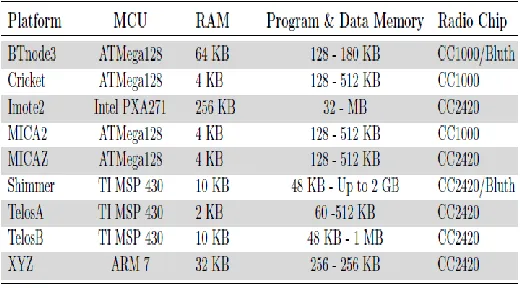
The memory of tiny sensor nodes usually ranges from 2 KB to 256 KB while the storage ranges from 32 KB to 2 GB. Table 1 provides the commonly available sensor nodes with memory and storage. Such hardware constraints of sensor nodes necessitate extremely efficient security algorithms in terms of computational complexity, bandwidth, and memory. The limitation of memory and storage makes it very difficult to implement highly efficient security mechanisms requiring more memory.
2) Limited power
© 2016, IJCSMC All Rights Reserved
12
Table 1: Selection of commonly available sensor nodes
B. Unreliability of communication
One of the major threats to sensor security is the very nature of the wireless communication medium, which is inherently insecure. The wireless medium is open and accessible to anyone unlike wired networks, where a device has to be physically connected to the medium. Due to this any transmission can easily be intercepted, altered, or replayed by an adversary. Intruder can easily intercept valid packets and inject malicious ones due to open access nature of wireless communication medium. Furthermore, damaging of packets may take place due to unreliable transmission channels, this may be result of channel errors or high congestion in sensor nodes. Even communication may still be unreliable in the case of reliable channels also. Conflicts may occur due to packets colliding meet in the middle of transfer resulting in failure of transfer. Such weakness can be easily exploited by an intruder having a strong transmitter, and can easily produce interference (like jamming)
C. Deployment and immense scale
A high degree of dynamics in WSNs is caused due to node mobility, node failures, and environmental obstructions. Frequent topology changes and network partitions are the reasons for this. Sensor node can be deployed in large areas which is one of the most attractive characteristics of WSNs ability. Thousands or millions of nodes, without any prior knowledge on their position can be deployed making the structure of the network complicated. It is therefore required that efficient security schemes can operate within this dynamic environment. It is a substantial task of networking tens to hundreds or thousands of nodes and implementing security over such a network is equally challenging too. More robust security techniques are needed to cope with such dynamics of ever-changing nature of sensor networks. At the same time changes in the network membership needs to be supported in an equally efficient and secure manner. There should be transparency regarding node device joining/leaving the network and a minimum amount of information should have to be reconfigured.
D. Operation unattended
The hostile environment in another challenging factor in which sensor nodes function. Nodes may be left unattended for long periods of time depending on the application which exposes them to physical attacks. Sensor nodes face the possibility of destruction or capture and compromise by attackers. Nodes are compromised when an attacker gains control of a node after deployment in the network. A compromised node may be physically damaged or forced to non-functional, even sensor nodes characteristics/mechanisms may be altered to send out data readings of intruders choice. After gaining control, the attacker can alter the node in order to listen to information in the network and input malicious data or perform a variety of attacks. Intruder may also disassemble the node in order to extract information vital to the network's security including routing tables, data, and cryptographic keys.
© 2016, IJCSMC All Rights Reserved
13
generating valid network data along with distributing it around in order to appear functionally stable. This is going to prevent cooperating nodes from taking measures against their corrupt neighbours who continue to rely on the fake information being fed to them.
III. WSNs SECURITY REQUIREMENTS
In this section of the paper we discuss requirements that are concern with the security of WSN. Sensor networks are a type of distributed networks and share some commonalities with a typical computer network, at the same time pose unique requirements and constraints. Therefore, security goals for WSN encompass both the typical network requirements and the special unique requirements suited for WSNs. The security requirement of WSN must include attributes such as confidentiality, integrity, data freshness, availability, and authentication. All network models allow provisions for implementing above said properties in order to assure protection against attacks to which these types of networks are vulnerable. In the following, standard security requirements (and eventually behavior) for the sensor network are discussed.
A. Confidentiality of data
Data confidentiality is the ability to conceal network traffic from an attacker so that any communication via the sensor network remains secret and is the most important issue concern with network security. In many applications (like key distribution) nodes communicate secret and highly sensitive data.
The approach commonly used for keeping sensitive data secret is to encrypt it with a secret key that only intended receivers possess, therefore achieving confidentiality. Public-key cryptography is very expensive to be used in the resource constrained sensor networks and therefore most of the proposed protocols make use of symmetric key encryption methods. Furthermore, confidentiality only guarantees the security of communications inside the sensor network, it does not prevent the misuse of information that reaches the base station. It is therefore required that information must be coupled with the right control policies so that unauthorized users can be prevented from having access to confidential information.
B. Authentication & integrity of data
False messages can be easily inject in a sensor network by an attacker, therefore the receiver needs to insure that the data to be used in any decision- making process is valid. Data integrity and authentication is therefore necessary to enable sensor nodes for detecting modified, injected, or replayed packets. Not only authentication of safety-critical applications is required, it is still needed for rest of applications otherwise the user of the sensor network may get the wrong information of the sensed world thus making decisions inappropriate. Symmetric or asymmetric mechanisms are used for achieving data authentication is in case sending and receiving nodes share secret keys. It is extremely challenging to ensure authentication due to the wireless and unattended nature of sensor networks that may cause data loss or damage. Authentication alone does not resolve the problem of node takeovers since compromised nodes can be still authenticated by themselves in the network. Therefore authentication mechanisms should be collectively used for aiming at securing the entire network. Intrusion detection techniques may be used to locate the compromised nodes for starting appropriate revoking procedures.
C. Availability of data
Availability is concern with the ability of a sensor node to use the resources and whether the sensor network is available for the communication of messages. A sensor network has to be robust against various security attacks, and impact should be minimized of a succeeded attack. However, it is extremely difficult to ensuring network availability due to limited ability of individual sensor nodes to detect between threats and failures.
D. Freshness of data
© 2016, IJCSMC All Rights Reserved
14
IV. ATTACKS IN WSN
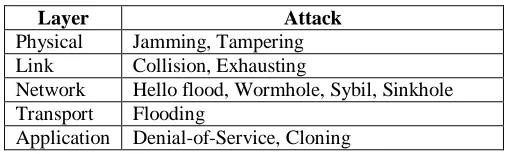
As mentioned earlier, due to the unique characteristics of underlying networking protocols, sensor networks are vulnerable to security threats. Attacks can occur at any layer such as physical, link, network, transport, and application etc. Most of these routing protocols are not designed to have security mechanisms and it makes it even easier for an attacker to break the security for example, attacks at the physical layer of the network include jamming of radio signal, tampering with physical devices etc. In the following section we discuss in detail the layer wise attacks in WSNs
A. Physical layer attacks
Jamming – It is caused due to interference with the radio frequencies of the network's devices which is an attack on the availability of the sensor network. It is different from normal radio propagation in the way that it is unwanted and disruptive, thus resulting in denial-of-service conditions.
Tampering – It is also called node capturing in which a node is compromised, it is easy to perform and is pretty harmful. Tampering is physically modifying and destroying sensors nodes.
B. Link layer attacks
Collision – It is caused in link layer that handles neighbor-to-neighbor communication along with channel arbitration. Entire packet can be disrupted if an adversary is able to generate collisions of even part of a transmission, CRC mismatch and possibly require retransmission can be caused by a single bit error.
Exhaustion – Exhaustion of a network's battery power can be induced by an interrogation attack. A compromised node could repeatedly send thus consuming the battery power more than required.
Table 1: Attacks on different layers in WSN
Layer Attack Physical Jamming, Tampering
Link Collision, Exhausting
Network Hello flood, Wormhole, Sybil, Sinkhole Transport Flooding
Application Denial-of-Service, Cloning
C. Network layer attacks
Hello flood attack – It is caused when an attacker with high transmission power can send or replay hello packets which are used for neighbour discovery. In this way, attacker creates an illusion of being a neighbor to other nodes and underlying routing protocol can be disrupted which facilitate further types of attacks.
Wormhole attack – It is caused due to formation of a low-latency link that is formed so that packets can travel from one to the other end faster than normally via a multi-hop route. The wormhole attack is a threat against the routing protocol and is challenging to detect and prevent. In this type of attack, an adversary can convince the distant nodes that are only one or two hops away through the wormhole causing confusion in the network routing mechanisms.
Sybil attack – It is caused when an attacker uses a malicious device to create a large number of entities in order to gain influence in the network traffic. The ID of these malicious nodes can be the result due to fake network additions or duplication of existing legitimate identities. The sybil attack usually targets fault tolerant schemes including distributed storage, topology maintenance, and multi-hop routing.
© 2016, IJCSMC All Rights Reserved
15
D. Transport layer attacks
Flooding attack – It is a Denial of Service (DoS) attack designed to bring a network or service down by flooding it with large amounts of traffic. Flood attacks usually occur when a network or service becomes weighed down with packets, thus initiating incomplete connection requests that it cannot, longer process genuine connection requests. By flooding a server with connections that cannot be completed, flood attack eventually fills the servers memory buffer and once this buffer is full, no further connections can be made, and thus resulting in a Denial of Service.
E. Application layer attacks
Denial-of-Service (DoS) – This attack is usually referred
as intended attack of opponent for the purpose of destroying or destructing the sensor network. DoS attack may result in limiting or eliminating the sensor network functionality than expected. DoS attack may occur at any layer of OSI layers of WSN. DoS penetrates the efficiency of targeted networks by affecting its associated protocols by consuming the resources, destructing or altering the infrastructure configuration, and physically destroying the network components.
Cloning attack – It is caused when adversaries may easily capture and compromise sensors nodes and deploy unlimited number of clones in the sensor network of the compromised nodes. As these clones have legitimate access to the sensor network (i.e. legitimate IDs, keys, other security credentials, etc.), they can easily participate in the sensor network operations in the same way as a legitimate node resulting in a large variety of insider attacks, or even taking over the entire network. If these clones in the sensor network are left undetected, the sensor network is unshielded to attackers, thus extremely vulnerable. That is why clone attackers are severely destructive. Effective and efficient solutions are required for clone attack detection to limit their damage.
V. CONCLUSION
Due to continue growth of wireless sensor networks, the need for more effective security mechanisms is also increasing. The security concerns of the sensor network should be addressed from the beginning of designing of the system as sensor networks interact with sensitive data and usually operate in hostile unattended environments. A detailed understanding of the capabilities and limitations of each of the underlying technology is required for secure working of wireless sensor networks. In the paper we discuss various requirements and issues concern with the security of WSNs. We also discuss various attacks that are possible in WSNs. A detail study of countermeasures for these attacks is required in order to minimize or eliminate their impact. More efficient and robust techniques for the countermeasures of various types of WSN attacks should be proposed in order to make WSNs more secure and their extension in other fields.
REFERENCES
[1] Chelli P, “ Security Issues in Wireless Sensor Networks: Attacks and Countermeasures,” Proceedings of the World Congress on Engineering 2015, Vol. 1, WCE 2015, July 13 3, 2015, London, U.K.
[2] Munish Dhar and Rajeshwar Singh, “A Review of Security Issues and Denial of Service Attacks in Wireless Sensor Networks,” International Journal of Computer Science and Information Technology Research, Vol. 3, Issue 1, March 2015, ISSN 2348-1196 (print), ISSN 2348-120X (online).
[3] Genita Gautam, Biswaraj Sen, “Survey on different types of Security Threats on Wireless Sensor Networks,” International Journal of Computer Science and Information Technologies, Vol. 6, 2015, ISSN: 0975-9646.
[4] Kanchan Kaushal and Taranvir Kaur, “A Survey on Attacks of WSN and their Security Mechanisms,” International Journal of Computer Applications, Volume 118, No. 18, May 2015.
[5] Sahabul Alam and Debashis De , “ Analysis of security threats in wireless sensor network,” International Journal of Wireless & Mobile Networks (IJWMN), Vol. 6, No. 2, April 2014.
[6] Hosam Soleman and Dr. Ali Payandeh , “ Self-protection mechanism for wireless sensor networks,” International Journal of Network Security & Its Applications (IJNSA), Vol. 6, No. 3, May 2014.
[7] Raja Waseem Anwar , Majid Bakhtiari, Anazida Zainal, Abdul Hanan Abdullah and Kashif Naseer Qureshi, “Security Issues and Attacks in Wireless Sensor Network,” World Applied Sciences Journal 30 (10): 1224-1227, 2014 ISSN 1818-4952.
© 2016, IJCSMC All Rights Reserved
16
[9] Mohamed Lamine Messai , “ Classification of Attacks in Wireless Sensor Networks , ” International Congress on Telecommunication and Application ’ 14 University of A. MIRA Bejaia, Algeria, 23-24 APRIL 2014.
[10] J. Steffi Agino Priyanka, S. Tephillah and A . M. Balamurugan, “Attacks and countermeasures in WSN,” International Journal of Electronics & Communication (IIJEC), Volume 2, Issue 1, January 2014, ISSN 2321-5984.
[11] Dines Kumar, Navaneethan. C, “Protection Against Denial of Service (DoS) Attacks in Wireless Sensor Networks,” International Journal of Advanced Research in Computer Science & Technology (IJARCST 2014), Vol. 2, Issue Special 1 Jan-March 2014, ISSN : 2347 - 8446 (Online) ISSN : 2347 - 9817 (Print).
[12] Anser Ghazzaal Ali Alquraishee and Jayaprakash Kar, “A Survey on Security Mechanisms and Attacks in Wireless Sensor Networks,” Contemporary Engineering Sciences, Vol. 7, 2014, no. 3, 135 – 147.
[13] Rajkumar , Vani B. A , G. Rajaraman , Dr. H G Chandrakanth, “Security Attacks and its Countermeasures in Wireless Sensor Networks,” International Journal of Engineering Research and Applications, Vol. 4, Issue 10 ( Part -1), October 2014, pp.04-15, ISSN : 2248-9622.
[14] Sunil Ghildiyal, Ashish Gupta, Musheer Vaqur, and Anupam Semwal, “Analysis of wireless sensor networks: security, attacks and challenges,” International Journal of Research in Engineering and Technology, Volume: 03 Issue: 03, Mar-2014, eISSN: 2319-1163, pISSN: 2321-7308.
[15] K .Venkatraman , J. Vijay Daniel , G. Murugaboopathi,
“Various Attacks in Wireless Sensor Network: Survey,” International Journal of Soft Computing and Engineering (IJSCE), ISSN: 2231-2307, Volume-3, Issue-1, March 2013.
[16] Jatinder Singh, Dr. Savita Gupta, and Dr. Lakhwinder Kaur, “A MAC Layer Based Defense Architecture for Reduction-of-Quality (RoQ) Attacks in Wireless LAN,” International Journal of Computer Science and Information Security, Vol. 7, No. 1, 2010.
[17] Jatinder Singh , Dr. Savita Gupta , and Dr. Lakhwinder