ARCHITECTURAL STATE-MACHINES
RESPONSIVE FIBER OPTIC FIELD
Christopher Leung BSc. DipArch & Professor Stephen A. Gage AA Dip. RIBA Bartlett School of Architecture, University College London
ABSTRACT
The work described was carried out at the Bartlett School of Architecture, University College London. It is an investigation into the design of an intelligent interactive environment. The term “Intelligent Architecture” is taken to mean a built environment with machine intelligence embedded into it. The availability of low cost, powerful, miniature and network-ready computers has been exploited with 1:1 scale working prototypes to investigate and experiment with a responsive architecture.
INTRODUCTION
Both projects described in detail demonstrate installations that are responsive in real-time and can be made using low cost sensing, computational and actuating equipment. These installations produce an elegant and ever changing architecture that can learn from the history of its experience. These and other similar projects have indicated that there could be a common working hypothesis in the design of many types of intelligent spatial environments. In any space, the installation, the enclosure and the occupants must be regarded as a whole. The implication is that spatial intelligence must be distributed in parallel throughout a building. Local control intelligence cannot reside solely in functional objects; control intelligence must learn to become space specific.
The “Turing Table” installation at the Crowbar Coffee1 is described in terms of its behavioral
CROWBAR COFFEE
'Design being a transactional art, it follows that the looser areas of behavioral psychology have a practical interest, despite the inability of most designers to 'place' such work confidently enough to form conclusions about it.'2
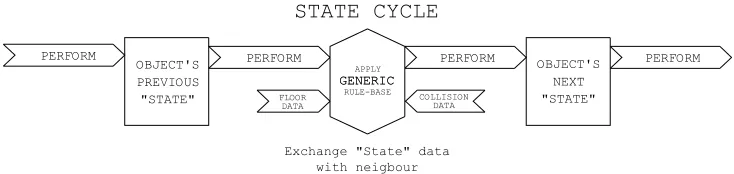
A number of reactive objects were placed in a gallery space, each object displaying either bored, content or excited behavior with three distinct rhythmic movements of antennae. The objects are connected together in a network and their individual behavior is under the control of a "state-machine3" computer program.
GENERIC GENERICAPPLY RULE-BASE OBJECT'S PREVIOUS "STATE" OBJECT'S "STATE" NEXT PERFORM PERFORM FLOOR
DATA COLLISIONDATA
STATE CYCLE
PERFORM PERFORM
Exchange "State" data with neigbour
Fig. 1 Generic State-Machine for Crowbar Installation
A state-machine (see Figure 1) operates by first expressing a state, observing the effects of that expression before deciding whether to remain in that state or to react to its observations by changing state. The state-machine software determines what each object should do with their observations in the form of a rule-base.
The aim of the study was to artificially model distinct behaviors by embedding logical rules of behavior into the actions of a community of "state-machines". Each of the objects has an attention-span in each state, the goal state of all the objects is initially contentness, this goal is conditioned by the object's success at surveying their environment for signs of visitors and the length of time that they can engage them. These values only represent logical values within the “state-machine” they do not in themselves physically express those behaviors. Each object expresses its state by different rhythmic motions and a corresponding facial expression.
In genetic algorithm terminology the "fitness-value" of a given behavior is taken to be the attention span of the audience. If an object can express different behaviors, successful ones ought to command a longer attention span which can sustain the environmental stimuli which got it to behave in that way in the first place. An analogy is a performer searching for a combination of subject, delivery, venue and audience that can sustain a show, work with positive social feedback. "Desire-time" is used in software controlling the objects to relate the success of their behaviors, the heuristic applied is that if an object performs behavior X and the "audience attention span" is longer than when it performs behavior Y then stop producing behavior Y and produce more behaviors like X.
The machine's behavior is rehearsed thoroughly during programming, however until it performs in the face of actual feedback the predicted behaviors presumed to be important may prove not to be. Similarly a performer who rehearses their act ad infinitum but when performing live judges their timing and gesture as not just a recital but an improvised real-time response to their audience.
The software controlling this system uses constants4 to describe the characteristics of "bored",
between "performance" and technical notions of "system optimization" in the plasticity of the software describing object behavior in the face of real inputs.
A genetic algorithm could potentially give this system a pool of possible "what if" behaviors, but fundamentally the programmer has to devise a rule-base with at least the following two abilities:
(i) Decide what behavior meant the system was having the desired effect on the visitor, For example that more floor input is good.
(ii) It must be able to evaluate the success or failure of generated behaviors. For example inferring from the floor pressure-pad input whether people paid any attention and how long excited state was maintained.
Equipped with an ability to learn from the experience of experimenting with entertaining visitors and an ability to compile a working knowledge of what does not work along the way, the installation may develop patterns of behavior.
RESPONSIVE FIBER OPTIC FIELD
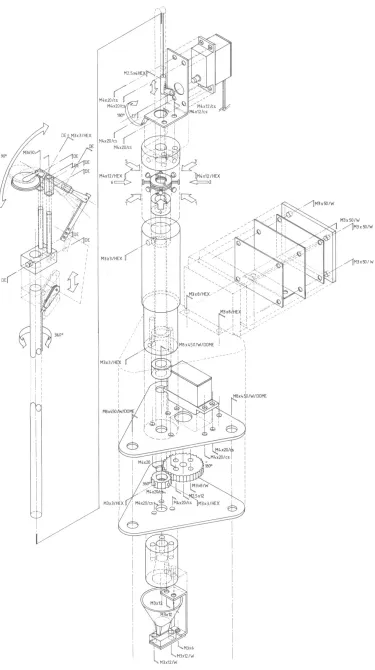
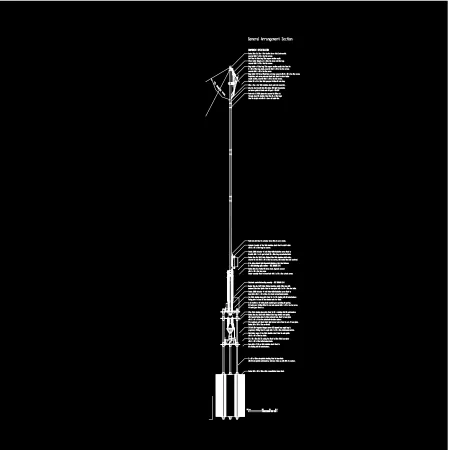
A light fitting was constructed from cast perspex, bespoke machined aluminium components and re-constituted stone (See Figure 5). The luminaire consists of a 1.0m x 0.01m diameter vertical fiber optic illuminated by a Tungsten Halogen lamp, a motorised mirror mounted at the fiber’s tip reflects and projects the fitting’s light beam.
The mirror is computer controlled in two-axes with servomotors and mechanical linkages, it can project the fiber optic’s light beam through 360 degrees in plan and 90 degrees in elevation by rotating and winking the mirror (See Figure 3). The lamp is powered and switched from a computer controlled relay-board located remotely. The mirror at the fiber’s tip is at average eye-level 1.85 metres above grade and in a dark space can project a light beam up to 10 meters away.
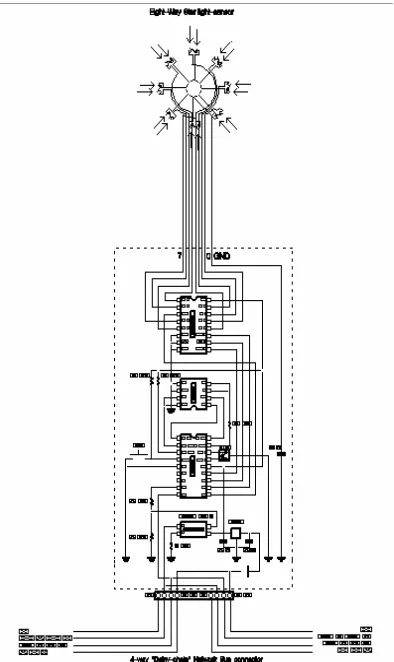
Each light fitting or “fiber optic mast” has an electronic light level sensing system inspired by the natural adaptation of the sunflower plant (Helianthus, Chrysanthemum) to the diurnal path of the sun across the sky. The question was “what information does a Sunflower need to grow, adapt and respond in its lighting environment from the moment of germination? How does it physically collect this information and what rule-base is applied to classify, interpret and react to it?” The working axioms of ‘what a system cannot sense does not exist’ and ‘sensing only those properties of the environment that the output can make use of’ determined the design of a sensing system for each fiber optic mast. It consists of eight photocells in a star configuration, each photocell is wired back to a
computer that measures the light levels and runs software to calculate the ambient light level and classify the eight directions in order of brightness (See Figure 2).
The installation proposal is to arrange in a space a field of masts. The masts are all physically identical but each has a unique address in a communications network connecting together the computers controlling the mirrors and those sensing the light levels local to each mast. With a number of masts and their embedded system for sensing, switching lights, direction control optics and communications infrastructure a speculation about choreographing them could begin.
• Spatial Self-Organization: Could a mast search and find the location of their neighboring mast(s) by controlling their mirror to shine light at their neighboring mast’s sensors?
• Coordinated Searches for the Presence of People: With the above information could individual and groups of masts search for visitors in the installation with beam breaking?
• The Emergence of an Individual and Collective Repertoire of Behavior: With the two pieces of information above could a mast gesture in a readable way to a visitor’s presence? Over a period of time could the system identify patterns of response in its history of visitors? What scope exists to respond to a visitor with anticipation?
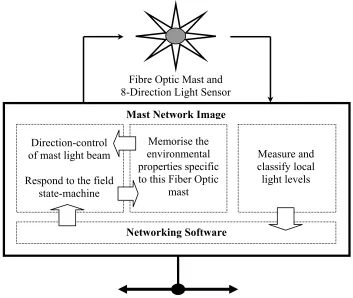
These speculations inspired the design of the installation’s software. The choice of raw data to collect from each mast at any given time and a framework for handling that raw data as described in Figure 3.
Fig. 3 Schematic of a Mast Network Image. Direction-control
of mast light beam
Respond to the field state-machine
Networking Software
Measure and classify local light levels Fibre Optic Mast and
8-Direction Light Sensor
Memorise the environmental properties specific to this Fiber Optic
mast
Mast Network Image
‘HIDE-AND-SEEK’ SELF-ORGANISATION
The game of hide-and-seek forces children to find out about their environment by making their placement in it competitive, whether in the desert, forest, arctic or central London their personalities and the physical idiosyncrasies of their hiding places make the game engaging.
Initially the field is choreographed to build a knowledge base of its environment using the analogy of hide-and-seek, it investigates any given installation environment with a mast "seeking" with gestures of sweeping light in random directions like a child's eyes darting around after finishing the count to one hundred. If a child searched systematically they should be able to locate everyone, eventually. However, the search would erode the children’s attention span, the trade-off between efficacy and efficiency5 favors a search method able to
build just enough of a picture to make useful inferences from. Like a child the field’s masts search speculatively by looking for a dynamically increasing light level value at another mast or in genetic algorithm terminology an increasing fitness-value from its speculation. The child pursues that mast into a positive feedback loop with a climax when mirror adjustments stop producing any “fitter” light levels.
Each successive "found" mast joins the search for other masts, the "seeker" masts co-operate to self-organize their light beam projection by selecting the target mast(s) with the highest light level and entering a positive feedback loop of generating projection dimensions that increase it. The field’s masts effectively co-operate to find a relation with each other, a shared relation without absolute positioning that continues until all masts are "had". After a number of rounds of the game with masts chosen at random as the first "seeker" the field would have "learnt" position relationships, the more times this game is run the more complete the field's collective picture of itself should become. The game of hide-and-seek is engaging for the masts as they mature a sense of location in a given environment, it is also anticipated that the field will realize boundaries of influence when some masts find fewer neighbors than other masts.
The installation will revert back to playing hide-and-seek in the absence of visitors, passing the time with a kind of geometric musing. It reinforces the internal representation of itself and updates that representation in the face of changes in its lighting environment and installation geometry. The field's exploration of its environment aims to self-organise the mosaic of network “images” describing the field’s state at a point in time, it is not systematic and the relationships formed between the properties of different mast network images are associative rather than absolute. The field is designed to adapt to a dynamic lighting environment.
ACTIVITY PACE-SETTING
The activity level of the field is determined by the lighting characteristics of the installation environment. From the ambient light level of each mast6 the operating system
weighs up the difference between the highest and lowest local ambient light level. When the difference is small then the field’s activity level is determined globally, if it is large for example between masts placed close to a window and a mast in a shaded corner then activity level is determined on an individual basis. Activity level is a fuzzy relation between two limiting thresholds of low ambient light level when the sensors zero-out and when it is so bright that the mast’s own light emission cannot be sensed.
ANTHROPOMORPHIC GESTURING
"There is no best strategy for supporting an interaction independently of its environment, which would suggest that the best strategy is to encourage the support of a protocol of interaction."7
Having learnt the light level caused by a combinations of "seekers" shining light at an individual mast, the field can access light levels by individual direction and compare found
(real-time sensed) with familiar (memory). When somebody passes through the field they disturb the familiar light levels and therefore their position can be inferred in real-time. The disturbance is checked by the nearest masts, if they corroborate then a mast’s reflex behavior to that disturbance is a mechanical animation of the mirror that is scaled and timed to mimick anthropomorphically a nodding head, shaking head, rolling your eyes and eyes staring you in the face. Meanwhile the other masts in the field continue as before sweeping light over their neighboring mast’s sensors.
The field generally reciprocates attention by increasing the number of masts that are gesturing and recording the frequency of disturbances by location. These recordings inform an analogue of "familiarity" in the field's response. The field reacts to multiple disturbances by dividing attention equally between groups of masts, the field’s gestures would respond to as many occupants as there are masts to direct. The response percolates through the field with more masts directing their light, the visual effect is the mast’s “following” and winking at people as they walk through the installation.
The "tit-for-tat" policy in the iterated prisoner's dilemma provides a framework for probing the field's disturbances: 'Its (the field's) niceness prevents it from getting into unnecessary trouble. Its retaliation discourages the other side (visitors) from persisting whenever defection is tried. Its (the field's) forgiveness helps restore mutual cooperation. And its clarity (gestures) makes it intelligible to other players, thereby eliciting long-term cooperation [my italics].8
Individual masts are analogous to instruments in an orchestra that has not learnt the repertoire of a score. Each mast holds a sketch of the whole with a detailed score of their own part to perform, the conductor's choreography provides the timing frame within which each instrument becomes active at the moment the composition calls for it.
The working definition of the field learning is the actions in the environment that the masts can carry out and know whether the effect was successful or not, by trying gestures (with characteristics and rule strengths) and testing them against visitor attention (measured and compared). What the searches materially change is the field's certainty about its environment by narrowing down the locations of its neighbours. The field's learning is analogous to a learner driver who is cautious when reversing out of the driveway, not completely sure how far away that rear bumper really is from the garden post or how wide the gap between the posts is relative to the car.
With practice reversing out of the drive gets faster as more is assumed. Squeezing into a tight parking slot uses similar judgement and with practice more confidently. The installation is slow at first, cautious and unsure about the locations of its neighbours and the light level threshold between them, as it experiments surveying its environment trying the various search strategies for corroboration it learns and reinforces its model of the world.
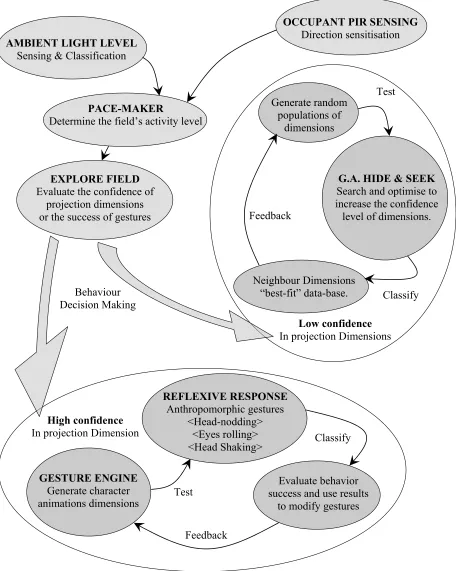
The operating system describes the state of the field as a mosaic of mast network images and the field’s behaviour is driven by real-time processing of the links between mast properties. Each mast‘s behaviour is determined using the state-machine paradigm where an individual mast’s state is conditioned by its previous state, the ambient light level, their confidence of the position of their neighbours and the perceived effect of the their gestures toward visitors (See Figure 6).
Classify
REFLEXIVE RESPONSE
Anthropomorphic gestures <Head-nodding>
<Eyes rolling> <Head Shaking>
G.A. HIDE & SEEK
Search and optimise to increase the confidence level of dimensions.
PACE-MAKER
Determine the field’s activity level
EXPLORE FIELD
Evaluate the confidence of projection dimensions or the success of gestures
Generate random populations of
dimensions
AMBIENT LIGHT LEVEL
Sensing & Classification
OCCUPANT PIR SENSING
Direction sensitisation
Evaluate behavior success and use results
to modify gestures Neighbour Dimensions
“best-fit” data-base.
GESTURE ENGINE
Generate character animations dimensions
High confidence
In projection Dimension
Low confidence
In projection Dimensions Behaviour
Decision Making
Test
Classify
Test
Feedback
Feedback
CONCLUSION
The installations described have been placed in the real world and inevitably have to deal with incomplete and conflicting data. In the responsive fiber optic field sensing the lighting environment has a structure and is attached to concepts of behavior through the state-machine model. Like the natural system that inspired its design, there is a redundancy in the field's hundreds of networked sensors that bring a greater certainty and robustness in responding to environmental changes. It appears at different scales, from responding to one light level in a single direction at one point in time to the sum of the whole field in its entire history of operation.
It has been argued that an "intelligent" machine is only as "intelligent" as our ability to fill in the gaps of what it cannot do, like a "social prosthetic9". The argument follows that one way
we perceive intelligence (not just in machines) is when something fills in thinking time for us during a process that we did not expect. The installations do aspire to this, the design challenge is to identify what common physical and cognitive interactions mediated by discrete states or gestures form a shared understanding between an environment and its occupants. This determines the heuristics used by the searches to seek associations between the system's behavior in an environment and people's reactions.
Neither installation behaves intelligently in any sentient way, the adaptation to the nature of its environment is what places it in the world and that is its scope for being more than the sum of its parts.
CREDITS
SIXTEEN MAKERS 22 Gordon Street, London, WC1, Tel. 020 71 504 4813
CROWBAR COFFEE Ltd. 55 Exmouth Market, London, EC1, Tel. 020 71 636 4443
PARALLAX INC. Sacremento, California, United States of America
Many Thanks to: Philippe Ayres, Edward Buckley, Nicholas Callicot, Professor Stephen Gage, Ruth James, Stefan Keuppers, Tara de Linde, Anna Lundström, William McLean, Josephine Pletts, Peter Silver, Andrew Whiting, and all the Staff at the Crowbar for their conversations, ideas, criticism and practical help.
REFERENCE LIST
1 Published in "A hearing, touching, feeling, living room", BD Interactive, BD, No.
1335 Jan 1998, Neil Spiller and p. 8, "Hypersurfaces", AD, Vol. 68 June-July 1998. Pete Silver/Chris Leung/Andrew Whiting
2 Potter, Norman, What is a designer: things, places, messages, (Hypen press, 1989).
3 Arizona MicroChip Technology Applications Handbook:
http:\\www.microchip\~\appdoc.pdf 23.09.98
4 PBasic values that do not change during run time.
5 p.1, Goldberg, David E., Genetic Algorithms in Search, Optimisation and Machine
Learning, (Addison Wesley, 1989).
6 The sum of a mast’s eight light level values divided eight.
7 Axelrod, Robert, The Evolution of Co-operation, (Penguin, 1984).
8 p.54, Chapter 2, "The emergence of co-operation", Axelrod, Robert, The Evolution of
Co-operation, (Penguin, 1984).