The Tao of Inference in Privacy-Protected Databases
Vincent Bindschaedler
UIUC
Paul Grubbs
Cornell Tech
David Cash
University of Chicago
Thomas Ristenpart
Cornell Tech
Vitaly Shmatikov
Cornell Tech
ABSTRACT
To protect database confidentiality even in the face of full compromise while supporting standard functionality, recent academic proposals and commercial products rely on a mix of encryption schemes. The recommendation is to apply strong, semantically secure encryption to the “sensitive” col-umns and protect other colcol-umns with property-revealing en-cryption (PRE) that supports operations such as sorting.
We design, implement, and evaluate a new methodology for inferring data stored in such encrypted databases. The cornerstone is themultinomial attack, a new inference tech-nique that is analytically optimal and empirically outper-forms prior heuristic attacks against PRE-encrypted data. We also extend the multinomial attack to take advantage of correlations across multiple columns. This recovers PRE-encrypted data with sufficient accuracy to then apply ma-chine learning and record linkage methods to infer columns protected by semantically secure encryption or redaction.
We evaluate our methodology on medical, census, and union-membership datasets, showing for the first time how to infer full database records. For PRE-encrypted attributes such as demographics and ZIP codes, our attack outper-forms the best prior heuristic by a factor of 16. Unlike any prior technique, we also infer attributes, such as incomes and medical diagnoses, protected by strong encryption. For ex-ample, when we infer that a patient in a hospital-discharge dataset has a mental health or substance abuse condition, this prediction is 97% accurate.
PVLDB Reference Format:
Vincent Bindschaedler, Paul Grubbs, David Cash, Thomas Ris-tenpart, and Vitaly Shmatikov. The Tao of Inference in Privacy-Protected Databases.PVLDB, 11 (11): 1715-1728, 2018. DOI: https://doi.org/10.14778/3236187.3236217
1
Introduction
Frequent large-scale breaches [3, 15, 88, 89] compromise mil-lions of credit card numbers, email messages, and health-care records. Several academic proposals [4, 10, 39, 43, 53, 75]
Permission to make digital or hard copies of all or part of this work for personal or classroom use is granted without fee provided that copies are not made or distributed for profit or commercial advantage and that copies bear this notice and the full citation on the first page. To copy otherwise, to republish, to post on servers or to redistribute to lists, requires prior specific permission and/or a fee. Articles from this volume were invited to present their results at The 44th International Conference on Very Large Data Bases, August 2018, Rio de Janeiro, Brazil.
Proceedings of the VLDB Endowment,Vol. 11, No. 11 Copyright 2018 VLDB Endowment 2150-8097/18/07. DOI: https://doi.org/10.14778/3236187.3236217
and commercial products [14, 50, 62, 65, 72, 80] aim to (1) protect the data even in the event of a whole-system com-promise, while (2) enabling standard applications to operate on this data in its original database, whenever possible.
A popular approach is encrypted databases, in which a client (or a proxy acting on his behalf) encrypts the data before uploading it to the database. For efficiency, these sys-tems employ various flavors of “property-revealing” encryp-tion (PRE). PRE schemes reveal certain properties of the underlying plaintexts, e.g., equality in the case of determin-istic encryption or sort order in the case of order-preserving encryption. Revealing this information enables essential op-erations (e.g., searching and sorting) to be performed on the encrypted database entries without decrypting them.
Efficiency in encrypted databases comes at a cost. Recent inference attacks against PRE [24, 42, 57, 64] showed that, in some situations, an adversary can recover plaintexts with good accuracy. These inference attacks use public auxiliary information to estimate the expected distribution of plain-texts, then target each database column separately.
In response to these attacks, academics and practitioners now suggest (e.g., [76]) increased protection based on “sen-sitivity analysis”: apply PRE to the less sensitive database columns (enabling efficient database operations on these col-umns) and strong encryption to the more sensitive columns. The database administrator decides which columns warrant stronger protection. From an attacker’s perspective, this is equivalent to redacting or segmenting the sensitive columns, a common practice in medical databases [39, 69, 70].
None of the previously proposed inference attacks work against strongly encrypted or redacted data. It may there-fore appear that the state-of-the-art privacy protection meth-ods based on “sensitivity analysis” ensure confidentiality of the sensitive database columns. After all, how can an ad-versary recover the data that is not even in the database?
Our contributions. We develop a new inference frame-work to demonstrate that even the state-of-the-art protec-tions described above cannot prevent an adversary from in-ferring full database records in realistic scenarios. Unlike prior heuristics, our framework exploits correlations across database columns and databases. Our key tool is a new, optimal inference attack against PRE-encrypted columns.
sources that provide the estimates not just of the distribu-tions for individual columns but also of joint distribudistribu-tions, as well as partial records of specific individuals.
Inference attacks on PRE-encrypted data. We first develop a new inference technique against deterministic and order-preserving encryption, the two PRE schemes that are used in practice. It provides a theoretical basis for attacks and greatly outperforms prior heuristics [24, 42, 64].
Consider attacking a single PRE-encrypted column. We treat the attacker’s task as a Bayesian inference problem whose objective is to identify the most probable plaintext-to-ciphertext mapping function that fits the constraints of the type of encryption (i.e., a permutation for deterministic encryption, an preserving injective function for order-preserving encryption), conditioned on the observed leakage from the ciphertexts and on the priors from the auxiliary data. We call this amultinomial attack because we model the vector of plaintexts as sampled according to the multi-nomial distribution. Subject to this assumption, our new at-tack is optimal: it is a maximum likelihood estimator (MLE) and inherits the optimality guarantees of MLEs [67].
We efficiently instantiate our MLE for deterministic and order-preserving encryption. For the former, our attack finds the same solution as frequency analysis [57], match-ing its optimality. For the latter, ours is the first provably optimal attack. Our approach offers additional benefits over prior work, e.g., the ability to calculate confidence estimates. Even an optimal single-column attack does not work well if, for example, the plaintexts of a column are almost uni-formly distributed—even if the column is strongly correlated with another, non-uniformly distributed column. To exploit such correlations across PRE-encrypted columns, we extend the multinomial attack to multiple columns, departing sig-nificantly from the single-column viewpoint of prior work.
To avoid the curse of dimensionality, our multi-column at-tack proceeds column by column. We start with a column for which the single-column attack should perform well, then pick another, correlated column as the target. To attack it, we use (a) the plaintext-ciphertext mappings recovered for the first column, and (b) the joint distribution, estimated from the auxiliary data, over just these two columns. Hav-ing recovered two columns, we proceed to the next target, and so on, following a dependency graph between columns. We explain how to build column dependency graphs that perform well in practice, using auxiliary estimates of the mutual information between columns.
Our multi-column multinomial attack greatly outperforms single-column attacks. For example, in our ACS dataset case study (Section 7.2), it recovers PRE-encrypted demographic attributes 2 times better than our own single-column attack and 16 times better than the best prior technique. In the FOP dataset case study (Section 7.4), it recovers ZIP codes 7 times better than the single-column attack and17 times better than the best prior technique.
Inference attacks on redacted data. After accurately inferring the values of the PRE-encrypted columns using our multinomial attacks, we proceed to infer the values of “sen-sitive” columns—which cannot be attacked using prior tech-niques. We employ two methods that exploit cross-database correlations: record linkage and machine learning.
If the target and (plaintext) auxiliary databases contain records of the same individuals and overlap on some
at-tributes, we can use record linkage. Instead of the classic techniques [63, 66, 81, 82] that assume plaintext records, we use the attributes recovered by the multinomial attack as
quasi-identifiers to join the target and auxiliary databases. The auxiliary database may provide only statistical infor-mation, as opposed to the records of individuals from the target database. In this case, we cast the problem of in-ferring the redacted values as a prediction task where these values are the target and the attributes recovered from PRE-encrypted columns are the features. The prediction model (a classifier or regression model) is trained on auxiliary data.
Case studies. We evaluate our framework on the HCUP National Inpatient Sample (NIS) dataset with 7,000,000 hos-pital stay records; the U.S. Census American Community Survey (ACS) dataset with 2,500,000 records; and the Fra-ternal Order of Police (FOP) dataset with the names and addresses of 600,000 police officers. In our experiments, we protect datasets using appropriate techniques—redacting di-agnoses, incomes, and addresses. All attacks are simulated and do not extract information that is not already public.
For the HCUP-NIS dataset, we recover all PRE-encrypted attributes and then infer the redacted medical diagnosis codes. Accurately inferring the condition of even a single patient is a privacy breach, thus our inference algorithm maximizes accuracy rather than coverage and only predicts the condition of the patients for whom it is most confident. When predicting that a patient has a mental health or sub-stance abuse condition, its accuracy is 97%; for mood disor-ders, accuracy is 96%. For the ACS dataset, we recover over 90% of PRE-encrypted attributes and infer annual income to within $8.4K. We also demonstrate that the attack would have succeeded even if the auxiliary data had been obsolete and much smaller. For the FOP dataset, we infer the exact home addresses of approximately 1 out of 13 police officers, and as many as 1 out of 7 in Michigan and Pennsylvania (equivalent to 7,200 officers in Pennsylvania).
2
Database Privacy Protection
We model a database DB as an m×k matrix of values pj[i], for 1≤i≤m and 1≤j≤k. The database schema specifies for columnjthe setPjto whichpj[i] must belong. For example,P1may hold names which are bounded-length strings andP2may hold salaries which are integers between 0 and 1,000,000. The data owner (client) applies the privacy protections from Section 2.2 to the data before uploading it to the database. For each encrypted column, the client chooses an independent secret key unknown to the server.
2.1
Threat model
We focus on the common “smash-and-grab” attack that compromises the entire system hosting the database but does not establish a persistent attacker presence. We as-sume a passive adversary who obtains a single snapshot of the server’s entire disk and memory, including all server-side secrets (thus defeating at-rest and full-disk encryption) but not clients’ secrets. In reality, a single snapshot of an encrypted database contains a wealth of information about past queries [41], thus our threat model is a conservative underestimate. Real-world compromises may reveal much more than the attacks described in this paper.
with the compromised database. In subsequent sections, we will detail our assumptions about the auxiliary data and its quality. For the purposes of this paper, we assume that the adversary does not perform active attacks such as inserting known plaintexts into the database (c.f., [40, 42]).
2.2
Privacy protection techniques
Aprivacy schemaassociates to each column a technique for protecting the confidentiality of the data in that column.
Redaction. Sensitive data elements can be replaced with random or otherwise unique identifiers chosen independently of the plaintext values. For example, data segmentation
—advocated for electronic health records (EHR) of individ-ual patients [39, 69, 70]—removes values or replaces them with random values sampled from the same distribution.
Another approach is to use strong encryption that achieves (at least) indistinguishability under chosen-plaintext attack (IND-CPA) security. Each element pj[i] in the sensitive column j is replaced by cj[i] = EK(pj[i]) for 1 ≤ i ≤ m, where keyK is not stored at the database server. In our threat model, strong encryption is equivalent to segmen-tation because the ciphertext carries no (compusegmen-tationally learnable) information about the plaintext. We refer to both segmented and strongly encrypted columns as “redacted.”
Property-revealing encryption. Redaction of columns severely limits the utility of a database, restricting the server to only insertion and retrieval queries; most processing must be performed by clients or client proxies. Property-revealing encryption (PRE) is an attractive alternative that intention-ally reveals some properties of plaintexts in order to support certain operations on the ciphertexts without the decryption key. The two PRE schemes used in practice are determinis-tic encryptionDEand order-revealing encryptionORE.
DEis a form of symmetric encryption that ensures that en-crypting the same message twice produces the same cipher-text. Therefore,DEleaks plaintext equality. This enables ef-ficient exact-match search: a client re-encrypts the word and submits the resulting ciphertext as a query to the database. Our treatment of DE covers a wide variety of specific re-alizations, such as using a block cipher for short messages or a deterministic length-preserving mode [45, 46]; format-preserving [6, 7] and -transforming encryption [26, 59, 60]; and deterministic authenticated encryption [79].
(Ideal)ORE leaks plaintext equality and plaintext order. We surveyORE schemes in Section 9. Our results apply to most of these schemes, including [2, 8, 12, 74].
Choosing privacy schema. Selecting the privacy schema for a given database involves delicate decisions that must balance confidentiality goals with database utility. For ex-ample, a schema that strongly encrypts all columns will achieve high confidentiality, but the database server will not be able to perform any database operations (beyond inser-tion and retrieval) without involving clients or client proxies. In practice, schemas are chosen in a utility-first manner: determine the operations for each column that must be per-formed by the database server, then choose the most secure scheme that still allows the server to perform those opera-tions. For example, Microsoft’s Always Encrypted database encryption guidelines [62] recommend “us[ing] deterministic encryption for columns that will be used as search or group-ing parameters.” This approach is often the only viable way to satisfy legacy constraints and business needs.
Another approach, espoused by some academics [76], is to task the security architect withcolumn sensitivity analy-sis to decide which columns warrant strong encryption (or, equivalently, segmentation). We are not aware of any frame-work or guidelines for these decisions. In Section 7.1, we show that naive analyses based on cross-column correlations can miss columns that arenot strongly correlated with the sensitive column yet enable accurate inference of the latter. We assume that the adversary knows the privacy schema. Even if the database encrypts column labels and randomizes column order (c.f., [75]), discovering the mapping between a known database schema and individual encrypted columns is almost always straightforward [64]. The lengths of the ciphertexts may reveal the column’s domain, or else the ad-versary can find the closest match between the number of distinct values in a column and domain sizes|P1|, . . . ,|Pk|.
3
Overview
In Section 4, we develop a new framework, based on Bayesian inference, for attacking individual PRE-encrypted columns. The framework can be instantiated to attack bothDE and
ORE. The resulting attacks are optimal in a well-defined sense, and our attack against ORE-encrypted columns out-performs prior heuristic approaches [42, 64].
Next, in Section 5, we develop the first ever multi-column attack against PRE-encrypted columns. It exploits corre-lations between columns and outperforms the best known single-column attacks. For example, attacking the state and ZIP code attributes simultaneously recoversORE-encrypted ZIP codes with 36% accuracy whereas the best prior work [42] only achieved 2% accuracy on the same dataset.
In Section 6, we develop a whole-database inference at-tack. Unlike all previous heuristics, it targets “sensitive” columns (e.g., medical diagnosis codes) protected by redac-tion, i.e., strong encryption or segmentation. Our attacks uses record linkage and machine learning techniques to in-fer the values of the redacted columns from those of the PRE-encrypted columns (recovered by our single- and multi-column attacks) and the cross-multi-column correlations. This breaks the last defense encrypted databases use against in-ference attacks, namely, “column sensitivity analysis.”
4
Inferring Single PRE Columns
In this section, we formalize a new approach to inference at-tacks against a single column of data encrypted usingDEor
ORE. The adversary has access to (1) auxiliary information providing (an estimate of) the distribution of plaintext val-ues, and (2) an observed ciphertext vector. In theDEcase, the vector leaks only frequency information (which cipher-texts correspond to the same plaintext); in the ORE case, the vector leaks both frequency information and ordering. Our attack thus applies to anyORE scheme that leaks fre-quency (including at least [12, 55, 74]). We make the most conservative assumption about leakage and treat the ORE
4.1
General attack framework
We first design a general framework for attacking PRE-encrypted columns via Bayesian inference, then instantiate it for specific PRE schemes. Letρ be the distribution of plaintext values for the target column. There arempossible plaintext values: [m]≡ {1,2, . . . , m}. Let ρi be the proba-bility (or expected proportion) of theithvalue;Pm
i=1ρi= 1. The ciphertext vector~ccontainsnciphertexts, each of which is a valid encryption of a plaintext in [m]. Encryption is a bijection, thus there are at mostmdistinct ciphertext val-ues. Without loss of generality, relabel them to [m], then the vector~c can be regarded as a histogram over [m]. Let cjbe the number of times ciphertextj∈[m] appears in~c.
Letf : [m]→[m] denote a bijective plaintext-ciphertext mapping,f the random variable describing the choice off made by the PRE key generation algorithm, andF the sup-port off, i.e., all possible functions. We assume that the attacker knows howf is chosen. His goal is to compute
Pr{f=f|~c;ρ}= Pr{~c|f=f ;ρ} ·Pr{f=f;ρ}
Pr{~c;ρ} (1)
which is simply the posterior probabilityf given ~c, ρ. Di-rectly computingPr{~c;ρ}is infeasible in general: it scales with|F|, which is exponential inm. The attack will instead target just the most likely decryption of~cby computing
fmax= arg max
f P
r{f|~c;ρ}
= arg max
f P
r{~c|f=f;ρ} ·Pr{f=f ;ρ} (2)
and then applyingfmax−1 to each ciphertext in~c. The second equality uses Bayes’ rule and then drops the denominator, which cannot affect the maximization. Equation 2 is the maximum likelihood estimator (MLE) forf ifPr{f=f ;ρ} is uniform. The actual distribution will be indistinguishable from uniform if the PRE scheme is indistinguishable from a random permutation or random order-preserving function, (q.v., [8,38]). Thus Equation 2 simplifies to arg maxf Pr{~c|
f=f ;ρ}and with all but negligible probability, the maxi-mized value is equal to the truefmax.
To estimate the likelihood, we model it as the density of a multinomial distribution, giving
Pr{~c|f=f;ρ}=Kc
m
Y
i=1 ρcf(i)
i (3)
whereKcis a normalization constant that depends on~cbut not onf. Thus, the posterior need not be computed directly. Subject to our assumption that data is aptly modeled by the multinomial distribution, the above approach has the optimality guarantees of an MLE.
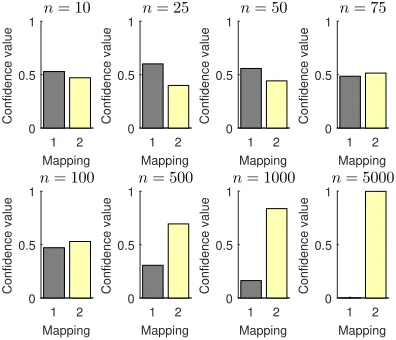
Our Bayesian approach allows the attacker to compute confidence values on the plaintext-ciphertext mappings. This is significant because low-confidence recovered values are un-likely to be useful in practice.
The general framework needs to be instantiated to attack specific encryption schemes. This involves fixing a particular random variablef and associated supportF and specifying an efficient way to compute Equation 3.
4.2
Attacking deterministic encryption
If the encryption scheme isDE,F is the set of all permuta-tions on [m]. Whenmis large, evaluating Equation 3 for all f is infeasible, since there arem! functions. However, if we
take the log of Equation 3, we getPm
i=1cf(i)log (ρi), i.e., the log likelihood of ciphertextjbeing an encryption of plaintext i is cjlog (ρi). Thus to find f that maximizes Equation 1 forDE, we solve a linear assignment problem. The solution is the maximum-weight bipartite matching of the induced graph where the weight on edge (i, j) iscjlog (ρi).
Lacharit´e and Paterson [57] showed that frequency anal-ysis is also an MLE for the permutation f. In the single-column case, the multinomial attack and frequency analysis are equivalent for recoveringDE-encrypted values (they find the same f). Frequency analysis, however, cannot incor-porate information about other correlated values, thus our approach is superior when this information is available.
4.3
Attacking order-revealing encryption
If the encryption scheme is ORE, F is the set of order-preserving injective functions. As above, we find the MLEf by computing a maximum-weight matching in the bipar-tite graph where the weight of edge (i, j) iscjlog (ρi), but only consider candidate matchings that correspond to order-preserving injective functions. (If an encryption of every possible plaintext appears in~c, only one such function ex-ists, but this was not the case in any our case studies.)
Such matchings are “non-crossing” [42]: if the match-ing contains edge (i, j), it cannot contain any edge (α, β) where α < ibutβ > j. We use the maximum-weight non-crossing matching algorithm from [42] to return a candi-date f inO(m2
) time. In contrast to [42], which uses the L1 distance as a heuristic to weigh the edges of the bipar-tite graph, our attack is optimal because log-likelihood edge weights ensure that it maximizes the likelihood function. This is not merely a theoretical advantage. In Section 7, we demonstrate that our attack significantly outperforms [42] on realistic datasets. Additionally, Appendix A includes a comparison on datasets from prior work [42].
5
Inferring Multiple PRE Columns
Prior inference techniques against PRE-encrypted databases target each column independently and fail in many situ-ations, e.g., if the values in a column are uniformly dis-tributed—even if they are strongly correlated with (and can thus be inferred from) another column.
In this section, we extend our multinomial attack to multi-ple columns. In Section 7.2, we show how this dramatically increases recovery rates versus our single-column multino-mial attack, which in turn outperforms previous work.
5.1
Exploiting cross-column correlations
same name may be associated with different states in differ-ent rows, thus this attack yields inconsistdiffer-ent results (i.e., maps the same ciphertext to different first names).
Instead, we extend our multinomial inference to directly account for correlations across columns. We start with a single target column. For expositional simplicity, we as-sume that it depends on one other column, but the attack generalizes to any numberk≥1 of dependent columns.
Letft denote the (unknown) encryption function for the target column, and letfddenote the (recovered) encryption function for the dependent column. Assume that the target column hasmvalues, and the dependent columnmdvalues. Using the chain rule for probability,Pr{ft=ft,fd=fd|~c;ρ} is equal toPr{fd=fd|~c;ρ} ·Pr{ft=ft|~c;ρ, fd}.
The attack consists in estimating Pr{ft=f | ~c ;ρ, fd}, assuming we have already discovered the correct mapping for the dependent column,fd. The inference is:
Pr{ft=f|~c;ρ, fd}
= Pr{~c|ft=f ;ρ, fd} ·Pr{ft=f ;ρ}
Pr{~c;ρ, fd} , (4)
where we assume the prior to be independent offd. The main technical challenge for finding the best mapping ftis how to compute the termPr{~c|ft=f;ρ, fd}. Here,~cis a vector of pairs of ciphertexts andρis the joint distribution over the two columns. Without loss of generality, we assume that the first column is the target and the second is the dependent. Thenρi,jis the joint probability of records with the ith plaintext value for the target column and the jth plaintext value for the dependent column. Similarly, letci,j denote the number of records with theith ciphertext value for the target and thejthciphertext value for the dependent. We model the likelihood as a multinomial distribution with probabilitiesρgiven by the (known) value offd:
Pr{~c|ft=f;ρ, fd}=Pr{c1,1, . . . , cm,md|ft=f;ρ, fd}
=KcY
i,j
ρci,jf(i),fd(j). (5)
HereKc is a constant that depends only on ~c (as before). The product is taken over all pairs of plaintexts for both the target and dependent columns, but the unknown part (i.e., f) is only over the target column mapping.
To findfthat maximizes Equation 4, we solve the appro-priate maximum-weight bipartite matching problem. The log-likelihood weight of edge (i, j) is P
kcj,klog (ρi,fd(k)).
ForDE, we solve the associated linear assignment problem; forORE, we find the maximum-weight non-crossing match-ing. The running time of both algorithms is the same as for a single column, but the complexity of computing edge weights increases by a factor ofmd.
5.2
Discovering correlated columns
To apply the techniques described above, the attacker must discover dependent columns for a given target. He can use the auxiliary data to search for them using a correlation measure like conditional entropy, i.e., the amount of uncer-tainty about the target column given knowledge of the de-pendent column. LetD={d1, . . . ,d`}be the set of random variables corresponding to columns. If random variablesdj and di (i, j ∈[`]) represent the target and dependent col-umns, andH(·) is entropy, the attacker wants to find a col-umn that minimizesH(dj|di) =H(di,dj)−H(di).
5.3
Attacking multiple columns
A pragmatic approach is to first use single-column attacks against the columns where they are likely to be successful and then, for each remaining column, identify one or more dependent columns among those recovered in the first stage. Once a remaining column is recovered by the multi-column attack, it can be used as a dependent column for another target. The attack against the entire database can thus be represented as a directed acyclic dependency graph (DAG), where the nodes are columns and an edge (i, j) indicates that column i will be used as a dependent to attack col-umnj. Columns with no incoming edges are attacked using the single-column attack. The order in which the columns are attacked is obtained via topological sort.
This formulation exposes the connection between our multi-column attack and Bayesian networks (BNs). The above approach can be viewed as a heuristic for inference on a simple BN. In Section 7, we show that it already performs extremely well, thus more principled algorithms (e.g., belief propagation) for exact inference on BNs may not be more beneficial in practice.
6
Inferring Redacted Columns
Because all previous inference heuristics target database col-umns one at a time, none of them recover any information about columns that are redacted, i.e., strongly encrypted or segmented. This observation is the basis of “column sen-sitivity analysis” [76], proposed as the defense against the inference attack of [64]. Encrypt the sensitive columns us-ing strong encryption, encrypt the rest of the columns usus-ing PRE, and the sensitive columns will be protected even if the PRE columns fall to an inference attack.
“Sensitivity analysis” implicitly assumes that columns are independent, which is unlikely to hold in practice. We ex-plore two techniques, both of which leverage the values re-covered from the PRE columns, in combination with the auxiliary data, to infer the values of the redacted columns.
Record linkage. If the auxiliary dataset includes records of the same individuals as the target database, the attacker can use classic record linkage [30,81]. The values of the PRE columns recovered by the multinomial attack serve as quasi-identifiers. The attacker performs an inner join of these columns with the auxiliary data. In each row of the resulting table, the value of the redacted column (which comes from the auxiliary database) should be identical to the value of the same column in the target database. In Section 7.4, we successfully apply this technique to a real dataset using real auxiliary data obtained from public sources.
Due to errors and incomplete data in the auxiliary dataset, record linkage may not recover the redacted column for ev-ery row. Our experiments in Section 7.4 are conservative and require the exact match on all quasi-identifier columns without any fuzziness (e.g., “William” and “Will” do not match). Our reported recovery rates are therefore a lower bound on what a real adversary might achieve, especially us-ing techniques for partial matchus-ing on noisy attributes [63].
the features and the redacted column is the prediction tar-get. In our experiments in Section 7.2, we use classifiers for categorical columns and regression for numerical columns.
Given a target database, the attacker applies the model to each row, predicting the value of the redacted column. This step depends on the previous single- and multi-column PRE attacks because they produce the features needed to apply the model. The accuracy of the recovery on the redacted column can be as much as the cross-validation accuracy of the model on the auxiliary dataset, provided the plaintexts recovered by the PRE attacks are not too noisy.
Directly using the prediction to infer the redacted value is not the best strategy if the correlations are weak or if the target column is binary with a highly skewed distribution, i.e., one label has a very low frequency. The latter case is common in medical databases. If the target column is a binary medical condition (e.g., some form of cancer), then most records have 0 in this column and very few (e.g., 0.1%) have 1. Simply predicting this binary value for each record is not a good strategy because (1) always predicting 0 already yields 99.9% accuracy, and (2) only the value of 1 is sensitive (i.e., the patient has this condition).
In this scenario, the attacker should define the (minority) sensitive value as the positive class and make predictions only for a small subset of records. Becauseonly positive labels leak information, this strategy deliberately yields low coverage due to the asymmetry of the reward. By con-trast, predicting the negative label for all records yields full coverage and high accuracy, yet is essentially useless.
The question then is how to predict the positive label so as to maximize the number of true positives (i.e., accuracy). Our classifier scores each record with respect to the positive label and then predicts positive values for the k highest-scoring records, where k is small enough that we expect more thank records with positive labels in the dataset, yet large enough that the results are statistically meaningful (e.g.,k= 100 or 1000 for a dataset of millions of records).
7
Case Studies
We now evaluate our inference framework on several realistic case studies. In each scenario, we populate a database DB with one of the datasets described below. These datasets are publicly available (one is from an actual database compro-mise leaked online), but all of them are representative of the data that encrypted databases intend to protect. For each DB, we apply an appropriate privacy schema (involving both encryption and redaction), producing an encrypted database EDB. Then, assuming an adversary has obtained EDB, as well as some auxiliary data, we ask: how much information about DB can the adversary infer? The ultimate goal is to recover entire plaintexts with high accuracy, but even par-tial leakage can be very damaging when the database holds healthcare or financial data, or home addresses.
In each case study, the first step is auxiliary data pro-cessing. It produces an estimate ρ of the distributions of plaintext values in the columns of the target database DB. The second step is inferring PRE columns. It usesρ and the multinomial attacks from Sections 4 and 5 to generate a database DB0pred, where the PRE-encrypted columns are filled with the inferred values. The third step is inferring redacted values. It usesρ and DB0pred to infer the strongly encrypted and segmented columns of DB and produce the final inferred database DBpred, where all cells are filled with
Attribute Description Type Encryption
AGE Age (in years) N ORE
FEMALE Female indicator B DE
RACE Race C DE
DIED Patient died B DE
ELECTIVE Elective admission B DE
HOSPBRTH In-hospital birth B DE
NEOMAT Neonatal / maternal code C DE
LOS Length of stay N ORE
DISPUNIFORM Disposition of patient C DE
NCHRONIC Number of chronic conditions N ORE
ORPROC Major operating room procedure B DE
PAY1 Expected primary payer C DE
ZIPINC QRTL Median household income quartile
for patient’s ZIP code
C DE
TOTCHG Total charges N ORE
MORTALITY Risk of mortality C DE
SEVERITY Severity of illness C DE
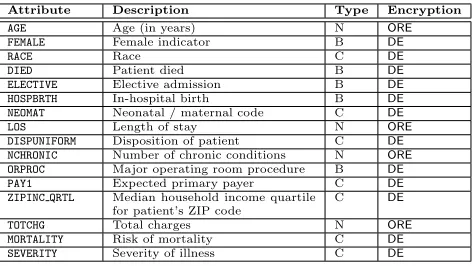
Table 1: HCUP-NIS data elements, data types (C = categorical, B = binary, N = numerical) and corresponding encryption type. Omitted are the 262 binary-valued columnsCAT1,CAT2,. . .for CCS diagnosis codes. For schema (A) these are all DE encrypted ex-cept a distinguished targetCATdiagnosis code, which is redacted. For schema (B) all 262CATcodes are redacted.
the inferred values or “don’t know.” Next, we describe the datasets used in our case studies.
Hospital patient data. The Nationwide Inpatient Sam-ple (NIS) of the Healthcare Cost and Utilization Project (HCUP) [47], from the Agency for Healthcare Research and Quality (AHRQ), is a database of U.S. hospital discharge data. It is available for purchase after completing an online training course describing the Data Use Agreement (DUA). We strictly abide by this DUA. We do not perform re-identification attacks on this data, nor do we present new techniques that would enable others to perform such attacks. We use the 2012 and 2013 datasets with 7,296,968 and 7,119,563 records, respectively. These datasets are random samples of all hospital admissions for 2012 and 2013 (not
two years of admissions for the same hospitals). We cleaned the data (e.g., removed records with missing attribute val-ues), obtaining 6,538,031 and 6,352,914 records, respec-tively. We then extracted a subset of the attributes, such as demographic information (age, sex, race), medical informa-tion (length of stay, disposiinforma-tion of patient, major operating room procedures, etc.), and Clinical Classifications Software (CCS) [48] category codes, which are fine-grained binary at-tributes corresponding to specific medical conditions or sets of related conditions. See Table 1 for the full list.
Census data. The American Community Survey (ACS) dataset, publicly available from the U.S. Census Bureau [85], consists of survey responses of millions of individuals. We use the 2012 and 2013 versions of the dataset with 3,113,030 and 3,132,795 records, respectively. Because ACS data is sampled independently for each survey year, the two datasets do not cover the same households.
We cleaned the data (e.g., removed records with miss-ing attribute values), obtainmiss-ing 2,563,935 and 2,582,042 records, respectively. We then extracted a subset of the at-tributes, such as demographic information (age and sex) and the individual’s yearly income. See Table 4 for the full list.
The full list of attributes, as well as the privacy schema used for this case study, appear in Appendix E.
Auxiliary data. Our attacks rely on auxiliary data to ob-tain the distributions of values for a single attribute, corre-lations between attributes, and records of individuals. Stan-dard sources of auxiliary data include publicly available data. For example, in our attack on the FOP dataset, we use U.S. voter registration lists, which are available for many states either for free, or for a nominal fee. We used databases from 7 states (Colorado, Connecticut, Florida, Michigan, North Carolina, Oklahoma, Washington) that are available online (e.g., [68]). The size of each dataset is shown in Appendix E. We also purchased the Pennsylvania voter database from the Pennsylvania Department of State [21]. Pennsylvania is one of the most common states in the FOP dataset, which will be relevant in one of our attack scenarios. The exact in-formation in the voter registration records varies from state to state, but all states collect full name, residential address including ZIP code, and birth year for each registered voter. Four states collect full birth date, and all but one collect gender. We also use per-state FOP membership statistics from state FOP websites [31–36] for six of the eight states.
For our attacks on the hospital-discharge and ACS data, we use the 2012 dataset as the auxiliary data for attacking the 2013 dataset. Neither of these attacks exploit or assume that some records in the 2012 dataset refer to the same in-dividuals as the 2013 dataset. These attacks do not perform record linkage and the attributes are not quasi-identifiers. In fact, HCUP and ACS are random samples of their re-spective populations (hospital patients and US households, respectively) so the likelihood of any individual appearing in both the 2012 and 2013 versions of these datasets is ex-tremely small. It is impossible to quantify the exact overlap between the 2012 and 2013 datasets; doing this would ne-cessitate linking records from two different years to a single person, itself a serious privacy breach. Attempting it would likely violate data-use agreements for these datasets. In Sec-tion 7.3, we demonstrate that our attacks are robust even if the auxiliary data is noisy, incomplete, or outdated. This provides evidence that the overlap between the two datasets is negligible—if our attacks only worked because of a large overlap between datasets, they would be totally ineffective with bad auxiliary data. In any case, we use the auxiliary data solely as a source ofstatisticalinformation, such as cor-relations between demographic attributes or distributions of medical attributes.
7.1
Scenario 1: Sensitive medical conditions
This case study is based on the 2013 HCUP-NIS dataset described above. The goal of this experiment is not to per-form a re-identification attack, but to infer the values in the encrypted database. We simulate an encrypted database using two different privacy schemas. In schema (A), the column corresponding to a specific medical condition (i.e., a CCS diagnosis code/category such as delirium dementia) is marked as sensitive and redacted; the other columns are less sensitive and encrypted with PRE. In schema (B), all columns corresponding to medical conditions (i.e., all CCS diagnoses) are marked as sensitive and redacted; the other columns are encrypted with PRE as shown in Table 1.
We use statistics extracted from the auxiliary data (in this scenario, the 2012 version of the dataset) to build a classi-fier that models the relationship between PRE-encrypted
Medical Condition (CCS Category) Prevalence Accuracy (±stddev)
Privacy Schema (A)
Diabetes mellitus with complications 7.08% 100.00%(±0.00%) Diabetes or abnormal glucose tolerance
complicating pregnancy; childbirth; or the puerperium
0.91% 99.40%(±0.70%) Other complications of pregnancy 5.56% 98.80%(±1.03%) Chronic kidney disease 11.75% 97.50%(±1.18%) Hypertension with complications and
secondary hypertension
11.80% 97.30%(±1.42%) Respiratory failure; insufficiency; arrest
(adult)
8.09% 96.80%(±1.55%)
Mood disorders 14.59% 96.30%(±0.95%)
Congestive heart failure; nonhyperten-sive
11.96% 95.90%(±1.66%) Coronary atherosclerosis and other heart
disease
17.66% 95.80%(±1.81%) Infective arthritis and osteomyelitis
(ex-cept that caused by TB or STD)
0.97% 95.80%(±1.81%) Privacy Schema (B)
Other complications of pregnancy 5.56% 92.30%(±2.11%) Respiratory failure; insufficiency; arrest
(adult)
8.09% 90.70%(±2.91%)
Mood disorders 14.59% 84.40%(±2.95%)
Chronic kidney disease 11.75% 82.40%(±2.46%) Coronary atherosclerosis and other heart
disease
17.66% 81.90%(±2.60%) Hypertension complicating pregnancy;
childbirth and the puerperium
1.25% 81.40%(±2.55%)
Osteoarthritis 8.29% 81.40%(±3.03%)
Hypertension with complications and secondary hypertension
11.80% 79.10%(±4.38%) Cardiac and circulatory congenital
anomalies
0.94% 78.70%(±3.50%) Congestive heart failure;
nonhyperten-sive
11.96% 76.40%(±4.25%)
Group of Medical Conditions Accuracy (±stddev)
Mental Health / Substance Abuse (MHSA) 99.30%(±0.48%) Strict Mental Health / Substance Abuse 97.10%(±1.85%)
Mental Health 96.90%(±1.29%)
Diseases of the musculoskeletal system and connective tissue 94.90%(±1.52%)
Congenital anomalies 93.40%(±2.76%)
Diseases of the nervous system and sense organs 82.70%(±2.98%)
Substance and Alcohol Abuse 81.00%(±2.21%)
Figure 2: (Top) Prediction accuracy (for 100 positive predic-tions) for the redacted medical conditions, privacy schema (A). Only the 10 conditions with the highest accuracy are shown. There are 30 more conditions with an accuracy above 75%. (Mid-dle)Same as above for privacy schema (B). These conditions are a subset of those for privacy schema (A). Rows corresponding to the conditions for which we achieve over 90% accuracy are shaded. (Bottom)Prediction accuracy for groups of semantically related medical conditions, privacy schema (B).
and sensitive columns. In Section 7.3 we consider noisier, obsolete auxiliary data.
We use MATLAB to train aGentleBoostensemble using 40 tree-based weak learners. We specify for each feature col-umn whether it contains numerical or categorical values and train the classifier with the default parameters on at least 1 million records. For both privacy schemas, the classifier predicts the value of a binary column associated with some medical condition. Predicting a value of 1 (the patient has the condition) is called apositive prediction.
For schema (A), we iterate over all single-code CCS cat-egories and train the classifiers for each using the selected column as the target and the other columns as the features. This corresponds to the case where information on specific medical conditions (e.g., those related to mental health) is redacted, as in prior work on segmentation [39, 43].
Inferring PRE columns. We use the single-column multinomial attack from Section 4 against each PRE en-crypted column. We start with the estimated probability distributionρ over the values of that column, where ρi is the proportion of records with theithvalue in the auxiliary dataset. We then compute allcjs, the number of occurrences of thejth ciphertext in the target. Finally, we perform the attack usingρand~cwith the appropriate graph assignment. For DE columns, we use a MATLAB implementation of the Hungarian Algorithm to find the best matching, i.e., pairs (j, i) such that thejth ciphertext is mapped to theith plaintext. ForORE, we use our own MATLAB implementa-tion of the maximum-weight non-crossing matching [42].
For both privacy schemas, the attack almost fully recov-ers the correct plaintexts all PRE columns. The plaintexts of DE columns are recovered with 100% accuracy, i.e., we correctly find the entire permutation for each such column. The reason is that these columns have a highly non-uniform distribution over small domains. For example, all CCS di-agnosis columns are binary-valued with 0 mode.
The accuracy of recovery for the numerical columns is also high. Columns AGE, LOS, and NCHRONIC have values from a relatively small domain and the multinomial attack recovers 100% of the plaintexts. By contrast, TOTCHG has values from a large sparse domain (e.g., few patients have the exact same total charges). The attack does not always recover the exact value, but the median error forTOTCHGis 1,052, thus the recovered plaintexts are close to the true value. The accuracy is so high for our single-column attack that there is no need to resort to the multi-column attack.
Inferring sensitive columns. As explained in Section 6, if the fraction of records with the positive label in the sensi-tive column is low (e.g., 1%), overall accuracy is not the right metric. For example, always predicting the patient doesnot
have the condition has high accuracy, yet is useless. Instead, we aim to maximize accuracy over positive pre-dictions. For each sensitive column, we apply the classifier trained on the auxiliary data to the partial records recovered by the multinomial attack on PRE columns. The classifier scores them w.r.t. the positive labels, we pick 100 records with the highest scores and only output those predictions. Accuracy is the fraction of those that are true positives.
Of 262 medical conditions, positive labels for 40 can be in-ferred with 75% or higher accuracy. Inferring even a single medical condition is a serious privacy breach, thus failure to infer certain conditions (false negatives) should not be considered a flaw of our methodology, as long as our false positives are low. Table 2 shows the results for the 10 condi-tions with the highest accuracy for the privacy schema (A) along with their prevalence, i.e., the proportion of records with the positive label for that condition in the database. To measure the mean accuracy and standard deviation, we repeat the score-and-predict experiment 10 times on ran-dom subsets of the partial records recovered by the PRE at-tack. The results demonstrate successful inference of many sensitive medical conditions, including hepatitis, leukemias, chronic kidney disease, and mood disorders.
Figure 2 shows the results for the privacy schema (B). 10 of the 40 conditions can still be inferred, including chronic kidney disease and mood disorders, albeit with slightly lower accuracy. This is significant, because none of the 16 columns available to the classifier in this scenario are sensitive; they
0 50 100 150 200 250
Medical Conditions (CCS Categories)
0% 10% 20% 30% 40% 50% 60% 70% 80% 90% 100%
Percentage of Correct Predictions
Schema A (100) Schema A (1000) Schema B (100) Schema B (1000)
Figure 3: Percentage of correct positive predictions for all CCS categories for privacy schema (A) with 100 (blue solid line) and 1000 (blue dotted line) predictions, and privacy schema (B) with 100 (red dot-dashed line) and 1000 (red dashed line) predictions.
provide only general or aggregate information. This demon-strates the limits of redaction: even strongly encrypted or segmented medical conditions can be successfully inferred from the non-sensitive columns, which, in turn, are inferred using the multinomial attack.
An attacker may also group semantically similar cate-gories and try to infer the whole group, e.g., find patients who suffer fromsomemental illness as opposed to a specific one. The bottom table of Figure 2 shows the results for groups of related diagnoses. We found 7 groups (out of 20) that can be inferred with accuracy of 75% or more.
Discussion. For the CCS categories other than those in Figure 2 the attack accuracy is below 75%. Some cancer-related categories are especially difficult to infer, e.g., for cancer of bone and connective tissue (prevalence 0.15%), only about 36% of the classifier’s predictions are correct. Figure 3 shows the percentage of correct predictions for both privacy schemas across all CCS categories.
Sensitivity analysis based on measuring correla-tions between columns will fail to prevent our attack
because weak correlations can enable accurate inferences. Consider Substance and Alcohol Abuse (Figure 2), which has prevalence of about 8.6%. To understand the classifier’s behavior, we look at the typical characteristics among the positive predictions, i.e., features that are popular among the positive records but rare in the population. Around 96% of the positive records have 7 in the DISPUNIFORMcolumn (“disposition of patient: against medical advice”), whereas only 1.02% of all records have 7 in this column.
The correlation between the target and theDISPUNIFORM column is very low (the Pearson correlation coefficient is −0.007). Therefore, even an experienced security architect may deem theDISPUNIFORMcolumn as not sensitive. Nev-ertheless, because Pr{S. & A. Abuse = 1 |DISPUNIFORM= 7}= 0.411, the classifier uses this column to make accurate positive predictions. SincePr{S. & A. Abuse = 1}= 0.086, predicting a positive label ifDISPUNIFORM= 7 increases the probability that this prediction is correct by five times.
7.2
Scenario 2: Sensitive demographic data
Attribute Description Type Encryption
AGE Age (in years) N ORE
SEX Sex B DE
RACE Race C DE
REL Relationship code C DE
MS Marital status C DE
OCCFC Occupation code C DE
COGD Cognitive difficulty B DE
DIS Disability C DE
ENG English language ability C DE
LANX non-Engl. lang. spoken C DE
EDU Educational attainment C DE
FOD1 Field of degree 1 C DE
FOD2 Field of degree 2 C DE
WORKCLASS Class of worker C DE
HPW Work hours per week N ORE
WLW When last worked C DE
TTTW Travel time to work N ORE
CITZ Citizenship status C DE
ST State C DE
POW Place of work C DE
POB Place of birth C DE
PUMA Microdata area code C DE
INC Yearly income N Redacted
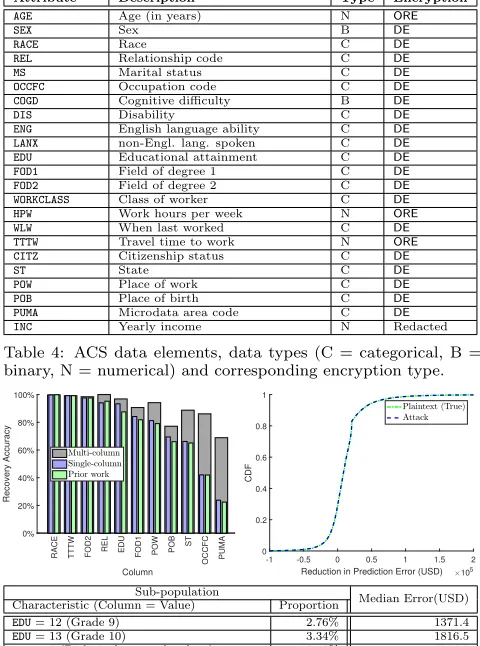
Table 4: ACS data elements, data types (C = categorical, B = binary, N = numerical) and corresponding encryption type.
RACE TTTW FOD2 REL EDU FOD1 POW POB ST OCCFC PUMA Column
0% 20% 40% 60% 80% 100%
Recovery Accuracy
Multi-column Single-column Prior work
-1 -0.5 0 0.5 1 1.5 2 Reduction in Prediction Error (USD) ×105
0 0.2 0.4 0.6 0.8 1
CDF
Plaintext (True) Attack
Sub-population
Median Error(USD) Characteristic (Column = Value) Proportion
EDU= 12 (Grade 9) 2.76% 1371.4
EDU= 13 (Grade 10) 3.34% 1816.5
REL= 2 (Biological son or daughter) 12.40% 2024.9 REL= 4 (Stepson or stepdaughter) 0.71% 1899.8
OCCFC= 3955 (PRT-LIFEGUARDS etc.) 0.16% 1849.7
Figure 5:(Top Left)Recovery accuracy for PRE-encrypted ACS columns. The plot compares the single- and column multi-nomial attack with prior work across the columns that we cannot recover with 100% accuracy in all cases.(Top Right)Empirical CDF of the reduction in prediction error (higher is better) for yearly income over a baseline predicting median yearly income for each record. The reduction in prediction error for the attack (blue dashed line) is compared to that of a model trained on the plaintext (true) target database (green dashed line). (Bottom) Median income prediction error for some sub-populations.
Auxiliary data. Because the redacted column (INC) is nu-merical (as opposed to binary for the medical case study), we train a regression model on 1 million records from the auxiliary dataset. We do this in MATLAB with an ensem-ble of 40 regression trees using bagging with the default parameters. For each column, we specify whether it con-tains numerical or categorical values. INCis the prediction target, the other columns are the features. To improve the quality of the regression model, we convert categorical fea-tures to binary vectors. For example, we replace the column SEXwhich can take two values (male and female) with two new binary columnsSEX MALEandSEX FEMALE.
Inferring PRE columns. We start with a single-column multinomial attack on each PRE column independently, as in Section 7.1. For about half of the columns, the recovery is perfect (100% accuracy). These areAGE,SEX, MS,COGD, DIS,ENG,LANX,WORKCLASS,HPW,WLW, andCITZ.
For the rest of the PRE columns, we improve the recov-ery using the multi-column attack from Section 5. We first create a dependency graph. To this end, we compute
condi-tional pairwise entropy between columns using the auxiliary data. As explained in Section 5, we cannot simply pick the most correlated dependent column because this may create a cycle. Also, we must consider the number of plaintext values in the dependent column (fewer is better due to the curse of dimensionality) and the length of the longest path (longer paths may result in cascading failures with mistakes).
We end up with the following acyclic dependency graph: RACEdepends on POB,RELonMS,OCCFC onWORKCLASS,EDU onFOD1, FOD1 onOCCFC,FOD2 onFOD1, POWonEDU, STon POW,PUMAonST, andPOBonCITZ. With these, we discover a valid topological order and perform the attack using the edge weights computed as in Section 5.
We compare three attacks: best prior heuristic [42], single-column multinomial, and multi-single-column multinomial. All three are performed using the appropriate graph matching algorithm for each column, i.e., the Hungarian algorithm forDEand MWNCM [42] for ORE. We compute the over-all row recovery rates, averaged over five experiments, as the percentage of rows across all 22 PRE columns that are recov-ered perfectly (no errors). These rates are 2.10% (±0.46%) for the attack of [42], 2.75% (±0.55%) for the single-column attack, and 33.38% (±7.05%) for the multi-column attack. In other words,the recovery rate of our multi-column multinomial attack is 16 times that of prior work.
Figure 5 shows the attack accuracy for the columns that are not recovered perfectly. The multi-column attack greatly outperforms the single-column attack, which in turn outper-forms prior work. For OCCFC and PUMA, the multi-column attack doubles accuracy of the single-column attack.
Inferring sensitive columns. To infer the value of the redactedINCcolumn, we apply our regression model trained on the auxiliary data to the plaintexts recovered by the multinomial attack. We compute the error as the absolute difference between the predicted and true income. We plot the empirical CDF of the reduction in error compared to a baseline always predicting the median income of the pop-ulation. This is shown in Figure 5, and compared with a regression model trained on the true plaintext data.
The median error of our predictions is 8388.3 USD (i.e., income can be predicted within around 8.4k USD for 50% of the records). This is much better than the baseline which attains such precision for only 20% of the records. Fur-thermore, the predictions almost perfectly coincide with a regression model trained on the true data (Figure 5). Even though the multinomial attack has recovered noisy plain-texts for some columns, prediction quality has not suffered. The table in Figure 5 shows examples of population sub-groups that are especially vulnerable to the attack. These subgroups share a common characteristic (e.g., the value of a certain column) that further reduces the error. For ex-ample, the median error for the sub-population whose ed-ucational attainment (EDU) is “Grade 9” is less than 1400 USD. Overall, these results suggest that segmentation and strong encryption cannot protect the confidentiality even of large-domain, sparse, numerical columns.
7.3
Quality of auxiliary data
We evaluate the robustness of our attacks when the auxiliary data is obsolete and noisy.
the 2004 dataset as the auxiliary data. This dataset is both outdated and sampled differently: 2013 is a random sample of patients, but 2004 is all patients from a random sam-ple ofhospitals. The attributes are different, too: (1) the 2004 dataset is missing the attributesHOSPBRTH,NCHRONIC, ORPROCand contains at most 15 different diagnosis codes (vs. up to 25 for recent versions); and (2) it uses an older ver-sion of CCS which (among other differences) has outdated categories for mental health. In our experiment, we did a best-effort remapping of the old categories to the new ones in the auxiliary data and ignored the attributes of the target data that are not present in the auxiliary data.
We follow the methodology from Section 7.1 to recover PRE columns using a multi-column attack. Using cross-column correlations makes our multi-cross-column attack very robust to high noise in the auxiliary data that would de-stroy the accuracy of a single-column attack. For exam-ple, a single-column attack onSEVERITY recovers little be-cause the distribution differs between the 2004 and 2013 datasets. Instead, we use a correlated dependent column, e.g.,MORTALITYwhich is linearly correlated withSEVERITY at about 0.72, to stage the attack from Section 5 with the following (acyclic) dependency graph: SEVERITYdepends on MORTALITYandZIPINCdepends onRACE. With this, the re-covery rate over all (non-numerical) PRE columns is 96.9%, almost a 6-fold increase over the naive single-column attacks. This demonstrates thateven with stale auxiliary data, the multi-column attack performs very well.
We then use the methodology from Section 7.1 to infer sensitive medical conditions from the recovered plaintexts of PRE columns. In spite of the 11.3% decrease in overall prediction accuracy vs. Section 7.1, we still achieve 93.30% accuracy for Mental Health / Substance Abuse (MHSA), 87.20% for Strict Mental Health / Substance Abuse, and 88.30% for Mental Health. This shows that our attack can infer sensitive medical conditions even if the attacker’s aux-iliary data is relatively poor.
Sensitive demographic data. We repeat experiments on the 2013 ACS dataset but replace the auxiliary data with sub-samples of 10, 50, and 100 thousand records from the outdated ACS PUMS 2009, 2010, 2011, and 2012 datasets. Figure 6 shows the attack accuracy for each combination of year and sample size. Overall, using old auxiliary data does not significantly lower the accuracy. For example, the median recovery accuracy (across all PRE columns) with 2009 auxiliary data is near 100%, just like with 2012 data. That said, for some columns (OCCFC and PUMA), the 2012 auxiliary data yields the highest accuracy by some margin. Using small sub-samples has more impact on accuracy for some columns across all years (e.g., compare the box length for 10K and 100K), yet the overall accuracy remains high.
To evaluate the impact on income prediction (i.e., infer-ring the sensitive column), we train a regression model as in Section 7.2 but on the degraded auxiliary data, then ap-ply it to the plaintexts recovered from the PRE columns by the multinomial attack. The detailed results appear in Figure 7. For incomes of 50k or more, the predictions are (almost) on par with those of Section 7.2. In all cases, the prediction error is substantially better than for the base-line (17702 USD). With the smallest sample of the most outdated auxiliary data (from 2009) the median prediction error is only around 10% worse than in Section 7.2. Overall,
10 50 100 10 50 100 10 50 100 10 50 100 Dataset Size (Thousands)
0% 20% 40% 60% 80% 100%
Recovery Accuracy
2009 2010 2011 2012
Figure 6: Recovery rates (accuracy) for degraded auxiliary data. Each box-whisker plot shows accuracy across all PRE columns.
Auxiliary dataset year 2009 2010 2011 2012
Size
10k 9106.3 9067.8 9160.8 9428.1 50k 8737.8 8564.9 8594.6 8587.7 100k 8560.4 8598.2 8230.3 8501.4
Figure 7: Median error for income prediction with outdated sub-samples of the auxiliary dataset.
this suggests that the attack will succeed even using aux-iliary data that is a few years old, as long as it contains a few tens of thousands of records (e.g., it works well with 50K records, which is only 2% of the available auxiliary dataset).
7.4
Scenario 3: Home addresses
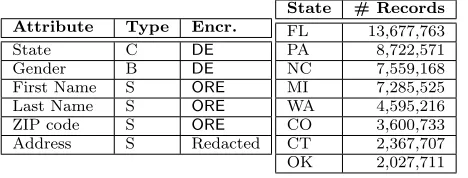
This case study is based on the FOP dataset described above. It uses the values recovered from the PRE-encrypted columns as quasi-identifiers in a record linkage attack on the home addresses of police officers. We simulate an encrypted database using a privacy schema informed by the practical applications of encrypted databases. Prior work [42] moti-vated the use of ORE for first name, last name, and ZIP code, which are commonly sorted and queried by prefix in electronic health records and customer relationship manage-ment systems such as OpenEMR and Salesforce. State and gender are encrypted using DE to enable grouping. Fre-quency analysis easily infers both because statewide FOP membership numbers are public (see the discussion above) and because most police officers are men.
Home addresses of police officers are considered extremely sensitive due to the risk of reprisal by criminals. In Florida in 2010, a man was arrested for publishing the address of an officer online [92]. Furthermore, they have little utility as a query or filter value in applications. Therefore, we assume that addresses are encrypted using IND-CPA encryption. We use the publicly available state voter registration records as the auxiliary data, as well as the ZIP code database with the list of valid ZIP codes for each state and the estimated population of each ZIP code [86]. We also use per-state first and last name distributions taken from the voter records.
Inferring PRE columns. We use the multi-column at-tacks to infer the first and last names and the ZIP code. For first names, we use state and gender as dependent at-tributes. For last names and ZIP codes, we use state as the dependent attribute. Because possible ZIP codes are uniquely determined by the state, we run an independent attack on ZIP codes for each state.
# rows↓ FN LN ZC Addrs Encr. type ORE ORE ORE STR PA 54,428 92 69 58 7,251 MI 13,136 93 69 59 1,789 NC 14,862 92 83 44 1,683
OK 10,333 92 85 43 469
WA 5,297 92 74 49 397
CT 2,969 93 69 71 370
FL 45,423 90 72 3 164
CO 11,311 90 74 0 0
FN LN ZC RR 0
20 40 60 80 100
Reco
v
ery
Rate
(%)
Prior Work Single-Column Multi-Column
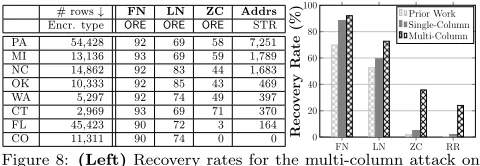
Figure 8: (Left)Recovery rates for the multi-column attack on FOP attributes. “# rows” is the number of rows in the FOP database for the state; “Encr. type” is the encryption scheme (STR is strong encryption); FN, LN, ZC, Addrs are the % of correctly recovered first names, last names, ZIP codes, and home addresses. (Right)Recovery rates of the multi-column, single-column, and best prior attack on FN, LN, ZC, and all three to-gether (RR) for all eight states.
the best prior heuristic. The recovery rates for all attributes are high. For first and last names, the accuracy of the multi-column attack is modestly higher (around 4% and 12%, re-spectively) than our single-column attack, which in turn is more accurate than prior heuristics. The multi-column at-tack on last names performs especially well: for two states, it recovers over 80%, whereas even our own single-column attack does not exceed 60%.
The multi-column attack on ZIP codes exhibits the most striking increase in overall accuracy. Whereas both single-column attacks (best prior [42] and our own) perform poorly (2-5%), the multi-column attack recovers 36% of all ZIP codes in the FOP records for the eight target states. This is due to our ability to attack ZIP codes separately for each state and the superiority of the multinomial attack over prior techniques. Recovery is much worse for Florida and Colorado because of the noise in the data: dozens of ZIP codes from other states and even non-existent codes appear in the FOP database, thus forcing the matching to preserve the order prevents correct matches. Increasing robustness of inference to noise in the target data is left to future work. The whole-row recovery rate (i.e., first name, last name, gender, and ZIP code) of the multi-column attack is nearly
one quarter, which is many times better than the single-column attacks. It is much higher for some states, e.g.,we recover the full name, gender, and ZIP code of almost half of FOP members in Connecticut.
Inferring sensitive columns. Once the first name, last name, and ZIP code are recovered for each row, we link them with the state voter records, using the usaddress [19] python library to canonicalize street addresses. We are extremely conservative when measuring the accuracy of our attack. After canonicalization, we only consider an address to be recovered if it is an exact match. We do not count correct matches with typos, nor correct recoveries of the address of an officer’s alternate residence. Another reason for the undercount is that not every officer is a registered voter. Using a more complete address list from a phone directory would likely result in higher recovery rates.
For the eight states for which we had the auxiliary data, our aggregate recovery rate is about 7.7%, i.e., roughly 1 out of every 13 FOP members would have their exact home address revealed by this attack. Our attack was most suc-cessful for Michigan and Pennsylvania, recovering 13-14% for both. On a real encrypted database, this would have been a massive privacy breach, with home addresses of over 7,000 officers compromised in Pennsylvania alone.
8
Limitations and Mitigations
Our multi-column attacks depend on the correlations be-tween columns and will fail if they are uncorrelated (our experiments show that this is unlikely to be the case in real-world datasets). The success of our attacks also depends on the privacy schema. If most or all columns are marked as “sensitive” and redacted or strongly encrypted, there may not be enough information revealed for successful inference. Such a privacy schema defeats the purpose of PRE, and we are not aware of any encrypted database that maintains performance and functionality in this scenario.
Another limitation is that any inference method, including ours, depends on the quality of the attacker’s auxiliary data. In Section 7.3, we show that our attacks are robust even if the auxiliary data is smaller and has low quality.
Ensuring that individual PRE-encrypted columns have high entropy does not mitigate our attacks because the joint distributions of two correlated columns can be useful for in-ference even if the individual columns have high entropy. An example is given in Appendix F.
In principle, inference potential could be detected by mea-suring cross-column correlations, but this is not straightfor-ward. In Section 7.1, we concretely showed that even weak correlations can, in aggregate, have high predictive power. Furthermore, in a database withmcolumns, the number of measurements required to detect correlations grows as 2m.
9
Related Work
Encrypted databases. Companies including Ciphercloud [14], Navajo Systems [27], Skyhigh Networks [65], and Per-specsys [72] deploy proprietary PRE schemes to enable search-ing and sortsearch-ing of ciphertexts stored within software-as-a-service (SaaS) systems. SAP’s SEEED system [80], IQcrypt [50], Microsoft’s Always Encrypted [62], and Galois’s Jana [5] use privacy schema where some columns are strongly en-crypted and other columns areDE- orORE-encrypted.
Damiani et al. [18] used DEwith custom indexing tech-niques to support some queries over encrypted data. An-other proposal is CryptDB [75], which “onion-wraps” PRE-encrypted data with strong encryption and relies on client proxies to expose PRE ciphertexts for querying. With re-spect to our inference methodology, this is equivalent to a privacy schema in which the columns not used in queries are strongly encrypted. After recent attacks against PRE-encrypted databases (see below), CryptDB designers advo-cated column sensitivity analysis and the use of strong en-cryption for columns deemed “sensitive” [76]. Monomi [83] performs a form of automated column sensitivity analysis and uses a mix of strong encryption and PRE.
Some approaches to encrypted databases achieve stronger security than the more practical systems we focus on in this paper. Arx [73] is claimed to be secure against “snapshot” attacks but requires garbled circuits to perform queries [93]; also, it is not actually secure against realistic “snapshot” at-tacks [41]. Lewi and Wu [58], Faber et al. [28], and Roche et al. [78] support only range queries but leak less information to “snapshot” adversaries than the systems we investigate. Lewi and Wu’s scheme can be adapted into a traditional