The Effect of Specialised Programming on
the Exercise Adherence of Corporate Executives
Craig C. Knox
This thesis is presented in accordance with the requirements for the degree of
Master of Applied Science
School of H u m a n Movement, Recreation and Performance Faculty of Human Development
Victoria University of Technology
FTS THESIS
613.71088658 KNO
30001007032990
Knox, Craig C
Dedication
T o m y loving wife A n n e and our three wonderful children Carmen, Gabrielle, and A n d r e w for allowing me the time to satisfy my curiosity,
to my mother and father, Ailsa and Ron, for their lasting interest and support, and
to those who strive to improve work-site health promotion.
ACKNOWLEDGEMENTS
My completion of this thesis has been reliant upon the support of many individuals.
The people I refer to range from my family and friends through to the supervisors directly
involved in this project. In particular, my principal supervisor Professor Terry Seedsman and co-supervisors, Dr. Vance Tammen and Associate Professor Mark Andersen have been
wonderful partners during the whole process. From the time I initially enquired about completing a post-graduate degree, until completion, Terry has been a dedicated colleague and friend. I am also greatly indebted to Vance, who provided the initial support in the planning stages and continued to give his sound advice and encouragement via email and phone contact from the U.S.A., where he now resides. I also thank co-supervisor, Associate Professor Mark Andersen, for his invaluable professional guidance and friendship during this project. To work with these three people was undoubtedly a highlight of this experience. My thanks are extended to the executives at the Coles Myer Ltd. head office for their willingness to take part in the study and for their continual interest in the project. In particular, I thank Alan Veitch, manager of the Coles Myer Staff Fitness Centre, for his tremendous support over the whole study period. My gratitude is also extended to Dr. John Reece for his advice on data analysis and Rebecca Sheehan for her involvement as a co-counsellor for the treatment group during the study. Finally, my sincere thanks go to my
family and close friends for their interest and support throughout this odyssey of learning and
discovery.
A B S T R A C T
T H E E F F E C T I V E N E S S O F S P E C I A L I S E D P R O G R A M M I N G O N T H E E X E R C I S E A D H E R E N C E O F C O R P O R A T E E X E C U T I V E S by Craig C. Knox
This thesis examines the effectiveness of a specialised fitness program on the exercise adherence of corporate executives over a six-month period. Seventy executives based at the head office of Coles Myer Ltd, in Melbourne, were randomly assigned to treatment and
control groups. The treatment group participants received a specialised fitness program and the control group participants received a traditional facility-based fitness program. The specialised fitness program included features and strategies recommended in the literature, and was structured in accordance with the transtheoretical 'stages of change' model
(Prochaska & Marcus, 1994). Sixty-six participants provided data at the completion of the
study period. All participants began the study at the action stage and were required to indicate their stage of change at the completion of the six-month period. These quantitative data were measured through the use of a questionnaire (PAQ) designed to assess stages of change
relating to exercise participation. All participants were asked two further questions at the end of the study period: a) Why did or didn't you adhere to the program? and b) what program
features influenced the outcome? All final data was collected during a short interview with the researcher.
The quantitative results support the research hypothesis. A Mann-Whitney analysis
produced a significant difference in final stage scores between the treatment and control groups, [U = 272.5, Z = 3.72, p < .001]. It is concluded that the specialised fitness program is more effective than the traditional facility-based fitness program in raising the exercise
adherence levels of corporate executives. The results indicate that the transtheoretical 'stages
of change' m o d e l appears to have relevance in designing exercise interventions in a corporate fitness program setting and in the use of the PAQ instrument as a measure of behavioural change and exercise adherence. The theory, however, requires more rigorous testing. The use of multiple strategies in exercise programming for corporate executives is also supported by the quantitative results.
The qualitative findings revealed the participants' underlying reasons for their
program outcomes and identified the program features that participants' perceived as being influential to exercise adherence. The importance of high quality exercise counselling, and, in particular, the client-counsellor relationship was highlighted by the qualitative results. The specialised fitness program appeared to increase the participants' sense of control over their programs as well as fostering an increased awareness of the internal and spontaneous benefits of exercise. In contrast, the participants in the traditional facility-based fitness program were largely motivated by external results and viewed the program as 'a means to an end'. Both
adherers and nonadherers of the specialised fitness program praised the program content. They displayed an understanding and appreciation for the program, whereas, the participants in the traditional facility-based fitness program were much more critical of their program content following the study period.
The challenge for most corporate organisations is to identify and implement more
effective fitness programs for executive personnel. The results of this study may help define the content and methods of implementation that best serve this aim. The findings imply a need for a specialised approach to executive fitness programming, in preference to the traditional facility-based approach. The results also imply that the traditional model for executive fitness programming is not ideal for a large proportion of participants. Larger scale research examining the worth of specialised fitness programming for executives is
recommended.
T A B L E O F C O N T E N T S Dedication. 3
Acknowledgements. 4 Abstract. 5
LIST OF TABLES 9 LIST OF APPENDICES 10 CHAPTER I INTRODUCTION 11
CHAPTER II REVIEW OF LITERATURE 14 Research Into Exercise Adherence. 14 Self-Efficacy Theory. 15
Health Belief Model. 15
Theory of Reasoned Action and Theory of Planned Behaviour. 16 Transtheoretical and Stages of Change Models. 18
Behavioural Processes and Change. 20
Use of the Transtheoretical Model in Exercise Counselling. 22 Exercise Adherence in Corporate Fitness Programs. 23
Specialised Programming. 26
The Use of Technology in Exercise Programming. 27 Theory-Based Research and Program Design. 28 CHAPTER III METHOD 32
C H A P T E R IV R E S U L T S A N D D I S C U S S I O N Demographic Characteristics.
Quantitative Results. Qualitative Results. The Reasons for Adhering. Treatment Group Adherence. Control Group Adherence.
The Reasons for Not Adherence. Treatment Group Nonadherence. Control Group Nonadherence.
Program Features that Influenced Outcome.
Program Features that Influenced the Treatment Group Adherers. Program Features that Influenced the Control Group Adherers. Program Features that Influenced the Treatment Group Non-Adherers Program Features that Influenced the Control Group Non-Adherers. CHAPTER V CRITIQUE AND CONCLUSIONS
Conclusions.
Implications of the Study.
Recommendations for Further Study. REFERENCES
LIST O F T A B L E S
Table 1 N u m b e r of Participants in Each Stage at the End 38 of the Program for Each Group
Table 2 Responses from the 24 Adherers in the Treatment Group 39 to the Question: W h y Did Y o u Adhere to the Program? Table 3 Responses from the Eight Adherers in the Control Group 44
to the Question: W h y Did Y o u Adhere to the Program? Table 4 Responses from the 11 Nonadherers in the Treatment Group 46
to the Question: W h y Didn't Y o u Adhere to the Program? Table 5 Responses to the 23 Nonadherers in the Control Group 48
to the Question: W h y Didn't Y o u Adhere to the Program? Table 6 Responses from the 24 Adherers in the Treatment Group 53
to the Question: What Program Features Influenced the Outcome?
Table 7 Responses from the Eight Adherers in the Control Group 58 to the Question: What Program Features Influenced the Outcome?
Table 8 Responses from the 11 Nonadherers in the Treatment Group 60 to the Question: What Program Features Influenced the Outcome?
Table 9 Responses from the 23 Nonadherers in the Control Group 62 to the Question: What Program Features Influenced the Outcome?
LIST O F A P P E N D I C E S
A Physical Activity Questionnaire 80 B Recruitment Letter 82
C Participant Consent Form 84 D Home Exercise Program 86 E Travel Exercise Program 88 F Example of Home Report Sheet 90 G Counselling Protocol 92
C H A P T E R I Introduction
The pressure and pace of business seems to be increasing, creating new sets of
challenges for modern business people. An expectation to work longer hours, while at the same time handling an increased workload at a faster rate, has made health and fitness in relation to workplace performance a concern for human resource managers (Palmer, 1995). The challenge for most organisations is to implement suitable, effective programs that can enhance the health and fitness of their staff. McCallum (1990) noted that the workplace is an ideal setting for health promotion, providing a suitable channel through which healthier employee habits can be fostered and maintained.
Over the past two decades, a variety of corporate fitness programs (CFP) have been implemented throughout the world (Leepson, 1983; Lovato, Green, & Stainbrook, 1994; Shephard, 1988). The successful implementation and maintenance of a CFP relies on the strong support of senior management (Dorzweiler, 1988; McCallum, 1990). Although all CFPs receive some degree of financial and moral support from senior management, such
backing does not ensure the participation of senior executives. (Work, 1989). Many CFPs are
designed to attract a cross-section of staff and are not specifically targeted at their executive personnel. Many business executives view exercise as an activity that should be done during
"one's own time," and not as part of the working day. The perception is that they do not have the time to exercise during the workday. Certainly, for the broader community, a "lack of time" is cited as the most common reason for not exercising (Shephard, 1988). The lack of time excuse, however, may often mask other reasons for non-participation such as low
enthusiasm, poor communication and leadership by fitness staff, unsuitable facilities, and in particular, unsuitable program content (Gettman, 1988; Shephard, 1988, 1999).
L o w exercise adherence a m o n g executive personnel presents a problem not only for
the individual but also for the organisation. Low exercise adherence levels within CFPs will greatly reduce the effectiveness of the programs. Individual and organisational benefits attained through a CFP only occur when workers participate in the exercise program over time (Blue & Conrad, 1995). Perceived personal benefits include improved work
performance, improved attitude toward work, increased stamina, and increased awareness of personal health, which all help to improve the overall productivity of the individual (Dreyer & Strydom, 1992; Shepherd, 1999). Perceived organisational benefits that are derived from CFPs include improved staff morale, reduced absenteeism, reduced staff turnover, and
increased staff satisfaction (Baun & Bernacki, 1988; Lynch, 1990; Shepherd, 1999). Baun and Bernacki also suggested that the ultimate success of a CFP is determined by selective
programming and motivational support for special groups. Executive personnel within an organization represent an example of the special groups Baun and Bernacki are referring to. Ideally, CFPs should be designed in accordance with an appropriate conceptual framework. The literature, however, contains few reports of programs being designed in accordance with theoretical frameworks. By understanding the reasons for low exercise adherence among
executives and by identifying strategies that increase adherence, organisations will be able to
further improve the CFPs effectiveness.
It has been noted by Shepherd (1988) that corporate executives may require exercise programming that suits their busy professional lives. Individual characteristics of an
executives work routine such as, long hours, frequent car and plane travel, regular meals with business associates and long periods of sitting may provide some grounds for selective
improve exercise adherence. A suitable theory-based instrument measured exercise
adherence. The review of literature provides an outline of relevant behavioural theories, including the theory that was used to design the specialised program, and from which the measurement instrument was derived (Appendix A).
C H A P T E R II Review of Literature
Due to the low levels of exercise participation throughout the general population, the health problems that exist throughout society and the costs associated with people leading sedentary lives, researchers and practitioners in community health organisations have been
interested in strategies that lead to increased participation in exercise and enhanced health and fitness standards (Dishman, 1994).
According to Blue and Conrad (1995) exercise adherence involves continual
participation in an exercise regimen with the necessary frequency, duration, and intensity required for health benefits. This definition may limit the perception of exercise adherence. It could be argued that a person is adhering to regular exercise even if the frequency, duration, and intensity of the activity is less than the accepted levels required to improve fitness. It is important to acknowledge that physical and mental benefits are derived from varying amounts of exercise. These considerations broaden the perception of what constitutes exercise, and furthermore, the definition of exercise adherence.
Research into Exercise Adherence
A large proportion of the research into exercise adherence has been atheoretical (Blue & Conrad, 1995; Godin, 1994). The concern with atheoretical research is that it produces inconsistencies in research designs across studies, and does not contribute to the better
organisation of theory, future research, or practice (Maddux, 1993). Godin stated that atheoretical research on exercise behaviour is generally guided by researcher bias and has previously led to a poor understanding of exercise adherence. Maddux noted that among the theory-based exercise adherence studies, social-cognitive models guided the vast majority.
T h e major social cognitive theories that have guided exercise adherence research will n o w be reviewed.
Self-Efficacy Theory
In the self-efficacy theory, Bandura (1977, 1986) stated that three cognitive mediating processes determine the adoption and maintenance of behaviour, these are:
(a) the belief about one's ability to execute a specific action, (b) beliefs regarding the probability that the action will led to a certain outcome, and (c) the subjective value that is
placed on a certain outcome. These processes are termed self-efficacy expectancies, outcome expectancies, and outcome value, respectively. Self-efficacy expectancies are considered to be important in directly influencing behavioural intentions, behaviour, and affect. Maddux (1993) stated that self-efficacy expectancies influence the adoption of health behaviours, the cessation of unhealthy behaviours, and the maintenance of these behavioural changes when
they are being challenged. Bandura contended that outcome expectancies are usually
determined by self-efficacy expectancies, and therefore, are not useful in predicting behaviour beyond what can be predicted from measures of self-efficacy. Self-efficacy theory has been successfully applied in explaining exercise behaviour (Godin, 1994). A number of studies have shown a positive association between self-efficacy and either the adoption or
maintenance of exercise (McAuley & Jacobson, 1991; McAuley, Lox & Duncan, 1993; Sallis et al., 1986, 1989; Wurtele & Maddux, 1987).
The Health Belief Model
The application of the health belief model (Becker & Maiman, 1975) to the study of exercise behaviour consists of four major cognitive components, namely, perceived
susceptibility to illness, perceived severity of health threat, perceived benefits of exercise, and
perceived barriers to exercising. For example, a person who has a family history of heart
disease may perceive a vulnerability to having a heart attack and realise the benefit of regular
exercise in offsetting such an occurrence. Other influential components are demographic
variables, socio-cultural variables, and cues to action (external or internal events that prompt action). An example of a cue to action would be placing jogging shoes near the front door to prompt action. The construct of self-efficacy has been added to the model (Rosenstock,
Strecher, & Becker, 1988) and social support has also been added to the original components (Maddux, 1993). Godin (1994) suggested that existing data from studies using the health
belief model provide no clear indication that the model is suitable for the study of exercise behaviour. Two investigations have shown no significant association between the model's
variables and exercise behaviour (Morgan, Shephard, Finucane, Schimmelfing, & Jazmaji, 1984; Mullen, Hersey, & Iverson, 1987). Maddux noted that the health belief model has been successfully used to investigate preventative health behaviour and compliance to medical regimes (Janz & Becker, 1984; Rosenstock, 1974), although applications to exercise
behaviour have been scarce.
Theory of Reasoned Action and Theory of Planned Behaviour
In the theory of reasoned action, Fishbein and Ajzen (1975) proposed that intentions
are the most important determinants of behaviour and that they are a function of attitudes and subjective norms. Attitude refers to an individual's positive or negative evaluation of
behaviour, and subjective norms are an individual's perception of the expectations other important people would have regarding a particular action (Ajzen & Fishbein, 1980). The
amount of influence attitudes and subjective norms have on intention is determined during the individual's decision-making process. Even though there has been support for the use of the theory of reasoned action in exercise adherence research (Ajzen, 1985), the strength of relationships between variables has been weak. Intention has not strongly predicted physical
activity participation (Dzewaltowski, 1989), and the relationship between attitudes and
subjective norms with intention to exercise has been w e a k (Biddle, 1999; Dzewaltowski, 1989).
The theory of planned behaviour (Ajzen, 1985, 1988) extended the theory of reasoned action by including the concept of "perceived behavioural control" as an influence upon
intention. Perceived behavioural control is a person's belief regarding the ease or difficulty of performing a behaviour (Ajzen, 1985). Ajzen questioned whether intention could be the only
determinant of behaviour when an individual does not have complete control over a
behaviour. Ajzen argued that when factors interfere with an intended behaviour, perceived behavioural control is necessary for strong prediction. Perceived behavioural control is
influenced by internal factors such as skill, abilities, and willpower and external factors such as time, opportunity, and the dependence on other people. Although attitude, subjective
norms, and perceived behavioural control are said to influence intention, perceived
behavioural control will directly influence behaviour, independent of intentions, when actual control is low. For example, when actual control over achieving a high academic score is low (due to not attending classes), perceived behavioural control (influenced by internal factors like skill and knowledge) will directly affect behaviour. There is a similarity between
perceived behavioural control and the self-efficacy construct in social-cognitive theory (Ajzen
& Madden, 1986). Ajzen and Timko (1986), however, suggested a difference in that
self-efficacy focuses on factors that are internal to the individual, whereas perceived
behavioural control reflects internal and external factors. There has been support for the use the theory of planned behaviour in predicting intention to exercise (Dzewaltowski, Noble, & Shaw, 1990; Gatch & Kendzierski, 1990). In the Dzewaltowski et al. study, the theory of planned behaviour was examined in the prediction of four weeks of physical activity
participation. Attitude and perceived control were found to predict intention, and intention
Social-cognitive models share a number of specific variables that are considered to
influence decisions and behaviour, namely, outcome expectancy, outcome value, self-efficacy expectancy, and intention (Maddux, 1993). By focussing on the decision-making process that underlies action, the social cognitive models only explain part of the variance in exercise behaviour. Maddux noted that social cognitive factors are critical in the early stages of exercise and become less important as the behaviour becomes more frequent and consistent. The role of situational cues and habit are also crucial to the understanding of behaviour over time. They are not, however, emphasized in the models. Maddux stated that changes in health and exercise behaviour are best understood in stages and to this end recommended an
integration of major social cognitive models into a single model for the benefit of future research.
Transtheoretical and Stages of Change Models
Prochaska and DiClemente (1982) developed the transtheoretical model as an
integrative perspective that explains the stages encountered when individuals attempt to change behaviour. The model has been successfully used to guide the study of addictive behaviours and is also useful for guiding exercise research (Prochaska & Marcus, 1994). According to the model, individuals who are undergoing behavioural change will move
through six stages. These six stages are precontemplation, contemplation, preparation, action,
maintenance, and termination. In precontemplation, people do not intend changing their
behaviour in the near future, therefore, it is not a stage of change but rather a stage during which people are maintaining their behaviour and change is not being considered. In the
contemplation stage, people seriously intend to change behaviour in the next six months.
During the preparation stage, the individual intends taking action within the next month, and the action stage marks the time when overt behavioural changes are occurring. The
for at least six months and continues until there is no risk of returning to the former
behaviour. Termination is the final stage of the model. It is the stage in which the new behaviour has become consolidated, and there is no temptation to return to the former behaviour.
The advantage of applying the transtheoretical model to the study of exercise
behaviour is its dynamic nature. Researchers have previously recommended the use of a dynamic model for the study of adoption and maintenance of exercise (Dishman, 1982; Sonstroem, 1988). The dynamic exercise cycle model (Brawley & Rodgers, 1992) and the
health action process model (Schwarzer, 1992) are examples of models that relate the stages of change to exercise and health behaviour. Brawley and Rodgers, in the dynamic exercise cycle model, proposed that the development and maintenance of exercise behaviour occurs in four stages: a sedentary pre-exercise phase, an initiation and adoption phase, a maintenance to drop out or relapse stage, and exercise resumption. An over-riding contention in this
progression of stages is that exercise behaviours begin under the control of deliberate cognitive processes, such as decisions and intentions, but gradually become controlled more by automatic cognitive processes. In the later stages, situational cues initiate the decision-making process that will elicit a decision to exercise or not. As the target behaviours become more frequent, maintenance of exercise is easier and relapses become fewer.
In the health action process model, Schwarzer (1992) distinguished between a
motivation/decision-making stage and an action/maintenance stage. In the initial stage people are said to make decisions and form intentions to change. In the action stage the person carries out the intentions and begins the new behaviour. In some cases, individuals may progress to a habit stage where the actions may come to be performed automatically in
response to situational cues.
Behavioural Processes and Change
An advantage of the transtheoretical model is that it provides the researcher with a
dynamic description of the cognitive processes employed by people at a particular stage of change. These cognitive processes of change are activities that people use both covertly and overtly to alter their experiences or environments so that behaviour may be modified.
Prochaska and Marcus (1994) outlined ten processes that can be categorised as being
experiential or behavioural. Experiential processes are useful in understanding and predicting
progress in the early stages of change. The experiential processes include consciousness-raising, dramatic relief, self re-evaluation and social re-evaluation. An example of
consciousness-raising for a person about to start exercise would be to gather new information and feedback from others regarding exercise. Dramatic relief relates to the affective aspects of changed behaviour that involve intense emotional experiences. An example of dramatic relief may be the satisfaction an overweight person experiences through losing some weight at the beginning of an exercise program. Self re-evaluation is the emotional and cognitive
reappraisal of values by an individual with respect to a particular behaviour. An example of self re-evaluation would be a person recognising that they place a high value on regular exercise. Social re-evaluation is the assessment an individual will make regarding the social changes they experience as a result of their new behaviour. For example, social re-evaluation would be the recognition of new friendships formed as a result of beginning exercise in a new
environment.
The behavioural processes are more useful in understanding the transition from
preparation to action and action to maintenance and include environmental re-evaluation, relationship fostering, counter-conditioning, contingency management, and stimulus control. Environmental re-evaluation is the assessment of how behaviour affects the physical and
h o m e encourage their children and partner to exercise as well. For the person starting an
exercise program, relationship fostering would involve the development of relationships with other trusted people and accepting and using their support in relation to exercise. Counter-conditioning is the substitution of a problem behaviour with a healthier alternative. An
example of counter-conditioning for an individual beginning exercise would be to substitute a sedentary behaviour (e.g., watching television) with an exercise session (e.g., a vigorous walk). Contingency management involves changing the contingencies that control or maintain a problem behaviour. An example of contingency management for a person starting an
exercise program would be to avoid going to bed late if they intend to exercise early the next morning. Stimulus control is the control of situations and causes that trigger a problem
behaviour. The problem behaviour for someone attempting regular exercise is being sedentary. Therefore, the individual may decide to avoid situations that can reinforce sedentary behaviour. Examples of avoiding sedentary behaviour may be having exercise
clothes permanently in the car or within easy access and engaging in the company of others who exercise rather than those who do not exercise.
In reference to exercise adherence, a sound knowledge of stages and processes of
change might lead to the use of strategies that facilitate acquisition and maintenance of exercise (O'Connor, 1994; Prochaska & Marcus, 1994). For example, knowledge of dramatic
relief as a process of change in the initial stages of change enables the exercise counsellor to
be aware of the emotional experiences the individual may encounter and to offer feedback and support regarding these experiences. Prior to beginning an exercise program, an elderly person may not be confident of their capabilities, therefore, to complete an initial exercise
U s e of the Transtheoretical M o d e l in Exercise Counselling
Pender, Sallis, Long, and Calfas (1994) used the transtheoretical model as a basis for assessment and intervention in developing a project named Physician-Based Assessment Counselling for Exercise (PACE), a counselling program designed for doctors to promote
physical activity in the United States. The assessment format enables health care providers to
identify an individual's stage of change and apply a protocol of counselling and program strategies suitable for that stage. Three protocols are used. One for individuals in
precontemplation, one for those in contemplation stage, and another for those in an active stage. The relevant processes of change for each of the three stages determine the content of each protocol. In the protocol for people in precontemplation stage, the individuals are asked to identify how they might benefit from activity and why they are not currently active. The counsellor is asked to give clear advice regarding the way exercise can benefit the person. The
individuals are asked to consider starting a moderate exercise program and to state how they may benefit from it. The protocol also outlines a summary of the benefits of exercise, and a worksheet is provided that lists potential barriers and suggestions for overcoming them. In the contemplator protocol, individuals are asked to plan their exercise programs, including the types of exercises, the specific time and days of the week they exercise, the duration of
activities, the venues for exercises and identifying the people who will support them. They are also asked to indicate potential barriers to their exercise. The counsellors are asked to
highlight the possible benefits of exercise and provide advice regarding the most suitable activities. Counsellors ask that clients also take advantage of social support, recognise the existence of potential barriers, and that they schedule follow-up appointments. Both the counsellor and the individual sign the plan as though it was a contract, signalling their
commitment to carrying it out. On the reverse side of the protocol are examples of activities,
protocol for people in the active stage includes a directive for the counsellor to praise
individuals for their current activities and to review and make recommendations about their programs. The most important part of this protocol is relapse prevention. If interruptions to exercise occur, the counsellor encourages individuals not to feel guilty and to restart exercise as soon as possible. To avoid relapses, individuals are asked to anticipate possible barriers to
their exercise and to plan a method to overcome them. The protocol for actives also includes information about injury prevention.
Recent studies (Marcus et al., 1997; Long et al., 1996) supported the use of PACE as
an intervention to be used by physicians in promoting exercise to their patients. The study conducted by Long et al. involved the participation of a diverse range of patients (N = 107) over ten locations in the USA. The results of this study included improvements in the use of exercise counselling, exercise knowledge, and enhanced confidence regarding counselling ability for the physicians.
The counselling protocol and program strategies used in project PACE are suitable for use in a CFP setting. The programming is specialised, catering to an individual's specific circumstance and requirements and helps each person progress in regard to their exercise behaviour. Implementation of a format similar to the PACE project might increase the exercise adherence of participants and the effectiveness of their CFP.
Exercise Adherence in Corporate Fitness Programs.
Research into exercise adherence in CFPs has revealed an average recruitment of only
20% of eligible workers with just half of the initial participants progressing to become
long-term adherents (Shephard, 1988). Blue and Conrad (1995) conducted a review of research into adherence to worksite exercise programs. The authors identified three categories of interventions aimed at improving adherence: (a) person-oriented strategies, (b)
interventions that are intended to improve motivation and personal control. Situation-oriented strategies involve environmental and program components that enhance accessibility and
convenience. Exercise-oriented strategies include characteristics within the exercise program, such as content preference and intensity, in order to improve adherence. All but one of the ten studies reviewed revealed that the preceding strategies improved exercise adherence, with the most impressive results coming from the studies that used multiple interventions. Blue and Conrad concluded that the use of a combination of strategies in programming is effective in increasing adherence for at least six months.
A number of studies that have examined the effect of one variable on exercise
adherence have reported no significant effects. Leslie and Schuster (1991) examined the
effect of contingency contracting on the exercise adherence of cardiac rehabilitation patients. Weekly contingency contracts were negotiated with patients in the contracting group for eight consecutive weeks. Adherence, defined as the number of days in attendance, was compared
between the contracting group and the standard treatment group. Both groups produced high attendance levels, and there was no significant difference in attendance between the groups. Cain (1996) studied the effect of instruction on exercise adherence. Participants in both control and treatment groups were offered three one-hour exercise sessions per week for eight weeks. The treatment group also received instruction on the basic facts about exercise. The effect of instruction on the total number of days attended by all participants was not significant, however this result may have been influenced low power. At the end of the eight-week study period there was greater attrition among the control group (48%) compared to the treatment group (35%), and there was a larger average attendance score for those in the treatment group (11.6 days) compared to the control group (9.6 days). White, Croce, Loureiro, and Vroman (1991) examined the effect of exercise duration and intensity on
minutes of exercise twice per w e e k at an intensity of 6 0 % to 7 0 % maximal heart rate, (b) 20
minutes of exercise four times per week at 60% to 70% heart rate, and (c) a control group in which participants did not have to exercise. The study found that exercise duration and intensity did not effect adherence for the two exercise groups. It was noted, however, that
those in group (a) were more likely to exercise in their leisure time after the termination of the exercise program.
Studies, such as the one by Stoffelmayr et al. (1992), showed how the use of a
combination of strategies in programming could be successful. The goal in the Stoffelmayr et al. study was for participants to exercise for thirty minutes four times per week. Participant adherence levels following the intervention in this study ranged from 90% to 100% after six months duration, which is well above the rates that are usually reported in the literature. The successful results obtained by Stoffelmayr et al. can be attributed to the use of behavioural modification principles in the design of the intervention. Behavioural modification principles enabled the design of contingencies of reinforcement aimed at enhancing the participant's
self-control. The interventions used to encourage high exercise adherence were contracting, incentives, social support, monitoring, and competition. Contracting involved the
commitment of the participant to exercise aerobically four times a week for the term of the study. The participant, the program leader, and a witness signed the contracts. The signature of a third party verified ongoing exercise. Monitoring of the program was provided at group meetings of participants with program leaders. Individual exercise prescription was provided during these meetings. Incentives were provided by way of a response-cost financial
contingency. Participants deposited $40 and lost funds if they did not comply with the terms of their contract. The participants were also divided into groups, and to reinforce competition, the funds lost by individuals in one group were distributed among the groups in which
everybody adhered to the contracts. This condition led to social support or social pressure
being provided a m o n g those participants in the same group and from the people w h o helped monitor adherence to the contract.
The design of this study was influenced by the Stoffelmayr et al. study in relation to
the use of multiple program strategies in the intervention. Similarities included the use of interventions aimed at making exercise more accessible, enjoyable, as well as contributing to the overall enhancement of participants' sense of control over their programs.
Specialised Programming
Shephard (1988) stated there may be grounds for specialised programming in CFPs
for senior management that will accommodate their demanding work schedules. It appears that the traditional model of exercise programming has been sub-optimal for most segments of the population, including corporate executives (Dirkin, 1994; Work, 1989). The traditional model of exercise programming consists of an initial fitness evaluation followed by the prescription of an exercise program. The exercise program would usually be designed for use within a gymnasium facility and include exercises aimed at improving muscular strength,
flexibility, and cardiovascular fitness. Most traditional programs would offer a re-evaluation of fitness parameters and adjustments to the exercise program every three months. Baun and Bernacki (1988) supported a style of programming that included regular re-testing and
counselling, stating that these features highlight the success participants experience and allow for the setting of new and realistic goals. Counselling in an exercise setting involves a
also had personal meaning. W a n k e l stated that regular counselling helps people select programs that are most appropriate to their current needs and interests.
The Use of Technology in Exercise Programming
The use of technological supports as a part of specialised programming may also
assist in increasing exercise adherence. Dirkin (1994) listed a number of facilities that enable the provision of monitoring, evaluation, and goal setting between remote locations without
time restrictions. Dirkin included personal computer (PC) services, phone systems, television systems, and print communications. Touch-tone telephones can be used to input data that can be analysed by an automated local or remote processor. A client-counsellor relationship can be maintained through the use of phone systems, in particular, the individual's voice-mailbox. One important advantage of this technology is the potential it has in reaching all population groups, considering most people have access to phones. Television based systems can provide important feedback including the actions involved in specific exercises. Dirkin explained that VCRs and existing cable television systems could be adapted to transmit and record
information efficiently and help create a more specialised form of personal feedback. Print technologies are now capable of providing publications that are tailored to the needs of an
individual. Such publications provide another means of interactive monitoring and
programming of exercise. The use of PCs in relation to exercise are varied and include, data collection, data processing, and feedback regarding the evaluation, prescription, and planning of an exercise program. For example, the use of heart rate monitors and pedometers and the
transferring of the information they gather onto a PC can provide individuals with valuable feedback on their programs. Sophisticated multimedia capabilities of PCs also allow for
moving images, sound, and text to be used to present information and feedback. Recently, worldwide internet communications have emerged, and this development in communications
b e c o m e an important communication tool in the business environment and its use in fitness programming is a logical extension for CFPs. A majority of business executives have access to email from personal computers at their desks. This service allows for detailed frequent communication between individuals in the corporate environment. Professionals in charge of CFPs can use email to communicate with groups of participants or individuals within the program. For example, a program newsletter could be distributed via email to an unlimited number of participants instantaneously, or a personal report or message could be sent via
email to just one individual. The flexibility of email, in being able to attach other documents as well as graphics, sound, and video clips, has made it a suitable and convenient form of
communication within a CFP.
Marcus, Owen, Forsyth, Cavill, and Frindinger (1998) reviewed 28 studies of
media-based physical activity interventions. They reported that interventions using print or telephone were effective in changing exercise behaviour in the short term, and positive behavioural
change occurred when contacts and interventions were tailored to the target audience. Furthermore, conceptual models from health education, social cognitive theory, social marketing frameworks, and the transtheoretical model shaped the media-based interventions. Theory Based Research and Program Design
In a review of the worksite exercise literature, Blue and Conrad (1995) reported that
only three of the ten studies reviewed were guided by theory. The authors stated that it would
be appropriate to use theoretical models to guide program design and that program interventions could ideally match the stage of behavioural change, as well as include
strategies for relapse prevention. Other inadequacies the authors raised in this review included a lack of long-term results, unreliable measures of exercise adherence, and susceptibility to
low statistical power.
Blue and Conrad (1995) suggested that to examine the effectiveness of a fitness
program for enhancing the exercise adherence of people in a worksite setting, there should be a conceptual base for both research design and program intervention. The transtheoretical model (Prochaska & Marcus, 1994) provides a suitable framework for this purpose and was
selected for use in this study. In regard to program content, there is also strong support for the use of multiple strategies including personalised exercise counselling that provides
evaluation, goal setting, and ongoing program adjustments, with the use of technological
aides such as email and communication via phone. Dishman (1990) noted that the use of
these strategies and the attention they provide individuals is effective in promoting exercise adherence. More recently, Griffin (1998) emphasized the importance of making exercise
prescription client-centered. Exercise counsellors need to listen to the clients' needs and help them identify and develop their under-used potential. Griffin described the prescription of exercise as a journey during which a counsellor and client work together to determine the
client's needs, wants, and lifestyle. In doing so, the client must have trust in the counsellor's
empathy, personal reliability, and professional competence. Griffin stated that the
effectiveness of counselling depends on the ability to target needs at specific stages of change. It is also a process during which client priorities, goals, and objectives need to be discovered and established. These features of counselling enable clients to take control and responsibility for their programs. Petitpas (1999) also highlighted the importance of the client-counsellor
relationship, stating that it needs to evolve as a "working alliance" to increase the likelihood of a positive outcome. Petitpas stated that the quality of the client-counsellor relationship
self-knowledge is an ongoing learning experience for the counsellor. Personalised exercise
counselling and other social support strategies were an integral component of the specialised program used in this study.
Blue and Conrad (1995), in their review of literature, found that the reliabilities of the measures used to assess participation in exercise programs were not provided and stated that standards are necessary for quantifying exercise adherence so that results can be compared across studies. Prochaska and Marcus (1994) noted that a limitation in previous exercise adherence research is the reliance on self-reporting of physical activity. In this study, a reliable and valid measurement of adherence was provided through the use of an instrument based upon the transtheoretical model (Marcus, Selby, Niaura, & Rossi, 1992). The
instrument used for this study measured individuals' stages of behavioural change and in doing so, indicated their levels of exercise adherence.
Shephard (1988) argued that the key to solving the problem of low exercise adherence in the CFP setting is to be found in modifying the behaviour of the individual. Blue and
Conrad (1995) noted that few recent studies in the corporate fitness setting have measured the effect of a specialised program on exercise adherence while basing their interventions and research designs on pertinent behavioural theory and relevant recommendations from the literature.
The research hypothesis of this study was that corporate executives who receive
specialised fitness programs, based on the transtheoretical model, will have a higher exercise adherence rate than corporate executives who receive a traditional facility based program. To test this hypothesis the researcher used quantitative and qualitative analyses. The first
phase was an analysis of the participants' stages of change, and the second phase was an
analysis of participants' descriptive information regarding why they did or did not adhere.
Included within this qualitative analysis w a s an examination of those aspects of the program that were more likely to lead to participant adherence.
C H A P T E R III
Method
Participants
Executive personnel (N = 70) who had just begun or had begun an on-site exercise
program in the past three months were randomly selected and assigned to either a control (n = 35) or treatment group (n = 35). All 70 executives were employed at the central office of Coles Myer Ltd. in Melbourne, and were eligible to use the on-site company fitness centre. Initially, a recruitment letter (see Appendix B) was sent to potential participants, inviting them to take part in the study. All of the participants returned their response letter to the
researcher via the fitness centre manager. After the participants indicated their willingness to take part in the study, the researcher contacted them individually to arrange an initial
consultation appointment. Participants were employed at grade 12 level of management or higher. The grade levels of employment extend to grade 20. At grade 12 level and above, the company provided employee benefits intended for executive personnel only. At the beginning
of the study all participants were in the action stage of change as defined by the
transtheoretical model in relation to their adoption of exercise. To determine that they were at
this specific stage of change, all participants were required to complete an exercise history form. Participants initially completed a consent form (see Appendix C) to indicate their
willingness to participate. The consent form provided a general outline of the study,
guaranteed participant confidentiality, and also informed the participants that the research had
been approved under the ethical guidelines adopted by Victoria University of Technology.
Measures
Participants in both groups completed the Physical Activity Questionnaire (PAQ)
of following their respective programs. T h e P A Q is attached as Appendix A . P A Q data were
collected again after six-months so that each participant could potentially progress from the action to maintenance stage of behavioural change. By completing the PAQ, participants in both groups indicated whether or not they had moved from the action stage to the
maintenance stage of behaviour. To progress to maintenance stage the participants must have exercised vigorously (i.e., with their heart rate elevated to a level between 60-90% of their maximum heart rate) for twenty minutes or longer at least three times per week for a six-month period. The preceding criteria for exercise intensity and frequency have been endorsed by the American College of Sports Medicine (1990) as an appropriate level for producing health benefits. For those who were not at maintenance stage, the PAQ indicated which stage they were at after the six-month program (i.e., precontemplation, contemplation, preparation,
or action). The PAQ lists five descriptions of current exercise status. Participants were required to choose one description that identified their current level of exercise. The five descriptions provide for rank order data to be collected and used in analysis. The scores for each stage were as follows: 1 = precontemplation, 2 = contemplation, 3 = preparation 4 = action, and 5 = maintenance. O'Connor (1994) stated that the PAQ is easily understood, can
be quickly administered and evaluated, and indicates the effectiveness of the relevant exercise program. Reliability of the instrument was tested by Marcus et al. (1992) and found to have a kappa index reliability of .78. Fleiss (1981) argued that a result over .75 indicates strong agreement. The PAQ was administered to each participant, in person, at the time of
recruitment and in a private interview after completion of the six-month program. Following the six-month program, qualitative response measures were obtained by
way of asking all participants two questions: (a) why they did or did not adhere to the fitness program, and (b) what were the most influential features of the program. These qualitative
Treatment
The participants who were assigned to the control group were provided with a
traditional facility-based fitness program for the duration of the six-month research project. The services provided by fitness centre staff included: (a) an initial health and fitness evaluation; (b) prescription and demonstration of a personalised exercise program for use at the centre; (c) a personalised exercise program card kept on file at the centre; (d) the option of
a follow-up fitness evaluation; and (e) a program adjustment consultation every three months. Participants assigned to the specialised treatment group also received a program for
the six-month research period. This program consisted of: (a) an initial health and fitness evaluation; (b) prescription and demonstration of a personalised exercise program for use at
the centre; (c) a personalised program card kept on file at the centre; (d) an initial consultation that included strategic planning, goal setting, a home exercise program (see Appendix D), and a travel exercise program (see Appendix E) consisting of exercise that does not require
equipment; (e) two bi-monthly follow-up consultations that included evaluation, program
adjustments, strategic planning, and goal setting; (f) training diary sheets that could be used by the participant to record details concerning their assigned program; and (g) the optional use of email once per month as a means of receiving further feedback. A report detailing program adjustments, strategies, and goals was sent to each participant's home address
following each consultation (see Appendix F). The strategies implemented during the consultation sessions were guided by the processes that are applicable to the action and maintenance stages of change as described by Prochaska and Marcus (1994). The counselling sessions and programming strategies were in line with the sequential proposed stages of
change in the transtheoretical model. The researcher developed a counselling protocol (see Appendix G) in accordance with the theory, which included stage-specific strategies
suggested by Pender, Sallis, Long, and Calfas (1994). Relapse prevention strategies were
incorporated in the specialised program for the treatment group. These strategies were
adapted from the behavioural processes of change that are used by individuals to adjust their experiences and environments in order to modify behaviour.
Procedure
To confirm the number of exercise sessions completed, participants from both the
control and treatment groups were asked to initial their respective program cards and training diaries as well as having a witness initial the documents following each exercise session.
Many of the participants from both groups did not initially have an appropriate witness sign their program card or diary as a verification of their adherence. This problem meant that another means of verification was needed. Every participant who produced a record of
exercise sessions on a program card or diary subsequently had them signed by the gymnasium manager, at the end of the six-month period, as an acknowledgement of the individual's participation. The gymnasium manager was present at the gymnasium for eight hours per day
and could provide accuracy in verifying most of these records.
The data collected from the PAQ provided a score between one and five for each
participant in both the control and treatment groups, representing the stage of change they
were at after their respective six-month programs. All participants were at action stage at the beginning of their programs (i.e., a score of 4). The duration of the study prevented the
possibility of any participant reaching termination stage. The rating of one to five indicated the eventual level of behavioural change for all participants including not only those who
progressed to maintenance stage, but also those who experienced relapse. The final rating for the treatment group was, therefore, influenced by the effectiveness of the strategies of the
specialised program.
The qualitative data were collected during an individual interview at the completion of
each participant's six-month program. The questions were asked orally immediately after the
administering of the P A Q . The participants replied to the questions orally. The responses
were recorded in written form by the researcher. The researcher utilized an oral conversation format (Clandinin & Connelly, 1994) in an attempt to place the participant in a relaxed and non-formal setting.
Data Analysis
The ordinal nature of the dependent variable meant that analysis was conducted with
non-parametric procedures. Specifically, a Mann-Whitney U test was conducted to determine the existence of any difference between the treatment and control groups. With an N = 70,
and a medium to large effect size expected, after considering past literature, the power of the current study was estimated to be between 80% and 99%. The qualitative data were gathered
and content analysed. Open-ended responses have been used in many psychological studies to provide additional information to quantitative data. (Russell, 1982; Tammen, 1996).
C H A P T E R IV RESULTS AND DISCUSSION
Demographic Characteristics
All of the treatment and control group participants provided data over a six-month
period. There were four participants that dropped out of the control group; two left the company and could not be located, and a further two did not provide data at the end of the study period. This situation meant that 31 participants from the control group provided final data. The age of the participants in the treatment group ranged from 24 to 60 with a mean age of 40.5. The age of those in the control group ranged from 24 to 55 with a mean age of 39.1 . The proportion of males and females in both groups was similar. The control group had 71% males (n = 22) and 29% females (n = 9) and the treatment group 74% males (n = 26) and 26% females (n = 9).
Quantitative Results
After the six-month program 69% (n = 24) of participants in the treatment group
progressed from action to maintenance stage, 17% (n = 6) remained at the action stage, 11% (n = 4) regressed to preparation stage, and 3% (n = 1) regressed further to contemplation stage. Following their respective six-month programs, 26% (n = 8) of the participants in the control group progressed from the action stage to the maintenance stage, 26% (n = 8)
remained at the action stage, 23% (n = 7) regressed to preparation stage, 23% (n = 7) regressed to contemplation stage and 3% (n = 1) regressed to precontemplation stage. The quantitative results support the research hypothesis. A significant difference in
final stage scores was found between the treatment and control groups, U = 272.5, Z = 3.72, p < .001. This result indicates that the specialised fitness program, as compared to traditional facility based program, facilitated behaviour change and an increase in exercise adherence for
the corporate executives in the treatment group. The following frequency scale (Table 1)
outlines the final stage scores for executives in both the treatment and control groups. Table 1
Number of Participants in Each Stage at the End of the Program for Each Group.
Final Stage 1 2 3 4 5
Pre-contemplation Contemplation Preparation Action Maintenance
Qualitative Results
This section contains the themes that arose from the executives' responses to two
open-ended questions. The answers to the questions were recorded by the researcher at post-program interviews.
The Reasons for Adhering
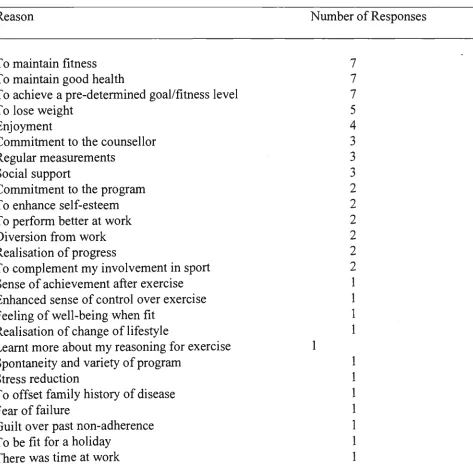
The adherers in both groups were initially asked: W h y did you adhere to the program? Table 2
Responses from the 24 Adherers in the Treatment Group to the Question: Why Did You Adhere to the Program?
Reason N u m b e r of Responses
T o maintain fitness T o maintain good health
T o achieve a pre-determined goal/fitness level T o lose weight
Enjoyment
Commitment to the counsellor Regular measurements
Social support
Commitment to the program T o enhance self-esteem T o perform better at work Diversion from work Realisation of progress
T o complement m y involvement in sport Sense of achievement after exercise Enhanced sense of control over exercise Feeling of well-being w h e n fit
Realisation of change of lifestyle
Learnt more about m y reasoning for exercise Spontaneity and variety of program
Stress reduction
T o offset family history of disease Fear of failure
Guilt over past non-adherence T o be fit for a holiday
There w a s time at work
Treatment Group Adherence
The responses obtained from the treatment group adherers included those that
represented a "means to an end" approach to exercise and those that displayed an appreciation of more internal reasons. Some responses, however, do not completely fit these descriptions. Many responses indicated the influence of features contained within the
specialised fitness program. Most of the treatment group adherers attributed their adherence to a combination of factors.
Many of the adherers in the treatment group were motivated to exercise in order to
achieve a specific result, viewing their exercise as a means to an end. The majority of these people sought "to maintain fitness," to "maintain good health" and "to lose weight." Other outcomes that were targeted included "to enhance self esteem," "to perform better at work," "to complement my involvement in sport," "to offset a family history of disease," and "to be fit for a holiday." It appears that most of these reasons for adhering would have been
established prior to the program beginning.
Reasons for adhering were often linked to the features provided within the treatment group program. These particular reasons included "commitment to the program or
counsellor," "regular measurements," "social support," "the spontaneity and variety of the program," and "enjoyment."
Several participants stated "achieving a pre-determined goal" as a reason for
adherence. In these cases, the goal setting process contained in the specialised program helped focus the efforts of these people in maintaining regular exercise. Program objectives, within a time frame, were more clearly defined through the goal setting process and individuals stated that they experienced a high degree of satisfaction when the recorded goals were achieved.
The objectives set by the counsellor, in conjunction with the treatment group participants, were carefully designed to be realistic and meaningful. This approach was successful for
m a n y of the treatment group adherers and provides strong support to the view that goal setting is a valuable component of exercise prescription (Griffin, 1998; Hoekenga, & Thompson, 1998).
"Commitment to the program" and "commitment to the counsellor" were stated as
reasons for adherence. This form of motivation may have originated from the desire to show the counsellor one could adhere (as much as to satisfy oneself). Kelman (1958) used the
terms, identification and internalisation to describe levels of motivation. In identification, clients are said to follow a behaviour regimen to please or try to be like a counsellor or to be part of a group. Internalisation represents a higher level of motivation where the client's behaviour is performed to please oneself as much as it would be to please others. In this
instance, exercise is intrinsically rewarding, and is performed by clients for their own benefit. The reported commitment of the treatment group adherers to the counsellor may have been
examples of identification, as outlined by Kelman. Those who said their commitment to the
program helped them adhere may be representative of internalisation. The existence of regular meetings with a counsellor for those in the treatment group provided an opportunity to
develop a personal commitment to the counsellor, especially in the initial stages of the program.
"Enjoyment of the program" was cited as a reason for adherence. Some of the
participants stated that the program enabled them to return to activities that had previously appealed to them, enhancing their enjoyment of the program. In most cases, the re-emergence of activities and enjoyment of the exercise was said to improve quality of life. This finding
supports Wankel's (1993) view that enjoyment of exercise must be considered during the exercise prescription process. The counselling process provided to the treatment group
adherers was designed to identify exercise activities that met with individual interests and needs. The enjoyment experienced by some participants helped to enhance self-efficacy for
other forms of exercise and encouraged a m o r e positive outlook on life, as demonstrated by this response:
Participant Number 13: The inclusion of variety and spontaneity in the program meant that I enjoyed it more and realised continual improvements. I was emotionally able to maintain adherence. I achieved relaxation through the program, and most importantly, it has given me the confidence to try different things I thought I was no longer capable of, such as competitive squash. It [the program] has been a great experience and has
changed my outlook on life.
Another reason for adhering was the positive influence of "social support" received during the program. The social support strategies supplied within the counselling sessions may have prompted these people to seek out and engage the support of other people. Participants may have become more aware of the value of social support and the role it can play in helping" them maintain regular exercise.
The influence of "regular measurements" of fitness parameters, taken during the
counselling sessions, was cited as another cause of adherence. This was a formal component
of the specialised program that complemented the goal setting process and provided important feedback to the participants.
Further responses from the treatment group adherers revealed a sense of improved
mastery over exercise. These responses provided a different type of rationale for adhering to a program. These reasons imply that an increased understanding of motivation and reasoning
for exercise had developed. The responses that indicate these developments included "a realisation of progress," "a sense of achievement after exercise," "an enhanced sense of
program, seem to have improved the sense of personal control for these adherers. These
participants were also able to identify internal characteristics or changes that helped lead to ongoing exercise adherence:
Participant number 19: The program helped me learn about my reasoning for exercising and led to the recognition that I needed to change my lifestyle.
Participant number 24: A heightened degree of self-motivation developed. Enjoyment was increased through a structured process with goals and regular monitoring.
There were other interesting responses from the group that related to the more immediate benefits of exercise. Examples of this type of response were that adherence occurred because exercise was a "diversion from work." The premise of this statement is that a diversion from work helps to re-energise the person and improve work quality. The diversion from work
experienced during exercise had a positive, healthy impact. Another experiential cause for
one person's adherence was that the exercise session acted as a vehicle for "stress reduction." For this person, regular exercise appears to have become a behaviour that helped him or her manage their stress.
Two individuals raised powerful emotive issues as causes for their ongoing adherence.
"Fear of failure" was cited as a motivational factor for one person and "guilt over past non-adherence" was stated by the other individual. The avoidance of negative outcomes motivated
these people.
One response from a participant in this group was that adherence resulted because
there was "available time at work for exercise." It seems that many others in the group would disagree with this opinion, intimating that they had to struggle to make time for exercise.
Table 3
Responses from the Eight Adherers in the Control Group to the Question: Why Did You Adhere to the Program?
Reason Number of Responses
T o maintain or improve fitness 5 To lose weight 4
To complement sporting activity 3
Enjoyment 2 To look good 1
To offset family history of disease 1 To plan for retirement 1
To maintain the habit of exercise 1 To feel better during the work day 1
To experience solitude and relaxation through exercise 1
Control Group Adherence
Most of the control group adherers attributed their outcome to reasons that were
result-oriented. To "improve fitness," "lose weight," and to "complement a sporting activity" were prominent reasons that would appear to indicate that these participants saw exercise as a
means to an end. Other result-oriented reasons were "to look good," "to plan for a retirement lifestyle," and "to offset a family history of disease." Some other responses indicated the importance of the exercise experience in helping to maintain adherence. These reasons
better during the work day." These latter responses highlight the importance of the
spontaneous exercise experience in increasing and maintaining exercise adherence for some people. The benefits focused upon within this reasoning are internal and experiential as compared to the external benefits derived from the more common "means to an end"
responses, such "weight loss" and "looking good."
The control group adherers did not refer to commitment as a reason for their program outcome, neither was there recognition of changed behaviour or motivation during the program. This group of people may not have required any specialised strategies to adhere. Their apparent high self-motivation may be a transferable behaviour for them. They may be highly self-motivated in most areas of their lives.
Most of the control group adherers did not believe that the content of the facility program influenced their adherence. In contrast, many of the treatment group adherers identified components of the specialised program as having a positive influence on their exercise adherence.
The Reasons for Nonadherence
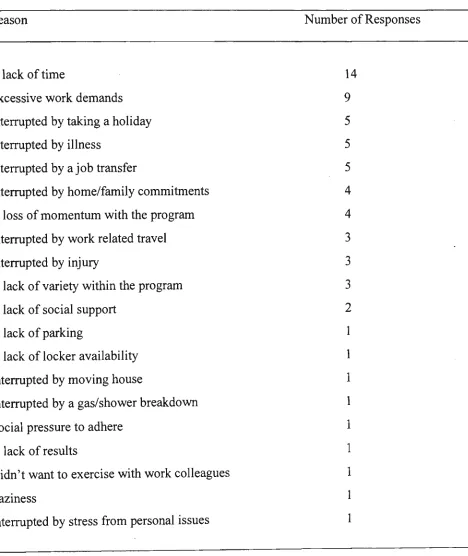
The nonadherers in both groups were initially asked: Why didn't you adhere to the program? Table 4
Responses from the 11 Nonadherers in the Treatment Group to the Question: Why Didn't You Adhere to the Program?
Reason N u m b e r of Responses
Excessive work demands
Interrupted by work-travel commitments A lack of time
Interrupted by home/family commitments
Lost momentum with the program
Stressed and distracted by personal issues
Laziness
Interrupted by injury
Interrupted by a job transfer
Interrupted by a gas/shower breakdown
A lack of social support
5 4 3 3 3 2
Treatment Group Nonadherence
The treatment group nonadherers said that their inability to adhere was linked to
external factors. Reasons such as "excessive work demands," "a lack of time," and "being interrupted by work-related travel or home commitments" were typical responses. The only