Available Online atwww.ijcsmc.com
International Journal of Computer Science and Mobile Computing
A Monthly Journal of Computer Science and Information Technology
ISSN 2320–088X
IJCSMC, Vol. 4, Issue. 4, April 2015, pg.541 – 548
RESEARCH ARTICLE
FPGA based Packet Classification using
multi-Pipeline Architecture
R.Sathesh Raaj
1, J.Kumarnath
21Department of Electronics and Communication Engineering, PSNA College of Engineering and Technology,
Dindigul, India
2PSNA College of Engineering and Technology, Dindigul, India
Email address:
[email protected] (R.Sathesh Raaj), [email protected] (J.Kumarnath) To cite this article:
R.Sathesh Raaj1, *, J.Kumarnath1, 2., FPGA based Packet Classification using multi-Pipeline Architecture
Abstract:
This paper proposes a decision-tree-based linear multi-pipeline architecture on FPGA’s for packet sorting. We
reflect on the next-generation packet classification problems where more than 5-tuple packet header fields has been
classified . From traditional fixed 5-tuple matching, Multi-field packet classification has been evolved for flexible
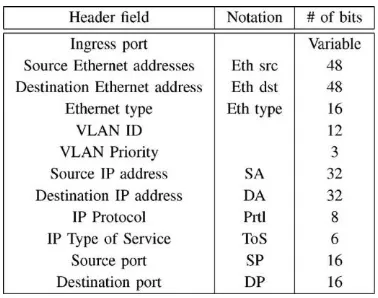
matching with arbitrary combination of numerous packet header fields. The recently proposed Open Flow switching
requires classifying each packet using up to 12-tuple packet header fields. It become a great task to develop scalable
solutions for next-generation packet classification that support larger rule sets, additional packet header fields and
higher throughput . This paper proposes a 2-D multi-pipeline decision-tree-based architecture for next-generation
packet classification which exploits the abundant parallelism and other desirable features such as current
field-programmable gate arrays (FPGAs),. We propose several optimization techniques for the state-of-the-art
decision-tree-based algorithm by examine the various traditional 5-tuple packet classification methods. By using set of
12-tuple rules, the framework has beed developed to partition the rule set into multiple subsets each of which is built
into an optimized decision tree. To maximize the memory utilization.a tree-to-pipeline mapping scheme is carefully
for least packets of size (40 bytes) respectively. To utilize the memory properly and to sustaining high throughput,a
mapping scheme based on tree-to-pipeline is designed carefully. This paper deal with the profuse parallelism and
other preferred features provided by present field-programmable gate arrays and propose a 2-D multi-pipeline
decision tree based architecture for next-generation packet sorting. The Verilog Hardware description languages
(VHDL) are used to design the proposed architecture and synthesized using Xilinx Software.
Keywords: Field Programmable Gate Array(FPGA), multi-pipeline architecture
1.
Introduction
Table 1: Header field supported in current open flow:
Ingrained node-to-stage mapping scheme is used for mapping the tree structure onto the pipeline architecture, which allows imposing the bounds on the memory size as well as the number of nodes in each stage. As a result, the memory consumption of the architecture is increased. Using external SRAM the memory allocation scheme is enabled to handle even larger rule sets. We make use of the dual-port high-speed Block RAMs provided in modern FPGAs to achieve a high throughput of two packets per clock cycle (PPC). Service interruption become possible due to memory-based linear architecture. All the routing path are located to avoid large routing delay hence high clock frequency is obtained,
2. Related Work
Traditional 5-tuple packet classification is considered a drenched research area, few work has been done on FPGAs. Decomposition based packet classifications algorithms such as DCFL{22} and BV{19}are commonly used in most of the readily available FPGA. Lakshman et al. [19] propose the Parallel Bit Vector (BV) algorithm, which is a decomposition-based algorithm targeting hardware implementation. It performs the parallel lookups on each individual field first. The lookup on each field returns a bit vector with each bit representing a rule. Taylor et al. [22] introduce Distributed Cross producting of Field Labels (DCFL), which is also a decomposition-based algorithm leveraging several observations of the structure of real filter sets. They putrefy the multi-field searching problem and use independent search engines, which can function in parallel to find the alike conditions for each filter field. Jedhe et al. [15] realize the DCFL architecture in their entire firewall implementation on a Xilinx Virtex 2 Pro FPGA, using a memory intensive approach, as opposed to the logic intensive one, so that on-the-fly update is possible. Two recent works [24], [25] discuss several issues in implementing decision-tree-based packet classification algorithms on FPGA, with different motivations. Luo et al. [24] propose a method called explicit range search to allow more cuts per node than the Hyper Cuts algorithm. Based on the cost of increased memory utilization, the tree height is radically reduced.At each internal node in order to find which child node to traverse it is needed to determine the a varying number of memory accesses, which may be infeasible for pipelining. Since the authors do not implement their FPGA design, the actual performance results are undecided.
3. Proposed Architecture Design
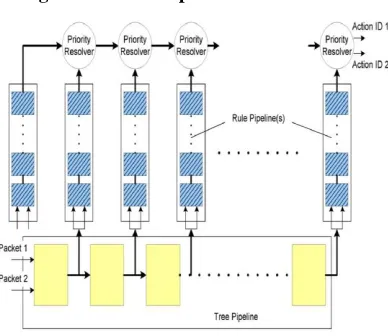
rule stage includes a memory block storing the fullcontent of rules and the matching logic which performs parallel matching on all header fields.Each incoming packet goes through all the pipelines in parallel. A different subset of header fields of the packet may be used to traverse the trees in different pipelines. Each pipeline outputs the rule ID or its corresponding action. The priority resolver picks the result with the highest priority among the outputs from the pipelines.
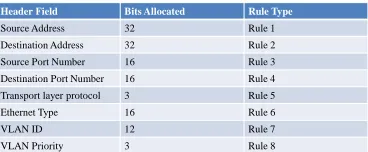
Table 2:
Formation of Rules:
Header Field Bits Allocated Rule Type
Source Address 32 Rule 1
Destination Address 32 Rule 2 Source Port Number 16 Rule 3 Destination Port Number 16 Rule 4 Transport layer protocol 3 Rule 5
Ethernet Type 16 Rule 6
VLAN ID 12 Rule 7
VLAN Priority 3 Rule 8
3.1.Pipeline:
Like the HyperCuts with the push common rule upwards heuristic enabled, our algorithm may reduce the memory consumption at the cost of increased search time, if the process to match the rules in the internal rule list of each tree node is placed in the same critical path of decision tree traversal. Any packet traversing the decision tree must perform: 1) matching the rules in the internal rule list of the existing node and 2) branching to the child nodes, in series. The number of memory accesses all along the grave path can be very large in the worst cases. Though the throughput can be improved by using a deep pipeline, the large delay transitory the packet classification engine need the router to use a large buffer to store the payload of all packets being classified. Moreover, since the search in the rule list and the traversal in the decision tree have different structures, a heterogeneous pipeline is needed, which complicates the hardware design.
3.2. Tree-to-Pipeline Mapping:
Before the FPGA implementation ,the size of the memory in the pipeline stages should be known. However, when simply mapping each level of the decision tree onto a separate stage, the memory distribution across stages can vary extensively. Allocating memory with the maximum size for each stage results in large memory wastage. This propose a Ring pipeline architecture which employs TCAMs to achieve balanced memory distribution at the cost of halving the throughput to one packet per two clock cycles, i.e., 0.5 PPC, due to its non-linear structure. Our task is to map the decision tree onto a pipeline (i.e., Tree Pipeline in our architecture) to achieve balanced memory distribution over stages, while sustaining a throughput of one packet per clock cycle (which can be further improved to 2 PPC by employing dual-port RAMs). The memory distribution across stages should be balanced not only for the Tree Pipeline, but also for all the Rule Pipelines. Note that the number of words in each stage of a Rule Pipelines depends on the number of tree nodes rather than the number of words in the corresponding stage of Tree Pipeline, as shown in Fig. 8. The challenge comes from the various number of words needed for tree nodes. As a result, the tree-to-pipeline mapping scheme requires not only balanced memory distribution, but also balanced node distribution across stages. Moreover, to maximize the memory utilization in each stage, the sum of the number of words of all nodes in a stage should approach some power of 2. Otherwise , for example, we need to allocate 2048 words for a stage consuming only 1025 words. The above problem is a variant of bin packing problems, and can be proved to be NP-complete. We use a heuristic similar to our previous study of trie-based IP lookup, which allows the nodes on the same level of the tree to be mapped onto different stages. This provides more flexibility to map the tree nodes, and helps achieve a balanced memory and node distribution across the stages in a pipeline, as shown in Fig. 3. Only one constraint must be followed.
We impose two bounds, namely and for the memory and node distribution, respectively. The values of the bounds are some power of 2. The criteria to set the bounds is to minimize the number of pipeline stages while achieving balanced distribution over stages. The complete tree-to-pipeline mapping algorithm , where denotes a tree node, the number of stages, the set of remaining nodes to be mapped onto stages, the number of words of the the stage, and the number of nodes mapped onto the Nth stage. We manage two lists, Ready List and Next Ready List. The former stores the nodes that are available for filling the current stage, while the latter stores the nodes for filling the next stage. We start with mapping the nodes that are children of the root onto Stage 1.When filling a stage, the nodes in Ready List are popped out and mapped onto the stage, in the decreasing order of their heights.2 After a node is assigned to a stage, its children are pushed into Next Ready List. When a stage is full or Ready List becomes empty, we move on to the next stage. At that time, Next Ready List is merged into Ready List. By these means, Constraint 1 is met. The complexity of this mapping algorithm is , where denotes the total number of tree nodes. Our tree-to-pipeline mapping algorithm allows two nodes on the same tree level to be mapped to different stages. We implement this feature by using a simple method. Each node stored in the local memory of a pipeline stage has one extra field: the distance to the pipeline stage where the child node is stored. When a packet is passed through the pipeline, the distance value is decremented by 1 when it goes through a stage. When the distance value becomes 0, the child node’s address is used to access the memory in that stage. External SRAMs are usually needed to handle very large rule sets, while the number of external SRAMs is constrained by the number of I/O pins in our architecture. By assigning large values of and for one or two specific stages, our mapping algorithm can be extended to allocate a large number of tree nodes onto few external SRAMs which consume controllablenumber of I/O pins
Fig 1:2-D Multi-Pipeline Architecture
3.3.Pipeline for Rule Lists:
Fig 2:
Decision Tree:
1
3 2
5 7
8
4 6
4. Simulation Results
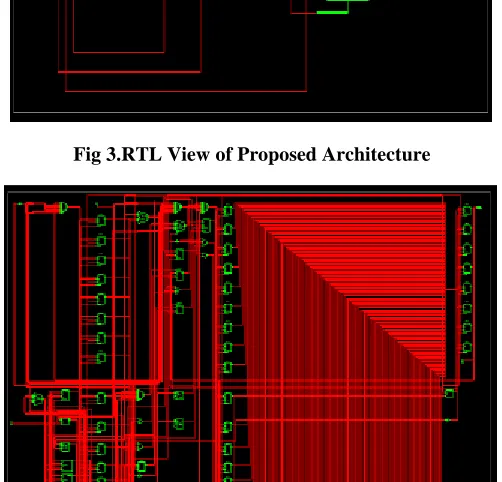
Fig 3.RTL View of Proposed Architecture
References
[1] M. Casado, T. Koponen, D.Moon, and S. Shenker, “Rethinking packet forwarding hardware,” in Proc. HotNets—VII, 2008, pp. 1–6.
[2] N. McKeown, T. Anderson,H.Balakrishnan, G. Parulkar, L. Peterson, J. Rexford, S. Shenker, and J. Turner, “OpenFlow: Enabling innovation in campus networks,” SIGCOMM Comput. Commun. Rev., vol. 38, no. 2, pp. 69–74, 2008.
[3]OpenFlowFoundation, “OpenFlow Switch Specification,
Version1.0.0,”2009.[Online].Available:http://www.openflowswitch.org/documents/openflow-spec-v1.0.0.pdf [4] P. Gupta and N. McKeown, “Algorithms for packet classification,” IEEE Network, vol. 15, no. 2, pp. 24–32, 2001.
[5] F.Yu,R.H. Katz, and T.V.Lakshman, “Efficient multimatch packet classification and lookup with TCAM,” IEEE Micro, vol. 25, no. 1, pp. 50–59, Jan. 2005.
[6] K. Lakshminarayanan, A. Rangarajan, and S. Venkatachary, “Algorithms for advanced packet classification with ternary CAMs,” in Proc. SIGCOMM, 2005, pp. 193–204.
[7] H. Song and J. W. Lockwood, “Efficient packet classification for network intrusion detection using FPGA,” in Proc. FPGA, 2005, pp. 238–245.
[8] S. Dharmapurikar, H. Song, J. S. Turner, and J. W. Lockwood, “Fast packet classification using bloom filters,” in Proc. ANCS, 2006, pp. 61–70.
[9] I. Papaefstathiou and V. Papaefstathiou, “Memory-efficient 5D packet classification at 40 Gbps,” in Proc. INFOCOM, 2007, pp. 1370–1378.
[10] A. Nikitakis and I. Papaefstathiou, “A memory-efficient FPGA-based classification engine,” in Proc. FCCM, 2008, pp. 53– 62.
[11] W. Jiang and V. K. Prasanna, “Sequence-preserving parallel IP lookup using multiple SRAM-based pipelines,” J. Parallel Distrib. Comput., vol. 69, no. 9, pp. 778–789, 2009.
[12] H. Yu and R. Mahapatra, “A power- and throughput-efficient packet classifier with n bloom filters,” IEEE Trans. Comput., vol. 60, no. 8, pp. 1182–1193, Aug. 2011.
[13] W. Jiang and V. K. Prasanna, “Large-scale wire-speed packet classification on FPGAs,” in Proc. FPGA, 2009, pp. 219–228. [14] I. Sourdis, “Designs & algorithms for packet and content inspection” Ph.D. dissertation, Comput. Eng. Div., Delft Univ. Technol., Delft, The Netherlands, 2007. [Online]. Available: http://ce.et.tudelft.nl/publicationfiles/ 1464_564 sourdis phdthesis.pdf
[15] G. S. Jedhe, A. Ramamoorthy, and K. Varghese, “A scalable high throughput firewall in FPGA,” in Proc. FCCM, 2008, pp. 43–52.
[16] Xilinx, Inc., San Jose, CA, “Xilinx Virtex-6 FPGA family,”2009.[Online].Available:www.xilinx.com/products/virtex6/
[17] Altera Corp., San Jose, CA, “Altera Stratix IV FPGA,”
2009.[Online].Available:http://www.altera.com/products/devices/stratix-fpgas/ stratix-iv/
[18] D. E. Taylor, “Survey and taxonomy of packet classification techniques,” ACM Comput. Surv., vol. 37, no. 3, pp. 238–275, 2005.
[19] T. V. Lakshman and D. Stiliadis, “High-speed policy-based packet forwarding using efficient multi-dimensional range matching,” in Proc. SIGCOMM, 1998, pp. 203–214.
[20] S. Singh, F. Baboescu, G. Varghese, and J. Wang, “Packet classification using multidimensional cutting,” in Proc. SIGCOMM, 2003, pp. 213–224.
[21] P. Gupta and N. McKeown, “Classifying packets with hierarchical intelligent cuttings,” IEEE Micro, vol. 20, no. 1, pp. 34– 41, 2000.
[22] D. E. Taylor and J. S. Turner, “Scalable packet classification using distributed crossproducing of field labels,” in Proc. INFOCOM, 2005, pp. 269–280.
[23] W. Eatherton, G. Varghese, and Z. Dittia, “Tree bitmap: Hardware/ software IP lookups with incremental updates,”
[24] Y. Luo, K. Xiang, and S. Li, “Acceleration of decision tree searching for IP traffic classification,” in Proc. ANCS, 2008, pp. 40–49.
[25] A. Kennedy, X.Wang, Z. Liu, and B. Liu, “Low power architecture for high speed packet classification,” in Proc. ANCS, 2008, pp. 131–140.
[26] Y. Luo, P. Cascon, E. Murray, and J. Ortega, “Accelerating OpenFlow switching with network processors,” in Proc. ANCS, 2009, pp. 70–71.