Formal Analysis of Distance Bounding with
Secure Hardware
Handan Kılın¸c and Serge Vaudenay EPFL, Lausanne, Switzerland
Abstract. A distance bounding (DB) protocol is a two-party authen-tication protocol between a prover and a verifier which is based on the distance between the prover and the verifier. It aims to defeat threats by malicious provers who try to convince that they are closer to the verifier or adversaries which seek to impersonate a far-away prover. All these threats are covered in several security definitions and it is not possible to have a single definition covering all. In this paper, we describe a new DB model with three parties where the new party is named hardware. In this model, called secure hardware model (SHM), the hardware is held by the prover without being able to tamper with. We define an all-in-one security model which covers all the threats of DB and an appropriate privacy notion for SHM. In the end, we construct the most efficient (in terms of computation by the prover-hardware and number of rounds) and secure DB protocols achieving the optimal security bounds as well as privacy.
Keywords: distance bounding, RFID, NFC, relay attack, tamper resistance, terrorist fraud
1
Introduction
Distance bounding (DB) protocols are two-party (a prover and a verifier) authen-tication protocols. A prover authenticates itself and proves that the distance be-tween its location and the verifier’s location is less than a predetermined bound. The verifier estimates the distance of the prover by computing the round trip time of sending a challenge to the prover and receiving a response from the prover. Brands and Chaum [6] first defined this notion as a solution to relay attacks. However, it may also provide a solution for the following threats:
Mafia Fraud (MiM) [12] : A man-in-the-middle (MiM) adversary between a verifier and a far-away honest prover makes the verifier accept the access of the prover. Malicious and far-away provers who want to convince that they are close to a verifier appear in the followings:
Distance Hijacking (DH) [11] : A far-away malicious prover takes advantage of some honest and active provers who are close to the verifier to make the verifier grant privileges to the far-away prover.
Terrorist fraud (TF) [12] : A far-away malicious prover, with the help of an adversary, tries to make the verifier accept the access of the prover.
Clearly, the strongest security notion is the resistance to TF. So, if we can construct a DB protocol that is secure against TF, then the DB protocol will be secure against MiM, DF and DH. However, it is not possible to achieve the TF-security because of a trivial attack: the malicious prover gives his secret (key) to a close adversary, and the adversary authenticates on behalf of the malicious prover by running the protocol. To achieve the TF-security, the trivial attack is artificially excluded from the TF model in the literature by assuming that malicious provers would never share their keys (in this paper, we call this weaker version “TF’-security”). However, we cannot adapt TF’-security as an all-in-one security notion because no connection between TF’-security and MiM, DF or DH security can be established. Because of this disconnection, all DB protocols require separate security analysis for each of them. The only public-key DB protocols that are secure against all of them (MiM, DF, DH, TF’) are ProProx [28], its variant eProProx [26] and TREAD [2]. Some important distance bounding protocols [6, 8, 10, 15, 22, 24, 19] are all vulnerable to TF’. The protocol by Bultel et al. [7] is TF’-secure thanks to a ‘cheat option’ (as explained below) but it is not DH-secure since it aims for anonymity against verifier.
Moreover, the formal definition of security is controversial. The TF’-security definition of D¨urholz et al. [13] allows treatment of the partial disclosure of the secret key. Essentially, the TF’ security in this definition implies that any information forwarded to a close-by adversary would allow another adversary to later pass, without a help of the prover, with the same probability, but through a “cheat option” in the protocol. Fischlin and Onete [14] adapted the Swiss-Knife protocol [20] to have this definition. However, it was proven that this technique weakens Swiss-Knife for MiM-security [25]. Clearly, it is not reasonable to weaken the most relevant security to protect it against the least relevant one. There are also extractor based TF’-security definitions [5, 28, 25] stronger than the definition of D¨urholz et al. model [13]. However, all TF’-security definitions are constructed with the assumption that the malicious prover do not reveal any secret key related information. This assumption is considered weak and not realistic[1]. In short, none of the models in the literature fully covers TF.
Apparently, there is no way of achieving TF-security without hiding the secret key from the prover. This intuitive idea has been noticed [23, 9], but never formally defined. A natural question to ask here is whether this idea really prevents TF. The answer is “yes and no” because hiding the key is necessary but not sufficient.
Therefore, in this paper, we define a new formal model where constructing TF-secure protocols are possible.
Our formal model for DB, which we call secure hardware model (SHM), provides a solution to all DB related problems that we mention. We denote the two-algorithm (Prover and Verifier) DB corresponding to the classical DB in the literature as “plain model” (PM) [6, 13, 4, 5, 27]. In the SHM, we have another entity called “Hardware” that is always honest and only communicate with their holder (the prover). Mainly, this hardware runs some part of the prover algorithm honestly and neither a malicious prover nor an adversary can corrupt it. In the real world, we can realize our new entity as e.g. tamper-resistant modules in smart-cards. In more detail,our contribution in this paper is the following:
– We define a new type of DB with three algorithms (V, P, H): verifier, prover, hardware. Then, we design a communication and adversarial model for three-algorithm DB which we call secure hardware model (SHM). In SHM, it is possible to have TF-secure DB protocols without excluding trivial attacks. We give a new security definition in SHM for a three-algorithm DB. In this security definition, achieving TF-security means achieving MiM, DF and DH-security. So, we obtain an all-in-one definition.
– We obtain a convincing model for TF based on SHM. We show that the TF-security of (V, P, H) in SHM is equivalent to the MiM-security of (V, H) in PM whereH in PM corresponds to the prover algorithm. This result implies thatP plays no role in security but only in the correctness of the protocol to have TF-security.
– We establish security relations between PM and SHM. We show that the MiM-security in SHM and the MiM-security in PM are equivalent where the prover algorithm in PM is the unionPH of the prover P and the hardware
Hin SHM. Additionally, we show that a MiM-secure DB protocol in PM can be converted into a fully-secure DB protocol in SHM. This result shows that if we have only a MiM-secure DB protocol in PM,we can easily construct an efficient DB protocol secure against all threats in SHM. – We define a strong privacy notion of DB in SHM. Strong privacy in DB
requires that the adversary cannot identify a prover even after getting his secret (e.g. by a corruption).
– We construct a symmetric DB protocolMiM-symDB which is the most efficient optimally secure MiM-secure protocol in PM (in terms of computation and number of rounds) among the protocols with binary challenges and responses.Then, we convert it into a DB protocol in SHM (Full-symDBH) and obtain the most efficient symmetric DB protocol secure against all threats and achieving optimal security bounds.
We underline that theonly assumption on the secure hardware is that it is honest which means that it runs the specified algorithm only. By doing so, we give a model here where the TF-security is achievable.
One may argue that our assumption on secure hardware is too strong for the real world applications. For example, in the real world, if the secure hardware is implemented using a tamper-resistant hardware, it is always possible that a side-channel attack will break our assumption. However, we believe that relying on our assumption is more reasonable than relying on some adversarial intention (e.g., that the adversary never shares his secret). We can never prevent a TF-adversary to share his secret-key, but we can construct a strong tamper-resistant hardware which requires very expensive devices to be tampered. Besides, MiM-security would be preserved even if the tamper resistance assumption is broken.
2
Definitions and Security in SHM
We first give the formal definitions of SHM and security in this model. Then, we provide some security relations related to PM and SHM.
2.1 Definitions
Parties of a DB protocol are a prover and a verifier [6]. However, we define a new version of it called three-algorithm (symmetric or public-key) DB where the algorithms are prover, verifier, and hardware.
Definition 1 (Three-Algorithm Symmetric DB). Three-algorithm sym-metric DB is a probabilistic polynomial-time (PPT) protocol. It consists of a tuple (K, V, P, B, H) where K is the key generation algorithm, P is the proving algorithm, H is the hardware algorithm, V is the verifying algorithm andB is the distance bound. The input of V and H is K generated by K. P interacts withH(K)andV(K). At the end of the protocol,V(K)outputs a final message
OutV ∈ {0,1}. If OutV = 1, thenV accepts. If OutV = 0, then V rejects.
In symmetric DB,V knows that it needs to use K (possibly resulting from a prior identification protocol).
Definition 2 (Three-Algorithm Public key DB). Three-algorithm pub-lic key distance bounding is a PPT protocol. It consists of a tuple
(KP,KV, V, P, B, H) where (KP,KV) are the key generation algorithms of P
and V, respectively. The output of KP is a secret/public key pair (skP,pkP)
and the output of KV is a secret/public key pair (skV,pkV).V is the verifying
algorithm with the input (skV,pkV),P is the proving algorithm with the input (pkP,pkV)andH is the hardware algorithm with the input (skP,pkP).B is the
This definition assumes a priori identification of pkV forP.
Definition 3 (Correctness of DB). A public-key (resp. symmetric) DB pro-tocol is correct if and only if under an honest execution, whenever the distance between P andV is at mostB,V always outputsOutV = 1andpkP (resp.∅).
In all definitions below, verifiers, provers, and hardware are parties running
V,PandH, respectively. The parties can move and run their algorithms multiple times. Each new execution of a party’s algorithm is aninstanceof this party.
Classical DB in the literature is very similar to three-algorithm DB with the following differences: no H algorithm exists and the input of P in public-key and symmetric DB is (skP,pkP,pkV) and K, respectively. The plain model is the model corresponding to the classical DB.
Plain Model (PM): Parties of PM are provers, verifiers and other actors. – Honest parties run their assigned algorithms only.
– Verifiers are always honest. Provers are either malicious or honest. – Each instance of a party has a location.
– A malicious party may run its instances concurrently, while an honest party runs its instances only sequentially.
– Communication between instances has a latency proportional to the distance (e.g., it travels at the speed of light).
The secure hardware model is the model corresponding to three-algorithm DB:P,V andH.
Secure Hardware Model (SHM): Parties of SHM are provers, hardware, verifiers and other actors. SHM includes all the characteristics of PM and the additional ones:
– Secure hardware are honest parties.
– Each prover possesses its own secure hardware.
– The secure hardware of an honest prover can only communicate with its prover and they are both at the same location.
In the rest of the paper, whenever we say “a distance bounding protocol in SHM”, it refers to the three-algorithm DB.
Remark that since secure hardware are honest parties, they always run their assigned algorithms even if malicious provers hold them. They should be taken as a subroutine of a prover algorithm running on a secure enclave where the prover can never change or interfere it.
SHM and PM follow the communication model from [5, 18]: instances can only communicate by sending messages which are delivered with a delay propor-tional to the distance, and malicious instances can prevent delivery or change the destination of messages [28].
Definition 4 (Security in SHM). Consider a public-key DB. The game consists of a verifier and provers P1, P2, ..., Pt with their corresponding
hard-wareH1, H2, ..., Ht. It begins by running the key setup algorithmKV outputting (skV,pkV) forV and KP outputting (skPi,pkPi) for Hi. The game consists of
instances of the verifier, provers, hardware and actors. V is a distinguished in-stance of the verifier. One prover (let’s denote P) is the target prover. The winning condition of the game isV outputsOutV = 1and privately pkP (public
key ofP) if no close instance ofP’s hardware exists during the execution ofV.
– The DB protocol is MiM-secure if the winning probability is always negligible wheneverP is honest1.
– The DB protocol is DF-secure if the winning probability is always negligible whenever there is no instance of any party close toV.
– The DB protocol is DH-secure if the winning probability is always negligi-ble whenever all close instances are honest provers other than P and their hardware.
– The DB protocol is TF-secure if the winning probability is always negligible. The same security definition holds for a symmetric DB where we replaceKV
andKP withK andskPi/pkPi with Ki.
Without loss of generality, we can consider all other actors as adversaries. It is clear that TF-security implies DF-security, MiM-security, and DH-security. So, we have an all-in-one security notion in SHM. Hence, we say “se-cure” instead of “TF-se“se-cure”in SHM.
Security in PM: The security in PM is almost the same as Definition 4 except that in PM, we do not have hardware. In PM, there is always a trivial TF-attack in which a malicious prover can give his secret key to another malicious party so that the party authenticates the prover while it is far-away. So, TF-security is not possible in PM. Clearly, this trivial attack is preventable in SHM if we can assure that H never leaksK.
Note that we do not consider the weaker version of TF-security [13, 20, 25] (TF’-security) which artificially excludes trivial attack. So, when we refer to TF-security in PM, we indeed refer to an impossible-to-achieve notion.
Notations:
Pdum is a dummy prover algorithm in SHM which only relays the messages between the outside world andH without even using any of its input. Remark that if the prover who should runPdum is malicious, then it can still play with its hardware or other parties maliciously.
PH is the algorithm which is constructed from joiningP and H in SHM.
More precisely, PH runs P and instead of interacting with H, it executes the same computation thatH would do ifP had interacted. Therefore,PdumH is the hardware algorithm H.
1 Recall that it implies thatH communicates with onlyP and that they are at the
“Challenge phase” is informally defined as the phase whereV comprehends the proximity of P. In the challenge phase, V sends challenges and receives responses from P. If all the responses are correct and arrive on time, then V
decides that the distance betweenV andP is less than the bound B.
2.2 Security Results
Some security implications in SHM and PM (see Figure 1): First, let us define “Null conversion”. It is a transformation of a protocol DB’ with (K, V, P0, B) in PM into another protocol DB with (K, V, P, B, H) in SHM whereP andH are described below:
P
askkey
receiveK
runP0(K)
H(K)
send K
This conversion shows that if we have a counterexample protocol in PM which is X-secure but not Y-secure (X,Y∈ {DF, DH, MiM, TF}), then the same counterexample applies for its null conversion. Hence,any non-implication in PM is correct for SHM as well.
We have already explained that TF-security implies DF, DH and MiM secu-rity in SHM and PM. Now, we show the other relations between these secusecu-rity notions. We give our counterexamples in PM for simplicity.
DH→DF:It is clear that DH-security implies DF-security in SHM and also in PM. But, there is no such relation between DF/DH-security and MiM-security as explained below.
DF 9 DH and DF 9 MiM: A simple counterexample for a DF-secure
protocol which is neither MiM nor DH-secure is an ‘echo’ protocol.
In an ‘echo’ protocol, the prover authenticates itself and then challenge phase begins. P receives a challenge(s) from V and P responds with the challenge(s) itself. If P replies with the same challenge(s), V computes the elapsed time between the sending the challenge and receiving the response. Thus,V can decide if the proximity ofP is less thanB. Clearly, this is DF-secure becauseP cannot correctly reply before seeing the challenge. So,P cannot show itself closer than its proximity. But, echo protocol is not DH and MiM-secure. It is not DH-secure because a far-away and malicious prover can authenticate itself and let the close and honest prover respond to the challenge(s). So,V decides that the malicious prover is close. It is not MiM-secure, because a MiM-adversary responds the challenge(s) itself in the challenge phase and, in the rest, he relays the messages between the (far-away) prover and the verifier.
MiM 9 DF and MiM 9 DH: MiM-symDB in Section 3 (Figure 4) is
MiM-secure but not DF-secure. So, it is not DH-secure either.
DH 9 MiM: We show a DB protocol which is DH secure in PM but not
MiM-secure in PM in Appendix A.
MiM9TF and DH9TF:Eff-pkDB [19], PrivDB [27] are MiM and DH
The relations of security notions are the same for a DB in PM and in SHM. However, since TF-security is not achievable for a DB in PM, actually, only the relations between DH, DF and MiM are valid in PM which basically shows why all-in-one security is not possible in PM.
Now, we give some security relations between a DB protocol in PM and SHM. Theorem 1 (MiM in SHM ⇒ MiM in PM). Let DB =(K, V, P, B, H) be a symmetric-key DB protocol in SHM. We define a DB protocol DB0 = (K, V, PH, B) in PM. IfDB is MiM-secure thenDB0 is MiM-secure.
The same holds with public-key DB.
The proof is trivial by adding a hardware to every honest prover at the same location: A MiM-game againstDB0 becomes a MiM-game againstDB.
Theorem 2 (MiM-security in PM with PH
dum ⇔ Security in SHM).
Let DB = (K, V, P, B, H) be a symmetric DB in SHM and and DB0 = (K, V, PH
dum, B) be a symmetric-key DB in PM where H in DB0 corresponds
H of DB.DB0 is MiM secure in PM if and only ifDB is TF-secure in SHM.
Here, the prover algorithm ofDB0 is justH because PH dum≡H.
Note that DB0 in Theorem 2 is not a correct DB protocol in general if P 6=Pdumas the algorithmP disappeared. However, we can still consider MiM-security forDB0 without correctness.
Proof. (⇒) Consider a TF-game in SHM. We run this game in PM by simulating the secure hardwareH ofDB with the proverPH
dum ofDB0 and simulating the prover P in SHM with an actor in PM (it is possible because P in SHM does not have any secret key as an input). Then, we obtain MiM-game ofDB0.
(⇐) IfAwins the MiM-game ofDB0, then a TF adversary runsAand wins
the TF-game forDB. ut
Remark that it is not possible to prove “MiM-security of DB0 =
(K, V, PH, B)
⇔ security of DB = (K, V, P, B, H)” where P in DB0 is not
necessarily Pdum because we could not simulate H and P in “⇒” case of the proof in Theorem 2.
Theorem 2 clearly shows that hiding the key is necessary to have security in DB. Because if H in DB does not hide the key, then the prover algorithm of DB0 which is H does not hide as well. So, DB0 would not be MiM-secure.
However, hiding may not be enough as explained below:
We consider the algorithm P of DB which does the computations C =
{C1, C2, ..., Ck} and where P does learn any key related information. So, all computations in C are executed independently from the key. Assume that the success probability of an adversary to break the TF-security ofDB is at most
p. Then, thanks to Theorem 2, the success probability of a MiM-adversaryAin
we can have another MiM-adversary A0 which runs P without C
i 2 and wins MiM-game with p0 > p. So, this contradicts with our assumption which says
that the success probability of a MiM-adversary can be at most p. As a result, Theorem 2 actually shows that the TF-security is not possible in SHM if the computations ofP has an effect onp.
We agree that having a secure hardware running whole algorithm without its prover’s effect on the security is a trivial solution to have TF-security. However, here, we show thatthe other way around is not possible.We underline that it does not mean that prover cannot do any computation to have TF-security. For example, in our TF-secure protocols in Section 4, the prover algorithm in SHM still executes some part of the algorithmPH in PM but it does not have any effect on the security of the protocol (as it can be seen in their security proofs Theorem 8 and Theorem 10.)
Some more results of Theorem 2: – We can conclude ifDB0 = (K, V, PH
dum, B) isMiM-secureand correct DB protocol, then we can construct asecureDB protocolDB= (K, V, P, B, H) in SHM for any algorithmP.DB is further correct whenP =Pdum. – In order to prove security ofDB = (K, V, P, B, H) in SHM, it is enough to
prove MiM-security ofDB0 = (K, V, PH
dum, B) in PM.
– MiM security and security of a DB protocol DB= (K, V, P, B, H) in SHM are equivalent ifP =Pdum due to Theorem 1 and Theorem 2.
Note that this result may not hold withoutPdum .
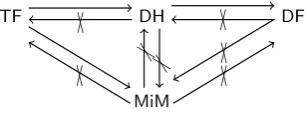
In Figure 1, we give the security (non)-implications in SHM and PM. In Figure 2, we give the same for SHM when the prover is Pdum. In this case,the full security is equivalent to MiM-security.
MiM
TF DH DF
C
C
C
C C C
C
Fig. 1.Security implications of DB proto-cols in PM and SHM. TF-security implies all of them, DH-security implies DF secu-rity and no relation exists between MiM and DH (also DF).
TF≡MiM C DH C DF
Fig. 2. Security implications in SHM with the prover Pdum. TF-security and
MiM security are equivalent in SHM with Pdum. The relations between DF, DH
and MiM are the same as in Figure 1.
2.3 Privacy
In strong-privacy definition of PM, the adversary can corrupt the provers and learn the secrets. However, the hardware in SHM is honest by nature. So, it
2 Remark that any adversary can compute the computations inCbecause they do not
cannot be corrupted. Hence, we define semi-strong privacy with no such corrup-tion. Achieving semi-strong privacy in a DB protocol is good enough assuming that the hardware is tamper-resistant. Nevertheless, we also allow corruption of hardware in order to define the strong privacy notion.
Definition 5 (Privacy in SHM). The privacy game consists of a verifier, proversP1, P2, ..., Ptand their corresponding hardware{H1, H2, ..., Ht}. We
gen-erate the secret/public key pairs of them with KV and KP for the verifier and
the hardware of provers. We pick b∈ {0,1} and start the game:
The adversary can create instances of the verifier and any prover. It can send/receive messages to/from instances of the verifier. It can corrupt any prover and hardware which let it learn the current state of their memory. At some mo-ment, it picks two provers Pi, Pj as a challenge of the game. Ifb= 0, we create
a virtual prover of Pi with its hardware and if b= 1, we create a virtual prover
ofPj with its hardware. The adversary can communicate with the virtual prover
and its virtual hardware. It can also release a virtual prover, if it exists. In this case, we remove the virtual prover from the game, anonymously. The game has to have at most one virtual prover. In the end, the adversary outputsb0. Ifb0=b, the adversary wins. Otherwise, it loses.
We say a DB protocol in SHM isstrong privateif the advantage of the ad-versary in this game is bounded by a negligible probability. We say a DB protocol in SHM issemi-strong private if the advantage of the adversary in a version of this game, where the corruption only lets the adversary communicate with the hardware non-anonymously, is bounded by a negligible probability.
In semi-strong privacy, even though we do not allow corruption of hardware, we let semi-strong corruption occur by allowing interaction with the secure hard-ware. In SHM, we stress that when P interacts with its secure hardware, this interaction remains private.
Hermans et al. [16] defined a similar game for thestrong privacy of DB in PM. In that game, no hardware exists, so the definition of semi-strong privacy is not considered. Instead, theweak privacynotion exists where no corruption on provers are allowed.
Note that we obtain a notion of strong privacy ofDB = (K, V, P, B, H) in SHM which is equivalent to the strong privacy ofDB0= (K, V, PH, B) in PM.
3
Optimal symmetric DB protocol in SHM
In this section, we show our new protocol MiM-symDB in PM which is only MiM-secure (not DF, DH or TF-secure). We construct a DB at this level of security because having MiM-security in PM is enough to achieve (full) security in SHM as a result of Theorem 2. The security bounds of MiM-symDB is very close to optimal security bounds [5]3. Its conversion into SHM reaches the same 3 A security bound of a DB means an upper bound of the success probability of an
bound as well. It is proved [5] that an optimal security bound in PM for a MiM-adversary is (1
2)
ngiven that challenges and responses are bits and the challenge phase consists of n rounds. The same bound applies in SHM as well. We give some details about optimal security bounds in DB protocols [5] in Appendix B. We note that using other optimally MiM-secure DB protocols such as DB1, DB2, DB3 [5] is reasonable as well to have fully secure DB protocols in SHM. However, these protocols are also secure against DF or TF’ in PM which is an overkill since we need only MiM-security. By constructing an optimal MiM-only secure DB in PM, we can save some computations and rounds.
Notation: When we useH as a superscript in the name of a protocol, it shows that it is in SHM.
V(K) P(K)
C||R=K C||R=K
challenge phase
fori= 0 ton
ci=C[i], starttimeri −−−−−−−−−−−−−→ci ifci6=C[i], abort
stoptimeri ←−−−−−−−−−−−−−ri otherwise,ri=R[i]
verification phase
checktimeri≤2B, ri=R[i]
OutV
−−−−−−−−−−−−−→
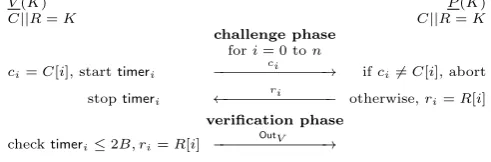
Fig. 3.MiM-OTDB
MiM-OTDB: First, we describe our MiM-OTDB protocol which is MiM-secure when it is executed only once. The proverP and the verifier V share a secret key K = C||R. Here, the bits of C correspond to the challenges and the bits of R correspond to the responses. In the challenge phase, in each round i, V
sends the challengeci=C[i] toP andP sends the responseri=R[i] toV. IfP receives a challenge which is different from C[i], then P does not continue the protocol. In the verification phase,V checks if the responses are correct and on time. (See Figure 3.)
MiM-symDB: The prover P and the verifier V share a secret key K. They use a pseudo random function (PRF) f returning strings of 2n bits. P and
V exchange the nonces NP, NV ∈ {0,1}s, respectively, where s is a security parameter. Then,P andV computef(K, NP, NV) which outputsC||R. Finally,
V andP run MiM-OTDB with usingC||R as a key. (See Figure 4.)
V(K) P(K)
pickNV ∈ {0,1}s ←−−−−−−−−−−−−−NP pickNP∈ {0,1}s
C||R=f(K, NP, NV)−−−−−−−−−−−−−→NV C||R=f(K, NP, NV)
MiM-OTDB(C||R)
←−−−−−−−−−−−−→
We prove the following theorem by using a lemma in [18]. The lemma shows that any messagem sent by a party is independent from the messages seen by another party at the time which is less than arrival time of m. This lemma is correct in SHM as well.
Theorem 3 (MiM-security of MiM-symDB). If f is a secure PRF, then the winning probability of a probabilistic polynomial time (PPT) adversary in a MiM-game of MiM-symDB in PM is at most 2n+13 +
q2
2s+1 + q02
2s+1 +AdvP RF(q+
q0, t). For a PPT game, this is negligible.
Here, q is the number of prover instances, q0 is the number of verifier in-stances, t is the total complexity of the game and AdvP RF is the advantage for
distinguishing the output off from the output of a random function with q+q0 queries and complexity t.
Proof. Γ0 : It is a MiM-game where P’s instances and V’s instances with the distinguished instanceV play in PM. The winning probability inΓ0 isp.
Γ1 : We reduce Γ0 to Γ1 where the nonces of the prover instances and the nonces of the verifier instances do not repeat. The probability that a prover (resp. verifier) instance selects the same nonce with the one of the other prover (resp. verifier) instances is bounded by q22 1
2s (resp. q02
2 1
2s). So, the winning probability ofΓ1 is at leastp−2qs+12 −
q02
2s+1.
Γ2: We reduceΓ1toΓ2whereV and the prover’s instances replacef(K, ., .) by a random function. Clearly, the winning probability inΓ2is at leastp−2qs+12 −
q02
2s+1 −AdvP RF(q+q0, t).
InΓ2, we have a game where at most one prover instancePseeing (NP, NV) pair withVandC||Ris completely random meaning that it is independent from
NP andNV. IfPexists, it has to be far fromV because of the winning condition of MiM-game. Assuming that V and P see the same (NP, NV), we look each roundifor the case whereriarrived on time. Ifriarrived on time, thanks to the lemma in [18], the response sent by Pis independent from ri or the challenge that P received is independent fromci sent byV. In any case, the adversary’s probability to pass each round is 1
2 because the responserihas to be correct and
on time: the adversary guesses eitherriorci(post-ask or pre-ask attack). There may also be one round where the pre-ask strategy is done for a constant number of rounds until it makesPabort. After abort, there is an additional opportunity (in the last of these rounds) for the adversary to pass the round by guessing the response. Therefore,
p= 3 2n+1 +
q2
2s+1 + q02
2s+1 +AdvP RF(q+q 0, t).
u t
Assuming that 2qs+12 + q02
2s+1+AdvP RF(q+q0, t) is negligible, the success prob-ability of a MiM-adversary is 2n3+1 very close to the optimal security
PRF function two times and some other mappings too. So, with parameternc=
nr = 2 in common structure, for a given target security, we construct a nearly optimal protocol, both in terms of number of round and computation complexity. Theorem 4 (OT-MiM security of MiM-OTDB). Any MiM-game against MiM-OTDB withonly one instanceofV(K)and one instance ofP(K)has a winning probability bounded by 3
2n+1. In short, MiM-OTDB is OT-MiM-secure
(one time MiM-secure) [27].
Proof. Using the last game in the proof of Theorem 3, we can show that
MiM-OTDB is OT-MiM-secure. ut
MiM-OTDB is the most efficient one-time MiM-secure protocol [27] since it does not need any computation.
Adaptation of MiM-symDB to SHM (Full-symDBH): We define Full-symDBH with the tuple (K, V, P
dum, B, H) whereB, V and K are as in MiM-symDB, H is the same withP in MiM-symDB.
Theorem 5 (Security of Full-symDBH). If f is a secure PRF,
Full-symDBH is secure in SHM.
Proof. The conversion of Full-symDBH in PM is (
K, V, PH
dum, B) which is equal to MiM-symDB. We know that MiM-symDB is MiM-secure sincef is a secure PRF. Hence, Full-symDBH with (
K, V, Pdum, B.H) is secure thanks to Theorem 2. The security bound of Full-symDBH is the same as MiM-symDB’s.
u t
Full-symDBHis the first protocol that reaches the optimal secure bounds for MiM, DH, DF and TF secure.
4
Optimal Public-key DB Protocols in SHM
In this section, we give two public key DB protocols in SHM: Full-pkDB1H and Full-pkDB2H4 which is correct, private and secure. The first one is derived
from Simp-pkDB [19] in PM. We modify Simp-pkDB to make it private in SHM because Simp-pkDB is not private in PM. The second one is derived from Eff-pkDBp [19] in PM which is a variant of Eff-pkDB [19] with privacy protection. We slightly modify Eff-pkDBp as well as Eff-pkDB to increase its efficiency. We use these protocols because of their efficiency in PM.
Full-pkDB1H:This protocol is derived from pkDB [19]. However, Simp-pkDB is not private. Therefore, we add an extra encryption process on the prover side to achieve privacy. The details of Full-pkDB1H is as follows:
The input of the verifier V is its secret/public key pair (skV,pkV) which is generated from the key generation algorithm of an encryption scheme (Enc0,Dec0). The input of H is the prover’s secret/public key pair (skP,pkP) which is generated by the key generation algorithm of the encryption scheme
4
V(skV,pkV) P(pkP,pkV) H(skP,pkP)
pkP, N=Dec0skV(eP) ←−−−−−−−−−−−−−eP eP=Enc 0
pkV(pkP, N)
pkP ,N
⇐====== N← {0,1}s
pickC||R∈ {0,1}2n
eV =EncpkP(C||R||N)−−−−−−−−−−−−−→eV ======eV ⇒C||R||N=DecskP(eV)
VerifyN
MiM-OTDB(C||R)
←−−−−−−−−−−−−−−−−−−−−−−−−−−−−−−−−−−−−−−−−−−−−→
outputpkP
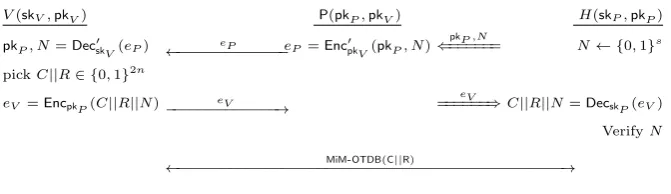
Fig. 5.Full-pkDB1H. The double arrow shows the communication betweenP andH
(Enc,Dec). The input ofP is (pkP,pkV). H picks a nonce N from {0,1}s and sends it to P along with pkP. Then, P encrypts pkP, N with pkV and sends the encryptioneP toV.V learnspkP andN by decryptingeP withskV. Then, it picks C||R from{0,1}2n and encrypts C||R||N withpk
P. Next, it sends the encryption eV to P and P relays it to H. H decrypts eV and learns C||R||N. If N is the same nonce that it picked, it runs MiM-OTDB(C||R) with V. The protocol is depicted in Figure 5.
The conversion of Full-pkDB1H into PM is called as “Simp-pkDBp”. Its prover algorithm is PH(skP,pkP) where P and H is from Full-pkDB1H. Simp-pkDBp is the same as Simp-pkDB except that the prover encrypts its public key and the nonce, and the verifier learns the public key and the nonce via decryption. Clearly, Simp-pkDBp is MiM secure since Simp-pkDB is MiM-secure [19]. Theorem 6 (Security of Full-pkDB1H). If the encryption scheme
(Enc,Dec) is IND-CCA secure and MiM-OTDB is OT-MiM-secure, Full-pkDB1H is secure in SHM.
Proof. ConsiderDB= (KV,KP, V, PdumH , B) withV andH from Full-pkDB1H. Actually,DB= Simp-pkDB. Using Theorem 2, Full-pkDB1H is secure because
DB = Simp-pkDB is MiM-secure [19] assuming that (Enc,Dec) is IND-CCA secure and MiM-OTDB is OT-MiM-secure.
u t
Full-pkDB1H achieves almost optimal security bounds because MiM-security of Simp-pkDB is reduced to MiM-security of MiM-OTDB [19].
We see that Full-pkDB1His secure without encryption. Actually, the encryp-tion is only used for achieving privacy. So, if privacy is not a concern, we can use Full-pkDB1H without the encryption and decryption. In this case, the verifier has no secret/public key pair. This can be useful in practical applications.
We first prove that Simp-pkDBpachieves weak privacy. This helps us to prove Full-pkDB1H is semi-strong private in SHM.
Theorem 7 (Weak privacy of Simp-pkDBp). Assuming the encryption
scheme with (Enc0,Dec0) is IND-CCA secure and the encryption scheme with
Proof. Γiis a game wherepiis the probability that the adversary inΓisucceeds.
Γ0: The adversaryAplays the weak-privacy game in PM. The success prob-ability ofAisp0.
Γ1: We reduceΓ0 toΓ1 where the verifiers do not decrypt (withDec0) any encryptions sent by the provers and the provers do not decrypt (with Dec) the encryptions generated by the verifiers. Instead, they directly use the values inside the encryption. Because of the correctness of both encryption schemes p1=p0.
Γ2: We reduceΓ1toΓ2where all provers encrypt (withEnc0) a random value instead of pkP, N and all verifiers encrypt (with Enc) a random value instead of (C||R||N). Note that the change on eV is indistinguishable by an adversary since it does not know skP because we prove here weak privacy. Thanks to the IND-CCA security of the encryption schemesp1−p2 is negligible.
Γ3 : We reduceΓ2 to Γ3 where the prover does not decrypt (with Dec) the encryptions eV generated by the adversaries and it aborts. Since N has never been used, the probability that A sends a valid encryption of N is negligible. Therefore,p3−p2 is negligible. Remark that inΓ3,DecskP has never used.
Γ4: We reduceΓ3toΓ4where the prover replacespkP by a freshly generated public-key (thatVuses ifeP is correctly forwarded). The only visible change from
Γ3 is that noweV is encrypted using a new key. Because of IK-CPA security of the encryption scheme (withEnc,Dec),p4−p3 is negligible.
Now, inΓ4, no identity is used by the verifiers and the provers, so adversary succeedsΓ4 with 1
2 probability. Therefore,p0− 1
2 is negligible. ut
Simp-pkDBpis not strong private due to the following attack: Assume that an adversary corrupts a proverP and learnsskP. Later, he can decrypt alleV sent by the verifier withskP. IfeV is sent toP, then it means the adversary learns the challenges and responses. When these challenges and responses become known during MiM-OTDB, the adversary can identifyP.
Theorem 8 (Semi-strong privacy of Full-pkDB1H). Assuming that the
encryption scheme with (Enc0,Dec0) is IND-CCA secure and the encryption scheme with(Enc,Dec)is IND-CCA and IK-CCA [3] secure, then Full-pkDB1H is semi-strong private in SHM.
Proof. The proof works like in Theorem 7. We only let non-anonymous hardware decrypt eV from the adversary with the right key through a CCA query in the
IK-CCA game. ut
Full-pkDB2H: Eff-pkDBp [19] is the most efficient public-key DB protocol which is secure against MiM, DF, DH and strong private. Briefly, in Eff-pkDBp, after the prover transmits its public key via encryption,V andP run a key agree-ment protocol with the algorithms (GenV,GenP, ANV, BNV, D). In the end, with the agreed key, they run a symmetric DB protocol.
One of the assumptions in MiM-security of Eff-pkDBpis that the symmetric DB is “one-time multi-verifier MiM-secure”5 [19]. It is not possible to use 5 It is equivalent to MiM-security with one prover instance and multiple verifier’s
V(skV,pkV) P(pkP,pkV) H(skP,pkP)
NV ← {0,1}s NV
−−−−−−→ ======NV ,pkV⇒ NP←D(1s),
pkP, NP=DecskV1(e),
e
←−−−−−− e=EncpkV1(pkP, NP) NP ,pkP
⇐======
C||R= C||R=
ANV(skV2,pkV2,pkP, NP) BNV(skP,pkP,pkV2, NP)
MiM-OTDB(C||R)
←−−−−−−−−−−−−−−−−−−−−−−−−−−−−−−−−−−−−−−→
outputpkP
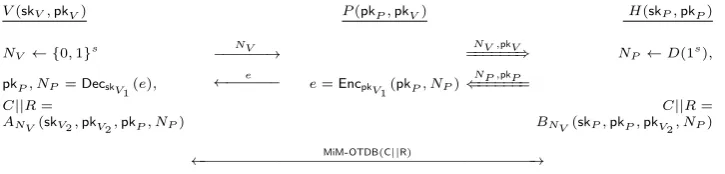
Fig. 6.Full-pkDB2H. Double arrow shows the communication withH.
MiM-OTDB on current Eff-pkDBp as a symmetric DB because MiM-OTDB does not fulfill the assumption. Hence, we modify Eff-pkDBp so that one time MiM-security is enough. In this way, we are able to use MiM-OTDB as a symmetric DB which does not require any computation.
We slightly change the verifier algorithm of Eff-pkDBp and convert Eff-pkDBp into SHM. We call this new version in SHM as Full-pkDB2H (in Fig-ure 6). The description of Full-pkDB2H is as follows: The verifier V has the secret/public key pair (skV,pkV) = ((skV1, skV2),(pkV1,pkV2)) which has two parts where the first part is generated from the key generation algorithm of an encryption scheme and the second part is generated by GenV.H has the input (skP,pkP) generated by GenP. The input of P is (pkP,pkV). First, V picks a nonce NV from {0,1}s and sends it to P. Then, P relays it to H. Similarly,
H picks NP from the distributionD(1s) and gives it P. P encrypts NP and pkP with pkV1. Then, P sends the encryption e to V. V decrypts it with skV and learnsNP,pkP. H andV run the algorithmsBNV(skP,pkP,pkV2, NP) and
ANV(skV2,pkV2,pkP, NP) which outputC||R, respectively. In the end, they run MiM-OTDB usingC||R as a secret key.
The conversion of Full-pkDB2H into PM is called as “our variant of Eff-pkDBp”. In this variant, the prover algorithm is PH(skP,pkP) where P and H are from Full-pkDB2H. The difference between the verifier algorithms of Eff-pkDBp [19] and our variant of Eff-pkDBp is the following: In Eff-pkDBp,V does not select any nonce (equivalently, we can say that NV is a constant) and the algorithms ANV and BNV generate a one-time secret key to run a symmetric DB protocol. Remember that we do this change in the verifier algorithm of Eff-pkDBp to increase its efficiency in SHM since we can use MiM-OTDB with this version.
Theorem 9 (Security of Full-pkDB2H). If the key agreement protocol (GenV,GenP, ANV, BNV, D) is D-AKA secure [19] (Appendix C) for all fixed
NV ∈ {0,1}s and MiM-OTDB isone time MiM-secure then Full-pkDB2H is
secure in SHM.
PM. Actually,DB is our variant of Eff-pkDB. Using Theorem 2, Full-pkDB2H is secure because our variant of EffpkDB is MiM-secure assuming that the key agreement protocol (GenV,GenP, ANV, BNV, D) is D-AKA secure for all fixed
NV ∈ {0,1}s and MiM-OTDB is one time MiM-secure. The MiM security proof of our variant of Eff-pkDB is in Appendix A.
u t
Full-pkDB2H achieves almost optimal security bounds because MiM-security of our variant of Eff-pkDB is reduced to MiM-security of MiM-OTDB.
We see that Full-pkDB2H is secure without encryption. Actually, the en-cryption is used for achieving privacy. So, if privacy is not a concern, we can use Full-pkDB2H without the encryption and decryption.
Theorem 10 (Strong privacy of Full-pkDB2H). Assuming that the
key-agreement protocol (GenV,GenP, ANV, BNV, D) is D-AKAp secure [19]
(Ap-pendix C) for all fixedNV ∈ {0,1}n and the crypto system is IND-CCA secure,
Full-pkDB2H is strong private in SHM.
Proof. We first show that our variant of Eff-pkDBp is strong private in PM. Actually, the strong privacy proof of our variant of Eff-pkDBp is the same with the proof of Eff-pkDBp (Theorem 7 of [19]) where first it reduces the privacy game to the game where all the encryptions are random (the reduction showed by using IND-CCA security) and then reduces to the game where the provers use a random secret and public key pair with BNV (the reduction showed by using D-AKAp). Because of the equivalence of strong privacy of a DB in SHM and its conversion in PM, we can conclude that Full-pkDB2H is strong private. ut The prover algorithms of Full-pkDB1H and Full-pkDB2H are notPdum, but it can be easily seen from the proofs of Theorem 6 and Theorem 9 that the computations in these algorithms do not have any effect on the security (i.e., the security of Full-pkDB1Hand Full-pkDB1Hdo not need any security assumptions on the encryption scheme with (Enc0,Dec0) which is used by P.)
5
Conclusion
We constructed a new only MiM-secure symmetric key DB in PM called MiM-symDB. It achieves optimal security bounds and it is the most efficient DB achieving this. We did not need to achieve other security models with MiM-symDB because MiM-security is enough to have a secure DB protocol in SHM by usingPdum. In addition, we constructed another symmetric DB protocol MiM-OTDB. It is MiM-secure when it is run at most one time. It does not require any computation, so it is the most efficient one.
We also considered public key DB protocols in SHM. For this, we derived protocols Full-pkDB1Hand Full-pkDB2H from Eff-pkDBp and Simp-pkDB [19], respectively. Full-pkDB1H was constructed through some modifications on Eff-pkDBpto be able to use computation free sub-protocol MiM-OTDB. We formally proved that Full-pkDB1H is strong private and secure in SHM. By adding one extra encryption, we added privacy to Simp-pkDB and constructed Full-pkDB2H from its private version. We proved Full-pkDB2H is semi-strong private and secure in SHM.
Compared to the previous models [1, 13, 5] which do not have any practical and secure solution against all the threats, SHM lets us construct more efficient protocols while achieving thehighest security.
References
1. G. Avoine, M. A. Bing¨ol, S. Karda¸s, C. Lauradoux, and B. Martin. A formal framework for analyzing RFID distance bounding protocols. Journal of Computer Security–Special Issue on RFID System Security, 2010.
2. G. Avoine, X. Bultel, S. Gambs, D. G´erault, P. Lafourcade, C. Onete, and J.-M. Robert. A terrorist-fraud resistant and extractor-free anonymous distance-bounding protocol. InProceedings of the 2017 ACM on Asia Conference on Com-puter and Communications Security, pages 800–814. ACM, 2017.
3. M. Bellare, A. Boldyreva, A. Desai, and D. Pointcheval. Key-privacy in public-key encryption. InASIACRYPT 2001, pages 566–582. Springer, 2001.
4. I. Boureanu, A. Mitrokotsa, and S. Vaudenay. Secure and lightweight distance-bounding. In Lightweight Cryptography for Security and Privacy, LNCS 8162, pages 97–113. Springer, 2013.
5. I. Boureanu and S. Vaudenay. Optimal proximity proofs. InInscrypt, LNCS 8957, pages 170–190. Springer, 2014.
6. S. Brands and D. Chaum. Distance-bounding protocols (extended abstract). In
EUROCRYPT, LNCS 765, pages 344–359. Springer-Verlag, 1993.
7. X. Bultel, S. Gambs, D. G´erault, P. Lafourcade, C. Onete, and J.-M. Robert. A prover-anonymous and terrorist-fraud resistant distance-bounding protocol. In
Proceedings of the 9th ACM Conference on Security & Privacy in Wireless and Mobile Networks, pages 121–133. ACM, 2016.
8. L. Bussard and W. Bagga. Distance-bounding proof of knowledge to avoid real-time attacks. InSecurity and Privacy in the Age of Ubiquitous Computing, IFIP Advances in Information and Communication Technology Volume 181, pages 223– 238. Springer, 2005.
10. S. Capkun, L. Buttyan, and J.-P. Hubaux. Sector: secure tracking of node encoun-ters in multi-hop wireless networks. InIn ACM Workshop on Security of Ad Hoc and Sensor Networks (SASN), pages 21–32, 2003.
11. C. Cremers, K. B. Rasmussen, B. Schmidt, and S. Capkun. Distance hijacking attacks on distance bounding protocols. InSecurity and Privacy (SP), 2012 IEEE Symposium on, pages 113–127. IEEE, 2012.
12. Y. Desmedt. Major security problems with the “unforgeable” (Feige-) Fiat-Shamir proofs of identity and how to overcome them. In Congress on Computer and Communication Security and Protection Securicom, pages 147–159. SEDEP Paris France, 1988.
13. U. D¨urholz, M. Fischlin, M. Kasper, and C. Onete. A formal approach to distance-bounding RFID protocols. InInformation Security, pages 47–62. Springer, 2011. 14. M. Fischlin and C. Onete. Terrorism in distance bounding: modeling terrorist-fraud
resistance. InApplied Cryptography and Network Security, LNCS 7954, pages 414– 431. Springer, 2013.
15. G. P. Hancke. A practical relay attack on iso 14443 proximity cards. Technical report, University of Cambridge Computer Laboratory, 59:382–385, 2005.
16. J. Hermans, A. Pashalidis, F. Vercauteren, and B. Preneel. A new RFID privacy model. InESORICS, LNCS 6879, pages 568–587. Springer, 2011.
17. J. Hermans, R. Peeters, and C. Onete. Efficient, secure, private distance bounding without key updates. In WiSec, Proceedings of the Sixth ACM Conference on Security and Privacy in Wireless and Mobile Networks, pages 207–218, 2013. 18. H. Kılın¸c and S. Vaudenay. Optimal proximity proofs revisited. InACNS, pages
478–494. Springer, 2015.
19. H. Kılın¸c and S. Vaudenay. Efficient public-key distance bounding protocol. In
Asiacrypt, 2016.
20. C. H. Kim, G. Avoine, F. Koeune, F.-X. Standaert, and O. Pereira. The swiss-knife RFID distance bounding protocol. InInformation Security and Cryptology–ICISC 2008, pages 98–115. Springer, 2008.
21. T. Okamoto and D. Pointcheval. The gap-problems: A new class of problems for the security of cryptographic schemes. InPublic Key Cryptography, pages 104–118. Springer, 2001.
22. J. Reid, J. M. G. Nieto, T. Tang, and B. Senadji. Detecting relay attacks with timing-based protocols. InProceedings of the 2nd ACM symposium on Information, computer and communications security, pages 204–213. ACM, 2007.
23. D. Singelee and B. Preneel. Location verification using secure distance bounding protocols. InMobile Adhoc and Sensor Systems Conference, 2005. IEEE Interna-tional Conference on, pages 7–pp. IEEE, 2005.
24. D. Singel´ee and B. Preneel. Distance bounding in noisy environments. InSecurity and Privacy in Ad-hoc and Sensor Networks, LNCS 4572, pages 101–115. Springer, 2007.
25. S. Vaudenay. On modeling terrorist frauds. In Provable Security, LNCS 8209, pages 1–20. Springer, 2013.
26. S. Vaudenay. On privacy for RFID. In Provable Security, pages 3–20. Springer, 2015.
27. S. Vaudenay. Private and secure public-key distance bounding application to NFC payment. InFC, LNCS 8975, 2015.
A
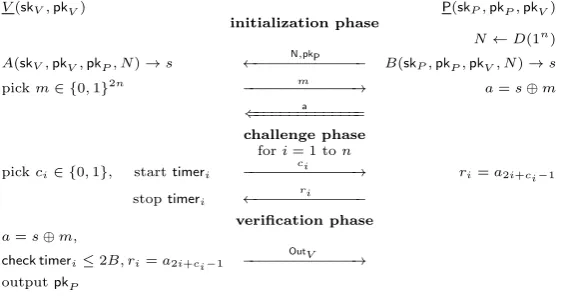
DH-secure but not MiM-secure DB protocol
V(skV,pkV) P(skP,pkP,pkV)
initialization phase
N←D(1n) A(skV,pkV,pkP, N)→s
N,pkP
←−−−−−−−−−−−−− B(skP,pkP,pkV, N)→s
pickm∈ {0,1}2n m
−−−−−−−−−−−−−→ a=s⊕m
a
⇐=============
challenge phase
fori= 1 ton
pickci∈ {0,1}, starttimeri −−−−−−−−−−−−−→ci ri=a2i+ci−1
stoptimeri ←−−−−−−−−−−−−−ri
verification phase
a=s⊕m,
check timeri≤2B, ri=a2i+ci−1
OutV
−−−−−−−−−−−−−→ outputpkP
Fig. 7.An example DB protocol in PM which is DH-secure but not MiM-secure
We modify the Eff-pkDB protocol [19] as in Figure 7. We let the prover send the secretabefore challenge phase. The rest is the same.
This protocol is still DH-secure because of the following proof sketch: Eff-pkDB is DH secure as shown in [19]. In the proof, it has been shown that the secret s1 generated by P0 (close and honest) is independent from s generated
by malicious P. It shows that P does not know anything about s1 just after it is generated before a1 is released. When we consider modified Eff-pkDB, we observe that even ifP sendsmhimself,athatP has anda1 thatP0 has will be
independent. Therefore, with the same arguments of DH-proof of Eff-pkDB, we can show that modified Eff-pkDB is DH secure.
On the other hand, it is not MiM secure because an adversary knows the responses beforehand.
When we convert it to SHM where P behaves as Pdum, we have the same security properties as well.
B
Optimal Security in DB
In this section, we shortly overview the optimal security bounds of a DB in PM given by Boureanu and Vaudenay [5]. A security bound of a DB means an upper bound of the success probability of an adversary.
matching the advantage of the generic attacks Pre-ask and Post-ask (defined below).
Definition 6 (Common Structure [5]).A DB protocol(K, V, P, B)based on common structure with parameters (nc, nr, n) consists of three phases which are
‘initialization phase’, ‘verification phase’ and between them ‘challenge phase’. Here, nc is the cardinality of challenge set,nr is the cardinality of the response
set andnis the number of rounds in the challenge phase. In the challenge phase, the verifier sends challenges to the prover and receives responses from the prover. Here, the verifier measures the elapsed time between sending the challenge and receiving the response in each round. Time is not used otherwise. If the elapsed time is less than what needed for information to travel in a distance 2B 6, the response is called “on time”. In the end of the verification phase, if each response is correct and “on time”, the verifier outputs Out = 1. Otherwise, it outputs
OutV = 0.
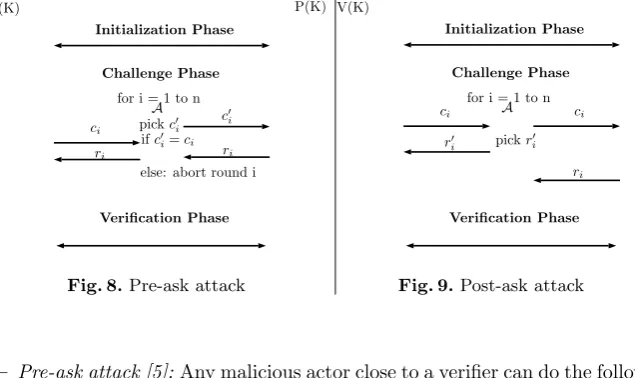
There exist some unpreventable MiM-attacks which are independent of any DB protocol using the common structure: pre-ask attack and post-ask attack [5]. The optimal security bounds of MiM were found [5] by showing these attacks are optimal.
Both in pre-ask (Figure 8) and post-ask (Figure 9), the malicious actor relays the messages between the prover and the verifier in the initialization and the verification phase. In challenge phase, it does the following:
pickc′
i
A for i = 1 to n
ri
Initialization Phase
Challenge Phase
Verification Phase
V(K) P(K)
ci
c′
i
ri
ifc′
i=ci
else: abort round i
Fig. 8.Pre-ask attack
pickr′
i
A for i = 1 to n
r′
i
Initialization Phase
Challenge Phase
Verification Phase
V(K) P(K)
ci ci
ri
Fig. 9.Post-ask attack
– Pre-ask attack [5]:Any malicious actor close to a verifier can do the following in each roundiof the challenge phase: Before receiving a challengeci from the verifier, he guesses it and sends the guessed challenge c0
i to the far-away prover. He does it early enough to receive a corresponding response
r0
i from the prover on time. Meanwhile, the malicious actor receives the
6
challengeci from the verifier. Ifci=c0i, then the malicious actor just relays
ri = r0i. Otherwise, he may not pass the round i, especially if P and V authenticate the challenges during the verification phase. The probability that the adversary passes the roundiis 1
nc. So, the overall success probability in the challenge phase of the adversary is (1
nc) n.
– Post-ask attack [5]: Any adversary close to a verifier can do the following in each roundi of the challenge phase: He receives a challengeci from the verifier. Then, he picks a random responseri0 and sends it to the verifier. At the same time, he forwardscito the prover. The adversary succeeds to pass the round i with the probability 1
nr. So, the overall success probability in the challenge phase of the adversary is (1
nr) n.
As a result, the optimal security bound of MiM-security is max(( 1
nr)
n,( 1
nc)
n). It means that a adversary cannot win
MiM-security game with probability more than the optimal MiM-security bound. Since the same attacks apply to a DB protocol in SHM, we have the same bounds in SHM as well.
C
MiM-security Proof of Our Variant of Eff-pkDB
Before giving the security proof of Full-pkDB1H, we briefly explain D-AKA (Decisional Authenticated Key Agreement) game which is defined in [19] for a key agreement protocol with the algorithms (GenV,GenP, ANV, BNV, D). The definition of D-AKA is recalled in Appendix C. Informally, in the D-AKA security game, the adversary has access to oracles that run the algorithms
ANV(skV,pkV, ., .) and BNV(skP,pkp, ., .) and tries to guess if the given secret by the challenger is generated by the algorithms or selected randomly.
Definition 7 ((D-AKA) security).
OA(., .) :
returnA(skA,pkA, ., .)
OB(.) :
N0←D(1n)
s0←B(skB,pkB, ., N0)
returns0, N0
Givenb∈ {0,1} and the oraclesOA(., .),OB(.), the game KAdb,−Aaka(n) is: 1. Challenger executes
GenA(1n)→(skA,pk A), GenB(1n)
→(skB,pkB),
OB(pkA)→(s0, N)
and pickss1∈ {0,1}n. Then, he sendss
b, N,pkB,pkA to the adversaryA.
2. A has access to the oracle OB(.) and OA(., .) under the condition of not querying the oracleOA with the input(pkB, N). Eventually,A outputsb0.
3. The advantage of the game is
Adv(KA1d−,Aaka(n)) =Pr[KAd0,−Aaka(n)= 1]−Pr[KAd1−,Aaka(n)= 1].
A KA protocol (GenA(1n),GenB(1n), D, A, B) is D-AKA secure if for all PPT
Definition 8 (D-AKAp privacy). Given b
∈ {0,1} and the oracle OA(., .)
(defined in Definition 7), the game KAdb,−Aaka(n)p is:
1. Challenger runs
GenA(1n)
→(skA,pkA), GenB(1n)
→(skB1,pkB1)
and givespkA,pkB1 andskB1 toA.
2. AselectsskB0 andpkB0 and sends them to the challenger. 3. Challenger executes
D(1n)→N,
B(skBb,pkBb,pk
skBb
A , N)→s.
Then, he sendss to the adversary A.
4. A has access to the oracle OA. Eventually, A outputs b0. (Remark that A
does not knowN.)
5. The advantage of the game is
Adv(KAd1,−Aaka(n)p) =Pr[KA0d−,Aaka(n)p= 1]−Pr[KAd1,−Aaka(n)p= 1].
A KA protocol (GenA(1n),GenB(1n), D, A, B) is D-AKAp private if for all
PPT algorithms A,Adv(KAdb,−Aaka(n)p)is negligible.
As an example D-AKAp and D-AKA secure key agreement protocol (GenV,GenP, ANV, BNV, D), we can give Nonce-DH [19] protocol. GenP resp. GenV generate a secret/public keys: secret keys are skP resp. skV which are in a prime order group G and public keys are pkP = gskP resp. pkV = gskV where g is a generator in G. The algorithm A
NV corresponds to H(g,pkP,pkV,pkskV
P , NP||NV) and the algorithm BNV corresponds to
H(g,pkP,pkV,pkskP
V , NP||NV). Under the Gap Diffie-Hellman assumption [21] and in the random oracle model, Nonce-DH is D-AKA and D-AKAp [19].
V(skV,pkV) P(pkP,pkV)
NV ← {0,1}s
NV
−−−−−−−−−−−−−−−−−−−−−−−−−−−−−−−−→ NP←D(1s), NP ,pkP
←−−−−−−−−−−−−−−−−−−−−−−−−−−−−−−−−
C||R= C||R=
ANV(skV,pkV,pkP, NP) BNV(skP,pkP,pkV, NP)
MiM-OTDB(C||R)
←−−−−−−−−−−−−−−−−−−−−−−−−−−−−−−−→
outputpkP
Fig. 10.Our variant of Eff-pkDB. Modified parts are shown bold.
Theorem 11. If the key agreement protocol (GenV,GenP, ANV, BNV, D) is
D-AKA secure (Appendix C) for all fixed NV ∈ {0,1}s and MiM-OTDB is one
time MiM-secure then our variant of Eff-pkDB is MiM-secure in PM.
Proof. Γ0
0 : The adversary plays MiM-game of our variant of Eff-pkDB in PM
with the prover instances and the verifier instances where one of them is the distinguished verifierV.
Γ0
1: We reduceΓ00 to the gameΓ10 where at most one prover instance andV
see the same pair (NP, NV). Because of the D-AKA security,D(1s) guarantees that the repetition of NP is negligible, andNV is picked randomly. So,p01−p00
is negligible.
Γ20 : We reduce Γ10 to the gameΓ20. In Γ20, we simulate all prover instances
receiving the nonceNV from V by picking a randomC||R instead of generating
C||R from the algorithmBNV. We simulateV receivingNP by using randomly pickedC||R. With the D-AKA assumption, we can show thatp02−p01is negligible
[19].
Now, we have at most one distinguished pairV and P which see (NV, NP) and they share a random secretC||R. Therefore, we are in one time MiM-game of MiM-OTDB. Since it is one time MiM-secure,p0
2 is negligible.
We deduce that our variant of Eff-pkDB is MiM-secure becausep0
0 is