© 2014, IJCSMC All Rights Reserved
462
Available Online atwww.ijcsmc.comInternational Journal of Computer Science and Mobile Computing
A Monthly Journal of Computer Science and Information Technology
ISSN 2320–088X
IJCSMC, Vol. 3, Issue. 3, March 2014, pg.462 – 469
RESEARCH ARTICLE
Design of Router Micro Architecture Based on
Runtime Adaptive Selection Strategies for On-Chip
Communication Interconnection Network
1
Ms. Aryadevi S,
2Mr. T Shanmuganathan
¹PG Scholar, Department of Electronics and Communication Engineering,
Hindustan University, Chennai, Tamil Nadu, India
²Assistant Professor, Department of Electronics and Communication Engineering, Hindustan University, Chennai, Tamil Nadu, India
1
[email protected]; 2 [email protected]
Abstract—To meet the growing computation-intensive applications and the needs of low-power, high- performance systems, and the number of computing resources in single-chip has enormously increased, because current VLSI technology can support such an extensive integration of transistors. This paper presents adaptive routing selection strategies suitable for network-on-chip (NoC). The main prototype presented in this paper use west first routing algorithm to make routing decision at runtime during application execution time. Messages in the NoC are switched with a wormhole cut-through switching method, where different messages can be interleaved at flit-level in the same communication link without using virtual channels. Hence, the head-of-line blocking problem can be solved effectively and efficiently.
Keywords— Network on Chip; Router; Adaptive Routing; VLSI; West First Routing
1. INTRODUCTION
For many-core processor systems, Network-on-Chip (NoC) is a feasible communication infrastructure because of the
scalable bandwidth capacity of the NoC. There are many research challenges in the field of many-core processor systems
starting from abstract application layer until physical network layer. In the network layer, optimum network and router
architecture design in terms of cost (logic area, power, etc.) as well as its performance issues (network bandwidth capacity,
router latency, etc.) are the challenging topics. In addition, many current System-on-Chips (SOCs) use a system bus to connect
several functional units. SOC technologies are the packaging of all the necessary electronic circuits and parts for a "system" on
a single integrated circuit, generally known as a microchip.
However, these SOC system buses can support only limited number of functional units, and thus will face scaling
© 2014, IJCSMC All Rights Reserved
463
many studies suggested the use of a packet based communication network which is known as Network-on-Chip (NoC). There
arethree main building blocks of the NoC. The first and most important one are the links that physically connect the nodes and
actually implement the communication. The second block is the router, which implements the communication protocol. The last
building block is the network adapter (NA) or network interface (NI).This block make a logic connection between the IP cores
and the network, since each IP may have a distinct interface protocol with respect to the network.
The, routing major impact of the routing algorithm would be on area and the network performance. The routing
algorithm, generally can be made in deterministic (static) or adaptive manner. Network designers are motivated to design
adaptive routing algorithms because of two main objectives, i.e., to avoid entering hotspot links such that communication
performance can be increased, and to avoid entering faulty network components.The adaptive routing algorithms have the main
issue of deadlock configuration problem due to cyclic dependency. Turn models can be principally used to design a
deadlock-free adaptive routing algorithm. Most of routing implementations made at design time use routing tables to route messages
(packets). The contents of the routing tables are programmed at design time, and then adaptive routing paths are assigned in
every routing table in the network nodes by using some technique.
Most of routing implementations made at design time using routing tables to route messages (packets). The contents of
the routing tables are programmed at design time, and then adaptive routing paths are assigned in every routing table in the
network nodes by using some technique. An offline routing method called “Application Specific Routing Algorithm” is used to
increase the degree of routing adaptivity for hotspot avoidance. The “Segment-based Routing” (SR) which is also an offline
routing method, in which the network is segmented into some subnets and restrictions are applied to avoid deadlock
configurations. Another method is the dynamic routing protocol is used for balancing distribution of traffic in NoCs.
In lookup-table-based routing algorithms, the size of the tables will increase as the network size increases, since all
entries must be added in the tables. So, different techniques were used to reduce the size of the routing tables. A region-based
routing algorithm aimed at reducing the size of routing tables for NoCs by grouping destination network into network regions.
The proposed methodology can be implicitly viewed also as a technique to design a router using West First Algorithm in 2D
mesh . Our methodology can be classified into runtime distributed routing approach, where the routing is made locally in every
NoC router at runtime during application execution time.
2. ROUTING ALGORITHMS AND SELECTION STRATEGIES
The routing algorithm determines the path that each packet follows between a source-destination pair. Routing is
deterministic if only one path is provided, or adaptive if several paths are available and dynamically selected at switches.
Generally, an adaptive routing algorithm is preferable since it has the potential of achieving higher performance (low latency, high throughput, and fault tolerance). Routing strategies can also be classified as source or distributed. In source routing, the
source node stores the entire path in the packet header. Since the header itself must be transmitted through the network, it
reduces the effective network bandwidth (especially with short packets). In distributed routing, the packet header contains the
address of the destination. Each switch computes the next link that will be used while the packet travels across the network. Distributed routing is preferred for NoCs as the packet header is reduced and more flexibility and adaptivity can be achieved.
© 2014, IJCSMC All Rights Reserved
464
The first method is called algorithmic routing and is suitable for on-chip and off-chip networks with regular topologies. In this method, a finite-state machine (FSM) is used for computing the routing option as a function of the current and destination
node addresses along with possibly other information like status of output ports, network traffic, packet priority, etc. The implementation is very efficient in both area and speed, but it is topology and routing algorithm dependent. The second method uses a table which stores the output ports that should be used for each destination end node. The main advantage of this
approach is that the same generic design can be reused for implementing any network topology and routing algorithm. It is also
much easier to incorporate fault tolerance with this approach as compared to the algorithmic approach.
3. EXISTING METHOD
In the existing method, we are using a wormhole cut-through switching method, where messages are interleaved at the
flit level rather than at packet level. Hence, single message can be associated as single packet, which consists of single header
flits, payload data flits and single tail flit header and tail flit, and it is not divided into packets. A single flit has 39-bit width, 32
bits for dataword plus 9 extra bits, i.e., 3-bit field to define the type of flits and 4-bit field to determine the local identity label or
ID-tag k of a message.Fig. 1 shows a 2D mesh-planar topology, where the NoC is divided into two subnets, i.e., (increment) subnetwork depicted in solid lines and (decrement) subnetwork depicted in dashed lines. If a target node offset of a packet is
0, then the packet will be routed through the subnetwork, while if its target node offset is , then it will be routed through the subnetwork. Once a packet is routed to a subnetwork, it will not move to
another subnet. By using such routing rule, the minimal planar adaptive routing algorithm will be free from a cyclic dependency.
Figure 1: Possible Adaptive Routing
3.1 ADAPTIVE ROUTING SELECTION FUNCTIONS
Five router implementations based on information that are considered to make routing decision and based on the view
© 2014, IJCSMC All Rights Reserved
465
Identity (ID) slot occupancy (the number of free ID slots). This information can be called also as Contention
Information of an output port, i.e., the number of messages that have competed so far to access the output port. Since
our router can interleave different wormhole messages at flit-level in the same link without using VCs, then the
number of reserved ID slots will represent the number of the wormhole messages that have been mixed in the outgoing
link.
BW space occupancy (the number of free BW space). This information can be called also as BW-Reservation
Information of an output port, i.e., the number of BW spaces that have been reserved by messages to access the output
port.
Buffer space occupancy (the number of data queue in a FIFO buffer). This information can be called also as CI of an
output port, i.e., the queue length in the FIFO buffer at the input port of the next neighbour switch connected directly
to the output port.
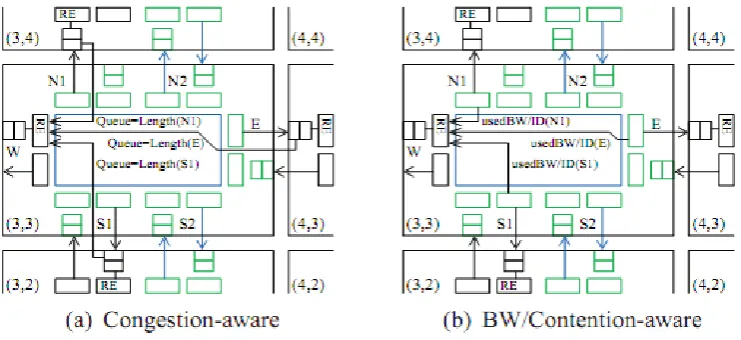
In Fig. 2.a, congestion aware routing is shown, where messages are routed to an output direction having less utilized buffer
spaces. The BW-ID prototype that uses two information signals to make routing decisions. The first prioritized signal is the
number of the reserved bandwidth spaces, and the second one is the number of used ID slots (ID slot occupancy). This adaptive
routing strategy can be called as a Contention and BWA Adaptive Routing Selection Strategy, is shown in Fig.2.b. Messages are
routed to an output direction having less reserved bandwidth spaces. If the numbers of the reserved BW spaces between two
output ports are equal, then the second prioritized signal is used, i.e., the number of reserved ID slots. When the numbers of the
reserved BW spaces between the alternative output ports are equal, the messages are then routed to an output direction having
less reserved ID slots.
Figure 2: Alternative information that can be used to make adaptive output routing selection.
3.2 ROUTING ARCHITECTUTRE
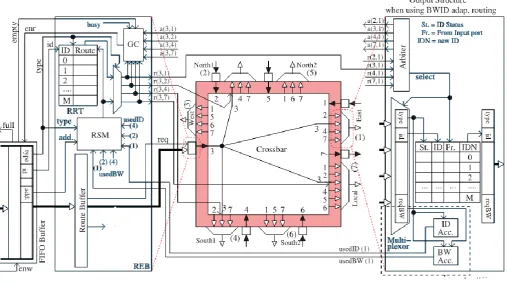
The microarchitectures of the NoC router that uses the CBWA adaptive routing and the CCA adaptive routing selection
© 2014, IJCSMC All Rights Reserved
466
depicted. The router is designed based on a 2D mesh-planar topology, where each router has seven IO ports, i.e., East, North1,
North2, West, South1, South2 and Local ports. Crossbar interconnect is customized to optimize the logic area of the router
based on the allowed turns in the 2D planar adaptive routing algorithm. The rest router internal IO connections representing the
prohibited turns are removed from the architecture.
Figure 3: Router Architecture
Set of components at each input and output ports n is the FIFO buffer, the Routing Engine with Data Buffering (REB),
the Multiplexor with ID Management unit (MIM) and the Arbiter unit. Based on the crossbar interconnects shown in Fig. 5, the
each port name is assigned to a port number as follows: East (1), North (2), West (3), South (4), North2 (5), South2 (6), and
Local (7).Set of subcomponents in the REB module at output port n are the Routing State Machine (RSM), the Route Buffer,
the RRT and Grant Controller (GC). In the REB unit, the combination of the RSM, in which the planar adaptive routing
algorithm is implemented, and the RRT is implemented to support runtime adaptive routing mechanism. The GC unit is used to
control the read operation of the FIFO Buffer, and the Route Buffer is used to store data that will be routed to an output port.
4. PROPOSED METHOD
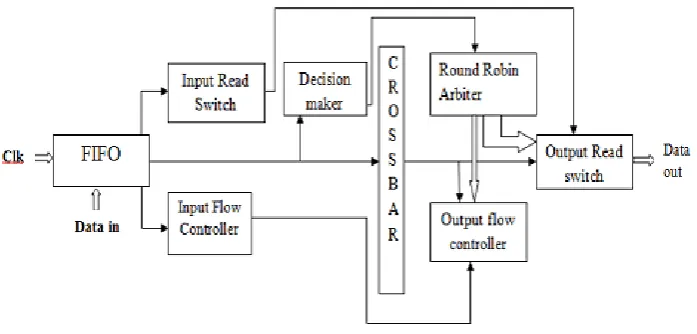
In the proposed method, deadlock free West first routing algorithm is applied to a 2D mesh topology and a wormhole
switching method is used along with data link layer flow control.The proposed router is shown in figure
.
Router is having fiveports east, west, north, south and local port. Each port is having its input and output channel, and each input and output channel
© 2014, IJCSMC All Rights Reserved
467
channel consists of three parts i.e. FIFO, FSM, and West First routing logic. The FIFO here is used as input buffer to store the
data temporarily. It is of 8 bits size and is of depth 16 bits. The first 8 bits of FIFO is header containing the coordinates of
destination port, thus the size of packet varies from 8 to 120 bits. FSM is used to control the read and write operation of FIFO,
according to status. If FIFO is empty, FSM generates the signal to perform the write operation and if FIFO is full, FSM
generates signal to perform the read operation.
Figure 4: Router for Proposed Method
West First Routing logic is the adaptive minimal logic which analyses the header of packet to find out its destination
address. West First logic compares the coordinates values stored in header with the locally stored coordinates values and send
the data to its destination port. Similarly the output channel consists of three parts i.e. FIFO, FSM and arbiter. The FIFO here is
used as output buffer to store the data temporarily. It is of 8 bits size and is of depth 16 bits the 8 bits are the header, thus the
packet size varies from 8 bits to 120 bits. FSM is used to control the read and write operation of FIFO according to its status. If
FIFO is empty, FSM generates signal to perform write operation and if FIFO is full FSM generates signal to perform read
operation. Arbiter is used in output channel to overcome the problem of multiple input requests coming at single output port.
Arbiter is based on rotating priority scheme in which each port get reduced its priority once it has been served.
The mesh based router consists of multi ports such as east, west, north, south and local port. It also has a central cross
point matrix. Inside each port there are two channels input and output. Data packet is sent from one port moves in to the input
channel of router by which it is forwarded to the output channel of the other port. Each input channel and output channel has its
own decoding logic which increases the performance of the router. Buffers are used at all ports to store the data for a short time
span. The store and forward method is used here for data transmission. Control logic is present to make decisions to grant access
to a port request. In this way communication is established between input and output ports. The transfer of data from source to
destination is called packet switching mechanism where the flit size is 8 bits. In router structural modelling is used in which
input channel of all 5 ports, output channel of all 5 ports and cross point matrix is used as component to form complete router.
The input signals here are five data input signals; five requests signals, and five acknowledgement signals. The output signals
are five data output signals, five acknowledgement signals and five request signals. The port mapping of each component is
© 2014, IJCSMC All Rights Reserved
468
5. RESULT AND OBSERVATION
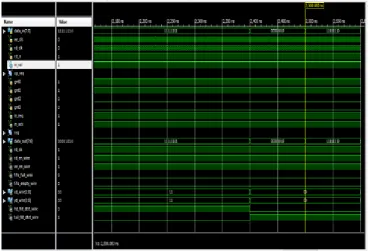
Two router architectures are implemented in Verilog and then synthesized in a Xilinx 13.1. Router design is simulated in ISIM
13.1. Synthesis process converts user’s hardware description into structural logic description. Figure 7 represents the synthesis
of input channel using west first algorithm, Figure 8 represents the synthesis of output channel.
Figure 6: Simulation waveformof input channel
© 2014, IJCSMC All Rights Reserved
469
6. CONCLUSION
In this paper, router architecture using west first algorithm is implemented using HDL called Verilog at RTL level.
Architecture is synthesized using Xilinx and simulated using ISIM 13.3 for evaluating latency and delay of two routers. The
simulation results show that there is reduced latency when using west first algorithm. Network on chip presents a most adapted
technology to perform communication in complex SoCs. In this work, we present a west first routing algorithm related router
which offers a low latency 1 clock cycles and high speed 216 MHz communication for on chip modules. This architecture offers
a variety of SoC communication services owing to its flexibility and adaptability.
REFERENCES
[1] J. Duato, “A New Theory of Deadlock-Free Adaptive Routing in Wormhole Networks,” IEEE Trans. Parallel and Distributed Systems, vol. 4, no. 12, pp. 1320-1331, Dec. 1993.
[2] T.T. Ye, L.Benini, and G. De Micheli, “Packetization and Routing Analysis of On-Chip Multiprocessor Networks,” J.System Architecture, vol. 50, nos. 2/3, pp. 81-104, 2004.
[3] M.K.F. Schafer, T.Hollstein, H.Zimmer, and M. Glesner, “Deadlock-Free Routing and Component Placement for Irregular Mesh-based Network-on-Chip,” Proc. IEEE/ACM Int’l Conf.Computer-Aided Design (ICCAD ’05), pp. 238-245, 2005.
[4] M.Li, Q.A.Zeng, and W.-B.Jone, “DyXY: A Proximity Congestion-Aware Deadlock-Free Dynamic Routing Method for Network on Chip,” Proc. 43rd Ann. Design Automation Conf. (DAC ’06), pp. 849-852, 2006.
[5] G. Ascia, V. Catania, M. Palesi, and D. Patti, “Implementation and Analysis of a New Selection Strategy for Adaptive Routing in NoC”, IEEE Trans. Computers, vol. 57, no. 6, pp. 809-820, June 2008.
[6] M. Palesi, R. Holsmark, S. Kumar, and V. Catania, “Application Specific Routing Algorithms for Networks on Chip,” IEEE Trans. Parallel and Distributed Systems, vol. 20, no. 3, pp. 316-330, Mar. 2009.
[7] F.A. Samman, T.Hollstein, and M.Glesner, “Adaptive and Deadlock-Free Tree-Based Multicast Routing for Networks-on-Chip,” IEEE Trans. Very Large Scale Integration Systems, vol. 18,no. 7, pp. 1067-1080, July 2010.