© 2014, IJCSMC All Rights Reserved 337
Available Online atwww.ijcsmc.com
International Journal of Computer Science and Mobile Computing
A Monthly Journal of Computer Science and Information Technology
ISSN 2320–088X
IJCSMC, Vol. 3, Issue. 2, February 2014, pg.337 – 342
RESEARCH ARTICLE
FACE RECOGNITION BASED
ATTENDANCE MARKING SYSTEM
K.Senthamil Selvi
1, P.Chitrakala
2, A.Antony Jenitha
31
M. Tech Scholar, Department of Information and Technology, Hindustan University, Chennai, Tamilnadu, India
2
Assistant Professor, Department of Information and Technology, Hindustan University, Chennai, Tamilnadu, India
3
M. Tech Scholar, Department of Information and Technology, Hindustan University, Chennai, Tamilnadu, India
Abstract:
Automatic face recognition (AFR) technologies have seen dramatic improvements in
performance over the past years, and such systems are now widely used for security and
commercial applications. An automated system for human face recognition in a real time
background for a college to mark the attendance of their employees. So Smart Attendance
using Real Time Face Recognition is a real world solution which comes with day to day
activities of handling employees. The task is very difficult as the real time background
subtraction in an image is still a challenge (6). To detect real time human face are used and a
simple fast Principal Component Analysis has used to recognize the faces detected with a
high accuracy rate. The matched face is used to mark attendance of the employee.Our system
in logbooks becomes a difficult task and it also wastes the time. So we designed an efficient
module that comprises of face recognition to manage the attendance records of employees.
Our module enrols the staff’s face (3). This enrolling is a onetime process and their face will
be stored in the database. During enrolling of face we require a system since it is a onetime
process. You can have your own roll number as your employee id which will be unique for
each employee. The presence of each employee will be updated in a database. The results
showed improved performance over manual attendance management system. Attendance is
marked after employee identification. This product gives much more solutions with accurate
results in user interactive manner rather than existing attendance and leave management
systems.
1.
INTRODUCTIONMaintaining the attendance is very important in all the institutes for checking the
performance of employees (4). Every institute has its own method in this regard. Some are
taking attendance manually using the old paper or file based approach and some have adopted
methods of automatic attendance using some biometric techniques. But in these methods
employees have to wait for long time in making a queue at time they enter the office. Many
biometric systems are available but the key authentications are same is all the techniques.
Every biometric system consists of enrolment process in which unique features of a person is
stored in the database and then there are processes of identification and verification. These
two processes compare the biometric feature of a person with previously stored template
captured at the time of enrollment. Biometric templates can be of many types like
Fingerprints, Eye Iris, Face, Hand Geometry, Signature, Gait and voice. Our system uses the
face recognition approach for the automatic attendance of employees in the office room
environment without employees’ intervention (2). Face recognition consists of two steps, in
first step faces are detected in the image and then these detected faces are compared with the
database for verification. A number of methods have been proposed for face detection i.e.
Ada Boost algorithm, the Float Boost algorithm, the S-Ada Boost algorithm Support Vector
Machines (SVM), and the Bayes classifier. The efficiency of face recognition algorithm can
be increased with the fast face detection algorithm. In all the above methods SURF is most
efficient. Our system utilized this algorithm for the detection of faces in the office room
image. Face recognition techniques can be Divided into two types Appearance based which
© 2014, IJCSMC All Rights Reserved 339
based which uses geometric features like mouth, nose, eyes, eye brows, cheeks and Relation
between them. Statistical tools such as Linear Discriminant Analysis (LDA), Principal
Component Analysis (PCA), Kernel Methods, and Neural Networks, Eigen-faces have been
used for construction of face templates. Illumination invariant algorithm is utilized for
removing the lighting effect inside the office room.
2. SYSTEM DESCRIPTION
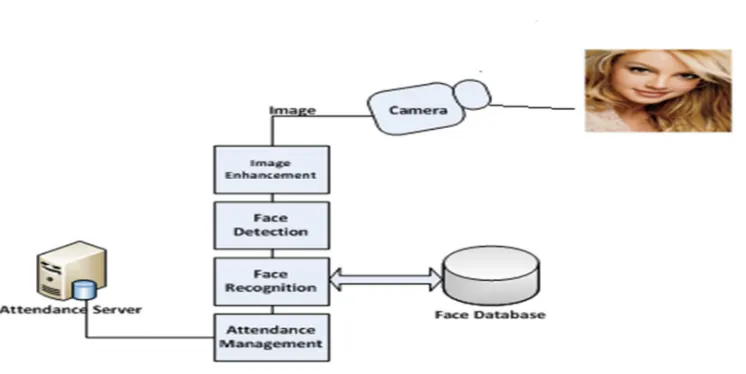
The system consists of a camera that captures the images of the employee and sends it to the
image enhancement module. After enhancement the image comes in the Face Detection and
Recognition modules and then the attendance is marked on the database server. This is shown
in the experimental setup in Figure(4). At the time of enrolment, templates of face images of
individual employees are stored in the Face database. Here all the faces are detected from the
input image and the algorithm compares them one by one with the face database.
If any face is recognized the attendance is marked on the server from where anyone can
access and use it for different purposes.
Fig. 1 Experimental Setup
In this way a lot of time is saved and this is highly secure process no one can mark
the attendance of other. Attendance is maintained on the server so anyone can access it for
we are using the skin classification technique. Using this technique enhance the efficiency
and accuracy of the detection process.
In this process first the skin is classified and then only skin pixels remains and all
other pixels in the image are set to black, this greatly enhance the accuracy of face detection
process. Two databases are displayed in the experimental setup. Face Database is the
collection of face images and extracted features at the time of enrolment process and the
second attendance database contains the information about the employees and also uses to
mark attendance.
2.1 Technical Requirements
2.1.1 Hardware Requirements
A standalone computer needs to be installed in the office room where the system is to
be deployed.
Camera must be positioned in the office room to obtain the snapshots. Optimum
Resolution: 512 by 512 pixels.
Secondary memory to store all the images and database
2.1.2 Software requirements
MATLAB Version 7.6(R2008a) or higher
Windows XP(Service Pack 2) or higher
2.1.3 Expenditure
The cost of the entire project will depend simply on the expenditure incurred for the
hardware requirements(5). The software requirements can be easily fulfilled without any cost.
Equipment: Cost:
Standalone PC : Rs. 30000/-
© 2014, IJCSMC All Rights Reserved 341
3. SYSTEM ALGORITHM
This section describes the software algorithm for the system.
The algorithm consists of the following steps
Image acquisition
Histogram normalization
Noise removal
Skin classification
Face detection
Face recognition
Attendance
In the first step image is captured from the camera. There are illumination effects in the
captured image because of different lighting conditions and some noise which is to be
removed before going to the next steps(1). Histogram normalization is used for contrast
enhancement in the spatial domain. Median filter is used for removal of noise in the image.
There are other techniques like FFT and low pass filter for noise removal and smoothing of
the images but median filter gives good results.
CONCLUSION
Automated Attendance System has been envisioned for the purpose of reducing the
errors that occur in the traditional (manual) attendance taking system. The aim is to automate
and make a system that is useful to the organization such as an institute. The efficient and
accurate method of attendance in the office environment that can replace the old manual
methods. This method is secure enough, reliable and available for use. No need for
specialized hardware for installing the system in the office. It can be constructed using a
camera and computer.
REFERENCES
[1]. W. Zhao, R. Chellappa, P. J. Phillips, and A. Rosenfeld,“Face recognition: A literature
survey,” ACM Computing Surveys, 2003, vol. 35, no. 4, pp. 399-458.
[2]. Herbert Bay, Andreas Ess, Tinne Tuytelaars, and Luc Van Gool. Surf: Speeded up robust
features. Computer Vision and Image Understanding (CVIU),110(3):346–359.
[3]. H.K.Ekenel and R.Stiefelhagen,Analysis of local appearance based face recognition: Effe
cts of feature selection and feature normalization. In CVPR Biometrics Workshop, New
York, USA, 2006
[4]. IJCSI International Journal of Computer Science Issues, Vol. 9, Issue 4, No 1, July 2012
ISSN (Online): 1694-0814
[5]. Javier Ruiz Del Solar, Rodrigo Verschae, and Mauricio Correa. Face recognition in
unconstrained environments: A comparative study. In ECCV Workshop on Faces in
Real-Life Images: Detection, Alignment, and Recognition, Marseille, France, October 2008.
[6]. Kyungnam Kim “Face Recognition using Principle Component Analysis”,
Department of Computer Science, University of Maryland, College Park, MD 20742, USA.
[7]. Osuna, E., Freund, R. and Girosit, F. (1997). "Training support vector machines: