Available Online atwww.ijcsmc.com
International Journal of Computer Science and Mobile Computing
A Monthly Journal of Computer Science and Information Technology
ISSN 2320–088X
IJCSMC, Vol. 3, Issue. 3, March 2014, pg.223 – 228
RESEARCH ARTICLE
Dynamic Data Aggregation Prediction
Based Clustering to Mobile Sink in
Wireless Sensor Networks
M.Suganthi
1, Mrs. Susmita Mishra
2¹Student, Department of Computer Science and Engineering, Rajalakshmi Engineering College, Chennai, India 2
Assistant Professor, Department of Computer Science and Engineering, Rajalakshmi Engineering College, Chennai, India 1
[email protected]; 2 [email protected]
Abstract-Wireless Sensor Networks is a fast leading technology which has showed up many opportunities in the field of data reporting and monitoring. It has a collection of sensor nodes which can report data to the base station. It increases energy consumption and traffic. So to avoid network traffic and to prolong network lifetime clustering scheme is used. Mobile sinks can easily move to the deployed area to reduce the data acquisition and gathering time. Therefore, an efficient clustering and prediction based routing protocol(EECPA) can be used to predict the mobile sink movement so as to minimize the energy consumption and to effectively transmit the aggregated data to the sink. Key terms: Wireless Sensor Network, Clustering, Prediction
I. INTRODUCTION
Wireless Sensor Networks (WSNs) are formed by hundreds or even thousands of sensor nodes that collect the information and forward it to the base-station or a sink. These large numbers of sensor nodes, which have the ability to communicate, sensing and data processing form the WSNs. A group of sensor nodes can be deployed over a region to monitor physical conditions like temperature, pressure, humidity etc. This information can be transmitted to the sink. Mobile sink move randomly serving as a sink in order to increase the network life-time. LEACH (Low Energy Adaptive Clustering Hierarchy) is the famous routing protocol which has been used as a basis for many clustering protocols. In LEACH, nodes form a group called clusters with one node acting as cluster head. This is to reduce communication overhead and to setup the routing path within the cluster. It can also prolong the battery life of sensor nodes so as to increase the network life-time. All other nodes are member nodes (normal nodes).These member nodes send their data to Cluster Heads. Cluster Head do some data fusion function and transmit the data to base station.
Design Issues:
Energy Consumption: Sensor nodes have very limited energy and they use their energy for communication, sensing and transmission, so energy conservation is an important issue in WSNs. In many scenarios, the sensor nodes are often deployed in a relatively uncontrollable means and it forms a network. In such environments, sensor nodes are energy-constrained and their batteries cannot be recharged.
Data Processing: Packets from multiple nodes can be congested which leads to packet loss.
Scalability: It is assumed that hundreds or even thousands of sensor nodes are involved. Designing and operating such large size network would require scalable strategies.
Cluster head selection: Selection of cluster head, cluster size and maintenance of cluster head are the main issues in designing a clustering algorithm.
In this paper, we propose an Energy Efficient Clustering and Prediction algorithm (EECPA) to select the cluster head by using centroid point. The centroid point can be evaluated using minimum Euclidean distance. After the selection of cluster head data can be sent to the base station by using prediction algorithm. This increases the overall packet delivery ratio when compared to LEACH.
II. RELATED WORK
Energy conservation should be gained by effective management of energy sources. Several energy conservation schemes have been proposed in the literature while there is a many survey of energy conservation methods for WSNs and it is explained in three main approaches [1][2][3](duty-cycling, data reduction, and mobility based approaches). Also these methods can be divided according to the layer of protocol stack with which they are involved such as several MAC protocols [4][5][6].. LEACH [5][6][7] is a well-known cluster-based routing algorithm, which uses a distributed clustering strategy. The operation of LEACH consists of two phases, the setup phase and the transmission phase. At the setup phase, the clusters and the Cluster Heads (CHs) are selected randomly [8][9][10]. At the transmission phase, the sensor nodes sense the surrounding environments and transmit the sensed data to the CHs. After receiving all the data, each CH aggregates the data before sending the data to the base station.
III. PROPOSED WORK
Mobility Random way point model
Mobility prediction can be done in highly dynamic environment where the number of nodes and sink may keep on changing and the network topology also be taken into consideration. Here, the mobile nodes may follow the random mobility where the nodes move randomly in the network region. Therefore, the random mobility model may have an effect on the routing methods and its network performance. If the number of mobile nodes future location and the distance can be predicted then routing process can be done easily by the successful delivery of packets.
Prediction Distance based method
It predicts the future location of the mobile nodes based on the distance between the mobile nodes and the cluster head. This movement of mobile nodes follows the random way point model. By predicting the future location of the mobile nodes according to the distance, routing can be done effectively, network life time can be increased and also immediate actions can be taken at the new location before the user moves into it[11][12]
.
ENERGY EFFICIENT CLUSTERING AND PREDICTION ALGORITHM
In this paper, we present an energy efficient clustering and prediction based algorithm (EECPA) to maximize the network life time.
Assumptions and network model:
Here we describe the assumptions and network model:
The network region is located in N*N square area.
„S‟ sensor nodes are randomly distributed within the network region.
Nodes and base station are dynamic
EECPA Algorithm:
In EECPA algorithm, the selection of cluster head and prediction is done by the following steps:
Creation of network region by using location information.
Dividing the network region into sub network.
Adding sensor node to a region randomly.
Selection of cluster head
Remaining nodes are member nodes.
Getting information from member nodes and sends it to the corresponding cluster head by finding the shortest distance.
Predict the path as enable or disable.
Finally transfer the information to the sink
This algorithm is divided into number of rounds:
Initialization phase: In the initialization phase, random deployment of „N‟ heterogeneous sensor in a given network
region with the same energy level.
Finding the sensor region: The sensor nodes which are deployed in the network region know the location information
by using position co-ordinates (x, y), sensor ID and current sensor ID. These coordinates are used to find the distance between two sensor nodes.
Cluster setup phase:
After the initialization phase, cluster is formed by using EECPA algorithm. If source sensor calculated is equal to the destination sensor assume that there is no sensor in the network region and assign the source sensor as destination sensor.
Step 1: Let we have a set of nodes in a cluster C={C1,C2….Ck};
Initialize region count,(x,y),ID Randomly select centroid Cm
Step 2: Calculate the centroid point for all nodes. for i=1 to n do
for j=1 to n do
CTij=distance between Cij to randomly selected centroid Cm
end end
Step 3: Select the minimum centroid point based on all centroid values Centroid=min(CT1,CT2,……CTn)
corresponding node will be selected as centroid.
Step 4: Calculate the cluster head by finding between each node and newly formed centroid c ci
CH= ∑ ∑ (||Cn-CTn||)^2 i=1 j=1
„||Cn – CTn||‟ is the Euclidean distance between xn and cn.
// Calculating path prediction Step 5:
find neighbour sensor that are within the transmission range; If(destination reached)
{
//find the next sensor as neighbour sensor that are within the transmission range; for int k=0 to pathsize do
find if the neighbour sensor is already in the path; else
neighboursensor =i; end
predict disable; }
Data Transmission phase:
After the formation of cluster now it‟s time to calculate the path prediction by calculating the distance between all nodes and the neighbor sensor that are within the transmission range. If the neighbor sensor is found to be the shortest distance predict the sensor as enable and transmit the information to destination.
Performance Evaluation:
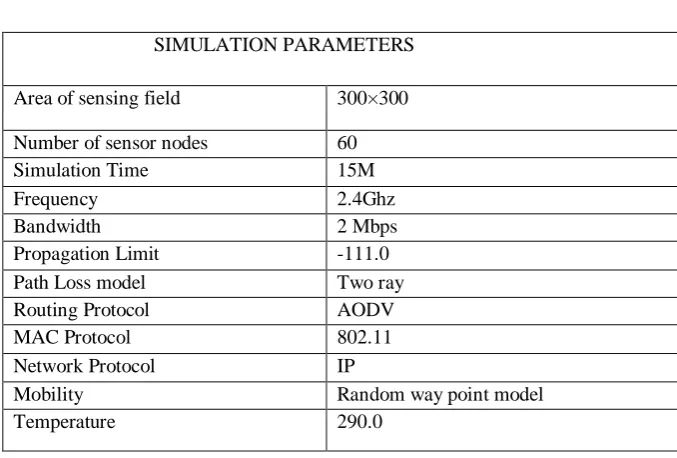
The simulations are done on an GloMoSim simulator. It is an efficient simulation environment for WSN. It uses a parallel discrete event simulation capability provided by Parsec. In this section the simulation parameters are evaluated. The relevant simulation parameters are shown in Table 2. The scenario consists of 60 sensor nodes including the sink.
TABLE 1
SIMULATION PARAMETERS
We compared our EECPA with LEACH based on the following parameters: Packet Delivery Ratio:
It is the ratio of the successfully delivered data packets to the number of data packets transmitted. PDR=Dp/Tp
Where Dp is the number of data packets successfully delivered
Tp is the number of data packets transmitted. Figure 1 explains the performance evaluation for packet delivery ratio. X-axis describes about the number of nodes and Y-axis describes about the % of packet delivery ratio.
SIMULATION PARAMETERS
Area of sensing field 300×300
Number of sensor nodes 60
Simulation Time 15M
Frequency 2.4Ghz
Bandwidth 2 Mbps
Propagation Limit -111.0
Path Loss model Two ray
Routing Protocol AODV
MAC Protocol 802.11
Network Protocol IP
Mobility Random way point model
Fig:1 Performance Evaluation for Packet Delivery Ratio The results are as follows:
The packet delivery ratio decreases as the number of load and network size increases. For LEACH, packet delivery ratio falls from 38.49% to 6.05%.For EECPA, packet delivery ratio falls from 78% to 32%.SoEECPA is more efficient compared to LEACH.
IV. CONCLUSION
In this paper, we have analyzed the need for clustering and prediction based techniques. We have also proposed energy efficient clustering and prediction protocol which uses mobile sink to route the path efficiently. We have simulated the packet delivery ratio using GloMoSim tool and we conclude that EECPA is more efficient than LEACH protocol in terms of clustering and prediction process.
AUTHORS PROFILE
REFERENCES
[1] Al-karaki J.N and Kamal A.E. Routing Techniques in Wireless Sensor Networks: A Survey, IEEE Wireless Communication, 2004, p.6-28.
[2] Anastasi G, Conti M and Passarella A.” Energy Conservation in Wireless Sensor Networks: a survey.” In: Ad Hoc Networks, volume 7, Issue 3, Elsevier; 2009,p.537-568
0 10000 20000 30000 40000 50000 60000
5 10 15 20 25
LEACH
EECPA
M.Suganthi
currently a student of Rajalakshmi Engineering College, Chennai
doing her Masters in “Computer Science and Engineering”. She received her
Bachelors degree in Computer Science and Engineering from Karunya
University in 2011, Coimbatore. Her areas of interest are Ad Hoc networks,
WSN and Network Security.
Mrs. Susmita Mishra
received her ME in Computer Science and Engineering
from KIIT University, Bhubaneswar, Odisha in 2008. She received her Bachelors
degree in Computer Science and Engineering from SEC, Jharpokharia,
Mayurbhanj, Odisha in 2003 . Her area of research includes Wireless Sensor
[4] L. Blazevic, S. Giordano, and J.-Y. LeBoudec, “A Location Based Routing Method for Mobile Ad Hoc Networks,” IEEE Trans.Mobile Computing, vol. 4, no. 2, pp. 97-110, Mar. 2005.
[5] Cordina M and Debono C.J, “Increasing Wireless Sensor Network Lifetime through the Application of SOM neural networks.” In: ISCCSP, IEEE, Malta, 2008, p. 467-471.
[6] Ye M, Li C. F and Chen G. H Wu J , “EECS: An Energy Efficient Clustering Scheme in Wireless Sensor Networks”. In: Proceedings of IEEE Int‟l Performance Computing and Communications Conference (IPCCC), 2005, p. 535-540.
[7] Fan Xiangning and Song Yulin, “Improvement on LEACH Protocol of Wireless Sensor Network,” International Conference on Sensor Technologies and Applications”, 2007.
[8] V. Loscrì, G. Morabito and S. Marano, “A Two-Levels Hierarchy for Low-Energy Adaptive Clustering Hierarchy,” IEEE 62nd Vehicular Technology Conference (VTC 2005- FALL), Vol.3, Sept. 25-28, 2005.
[9] Udit Sajjanhar and Pabitra Mitra, “Distributive energy efficient adaptive clustering protocol for wireless sensor networks,” in Proceeding of International Conference on Mobile Data Management (MDM07), Mannheim, Germany 2007.
[10] Omar Moussaoui and Mohamed Naimi, “A distributed energy aware routing protocol for wireless sensor networks,” in Proceeding of ACM PE-WASUN‟05, Montreal, Quebec, Canada, October 10–13 2005, 34-40.
[11] Rahul C. Shah R and Jan M. Rabaey, “Energy aware routing for low energy ad-hoc sensor networks,” in Proceeding of IEEE Wireless Communication and Networking” Conf. (WCNC,) Orlando, March, 2002, pp 1-5.