Ciphertext-Policy Attribute-Based Broadcast Encryption
with Small Keys
?Benjamin Wesolowski1 and Pascal Junod2 1
EPFL, Lausanne, Switzerland ([email protected])
2 University of Applied Sciences and Arts Western Switzerland (HES-SO/HEIG-VD),
Yverdon-les-Bains, Switzerland ([email protected])
Abstract. Broadcasting is a very efficient way to securely transmit information to a large set of geographically scattered receivers, and in practice, it is often the case that these receivers can be grouped in sets sharing common characteristics (or attributes). We describe in this paper an efficient ciphertext-policy attribute-based broadcast encryption scheme (CP-ABBE) supporting negative attributes and able to handle access policies in conjunctive normal form (CNF). Essentially, our scheme is a combination of the Boneh-Gentry-Waters broadcast encryption and of the Lewko-Sahai-Waters revocation schemes; the former is used to express attribute-based access policies while the latter is dedicated to the revocation of individual receivers. Our scheme is the first one that involves a public key and private keys having a size that is independent of the number of receivers registered in the system. Its selective security is proven with respect to the Generalized Diffie-Hellman Exponent (GDHE) problem on bilinear groups.
Keywords: Attribute-based encryption, broadcast encryption
1
Introduction
Broadcast channels allow transmitting information to a large set of geographically scattered receivers in a very efficient way. When this information is of high value, such as a high-definition Pay-TV stream or when delivered by a military geolocation system, for instance, one needs technical ways to enforce the signal reception by authorized receivers only. More than twenty years ago, the problem of securing a broadcast channel has began to attract cryptographers: the first works were the ones of Berkovits [2] and of Fiat and Naor [15], who coined the term “broadcast encryption”. The underlying idea is that the broadcasting center sends an encrypted message to a set of non-revoked receivers, which is a subset of all receivers. Obviously, revoked receivers (or other entities) spying the broadcast channel must not be able to decrypt a ciphertext, even if they collude together by sharing their private key material.
Precisely, if we denote byU, withn=|U|, the set of users (or receivers) and byR, with`=|R|, the set of revoked receivers, respectively, abroadcast encryption scheme is often meant to allow the secure transmission of information to an arbitrary set of receivers,i.e., whenn−`n, whilerevocation systems
are designed to exclude a small set of rogue receivers,i.e.when`n.
A key characteristic of broadcast encryption and revocation schemes is the fact that no synchronism is assumed between the broadcasting center and the receivers, besides the initial key setup procedure: one speaks fromstateless receivers. It means that, once each receiver is provisioned with its decryption key material, all the information required to decrypt a ciphertext must be contained in that ciphertext. Many stateless broadcast encryption schemes have been proposed in the past, being in the secret-key [18,20,34]) or in the public-key settings [6–8, 12, 13, 17, 27, 37], while a large body of literature tackling the same problem, but for stateful receivers, this time, is available; we refer the reader to [9] and the references therein.
Attribute-Based Encryption In practice, it is often the case that the receivers in a system can be grouped by common characteristics (or attributes). If we stick to a scenario around Pay-TV, receivers could be categorized by geographical location (“receivers located in California”, “receivers located in a rural zone”),
?
by technical capabilities (“receivers supporting HD content”, “receivers supporting 4K content”, “receivers having an OS with patch level 3.14.159”), by subscription type (“receivers having access to the XYZ sport channels package”, “receivers having access to the FGH adult channels package”), etc. Ideally, a broadcaster might then be willing to grant access to receivers according to a complicated access equation, such as to all “receivers having access to XYZ sport channels package, having an OS with patch level 3.14.159, butnot
located in California”.
The idea of attribute-based encryption (ABE) has been proposed by Sahai and Waters in [41], as a generalization of identity-based encryption [5, 42]; it was then formalized by Goyal and his co-authors in [19], who proposed the concepts ofciphertext-policy (CP-ABE) andkey-policy (KP-ABE)encryption schemes. In the CP-ABE and KP-ABE models, the access policies are embedded in the ciphertext and in the private key, respectively. Since then, numerous variants of CP- and KP-ABE schemes have been published; see for instance [3, 10, 16, 21, 22, 26, 28, 29, 35, 38, 40, 43].
Attribute-Based Broadcast Encryption Transforming an ABE encryption scheme for using it in a broad-cast scenario is a natural question, as in practice, broadbroad-casters are most of the time addressing sets of receivers sharing the same characteristics, instead of individual ones. An exception where a receiver might be addressed individually is when a key update is necessary, for example. This operation is rather costly in terms of bandwidth, as synchronism comes into play. It means that the individual key update messages have to be broadcast sufficiently many times on a sufficiently long period to guarantee their reception with high probability. This explains why addressing individual receivers is not possible in prac-tice to enforce access equations in a broadcast setting and why efficient stateless broadcast encryption schemes are so useful.
The key difference between an attributed-based broadcast encryption (ABBE) scheme and an ABE one is the additional possibility to revoke individual receivers in an efficient way. Given an ABE scheme, it is possible to create a revocation system by defining a dedicated unique attribute for each receiver and to specify an access policy which rejects the revoked receivers. Unfortunately, this is in general not efficient, since in an ABE scheme, the length of the keys or ciphertexts depend often in a linear way from the number of attributes. This can become unpractical when the number of receivers is large. Concretely, one could use an ABE supporting negative attributes, such as [35], and assign individual attributes to each receivers. A ciphertext can then be sent to the non-revoked receiver identities by conjunctively adding the AND of negations of revoked receivers attributes to the access policy. Implementing this idea with [35], this would imply an acceptable overhead ofO(`) group elements in the ciphertext, with`=|R|, but the private key would involveO(n) attributes, wherenis the total number of receivers. Furthermore, this scheme would not be dynamic in the sense of [12], i.e, one cannot easily add receivers in the system without sending individual messages to the receivers, which is, as mentionned above, costly in terms of bandwidth in a broadcast setting.
In a context where the number of receivers is way larger than the number of attributes, one is therefore interested in splitting the revocation system from the access structure. Motivated by this fact, a line of research has focused on designing ABE schemes allowing to efficiently revoke individual receivers. In other words, revoking a receiver is implemented conjunctively, meaning that even if that receiver possesses compatible attributes for a given access equation, but it belongs to the revoked receivers set R, it will not be able to correctly decrypt the ciphertext.
Lubicz and Sirvent [33] have proposed a scheme allowing to express access policies in disjunctive normal form (DNF), i.e., with disjunctions (OR) of conjunctions (AND), and able to handle negative attributes (NOT). Then, Attrapadung and Imai [1] proposed another approach, namely using a separate broadcast encryption scheme on the top of an ABE scheme, and they constructed both ciphertext-policy and key-policy variants. Since then, other designs have been published as well, see e.g. [24, 32, 44].
Finally, we note that attribute-based broadcast encryption schemes have numerous applications be-sides the Pay-TV or the geolocation satellites scenarios mentionned above. For instance, applications involving ABBE have been proposed in the context of secure storage of personal health records [31], of securing smart grids [14], and, more generally, in any data outsourcing systems requiring privacy [23].
is a combination of the Boneh-Gentry-Waters broadcast encryption scheme [6] and of the Lewko-Sahai-Waters revocation system [27]. The former is used to express attribute-based access policies while the latter is dedicated to the revocation of individual receivers.
Denoting byB the set of attributes, our scheme requires a public key and private keys of sizeO(N), where N =|B|is the total number of attributes. Ciphertexts are of sizeO(¯ν+`), where`=|R| is the number of revoked receivers and ¯ν is the number of clauses in the access policy. We note that ¯ν,N and`
are quantities independent of the numbernof receivers registered in the system. As a consequence, and to the best of our knowledge, our proposal is the first ABBE scheme whose public and private key sizes
do not depend on the number of receivers in the system, while the ciphertext length keeps linear in the size of the access policy and in the number of revoked receivers. This property is especially important in scenarios involving large numbers of users, such as large-scale Pay-TV or cloud-based storage systems, for instance.
Eventually, we prove the selective security of our scheme with respect to the Generalized Diffie-Hellman Exponent (GDHE) problem on bilinear groups [4], and we derive security bounds in the generic group model.
This paper is organized as follows: in§2, we recall the formal definition of attribute-based broadcast encryption schemes, their underlying security model as well as other mathematical preliminaries. Then, we describe our new scheme§3and we prove its security in§4. Finally, we compare its characteristics to other existing ABBE schemes and we discuss some of its practical aspects in§6.
2
Mathematical Preliminaries
LetUdenote a set of receivers (or users),R⊂Uthe set of revoked receivers andB a set of attributes. Furthermore, let λ be a security parameter. A ciphertext-policy attribute-based broadcast encryption (CP-ABBE) scheme consists of the following four algorithms:
– Setup(λ)→ (pk,msk) is a randomized algorithm which takes a security parameter λ as input and outputs the public key pkand a master keymsk.
– KeyGen(u, ω,msk,pk)→dku is a randomized algorithm that takes as input a receiver u∈U, a set of attributes ω ⊂ B, the master key msk and the public key pk. It outputs a private, individual decryption key dk(u,ω) for the receiver u. dk(u,ω) will be simply denoted dku if it is clear from the context thatuhas set of attributesω.
– Encrypt(R,A,pk)→(hdr,k) is a randomized algorithm that takes as input a set of revoked receivers R ⊂U, a Boolean access policyA expressed in conjonctive normal form and the public key pk. It outputs a headerhdras well as a session keyk.
– Decrypt(hdr,(R,A),dk(u,ω),(u, ω),pk)→kor ⊥is an algorithm taking as input a headerhdr, a set of revoked receivers R, an access policy A, a decryption key dk(u,ω) for receiver u equipped with attributesω as well as the public keypk. It outputs the session keykif and only ifω satisfiesAand
uis not inR; otherwise, it outputs⊥.
Theselective security notion for CP-ABBE is defined by the following probabilistic game:
– Setup. The adversary chooses a distribution of attributesB:U→ P(B), declares a set of revoked receivers R∗ ⊂Uand an access policy A∗. The challenger runs the Setup algorithm and gives the public keypkto the adversaryA.
– Query phase 1.The adversary is allowed to (adaptively) issue queries to the challenger for private keys dku for receiversu ∈U such that either u∈ R∗ or B(u) does not satisfy the policy A∗, i.e., receivers not able to decrypt a ciphertext.
– Challenge. After having run the encryption algorithm Encrypt(R∗,
A∗,pk), the challenger gets a header hdrand a session key k. Next, he draws a bit b uniformly at random, setskb=k and picks k1−buniformly at random in the space of possible session keys. He finally gives the triple (hdr,k0,k1) to the adversary.
– Query phase 2. The adversary is again allowed to (adaptively) issue queries for private keysdku for receiversu∈Usuch that eitheru∈R∗or B(u) does not satisfy the policy
The adversary wins the game ifb=b0 and its advantage is defined as
Advind(λ,U,B,A) =|2Pr[b=b0]−1|.
The set of receivers ufor which A requested the private keys is the set of colluding receivers. Hence, selective security ensures semantic security against colluding receivers if the advantage of the adversary is negligible.
We note that in the selective security model, the attacker must output the access policybeforeseeing the public parameters. A stronger model, named full security, has been proposed in [30]. While selective security is not the strongest model one might hope for our scheme, we think that it is stronger than what one could expect in practice, as the list of revoked nodes and the access equations are typically defined by the broadcaster.
Now, let us recall the notion of bilinear group. LetGand GT be two (multiplicative) cyclic groups, andga generator ofG. A mape:G×G→GT is asymmetric, non-degenerate pairingif it is bilinear,i.e.
for any u, v∈Ganda, b∈Z, we have e(ua, vb) =e(u, v)ab, and if it is non-degenerate,i.e.e(g, g)6= 1. Endowed with such a pairing,Gis called abilinear group. For practical purposes, let us further assume that in a bilinear groupG, both the action ofGand the pairingeare efficiently computable. Finally, we recall theGeneralized Diffie-Hellman Exponent (GDHE) Problem [4].
Definition 1 (GDHE Decisional Problem). Let G and GT be two groups of prime order p, g a
generator of G, and e : G×G → GT a non-degenerate bilinear map. Let f ∈ Fp[X1, ..., Xn] be a
polynomial inn variables overFp, the finite field withpelements, andP, Q⊂Fp[X1, ..., Xn] be two sets
of polynomials, both containing 1. Choose x1, ..., xn ∈Fp andU ∈GT uniformly at random. Given the
elements
gπ(x1,...,xn) ande(g, g)ρ(x1,...,xn)
for eachπ∈P andρ∈Q, the Generalized Diffie-Hellman Exponent (GDHE) Decisional Problemis the problem of distinguishinge(g, g)f(x1,...,xn) fromU.
Observe that in this setting, the classical Decisional Diffie-Hellman (DDH) problem reduces to an easy instance of the GDHE Decisional problem: let P = {1, a, b},Q ={1} and f =ab. Given ga and
gb, we can distinguishgabfrom a uniform random elementh∈Gby observing thate(ga, gb) =e(gab, g). This fact justifies the following definition, as in this example, (P, Q) andf aredependent functions.
Definition 2 (Dependent Functions).A function f is said to be dependenton the sets P andQ if there exist constants aπ,π0 with π, π0 ∈P andcρ withρ∈Qsuch that
f = X π,π0∈P
aπ,π0ππ0+
X
ρ∈Q
cρρ.
With this independence notion, it is proven that the (P, Q, f)-GDHE Decisional Problem is difficult in the generic group model.
Theorem 1 (Boneh, Boyen, Goh [4, Theorem A.2]).Let
d= max{2 deg(π),deg(ρ),deg(f)|π∈P, ρ∈Q},
ands= max{|P|,|Q|}If f is independent ofP andQ, then for any adversary A that makes a total of at mostq queries to the oracle computing the group operations inG,GT and the pairinge, we have
|2 Pr [Aoutputs 0]−1| ≤ (q+ 2s+ 2)
2·d
p .
3
The New Scheme
3.1 High-Level Description
The BGW scheme targets arbitrary sets of priviledged receivers and involves ciphertexts with a constant size, if, as customary, one omits bandwidth consumed by the description of the set of priviledged receivers to be addressed; its public and private keys have a size depending on the number of receivers; note that, with the BGW scheme, one needs the public key to decrypt. Hence, we use it to express arbitrary access equations, that typically depend on a small number of attributes when compared to the total number of receivers. On its side, the LSW revocation scheme has ciphertexts whose size depends on the number of revoked receivers; however, its encryption and decryption keys are independant of the total number of users in the system. In systems potentially involving millions of receivers, this is a decisive practical advantage.
Given an access structure in CNF form A = β1∧ · · · ∧βN and a revocation set R, our idea is to associate to each clauseβi a fragment of the session keyki which can be computed only by a receiver satisfying the corresponding clause, and a fragment k0 computable by non-revoked receivers. Then, the session keyk can be derived out of theki’s.
This alone would not resist to an attack from colluding receivers: if receiveruis revoked but satisfies
A, he can computeki fori= 1, ..., N, andv is not revoked but does not satisfyA, he can compute k0; together, uand v can compute k. To prevent this, we do not allow a receiveruto compute ki directly, but rather an blinded valuekεu
i thereof, whereεuis a secret exponent unique for each receiveru. Then, k can be derived from any collection (kεu
i )ni=1. Ifucan compute k εu
i fori= 1, ..., N and v can compute kεv
0 , they cannot derivek.
3.2 Formal Definitions
Let us writeB∗ =B∪ ¬Bthe set of all attributesB and their negations¬B. LetB:U→ P(B∗) be a
distribution of attributes,i.e., a map such that for any receiveru∈Uand attributea∈B, eithera∈B(u) or¬a∈B(u), but not both. Let id :U→(Z/pZ)∗ be a public injection, andı:B∗→ {2,4,6, ..., t−1} be a public bijection wheret= 4N+ 1.
Setup(λ) → (pk,msk) According to the security parameter λ, choose two groups G and GT of prime order p > 2λ as well as a non-degenerate bilinear pairing e :
G×G → GT. Additionnaly, choose two non-zero elementsg, h=gξ ∈
Gand seven random exponentsα, γ, b, β, δ, r andr0 in Z/pZ. Finally, let
gi=gα
i
. The public keypkconsists of the elements ofG
g, gγrn 0, gr, grr
0
n+1, grr
0b
n+1, grr
0b2 n+1 , hbα
n+1r0r
, gδr, gn,
gır(a)
a∈B∗,
and the two elements ofGT
e(g1, gn)rr
0βγ
, e(g1, gn)rβ. The authority keeps the exponents secret.
KeyGen(u,B(u),msk,pk)→dku Letu∈U. Choose two random elements σu, εu∈Z/pZ. Define
Du,0=
gγgb2σu
εu
, Du,1=
gb·id(u)h
σuεu
,
Du,2=g−σuεu, Du,3=g r(β+εu)
1 .
The private key of receiveruis
dku=
(Du,k)3k=0,gεu
ı(a)
a∈B∗,
gεu
n+1+ı(a)
a∈B∗,
gδεu
ı(a)
a∈B(u)
Encrypt(R,A,pk)→(hdr,k) Given an access policyA=β1∧...∧βN, withβi=βi,1∨...∨βi,Mi (modeled
asβi,j⊆B∪ ¬B) and a revocation setR⊂U, one choosess0, ..., sN ∈Z/pZat random and one defines
s=γr0s0+ N X
i=1
si
(which needs not be computed). Also, one splits
s0= X
u∈R
su.
Let us define
C=gsn=gγn·r0
s0
g(
PN i=1si)
n .
For alli= 1, ..., N, one defines the elements
Ci,0=grsi andCi,1=
grδ Y
a∈βi
grn+1−ı(a)
si
,
as well as the correspondingN parts of the header hdri= (Ci,0, Ci,1). One definesC0=grr
0s
0
n+1 , and for eachu∈R,
Cu,1=grr
0bs u
n+1 and Cu,2=
gb2id(u)hb
αn+1rr0su
.
Lethdr0= (C0,(Cu,1)u∈R,(Cu,2)u∈R). Finally, the header ishdr= (C,hdr0, ...,hdrN). The global session keykis given by
k=e(g1, gn)rβs=
e(g1, gn)rr
0βγs0
·e g1r, gnβ(PNi=1si)
Decrypt(hdr,(R,A),dku,(u, ω),pk) → k or ⊥ If u ∈ R or if there exists i ∈ {1, ..., N}, such that
βi∩B(u) =∅, return⊥. Fori= 1, ..., N, choose one satisfying attributea∈βi∩B(u) and compute
kεu
i =
e(gεu
ı(a), Ci,1)
egδεu
ı(a) Q
a0∈βi\{a}g
εu
n+1−ı(a0)+ı(a), Ci,0 .
Also compute
kεu
0 =e(Du,0, C0)×e Du,1, Y
u0∈R
Cu1/0,(id(1 u)−id(u0))
!−1
×e Du,2, Y
u0∈R
Cu1/0,(id(2 u)−id(u0))
!−1
.
We havekεu
0 =e(g1, gn)rr
0s0ε uγ and
kεu
i =e(g1, gn)rsiεu fori= 1, ..., N. Eventually, we can recoverk as
k= e(Du,3, C) QN
i=0k εu
i
=e(g1, gn)rβs.
One can observe that the public-key size depends only on the total number of attributes defined in the system, and that the same holds for the decryption keys. The header size linearly depends only on the number of revoked rogue receivers.
If the number of attributes does not change during the lifetime of the system, we note that our new ABBE scheme is fully dynamic in the sense of [12]. Indeed, the deployment of new receivers does not imply to change the encryption or the decryption keys of other receivers, which is a desirable property for a stateless scheme.
4
Security Analysis
To prove the security of our scheme, and similarly to the approach taken in [12], we show that the CP-ABBE selective security of this scheme reduces to an instance of a (P, Q, f)-GDHE problem [4]. We then prove that (P, Q) and f are independent, which implies in particular that the corresponding problem is difficult in the generic group model. This leads to a security reduction in the standard model, and a proof of security in the generic group model. Thereafter, all the polynomials considered are from the polynomial ring
Fp[α, β, γ, δ, ξ, b, r, r0, si, su, σu, εu:i∈N, u∈U].
LetAbe an adversary for the CP-ABBE selective security game. It declares a distribution of attributes
B:U→ P(B∗), an access structure Aand a setRof revoked receivers. LetCbe the set of all receivers which do not satisfy the policyA, and/or are revoked. LetP be the list of polynomials consisting of 1, and all the following elements corresponding to the information inpk,hdr, anddku for all the receivers
u∈C.
1. Contribution of pk: the setPpkof polynomials
1, αnγr0, r, αn+1rr0, αn+1rr0b,
αn+1rr0b2, ξbαn+1rr0, δr, αn
and fora∈B∗, the elementαı(a)r.
2. Contribution of dku, for anyu∈C: the setPdku of polynomials
εu(γ+b2σu), σuεu(b·id(u) +ξ), σuεu, αr(β+εu),
for eacha∈B∗,
αı(a)εu, αn+1+ı(a)εu, and for eacha∈B(u),
αı(a)δεu; 3. Contribution of hdr: the set Phdr of polynomials
αns, αn+1rr0s0,
for eachi= 1, ..., N,
rsi, rsi
δ+ X
a∈βi
αn+1−ı(a)
,
and for each revoked receiver u∈R,
αn+1rr0bsu, αn+1rr0su(b2·id(u) +ξb).
The listQis simply
(1, αn+1rr0βγ, αn+1rβ),
andf =αn+1rsβ.
Lemma 1. If the adversary A solves the CP-ABBE selective security game with advantage ε, then a simulator can be constructed to solve the (P, Q, f)-GDHE problem with advantage εin polynomial time, with one oracle call toA.
Proof. Suppose we are given an instance of the (P, Q, f)-GDHE problem, i.e., elements of the form
gπ(x1,...,x`)∈
Gande(g, g)ρ(x1,...,x`)∈
GT for eachπ∈P and ρ∈Q, and for randomxi’s inFp. We get as well two elementsX0, X1 ∈GT such thatXb=e(g, g)f and X1−b is a uniformly random element of GT, for a random bitb. We will use this instance to simulate a CP-ABBE selective security game, and useA to solve it and guess b. During the setup phase, the simulator gives to the adversary the public key, given by the elements gπ(x1,...,x`) and e(g, g)ρ(x1,...,x`) for all the polynomials π∈ P
with the access policy), and the simulator responds by sending the elementsgπ(x1,...,x`)for eachπ∈P
dku.
The challenge sent to the adversary isgπ(x1,...,x`) forπ∈Phdr, together withX
0andX1. There is a new query phase, and thenAfinally outputs a guess bit b0. SinceAhas advantage εto solve the CP-ABBE
selective security game, it will distinguishe(g, g)f from a random element with advantageε, solving the (P, Q, f)-GDHE problem with an advantage of at mostε.
Therefore, an adversary for the CP-ABBE selective security game gives rise to an adversary for the (P, Q, f)-GDHE problem. It now needs to be justified that the (P, Q, f)-GDHE problem is difficult. The end of Section 2 explains that we can suppose this problem to be difficult when (P, Q) andf are independent: it is proven to be difficult in the generic group model, and assumed to remain difficult in cryptographic bilinear groups. Thus, it remains to show that (P, Q) andf are indeed independent.
Lemma 2. (P, Q)andf are independent.
Proof. Recall that for any receiver u ∈ C, either u ∈ R or there exists an i ∈ {1, ..., N} such that
B(u)∩βi =∅. Byterm, we mean polynomials of the formππ0 orρwith π, π0 ∈P orρ∈Q. We want to show thatf is not a linear combination of those terms. Let us proceed by contradiction and suppose that it is a linear combination: there exist constantsaπ,π0 withπ, π0∈P andcρ withρ∈Qsuch that
f = X π,π0∈P
aπ,π0ππ0+
X
ρ∈Q
cρρ.
The only polynomials ofP containingβ are theαr(β+εu), for allu∈C. Let us writeπu=αr(β+εu) for anyu∈C, andP1=P\ {πu}u∈C. We can now splitf into the following different sums:
f = X u,v∈C
aπu,πvπuπv
| {z } :=fβ2
+X
u∈C
πu X
π∈P1
aπu,ππ
| {z } :=fβ
+ X
π,π0∈P
1
aπ,π0ππ0
| {z } :=f1
+X
ρ∈Q
cρρ.
The terms offβ2 are of the form
aπu,πvπuπv =aπu,πvα
2r2 β2+βε
u+βεv+εuεv
,
foru, v ∈C. This is the only way to form a monomial of the formaα2r2ε
uεv, so ifaπu,πv 6= 0, there is no
way any other term will cancel this monomial. But it must be canceled since it does not appear inf, so
aπu,πv = 0 for any u, v∈C, and fβ2 = 0. Since the only polynomials ofP containingβ areαr(β+εu),
for all u∈C, one can multiply them with the polynomials containing anαn to obtain all the possible terms with a monomial containingαn+1β that can be formed. Those are, for anyu∈C,
αn+1rr0γ(β+εu), αn+1r(β+εu), αn+1rs(β+εu),
plus the two elements ofQ
αn+1rr0βγ, αn+1rβ.
Among those,αn+1rs(β+εu) is the only polynomial containing ans. Therefore the only way to obtain the termαn+1rsβ off is via sums of the polynomialsαn+1rs(β+εu). With this fact in mind, rewrite the polynomialfβ as
fβ= X
u∈C
aπu,αnsπuα
ns+X
u∈C
πu X
π∈P1\{αns}
aπu,ππ
| {z }
:=f2 =αn+1rsβX
u∈C
aπu,αns+
X
u∈C
aπu,αnsα
n+1rsε u+f2,
and since there is no other way to form a term of the formαn+1rsβthan in the first sum of thisfβ, we must haveP
u∈Caπu,αns= 1. Therefore,
fβ=f+ X
u∈C
aπu,αnsα
and we obtain
0 =X u∈C
aπu,αnsα
n+1
rsεu+f2+f1+ X
ρ∈Q
cρρ. (1)
The polynomialf2 splits into the two sums
f2=αrβ
X
u∈C,π∈P1\{αns}
aπu,ππ
| {z }
f2,1
+αrX
u∈C
εu X
π∈P1\{αns}
aπu,ππ
| {z }
f2,2
.
In Eq. (1), the only terms containingβ are inf2,1and inPρ∈Qcρρ, and they must cancel each other; therefore, removing all the monomials containing aβ, and the constant monomial, we are left with
0 =X u∈C
aπu,αnsα
n+1rsε
u+f2,2+f1. (2)
From the fact that P
u∈Caπu,αns = 1, we know we can chose a u∈ C such that aπu,αns 6= 0. This is
the coefficient of αn+1rsε
u in the first sum of (2). It must be canceled, and we will show that this is impossible, which will end this proof by contradiction. It is the sum of monomials
αn+1rsεu= N X
i=1
αn+1rεusi+ X
v∈R
αn+1rεur0γsv.
The only terms inf2,2 andf1 containing such monomials are the term
αn+1rr0s0εu(γ+b2σu), (3) which is the only one containingαn+1rε
ur0γsvforv∈R, and for anyi= 1, ..., N anda∈B(u)∩βi, the term
αı(a)εusir
δ+ X
a0∈β i
αn+1−ı(a0)
,
which is the only one containing αn+1rε
usi. Observe that if there exists an i ∈ {1, ..., N} such that
B(u)∩βi =∅, then there is no monomial of the formαn+1rsiεu so it is impossible to cancelαn+1rsεu. Therefore for any i= 1, ..., N we have B(u)∩βi 6=∅, so from the assumption of this lemma, we must have u∈R. From the fact that Eq. (3) is the only term which can cancel the monomialsαn+1rε
ur0γsv forv∈R, we deduce that
a{αn+1rr0s0,ε
u(γ+b2σu)}=−aπu,αns6= 0.
In particular, this adds the sum of monomials
αn+1rr0s0εub2σu= X
v∈R
αn+1rr0svεub2σu
which all need to be canceled by other terms in f2,2 and f1. And since u∈ R, we need to cancel the monomialαn+1rr0s
uεub2σu. But the only other term containing this monomial is
αn+1rr0bsuσuεu(b·id(u) +ξ) =
αn+1rr0suεub2σu·id(u) +αn+1rr0suεubσuξ.
So its coefficient must be non-zero, which in turn introduces the monomialαn+1rr0s
uεubσuξwhich, this time, cannot be canceled by any other term. This is a contradiction and this proves that (P, Q) and f
are independent.
We are now able to derive a bound on the security of our new scheme in the generic group model.
Theorem 2. For any probabilistic algorithmAthat totalizes at mostq queries to the oracle performing group operations in(G,GT)and evaluations of e(·,·), and declaring a set of revoked receivers of size at mostη, as well as an access policy with at mostN clauses (A=β1∧ · · · ∧βN), thenAdvind(λ,U,B,A)
is smaller or equal to
(q+ 4(N+N+η) + 22 +|U|(10N+ 8))2(8N+ 3)
2λ−1 .
Proof. This is a direct consequence of Lemmas 1 and2, and Theorem1, with|Ppk|= 9 + 2N,|Pdku|=
5
Optimizing the Bandwidth and
Computational Overheads
As the number of revoked receivers grows, the computation ofkεu
0 can become expensive for the receivers. The heavy computations are the products
Y
u0∈R
Cu1/0,i(id(u)−id(u0))
fori= 1,2, which requireO(`) exponentiations. This could be optimized if theCu0,1’s andCu0,2’s did not
change from a message to another: those products could be computed the first time and reused, and any new revoked receiver would only require one exponentiation and multiplication for each of the receivers. To do so, the broadcaster chooses a randomsu0 for every revoked receiveru0 ∈R, and reuses it for all
the following communications, thus generating the sameCu0,1’s andCu0,2’s.
This optimization requires a new proof of security. We can show that even if the adversary is given access to old ciphertextshdr(1), ...,hdr(m), (in addition to the challengehdr) for which the sets of revoked receivers are subsets R(j) of the set of revoked receivers R for hdr, and the access policies have N(j)
clauses denoted βi(j), for each j = 1, ..., m, the underlying (P, Q, f)-GDHE is still difficult (i.e., (P, Q) andf are independent). We need to supposeN(j)>0 for eachj= 1, ..., m.
This technique reduces the computational cost, but in a fully stateless situation, the broadcaster still needs to send all theCu0,1’s andCu0,2’s with each message. In a context where it is possible to maintain
a synchronized state, via a two-way connection with a possibly very limited bandwidth, it is possible for the broadcaster to send with each ciphertext only theCu0,1’s andCu0,2’s for the newly revoked receivers.
Then, the ciphertexts’ lengths drop fromO(N+`) toO(N+|∆R|) (where∆Ris the set of newly revoked receivers, for example those revoked during the last day or the last week).
The only thing we have to change from the setting of the original security proof is to add to P
the contribution of the ciphertexts hdr(1), ...,hdr(m), where the secret exponents of hdr(j) are denoted
s(j), s(j) 0 , s
(j) i ands
(j)
u0 for i= 1, ..., N(j) and u0 ∈R(j). This contribution consists, for eachj = 1, ..., m,
of the polynomials
αns(j), αn+1rr0s(0j),
and for eachi= 1, ..., N(j), the polynomials
rs(ij), rs(ij)
δ+
X
a∈βi(j)
αn+1−ı(a)
.
Only a few observations are needed to adapt the original security proof to this new setting. The first thing is to notice that we now have new terms with a factorαn+1β. Those are, for anyj= 1, ..., M and
u∈C,
αn+1rs(j)(β+εu).
But those terms cannot have a non-zero coefficient in the linear combination formingf, because for each
j, αn+1rs(j)(β+ε
u) is the only term containing the monomial αn+1rs (j)
1 (β+εu), thus the later could not be canceled by any other linear combination of terms (here we use our assumption thatN(j)>0).
The second thing to notice is that the terms which can cancel the monomialsαn+1rε
ur0γsv forv∈R are now not onlyαn+1rr0s
0εu(γ+b2σu), but also the terms
αn+1rr0s0(j)εu(γ+b2σu)
for all thej’s such thatv ∈R(j). We can then deduce that there is a linear combination of those terms such that the resulting coefficient of the monomialαn+1rε
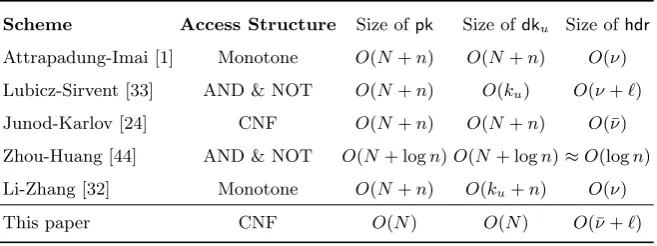
Scheme Access Structure Size ofpk Size ofdku Size ofhdr
Attrapadung-Imai [1] Monotone O(N+n) O(N+n) O(ν)
Lubicz-Sirvent [33] AND & NOT O(N+n) O(ku) O(ν+`)
Junod-Karlov [24] CNF O(N+n) O(N+n) O(¯ν)
Zhou-Huang [44] AND & NOT O(N+ logn)O(N+ logn)≈O(logn)
Li-Zhang [32] Monotone O(N+n) O(ku+n) O(ν)
This paper CNF O(N) O(N) O(¯ν+`)
Table 1.Bandwidth and key storage complexity comparison. Denoting the set of all receivers by U, the set of all attributes byB, the set of revoked receivers byR, then kuis the number of attributes assigned to a receiver
u∈U,νthe length of the access structure, ¯ν the number of clauses in a CNF access structure,N=|B|,n=|U| and`=|R|.
6
Practical Aspects
In this section, we compare the practical properties of our scheme to the other existing ABBE schemes listed in Table6.
Size of Keys First, we observe that our scheme is the only one where the public and private key sizes do not depend on the total number of receiversn=|U| registered in the system. Except for the Zhou-Huang scheme, whose dependency is of logarithmic nature, this dependence in n is linear in the com-peting schemes, which is highly impractical for a large scale deployment potentially involving millions of receivers, such as a Pay-TV system, for instance. The length of the keys in our scheme only depends linearly on the total number of attributes N =|B| defined in the system. This allows high scalability: the broadcaster can initially decide on a large set of possible receivers Uwithout affecting the length of the keys. Adding new receivers to the system can be done efficiently, whereas with a key size linear in n, the broadcaster should choose the smallest possibleUand change all the settings and keys when there are too many new receivers. This is undesirable in practice, as changing all the keys is way too expensive, especially when they are so long. In a nutshell, from the point of view of the key lengths, the Zhou-Huang scheme and our scheme are the only really practical candidates for large-scale deployment, while the Lubicz-Sirvent scheme can also be considered as acceptable since only its public key size is large, the private keys being pretty small.
Ciphertexts Size The overhead on the ciphertext is O(N+`) for our scheme, which is the same as the Lubicz-Sirvent scheme. The three schemes presenting a smaller overhead of sizeO(N) have to compensate with private keys whose size is linear inn.
The Zhou-Huang scheme can in theory reach an overhead as small asO(logn). This length relies on an optimization phase, which leads to an average length inO(logn) and a worst case length inO(n); the worst case however occurs with small probability. This optimization phase is a Sum-of-Product Expression (SOPE) minimization, which is known to be an NP-Hard problem, so we can only hope for approximations.
Finally, we would like to emphasize thatν and ¯ν have a somewhat different cardinality in the case of access structures involving only AND and NOT gates or in the case of complete CNF formulas. In the first case,ν represents the number of atomic variables,i.e., the number of attributes or their negation, while in the case of a complete CNF formula, ¯ν represents the number of clauses, and it is independent of the number of atomic variables in the clauses. Hence, ¯ν is always smaller or equal, if not significantly smaller, thanν.
difference as long as the set of attributes remains reasonably small. The ciphertext overhead is the same. Our scheme allows a more flexible access control model via CNF formulas. The Lubicz-Sirvent only allows AND and NOT gates; one can also add OR gates, allowing access control by CNF formulas, via ciphertext concatenation, but the ciphertext overhead is then multiplied by the number of clauses. Note that, similarly to the Junod-Karlov scheme, our scheme allows to implement access policies in DNF form by concatenation as well. Overall, as long asN =Bis of reasonable size, our scheme is more flexible and efficient than the Lubicz-Sirvent one.
Compared to the Zhou-Huang scheme, the lengths of the public and private keys are similar; even though there is this additional term logn in the Zhou-Huang’s scheme, there is no difference under the reasonable assumption that N = O(logn). As for the Lubicz-Sirvent scheme, the Zhou-Huang scheme only allows AND and NOT gates, and OR gates via ciphertext concatenation and a ciphertext overhead multiplied by the number of clauses. Furthermore, as mentioned above, the ciphertext overhead depends on the SOPE minimization phase, which is a NP-hard problem.
Practical Performances We have implemented our new scheme using the C programming language and with help of the PBC library3for the elliptic curve arithmetic and pairings. The curve used let us work in
a group of 160-bit long order and a base field of 512-bit long order, suitable for cryptographic use (it is a Type A curve, in PBC’s classification). We ran an example with 5 attributes, on a 2.3 GHz Intel Core i7; the setup phase, including the generation of the public key takes 237 milliseconds, generating the private key of a receiver takes 75 milliseconds, the decryption of a message with 3 clauses, and without new revocations takes 25 milliseconds, and each new revocation adds 4 milliseconds to the first decryption after the revocation.
7
Conclusion
This paper describes, to the best of our knowledge, the first attribute-based broadcast encryption scheme for which the length of the encryption and decryption keys does not depend on the total number of users, but only on the number of attributes defined in the system. This property has been achieved by combining the Boneh-Gentry-Waters broadcast encryption scheme with the Lewko-Sahai-Waters revocation system in a secure way. Our scheme requires also a modest bandwidth, as the length of the header depends only of the number of revoked rogue receivers. The access equations can be defined in conjunctive normal form, i.e., as AND of clauses involving ORs of attributes, and it supports negative attributes. We have proven the security of this scheme relatively to a GDHE problem in the standard model, which additionnaly allows us to derive corresponding security bounds in the generic group model. In summary, we are convinced that our scheme is fully practical in a number of real-life scenarios, including Pay-TV or cloud-storage ones involving millions of users.
References
1. Nuttapong Attrapadung and Hideki Imai. Conjunctive broadcast and attribute-based encryption. In Hovav Shacham and Brent Waters, editors,Pairing-Based Cryptography - Pairing 2009, Third International Con-ference, Palo Alto, CA, USA, August 12-14, 2009, Proceedings, volume 5671 ofLecture Notes in Computer Science, pages 248–265. Springer, 2009.
2. Shimshon Berkovits. How to broadcast a secret. In Donald W. Davies, editor,Advances in Cryptology -EUROCRYPT ’91, Workshop on the Theory and Application of of Cryptographic Techniques, Brighton, UK, April 8-11, 1991, Proceedings, volume 547 ofLecture Notes in Computer Science, pages 535–541. Springer-Verlag, 1991.
3. John Bethencourt, Amit Sahai, and Brent Waters. Ciphertext-policy attribute-based encryption. In 2007 IEEE Symposium on Security and Privacy (S&P 2007), 20-23 May 2007, Oakland, California, USA, pages 321–334. IEEE Computer Society, 2007.
4. Dan Boneh, Xavier Boyen, and Eu-Jin Goh. Hierarchical identity based encryption with constant size ciphertext. In Cramer [11], pages 440–456.
5. Dan Boneh and Matthew K. Franklin. Identity-based encryption from the Weil pairing. In Kilian [25], pages 213–229.
3
6. Dan Boneh, Craig Gentry, and Brent Waters. Collusion resistant broadcast encryption with short ciphertexts and private keys. In Victor Shoup, editor,Advances in Cryptology - CRYPTO 2005: 25th Annual International Cryptology Conference, Santa Barbara, California, USA, August 14-18, 2005, Proceedings, volume 3621 of
Lecture Notes in Computer Science, pages 258–275. Springer-Verlag, 2005.
7. Dan Boneh and Brent Waters. A fully collusion resistant broadcast, trace, and revoke system. In Ari Juels, Rebecca N. Wright, and Sabrina De Capitani di Vimercati, editors,Proceedings of the 13th ACM Conference on Computer and Communications Security, CCS 2006, Alexandria, VA, USA, October 30 - November 3, 2006, pages 211–220, New York, NY, USA, 2006. Association for Computing Machinery.
8. Dan Boneh, Brent Waters, and Mark Zhandry. Low overhead broadcast encryption from multilinear maps. In Juan A. Garay and Rosario Gennaro, editors, dvances in Cryptology - CRYPTO 2014 - 34th Annual Cryptology Conference, Santa Barbara, CA, USA, August 17-21, 2014, Proceedings, Part I, volume 8616 of
Lecture Notes in Computer Science, pages 206–223. Springer-Verlag, 2014.
9. Mike Burmester. Group key agreement. In Henk C.A. van Tilborg and Sushil Jajodia, editors,Encyclopedia of Cryptography and Security, pages 520–526. Springer US, 2011.
10. Melissa Chase. Multi-authority attribute based encryption. In Salil P. Vadhan, editor,TCC, volume 4392 of
Lecture Notes in Computer Science, pages 515–534. Springer, 2007.
11. Ronald Cramer, editor. Advances in Cryptology - EUROCRYPT 2005, 24th Annual International Con-ference on the Theory and Applications of Cryptographic Techniques, Aarhus, Denmark, May 22-26, 2005, Proceedings, volume 3494 ofLecture Notes in Computer Science. Springer-Verlag, 2005.
12. C´ecile Delerabl´ee, Pascal Paillier, and David Pointcheval. Fully collusion secure dynamic broadcast encryption with constant-size ciphertexts or decryption keys. In Tsuyoshi Takagi, Tatsuaki Okamoto, Eiji Okamoto, and Takeshi Okamoto, editors,Pairing-Based Cryptography - Pairing 2007, First International Conference, Tokyo, Japan, July 2-4, 2007, Proceedings, volume 4575 ofLecture Notes in Computer Science, pages 39–59. Springer, 2007.
13. Yevgeniy Dodis and Nelly Fazio. Public key broadcast encryption for stateless receivers. In Joan Feigenbaum, editor,Security and Privacy in Digital Rights Management, ACM CCS-9 Workshop, DRM 2002, Washington, DC, USA, November 18, 2002, Revised Papers, volume 2696 ofLecture Notes in Computer Science, pages 61–80. Springer-Verlag, 2002.
14. Z.M. Fadlullah, N. Kato, Rongxing Lu, Xuemin Shen, and Y. Nozaki. Toward secure targeted broadcast in smart grid. IEEE Communications Magazine, 50(5):150–156, May 2012.
15. Amos Fiat and Moni Naor. Broadcast encryption. In Douglas R. Stinson, editor,Advances in Cryptology -CRYPTO ’93, 13th Annual International Cryptology Conference, Santa Barbara, California, USA, August 22-26, 1993, Proceedings, volume 773 ofLecture Notes in Computer Science, pages 480–491. Springer-Verlag, 1994.
16. Sanjam Garg, Craig Gentry, Shai Halevi, Amit Sahai, and Brent Waters. Attribute-based encryption for cir-cuits from multilinear maps. In Ran Canetti and Juan A. Garay, editors,Advances in Cryptology - CRYPTO 2013 - 33rd Annual Cryptology Conference, Santa Barbara, CA, USA, August 18-22, 2013. Proceedings, Part II, volume 8043 ofLecture Notes in Computer Science, pages 479–499. Springer, 2013.
17. Craig Gentry and Brent Waters. Adaptive security in broadcast encryption systems (with short ciphertexts. In Antoine Joux, editor,Advances in Cryptology - EUROCRYPT 2009, 28th Annual International Conference on the Theory and Applications of Cryptographic Techniques, Cologne, Germany, April 26-30, 2009. Proceedings, volume 5479 ofLecture Notes in Computer Science, pages 171–188. Springer-Verlag, 2009.
18. Michael T. Goodrich, Jonathan Z. Sun, and Roberto Tamassia. Efficient tree-based revocation in groups of low-state devices. In Matthew K. Franklin, editor, Advances in Cryptology - CRYPTO 2004, 24th An-nual International Cryptology Conference, Santa Barbara, California, USA, August 15-19, 2004, Proceedings, volume 3152 ofLecture Notes in Computer Science, pages 511–527. Springer-Verlag, 2004.
19. Vipul Goyal, Abhishek Jain, Omkant Pandey, and Amit Sahai. Bounded ciphertext policy attribute based encryption. In Luca Aceto, Ivan Damg˚ard, Leslie Ann Goldberg, Magn´us M. Halld´orsson, Anna Ing´olfsd´ottir, and Igor Walukiewicz, editors, Automata, Languages and Programming, 35th International Colloquium, ICALP 2008, Reykjavik, Iceland, July 7-11, 2008, Proceedings, Part II - Track B: Logic, Semantics, and Theory of Programming & Track C: Security and Cryptography Foundations, volume 5126, pages 579–591, 2008.
20. Dani Halevy and Adi Shamir. The LSD broadcast encryption scheme. In Moti Yung, editor,Advances in Cryptology - CRYPTO 2002, 22nd Annual International Cryptology Conference, Santa Barbara, California, USA, August 18-22, 2002, Proceedings, volume 2442 of Lecture Notes in Computer Science, pages 47–60. Springer-Verlag, 2002.
21. Susan Hohenberger and Brent Waters. Attribute-based encryption with fast decryption. In Kaoru Kurosawa and Goichiro Hanaoka, editors, Public-Key Cryptography - PKC 2013 - 16th International Conference on Practice and Theory in Public-Key Cryptography, Nara, Japan, February 26 - March 1, 2013. Proceedings, volume 7778 ofLecture Notes in Computer Science, pages 162–179. Springer, 2013.
22. Susan Hohenberger and Brent Waters. Online/offline attribute-based encryption. In Hugo Krawczyk, editor,
23. Junbeom Hur and Dong Kun Noh. Attribute-based access control with efficient revocation in data outsourcing systems. IEEE Transactions on Parallel and Distributed Systems, 22(7):1214–1221, July 2011.
24. Pascal Junod and Alexandre Karlov. An efficient public-key attribute-based broadcast encryption scheme allowing arbitrary access policies. InProceedings of the 10th ACM Workshop on Digital Rights Management (DRM 2010), October 4, 2010, Chicago, Illinois, USA, pages 13–24, 2010.
25. Joe Kilian, editor. Advances in Cryptology - CRYPTO 2001, 21st Annual International Cryptology Confer-ence, Santa Barbara, California, USA, August 19-23, 2001, Proceedings, volume 2139 of Lecture Notes in Computer Science. Springer-Verlag, 2001.
26. Allison B. Lewko, Tatsuaki Okamoto, Amit Sahai, Katsuyuki Takashima, and Brent Waters. Fully secure functional encryption: Attribute-based encryption and (hierarchical) inner product encryption. In Henri Gilbert, editor,Advances in Cryptology - EUROCRYPT 2010, 29th Annual International Conference on the Theory and Applications of Cryptographic Techniques, French Riviera, May 30 - June 3, 2010. Proceedings, volume 6110 ofLecture Notes in Computer Science, pages 62–91. Springer, 2010.
27. Allison B. Lewko, Amit Sahai, and Brent Waters. Revocation systems with very small private keys. In
Proceedings of 31st IEEE Symposium on Security and Privacy, S&P 2010, 16-19 May 2010, Berleley/Oakland, California, USA, pages 273–285. IEEE, 2010.
28. Allison B. Lewko and Brent Waters. Decentralizing attribute-based encryption. In Paterson [36], pages 568–588.
29. Allison B. Lewko and Brent Waters. Unbounded HIBE and attribute-based encryption. In Paterson [36], pages 547–567.
30. Allison B. Lewko and Brent Waters. New proof methods for attribute-based encryption: Achieving full security through selective techniques. In Safavi-Naini and Canetti [39], pages 180–198.
31. Ming Li, Shucheng Yu, Yao Zheng, Kui Ren, and Wenjing Lou. Scalable and secure sharing of personal health records in cloud computing using attribute-based encryption.IEEE Transactions on Parallel and Distributed Systems, 24(1):131–143, January 2013.
32. Qinyi Li and Fengli Zhang. A fully secure attribute based broadcast encryption scheme.International Journal of Network Security, 17(3):263–271, 2015.
33. David Lubicz and Thomas Sirvent. Attribute-based broadcast encryption scheme made efficient. In Serge Vaudenay, editor,Progress in Cryptology - AFRICACRYPT 2008, First International Conference on Cryp-tology in Africa, Casablanca, Morocco, June 11-14, 2008. Proceedings, volume 5023 of Lecture Notes in Computer Science, pages 325–342. Springer, 2008.
34. Dalit Naor, Moni Naor, and Jeffery Lotspiech. Revocation and tracing schemes for stateless receivers. In Kilian [25], pages 41–62.
35. Rafail Ostrovsky, Amit Sahai, and Brent Waters. Attribute-based encryption with non-monotonic access structures. In Peng Ning, Sabrina De Capitani di Vimercati, and Paul F. Syverson, editors,Proceedings of the 2007 ACM Conference on Computer and Communications Security, CCS 2007, Alexandria, Virginia, USA, October 28-31, 2007, pages 195–203. ACM, 2007.
36. Kenneth G. Paterson, editor. Advances in Cryptology - EUROCRYPT 2011 - 30th Annual International Conference on the Theory and Applications of Cryptographic Techniques, Tallinn, Estonia, May 15-19, 2011, Proceedings, volume 6632 ofLecture Notes in Computer Science. Springer-Verlag, 2011.
37. Duong Hieu Phan, David Pointcheval, Siamak Fayyaz Shahandashti, and Mario Strefler. Adaptive CCA broadcast encryption with constant-size secret keys and ciphertexts. In Willy Susilo, Yi Mu, and Jennifer Seberry, editors,Information Security and Privacy - 17th Australasian Conference, ACISP 2012, Wollongong, NSW, Australia, July 9-11, 2012. Proceedings, volume 7372 ofLecture Notes in Computer Science, pages 308– 321. Springer-Verlag, 2012.
38. Yannis Rouselakis and Brent Waters. Practical constructions and new proof methods for large universe attribute-based encryption. In Ahmad-Reza Sadeghi, Virgil D. Gligor, and Moti Yung, editors,2013 ACM SIGSAC Conference on Computer and Communications Security, CCS’13, Berlin, Germany, November 4-8, 2013, pages 463–474. ACM, 2013.
39. Reihaneh Safavi-Naini and Ran Canetti, editors. Advances in Cryptology - CRYPTO 2012 - 32nd Annual Cryptology Conference, Santa Barbara, CA, USA, August 19-23, 2012. Proceedings, volume 7417 ofLecture Notes in Computer Science. Springer-Verlag, 2012.
40. Amit Sahai, Hakan Seyalioglu, and Brent Waters. Dynamic credentials and ciphertext delegation for attribute-based encryption. In Safavi-Naini and Canetti [39], pages 199–217.
41. Amit Sahai and Brent Waters. Fuzzy identity-based encryption. In Cramer [11], pages 457–473.
42. Adi Shamir. Identity-based cryptosystems and signature schemes. In G. R. Blakley and David Chaum, editors,Advances in Cryptology, Proceedings of CRYPTO ’84, Santa Barbara, California, USA, August 19-22, 1984, Proceedings, volume 196 of Lecture Notes in Computer Science, pages 47–53. Springer-Verlag, 1984.
Cryptography - PKC 2011 - 14th International Conference on Practice and Theory in Public Key Cryptog-raphy, Taormina, Italy, March 6-9, 2011. Proceedings, volume 6571 ofLecture Notes in Computer Science, pages 53–70. Springer, 2011.