© 2015, IJCSMC All Rights Reserved
810
Available Online at www.ijcsmc.comInternational Journal of Computer Science and Mobile Computing
A Monthly Journal of Computer Science and Information Technology
ISSN 2320–088X
IJCSMC, Vol. 4, Issue. 5, May 2015, pg.810 – 818
RESEARCH ARTICLE
IMPLEMENTATION OF DIFFERENTIAL SERVICES BASED ON
PRIORITY, TOKEN BUCKET, ROUND ROBIN ALGORITHMS
Satinder Kaur,
M.Tech Student, Department of Computer Science and Engineering, Yamuna Institute of
Engineering and Technology, Gadholi
Gurpreet Singh
, Associate Professor, Department of Computer Science and Engineering, Yamuna Institute of
Engineering and Technology, Gadholi
Abstract - The purpose of this paper is to analyze and compare the different tools being used in DiffServ (Differential
services) which have been proposed for QoS (quality of services). Differentiated Services approach provides a way to
control traffic that is more flexible and more scalable than the Quality of Service approach. In this paper, we analyze and
compare the performance of metrics used in DiffServ namely Token bucket, Round Robin and Priority based to classify
that which of the DiffServ performs better in terms of throughput, jitter, end to end delay, delivery ratio and no packet loss.
This analysis will be useful in determining the best algorithm among DiffServ to ensure better data transfer, speed, and
reliability.
Keywords - Bandwidth, Quality of Service, DiffServ, Packet Loss, Throughput.
I. INTRODUCTION
QoS (Quality of Service) refers to a broad collection of networking technologies and techniques. The goal of QoS is to provide
guarantees [1] on the ability of a network to deliver predictable results. Elements of network performance within the scope of
QoS often include availability, bandwidth (throughput), and number of packet loss, etc. QoS involves prioritization of network
© 2015, IJCSMC All Rights Reserved
811
The QoS implementation may be divided into two broad categories [7]:i. Application layer QoS – These are implemented at the application level i.e. at the end system. The jitter is mainly
controlled at end system in such cases.
ii. Network layer QoS – In this approach the QoS performance are controlled at the network layer i.e. at the router and
switch. Usually the bandwidth compliance and delay is controlled in the intermediate system in such cases.
QoS Performance Metrices
The transmission quality of the network is determined by various parameters [5] [8]:
i. Average Delay: Delay would be time taken by the packets to travel from the source to the destination. The main source
of delay can be further classified into propagation delay, network delay, source-processing delay and destination
processing delay.
ii. Jitter: It is the variation in the delay introduced by the components along the communication path. It is the variation in
the time between packets arriving. Jitter is commonly used as indicator of consistency and stability of a network.
iii. Packet loss: It affects the perceived quality of the application. This is a quantity that can be measured by the network
analysis tools and this quantity is the percentage of packets that are sent from one end of the network connection that
do not reach the other end. Packet loss increases due to congestion.
iv. Throughput or Bandwidth: It is a measure of the data rate (bits per second) generated by the application. Performance
will also be greatly affected due to the process latency, inefficiency in radio source management and channel access
mechanisms can become a bottleneck in high speed networks.
II. DIFFERENTIAL SERVICES
Differentiated Services (DiffServ or DS) [4] is a criteria for specifying and controlling network traffic by class so that certain
types of traffic get precedence - for example, voice traffic, which requires a relatively uninterrupted flow of data, might get
precedence over other kinds of traffic. Differentiated Services is the most advanced method for managing traffic in terms of
what is called Class of Service. All traffic allocated to that class is treated with the same policy, such as being queued in a high
priority queue. DiffServ is provided by the router and defines a set of service classes with corresponding forwarding rules. A
packet coming to the router with a Type of Service (ToS) field may get better services than other, provided by some classes
depending upon that ToS content. There are different forwarding classes as follows.
a) Expedited Forwarding (EF) [24] - It is intended to provide a building block for low delay, low jitter and low loss services by ensuring that the traffic is served at a certain configured rate over a suitably defined interval, independent
of the offered load of non-EF traffic to that interface.
b) Assured Forwarding (AF) [18] - The AF Per Hop Behavior (PHB) group provides delivery of IP packets in four independently forwarded AF classes. Within each AF class, an IP packet can be assigned one of three different levels
© 2015, IJCSMC All Rights Reserved
812
A. DIFFERENTIAL SERVICE ARCHITECTUREDiffServ model [9] trying to solve scalability issues by marking packets with a label read by the routers detailing the treatment
and priority they should be given by the routers. In this model, there are no reservations so the routers do not see the flows,
which imply that there is no signaling protocol or status information that caused so many problems to the IntServ mode [1] [3].
Quality guarantees are not so strict, which may occasionally be tolerable. Packets are classified into classes, also called Class of
Service (CoS). Classes are limited and independent of the number of flows; for this reason, the complexity does not depend on
the number of users and does not involve problems of ascending information making the architecture scalable.
QoS information is in the datagrams in a DS field; this information is recognized by the routers by configuration and they give
the treatment to each class.
Figure1: Fields of DS [22]
Figure 1 [22] shows six bits dedicated to Differentiated Service code point (DSCP), which indicate the treatment and two CU
bits that are not used (currently used in congestion control). With the six bits, it has 64 categories of traffic but they have been
divided into three groups. Packets entering a DiffServ Domain (DS-Domain) can be metered, marked, shaped, or policed to
implement traffic policies. Metering is done using a token bucket algorithm, shaping is done using Frame Relay Traffic Shaping
(FRTS), and policing is done using class-based Policing.
B. DIFFERNTIAL SERVICE TECHNICAL TOOLS In this paper some algorithms are used:
i. Round Robin (RR)
ii. Priority Based (PRI)
iii. Token Bucket (TB)
i. ROUND ROBIN (RR)
Round–robin [21] is one of the algorithms employed by process and network scheduler in computing . As the term is generally
used, time slices are assigned to each process in equal portions and in circular order, handling all processes without priority.
Round-robin scheduling is simple, easy to implement. Round-robin scheduling can also be applied to other scheduling
problems, such as data packet scheduling in computer networks. It is a system concept.
ii. PRIORITY BASED (PRI)
Each process [20] is assigned a priority, and the process having priority is allowed to execute. Equal-Priority processes are
scheduled in FCFS order. The shortest-Job-First (SJF) algorithm is a special case of general priority scheduling algorithm. An
SJF algorithm is simply a priority algorithm where the priority is the inverse of the (predicted) next CPU burst. That is, the
© 2015, IJCSMC All Rights Reserved
813
defined priorities use some measurable quantities or qualities to compute priority of a process. Figure 2 shows the process of
priority based algorithm [20].
Figure 2: Priority – based algorithm [20]
iii. TOKEN BUCKET (TB)
The token bucket algorithm [20] is based on an analogy of a fixed capacity bucket into which tokens, normally representing a
unit of bytes or a single packet of predetermined size, are added at a fixed rate. When a packet is to be checked for conformance
to the defined limits, the bucket is inspected to see if it contains sufficient tokens at that time. If so, the appropriate number of
tokens, e.g. equivalent to the length of the packet in bytes, are removed ("cashed in"), and the packet is passed, e.g., for
transmission. The packet does not conform if there are insufficient tokens in the bucket, and the contents of the bucket are not
changed. Non-conformant packets can be dropped. A conforming flow can thus contain traffic with an average rate up to the
rate at which tokens are added to the bucket.
III. SIMULATION
The topology shown in Figure 3 is made to carry out the task. In this topology we have 3 source node, 3 intermediate nodes
and 3 receptors nodes.
© 2015, IJCSMC All Rights Reserved
814
The topology will be implemented in the NS-2 software to verify the performance of three algorithms (token bucket,
round robin, priority algorithm) used in differentiated services. Values of packet loss, total number of packets send and
total number of packets received usage will be determined as parameters for comparison between these three algorithms
as mentioned in the service.
IV. RESULT
A. TOTAL PACKETS SEND
In the given scenario, we implemented the topology and found the total number of packets send from source nodes to
destination nodes, example in figure 3 node 0, node 1 and node 2 are the source nodes and node 6, node 7 and node 8 are
the destination nodes respectively. By using the above scenario, we compared the capacity in terms of number of packets
communicated.
Three virtual queues are maintained at the intermediate nodes 3 to queue the packets send by three source nodes
respectively. In this simulated topology different queues are associated with different source nodes like queue 10 is
associated with node 0; queue 20 is associated with node 1 and queue 30 with node 2. These nodes are programmed to
send packets.
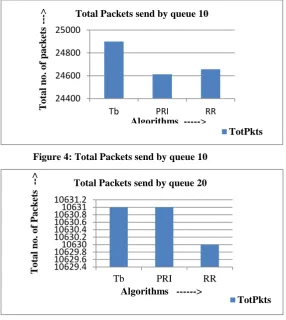
Figure 4: Total Packets send by queue 10
Figure 5: Total packets send by queue 20
24400 24600 24800 25000
Tb PRI RR
Total Packets send by queue 10
TotPkts T o ta l no . o f pa ck et s --->
Algorithms --->
10629.4 10629.6 10629.810630 10630.2 10630.4 10630.6 10630.810631 10631.2
Tb PRI RR
TotPkts T o ta l no. o f P a ck et s -->
© 2015, IJCSMC All Rights Reserved
815
Figure 6: Total packets send by queue 30
Figure 4 shows that TB has maximum capacity to send packets as compared to other algorithms. In figure 5 TB and
PRI both have equal capacity to send packets. Similarly figure 6 show that PRI can send maximum number of packets.
B. TOTAL PACKETS RECEIVED
In thissubsection, we will count the total number of packets received at the receptor nodes such as node 6, node 7 and
node 8. As discussed above in subsection A earlier that queue 10, queue 20 and queue 30 are associated with node 0,
node 1 and node 2 respectively. Likewise queue 11, queue 21 and queue 31 are associated with node 6, node 7 and node
8 respectively.
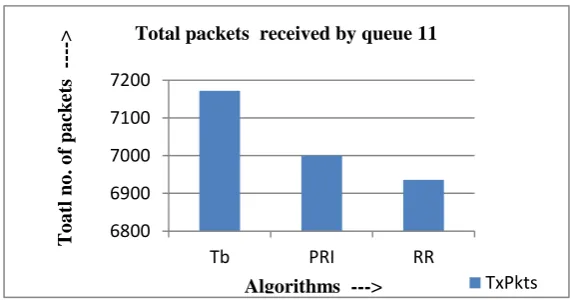
Figure 7: Total packets received by queue 11
10626
10628
10630
10632
Tb PRI RR Total Pakets send by queue 30
TotPkts
T
o
ta
l no
.
o
f
P
a
ck
et
s
--->
Algorithms --->
6800 6900 7000 7100 7200
Tb PRI RR
Total packets received by queue 11
TxPkts
T
o
a
tl no
.
o
f
pa
ck
et
s
---->
© 2015, IJCSMC All Rights Reserved
816
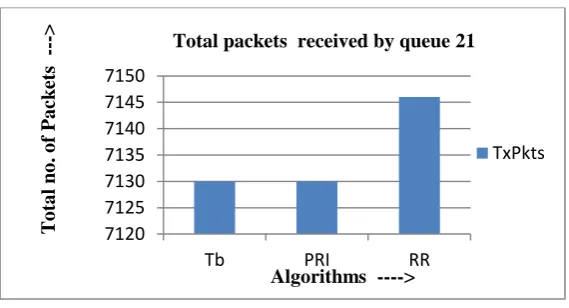
Figure 8: Total packets received by queue 21
Figure 9: Total packets received by queue 31
Figure 7 illustrates that TB have maximum capacity to receive the packets as compared to other. In figure 8 RR
algorithms performed better than other. Whereas, figure 9 shows the results in favor of RR algorithm.
V. CONCLUSION
In this paper we implement the various techniques used in a traffic engineering model to provide QoS, to improve the
performance of real-time traffic in a constrained bandwidth network. The procedures like shaping, marking, metering,
conditioning and classifiers were also studied which help the packet to bring into the level of conformance with an agreed
over service level. We implemented a network topology of nine nodes and compared the results of the algorithms such as
TB, PRI, RR on the basis of parameters like number of packets send, number of packets received and number of packets
lost. Various graphs were drawn for of these parameters and compared the results for the obtained result. 7120 7125 7130 7135 7140 7145 7150
Tb PRI RR
TxPkts T o ta l no . o f P a ck et s --->
Algorithms ----> Total packets received by queue 21
6800 6900 7000 7100 7200 7300
Tb PRI RR
Total packets received by queue 31
TxPkts T o ta l no . o f P a ck et s ---->
© 2015, IJCSMC All Rights Reserved
817
REFERENCES[1] M. Carlson, W. Weiss, S. Blake, Z. Wang, D. Black, and E. Davies. “An architecture for differentiated services. Request
for Comments”, RFC: 2475, December 1998.
[2] R. Braden, L. Zhang, S. Berson, S. Herzog, and S. Jamin, “Resource ReSer-Vation Protocol (RSVP)-Version 1”,
Functional Specification, and Request for Comments: 2205, September 1997.
[3] R. Cruz, “SCED: Efficient Management of quality of service guarantees”, in Proc. IEEE INFOCOM, San Francisco, CA,
pp. 625- 634, March 1998.
[4] S. Wang, D. Xuan, R. Bettai and W. Zhao, “Providing Absolute Differentiated Services for Real-Time Application in
Static-Priority Scheduling Networks”, IEEE INFOCOM, Anchorage, Pages 326-339, Volume 12, Issue 2, April 2001.
[5] B. Davie, A. Charny, J. Bennet, K. Benson, J. L. Boudec, W. Courtney, S. Davari, V. Firoiu, and D. Stiliadis, “An
Expedited Forwarding PHB (Per-Hop Behavior)”, RFC: 3246 by Internet Engineering Task Force, March 2002.
[6] Saurabh Sharma, Manjit Singh, Gurpreet Singh, “Realistic inspection of proposed ant algorithm with ANTNET
algorithm using NS-2”, International Journal of Research in IT, Management and Engineering, Volume 2, Issue 6, Pages
146-156, June 2012.
[7] Sraw Shalu, Singh Gurpreet, Amanpreet Kaur, “A Survey of Multicast Routing Protocols in MANETS”, International
Conference on Futuristic Trends in Engineering & Management 2014 (ICFTEM-2014), Pages 220-224, May 2014.
[8] T. Ahmed, R. Boutaba and A. Mehaoua, ”A Measurement-Based Approach for Dynamic QoS Adaptation in DiffServ
Networks”, Science Direct, Computer Communications, Volume 28, Issue 18, pp. 2020-2033, November 2005.
[9] Shalu Sraw, Gurpreet Singh, “Investigating Diverse Multicast Routing Protocols in MANETs”, in the proceedings of 3rd
National Conference of Advances and Research in Technology (ART-2014) Pages 14.1-14.6, 8-9 March, 2014.
[10] I. McDonald and R. Nelson, “Application-level QoS: Improving Video Conferencing Quality through Sending the Best
Packet Next”, Int. J. Internet Protocol Technology, Volume 4, Number 1, Page 24-31, 2009.
[11] I. Stoica and H. Zhang, “Providing guaranteed services without per flow management”, in Proc. ACM SIGCOMM,
Cambridge, MA, pp. 81-94, August 1999.
[12] C. Dovrolis, D. Stiliadis and P. Ramanathan, “Proportional differentiated services: Delay differentiation and packet
scheduling”, in Proc. ACM SIGCOMM, Cambridge, MA, pp. 109-120, August 1999.
[13] H. Wu, H. Shao, and X. Li, “Enhanced End-system Support for Multimedia Transmission over the Differentiated
Services Network “, LNCS 2093, pp. 235- 244, 2001.
[14] Neha Batla, Amanpreet Kaur, Gurpreet Singh, “Relative Inspection of TCP Variants Reno, New Reno, Sack, Vegas in
AODV”, International Journal of Research in Engineering and Applied Sciences (IJREAS), Volume 4, Issue 5, pages
1-12, May 2014.
[15] K. Park and H. Lee, “On the Effectiveness of Probabilistic Packet Marking for IP Traceback under Denial of Service
Attack,” IEEE INFOCOM, Vol. 1, pp. 338–347, April 2001.
[16] J. Heinanen, F. Baker, W. Weiss, and J. Wroclawski, “Assured Forwarding PHB Group”, RFC 2597 updated to RFC:
3260, April 2002.
[17] K. Nichols, V. Jacobson and L. Zhang, “A two-bit differentiated services architecture for the Internet”, Network
© 2015, IJCSMC All Rights Reserved
818
[18] Singh, G.; Kumar, N.; Verma, A., “ANTALG: An Innovative ACO based Routing Algorithm for MANETs”, Journal of
Network and Computer Applications, Volume 45, Pages 151-167, August 2014.
[19] K. Nichols, S. Blake and D. Black, “Definition of the Differentiated Services Field (DS Field) in the IPv4 and IPv6
Headers," IETF.org, December 1998.
[20] E. O. Oyetunji, A. E. Oluleye,” Performance Assessment of Some CPU Scheduling Algorithms”, Research Journal of
Information Technology, Volume 1, Issue 1, pages 22-26, 2009.
[21] Saroj Hiranwal, K. C. Roy,” Adaptive Round Robin Scheduling using shortest burst approach based on smart time slice”,
International Journal of Computer Science and Communication Vol. 2, Number 2, pp. 319-323, July-December 2011.
[22] K. Nichols, S. Blake and D. Black, " Definition of the Differentiated Services Field (DS Field) in the IPv4 and IPv6
Headers," IETF.org, December 1998.
[23] Neha Batla, Amanpreet Kaur, Gurpreet Singh, “Congestion Control Techniques in TCP: A Critique”, in the proceedings
of 3rd National Conference of Advances and Research in Technology (ART-2014), Pages 45.1-45.5, 8-9 March, 2014.
[24] B. Davie, A. Charny, J.C.R. Bennett, K. Benson, J.Y. Le Boudec, W. Courtney, S. Davari, V. Firoiu and D. Stiliadis,
“RFC 3246: An Expedited Forwarding PHB (Per-Hop Behavior)”, 2002.
[25] Satinder Kaur, Gurpreet Singh “Differentiated services – An Introduction”, International Journal of Innovative Research
![Figure 1: Fields of DS [22]](https://thumb-us.123doks.com/thumbv2/123dok_us/1952214.1256998/3.595.169.428.218.291/figure-fields-of-ds.webp)
![Figure 2: Priority – based algorithm [20]](https://thumb-us.123doks.com/thumbv2/123dok_us/1952214.1256998/4.595.148.474.495.698/figure-priority-based-algorithm.webp)