88 JOHNSON
LITERATURE CITED
ANDERSON, J. P. 1959. Flora of Alaska and adjacent parts of Canada. Iowa State University Press. Ames, Iowa.
BRIGGS, H. M. 1958. Modern breed of livestock. The MacMillan Com- pany, New York.
ELLIOTT, H. W. 1887. Our arctic prov- ince, Alaska and the Seal Islands. Scribners, New York.
GEORGESON, C. C. 1915. Annual re- port of Alaska Agriculture Exper- iment Station for 1914.
PIPER, C. V. 1905. Grasslands of the south Alaska coast. U. S. Dept. of
Agr. Bur. of Plant Indus. Bul. No. 82.
ST~DDART, L. A. AND A. P. SMITH. 1943. Range management. Mc- Graw-Hill Book Company, 547 pp. Pages 213-217.
1933. Annual report of Alaska Agriculture Experiment Station for 1931-32.
Grass Seed Production from Seeded
Range Lands1
‘CHESTER L. CANODE AND J. K. PATTERSON Research Agronomist, U.S. Department of Agriculture, Crops Research Division, Agricultural Research Service and Associate Professor of Agronomy, Washington State University, Pullman, Washington.
lands in the Northwest have been depleted of perennial grasses to the extent that only revegetation with adapted for- age grasses will restore them to their production potential. Al-
Millions of acres of range-
though many problems concern- ing range revegetation remain unsolved, a large amount of in- formation is available on the cul- tural techniques necessary for establishing and maintaining grass under various conditions. Several superior grasses have been developed or selected and seed stocks are available from commercial sources.
At the present time only a small percentage of the range lands are being seeded even though proper cultural practices are generally known and seed is available. The prime reason for this situation appears in the eco- nomics of range seeding. General
pounds of seed per acre to pro- duce adequate grass stands in a reasonable length of time. Seed of improved range grasses from commercial sources costs from $.40 to $1.00 per pound. Narrow recommendations specify 6 to 9
operating margins make it nec- essary for the rancher to reduce seeding cost.
Records of the Idaho State Of- fice, Bureau of Land Manage- ment, U. S. Department of the Interior2, indicate the potential of seed production from range seedings. This agency secured 990,000 pounds of seed of crested wheatgrass (Agropyron des- ertorum (Fisch.) Schult.) and a small quantity of intermediate wheatgrass (Agropyron interme- dium (Host) Beauv.) seed during the years of 1956 and 1957 from range lands seeded in South-cen- tral Idaho. Yields for these 2 years averaged approximately 50 pounds of clean seed per acre, without fertilization, in an area receiving between 8 and 10 inches of annual precipitation (Figure 1). The seed was har- vested on a contract basis with the price for clean sacked seed in 1956 ranging from $0.16 to $0.22 per pound. In 1957 the av- erage contract price for harvest- ing was $0.13 per pound for clean seed. As a general policy, the Bureau retains all the seed har- IScientific Paper No. 2006, Washing-
ton Agricultural Experiment Sta- tions, Pullman, Washington. Co- operative investigations, Crops Re- search Division, ARS, USDA, and Washington Agricultural Experi- ment Stations.
2PersonaZ communication from Mr. Joe T. Fallini, State Supervisor, Idaho State Office, Bureau of Land Management, U.S. Department of Interior, Boise, Idaho.
vested for the seeding of federal range lands.
The research reported here was designed to determine the feasibility of producing seed from seeded ranges to provide an economical source of seed and in some instances to provide a cash income crop to pay a portion of the seeding costs.
Methods
The study was located on the McGregor Land and Livestock Company Ranch at Hooper, Washington at an elevation of approximately 1,500 feet. The soil was a silt loam overlying basalt rock to a depth of about 3 feet. Precipitation averaged from 12 to 13 inches with 3 to 4 inches being received during the growing season.
In the fall of 1951, crested wheatgrass was seeded at a rate of approximately 6 pounds per acre in rows l-foot apart. In the fall of 1952, the area was divided into 8 x 20 foot plots and treated with ammonium nitrate at 0, 20, 40, 60, and 80 pounds of nitrogen per acre. Fertilizer treatments were replicated three times and the same rate applied to the des- ignated plot each fall during the remainder of the experiment. Seed yields were taken in 1953, 1954, 1956, and 1957. The plots were not harvested in 1955 be- cause of excessive shatter.
FIGURE 1. Crested wheatgrass seeding near Hollister, Idaho, harvested for seed on the left and not harvested for seed on the right. Picture courtesy of the Idaho State Office, Bureau of Land Management, U.S. Department of Interior.
periment was also l-foot. Each plot was split in the fall of 1956 and one-half received 40 pounds and the other half received 60 pounds of actual nitrogen per acre. Seed yields harvested in 1957 indicated no differences in the two fertilizer treatments, therefore, the area was uni- formly fertilized at the rate of 50 pounds of nitrogen per acre in the fall of 1957 and 1958.
During 1958 the variety nurs- ery was invaded by cheatgrass
(Bromus tectorum L.) which re- sponded to the fertilizer treat- ments. As a result, no seed could be harvested from any of the seeded varieties. The nursery was burned in the fall of 1958 to remove the excess vegetation due to cheatgrassand to re- duce rodent damage. One-half of each plot was sprayed in the spring of 1959 with 4 pounds of Isopropyl N-phenylcarbamate
(IPC) per acre for cheatgrass control.
Results
The crested wheatgrass seeded in the fall of 1951 established
good stands during 1952. The yields for 1953 (Table 2) indicate the desirability of harvesting at least one seed crop before using a seeding for grazing. Even the plots that received no nitrogen produced 219 pounds of clean seed per acre. The 40 pound rate of nitrogen gave a significant and economical increase in seed yield (505 pounds per acre) over
the plots that received no fertili- zation. Rates of nitrogen over 40 pounds per acre stimulated the vegetative growth (Table 3) in 1953, evidently to the point of being detrimental to seed pro- duction.
Data in Table 2 show the re- duction in seed yields as the stand of grass became older. It is evident that without nitrogen fertilization only one or two good seed crops could be har- vested in this area. However, with as little as 40 pounds of ni- trogen per acre even the fourth seed crop (1956) produced over 400 pounds of clean seed per acre. It should be noted that the 60 and 80 pounds of nitrogen per acre resulted in higher seed yields than the 40 pounds appli- cation as the stands become older (1956 and 1957).
Variefy and Species Evaluation The variety or strains of the different species used in the sec- ond experiment and the percent of stand for each are given in Table 1. The 1956 season was very favorable, with above av- erage precipitation, 15.16 inches for the year. All adapted species should have established good stands. Five entries of the 15 planted made good stands but only 4 of the 5 were harvested in 1957 since the Russian wild-rye
Table 1. Stands of varieties and sirains of grasses at the end of fhe first year of growih.
Strain or variety* Ky 31 tall fescue Alta tall fescue
Manchar smooth brome Lincoln smooth brome P-2447 Russian brome P-2517 hard fescue P-9839 Amur wheatgrass
Greenar intermediate wheatgrass Alkar tall wheatgrass
Sodar streambank wheatgrass Topar pubescent wheatgrass Whitmar bluebunch wheatgrass P-27 Siberian wheatgrass Nordan crested wheatgrass PI 75-737 Russian wild-rye
Scientific Name
Estimated Acre Stand Festuca elatior var arundinacea 40 Festuca elatior var arundinacea 30
Bromus inermis 50
Bromus inermis 30
Bromus tomentellus 50
Festuca ovina var duriuscula 60
Agrop yron intermedium 50
A. intermedium 50
A. elongatum 10
A. riparium 80
A. trichophorum 40
A. inerme 70
A. sibericum 100
A. desertorum 100
E 1 ymus junceus 100
*P-Plant Material Center, Pullman, Washington
90 CANODE AND PATTERSON
Table 2. Seed yield of crested wheafgrass planted in rows one foot apart in fall of 1951.
Pounds
N per acre
Clean seed per acre* each pound of N of seed for
1953 1954 1956 1957 Ave. over 0
(Pounds) - - - (Pounds) - - - - -
0 219 102 91 47 115
20 322 182 159 53 179 3.2
40 505 266 412 123 326 5.2
60 369 210 471 147 299 3.1
80 451 136 614 150 338 2.8
- - - ~
Average 373 179 349 104 251
LSD 051 NS NS 176 NS 92
C. V. (Percent)2 37 33 27 50 19
* Seed was not harvested in 1955 because of high losses due to shattering. 1 Least significant difference
2 Coefficient of variation
(Elymus junceus Fisch.) pro- duced only a few seed heads in each plot.
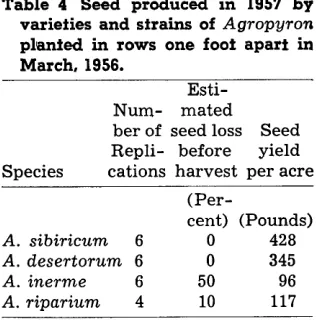
The data in Table 4 further demonstrate the seed production potential of crested wheatgrass from range seeding. Siberian wheatgrass (Agropyron s i b i r i- cum (Willd.) Beauv.) appeared to be superior in seed production
(428 pounds per acre) compared with crested wheatgrass (345 pounds per acre) in this trial. Whitmar bluebunch wheatgrass
(Agropyron inerme (Scribn. & Smith) Rybd.) produced 96 pounds of seed per acre, even af- ter serious seed loss due to shat- tering. Sodar streambank wheatgrass (Agropyron ripar- ium (Scribn. & Smith), which is considered a soil conservation grass, but not a good forage spe- cies, also performed well in the first harvest year by producing 117 pounds of seed per acre.
The IPC application made in the spring of 1959 was only par- tially effective in controlling cheatgrass. But since this weedy grass did not become a problem that season, it can be eliminated as a major factor affecting 1959 seed production. The data in Table 5 indicate that the IPC did not reduce seed production be- cause of chemical damage. Al- though chemicals for cheatgrass control are not economical for range use, there may be situ-
ations where their use would be economical in seed production under the more favorable soil and climatic conditions on range seedings. It should be noted that both Siberian and crested wheat- grass produced over 150 pounds of seed per acre in 1959, the fourth year of growth. None of the other varieties or strains pro- duced seed worth harvesting in 1959.
In an area adjacent to the test reported above, an eight-year- old stand of intermediate wheat- grass (Agropyron intermedium) planted in 3-foot rows was badly damaged by a soil sterilant used for cheatgrass control in Febru- ary of 1958. The intermediate wheatgrass recovered with ap- proximately one-half of the plants left, and in 1959 produced an average of 206 pounds of
clean seed per acre compared with 25 pounds of seed in plots where the cheatgrass had been controlled with 4 pounds of IPC per acre without injury to the intermediate wheatgrass. The check plots in this experiment where cheatgrass was allowed to grow produced only 18 pounds of clean seed per acre.
Discussion
The seed yields of crested wheatgrass and other species of Agropyron presented in this pa- per point out the possibility of producing seed from range seed- ings. In many areas of the north- west a rancher could start with a small seeding of an improved range grass on his best range land and produce enough seed in two to three years to seed a large acreage. The larger area in turn should produce seed at least once. Any surplus seed produced above the amount needed for seeding his own ranch could, in some instances, be used as a cash crop to help defray the cost of his seeding program.
Under many circumstances, it would be economical to use mar- ginal or sub-marginal wheat lands for producing seed needed for seeding ranges. Land of the type used in this research is gen- erally considered range land, however, this type of land is sometimes used for wheat and barley production. Wheat pro- duces approximately 30 bushels per acre under these conditions on a wheat-summer-fallow rota-
Table 3. Forage yields of crested wheaigrass planted in rows one foot apart in the fall of 1951.
N Oven-dry forage per acre
per acre 1953 1954 1956 1957
(Pounds) ----__- (Pounds)---
0 2,130 1,050 1,120 970
20 2,680 1,450 1,150 990
40 . 3,350 2,160 2,550 1,590
60 4,020 2,390 3,420 2,040
80 4,180 2,570 3,680 3,050
Average 3,270 1,920 2,380 1,730
LSD 051 1,520 560 990 1,180
C.V. (Percent):! 25 16 22 24
Table 4 Seed produced in 1957 by varieties and strains of Agropyron plcanfed in rows one fooi apart in March, 1956.
Esti- Num- mated
ber of seed loss Seed Repli- before yield Species cations harvest per acre
(Per-
cent) (Pounds)
A. sibiricum 6 0 428
A. desertorum 6 0 345
A. inerme 6 50 96
A. riparium 4 10 117
tion.
In a 4 year period wheat
could be expected to produce a
total of 60 bushels per acre.
Over the same period, crested
wheatgrass supplied
with 40
pounds of nitrogen
per acre
would produce about 900 pounds
of clean seed per acre. This al-
lows 1 year for establishment of
the grass and 3 years of produc-
tion at 300 pounds per acre each
year. Based on the price of
wheat at $1.75 per bushel and
crested wheatgrass at $0.20 per
pound to the grower, the income
from wheat on this land for the 4
year period would be $105.00 per
acre compared with $180.00 for
the crested wheatgrass seed. If
the rancher had to purchase this
grass seed on the commercial
market probable cost would be
about $0.40 per pound.
This
gives the 900 pounds of crested
wheatgrass
seed a value of
$360.00 for the 4 year period for
each acre in production.
Even under more adverse soil
or climatic conditions it would.
appear that seed production
from range seedings averaging
between 50 and 100 pounds of
clean seed per acre would be
profitable if the seed was used
by the rancher for seeding his
own ranges. In the interest of
good range management, it is
advisable to defer grazing on
new seedings until at least the
second fall after planting in or-
der to insure good establishment.
Consequently, no use would be
made of the range during the
season the first seed crop was re-
moved. Under these conditions
the only added expense
that
could be directly chargeable to
seed production would be for
combining and cleaning.
The
records of the Bureau of Land
Management in Idaho demon-
strate that even on a contract
basis grass seed can be combined
and cleaned economically. Many
ranches have their own com-
bines that could be used with
minor adjustments
to harvest
the grass seed crop which would
reduce the cost considerably. If
the seed were used on the pro-
ducers’ own ranges, cleaning
could consist of a simple scalping
operation to remove only the
larger straw and foreign mate-
rial so the seed would flow read-
ily through a drill.
Care should be exercised to
avoid harvesting any areas in-
fested with noxious or trouble-
some weeds.
Common weed
seeds such as cheatgrass may oc-
cur in such abundance in the
seed harvested from range re-
seedings as to keep the product
from being qualified for the
commercial market or may in-
crease cost of cleaning to meet
market specifications. However,
if the rancher uses the seed on
his own range lands, a small
amount of common weed seed
may not be detrimental enough
to warrant the extra expense for
removing them by cleaning.
In addition to the possibility
of providing
an economical
Table 5. Seed produced in 1959 by crested and Siberian wheafgrass planted in rows one foot apart in 1956, with one-half of each plot treated with IPC for cheafgrass control in the spring of 1959.
Clean seed per acre*
Variety Not IPC
or Strain treated 4 lbs/acre - - (Pounds) - - Nordan crested
wheatgrass 167 179
P-27 Siberian
wheatgrass 177 196
* Average of four replications, ex- cept only three replications for non-treated Siberian wheatgrass.
source of seed for increased
range seeding, the practice of
taking at least one seed crop has
at least three other desirable
aspects in range management.
Delaying grazing on the new
range seedings until at least one
seed crop has been produced in-
sures good establishment of the
plants before grazing. Removal
of the seed heads of the second
or third year of growth leaves
the range area in a more uniform
condition from the standpoint of
old straw and is conducive to
more uniform grazing when the
area is actually put into range
use. The stubble height es-
tablished by the combine can be
used to regulate the height of
grazing in subsequent seasons
since animals usually are hesi-
tant in grazing forage that is
mixed with the old stubble.
Summary
Three experiments conducted
at Hooper, Washington under 12
to 13 inches average precipita-
tion at an elevation of about
1500 feet demonstrate the feas-
ibility and desirability of pro-
ducing seed from range seedings
before using them as grazing
units.
Under the conditions of this
experiment, crested wheatgrass
produced an economical crop of
seed (219 pounds per acre) in
the second growing season with-
out nitrogen fertilization. With
an application of 20 pounds of
nitrogen per acre, yields averag-
ing 179 pounds per acre were ob-
tained for the 4 years harvested.
Forty pounds of nitrogen per
acre produced an average of 326
pounds of clean seed per acre per
year over the 4 year period.
92 CANODE AND PATTERSON
growing season. Siberian wheat- grass and crested wheatgrass produced 428 and 345 pounds of clean seed per acre, respectively. Sodar streambank wheatgrass produced 117 pounds of seed after a slight loss by shattering. Whitmar bluebunch wheatgrass
produced 96 pounds after loosing a 1 m o s t half of the seed by shattering. These four wheat- grasses did not produce enough seed for harvest in the third year due to competition from cheat- grass. In the fourth year, crested and Siberian wheatgrasses pro-
duced an average of 180 pounds of clean seed per acre.
Another experiment indicated t h a t intermediate wheatgrass would produce good seed yields under limited rainfall if grown in thin, uniform stands on deeper soils.
Comparison of Coastal and Common Bermuda-
Grass on a Shallow Droughty Soil1
E. R. BEATY, D. D. HAYES AND R. A. McCREERY
Assistant Professor of Agronomy; Superintendent, Northwest Georgia Branch Experiment Station, Cal- houn, and Assistant Agronomist, University of Georgia.
Common bermudagrass (Cyno- don dactylon (L.) Pers.) has long been a pest in the dominant row crop economy of Southeast- ern United States. Decrease of cotton acreage in recent years has made more land available for herbage production. Common bermudagrass readily becomes established when row crops are discontinued. More herbage has led to a rapid increase in beef cattle numbers.
In 1959, the South, excluding Texas and Oklahoma, was re- ported to have 18 percent of the nations beef cattle, (Hughes, 1959). The “Cattle States” of the west supported 21 percent. From a rate of increase viewpoint, the South’s beef cattle numbers here increased at a rate almost twice that of the national average.
Long summer growing seasons with ample possibilities for fall and winter grazing have pro- vided opportunity for animal production based on a grassland agriculture.
Herbage management prob- lems in the South are rather di- verse. In some pastures a stock- ing rate in excess of one animal per acre is followed while in ad-
IJournal Paper No. 127 of the Col- lege Experiment Station of the Uni- versity of Georgia, College of Agri- culture Experiment Stations.
joining areas one animal may graze 50 or more acres (Williams et. al. 1955). Management of grasslands changes from season to season as the stocking rate fluctuates.
A satisfactory herbage grass must be one that is persistant, responsive to varying levels of fertilizer applications and is drought resistant. Coastal ber- mudagrass was developed to fill these and other needs. Coastal bermudagrass has been found to be much higher yielding than common bermudagrass in the Coastal Plain and Piedmont re- gions of the Southeast (Adams and Stelly, 1958; Beaty, 1954; Burton, 1954). These compari- sons have been made on the deep more sandy and better aerated soils which are generally used for row crop production. Since the limited areas of good soils are used for row crops, herbage production is likely to be rele- gated to the marginal soils. Coastal bermudagrass produc- tion data are lacking, yet are badly needed, on these latter soils.
The purpose of this study was to compare common bermuda- grass with Coastal bermudagrass when grown on a shallow, eroded, droughty yet poorly drained soil and with varying levels of fertilizer.
Methods and Materials The experiment was conducted on Montevallo shaley silt loam, a lithosol, which occurs widely in the Georgia portion of the Limestone Valley and Upland soil province. It is generally con- sidered to be a very poor agri- cultural soil characterized by a shallow and poorly drained top- soil overlying the subsoil, start- ing at a depth of 6 to 8 inches which is incompletely decom- posed shale. The area selected had a 3 to 5 percent slope and severe sheet erosion. When the experiment was initiated, in 1954, the soil reaction was pH 6.0, the soil was low in available phosphorus and medium in avail-
able potassium according to soil tests.
The bermudagrass sprigs were planted on two-foot centers with portions of the stems uncovered. Fertility treatments were ap - plied about 45 days after estab- lishment of the grass in 1954 and a uniform application of 600 pounds of 4-12-12 was made in May 1955. Two years (1954 and 1955) were required to obtain a uniform sod area for plot trials.