Association for Information Systems
AIS Electronic Library (AISeL)
AMCIS 2001 Proceedings
Americas Conference on Information Systems
(AMCIS)
12-31-2001
Outsourcing Tools for IT
Wai-Ho Au
The Hong Kong Polytechnic University
Hareton Leung
The Hong Kong Polytechnic University
Keith Chan
The Hong Kong Polytechnic University
Ming-Shu Li
Chinese Academy of Science
Follow this and additional works at:
http://aisel.aisnet.org/amcis2001
This material is brought to you by the Americas Conference on Information Systems (AMCIS) at AIS Electronic Library (AISeL). It has been accepted for inclusion in AMCIS 2001 Proceedings by an authorized administrator of AIS Electronic Library (AISeL). For more information, please contact
Recommended Citation
Au, Wai-Ho; Leung, Hareton; Chan, Keith; and Li, Ming-Shu, "Outsourcing Tools for IT" (2001).AMCIS 2001 Proceedings.Paper 357.
Wai-Ho Au
Laboratory for Software Development and
Management
The Hong Kong Polytechnic University
[email protected]
Hareton K. N. Leung
Laboratory for Software Development and
Management
The Hong Kong Polytechnic University
[email protected]
Keith C. C. Chan
Laboratory for Software Development and
Management
The Hong Kong Polytechnic University
[email protected]
Ming Shu Li
Institute of Software
Chinese Academy of Science
Abstract
IT outsourcing is concerned with contracting technology services to an external organization. Although IT outsourcing can provide many potential advantages, it is a risky business venture such that it may also result in serious negative consequences. In order to obtain the potential benefits of IT outsourcing, an organization should adopt a systematic methodology for IT sourcing management. It can also use automated tool to better manage outsourced projects. In this paper, we review two off-the-shelf IT outsourcing management tools, especially for software development and maintenance. We evaluate the tools against a method, which provides a guideline for an organization to manage outsourcing of software development and maintenance to a third party. In this method, the outsourcing of software development and maintenance projects involves six phases: planning, analysis, design, implementation, operations, and termination. We identify the key activities and evaluate the outsourcing management tools against these activities in each of these phases.
Keywords: Outsourcing management tools, outsourcing management, software development, software maintenance
Introduction
Information technology (IT) outsourcing is concerned with the strategic use of outside resources to perform IT operations, which are originally handled by internal staff and resources. It has been reported in (Huff 1991), (Saunders et al. 1997) that IT outsourcing can reduce operating costs by a substantial amount. According to the Outsourcing Institute, a professional association and executive network with a mission to provide timely information and services on outsourcing and related sourcing strategies, IT outsourcing also allows an organization to share risks with outsourcing partners and gain access to world-class IT capabilities. Furthermore, outsourcing IT infrastructure tasks also permits the organizations to concentrate at core competencies, product development, and other concerns more directly related to revenue development (Goth 1999). It is for these reasons that many organizations consider IT outsourcing as a means to remain competitive.
Although IT outsourcing has enormous advantages, it is a risky business venture and it may result in a number of negative consequences such as hidden transaction and management costs, costly contractual amendments, diminished quality of service, and loss of expertise, etc. (Earl 1996). It is important to note that the negative consequences do not mean IT outsourcing is bad. It only indicates that IT outsourcing is one of the risky business ventures and an effective methodology is required to manage IT outsourcing projects so that the potential benefits can be obtained.
Among IT outsourcing projects, a recent study (Goth 1999) has estimated that money spent on software application development and maintenance will be increased by 55% in a five-year time from 1998 to 2003. Owing to the dramatic increase in budgets,
IT Management
there is a rise in the demand of methods for effectively managing outsourcing of software development and maintenance. Additionally, an organization can better manage outsourced projects using automated tools.
In this paper, we review two off-the-shelf outsourcing management tools for software development and maintenance. We evaluate the tools against a method developed in (Au et al. 2000) for service requesters to manage the outsourcing of software development and maintenance projects. The outsourcing of software projects comprises a number of phases including planning, analysis, design, implementation, operations, and termination. The planning phase includes activities to determine which projects should be outsourced. The analysis phase consists of activities to select appropriate external software houses. The design phase comprises activities to prepare a contract between the service requester and external software houses. The implementation phase is composed of activities to transit from in-house provision of services to outsourcing. The operation phase involves activities to manage the outsourcing relationship. The termination phase includes the activities to test the final software products and to negotiate another contract with the software house or a new contract with another software house at the end of the contract. We identify the key activities and evaluate the outsourcing management tools against these activities in each of these phases. The rest of this paper is organized as follows. In Section 2, we provide an overview of the method for managing outsourcing of software development and maintenance projects. In Section 3, we describe how we identify and select the outsourcing management tools for evaluation. In Section 4, we evaluate the tools against the key activities in each phase of the outsourcing management method. Finally, we conclude this paper with a summary in Section 5.
An Overview of Outsourcing Management
In this section, we describe a method developed in (Au et al. 2000) for managing the outsourcing of software development and maintenance. This method provides a means for service requesters to manage the outsourcing of software projects. It covers all phases of software outsourcing, from the initial sourcing decision, to the management of the outsourcing relationship, to its termination. Our method is based on the following principles that underlay all phases and activities.
• The results of outsourcing are dependent on different circumstances. An outsourcing arrangement that is best for one organization may not be appropriate for other organizations.
• There is a strong relationship between outsourcing and information planning and strategy. The objectives of outsourcing should align with the business objectives of the organization.
• The outsourcing arrangement should be implemented systematically. A methodology that describes the various steps to be performed should be adopted.
• Successful outsourcing arrangements focus on results. These results should be objective, measurable, quantifiable, and comparable against pre-established criteria.
• The performance should be monitored regularly, and appropriate corrective actions should be taken when necessary. In this method, an organization determines which projects should be outsourced at the beginning (the planning phase). When it has been decided that a project will be outsourced, the organization will select a software house for outsourcing (the analysis phase). Once a software house is selected by the organization, a contract will be produced upon their mutual agreement (the design phase). Upon the agreement of the contract, the organization will transfer the business logic, system design, documentation, etc. to the software house so that it can work on the software project (the implementation phase). In the process of developing the software, the organization keeps on monitoring the progress and managing the outsourcing relationship (the operations phase). At the end of the contracting period, the organization will test the final software products and make a decision to negotiate another contract with the software house or a new one, and the cycle repeats (the termination phase).
The Planning Phase
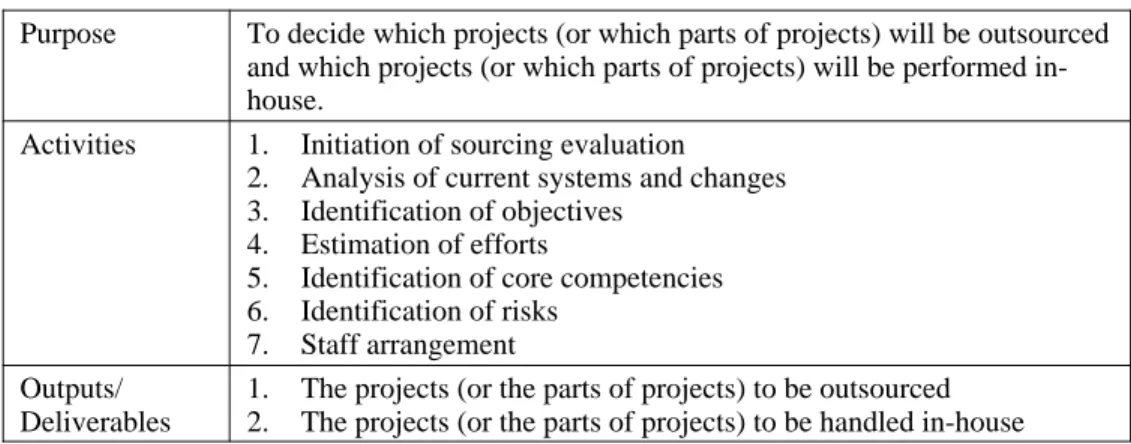
In the planning phase, an organization will determine which projects will be outsourced and which projects will be handled in-house. The details for this phase are shown in Figure 1 below.
Purpose To decide which projects (or which parts of projects) will be outsourced and which projects (or which parts of projects) will be performed in-house.
Activities 1. Initiation of sourcing evaluation
2. Analysis of current systems and changes 3. Identification of objectives
4. Estimation of efforts
5. Identification of core competencies 6. Identification of risks
7. Staff arrangement Outputs/
Deliverables
1. The projects (or the parts of projects) to be outsourced 2. The projects (or the parts of projects) to be handled in-house
Figure 1. The Activities and Deliverables of the Planning Phase
The Analysis Phase
In the analysis phase, the organization should select a software house for outsourcing software development and maintenance. The details for this phase are given below (Figure 2).
Purpose To select a software house as service provider for a software development and maintenance project to be outsourced. Activities 1. Preparation of request for proposal
2. Identification of potential service providers 2. Distribution of request for proposal 4. Determination of criteria
5. Selection of service provider Outputs/
Deliverables
1. The software house to which the project will be outsourced
Figure 2. The Activities and Deliverables of the Analysis Phase
The Design Phase
In the design phase, the organization designs the outsourcing relationship with the selected software house and negotiates with the selected software house to produce a contract. Figure 3 shows the activities and deliverables of the design phase.
Purpose To design the outsourcing relationship with the selected software house. Activities 1. Determination of outsourcing relationship
2. Determination of contract type 3. Preparation of contracts Outputs/
Deliverables
1. The outsourcing contract between the organization and the service provider (i.e. the selected software house)
Figure 3. The Activities and Deliverables of the Design Phase
The Implementation Phase
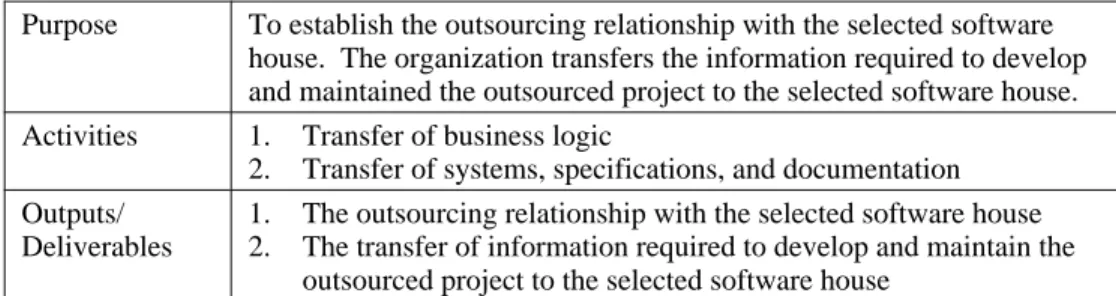
In the implementation phase, the outsourcing relationship is established between the organization and the software house. The activities involved in this phase are shown in Figure 4.
IT Management
Purpose To establish the outsourcing relationship with the selected software house. The organization transfers the information required to develop and maintained the outsourced project to the selected software house.
Activities 1. Transfer of business logic
2. Transfer of systems, specifications, and documentation Outputs/
Deliverables
1. The outsourcing relationship with the selected software house 2. The transfer of information required to develop and maintain the
outsourced project to the selected software house
Figure 4. The Activities and Deliverables of the Implementation Phase
The Operations Phase
In the operations phase, the outsourcing relationship with the software house is managed and any maintenance or changes in the outsourcing relationship are negotiated and implemented. Figure 5 shows the activities and deliverables of the operations phase.
Purpose To manage the outsourcing relationship with the selected software house.
Activities 1. Measurement of compliance to requirements
2. Enforcement of compliance Outputs/
Deliverables
1. The software product compliant with the requirements
Figure 5. The Activities and Deliverables of the Operations Phase
The Termination Phase
In the termination phase, the outsourcing relationship is terminated because of the end of the contracting period or the early termination of the contract. The termination phase should be carried out in a way that causes the least possible disruption and ensures a smooth transition to the new situation. The details of the termination phase are given in Figure 6 below.
Purpose To minimize the possible disruption and ensure a smooth transition to the new situation when the contracting period ends or the contract is terminated.
Activities 1. Preparation for early termination
2. Evaluation of final software products Outputs/
Deliverables
3. Starting evaluation of another contract with the selected software house or another software house.
Figure 6. The Activities and Deliverables of the Termination Phase
Outsourcing Management Tools
We have identified two off-the-shelf outsourcing management tools in the market. In this section, we summarize their functionalities and describe how they can be used in managing outsourcing of software development and maintenance projects.
FM-1
FM-1 (Formation Consulting Ltd. 1997) is a toolset for planning and managing IT outsourcing projects. Its outsourcing management model consists of eight stages, namely, (i) project initiation, (ii) internal assessment, (iii) external assessment, (iv)
proposal acquisition, (v) vendor selection, (vi) agreement finalization, (vii) service implementation, and (viii) project closure. The activities involved in each stage are summarized in Figure 7.
Tabular Format (TF!)
Tabular Format (TF!) (Acquisition Services Consulting Group, Inc. 1992) is a tool employing a disciplined and structured approach to contracting for services. It enforces (i) a rigorous definition of the required services, (ii) a disciplined and timely assessment of responses, and (iii) a comprehensive process for contract and relationship management. The activities supported are summarized in Figure 8.
Evaluation of Outsourcing Management Tools
In this section, we evaluate the features of the outsourcing management tools we described in Section 3 against the approach we reported in Section 2. The evaluation is summarized in Figure 9. As shown in Figure 9, FM-1 is able to support more phases of the approach when compared to TF!. Unfortunately, none of them can support all the phases of the approach. Both tools provide strong support of the analysis phase. FM-1 also provides good support of the implementation. We are still in lack of an outsourcing management tool, which supports all the phases.
Stage Activities
Project Initiation 1. Define project scope.
2. Design project plan and budgeting. 3. Prepare business case.
4. Prepare stage schedule. 5. Arrange project organization. 6. Define project control procedures.
Internal Assessment 1. Define outsourcing scope.
2. Assess situations. 3. Define financial model.
4. Consolidate investigation results. 5. outsourcing options.
6. Approve outsourcing options.
External Assessment 1. Perform market survey.
2. Define evaluation criteria. 3. Evaluate vendors.
4. Approve vendor evaluation.
Proposal Acquisition 1. Prepare Request for Proposal (RFP).
2. Define evaluation criteria.
Vendor Selection 1. Evaluate proposals.
2. Vendor presentations. 3. Reference visits. 4. Select vendor.
5. Approve vendor selection. Agreement Finalization 1. Produce initial agreement.
2. Negotiation cycle. 3. Approve agreement.
Service Implementation 1. Prepare Service Level Agreement.
2. Service reporting. 3. Service management.
4. Implementation and hand over.
Project Closure 1. Evaluate transition project.
2. Project completion. 3. Process improvement.
IT Management
Stage Activities/
SOW Development 1. Prepare Statement of Work (SOW).
Biddable RPF 1. Prepare Request for Proposal (RPF) for potential vendors to
bid the project.
2. Define evaluation criteria.
Evaluation of Bids 1. Evaluate proposals.
Implementation and Management
1. Implement and manage the outsourced project. Monitoring and
Performance Reporting
1. Monitor the performance of the selected vendor.
Contract Re-let 1. Project completion.
2. Decide to renew the contract or not.
Figure 8. Project Stages of TF!
Conclusions
In this paper, we described a method, which provides a guideline for an organization to manage outsourcing of software development and maintenance to a third party. The method involves six phases: planning, analysis, design, implementation, operations, and termination. We identified the key activities. Furthermore, we provided a survey of off-the-shelf IT outsourcing management tools, especially for software development and maintenance. We then evaluated the tools against the method. Some of these tools support more phases of the method than others. However, none of them can support all the phases. We are still in lack of an outsourcing management tool, which supports all the phases of the method.
FM-1 TF!
Planning
1. Initiation of sourcing evaluation
2. Analysis of current systems and changes 3. Identification of objectives
4. Estimation of efforts
5. Identification of core competencies 6. Identification of risks 7. Staff arrangement No Yes No Yes No Yes Yes No No No No No No No Analysis
1. Preparation of request for proposal
2. Identification of potential service providers 3. Distribution of request for proposal 4. Determination of criteria
5. Selection of service provider
Yes Yes Yes Yes Yes Yes Yes Yes Yes Yes Design
1. Determination of outsourcing relationship 1. Determination of contract type
3. Preparation of contracts Yes No Yes No No No Implementation
1. Transfer of business logic
2. Transfer of systems, specifications, and documentation
Yes Yes
No No Operations
1. Measurement of compliance to requirements 2. Enforcement of compliance Yes No Yes No Termination
1. Preparation for early termination 2. Evaluation of final software products
No Yes
No Yes
References
Acquisition Services Consulting Group, Inc., “Tabular Format (TF!),” http://www.ascginc.com/tf.html, 1992.
Au, W.-H., Leung, H.K.N., and Chan, K.C.C., “Outsourcing Management for Software Development and Maintenance,” in Proc. of the Int’l Software Development & Management Conf., Hong Kong, 2000, pp. 313-323.
Aubert, B.A., Rivard, S., and Patry, M., “A Transaction Cost Approach to Outsourcing Behavior: Some Empirical Evidence,” Information & Management, vol. 30, pp. 51-64, 1996.
Collins, J., and Millen, R., “Information Systems Outsourcing by Large American Firms: Choices and Impacts,” Information Resources Management Journal, Winter 1995.
Dedene, G., and De Vreese, J.-P., “Realities of Off-Shore Reengineering,” IEEE Software, vol. 12, no. 1, pp. 35-45, 1995. Earl, M.J., “The Risks of Outsourcing IT,” Sloan Management Review, pp. 26-32, Spring 1996.
Formation Consulting Ltd., “FM-1: Outsourcing Tools for Project Managers,” http://www.formation-consulting.co.uk/, 1997. Goth, G., “The Ins and Outs of IT Outsourcing,” IT Professional, vol. 1, no. 1, pp. 11-14, 1999.
Huff, S., “Outsourcing of Information Services,” Business Quarterly, pp. 62-65, Spring 1991.
Judenberg, J., “Applications Maintenance Outsourcing: An Alternative to Total Outsourcing,” Information Systems Management, pp. 34-48, Fall 1994.
Ketler, K., and Willems, J.R., “A Study of the Outsourcing Decision: Preliminary Results,” in Proc. of the ACM SIGCPR Conf. on Computer Personnel Research, New Orleans, LA, 1999, pp. 182-189.
Khandelwal, V.K., and Ferguson, J.R., “Critical Success Factors (CSFs) and the Growth of IT in Selected Geographic Regions,” in Proc. of the 32nd Annual Hawaii Int’l Conf. on System Sciences, 1999, pp. 1-13.
Marcolin, B.L., and McLellan, K.L., “Effective IT Outsourcing Arrangement,” in Proc. of the 31st Annual Hawaii Int’l Conf. on System Sciences, 1998, pp. 654-665.
Nam, K., Rajagopalan, S., Rao, H.R., and Chaudhury, A., “A Two-Level Investigation of Information Systems Outsourcing,” Communications of the ACM, vol. 39, no. 7, pp. 36-44, 1996.
Saunders, C., Gebelt, M., and Hu, Q., “Achieving Success in Information Systems Outsourcing,” California Management Review, pp. 63-79, Winter 1997.