Evaluation of Selection Algorithms for
Simultaneous Layout and Pipe Size
Optimization of Water Distribution Networks
M.H. Afshar1
In this paper, a genetic algorithm is presented for the simultaneous layout and pipe size optimization of water distribution networks and its eciency is evaluated and compared using dierent selection mechanisms. An engineering concept of reliability is used, in which the number of independent paths from source nodes to each of the demand nodes is considered as a measure of reliability. The method starts with a predened layout, which includes all possible links. The method is capable of designing a layout of predened reliability, including tree-like and looped networks. It is shown that a layout optimization of a network, followed by size optimization, does not lead to an optimal or a near-optimal solution. This emphasizes the need for simultaneous layout and size optimization of networks, if an optimal solution is desired. The performance of the method for layout optimization of pipe networks is tested against two benchmark examples in the literature and the results are presented.
INTRODUCTION
Pipe networks are an essential part of the world's infrastructure. The construction and operation of these networks, as it is for gas, sewer, irrigation, elec-tricity and communication networks, are very costly. A relatively small decrease in the construction and component cost of these networks, therefore, leads to a huge total saving. These can be considerably reduced through optimal design of the networks. Optimization of water distribution networks is a multidisciplinary task, involving hydraulics, quality, reliability and avail-ability of the components' requirements. In spite of all the progress made, the optimization of pipe networks fullling all these requirements seems to be out of reach at the present time. Most of the current investigations are, therefore, restricted to considering the hydraulic and availability requirements, leading to the so-called optimal pipe sizing of the pipe networks. The reliability requirement is usually addressed by considering a pre-dened xed, usually looped, layout for the networks to be designed [1-7]. All these investigations neglect the inuence of the layout on the pipe sizing of the pipe networks.
1. Department of Civil Engineering, Iran University of Science and Technology, Tehran, I.R. Iran.
Some researchers, on the other hand, have ad-dressed the layout geometry optimization of the pipe networks, neglecting the inuence of the pipe sizing on layout determination. Early work in this area focused on branched networks, which are of little use in water distribution networks, due to poor reliability. Walters and Lohbeck [8] proposed two Genetic Algo-rithms (GA) using binary and integer coding for layout determination of tree-like networks and compared their storage and computation time requirements with those of dynamic programming. Davidson and Goulter [9] proposed an evolution programming method for layout optimization of rectilinear branched networks. They replaced crossover and mutation of the GA with two op-erators, named recombination and perturbation, that ensured the feasibility of the children. Walters and Smith [10] combined graph theory with conventional crossover and mutation operators to ensure that non-feasible solutions are avoided in the reproduction stage. Geem et al. [11] proposed a heuristic algorithm, namely harmony search, mimicking the improvisation of music players for optimal design of branched networks. A tree-growing algorithm from the base graph was used to restrict the search space to feasible solutions during the search process. Davidson [12] was the rst to address the layout optimization of looped networks. Emphasizing the need for joint optimization of layout
and pipe sizing, he restricted his research to layout determination, due to the diculty in selecting optimal component sizes, while maintaining a sucient level of reliability. An evolution program was devised, incor-porating the concept of the preference and threshold method into the conventional GA. The preference and threshold method [12] was used in the initial population generation, crossover and mutation stage of the process to ensure the feasibility of the networks. All these works assume that pipe network optimization, con-sidering hydraulics, reliability and availability require-ments can be reduced to two separate optimization problems, in which the layout optimization is followed by a pipe size optimization. The aforementioned assumption is weak because of strong coupling between pipe sizing and layout determination for pipe networks. The joint problem of layout and pipe design of water distribution networks has been addressed for the much easier problem of branched networks [13,14]. Such systems, however, are not favored in practice, mostly because they lack reliability. Failure or sched-uled maintenance of any of the pipes would lead to a part of the network being cut o from the source nodes. The problem of layout optimization for looped water distribution networks has received even less attention, mostly because of its complexity. Rowel and Barnes [15] were the rst to consider the joint problem of layout and size design for looped water distribution networks. They developed a two-level model, in which a least cost branched layout is rst determined. The looping requirement is, then, provided by the inclusion of redundant pipes interconnecting the branches of the network. Morgan and Goulter [16] developed a model, using two linked linear programs, to solve the least-cost solution of looped networks. In this mode, one linear program solves the layout, while the other determines the optimal pipe design. The looping constraint is enforced by requiring that every node be connected by at least two pipes, which does not explicitly guarantee the true redundancy required by the looped networks. This problem was recognized and removed by Morgan and Goulter [17] in a new model that was based on a linear programming method linked to a network solver. The linear model designs pipe sizes, while the network solver balances ows and pressures. Within the linkage between these two steps is a means for removing uneconomical pipes from the network. The procedure is continued until no pipe can be removed without undermining the looping of the network. More recently, Kessler et al. [18] and Cembrowicz [19] proposed models for the underlying problem, in which the design of the layout geometry was based on the inclusion or exclusion of the links chosen from a predened base graph. The complexity feature in the development of an algorithm capable of addressing this subject is the strong coupling between the layout and pipe size determination. On
the other hand, layout determination of pipe networks is very much dependent on reliability considerations.
In this paper, a GA for joint layout and pipe-size optimization of pipe networks is presented for a given level of reliability and its performance is tested and compared for four dierent selection algorithms. In the following, the problem of least-cost layout and size design is rst formulated. The application of GA to the problem is then described. The necessity of a coupled solution of the layout and pipe sizing problem is shown by comparing the results produced by the proposed method with that of a decoupled two-level approach. Finally, the applicability of the model for optimization of pipe networks with prede-ned reliability is illustrated by testing the method against two benchmark example in the literature. Four commonly used selection operators are incorporated in the GA and their performances are tested against the benchmark examples.
RELIABILITY OF PIPE NETWORKS
It is well-known that optimal pipe sizing of a pipe network under single loading with any optimization algorithm would lead to a branched network, if no reliability constraint is enforced on the problem. No inclusive denition of reliability exists in the literature. According to Tanymboh and Templeman [20], there is little agreement on the correct approach: \The diculties introduced by reliability consideration are twofold. Conceptually, there is still some uncertainty about the exact meaning of the term `reliability' in the context of water supply. On the practical level, the more realistic and useful a candidate measure of reliability is, the more dicult and time-consuming it is to measure quantitatively".
Investigators have used various denitions for reliability of a network and presented dierent methods for its calculation. Two lines of denition, however, namely mathematical and engineering-based deni-tions, appear to be widely accepted in the community. The mathematical denition of the reliability of a system proposed by Bazovoski [21], has been used by many researchers as a measure of the reliability of pipe networks. Dierent measures for mathe-matical reliability have been suggested and used in pipe network optimization problems, depending on the relative importance given to the impact of three main factors on pipe network reliability, namely; failure of the system components, variability of demands and uncertainty in the pipe capacity. The rst explicit considerations of probabilistic issues in the reliability of water distribution networks were reported by Kettler and Goulter [22], who included the probability of pipe breakage as a constraint in an optimization model for the design of pipe networks. This model was
later rened and extended by Goulter and Coals [23], using a node isolation concept and by Goulter and Bouchart [24], using a heuristic measure of node failure as surrogate measures of system reliability. Mays [25] examined the application of nonlinear programming-based formulations to the reliability design problem and developed several reliability-based optimization models for the design of water distribution systems. These and other subsequent models incorporated a number of dierent reliability measures, e.g., a mod-ied cut-set approach [26], modmod-ied frequency and duration [27] and the availability concept [28]. A major feature of these approaches was the use of a hydraulic network solver, embedded within the optimization, to determine the detailed network responses during the reliability analysis. Fujiwara and Tung [29] proposed a two-level optimization procedure, in which shortfall in supply during the failure of system components was used as a surrogate reliability constraint [30]. Park and Liebman [31] incorporated the concept of failure-tolerance into a least-cost design model developed earlier by Quindry et al. [32] and an ecient algorithm to solve the augmented optimization. A number of these models considered the reliability implications of random pipe failures in least-cost optimization models. However, with the exception of the work by Lansey et al. [33] and Bouchart and Goulter [34], there has been little success in incorporating reliability aspects arising from the variability of nodal demands and the uncertainty in the hydraulic capacity of the pipes and other components in the network. Other work on the design of reliable water distribution networks involved the use of heuristic measures as surrogate measures of reliability/redundancy, e.g., entropy-based measures [35-37] and a redundant path measure [38]. In spite of all the progress made, there is a little agreement on the correct approach. The diculties introduced by reliability considerations are twofold. Conceptually, there is still some uncertainty about the exact meaning of the term `reliability' in the context of water supply. On the practical level, the more realistic and useful a candidate measure of reliability is, the more dicult and time-consuming it is to measure quantitatively [20].
Reliability, in its engineering concept, is measured by the number of independent paths from the source node, or nodes, to each of the consumption nodes. This denition of reliability is unique and easy to calculate, making it suitable for use in the least cost layout and pipe size design of the pipe networks. The danger of using a complex and ambiguous measure for reliability is that the results of the experiments will be subject to `interpretation'. It is easy to take ordinary results and interpret them as good, or vice versa. Such results can only be inconclusive with respect to the eectiveness of the method proposed.
FORMULATIONOF JOINTLAYOUT AND
SIZE OPTIMIZATIONOF PIPE NETWORKS
The optimal design of a pipe network with a pre-specied layout in its standard form can be described as: minC o= N X i=1 C i L i ; (1) where L
i is the length of the link i,C
i is the cost per unit length of the pipe used in link i and N is the number of links in the network.
1. Hydraulic constraints: X
i2in(k) q
i X i2out(k)
q i=
Q k
; k= 1;;J; (2) X
i2l J
i= 0
; l= 1;;L; (3)
q i= Kch i d i( J i =L i) ; (4)
whereJandLare the number of existing nodes and loops in the network, respectively,q
iis the ow rate in pipei,Q
kis the required demand at consumption node k, J
i is the head loss in the
ith pipe, ch i is the Hazen-Williams coecient for the ith pipe and = 2:63, = 0:54, and K = 0:281 for q in cubic meters and d in meters. These constraints, therefore, describe the ow continuity at nodes, head loss balance in loops and the Hazen-Williams equation.
2. Head and velocity constraints: HminH
k
Hmax; k= 1;;J; (5) VminV
i
Vmax; i= 1;;N: (6) 3. Pipe size availability constraints:
dmind i
dmax; i= 1;;N; (7) in which N is the number of existing pipes, H
k is the nodal head, Hmin and Hmax are minimum and maximum allowable nodal head,VminandVmax are minimum and maximum allowable ow velocity, and dmin and dmax are minimum and maximum commercially available pipe diameters.
A penalty method is often used to formulate the optimal design of a pipe network as an unconstrained optimization problem, in which head and ow con-straints are included in the objective function, leading to a new problem dened by minimization of the
following penalized objective function subject to the constraints dened in Equation 7.
C p= N X i=1 C i L i+ p ( N X i=1 (V i
=Vmin 1)
2 + N X i=1 (V i
=Vmax 1)2+ J X k=1
(H k
=Hmin 1)2 + J
X k=1
(H k
=Hmax 1)
2
)
; (8)
where
p is the penalty parameter with a large value when the constraints are violated and zero value oth-erwise. The hydraulic constraints are satised via the use of a simulation program that explicitly solves the set of hydraulic constraints for nodal heads [39]. This formulation can be easily extended to the problem of joint layout and pipe size optimization. The reliability constraint in pipe network optimization problems is usually enforced by assuming a looped layout for the network and dening a minimum size for the available pipe diameters (Equation 7). It is well-known that relaxing this constraint in the absence of any reliability requirement would lead to a branched network as the optimal solution of the problem. The resulting branched network is, in fact, the same initial looped network, in which the diameters of the redundant pipes are set to zero. Adding a zero pipe diameter to the list of available pipe diameters would, therefore, enable the optimization algorithm to remove pipes from the network in its search towards an optimal layout. It is, therefore, sucient to add a proper reliability constraint to the previous constraints to arrive at formulation of the least-cost layout and pipe size optimization problem. The reliability constraint can be dened as:
RR; (9)
in which, R is the reliability of the current network andRis the required level of reliability of the optimal network. The reliability of the current network is dened as the minimum of the reliabilities of all the demand nodes of the network. The reliability of a demand node is the number of independent paths from the source nodes to the demand node. Including these constraints into the penalized objective function of Equation 8, leads to the nal form of the objective
function. MinimizeC j= C p+ C r ; (10) whereC r=
Cmax+nifR<RandC
r= 0 otherwise. Here,Cmax is the cost of the most expensive network possible and n is the number of nodes of the current network failing the reliability requirement dened in Equation 9.
The same procedures and algorithms currently used for optimal pipe sizing can, then, be used for the underlying problem. The procedure requires a predened maximum layout, including all the possible and useful links which could contribute to the optimum layout of the network. This layout should include all candidate links within the network. The complete set of all candidate links can be theoretically very large, but the physical conditions, such as the streets rights of way, private easements and topography, etc., generally restrict the actual number of candidate links to a considerably smaller subset. It is obvious that the maximum layout for every network should be determined by the user and provided as a part of the input for the model.
MODEL APPLICATION
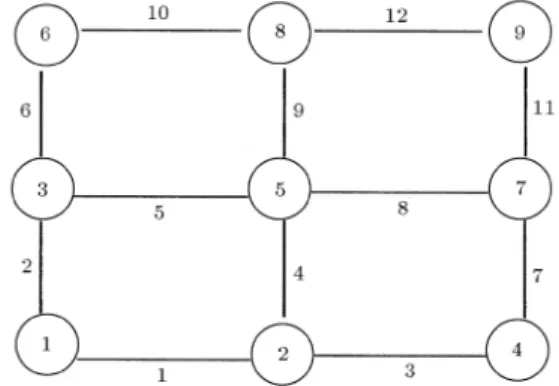
The rst example to be considered is that of a simple network shown in Figure 1. The network consists of nine nodes, twelve links and a source located at node number 9. This example has been considered as a test network by Geem et al. [11], to test the performance of the model they proposed for layout geometry optimization in the absence of size optimiza-tion. The water demand at each node of the network is shown in Table 1. The pipe cost of each link is
Figure 1.
Maximum (base) layout of the test network.Table 1.
Nodal demand and elevation data for Network 1.Node
1 2 3 4 5 6 7 8 9Figure 2.
Top four solutions obtained from enumeration.assumed to be proportional to its length and the ow along the link Cost = Length (Flow)1=2. The top four solutions of least cost can be obtained [11] by complete enumeration, as shown in Figure 2. These data are augmented by additional data, so that the network can be used as an appropriate test example
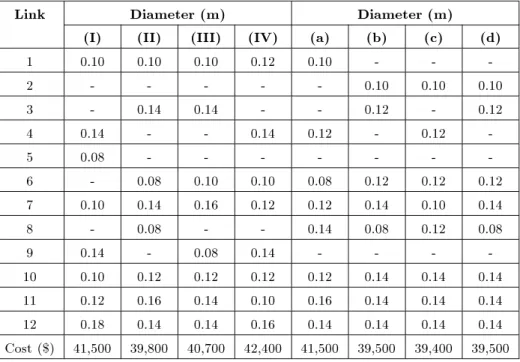
for the joint layout and size optimization algorithm proposed. This would also make it possible to compare the results of layout geometry optimization with that of joint layout and size optimization. Table 2 shows the data regarding available pipe sizes and their cost. The elevation of all the demand nodes is set equal to zero and that of the source node is assumed to be 50 m. A minimum pressure requirement of 30 meters is used at all the demand nodes. Columns 2 to 5 in Table 3 show the results of size optimization performed on the four top layouts obtained from enumeration, using the data of Table 2. Partial enumeration and a GA were used to obtain these solutions as an exhaustive enumeration would have been very costly. To make sure of the globality of these results, many GA runs with dierent population sizes were performed. The results shown in columns 2 to 5 of Table 3 can, therefore, be considered as the four top solutions, which can be obtained by decoupling the layout and size optimization for the underlying example. It is surprisingly seen that the top solution of the layout optimization process yields the second most expensive network upon size optimization. The optimal solution is obtained with the second top solution of the layout optimization process. These results clearly show that layout geometry optimization, in the absence of optimal sizing, would not lead to the optimum network regarding both layout and pipe sizes.
Table 2.
Cost data for Network 1.Diameter (m)
0.01 0.02 0.03 0.04 0.06 0.08 0.10 0.12 0.14 0.16 0.18 0.20 0.22Cost (Units/m)
2 5 8 11 16 23 32 50 60 90 130 170 300Table 3.
Optimal pipe size solutions obtained for Network 1 using xed four top layout (I to IV) and proposed method ((a) to (d)).Link
Diameter (m)
Diameter (m)
(I)
(II)
(III) (IV)
(a)
(b)
(c)
(d)
1 0.10 0.10 0.10 0.12 0.10 - -
-2 - - - 0.10 0.10 0.10
3 - 0.14 0.14 - - 0.12 - 0.12
4 0.14 - - 0.14 0.12 - 0.12
-5 0.08 - - -
-6 - 0.08 0.10 0.10 0.08 0.12 0.12 0.12 7 0.10 0.14 0.16 0.12 0.12 0.14 0.10 0.14
8 - 0.08 - - 0.14 0.08 0.12 0.08
9 0.14 - 0.08 0.14 - - -
-10 0.10 0.12 0.12 0.12 0.12 0.14 0.14 0.14 11 0.12 0.16 0.14 0.10 0.16 0.14 0.14 0.14 12 0.18 0.14 0.14 0.16 0.14 0.14 0.14 0.14 Cost ($) 41,500 39,800 40,700 42,400 41,500 39,500 39,400 39,500
Figure 3.
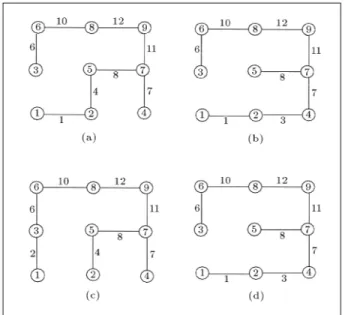
Optimal layout obtained for Network 1 with various selection algorithms for reliability Level 1.This is further supported by comparing these solutions with the solutions obtained with the proposed joint layout and pipe size optimization procedure shown in columns 6 to 9 of Table 3. The corresponding networks to these solutions are illustrated in Figure 3. These results show the optimal layout and pipe diameters obtained using the four most commonly used selection schemes with genetic algorithms: (a) Roulette wheel, (b) Roulette wheel with linear scaling, (c) Roulette wheel with ranking and (d) Roulette wheel with power law scaling. It is seen that the best solution of simultaneous layout and size optimization, with a cost of 39,400, is about 5% cheaper than the solution corre-sponding to the supposedly optimum layout obtained with layout optimization alone. In fact, this solution is better than all the solutions resulting from the four top layouts. These observations clearly show that joint layout and size optimization is unavoidable in a search towards optimal or near optimal design of pipe networks. The best solution of 39,400 is obtained within 7,500 function evaluations, some of which only check the feasibility of the network and avoid the more costly hydraulic analysis of the network. This can be compared with the, approximately, 9,200 and 250,000 network analyses required by one of the most recent [6] and earliest [4] genetic algorithms for pipe size optimization of a network with 8 pipes and 13 available diameters, a problem with a much smaller search space compared to the problem considered here. It should be remarked here that the solution of the rst case, with reliability level one, leads to a tree network that is of little use for water distribution networks, due to the lack of sucient reliability. This case is only considered here to show that a two phase solution of the layout and pipe size optimization problem will
not lead to an optimal solution and, therefore, a joint layout and pipe size determination methodology has to be used. The solution of the rst test case for reliability level two is not attempted here, because there are no published results for comparison.
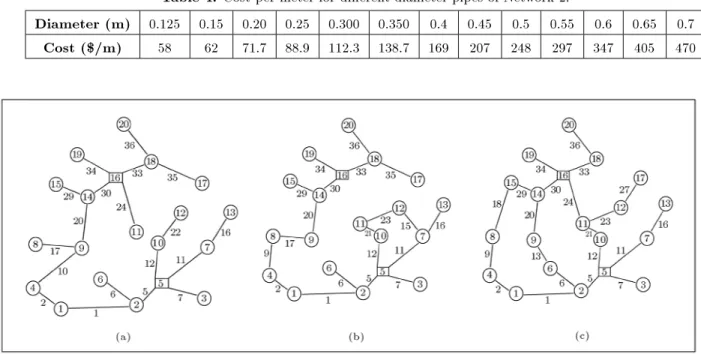
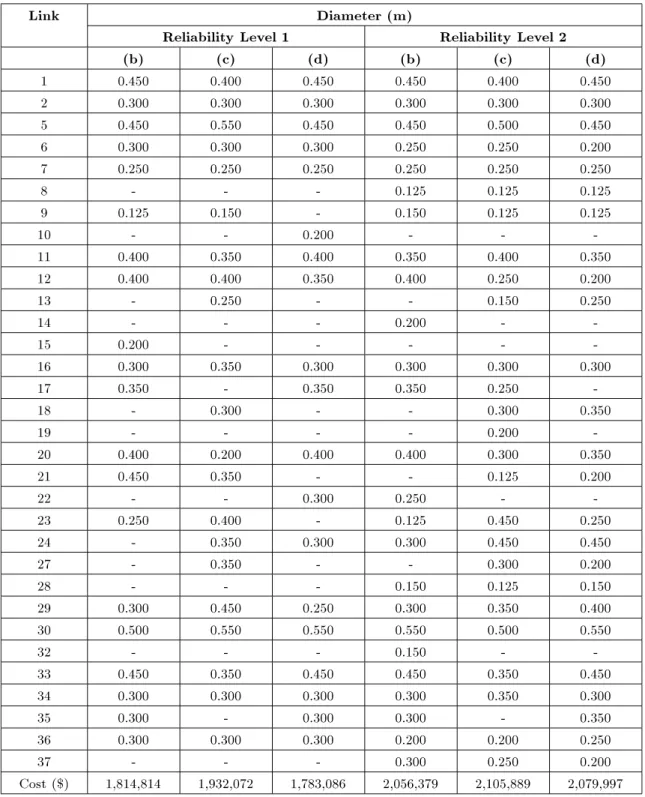
The second example is considered to demonstrate the applicability and eciency of the method for the layout and pipe size design of real-world networks. The network, shown in Figure 4, is a small part of the Winnipeg system, with 2 sources, 20 nodes and 37 possible links. The available pipe diameters and their costs are shown in Table 4. The length of the 37 possible links included in the maximum layout of the network, along with the nodal demands and minimum nodal head requirements, can be found in Morgan and Goulter [17]. The problem is solved for two dierent levels of reliability, namely level 1 and level 2, where the reliability of level n refers to the minimum number of independent paths from source nodes to each and every demand node. Figure 5 and column 2 to 4 of Table 5 show the resulting layouts, including pipe diameters for reliability level 1 obtained with three of the selection algorithms used earlier, that is, (b) Roulette wheel with linear scaling; (c) Roulette wheel with ranking; and (d) Roulette wheel with power law scaling. The conventional roulette-wheel method is not included in these tests because of its poor performance in the rst example. The best solution is obtained by the power law scaling algorithm, with 19 pipes and a total cost of $ 1,783,086. The optimal solution to this problem is a tree network and, therefore, this solution can only be regarded as near-optimal. The best solution is achieved within 100,000 function evaluations, some of which merely test layout feasibility.
Table 4.
Cost per meter for dierent diameter pipes of Network 2.Diameter (m)
0.125 0.15 0.20 0.25 0.300 0.350 0.4 0.45 0.5 0.55 0.6 0.65 0.7Cost ($/m)
58 62 71.7 88.9 112.3 138.7 169 207 248 297 347 405 470Figure 5.
Optimal layout obtained for Network 2 with various selection algorithms for reliability Level 1.Figure 6.
Optimal layout obtained for Network 2 with various selection algorithms for reliability Level 2.The problem is solved once more for optimum layout and pipe diameters of the network enjoying reliability level 2. The resulting layouts are shown in Figure 6 while the optimal pipe diameters are shown in columns 5 to 7 of Table 5. The best solution is obtained by the selection method of linear scaling, with a cost of $ 2,056,379. It seems that pipe no. 11 is redundant in the resulting layout, regarding the reliability of the network. This link, however, is present in the nal layout to maintain the minimum pressure head requirement at nodes 7, 13 and, probably, 17. Removing this link will certainly require larger diame-ters for pipes 7 and 8, to meet the minimum pressure requirement leading to an increase in the cost of the resulting network. These solutions can be compared
to the solution obtained by Morgan and Goulter [17], with a cost of $ 1,950,698, using a linear programming method. The Morgan and Goulter solution appar-ently obtained under multiple re loading is, however, found to be infeasible, even for the single loading considered in this paper using the EPANET package (www.epa.gov/ORD/NRMRL/wswrd).
CONCLUDING REMARKS
A genetic algorithm incorporating dierent selection algorithms is presented for the simultaneous layout and pipe size optimization of water distribution networks. An engineering concept of reliability is used, in which the number of independent paths from source nodes to
Table 5.
Optimal layout and pipe size solutions obtained with various selection algorithms for Network 2.Link
Diameter (m)
Reliability Level 1
Reliability Level 2
(b)
(c)
(d)
(b)
(c)
(d)
1 0.450 0.400 0.450 0.450 0.400 0.450
2 0.300 0.300 0.300 0.300 0.300 0.300
5 0.450 0.550 0.450 0.450 0.500 0.450
6 0.300 0.300 0.300 0.250 0.250 0.200
7 0.250 0.250 0.250 0.250 0.250 0.250
8 - - - 0.125 0.125 0.125
9 0.125 0.150 - 0.150 0.125 0.125
10 - - 0.200 - -
-11 0.400 0.350 0.400 0.350 0.400 0.350
12 0.400 0.400 0.350 0.400 0.250 0.200
13 - 0.250 - - 0.150 0.250
14 - - - 0.200 -
-15 0.200 - - - -
-16 0.300 0.350 0.300 0.300 0.300 0.300
17 0.350 - 0.350 0.350 0.250
-18 - 0.300 - - 0.300 0.350
19 - - - - 0.200
-20 0.400 0.200 0.400 0.400 0.300 0.350
21 0.450 0.350 - - 0.125 0.200
22 - - 0.300 0.250 -
-23 0.250 0.400 - 0.125 0.450 0.250
24 - 0.350 0.300 0.300 0.450 0.450
27 - 0.350 - - 0.300 0.200
28 - - - 0.150 0.125 0.150
29 0.300 0.450 0.250 0.300 0.350 0.400
30 0.500 0.550 0.550 0.550 0.500 0.550
32 - - - 0.150 -
-33 0.450 0.350 0.450 0.450 0.350 0.450
34 0.300 0.300 0.300 0.300 0.350 0.300
35 0.300 - 0.300 0.300 - 0.350
36 0.300 0.300 0.300 0.200 0.200 0.250
37 - - - 0.300 0.250 0.200
Cost ($) 1,814,814 1,932,072 1,783,086 2,056,379 2,105,889 2,079,997
each of the demand nodes indicates reliability. The method starts with a predened maximum layout, which includes all possible links. The method is capable of designing a layout of predened reliability, including tree-like and looped networks. The method is used for layout and pipe size design of a benchmark example, for which the optimum layout geometry is available via complete enumeration. The optimal pipe size solution to the optimum layout is obtained and
compared to the results of the proposed method to show the superiority of the joint layout and pipe size optimization process to the process of layout geometry optimization, followed by a pipe size design operation. This clearly illustrates the need for simultaneous opti-mization of layout and pipe size, if an optimal solution to a water distribution network is desired. The method is further used for optimal design of a second example in the literature with dierent reliability, illustrating
the ability of the proposed method to design both tree-like and fully-looped networks.
REFERENCES
1. Murphy, L.J., Simpson, A.R. and Dandy, G.C. \Design of a network using genetic algorithms",Water,
20
, pp 40-42 (1993).2. Dandy, G.C., Simpson, A.R. and Murphy, L.J. \An improved genetic algorithm for pipe network optimiza-tion",Water Resour. Res.,
32
, pp 449-458 (1996). 3. Halhal, D., Walters, G.A., Quazarm D. and Savic,D.A. \Water network rehabilitation with structured messy genetic algorithm", J. of Water Resour. Plan-ning and Management,
123
, pp 137-146 (1997). 4. Savic, D.A. and Walters, G.A. \Genetic algorithms forleast-cost design of water distribution networks", J. of Water Resour. Planning and Management,
123
, pp 67-77 (1997).5. Cunha, M. and Sousa, J. \Water distribution network design optimization: Simulated annealing approach",
J. of Water Resour. Planning and Management,
125
, pp 215-221 (1999).6. Boulos, P.F., Wu, Z.Y., Orr, C.H. and Ro, J.J. \Least-cost design and rehabilitation of water distribution systems using genetic algorithms", in Proc. of the AWWA IM Technical Conf., April 16-19, Seattle, WA, USA (2000).
7. Wu, Z.Y. and Simpson, A.R. \A self-adaptive bound-ary search genetic algorithm and its application to water distribution systems",J. of Hydraulic Res.,
40
, pp 191-203 (2002).8. Walters, G.A. and Lohbeck, T.K. \Optimal layout of tree networks using genetic algorithms", Engineering Optimization,
22
, pp 27-48 (1993).9. Davidson, J.W. and Goulter, I.C. \Evolution program for design of rectilinear branched networks", J. of Computing in Civil Engrg.,
9
, pp 1-10 (1995). 10. Walters, G.A. and Smith, D.K. \Evolutionary designalgorithm for optimal layout of tree networks", Engi-neering Optimization,
24
, pp 261-268 (1995).11. Geem, Z.W., Kim, J.H. and Yoon, Y.N. \Optimal lay-out of pipe networks using harmony search",in Proc. of 4th Int. Conf. on Hydro-Science and Engineering, Seoul, South Korea (2000).
12. Davidson, J.W. \Evolution program for layout geom-etry of rectilinear looped networks", J. of Computing in Civil Engrg.,
13
, pp 246-253 (1999).13. Mays, L.W., Wenzel, H.G. and Liebman, J.C. \Model for layout and design of sewer systems", J. of Water Resour. Planning and Management,
102
, pp 385-405 (1976).14. Martin, W. \Optimal design of water conveyance systems", J. of the Hydraulics Div., ASCE,
106
, pp 1415-1432 (1980).15. Rowel, W.F. and Barnes, J.W. \Obtaining layout of water distribution systems",J. of the Hydraulics Div., ASCE,
108
, pp 137-148 (1982).16. Morgan, D.R. and Goulter, I.C. \Least cost layout and design of looped water distribution systems", inProc. of Ninth Int. Symp. on Urban Hydrology, Hydraulics and Sediment Control, University of Kentucky, Lex-ington, KY, USA, July 27-30 (1982).
17. Morgan, D.R. and Goulter, I.C. \Optimal urban water distribution design",Water Resour. Res.,
21
, pp 642-652 (1985).18. Kessler, A., Ormsbee, L. and Shamir, U. \A method-ology for least-cost design of invulnerable water dis-tribution networks",Civil Engineering Systems,
1
, pp 20-28 (1990).19. Cembrowciz, R.G. \Water supply systems optimisa-tion for developing countries", Pipeline Systems, B. Coulbeck and E. Evans, Eds., Kluwer Academic, London, UK, pp 59-76 (1992).
20. Tanymboh, T.T. and Templeman, A.B. \Discussion of redundancy-constrained minimum-cost design of water distribution networks", by H. Parh and J.C. Liebman., Eds.,J. of Water Resour. Planning and Management,
120
, pp 568-569 (1994).21. Bazovski, I.,Reliability Theory and Practice, Prentice-Hall, Inc., Englewood Clis, NJ, USA (1961). 22. Kettler, A. and Goulter, I. \Reliability consideration
in the least cost design of looped water distribution networks", Proc. 10th Int. Symp. on Urban Hydro. Hydr. and Sediment Control, University of Kentucky, Lexington, KY, pp 305-312 (1983).
23. Goulter, I.C. and Goals, A. \Quantitative approaches to reliability assessment in pipe networks", in J. of Transportation Engrg.,
112
, pp 104-113 (1986). 24. Goulter, I. and Bouchart, F. \Reliability-constrainedpipe network model",J. Hydr. Engrg., ASCE,
116
(2), pp 211-229 (1990).25. Mays, L.W. \Methodologies for assessment of aging water distribution systems", Rep. No. CRWR 227, Ctr. for Res. in Water Resour., The University of Texas, Austin, Tx, USA (1989).
26. Su, Y.C. Mays, L.W. Duan, N. and Lansey, K.E. \Reliability-based optimization model for water dis-tribution systems", J. of Hydraulic Engrg.,
114
, pp 1539-1556 (1987).27. Duan, N., Mays, L.W. and Lansey, K.E. \Optimal reliability-based design of pumping and distribution systems",J. Hydr. Engrg., ASCE,
116
(2), pp 249-268, (1990).28. Cullinane, M.J., Lansey, K.E. and Mays, L.W. \Opti-mization availability-based design of water distribution networks",J. Hydr. Engrg., ASCE,
118
(3), pp 420-441 (1992).29. Fujiwara, O. and Tung, H.D. \Reliability improvement for water distribution networks through increasing pipe size",Water Resour. Res.,
27
(7), pp 1395-1402 (1991).30. Xu, C. and Goulter, I. \Simulation-based optimal design of reliable water distribution networks",Proc., 3rd Int. Conf. on Modeling and Simulation, A. Zayegh, Ed., Victoria University of Technology, Melbourne, pp 107-112 (1997b).
31. Park, H. and Leibman, J. \Redundancy-constrained minimum cost design of water distribution networks",
J. Water Resour. Plng. and Mgmt., ASCE,
119
(1), pp 83-98 (1993).32. Quindry, G., Brill, E.D. and Liebman, J.C. \Optimiza-tion of looped distribu\Optimiza-tion systems",J. Envir. Engrg. Div., ASCE,
107
(4), pp 665-679 (1981).33. Lansey, K., Duan, N., Mays, L.W. and Tung, Y.K. \Water distribution system design under uncertainty",
J. Water Resour. Plng. and Mgmt., ASCE,
115
(5), pp 630-645 (1989).34. Bouchart, F. and Goulter, I. \Reliability improvements in design of water distribution networks recognizing
valve location",Water Resour. Res.,
27
(12), pp 3029-3040 (1991).35. Awumah, K., Goulter, I.C. and Bhatt, S.K. \Entropy-based redundancy measures in water distribution net-work design",J. Hydr. Engrg., ASCE,
117
(5), pp 595-614 (1991).36. Awumah, K. and Goulter, I.C. \Maximizing entropy dened reliability of water distribution networks",
Engrg. Optimization,
20
(1), pp 57-80 (1992).37. Tanyimboh, T.T. and Templeman, A.B. \Optimum design of exible water distribution networks", Civ. Engrg. Sys.,
10
(3), pp 243-258 (1993).38. Ormsbee, L. and Kessler, A. \Optimal upgrading of hydraulic network reliability",J. Water Resour. Plng. and Mgmt., ASCE,
116
(6), pp 784-802 (1990). 39. Afshar, M.H. \An element-by-element algorithm forthe analysis of pipe networks",Int. J. for Engineering Science,