A Multiple Scale Method Solution for the
Nonlinear Vibration of Rectangular Plates
A. Shooshtari
1and S.E. Khadem
In this paper, rst, the equations of motion for a rectangular isotropic plate have been derived. This derivation is based on the Von Karmann theory and the eects of shear deformation have been considered. Introducing an Airy stress function, the equations of motion have been transformed to a nonlinear coupled equation. Using the Galerkin method, this equation has been separated into position and time functions. By means of the dimensional analysis, it is shown that the orders of magnitude for nonlinear terms are very small, with respect to linear terms. Then, for the rst time, the invariant manifold theory has been applied to the plate problem and it is proved that the nonlinearities are stiness and inertia types. Finally, the multiple scale method is applied to the equations of motion and closed-form relations for the nonlinear natural frequencies and mode shapes of the plate are derived. The obtained results are in good agreement in comparison with numerical methods. Using the obtained relation, the eects of initial displacement, thickness and dimensions of the plate on nonlinear natural frequencies and displacements have been investigated. These results are valid for a special range of the ratio of thickness to dimensions of the plate, which is a characteristic of the multiple scale method.
INTRODUCTION
Large amplitude vibrations of rectangular plates have been investigated rigorously by many authors. A good review has been done by Sathyamoorthy [1], and Benamar et al. [2] have developed one model for large displacements and nonlinear vibrations of plates with dierent boundary conditions. This model is based on the Hamilton principle and spectral analysis. In this method, one assumes that for a system with weakly nonlinear terms, the response is:
w(x;y;t) =(x;y)q(t):
Assumingq(t) as a harmonic function, the(x;y) will be found by the harmonic balance method.
Also, Bikri et al. [3] investigated the eects of geometrical nonlinearity in the free vibration case of thin isotropic laminated rectangular composite plates. They determined the fundamental nonlinear natural 1. Department of Mechanical Engineering, Tarbiat Modares
University, P.O. Box 14115-177, Tehran, I.R. Iran.
*. Corresponding Author, Department of Mechanical Engi-neering, Tarbiat Modares University, P.O. Box 14115-177, Tehran, I.R. Iran.
frequency and related mode shapes of the plate using a numerical method.
Ribeiro and Petyt [4] used the hierarchical nite element method for the free vibration analysis and discovered the internal resonances of the system by this method. In this work, they considered the geometrical nonlinearity and demonstrated the plate mode shapes with the amplitude of the vibration.
Amabili [5] investigated, theoretically and exper-imentally, large amplitude (geometrically nonlinear) vibrations of rectangular plates subject to radial har-monic excitation in the spectral neighborhood of the lowest resonances with dierent boundary conditions.
Huang and Zheng [6] investigated the nonlinear vibration and dynamical response of simply supported shear deformable plates on elastic foundations. The plate was subjected to a transverse dynamic load, combined with initial in-plan static loads and resting on an elastic foundation.
In all the above works, the researchers have con-sidered the eects of geometrical nonlinearity, which is a kind of nonlinearity in the stiness. But, in a nonlinear system, there may be some other kinds of nonlinearity, such as nonlinear inertia and nonlinear damping.
Shaw and Pierre [7] dened a new method, which is named the invariant manifold, for nonlinear contin-uous systems and detected the kind of nonlinearities in nonlinear equations. This method can be used for systems with weak nonlinearities. Based on this method, Nayfeh et al. [8] obtained the nonlinear fre-quencies and mode shapes for one-dimensional contin-uous systems, which have nonlinearities in stiness and inertia. Mahmoodi et al. [9] analyzed the nonlinear free vibration of a continuous damped system, which contains nonlinearity terms in inertia, stiness and damping.
In this paper, for the rst time, the method of the invariant manifold is used for plate vibration analysis, which has nonlinearities in inertia and stiness. The advantage of this method is that of obtaining closed-form relations for the nonlinear natural frequencies and nonlinear mode shapes. Also, using this method, the eects of system parameters on the natural frequencies and nonlinear mode shapes can be determined accu-rately. It is shown that by increasing the ratio of thickness to the dimensions of the plate, the nonlinear frequencies of the plate will increase.
The obtained results show good agreement, with respect to what has been obtained by other researchers, and, also, with respect to available numerical results.
DEFINITIONOF THEPROBLEM
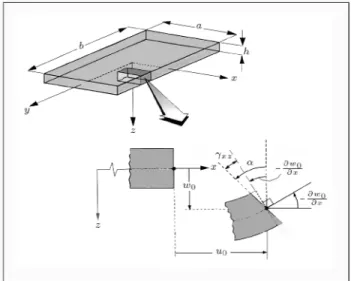
An isotropic elastic rectangular plate, with dimensions aandband thicknessh, is considered. Figure 1 shows the dimensions and displacement of the plate. The plate is under large deection and the displacements are unknown.
The displacement relations, based on the rst order shear deformation and the Von Karmann theory,
Figure1. Rectangular isotropic plate and displacement after deection.
are:
u(x;y;z;t) =u 0(
x;y;t) +z(x;y;t); v(x;y;z;t) =v
0(
x;y;t) +z(x;y;t); w(x;y;z;t) =w
0(
x;y;t); (1)
in which u, v and w are the displacements in the directions ofx,yandz, respectively, andu
0, v
0and w
0 are the displacements of the mid-plane. Also,and are the angles between the normal to mid-plane before and after deformation. The components of stresses are:
x=
N x h
+ 12M x h
3 =
N x h
+M
x I
;
y = N
y h
+ 12M y h
3 =
N x h
+M
y I
;
xy = N
xy h
+ 12M xy h
3 =
N xy h
+M
xy I
;
xz= 32
Q x h
1 4z 2 h
2
;
yz= 32
Q y h
1 4z 2 h
2
; (2)
where N x,
N y and
N
xy are the membrane in-plane forces,M
x, M
yand M
xyare the bending moments and Q
x and Q
y are the internal shear forces. Also, I is the moment of inertia and E is the Young modulus. The internal forces and bending moments are shown in Figure 2.
Considering the rst order shear deformation theory and using variational calculus, the force-displacement relations for an elastic isotropic plate will
Figure 2. Internal forces and bending moment in the plate.
become as follows: @u
0 @x + 12
@w 0 @x 2 N x Eh + N y Eh
= 0;
@v 0 @y + 12
@w 0 @y 2 N y Eh + N x Eh
= 0; @u 0 @y +@v 0 @x +@w 0 @x : @w 0 @y
2(1 +) Eh
N xy= 0
; @ @x 12M x Eh
3 + 12 M
y Eh
3 = 0 ; @ @y 12M y Eh
3 + 12 M
x Eh
3 = 0 ; @
@y
+@
@x
24(1 +) Eh
3 M
xy= 0 ; +
@w @x
12(1 +) 5Eh
Q x= 0
; +
@w @y
12(1 +) 5Eh
Q y= 0
: (3)
Computing kinetic and potential energy and using the Hamilton principle for conservative systems, the equations of motion are found, as follows:
@M x @x +@M xy @y Q x= h 3 12 ;tt ; (4) @M y @y +@M xy @x Q y= h 3 12 ;tt ; (5) @N x @x +@N xy @y =hu ;tt ; (6) @N y @y +@N xy @x =hv ;tt ; (7) @N x @x w ;x+ N x @ 2 w @x 2 + @N y @y w ;y+ N y @ 2 w @y 2 +@N xy @x w ;y+ @N xy @y w ;x+ 2
N xy @ 2 w @x@y +@Q x @x +@Q y @y =hw ;tt : (8)
Also, the boundary conditions are: atx= 0 and x=a:
u= 0 or N x= 0
;
v= 0 or N xy= 0
; w= 0 or Q
x+ N x @w @x +N xy @w @y = 0;
= 0 or M
x= 0 ;
= 0 or M
xy= 0
; (9)
and aty= 0 and y=b: u= 0 or N
xy= 0 ; v= 0 or N
y= 0 ; w= 0 or Q
y+ N xy @w @x +N y @w @y = 0;
= 0 or M
xy= 0 ;
= 0 or M
y= 0
: (10)
Equations 4 through 8 are the equations of motion for a rectangular isotropic elastic plate under large amplitude vibration, considering the shear deformation and rotary inertia phenomena.
Assuming, principly, transverse motion, an Airy stress function, , is introduced as:
N x= @ 2 @y 2 ; N y= @ 2 @x 2 ; N xy= @ 2 @x@y : (11) Substituting the above function in the equations of motion, Equations 6 and 7 are satised automatically and the other equations become, as follows:
D @ 2 @x 2 +
D(1 )
2 @
2 @y
2 +
D(1 +)
2 @
2 @x@y 5Eh
12(1 +) + @w @x h 3 12
;tt= 0 ; (12) D @ 2 @y 2 +
D(1 ) 2 @ 2 @x 2 +
D(1 +) 2 @ 2 @x@y 5 Eh
12(1 +) + @w @y h 3 12
;tt= 0 ; (13) " @ 2 @x 2 @ 2 w @y 2 + @ 2 @y 2 @ 2 w @x 2 2 @ 2 @x@y + 5Eh
12(1 +v) @ @x +@ @y +r 2 w hw ;tt= 0
#
whereD= Eh
3 12(1
2 ).
The proper compatibility equation must be con-sidered for the middle surface strains, which is stated, as follows:
r 4
=Eh "
@
2 w @x@y
2
@ 2
w @x
2 @
2 w @y
2 #
: (15)
Eliminating and from Equations 12 through 14, will obtain:
" D
2(1 v)
2 r
4 Dh
3(3 v)
24 r
2 @
2 @t
2
5DEh(3 v) 24(1 +v)
r 2 + 25E
2 h
2 144(1 +v)
2+ 5 Eh
4 72(1 +v)
@ 2 @t
2 #
"
@ 2
@x
2 @
2 w @y
2+ @
2 @y
2 @
2 w @x
2 2 @
2 @x@y
@ 2
w @x@y + 5Eh
12(1 +v) r
2
w hw #
+ 5Eh 12(1 +v)
" 5DEh
24 (1 v) (1 +v)
r 4 25E
2 h
2 144(1+v)
2 r
2 5
Eh 4 144(1+v)
@ 2 @t
2 #
w=0: (16) The above equation is the equation of motion in a transverse direction, for a rectangular isotropic elastic plate.
Such an equation is derived for the Classical Plate Theory (CPT), without considering the eects of shear deformation and rotary inertia by Nayfeh [10], as follows:
" Dr
4+ h
@ 2 @t
2 @
2 @x
2 @
2 @x
2 @
2 @y
2 @
2 @y
2 2 @
2 @x@y
@ 2 @x@y
#
w= 0; (17)
where is the Airy stress function. Comparing Equations 17 and 16, it can be seen that the existence of shear deformation and rotary inertia will complicate the equation of motion and will generate more nonlin-ear terms, which are explained later.
MULTIPLE SCALEMETHOD
In order to calculate the natural frequencies and trans-verse mode shapes of the system, Equation 16 must
be solved. For this purpose, there are many dier-ent methods, i.e., numerical methods, nite elemdier-ents methods and analytical analysis, such as perturbation methods.
The method that will be used in this paper is the multiple scale method [9]. The most important advantage of this method is that, by identication of a non-dimensional small parameter, which has a physical interpretation and by using several time scales, one can obtain a complete physical understanding about the behavior of the system and the inuence of dierent parameters and terms on the nal response of the system.
To solve the above nonlinear equation, rst, by using the Galerkin method, one discretizes the equation by writing the solution as:
w(x;y;t) = N X i=1
M X i=1
ij(
x;y)f(t): (18) Then, by selecting ij(
x;y), which satises the bound-ary conditions, the multiple scale method is used to nd the time function f(t). For this purpose, without any lack of generality, the case of a square plate with all sides hinged will be considered in the rst mode. Therefore;
11(
x;y) =hsin
x a
sin
y a
: (19)
So: w
11(
x;y;t) =hf(t)sin
x a
sin
y a
: (20)
Also, the function,, will be selected, as follows:
=f 2(
t) Eh
3 32
" 2
2 a
2(1 v
2)( x
2+ y
2) + cos2 x
a + cos2
y a
#
; (21)
to satisfy Equation 15. The boundary conditions of the problem are used, as follows:
atx= 0 andx=a:
w(x;y) = 0; @
2 w @x
2 = 0
; (22)
and aty= 0 and y=a: w(x;y)=0;
@ 2
w @y
2=0
By dening the non-dimensional parameters as: =t s E a 2 ; x = x a ; y = y a ; w = w h ; (24) and substituting Equations 20 and 21 into Equation 16, multiplying the left-hand side by sin(x
a )sin( y
a ) and integrating over the plate area, one obtains a non-dimensional equation, as follows:
a 1 f 3+ a 2
f+a 3 f 00+ a 4 f 2 f 00+ a 5
f(f 0)2= 0
; (25) where: a 1= 8 r 6 2304 (3 ) (1
2)2 + 5 6(3 ) 2 r 4 4608(1
2)2
+ 25 4 r 2(3 ) 4608(1 + 2)(1 ) ; a 2= 5 6 r 4 1728(1 +)
2(1
2) +
25 4
r 2 1728(1 +)
2(1 2) ; a 3= 4 r 4 1728(1 +)
2(1
2) + 5
2 r
2(23 11 ) 3456(1 +)(1 2) +576(1 +25
) 2 ; a 4= 6 r 6(3 ) 2 1536(1 )(1
2) + 5 4 r 4(3 ) 768(1 2) ; a 5= 6 r 6(3 ) 2
768(1 )(1
2) + 5 4 r 4(3 ) 384(1 2) ; (26)
andr= h a.
Comparing Equation 25 with the equation which is derived by Nayfeh [8], it is found that the rst term of this equation presents the nonlinearity in the stiness and the two last terms are the nonlinear terms in inertia. So, this system has nonlinearity in stiness and inertia.
Now, Equation 25 is rewritten as: f
00+ b
1 f+b
2 f 3+ b 3 f 2 f 00+ b 4 f(f
0)2= 0
; (27) where: b 1= a 2 a 3
=O(1); b 2=
a 1 a
3 =O(r
2) ; b 3= a 4 a 3 =O(r
2) ; b 4= a 5 a 3 =O(r
2)
: (28)
Equations 28 show that the order of magnitude of nonlinear terms, with respect to linear terms, is weak. So, the system has weak nonlinearities.
By denition, the small parameter, ", is, as follows:
p
"=r=h=a: (29)
Equation 27 will be written as: f
00+ !
2
f+"G(f;f_;f) = 0; (30) and:
G(f;f_;f) =b 2 f 3+ b 3 f 2 f 00+ b 4
f(f 0)2
: (31)
Therefore, due to the presence of ", Equation 30 has weak nonlinear terms. Now, Equation 30 will be solved by the method of multiple scales. First, this equation is rewritten as:
f 00+
! 2
f+"(b 2 f 3+ b 3 f 2 f 00+ b 4
f(f
0)2) = 0
: (32) Two time scales are dened, as follows:
T 0=
t; T
1=
"t: (33)
Thus, the rst and second derivatives off are written as:
df dt
= df dT 0 +" df dT 1 ; d 2 f dt 2 = d 2 f dT 2 0
+ 2" d 2 f dT 0 dT 1 +" 2 d 2 f dT 0 dT 2 1 : (34)
Considering the above relations and expanding the function,f, as follows:
f =f 0+
"f 1+
; (35)
and, by substituting it in Equation 32 and equating the coecients of"
0 and "
1 with zero, one obtains the following:
0("
0) = 0(1) : d 2 f 0 dT 2 0 +! 2 f 0= 0
; (36)
0(" 1) :
d 2 f 1 dT 2 0 +! 2 f 1= 2
d 2 f 0 dT 0 dT 1 b 2 f 3 0 b 3 f 2 0 d 2 f 0 dT 2 0 b 4 f 0 df 1 dT 0 2 ; (37) a general solution for Equation 36 can be written as:
f 0(
T 0
;T 1) =
A(T 1)
e i!T
0+ A(T
1) e
i!T 0
; (38)
A(T
1) is an undetermined function of T
1 and will be determined later. A(T
A(T
1). Substituting f
0 from Equation 38 in Equa-tion 37 will result in:
d 2
f 1 dT
2 0
+! 2
f 1= 2
iA 0
!e
i!T0+ 2 iA
0 e
i!T0 b
2(
Ae i!T
0+ Ae
i!T 0)
3 b
3(
Ae i!T
0+ Ae
i!T 0)
2( A!
2 e
iwT 0
A! 2
e iwT:) b
4(
Ae i!T0+
Ae iwT:)(
Ai!e i!T0
Ai!e i!T0)2
+cc; (39)
where prime denotes a derivative, with respect to T 1 and cc means complex conjugates. Secular terms, which are the terms that produce nonperiodic solu-tions, must be eliminated from Equation 39. So, the solvability condition for Equation 39 is, as follows:
2A 0
i!+ [3b 2+
! 2(
b 4 3
b 3)]
A 2
A= 0: (40)
Now,A(T
1) is stated in the polar form, as: A(T
1) = 12 (T
1) e
i(T 1
)
; (41)
whereis the amplitude andis the phase. Substitut-ing Equation 41 in Equation 40 and separatSubstitut-ing the real and imaginary components equal to zero, the following are obtained:
0= 0
; (42)
0
= 38b 2
! 2(
b 4 3
b 3)
: (43)
Equation 42 means that the amplitude of the mode shape is constant and it is not a function of any time scales. This is because the system does not possess any kind of damping. Also, from Equation 43, it is obtained that:
= 38b 2
! 2(
b 4 3
b 3)
T 1+
0
; (44)
where
0 is constant. Therefore, substituting Equa-tions 42 and 44 in Equation 38, it is obtained that:
f 0(
T 0
;T 1) = 12
e i[!T0+
3 8 b
2
! 2
(b 4
3b 3
)T1+0]+ cc:
(45) So, by eliminating the secular terms, Equation 39 will become:
d 2
f 1 dT
2 0:
+! 2
f 1= [
b 2+
! 2(
b 3+
b 4)]
A 3
e 3i!T0+
cc: (46)
The solution of this equation is: f
1( T
0 ;T
1) =
3 64!
2[ b
2
! 2(
b 3+
b 4)]
e i[
9 8 b
2 !
2 (b
4 3b
3 )T
1 +3
0 ]+
3i! T 0
: (47) Substituting Equations 45 and 47 into Equation 35 and converting it to a triangular form, the time function will be:
f =cos+"
3 64!
2[ b
2
! 2(
b 3+
b 4)]cos(3
) +; (48) where and!
N are introduced as: =!
N t+
0
; (49)
and: !
N = !+ 3
b 2 !
2( b
4 3
b 3) 8!
" 2+
; (50)
! and !
N are the linear and nonlinear natural fre-quencies of the rst mode, respectively, and is the amplitude of vibration.
Equation 50 means that the frequency of nonlin-ear oscillation is dependent on the parameters of the system, the small parameter (relative thickness),", and the amplitude of oscillation, which are characteristics of nonlinear systems.
One of the advantages of the multiple scale method, with respect to other methods, is that, by using this method, the eects of system parameters on the system responses can be recognized accu-rately.
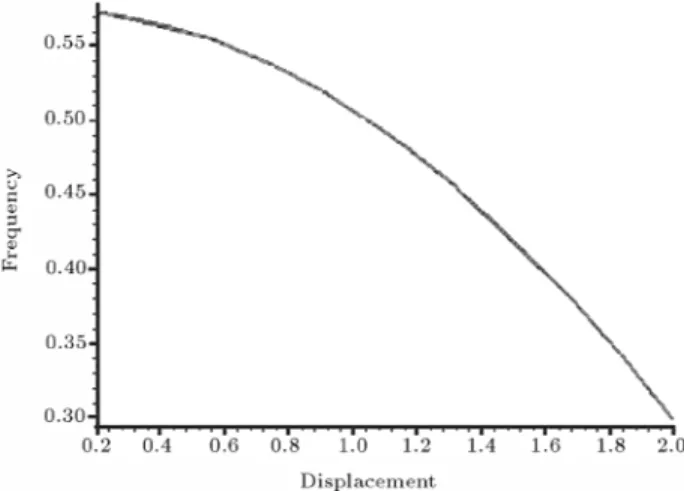
For example, the dependence of the rst nonlinear frequency to amplitude (initial displacement of the mid-point of the plate) is illustrated in Figure 3.
Figure 3. Variation of rst nonlinear frequency with respect to initial displacement of mid-point.
This gure shows that, for an elastic plate, by in-creasing the initial displacement, the nonlinear natural frequencies are decreased quadratically.
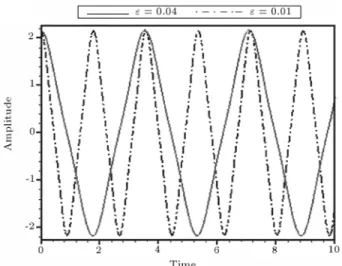
Figure 4 shows the eect of small parameters on the amplitude and rst frequency of the plate.
It is shown that, because there is no damping in this system, the amplitude is constant and does not vary with respect to time. However, the period of harmonic oscillations is decreased by increasing this small parameter.
Figure 5 shows the variation of the rst nonlinear frequency of the plate, with respect to the ratio of thickness to dimension, i.e.,r=
h a .
Thus, the frequency is increased, with respect to the ratio of thickness to dimension and, after a critical value of this ratio, the nonlinear frequency is decreased. For some values above the critical value of this ratio, the frequency will become negative. This means that the method which is described here is valid when the
Figure4. Eect of small parameter on the displacement of the mid-point (x=a=2,y=a=2).
Figure5. Variation of rst nonlinear frequency with respect to the square ratio of thickness to dimension.
ratio of thickness to dimension is small and, therefore, the multiple scale method can be used.
NUMERICAL SOLUTION
To compare the above solution, with respect to other solutions, Equation 25 has been solved by the Runge-Kutta numerical method. This solution has been obtained using MAPLE 9 software and the following values for numerical parameters as = 0:3, h = 2, a = 50. The numerical method and multiple scale method results have been compared in Figure 6.
One can see from Figure 6 that the numeri-cal results are in good agreement with the multiple scale method. However, the multiple scale method solution has the advantage that it provides a closed-form solution with a good physical insight, whereas the numerical methods do not provide a closed form solution and lack this type of physical insight.
CONCLUSION
In this paper, rst, the equations of motion for an isotropic elastic plate were derived. In this derivation, the eects of shear deformation and rotary inertia were considered. Then, by using an Airy stress function, these equations were converted to one coupled equation and a compatibility equation. Using the Galerkin method, a nonlinear dierential equation, with respect to time, was obtained. This equation has nonlinearities in stiness and inertia.
Then, by using the method of multiple scales, this equation was solved and the nonlinear natural frequencies and response of the system were obtained. It is shown that the analytical results are in good agreement with the numerical results.
The advantage of the present solution is that the eects of nonlinearities can be determined accurately.
Figure6. Comparison of the numerical and multiple scale method,= 0:3,h= 2,a= 50.
Dimensional analysis shows that the order of magni-tude of nonlinear terms, with respect to linear terms, is weak. Also, the obtained results and the gures show that, by increasing the initial displacement of the mid-point, the rst nonlinear frequency is decreased quadratically. Also, it is shown that, by increasing the ratio of thickness to the dimension of the plate, the nonlinear frequency of the plate will increase, but, this result is valid for a special range of this ratio, which is a characteristic of the multiple scale method.
NOMENCLATURE
a;b dimensions of plate
E Young's modulus
f time function
h thickness of plate
I moment of inertia
N x
;N y
;N
xy in-plane internal forces M
x ;M
y ;M
xy internal bending moments Q
x ;Q
y internal shear forces T
0 ;T
1 time scales
u;v in-plane displacement
w lateral displacement
Greek
; angle of rotation
" non-dimensional small parameter
Airy stress function
Poisson's ratio
density
! linear natural frequency !
N nonlinear natural frequency
non-dimensional time parameter
position function
REFERENCES
1. Sathyamoorphy, M. \Nonlinear vibrations of plates: An update of recent research developments",Applied Mechanics Review,49, pp 55-62 (1996).
2. Benammar, R., Bennouna, M. and White, R.G. \The eects of large vibration amplitude on the fundamen-tal mode shape of thin elastic structures. Part II: Fully clamped rectangular isotropic plates", Journal of Sound and Vibrations,164, pp 295-319 (1993). 3. Bikri, K.E.I., Benamar, R. and Bennouna, M.
\Geo-metrically non-linear free vibrations of clamped simply supported rectangular plates. Part I: The eects of large vibration amplitudes on the fundamental mode shapes", Computers & Structures, 81, pp 2029-2043 (2003).
4. Ribeiro, P. and Petyt, M. \Non-linear free vibration of isotropic plates with internal resonance",International Journal of Non-Linear Mechanics, 36, pp 263-278 (2000).
5. Amabili, M. \Nonlinear vibrations of rectangular plates with dierent boundary conditions: Theory and experiments",Computers &Structures, 82, pp 2587-2605 (2004).
6. Huang, X.L. and Zheng, J.J. \Nonlinear vibration and dynamic response of simply supported shear deformable laminated plates on elastic foundations",
Engineering Structures,25, pp 11-07-1119 (2003). 7. Shaw, S.W. and Pierre, C. \Normal modes of nonlinear
vibratory systems",Journal of Sound and Vibrations, 164, pp 85-124 (1993).
8. Nayfeh, A.H. and Nayfeh, S.A. \On nonlinear modes of continuous systems", Journal of Vibration and Acoustics,116, pp 129-136 (1994).
9. Mahmoodi, S.N., Khadem, S.E. and Rezaee, M. \Anal-ysis of non-linear shapes and natural frequencies of continuous damped systems", Journal of Sound and Vibration,275, pp 283-298 (2004).
10. Nayfeh, A.H. and Mook, D.T.,Nonlinear Oscillations, pp 500-519, John Wiley & Sons Inc., USA (1979).