CRITERION
1
.
1.0.
The Public Health Program: Introduction and Executive
Summary
In Fall 2009, Washington University in St. Louis (WUSTL) launched its Master of Public Health (MPH) degree program. In May 2011, the MPH program celebrated the graduation of its first class of 23 students and has now graduated 30 students. The University’s MPH program is built upon a base of solid institutional support, and is housed in a fully accredited institution of higher learning founded in 1853 (accredited by the Higher Learning
Commission of the North Central Association of Colleges and Schools through 2014), which becomes the program’s primary resource for building public health expertise, research, community relationships and education. The MPH program is housed in the George Warren Brown School of Social Work (also called the Brown School), a 66-year-old School that is home to the nation’s top-ranked Master of Social Work (MSW) program (with over 400 students enrolled), and a leading doctoral program (with over 50 students enrolled). In addition, the MPH program closely partners with the School of Medicine at Washington University, the fourth ranked medical school in the United States, and the University’s newly formed Institute for Public Health (IPH), founded in 2008.
History of Washington University’s MPH Program
In 2008, the University’s Board of Trustees approved the Brown School’s 10-year strategic plan. Three years in the making, and developed under the leadership of Brown School Dean Edward Lawlor, this plan identified public health as a key area of growth for the School. Specifically, the plan outlines an initiative to “Build new degree programs in public health that focus on community health, health policy, and international health and provide a powerful perspective to this growing field.”
This bold initiative embraced by the School’s faculty, stakeholders and the University’s Board of Trustees may seem a dramatic departure for the Brown School. However, in many ways, this move brings the School back to its historic roots. In 1909, the University
established the School of Social Economy, a forerunner to the Brown School. The School’s mission focused on “the improvement of social and living conditions in the United States.” While more than a century has passed, these goals remain at the heart of the work being done at the Brown School and its MPH program. This mission was reinforced in 1952, when the school’s dean, Benjamin E. Youngdahl, delivered a speech titled “What We Believe” and encouraged the social work profession to focus on the need for research to inform the field, more input on social policy issues, and a solid grounding in basic values and moral commitments, especially to the disadvantaged. The current dean, Edward F. Lawlor, reaffirmed these values in the School’s strategic plan, revised in 2005, citing the School’s commitment to evidence-based research, social policy, economic opportunity, public health and international social development.
The decision to pursue an MPH degree was affirmed by Chancellor Mark Wrighton when he announced in a public forum on March 25, 2008 that:
“We see other ways to improve the health of people in our community. Indeed, an assessment of ways to align university aspirations with interests and needs of the
community reveals a major opportunity in the area of public health. The strategic plan for the University, on which we have been working for several years, includes … the
development of the University’s public health curriculum, including a master of public health degree to be offered at the Brown School beginning in the fall of 2009.”
Later in 2008, Washington University announced the founding of a new Institute for Public Health (IPH), also led by Dean Lawlor.
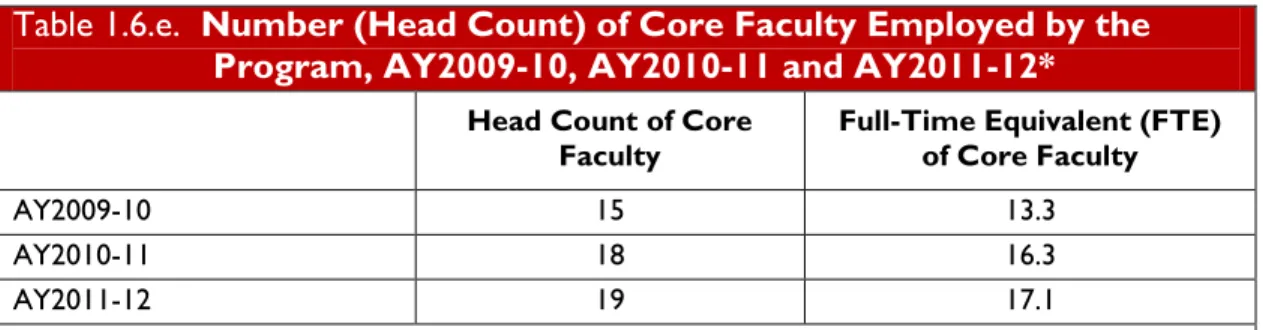
By Spring of 2009, the University and Brown School had hired an inaugural group of five tenured faculty members, five additional research faculty members and over 60 additional research staff, all working at the Brown School in the area of public health. This reflected a strong initial fiscal investment in the MPH program by the University, as does the MPH program’s present expenditures of roughly $12 million in FY2011. These inaugural faculty members, together with other faculty at the Brown School with public health experience, began work on crafting the curriculum, policies and procedures for the MPH program in Fall 2009.
One of the first decisions for the MPH program made by the faculty was to develop and approve a mission:
• To educate and prepare students to apply public health sciences and transdisciplinary approaches to problem solving for improving population health, especially in vulnerable communities;
• To conduct pioneering research that leads to greater evidence-based public health, and apply systematic approaches to implement and sustain public health discoveries regionally, nationally and internationally; and
• To conduct professional and community service that improves population health and eliminates health disparities in the region, nationally and internationally.
Transdisciplinary Public Health
The Brown School has built upon a strong academic and institutional foundation to develop an innovative and unique curriculum centered on the concept of transdisciplinary public health. While other public health programs in the country also have focused on
transdisciplinary public health, to our knowledge Washington University’s MPH program is the first MPH program in the United States to focus explicitly on a transdisciplinary
Box 1. Defining Approaches to Public Health*
How are research approaches defined, and what is the distinction between multidisciplinary, interdisciplinary and transdisciplinary research approaches?
Multidisciplinary research is where researchers from different fields work independently or sequentially, each from his or her own disciplinary perspective, to address a particular research topic.
Interdisciplinary research requires greater sharing of information and closer coordination among researchers from various fields than occurs in multidisciplinary projects, yet the participants remain anchored in their respective disciplinary models and methodologies, as do the members of multidisciplinary teams.
Transdisciplinary research requires researchers to work together to develop a shared conceptual framework that integrates and extends discipline-based concepts, theories and methods to address a common research topic.
Transdisciplinary research collaborations are intended to achieve the highest levels of intellectual integration across multiple fields and yield shared conceptual formulations that move beyond disciplinary perspectives, sometimes leading to the development of novel conceptual models and empirical approaches that integrate and extend the concepts, theories and methods of particular fields.
*Drawn directly from: Daniel Stokols. 2006. “Toward a Science of Transdisciplinary Action Research,” American Journal of Community Psychology 38 (63–77).
approach to research and practice in public health as the core of its MPH curriculum, drawing upon the interaction of the core foundations of public health as well as a range of other disciplines and applying these to complex public health problems.
For many years, analysts have drawn the conclusion that public health graduate students can benefit from a foundation of collaborative thinking to guide problem identification, solutions and analysis.1 While traditional educational methods in public health have favored unidisciplinary approaches (e.g., epidemiology, behavioral science, economics) that teach students to focus on the individual pieces of the puzzle that define population health, this approach may lead to scientific silos that can limit knowledge and understanding of the complex systems that influence population health. In contrast, transdisciplinary methods use shared disciplinary frameworks in analyzing health problems, but also use the
integration and evaluation of transdisciplinary solutions to complex public health problems (see Box 1). The practical application of transdisciplinary concepts across real-world case studies, as well as evaluation of these approaches, offers students the opportunity to reorganize thinking and practice around transdisciplinary research and practice as a means of promoting long-term and long-lasting solutions to complex problems in human health. The Brown MPH program takes this work further in several ways, explicitly documented in this self-study, but particularly through: (a) a requirement that students take at least two transdisciplinary public health problem-solving courses during their curriculum, (b) a unique cross-cutting themes course also required as part of the curriculum, and (c) a set of competencies that guide the program that explicitly lay out how transdisciplinary public health concepts should be folded into coursework.
While MPH students at the Brown School obtain a solid grounding in the knowledge basic to public health, delivered in five Foundations in Public Health courses, the essence of the innovation in the MPH curriculum is that each student becomes a transdisciplinary-oriented investigator, well grounded in public health foundations as well as other methods. The program uses structured transdisciplinary problem-solving courses to broaden the
foundational approach to a problem by identifying the needed perspectives, understanding their importance, and using the professional communicative structure and exchange from these different intellectual perspectives to create a more integrated intellectual synthesis of the problem at hand.
The transdisciplinary approach in the MPH curriculum is also woven throughout the curriculum – from an introductory cross-cutting themes course to the transdisciplinary problem-solving courses to the culminating experience that requires the students to demonstrate their transdisciplinary problem-solving skills.
The notion of a transdisciplinary organizational principle for the curriculum of the Brown School MPH emerges naturally from the program’s strong research and community service base. The School’s public health faculty members have developed an exceptionally
productive and well-funded research enterprise in the short period of time since the inception of the program in July 2008. Grant and contract income for the program, over $9.6 million in Fiscal Year 2009 (FY2009), had grown to over $11.7 million in FY2010 and to over $13 million in FY2011.
1Institute of Medicine, Genes, Behavior, and the Social Environment: Moving Beyond the Nature/Nurture Debate, Washington, D.C.: Institute of Medicine, 2006; Institute of Medicine, Who Will Keep the Public Healthy? Educating Public Health Professionals for the 21st Century. Washington, D.C.: Institute of Medicine, 2003.
The research mission is also reflected in the work of several nationally recognized research centers (see Box 2). These systematic, broad-based research centers have long incorporated the talents of public health professionals, physicians, biostatisticians, behavioral and social scientists, and psychologists to form the funded core of transdisciplinary projects composing the centers. Students working in these centers as research assistants have experienced this transdisciplinary perspective, so when creating the new MPH, the principles already embedded in the scientific work of faculty and staff were extended into the planning of the curriculum itself.
The MPH program is part of a broader initiative in public health at Washington University (see Figure 1), identified and unified under the campus-wide Institute for Public Health. The Institute was launched in 2008 with an $8 million endowment gift from the University. The Institute’s goal is to facilitate groundbreaking research by orchestrating thought leaders from a broad range of different disciplines to develop evidence-based solutions that positively impact public health in the St. Louis region and around the globe. Recognizing that solutions to the complex health issues facing society require collaboration from many different disciplines and partners, the Institute has appointed more than 150 scholars from across different professional schools and programs at WUSTL. The Institute also strives to
Box 2. Research Centers at Brown School, Washington University, Focused on Public Health
The Center for Obesity Prevention and Policy Research focuses on the dissemination of new knowledge to inform the creation and implementation of programs and policies designed to prevent obesity.
The Center for Tobacco Policy Research focuses on the research and evaluation of tobacco control programs and policies in Missouri and across the country.
The Center for Violence and Injury Prevention focuses on advancing prevention science and developing evidence-based, real-world strategies for preventing child maltreatment, intimate partner violence, sexual violence and suicide attempts.
The Center for Mental Health Services Research works with public social service agencies to build a base of evidence designed to address the challenges of delivering mental health services to vulnerable populations.
The Health Communication Research Laboratory is dedicated to the research, development and dissemination of health communication programs that enhance the health of individuals and populations. The Prevention Research Center in St. Louis explores the behaviors that place Americans at risk for chronic diseases, such as obesity, cancer and stroke.
Figure 1.
Public Health at Washington University
Brown School Master of Public Health
Undergraduate
Public Health
Minor Olin School MBA
Health Management Concentration
Engineering Master of Science
Environmental Health Specialization
Medical School
Master of Population Health Master of Psychiatric Epidemiology Master of Science in Clinical Investigation Master of Science in Health Care Services
coordinate a unique and complementary set of academic programs designed to recruit and train the next generation of public health leaders. The MPH draws upon the depth of five other master’s programs, two master’s programs with concentrations in public health areas (business and environmental health), and an undergraduate program offering a minor in public health.
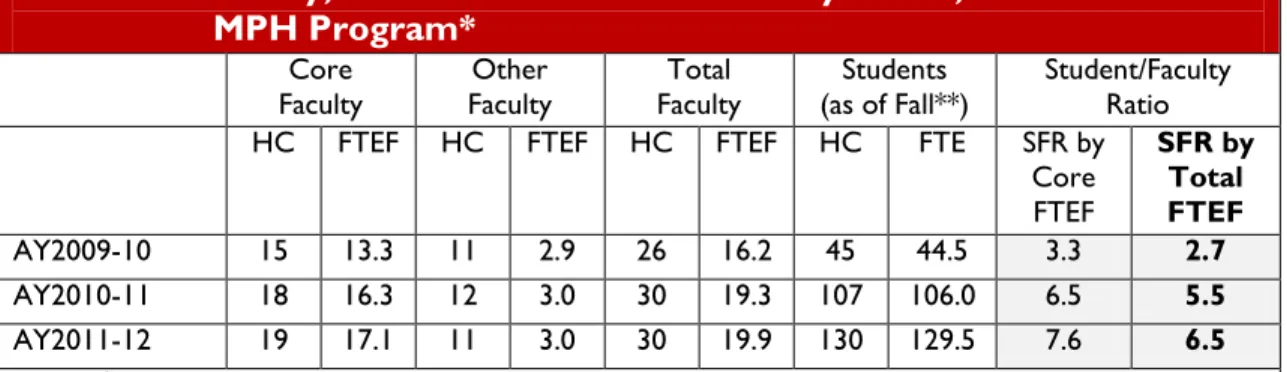
From its inception in 2009, the MPH program has matured from a newly conceived degree to a vibrant and well-connected program, currently educating almost 130 students with roughly 30 members of the public health faculty.
This self-study document serves as an introduction to and critical evaluation of the Washington University MPH program. Although it has been prepared to meet the requirements of accreditation by the Council on Education for Public Health (CEPH), the self-study reflects a report on the program’s process used to engage the program’s stakeholders in an opportunity to examine the program – its strengths and weaknesses – and consider how to further develop the program in the near future.
Overview of Program Strengths, Challenges and Opportunities
Strengths• The Brown MPH program has a strong mission statement, and a set of goals and measurable objectives developed through a careful deliberative process that is very well suited to the School, Washington University and the University’s Institute for Public Health. [Criterion 1.1]
• The MPH program is an integral part of an accredited institution of higher education, in one of the premier academic institutions in the world, Washington University, that has a well-established clear organizational structure, with clearly defined policies for accountability, the prerogatives of academic units, budgeting and resource allocation, personnel recruitment, and academic standards and policies, including establishment and oversight of curricula. [1.3]
• The Brown School MPH program provides an organizational setting conducive to teaching and learning, research and service, and a setting that facilitates
interdisciplinary communication, cooperation and collaboration. [1.4]
• The Brown School MPH program has in place governance procedures that protect the rights and responsibilities of the program’s administration and faculty. MPH students have participatory roles in conduct of program evaluation procedures, policy-setting and decision-making, where appropriate. [1.5]
• The MPH program has access to a significant array of resources that are certainly adequate to fulfill its stated mission and goals, and its instructional, research and service objectives as a result of the strong commitment from the University and the School’s leadership. The source of funds available to the MPH program has grown from $6.7 million in FY2009 to an estimated $11.6 million in FY2011, and expenditures have similarly grown from $6.4 million to $11.3 million from FY2009 to FY2011. [1.6]
• The Brown MPH program has a very strong curriculum and degree program, unique in the country for the centrality of applying transdisciplinary public health to MPH
education, and the program is already showing great success in delivering meaningful skills and competencies to its students [2.1].
• The MPH program delivers the core public health knowledge its students need, in a set of strong Foundations courses. In addition, the program enhances the students’ abilities to process and use this knowledge to tackle important public health problems through its set of research sequence courses and transdisciplinary problem-solving courses [2.3].
• Even though the MPH program is relatively new, the students have had a wide array of practical experiences, including, not insignificantly, a dozen students who had
international health practical experiences in Africa, Asia and Europe. The MPH program has had the benefit of adding its practical experience program to the infrastructure of an Office of Field Education that has existed for decades at the Brown School. The program places an emphasis on skills in delivering great practical experiences for its students, and a huge array of relationships with many organizations that translate well from social work to public health [2.4].
• The culminating experience allows the students to show their ability to integrate and apply knowledge gained during the program to a topic of interest to them, while incorporating transdisciplinary public health skills and competencies [2.5].
• The MPH program has developed a clearly stated set of competencies that guide the development of educational programs, and that are appropriate to the curriculum being delivered. The set of competencies are unique, since many of these competencies have been newly written for this School’s curriculum. Moreover, the competencies have been carefully developed in an exercise of program planning that has been careful,
deliberative and inclusive of all Brown School stakeholders (including students, staff and community leaders). [2.6]
• The Brown School MPH program has a strong set of procedures in place for assessing and documenting the extent to which each student has demonstrated competence in the required areas of performance. In part, the program has been able to proceed more quickly on this score than other new programs, because we have benefited from a set of procedures that have been developed over time to monitor and assess the MSW program in the Brown School, including but not limited to: course evaluations,
regularly scheduled forums to assess the program from the students’ perspective and an exit survey. [2.7]
• The Brown MPH program offers two joint (or dual) degree programs, the MPH/MSW degree and the MPH/MBA degree. These programs have been carefully developed to ensure that the required curriculum for the professional public health degree is being delivered in a way that makes it equivalent to that required for the separate public health degree [2.10].
• The Brown School MPH program has a remarkably active research program, consistent with its mission, that facilitates the possibilities for the faculty and students to
contribute to the knowledge base of the public health disciplines, including research directed at improving the practice of public health. As one measure of this, the Brown School’s MPH faculty brought in over $11.7 million in grant awards in FY2010, translating to over $718,000 per core public health faculty member. [3.1]
• The Brown MPH faculty make remarkable contributions to the discipline of public health, as measured by the breadth and depth of their published articles, as well as
remarkable contributions to the practice of public health in the community. The Brown School has an impressive array of leading-edge research centers, contributing
impressively to the public health profession in the areas of: prevention, obesity and diabetes, health communication, tobacco policy, mental health, health disparities and injury prevention. [3.1]
• MPH program faculty and students benefit from their presence on one of the most productive research university campuses in the country, with world-class research programs in many areas affiliated with the program and School, including but not limited to: medicine, business, architecture, engineering and law. The creation of the new Institute for Public Health demonstrates the University’s commitment to public health, and creates the energy and focus to develop transdisciplinary public health perspectives. [3.1]
• The MPH program pursues an active set of service activities, consistent with its mission, which allows the faculty and students to contribute to the advancement of public health practice. The MPH program has a large array of over 175 community partner relationships through which the faculty and students can contribute directly to public health practice. [3.2]
• For a new MPH program, who only recently graduated their first class, the Brown School has a growing array of professional development programs that enhance the needs of the public health workforce. The Brown MPH program has made impressive contributions to public health workforce development, especially in the areas of: evidence-based public health, health policy, obesity and health communication. These build on previously existing contributions to workforce development, particularly by the Prevention Research Center. [3.3]
• The MPH program has a clearly defined public health faculty that numbers 17FTE core faculty and 3FTE other faculty in Fall 2011, a number more than sufficient to meet the needs of the program’s mission, goals and objectives. This faculty has an impressive array of qualifications of a multidisciplinary nature, with impressive educational preparation, world-class research, teaching and practice experience. [4.1]
• The MPH program has a well-defined set of policies and procedures to recruit, appoint and promote qualified faculty; to evaluate competence and performance of the faculty; and to support the professional development and advancement of faculty. The program, although new, benefits from a strong set of policies and procedures already in place in the Brown School and Washington University. Where it was necessary to adapt these to the field of public health, this was accomplished easily and fully supported by the Dean and other faculty in the Brown School. [4.2]
• The MPH program has significant policies and procedures in place to recruit, retain and promote a diverse faculty and offer equitable opportunities to qualified individuals regardless of age, gender, race, disability, sexual orientation, religion or national origin. The program benefits from the development of a strategic initiative in this area, called the Serenade Project, and the Chancellor and Provost have given significant focus to this initiative. The MPH program and the Brown School at large demonstrates leadership to the rest of the Washington University campus on aspects of diversity, given that the MPH program has one of the highest proportions of faculty who are women (67%) and underrepresented minorities (20%) on campus. [4.3]
• The MPH program has implemented an impressive array of student recruitment and admissions policies and procedures that enables it to locate and select qualified
individuals capable of taking advantage of the program’s various learning activities and developing competence for a career in public health. The program has met the
enrollment targets set and in its third year is close to meeting its target enrollment of 150 students. The quality of the students enrolling in the MPH program has increased significantly over time, in terms of our admission criteria: GRE scores, academic record, and experience. [4.4]
• The Brown MPH program has in place a set of policies, procedures and plans to achieve a diverse student population. The MPH program has achieved an impressive and diverse application pool in its first two years of recruitment of students, since in AY2010-11, 57% of the applicants to the program were not Caucasian or were international students, an increase from 51% in AY2009-10. The final student class is also quite diverse, as 43% of the enrolled students in AY2010-11 were not Caucasians, an increase from 33% in the AY2009-10 class. [4.5]
• The MPH program has a clearly explained and accessible academic advising system for students and readily available career and placement advice. [4.6]
Challenges
• The MPH program has encountered some challenges in aligning the course delivery (measured by course syllabi and other metrics) with the objectives for the program. [Criterion 1.2]
• Introducing a new academic program within the structure of an exisiting School has required some institutional changes in the organizational structure of the program. [1.4]
• The MPH program faces significant and immediate constraints related to space
available for the program. The rapid growth in the Brown School has caused strains on the program, in relation to its ability to deliver its education, research and service missions. [1.6]
• Since the Brown School’s MPH program is at this point a “generalist” MPH program, it does not deliver concentrations or concentrations in public health. This can create challenges in helping students and their prospective employers understand how the unique skill sets our students have make them incredibly well qualified to tackle public health issues and problems [2.1].
• The creation of a curriculum that delivers a unique set of transdisciplinary public health skills, while also delivering the key core competencies in public health, is a balance for any curriculum that has “only” 45 credit hours. However, the faculty has carefully crafted a curriculum that achieves this balance and is constantly monitoring the curriculum to make sure the students are receiving the best education possible [2.3].
• The MPH program has faced some challenges in implementing a new practical
experience, appropriate for the MPH degree, into a School that has policies and practices adapted for a different degree program, and professional standards appropriate for that field, social work. However, the MPH program has benefited greatly from the many existing relationships that the Brown School has with health agencies, and so largely the MPH program has navigated this institutional change with few difficulties [2.4].
• In the Culminating Experience, topics are student-selected, so to-date not every
competency in public health appears to apply to every topic selected. The grading rubric chosen has not been as clear to reviewers and advisors as it could have been for the completion of successful culminating experiences [2.5].
• The process of making sure that dual-degree students in the MSW/MPH degree program are receiving a curriculum in a way that every one of the 45 credits is equivalent to those delivered to students receiving the separate degree has been time-consuming and has required careful coordination between the MSW and MPH programs [2.10].
• Like all other academic programs in the current funding environment, the Brown School faces the challenge of maintaining its remarkable productivity and growth, while also nurturing the development of new junior faculty. [3.1]
• Developing a contribution to the public health practice community is a challenge for any new MPH program. However, the existing infrastructure of the Brown School has
enhanced the ability of the faculty to lead in the development of these contributions. [3.2]
• Developing an array of professional development programs that meet the significant challenges of the St. Louis community requires a careful assessment of the needs of the community. This needs assessment is ongoing, and is being done through the work of MPH program administration, the Public Health Community Advisory Committee and the Institute for Public Health. [3.3]
• The program continues to face the need to recruit a sufficient array of well-qualified faculty to meet the growth of its program. Significant recruitment in AY2010-11 of new faculty will continue to meet the program’s needs, though challenges remain to make sure the program has enough faculty in each core area of public health to meet its mission, goals and objectives (particularly health policy and management, as well as environmental health). [4.1]
• The MPH program has added a new degree program and discipline to an existing School, so this raises the possibility that policies and procedures may need to be changed to adapt to these changes. [4.2]
• The Brown MPH program recognizes that maintaining a diverse faculty requires attention not only to recruitment of faculty, but retention of these faculty and their academic success. The program has a significant array of initiatives and efforts in place to make sure that retention of faculty can occur. In the School’s increased attention to faculty diversity, we are recognizing that we also need to pay attention to the diversity of Brown School staff, including research staff. The Dean has initiated efforts to explore the success, retention and promotion of diverse staff as well. [4.3]
• The diversity of the MPH student body initially was more regional in focus and had few international students, but the most recent classes have more diversity in terms of national, international and ethnic diversity. As a new MPH program, the Brown School faced some challenges to recruit students initially, but these challenges to a great extent no longer exist. [4.4]
• Analysis presented here suggests that while underrepresented students are more likely than others to apply, fewer of these students end up being enrolled in the program. This analysis suggests that the MPH program needs to assess the program’s policies and procedures to determine the reasons why this may be occurring. [4.5]
• The program has observed some challenges in the strength and quality of its advising system during the first year of operation of the program but instituted significant changes in advising to improve the quality of the advising experience. Student
evaluations show that these changes had a significant positive effect on the evaluations of the advising system. [4.6]
Future Plans
• The program plans to continue to monitor changes in the public health and academic environment, and is ready to adapt its mission, goals and objectives if necessary for these changes. As a new MPH program, the administration and faculty will continually assess the program’s progress toward meeting its goals and objectives, and institute changes in the program where necessary to meet these objectives, or adopt new goals or objectives to enhance the ability of the program to meet its mission. [Criterion 1.1]
• The MPH program plans to work with faculty and instructors to assure that syllabi reflect the objectives identified for the curriculum. Continued monitoring of the
culminating experience will increase guidance to MPH students on expectations for this experience. [1.2]
• The Brown School’s leadership and faculty will continue to monitor the structure of the MPH program, and institute changes where necessary to meet the program’s mission, goals and objectives [1.4]
• The University’s leadership has approved the hiring of an architect to initiate plans to build a new facility for the Brown School and, pending approval of the Board of Trustees, this facility should be under construction within two years. [1.6]
• The MPH program is exploring the addition of specializations, now that the program has been in existence for two years, and we have enough faculty to deliver these specializations [2.1].
• The MPH program plans to continue to develop its unique transdisciplinary public health curriculum, especially the resource-intensive transdisciplinary problem-solving courses. We have plans to develop a remarkable six new transdisciplinary problem-solving courses in AY2011-12, increasing our set of TPS courses to a total set of 11. Associate Deans Debra Haire-Joshu and Timothy McBride are jointly editing a textbook for the public health field, on the issue of transdisciplinary public health, due for release in 2012 [2.3].
• The Brown School will continue to develop a wide array of relationships with employers seeking practicum students, as the demand for these relationships increases with the size of the student body. The program will continue to develop policies and procedures for the practical experience that maximize the quality of the experience for the students, their careers and the preceptors supervising the students [2.4].
• The faculty plan completed plans to create a new format for the culminating experience and will monitor the implementation of the new Culminating Experience for AY2012. The program has provided students with more detailed information regarding the culminating experience, its guidelines and expectations during the middle of the semester prior to their enrollment in the culminating experience in order to allow more time for students to develop their ideas [2.5].
• Although the introduction of a unique curriculum that is designed to deliver
transdisciplinary public health skills to its students may present a challenge, in that it is crucial to make sure that important core public health competencies are delivered to the students, the competencies have been developed with this balance in mind. In addition, in a focus group of the students, they reported not having any concerns about the delivery of the competencies in the MPH program, and they strongly support the list of competencies proposed. [2.6]
• The Brown School’s MPH program is designed to deliver a program that is proactive and responsive to the public health professional community, but always designed to meet the needs of the MPH students and employers. This will require a constant monitoring of the competencies, and professional development experiences, to see whether they need to be altered to adapt to changes in the professional environment [2.6].
• As a new MPH program, the program is still developing procedures and mechanisms to monitor and assess the progress of the program in meeting its required areas of
performance that are unique to the MPH program and public health. The program will continue to study the procedures and methods used to assess the program’s
performance, and adjust these procedures and methods if necessary [2.7].
• The Brown School is exploring the potential for additional dual degrees, including, but perhaps not limited to: a dual degree in Occupational Therapy and public health (MPH/OT), and a dual degree in medicine and public health (MPH/MD) [2.10].
• The MPH program will continue to focus on developing opportunities for the faculty and students to engage in leading-edge research, especially with a transdisciplinary focus. This will include the pursuit of training programs that will enhance the School’s ability to develop these opportunities. [3.1]
• The MPH program will continue to develop as many service activities as possible that are consistent with the mission of the program, especially in the St. Louis community, which faces many public health challenges, and in the international community, where the Brown School already has significant – but growing – relationships. [3.2]
• The Brown School will continue to develop and assess professional development
programs as it collects a growing array of alumni, and continues to increase connections to the public health community. [3.3]
• The MPH program will continue to recruit new faculty in the areas where there are gaps, and at a pace consistent with the growth of the program and the program’s mission, goals and objectives. [Criterion 4.1]
• The MPH program plans to continue to recruit new faculty at a pace consistent with the growth of the program and the program’s mission, goals and objectives. [4.1]
• The School is engaged in a process to change tenure and promotion standards and policies, and continues to assess ways in which policies and procedures may need to be changed to reflect the growth of the School and the addition of a new degree program. [4.2]
• The MPH program has had a successful year of recruiting in AY2010-11, especially in the area of recruitment of diverse faculty, leading to a rise to 20% in AY2011-12 that are in underrepresented groups, while maintaining the diversity of their faculty from a gender perspective (67% female). [4.3]
• The program has plans in place to achieve an entering cohort of 75 students each, with increasing diversity. Methods and procedures are in place to achieve these goals. [4.4]
• The MPH program will continue to monitor its rate of applications, enrollment and acceptance by diverse populations, and institute policies, procedures and methods to enhance and maintain diversity where appropriate and in agreement with the mission, goals and objectives of the program. [4.5]
• The program will continue efforts to reach out to public health employers to enhance the placement of MPH students. The program continues to explore changes in the advising system that will improve its quality for MPH students. [4.6]
1.1. Mission
The mission statement for the MPH program was approved by the Brown School’s Public Health Committee in Fall 2008 (and later revised in 2009 and 2010).
The mission of the Brown School’s MPH program is:
• To educate and prepare students to apply public health sciences and transdisciplinary approaches to problem solving for improving population health, especially in vulnerable communities;
• to conduct pioneering research that leads to greater evidence-based public health, and apply systematic approaches to implement and sustain public health discoveries regionally, nationally and internationally; and
• to conduct professional and community service that improves population health and eliminates health disparities in the region, nationally and internationally.
This MPH mission closely parallels the mission statement of the Brown School, most recently revised in 2008 as part of the School’s strategic planning process, Impact 2020.
The mission of the Brown School is:
• To educate and prepare future social work and public health leaders in areas of policy, practice and research.
• To pioneer research and apply results to impact policy and practice locally, nationally and internationally.
• To collaborate with organizations to use evidence to improve access to and quality of social services and to address social and economic justice.
Public health faculty members, in recent retreats, have also established goals and objectives for the MPH program to match the goals and mission for the MPH program described above. These goals and measurable objectives are enumerated in Table 1.1.b.
1.1.b. One or more goal statements for each major function by which the program intends to attain its mission, including instruction, research and service. 1.1.c. A set of measurable objectives relating to each major function through which
the program intends to achieve its goals of instruction, research and service. 1.1. Mission. The program shall have a clearly formulated and publicly stated
mission with supporting goals and objectives. The program shall foster the development of professional public health values, concepts and ethical practice.
Table 1.1.b.
Brown School MPH Goals and Objectives
EDUCATION
EDUCATION GOAL 1: Train students to deploy transdisciplinary strategies from a variety of intellectual disciplines to solve extant problems in public health
Objective 1.a: Develop 2 TPS courses by AY2009-10, five TPS courses by AY 2010-2011 and 10 TPS courses by AY 2011-2012
Objective 1.b: Assure that syllabi for 100% of required MPH courses have transdisciplinary content Objective 1.c: Assure that 100% of students demonstrate competency developing transdisciplinary responses to public health problems through their culminating experience
EDUCATION GOAL 2: Train students to comprehend and apply a range of foundations-level public health competencies
Objective 2.a: Assure that 100% of foundations-level competencies (biostatistics, epidemiology, health behavior, health policy and environmental health) are addressed in more than one MPH course Objective 2.b: Assure that 100% of students demonstrate mastery of foundations-level competencies in their culminating experience
EDUCATION GOAL 3: Train students to identify relevant scientific research evidence, understand the dynamic nature of this evidence and apply this evidence in public health practice
Objective 3.a: Assure that evidence-based public health is present in syllabi for 100% of required MPH courses
Objective 3.c: Assure that 100% of students demonstrate evidence-based public health skills in their culminating experience
EDUCATION GOAL 4: Train students to understand the nature, causes and strategies for eliminating health disparities, and to be prepared to engage in the reduction and elimination of health disparities locally, regionally, nationally and internationally
Objective 4.a: Assure that the study of health disparities is present in syllabi for 100% of required MPH courses
Objective 4.b: Assure that 100% of students demonstrate the ability to recognize, explain and address disparities for the health problem being addressed in the culminating experience
EDUCATION GOAL 5: Train students to communicate effectively to key stakeholders and diverse audiences, and to assume leadership roles across a spectrum of public health research and practice settings
Objective 5.a: Assure that 50% of required MPH courses include a presentation opportunity per the course syllabus
Objective 5.b: Assure that 100% of students make a professional presentation to a key public health stakeholder audience (non-faculty) in their culminating experience
EDUCATION GOAL 6: Create a program with a culture of learning supported by a diverse range of educational activities
Objective 6.a: Provide opportunities for students, faculty and staff to attend 15 public health seminars per academic year through the Brown School and the Institute of Public Health
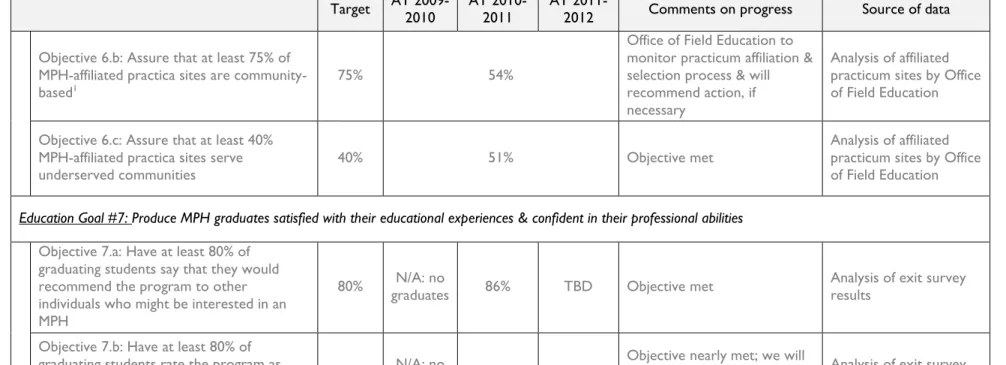
Objective 6.b: Assure that at least 75% of MPH-affiliated practica sites are community-based
Objective 6.c: Assure that at least 40% of MPH-affiliated practica sites serve underserved communities
EDUCATION GOAL 7: Produce MPH graduates satisfied with their educational experiences and confident in their professional abilities
Objective 7.a: Have at least 80% of graduating students say that they would recommend the program to other individuals who might be interested in an MPH
Objective 7.b: Have at least 80% of graduating students rate the program as “excellent” or “good” in its ability to meet their needs for a professional education
Table 1.1.b.
Brown School MPH Goals and Objectives
Objective 7.c: Have at least 80% of graduating students rate the MPH program as “excellent” or “good” for each objective measured
RESEARCH
RESEARCH GOAL 1. Conduct research that has a beneficial impact on public health policy and practice, and engage in translation and dissemination of this research to policy and practice
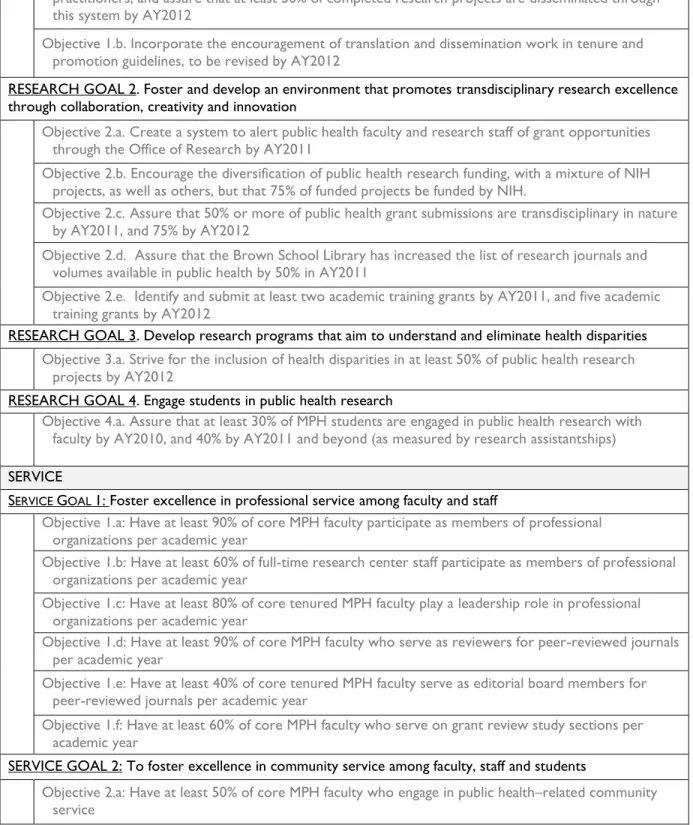
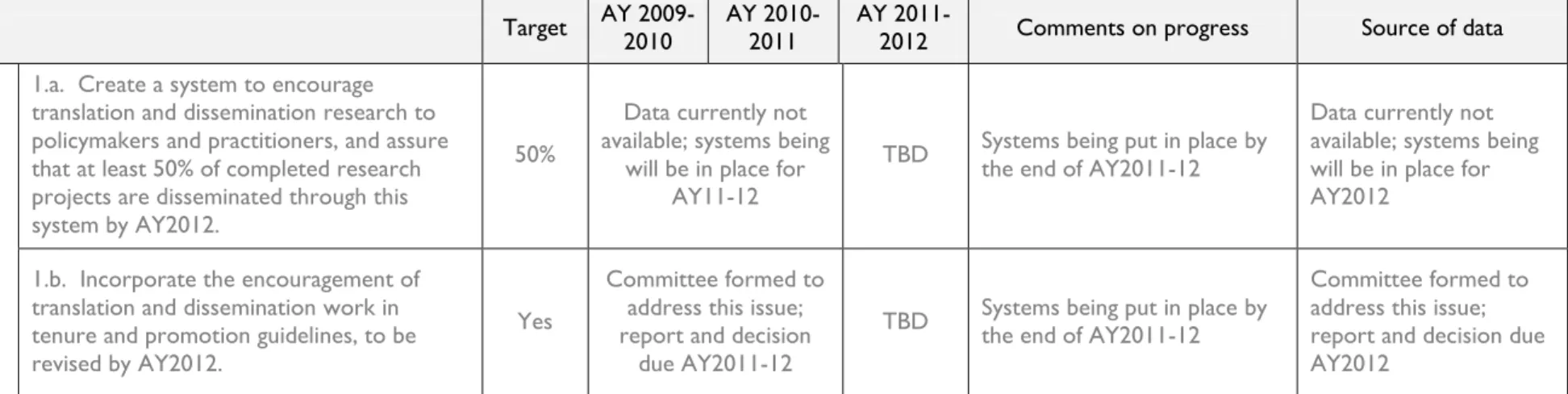
Objective 1.a. Create a system to encourage translation and dissemination research to policymakers and practitioners, and assure that at least 50% of completed research projects are disseminated through this system by AY2012
Objective 1.b. Incorporate the encouragement of translation and dissemination work in tenure and promotion guidelines, to be revised by AY2012
RESEARCH GOAL 2. Foster and develop an environment that promotes transdisciplinary research excellence through collaboration, creativity and innovation
Objective 2.a. Create a system to alert public health faculty and research staff of grant opportunities through the Office of Research by AY2011
Objective 2.b. Encourage the diversification of public health research funding, with a mixture of NIH projects, as well as others, but that 75% of funded projects be funded by NIH.
Objective 2.c. Assure that 50% or more of public health grant submissions are transdisciplinary in nature by AY2011, and 75% by AY2012
Objective 2.d. Assure that the Brown School Library has increased the list of research journals and volumes available in public health by 50% in AY2011
Objective 2.e. Identify and submit at least two academic training grants by AY2011, and five academic training grants by AY2012
RESEARCH GOAL 3. Develop research programs that aim to understand and eliminate health disparities
Objective 3.a. Strive for the inclusion of health disparities in at least 50% of public health research projects by AY2012
RESEARCH GOAL 4. Engage students in public health research
Objective 4.a. Assure that at least 30% of MPH students are engaged in public health research with faculty by AY2010, and 40% by AY2011 and beyond (as measured by research assistantships)
SERVICE
SERVICE GOAL 1: Foster excellence in professional service among faculty and staff
Objective 1.a: Have at least 90% of core MPH faculty participate as members of professional organizations per academic year
Objective 1.b: Have at least 60% of full-time research center staff participate as members of professional organizations per academic year
Objective 1.c: Have at least 80% of core tenured MPH faculty play a leadership role in professional organizations per academic year
Objective 1.d: Have at least 90% of core MPH faculty who serve as reviewers for peer-reviewed journals per academic year
Objective 1.e: Have at least 40% of core tenured MPH faculty serve as editorial board members for peer-reviewed journals per academic year
Objective 1.f: Have at least 60% of core MPH faculty who serve on grant review study sections per academic year
SERVICE GOAL 2: To foster excellence in community service among faculty, staff and students
Objective 2.a: Have at least 50% of core MPH faculty who engage in public health–related community service
Table 1.1.b.
Brown School MPH Goals and Objectives
Objective 2.b: Have at least 80% of full-time research center staff members who engage in public health– related community service
Objective 2.c: Have at least 80% of students who engage in public health–related community service
The mission, goals and objectives for the Brown School MPH program were developed over a period of time using this timeline and process:
• The mission statement for the program was initially developed (and later revised) by the faculty on the Brown School Public Health Committee in Fall 2008.
• Goals and objectives for the program were developed at a series of biannual faculty retreats held in 2009 and 2010, in meetings attended by MPH faculty (including adjunct faculty).
• The mission, goals and objectives were presented to the full Brown School faculty during regular faculty meetings during the 2009-10 periods, for comment.’
• Revisions were made to the mission, goals and objectives in AY2010-11, as the program further developed.
• The mission, goals and objectives were presented at key points during the 2009-10 periods to stakeholder groups, including the MPH Community Advisory Committee, after it was formed in 2010, the Brown School National Council and the Dean’s Advisory Committee.
Periodic reviews of the mission, goals and objectives have occurred at regular faculty retreats in January 2009, August 2009, January 2010 and August 2010. This has led to revisions, in particular of the program goals and objectives, with input from MPH program faculty and community advisors (from the National Council and Dean’s Professional Advisory Committee, and the MPH Community Advisory Committee). Final decisions on the mission, values, goals and objectives for the program rest with the MPH program faculty and administration, however.
The values that guide the Brown MPH program faculty, students and staff are:
• Professional integrity in education, research and service
• Compassion, equity and social justice in defining and addressing public health problems
• Respect for and inclusion of diversity and community
1.1.d. A description of the manner in which mission, goals and objectives are developed, monitored and periodically revised and the manner in which they are made available to the public.
1.1.e. A statement of values that guide the program, with a description of how the values are determined and operationalized.
The values statement was determined in the same manner as the mission, goals and
objectives were developed, that is, through an iterative process that started with the Public Health Committee, and leading to the broader community of MPH faculty, staff, students and community stakeholders. The program’s values are communicated to students at their program orientation, to faculty as part of their orientation to the School and program, and to our community stakeholders in periodic meetings. The program values are consistent with the values guiding Washington University in general and the Brown School in particular. Expectations and values for students and faculty are reflected in their respective handbooks [Faculty handbook: http://provost.wustl.edu/faculty_information_brochure; Student handbook: http://provost.wustl.edu/studebt_related_policies]. Note that these handbooks are University-wide handbooks that govern expectations and values for students in all academic programs on the campus. Program values are operationalized through introduction in the Cross-Cutting Themes core course that starts the curriculum and through the students’ application of core values in the field experience and culminating experience. The values are also incorporated into the MPH program core competencies. All syllabi include a statement laying out the program’s policy on plagiarism. The MPH faculty has endorsed the American Public Health Association’s Code of Ethics for Public Health. Respect for and inclusion of diversity and community is also operationalized by diversity and cultural sensitivity training and community-based research workshops (more fully described in Criterion 4), provided to students during orientation.
Strengths
• The Brown School MPH program has a strong mission statement, and a set of goals and measurable objectives developed through a careful deliberative process that is very well suited to the Brown School, Washington University and the University’s Institute for Public Health.
Future Plans
• The program plans to continue to monitor changes in the public health and academic environment, and is ready to adapt its mission, goals and objectives if necessary for these changes.
• As a new MPH program, the administration and faculty will continually assess the program’s progress toward meeting its goals and objectives, and institute changes in the program where necessary to meet these objectives, or adopt new goals or objectives to enhance the ability of the program to meet its mission.
Criterion 1.1 is met.
1.2. Evaluation and Planning
The MPH program at Washington University’s Brown School is the result of three years of school- and university-wide long-range planning, and is explicitly stated in the School’s 10-year plan, Impact 2020. Internal and external constituents actively participated in the discussion and analysis of the desire to develop and launch an MPH program.
Within the public health program, faculty, students, staff and community members are integrally involved in regular evaluation and planning. Faculty members participated in the
Impact 2020 planning process. A faculty retreat is held every August prior to the start of the academic year. Brown School faculty meetings are held on a regular basis (usually monthly) throughout the academic year.
The Public Health committee is the principal body for making all decisions about the MPH program and making recommendations to the Dean. The Public Health committee meets regularly (usually monthly) to discuss all major issues concerning the program. Faculty and staff also serve on ad hoc committees convened to tackle specific issues. In all cases, decisions about the policies and procedures for the MPH program were devised (and continue to be governed) by the MPH faculty in consultation with the Dean of the School. Where the Brown School had an existing policy, procedure or department that met the needs of the MPH program, or did not need to be changed, these policies were left in place. In all cases, these were deliberate decisions made by the MPH faculty. In all cases where curriculum, policies and procedures needed to be implemented to conform to the public health profession, CEPH guidelines and standards, or the strong desires of the MPH faculty, these policy changes have been adopted. In some cases, however, Washington University rules require that Schools govern certain policies and procedures. These cases will be explicitly identified in the Self-Study document.
Faculty and other instructors receive the results of midterm and final course evaluations in a timely fashion so they can make mid-semester adjustments to their courses and plan for
upcoming semesters. The Associate Dean for Public Health reviews these evaluations for every course and meets with faculty and instructors to discuss teaching strategies, as necessary. Students are heavily involved in the evaluation of and planning for the program. In addition to anonymous midterm and final course evaluations completed for each public health course, every spring, graduating students complete an exit survey to assess their overall experience at the Brown School and MPH program. Two elected student representatives – one in his or her first year of the program, and one from his or her second year in the program – serve on the public health committee. These student representatives hold periodic “office hours”
1.2. Evaluation and Planning. The program shall have an explicit process for evaluating and monitoring its overall efforts against its mission, goals and objectives; for
assessing the program’s effectiveness in serving its various constituencies; and for
planning to achieve its mission in the future.
Required Documentation. The self-study document should include the following:
1.2.a. Description of the evaluation procedures and planning processes used by the program, including an explanation of how constituent groups are involved in these processes.
to hear concerns from students and have maintained a student blog on Inside Brown, the School’s intranet, or obtained feedback from students through email exchanges to solicit feedback from students on particular topics under consideration by the committee.
Periodically, students are invited to participate in meetings organized by the MPH Program Office to solicit feedback on specific topics (e.g., focus group discussion of students about the program competencies). And in the first two years of the program, the MPH leadership has put out four special surveys, conducted at midway points through every semester, to get real-time student opinions about the MPH curriculum and other issues. It was mostly in response to the first of these surveys that the faculty made several significant changes to the curriculum, put in place before the second year of the program. Finally, the MPH Office maintains an “open-door” policy for students to drop by or send an email with concerns about or ideas for the program at any time.
Community members are an integral part of the MPH program’s planning and evaluation processes through a variety of mechanisms:
• A National Council, consisting of business and community leaders, as well as school alumni, meets twice annually and serves in an advisory capacity to the Dean regarding the progress, goals and future direction of the Brown School. The National Council always includes at least one member of the University’s Board of Trustees.
• The MPH program established a Community Advisory Committee consisting of representatives from local health departments, nonprofit organizations and foundations. The Community Advisory Committee’s charge is to provide the program with feedback and guidance on developing students into professionals with the skills to meet the needs of the public health community.
• The MPH Practicum Advisory Committee was created to provide guidance to the MPH program and the Office of Field Education in developing, providing and maintaining a strong practicum component for MPH students. The committee consists of
representatives from the Office of Field Education, the MPH Office and community members. To help guide this committee and the Office of Field Education, practicum field site supervisors are contacted at least once for each student that is being supervised.
A variety of methods are used to digest the results of evaluation and planning, and make recommendations for how to enhance the quality of the MPH program and activities.
• The National Council meets every fall and spring to review the School’s progress, including the MPH program, and to provide guidance to the Dean.
• Annual surveys of enrolled students are critical to the program’s planning processes. The students’ responses help drive elective course options and the focus of the Transdisciplinary Problem Solving courses offered each semester. For example: - Students in the inaugural MPH class raised concerns about the limited amount of
class time allotted to foundations-level courses. This feedback led to curriculum revisions and the expansion of foundations-level courses from 2 credit hours to 3
1.2.b. Description of how the results of evaluation and planning are regularly used to enhance the quality of programs and activities.
credit hours prior to the entry of the second MPH class. Results from this year’s survey of enrolled students indicate that students are more satisfied with the 3-credit-hour format now allotted to foundations-level courses.
• Conducting mid-semester and final course evaluations for each MPH course every semester provides instructors with timely feedback about their courses. Many instructors make mid-semester adjustments to their courses based on the evaluation feedback they receive. The Associate Dean for Public Health provides instructors with individual feedback on their course evaluations via email or in-person meetings, as appropriate. The course evaluations also help instructors and the MPH Office plan for future semesters.
- For example, course evaluations from students enrolled in the culminating experience for the Fall 2010 semester led to changes in the structure of and
guidance for the culminating experience for Spring 2011. The MPH Office provided students and faculty advisors with more detailed instructions in the syllabus; established voluntary monthly “check-in” meetings to provide students an opportunity to share their experiences of the process with each other and to get more guidance from the MPH Office about the expectations for the culminating experience; and lengthened the time allotted for presentation from 10 minutes to 20 minutes.
• The Brown School provides a structured mentoring process for all junior faculty members. Each junior faculty member is assigned a faculty mentor who is available to him or her for guidance on research, teaching and the tenure-track process. In addition, the Associate Dean for Faculty and the Associate Dean for Public Health meet
individually with MPH junior faculty members on a regular basis to discuss their teaching and research agenda.
• The Community Advisory Committee (CAC) and the MPH Practicum Advisory Committee are designed to provide the MPH program with feedback on what
professional skills and experiences the program should be developing and providing to its students. CAC members serve as panel members for the culminating experience final presentations. This involvement allows CAC members additional insight into the knowledge, skills and professionalism of students graduating from the program so that they can provide guidance on developing the strongest MPH program possible.
• Student representatives serve on the Public Health Committee. The student
representatives have dedicated time on the agenda for every committee meeting. This participation provides a student perspective on the major decisions facing the MPH program. The committee also solicits feedback from a broader range of students on specific issues through a student-managed blog on Inside Brown, the School’s Intranet Student representatives also hold periodic “office hours” to listen to student concerns and solicit feedback about the program.
The exit survey of graduating MPH students was being conducted for the first time in Spring 2011. The survey provides a self-assessment by the students of their progress in mastering professional public health competencies while at the Brown School and of their satisfaction with the program overall, as well as with specific administrative departments, such as Admissions, Student Services, Academic Affairs, Field Education, Career Services and the MPH Office. The results of the exit survey are used to address any specific issues identified and to enhance the overall program experience for future students. Results of this exit survey are presented and summarized in detail under Criterion 2.7, and the complete results are available in the Resource File.
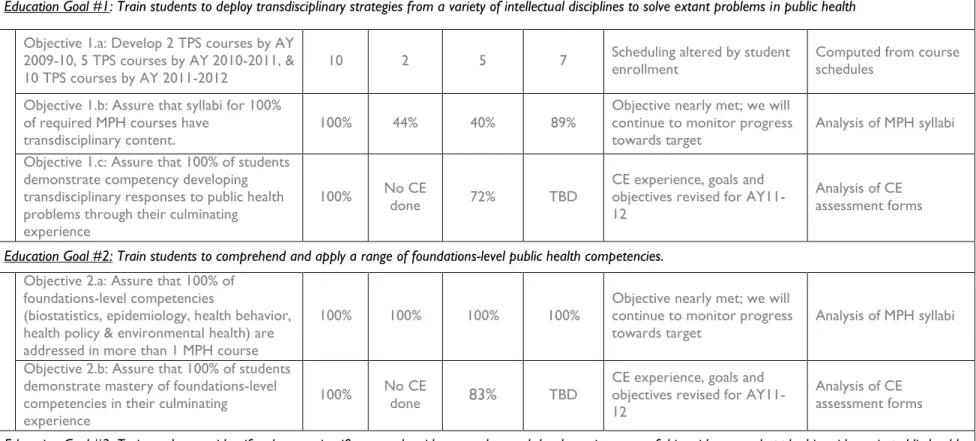
Table 1.2.c provides an assessment of the MPH program’s performance to date against the measurable objectives set by the faculty in their strategic planning process. The table presents the objectives, and the data to assess whether the objectives were met in AY2009-10 or AY20AY2009-10-11 (data on AY2011-12 not available yet). In general, the overall findings from this assessment are:
• Education objectives: The faculty identified seven goals and 17 objectives. By AY2010-11, over half (nine) of these objectives had been met. With regard to the nine objectives not met:
- Three of the objectives not met reflect analysis of the culminating experience (CE). Faculty members reviewed the competencies used for the CE, and the assessment tool used to measure whether those competencies have been achieved. These
changes were approved by the MPH faculty in Fall 2011 and will be implemented in Spring 2012.
- Three of the objectives not met relate to course content not always clearly reflecting the objectives set out. A system has been put in place to proactively encourage faculty members to make sure these competencies are included in the course content by the end of AY2012.
- One objective relates to the number of TPS courses offered, but the number of course sections offered has been adjusted to adapt changes in the actual number of students enrolled (slightly lower than projections).
- One objective not met relates to the practicum experience (the percentage of sites that are community-based). The Office of Field Education will put in place
procedures to monitor this situation, and report to the Associate Dean and faculty if changes need to be implemented.
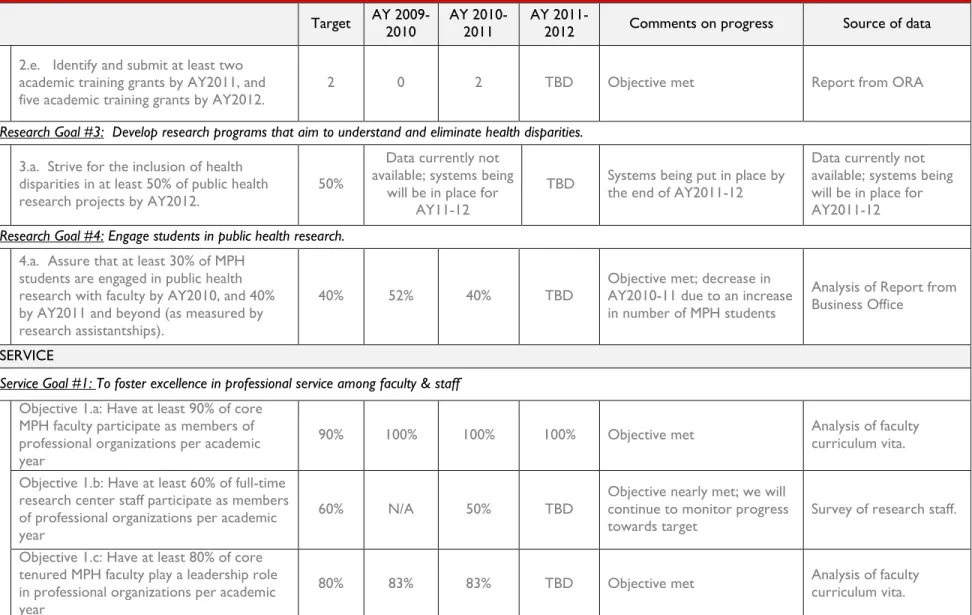
• Research objectives: The faculty identified four goals for research, and 10 objectives. By AY2010-11, five of the 10 objectives had been met. With regard to the objectives not met, in all five cases, work is in progress on these objectives, and data to measure the objective are not currently available. However, the Office of Research is working on putting in place systems to measure progress toward this objective, with an expected completion date by the end of AY2012.
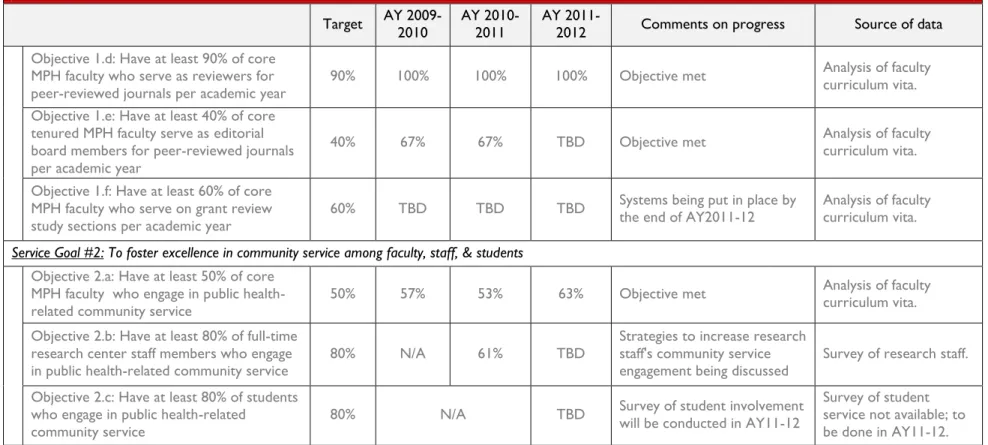
• Service objectives: The faculty identified two service goals and nine service objectives. By AY2010-11, six of these nine service goals had been met (or nearly met). With regard to two of the remaining unmet goals, systems are being put in place to measure whether the objective is being met. With regard to one remaining goal, the faculty will work with research staff on strategies for increasing engagement in professional associations.
In summary, the assessment of the goals and objectives shows that the Brown MPH program has made substantial progress toward meeting its goals and objectives. In particular, 20 of the 36 objectives had been met by AY2010-11. Work is in progress to assess whether seven of the remaining objectives have been met. These will be in place by
1.2.c. Identification of outcome measures that the program uses to monitor its effectiveness in meeting its mission, goals and objectives. Target levels should
be defined and data regarding the program’s performance must be provided for
AY2011-12, because in nearly all of these cases, systems are not in place currently to measure progress toward these objectives. In the remaining nine cases, the objective has not been met, but the administration and faculty have instituted processes to assure that the objective is met in AY2011-12.
This self-study document provides a qualitative and quantitative assessment of how our public health program achieves its mission, goals and objectives, and meets the accreditation criteria. We have identified outcome measures that we use to monitor the public health program’s effectiveness in meeting our mission, goals and objectives. Table 1.2.c presents the program’s performance against these measures for the past 2 academic years (since the public health program’s inception) along with what information is available, thus far, about the current academic year (AY2012).
1.2.d. An analytical self-study document that provides a qualitative and quantitative assessment of how the program achieves its mission, goals and objectives, and meets all accreditation criteria, including a candid assessment of strengths and weaknesses in terms of the program’s performance against the accreditation
criteria. Identification of outcome measures that the program uses to monitor its effectiveness in meeting its mission, goals and objectives. Target levels should be defined and data regarding the program’s performance must be provided for
Table 1.2.c
Progress towards measurable objectives
Target AY 2009-2010 AY 2010-2011 AY 2011-2012 Comments on progress Source of data
EDUCATION
Education Goal #1: Train students to deploy transdisciplinary strategies from a variety of intellectual disciplines to solve extant problems in public health
Objective 1.a: Develop 2 TPS courses by AY 2009-10, 5 TPS courses by AY 2010-2011, &
10 TPS courses by AY 2011-2012 10 2 5 7
Scheduling altered by student enrollment
Computed from course schedules
Objective 1.b: Assure that syllabi for 100% of required MPH courses have
transdisciplinary content. 100% 44% 40% 89%
Objective nearly met; we will continue to monitor progress
towards target Analysis of MPH syllabi Objective 1.c: Assure that 100% of students
demonstrate competency developing transdisciplinary responses to public health problems through their culminating experience
100% No CE done 72% TBD CE experience, goals and objectives revised for AY11-12
Analysis of CE assessment forms
Education Goal #2: Train students to comprehend and apply a range of foundations-level public health competencies.
Objective 2.a: Assure that 100% of foundations-level competencies
(biostatistics, epidemiology, health behavior, health policy & environmental health) are addressed in more than 1 MPH course
100% 100% 100% 100% Objective nearly met; we will continue to monitor progress
towards target Analysis of MPH syllabi Objective 2.b: Assure that 100% of students
demonstrate mastery of foundations-level competencies in their culminating experience
100% No CE done 83% TBD CE experience, goals and objectives revised for AY11-12
Analysis of CE assessment forms
Education Goal #3: Train students to identify relevant scientific research evidence, understand the dynamic nature of this evidence, and apply this evidence in public health practice
Objective 3.a: Assure that evidence-based public health is present in syllabi for 100% of
Table 1.2.c
Progress towards measurable objectives
Target AY 2009-2010 AY 2010-2011 AY 2011-2012 Comments on progress Source of data
Objective 3.c: Assure that 100% of students demonstrate evidence-based public health
skills in their culminating experience 100%
No CE
done 88% TBD
CE experience, goals and objectives revised for AY11-12
Analysis of CE assessment forms
Education Goal #4: Train students to understand the nature, causes & strategies for eliminating health disparities, and to be prepared to engage in the reduction & elimination of health disparities locally, regionally, nationally, and internationally.
Objective 4.a: Assure that the study of health disparities is present in syllabi for
100% of required MPH courses 100% 44% 40% 89%
Objective nearly met; we will continue to monitor progress
towards target Analysis of MPH syllabi Objective 4.b: Assure that 100% of students
demonstrate the ability to recognize, explain, & address disparities for the health problem being address in the culminating experience
100% No CE done 78% TBD CE experience, goals and objectives revised for AY11-12
Analysis of CE assessment forms
Education Goal #5: Train students to communicate effectively to key stakeholders & diverse audiences, and to assume leadership roles across a spectrum of public health research & practice settings
Objective 5.a: Assure that 50% of required MPH courses include a presentation opportunity per the course syllabus
50% 67% 40% 44% Objective nearly met; we will continue to monitor progress towards target
Analysis of MPH syllabi Objective 5.b: Assure that 100% of students
make a professional presentation to a key public health stakeholder audience (non-faculty) in their culminating experience
100% No CE done 93% TBD
Objective nearly met; CE experience, goals and objectives revised for AY11-12
Analysis of CE assessment forms
Education Goal #6: Create a program with a culture of learning supported by a diverse range educational activities
Objective 6.a: Provide opportunities for students, faculty & staff to attend 15 public health seminars per academic year through the Brown School & the Institute of Public Health.
15 44 33 TBD Objective met
Survey of Research Centers and IPH compiled into spreadsheet