RsmV, a Small Noncoding Regulatory RNA in
Pseudomonas
aeruginosa
That Sequesters RsmA and RsmF from Target
mRNAs
Kayley H. Janssen,
aManisha R. Diaz,
aCindy J. Gode,
cMatthew C. Wolfgang,
b,cTimothy L. Yahr
aaDepartment of Microbiology and Immunology, University of Iowa, Iowa City, Iowa, USA
bDepartment of Microbiology and Immunology, University of North Carolina at Chapel Hill, Chapel Hill, North Carolina, USA
cCystic Fibrosis/Pulmonary Research and Treatment Center, University of North Carolina at Chapel Hill, Chapel Hill, North Carolina, USA
ABSTRACT
The Gram-negative opportunistic pathogen
Pseudomonas aeruginosa
has distinct genetic programs that favor either acute or chronic virulence gene
pression. Acute virulence is associated with twitching and swimming motility,
ex-pression of a type III secretion system (T3SS), and the absence of alginate, Psl, or Pel
polysaccharide production. Traits associated with chronic infection include growth as
a biofilm, reduced motility, and expression of a type VI secretion system (T6SS). The
Rsm posttranscriptional regulatory system plays important roles in the inverse
con-trol of phenotypes associated with acute and chronic virulence. RsmA and RsmF are
RNA-binding proteins that interact with target mRNAs to control gene expression at
the posttranscriptional level. Previous work found that RsmA activity is controlled by
at least three small, noncoding regulatory RNAs (RsmW, RsmY, and RsmZ). In this
study, we took an
in silico
approach to identify additional small RNAs (sRNAs) that
might function in the sequestration of RsmA and/or RsmF (RsmA/RsmF) and
identi-fied RsmV, a 192-nucleotide (nt) transcript with four predicted RsmA/RsmF
consen-sus binding sites. RsmV is capable of sequestering RsmA and RsmF
in vivo
to
acti-vate translation of
tssA1
, a component of the T6SS, and to inhibit T3SS gene
expression. Each of the predicted RsmA/RsmF consensus binding sites contributes to
RsmV activity. Electrophoretic mobility shifts assays show that RsmF binds RsmV
with
⬎
10-fold higher affinity than RsmY and RsmZ. Gene expression studies revealed
that the temporal expression pattern of RsmV differs from those of RsmW, RsmY,
and RsmZ. These findings suggest that each sRNA may play a distinct role in
con-trolling RsmA and RsmF activity.
IMPORTANCE
The members of the CsrA/RsmA family of RNA-binding proteins play
important roles in posttranscriptional control of gene expression. The activity of
CsrA/RsmA proteins is controlled by small noncoding RNAs that function as decoys
to sequester CsrA/RsmA from target mRNAs.
Pseudomonas aeruginosa
has two CsrA
family proteins (RsmA and RsmF) and at least four sequestering sRNAs (RsmV
[identi-fied in this study], RsmW, RsmY, and RsmZ) that control RsmA/RsmF activity. RsmY
and RsmZ are the primary sRNAs that sequester RsmA/RsmF, and RsmV and RsmW
appear to play smaller roles. Differences in the temporal and absolute expression
levels of the sRNAs and in their binding affinities for RsmA/RsmF may provide a
mechanism of fine-tuning the output of the Rsm system in response to
environmen-tal cues.
KEYWORDS
Pseudomonas aeruginosa
, RsmA, RsmF, RsmV, RsmW, RsmY, RsmZ, type
III secretion, type VI secretion
Received4May2018 Accepted29May2018
Acceptedmanuscriptpostedonline4June 2018
CitationJanssenKH,DiazMR,GodeCJ, WolfgangMC,YahrTL.2018.RsmV,asmall noncodingregulatoryRNAinPseudomonas aeruginosathatsequestersRsmAandRsmF fromtargetmRNAs.JBacteriol200:e00277-18.
https://doi.org/10.1128/JB.00277-18. EditorGeorgeO'Toole,GeiselSchoolof MedicineatDartmouth
P
seudomonas aeruginosa
is a Gram-negative opportunistic pathogen that can cause
acute infections in the immunocompromised and chronic infections in individuals
with
cystic
fibrosis
(CF)
(1,
2).
Acute
P.
aeruginosa
maladies
include
skin
and
soft
tissue
infections,
ventilator-associated
pneumonia
(VAP),
and
urinary
tract
infections.
P.
aeruginosa
bacteria
isolated
from
acute
infections
are
typically
motile,
nonmucoid,
and
toxigenic.
Acute
infections
by
multidrug-resistant
P.
aeruginosa
are
difficult
to
resolve
and
can
progress
to
sepsis
resulting
in
a
high
rate
of
morbidity
and
mortality
(3).
Chronic
P.
aeruginosa
infections
are
most
common
in
CF
patients
and
result
from
a
variety
of
mutations
in
the
CF
transmembrane
conductance
regulator
(CFTR)
ion
channel.
The
clearance
defect
in
CF
results
from
dehydrated
and
thickened
mucus
and
from
physiochemical
changes
in
the
airway
surface
fluid
(4).
The
persistence
of
P.
aeruginosa
in
the
CF
airways
is
associated
with
adaptive
changes,
including
loss
of
motility,
growth
as
a
biofilm,
mucoidy,
and
loss
of
some
acute
virulence
functions
(5,
6).
The
coordinate
transition
from
an
acute
to
a
chronic
infection
phenotype
is
regulated
by
a
variety
of
global
regulatory
networks,
including
the
Rsm
system
(7).
The
Rsm
system
controls
⬃
10%
of
the
P.
aeruginosa
genome,
including
type
III
secretion
(T3S)
and
type
VI
secretion
(T6S),
exopolysaccharides
important
for
biofilm
formation,
and
motility
(8,
9).
The
Rsm
system
includes
two
small
RNA-binding
proteins
(RsmA
and
RsmF/RsmN
[RsmA
and
RsmF])
and
at
least
three
small
noncoding
RNAs
(RsmW,
RsmY,
and
RsmZ)
that
function
by
sequestering
RsmA
and
RsmF
from
mRNA
targets.
RsmA
and
RsmF
are
part
of
the
CsrA
family
and
regulate
gene
expression
at
the
posttranscriptional
level.
RsmA
and
RsmF
are
31%
identical
at
the
amino
acid
level,
and
both
rely
on
a
conserved
arginine
residue
for
RNA-binding
activity
(10,
11).
RsmA
and
RsmF
directly
interact
with
mRNA
targets
to
positively
or
negatively
alter
translation
efficiency
and/or
mRNA
stability
(8,
12,
13).
The
RsmA
and
RsmF
binding
sites
on
target
mRNAs
commonly
overlap
the
ribosome
binding
site
and
consist
of
a
conserved
5
=
-CANGGAYG
sequence
motif
(where
N
is
any
nucleotide,
the
underlined
GGA
is
100%
conserved,
and
Y
is
either
a
cytosine
or
uracil)
that
presents
the
GGA
sequence
in
the
loop
portion
of
a
stem-loop
structure
(10,
14–16).
While
RsmA
is
able
to
bind
mRNA
targets
with
a
single
CANGGAYG
sequence
(14),
RsmF
differs
in
that
high-affinity
binding
is
observed
with
mRNA
targets
possessing
at
least
two
CANGGAYG
consensus
binding
sites
(14).
Although
RsmA
and
RsmF
have
some
targets
in
common,
the
full
extent
of
the
regulons
is
unknown
(10,
11).
The
RsmF
regulon,
however,
was
recently
determined
using
a
pulldown
method
to
identify
503
target
RNAs
(17).
The
RNA-binding
activity
of
RsmA
is
controlled
by
the
small
noncoding
RNAs
RsmW,
RsmY,
and
RsmZ
(10,
18).
RsmW,
RsmY,
and
RsmZ
each
have
multiple
CANGGAYG
binding
sites
that
allow
sequestration
of
RsmA
from
target
mRNAs
(19).
It
is
unclear
whether
RsmW,
RsmY,
and
RsmZ
are
the
only
small
RNAs
(sRNAs)
that
function
in
the
sequestration
of
RsmA
or
whether
RsmW,
RsmY,
or
RsmZ
are
the
primary
sRNAs
that
function
in
sequestration
of
RsmF.
The
affinity
of
RsmF
for
RsmY
and
RsmZ
is
10-fold
lower
than
that
of
RsmA.
In
this
study,
we
sought
to
identify
additional
sRNAs
that
regulate
RsmA
and
RsmF
activity
and
identified
RsmV,
a
192-nucleotide
(nt)
transcript
that
has
four
CANGGAYG
sequences
presented
in
stem-loop
structures.
We
demon-strate
that
RsmV
is
able
to
sequester
RsmA
and
RsmF
in
vivo
,
that
full
RsmV
activity
is
dependent
upon
each
of
the
four
CANGGAYG
sequences,
and
that
RsmV
demonstrates
a
temporal
expression
pattern
that
is
distinct
from
those
seen
with
RsmW,
RsmY,
and
RsmZ.
We
propose
a
model
wherein
each
sRNA
plays
differential
and
distinct
roles
in
control
of
the
Rsm
system.
RESULTS
in
P.
aeruginosa
(20,
21).
The
secondary
structure
of
each
sRNA
was
predicted
using
mFold
and
then
examined
for
the
presence
of
ⱖ
2
GGA
sequences
presented
in
stem-loop
structures.
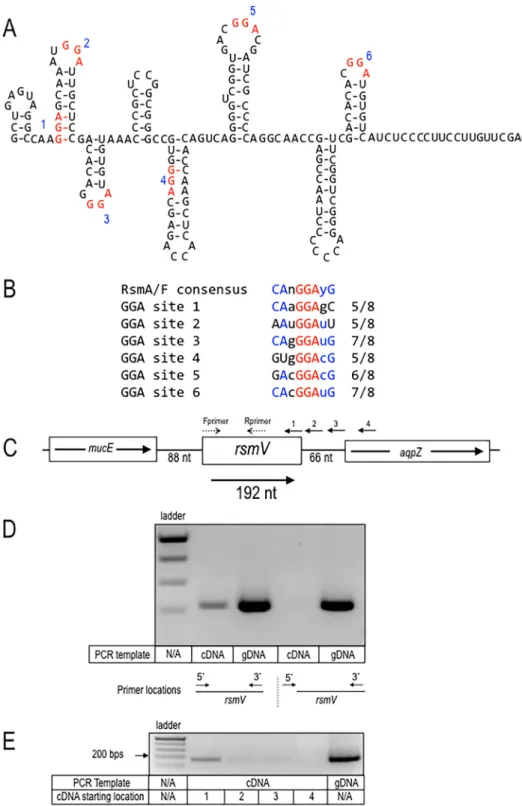
One
sRNA
candidate
had
six
GGA
sequences
(Fig.
1A).
Each
GGA
sequence
demonstrated
a
ⱖ
60%
match
to
the
full
RsmA/RsmF
consensus
binding
site
(CAnGGAyG)
(Fig.
1B).
Four
of
the
GGA
sequences
(designated
sites
2,
3,
5,
and
6)
are
predicted
by
mFold
to
be
presented
in
stem-loop
structures
(Fig.
1A).
The
gene
encoding
the
sRNA
is
located
in
the
intergenic
region
between
mucE
and
apqZ
and
has
been
designated
rsmV
(Fig.
1C).
A
search
of
the
Pseudomonas
Genome
Database
indicated
that
the
rsmV
sequence
is
highly
conserved
in
⬎
100
sequenced
P.
aeruginosa
genomes
and
is
absent
from
the
genomes
of
other
pseudomonads.
The
RNA-seq
study
that
identified
rsmV
concluded
that
the
RNA
is
192
nucleotides
(nt)
long
(21).
To
verify
the
rsmV
transcription
start
site,
cDNA
was
generated
using
a
primer
within
the
gene
(Fig.
1D).
The
cDNA
was
then
used
in
a
PCR
with
primers
positioned
just
upstream
of
and
at
the
predicted
start
site.
Whereas
the
primer
positioned
at
the
start
site
generated
the
expected
product,
the
primer
located
just
upstream
did
not
generate
a
product.
This
finding
is
consistent
with
the
rsmV
tran-scription
start
site
identified
in
the
Wurtzel
RNA-seq
study
(21).
There
is
no
identifiable
transcriptional
terminator
downstream
of
rsmV
.
To
verify
the
3
=
boundary,
cDNA
was
generated
from
total
cellular
RNA
with
primers
positioned
at
the
predicted
3
=
end
of
rsmV
and
at
several
downstream
positions
as
shown
in
Fig.
1C.
The
resulting
cDNAs
were
then
used
as
templates
in
PCRs
with
primers
(Fprimer
and
Rprimer)
positioned
within
the
gene
(Fig.
1C).
The
cDNA
primer
positioned
within
the
aqpZ
coding
region
(primer
4)
did
not
yield
a
product.
The
cDNA
primers
positioned
upstream
of
aqpZ
(primers
1,
2,
and
3)
all
yielded
products,
and
the
strongest
product
was
observed
with
cDNA
generated
at
the
predicted
3
=
terminus
of
rsmV
using
primer
2
(Fig.
1E).
The
weaker
PCR
products
produced
from
cDNA
generated
with
primers
2
and
3
may
represent
transcriptional
readthrough.
RsmV interacts with and controls RsmA and RsmF activity.
The
presence
of
four
predicted
GGA
sequences
in
stem-loop
structures
is
consistent
with
RsmV
serving
as
a
sequestering
sRNA
for
RsmA
and/or
RsmF.
To
test
this
prediction,
we
measured
binding
using
electrophoretic
mobility
shift
assays
(EMSAs).
Full-length
RsmV
was
synthesized
in vitro
,
radiolabeled
at
the
5
=
end,
and
incubated
with
purified
RsmA
Hisor
RsmF
Hisprior
to
electrophoresis
on
nondenaturing
gels.
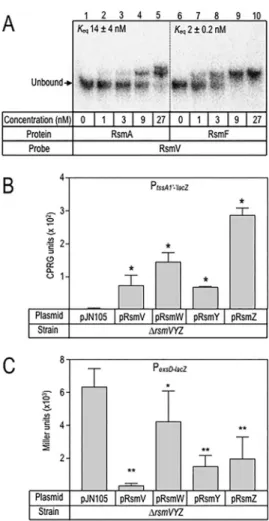
RsmA
Hisformed
high-affinity
binding
prod-ucts
with
RsmV
(equilibrium
constant
[
K
eq]
⫽
14
nM),
and
two
distinct
binding
complexes
were
evident
(Fig.
2A).
Those
products
could
reflect
binding
of
multiple
RsmA
Hisdimers
or
differential
interactions
with
multiple
sites
on
the
RsmV
probe.
RsmF
also
bound
the
RsmV
probe
with
high
affinity
(
K
eq⫽
2
nM),
but
only
a
single
binding
complex
was
detected
(Fig.
2A).
With
evidence
indicating
that
both
RsmA
and
RsmF
interact
with
RsmV,
we
next
examined
whether
RsmV
can
sequester
RsmA/RsmF
in
vivo
.
RsmA
and
RsmF
have
inverse
effects
on
expression
of
the
type
VI
secretion
system
(T6SS)
and
the
type
III
secretion
system
(T3SS)
(10).
We
used
the
previously
described
P
lac-tssA1=-=lacZtransla-tional
reporter
as
a
surrogate
for
regulatory
control
of
the
T6SS
(10)
and
the
P
exsD-lacZtranscriptional
reporter
as
a
marker
for
the
T3SS
(22).
RsmA/RsmF
directly
bind
the
tssA1
leader
region
to
inhibit
translation
(10,
14)
and
positively
regulate
T3SS
gene
expression
through
a
mechanism
that
remains
to
be
defined
(10).
In
a
mutant
lacking
rsmV
,
rsmY
,
and
rsmZ
,
RsmA/RsmF
availability
is
high,
resulting
in
repression
of
P
lac-tssA1=-=lacZreporter
activity
and
high
levels
of
P
exsD-lacZreporter
activity
(Fig.
2B
and
C).
The
presence
of
plasmid-expressed
RsmV
resulted
in
significant
activation
of
P
lac-tssA1=-=lacZreporter
activity
and
inhibition
of
the
P
exsD-lacZreporter.
Both
of
these
findings
are
FIG 1Predictedstructure of RsmV and genomic context. (A) Predicted mFoldstructure of RsmV. The P. aeruginosaRsmVsecondarystructurewasdeterminedbymFoldmodeling.EachofthesixGGAsequencesis highlightedinredandnumberedbyorderofappearancefromthe5=endofthesequence.(B)Alignmentofeach GGAsitetothefullRsmA/RsmFconsensusbindingsite.TheGGAsitesare100%conserved(red),andother conservedportionsoftheconsensussequencearehighlightedinblue.(C)ThegenomecontextofrsmV,located betweenmucEandaqpZ.ThepositionsoftheprimersusedtogeneratecDNAfortheexperimentrepresented inFig.2Barelabeled1to4.TheprimersusedtogeneratePCRproductsinFig.2BarelabeledFprimerand Rprimer.(DandE)VerificationofthersmV5=and3=boundaries.(D)RNApurifiedfromwtcellswasusedto generatecDNAusingtheindicated3=primer.ThecDNAwasthenusedinPCRswiththesame3=primerand5=
FIG2RsmVbindingandregulatoryactivity.(A)RsmVwasradiolabeledandusedinelectrophoretic mobility shiftassayswith purifiedRsmA(lanes2to 5)and RsmF(lanes7 to10)at theindicated concentrations.Thepositionof theunboundRsmVprobeisindicated. (BandC)Effectof RsmVon Plac-tssA1=-=lacZ(PtssA1=-=lacZ) translational reporter(B) andPexsD-lacZ transcriptional reporter(C)activities. Strains consistingof a ΔrsmVYZmutant transformedwith eithera vector control(pJN105) orthe indicated sRNA expression plasmids were cultured in the presence of 0.4% arabinose to induce expressionoftherespectiveRNAsandwereassayedfor-galactosidaseactivity.Thereportedvalues representtheaveragesofresultsfromatleastthreeexperiments,withthestandarderrorindicated.*,P valueof⬍0.05;**,Pvalueof0.01(relativetothevectorcontroldata).
(Fig.
2B)
and
had
strong
inhibitory
activity
with
respect
to
the
P
exsD-lacZreporter
(Fig.
2C).
To
determine
whether
RsmV
preferentially
sequesters
either
RsmA
or
RsmF,
the
P
lac-tssA1=-=lacZtranslational
reporter
was
introduced
into
⌬
rsmAVYZ
and
⌬
rsmFVYZ
mutant
backgrounds.
RsmA
is
more
active
than
RsmF,
resulting
in
stronger
repression
of
P
lac-tssA1=-=lacZreporter
activity
in
the
Δ
rsmFVYZ
mutant
than
in
the
Δ
rsmAVYZ
background
for
strains
carrying
the
vector
control
(pJN105)
(Fig.
3A
versus
B).
In
the
Δ
rsmFVYZ
mutant,
where
repression
of
P
lac-tssA1=-=lacZactivity
is
attributable
to
RsmA,
RsmV
demonstrated
relatively
weak
suppressive
activity
compared
to
RsmW,
RsmY,
and
RsmZ
(Fig.
3A).
A
similar
picture
emerged
in
experiments
using
the
Δ
rsmAVYZ
background
to
examine
RsmF
sequestration
in
that
RsmV
demonstrated
the
weakest
suppressive
activity
(Fig.
3B).
Thus,
RsmV
is
capable
of
sequestering
both
RsmA
and
RsmF
but
appears
to
lack
a
strong
preference
for
one
versus
the
other
under
the
conditions
tested.
FIG3SequestrationofRsmAorRsmFbytheRsmV,RsmW,RsmY,andRsmZregulatoryRNAs.Either ΔrsmAVYZ(A)orΔrsmFVYZ(B)quadruplemutantscarryingthePlac-tssA1=-=lacZ(PtssA1=-=lacZ)translational
reporterweretransformed witheithera vectorcontrol(pJN105)orRsmV,RsmW,RsmY, andRsmZ expressionplasmids.Theresultingstrainswereculturedinthepresenceof0.4%arabinosetoinduce expressionoftherespectiveRNAsandassayedfor-galactosidaseactivity.Reportedvaluesrepresent averagesofresultsfromatleastthreeexperiments,withthestandarderrorindicated.*,Pvalueof⬍0.05 relativetothevectorcontrol.
mutants
indicated
that
each
is
expected
to
adopt
the
same
secondary
structure
shown
in
Fig.
1A
for
wild-type
(wt)
RsmV.
The
activity
of
each
mutant
RNA
was
tested
using
the
P
lac-tssA1=-=lacZtranslational
and
P
exsD-lacZtranscriptional
reporters.
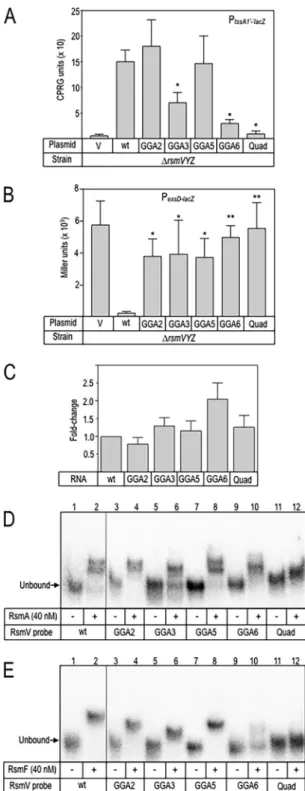
The
GGA3
and
GGA6
mutant
RNAs
demonstrated
a
significant
loss
of
regulatory
activity
for
the
P
lac-tssA1=-=lacZtranslational
reporter
compared
to
wt
RsmV
(Fig.
4A).
In
contrast,
each
of
the
GGA
sites
was
required
for
full
regulatory
control
of
the
P
exsD-lacZtranscriptional
reporter
(Fig.
4B).
Differences
in
the
activities
of
the
mutant
RNAs
were
not
attributable
to
altered
RNA
stability
as
determined
by
quantitative
reverse
transcription-PCR
(qRT-PCR)
(Fig.
4C).
The
most
likely
explanation
for
the
differential
requirement
for
the
GGA2
and
GGA5
sites
is
that
the
P
exsD-lacZreporter
is
more
sensitive
to
changes
in
RsmA
availability
than
the
P
lac-tssA1=-=lacZreporter.
The
simplest
interpretation
of
the
reporter
findings
is
that
the
mutant
RNAs
with
altered
activity
have
a
reduced
capacity
to
sequester
RsmA/RsmF.
To
test
this
predic-tion,
binding
assays
were
performed
with
radiolabeled
RNA
probes.
RsmA
bound
each
of
the
single
GGA
substitution
mutants
with
affinities
similar
to
or
greater
than
those
seen
with
wt
RsmV
(Fig.
4D
and
Table
1)
(see
also
Fig.
S1
in
the
supplemental
material).
We
consistently
observed
two
distinct
products
upon
RsmA
binding
to
the
wt,
GGA2,
and
GGA5
probes.
Only
a
single
product
was
observed
for
the
GGA3
and
GGA6
probes.
This
is
noteworthy,
as
the
mutant
GGA3
and
GGA6
RNAs
also
demonstrated
a
defect
in
activation
of
the
P
lac-tssA1=-=lacZtranslational
reporter
(Fig.
4A).
RsmF
also
bound
each
of
the
mutant
probes
with
high
affinity,
with
the
exception
of
GGA6,
where
binding
affinity
was
significantly
reduced
(Fig.
4E
and
Table
1;
see
also
Fig.
S1).
Given
that
RsmA
and
RsmF
are
homodimers
with
two
RNA
binding
sites
(one
from
each
monomer)
and
that
each
mutant
RNA
still
has
three
potential
GGA
interaction
sites,
high-affinity
binding
to
the
mutant
probes
was
not
unexpected.
We
thus
generated
a
probe
bearing
CCU
substitutions
at
all
four
sites
(Quad)
and
found
that
RsmA
(
K
eq,
⬎
27
nM)
and
RsmF
(
K
eq,
⬎
243
nM)
were
unable
to
bind
(Fig.
4D
and
E
and
Table
1;
see
also
Fig.
S1)
or
exert
regulatory
control
over
the
P
lac-tssA1=-=lacZtranslational
and
P
exsD-lacZtranscriptional
FIG4FunctionalanalysesoftheRsmVmutants.(AandB)ThePA103ΔrsmVYZmutantcarryingthe Plac-tssA1=-=lacZ(PtssA1=-=lacZ)translationalreporter(A)orPexsD-lacZtranscriptionalreporter(B)wastransformed
Role of RsmV
in vivo
.
Data presented thus far have relied upon plasmid-expressed
RsmV, the expression of which may result in RNA levels that exceed the native level
expressed by cells under physiologically relevant conditions. To address the effect of RsmV
expressed at native levels on the output of the Rsm system, we generated an in-frame
rsmV
deletion mutant (Δ
rsmV
) and measured P
exsD-lacZreporter activity. Compared to wt cells, the
Δ
rsmV
mutant cells demonstrated a modest but significant increase in reporter activity (Fig.
5A). This increase in reporter activity is consistent with reduced sequestration of RsmA and
RsmF, both of which have a positive effect on T3SS gene expression. By comparison,
P
exsD-lacZreporter activity was also elevated in an Δ
rsmYZ
double mutant.
A second approach to test the relevance of RsmV
in vivo
involved precipitation
experiments with histidine-tagged RsmA or RsmF. A Δ
rsmAF
double mutant
trans-formed with either RsmA
Hisor RsmF
Hisexpression plasmids was cultured to mid-log
phase and then rapidly subjected to precipitation with Ni
2⫹-agarose beads and
isola-tion of bound RNA. The presence of specific RNAs was detected from the entire pool
of bound RNAs by qRT-PCR. The positive controls were the known RsmA/RsmF targets
RsmY and RsmZ and the
tssA1
leader region (10). Negative controls included (i) two
mRNAs (
lolB
and
rnpB
) that are not known targets of RsmA or RsmF and (ii) Ni
2⫹-agarose beads alone. Whereas no enrichment of the
lolB
or
rnpB
mRNAs was detected,
TABLE 1RsmA and RsmF affinities for wt and mutant RsmVRNA
Affinity (nM)
RsmA RsmF
wt RsmV 14⫾4a 2⫾0.2
GGA2 3⫾3 1⫾0.6
GGA3 1⫾0.4 5⫾3
GGA5 3⫾3 8⫾13
GGA6 9⫾11 ⬎243
Quad ⬎27 ⬎243
aThe indicated value represents the apparent equilibrium binding constant.
FIG5InvivoactivityofRsmV.(A)StrainPA103(wt)andtheΔrsmVandΔrsmYZmutantscarryingthe PexsD-lacZtranscriptionalreporterwereculturedunderinducingconditionsforT3SSgeneexpressionand assayedfor-galactosidaseactivity.*,Pvalueof⬍0.05relativetowt.(B)AΔrsmAFmutanttransformed witheitheravectorcontrolorpRsmAHis orpRsmFHis expressionvectorswasculturedandsubjectedto
rapidpurificationofpRsmAHis orpRsmFHis andboundRNAs.SelectRNAs(asindicated)werequantified
FIG6ExpressionprofilesofRsmV,RsmW,RsmY,andRsmZshownbyagrowthcurveanalysis.RNAwas isolatedfromwtcellsharvestedattheindicatedA600 readingsandusedasthetemplateinRT-qPCR
experimentswithprimersspecifictorsmV,rsmW,rsmY,andrsmZ.EachRNAsamplewasnormalizedto rimM.ThevaluesforeachRNAarereportedrelativetothemeasurementofthesamplecollectedatan A600 of0.5.Thedatarepresentaveragesofresultsfromatleastthreereplicates.
there
was
significant
enrichment
of
the
tssA1
mRNA
and
of
the
RsmV,
RsmY,
and
RsmZ
sRNAs
by
both
RsmA
and
RsmF
(Fig.
5B).
Differential
expression
of
RsmV,
RsmW,
RsmY,
and
RsmZ.
The
in
vivo
data
demonstrate
that
RsmV,
RsmW,
RsmY,
and
RsmZ
are
each
capable
of
sequestering
RsmA
and
RsmF.
We
hypothesized
that
differential
expression
of
the
RNAs
might
allow
cells
to
fine-tune
the
output
of
the
Rsm
system.
To
test
for
differential
expression,
RNA
samples
were
collected
from
cells
cultured
at
optical
densities
at
600
nm
(OD
600)
of
0.5
(mid-log
phase),
1.0
(late
log
phase),
and
2.0,
5.0,
and
7.0
(late
stationary
phase)
and
readings
were
performed.
The
amount
of
each
RNA
detected
by
qRT-PCR
at
each
growth
phase
was
normalized
to
cells
harvested
at
an
OD
600of
0.5,
and
the
values
for
each
subsequent
time
point
are
reported
relative
to
those
values
(Fig.
6).
Both
RsmY
and
RsmZ
showed
a
transient
increase
in
expression
at
late-log
phase,
followed
by
a
decrease
at
OD
600of
2.0
and
5.0,
and
then
a
significant
increase
in
late
stationary
phase
(OD
600of
7.0).
Expression
for
RsmW
was
delayed
until
the
OD
600reached
2.0,
but
the
highest
fold
changes
in
expression
were
demonstrated
at
OD
600values
of
2.0
and
5.0
and
then
approached
the
fold
changes
observed
for
RsmY
and
RsmZ
at
an
OD
600of
7.0.
In
contrast,
RsmV
demonstrated
a
slow
but
steady
increase
in
expression
throughout
the
growth
curve
but
was
the
least
dynamic
of
the
four
RNAs.
The
observed
differences
in
expression
patterns
are
consistent
with
the
hypothesis
that
the
sRNAs
may
serve
distinct
roles
in
RsmA/
RsmF
sequestration
on
the
basis
of
their
timing
of
expression.
One
mechanism
to
account
for
the
differential
expression
of
RsmV,
RsmW,
RsmY,
and
RsmZ
is
transcriptional
control
by
distinct
transcription
factors.
Transcription
of
rsmY
and
rsmZ
is
controlled
by
the
GacAS
two-component
system
(24).
A
previous
study
found
that
GacAS
does
not
control
rsmW
transcription
(23).
To
determine
whether
rsmV
transcription
is
regulated
by
GacA,
a
P
rsmV-lacZtranscriptional
reporter
was
integrated
at
the
⫾
CTX
phage
attachment
site
of
wt
cells
and
a
Δ
gacA
mutant.
Whereas
P
rsmY-lacZand
P
rsmZ-lacZreporter
activity
demonstrated
strong
gacA
depen-dence,
P
rsmV-lacZactivity
showed
no
difference
between
the
wild-type
strain
and
the
gacA
mutant
(Fig.
S2).
DISCUSSION
seques-tering
sRNAs
in
the
control
of
CsrA/RsmA
activity
is
common.
CsrB
is
the
primary
CsrA-sequestering
RNA
in
Escherichia coli
and
contains
18
GGA
motifs
(26).
Other
E.
coli
sRNAs
can
also
sequester
CsrA,
including
CsrC
and
McaS
(27,
28).
CsrC
has
a
structure
similar
to
that
of
CsrB
but
with
fewer
GGA
motifs
(27).
McaS
is
an
sRNA
that
shows
base
pairing
with
some
mRNAs
involved
in
curli
and
flagellum
synthesis
and
can
also
sequester
CsrA
via
two
GGA
motifs
(28).
In
addition
to
sRNAs,
the
5
=
untranslated
region
of
mRNAs
can
also
function
in
the
sequestration
of
CsrA
(29).
The
activities
of
RsmV,
RsmW,
RsmY,
and
RsmZ
were
compared
by
expressing
each
sRNA
from
an
arabinose-inducible
expression
vector.
Plasmid-expressed
RsmV
activated
P
lac-tssA1=-=lacZreporter
activity
and
inhibited
P
exsD-lacZreporter
activity
(Fig.
3B
and
C).
RsmV
had
activity
comparable
to
that
shown
by
RsmY
for
activation
of
the
P
lac-tssA1=-=lacZreporter
activity
and
a
strong
effect
on
activation
of
P
exsD-lacZreporter
activity.
RsmA
and
RsmF
both
bind
to
RsmV
with
high
affinity
in
vitro
(Fig.
2A),
and
the
affinity
of
RsmF
for
RsmV
is
at
least
10-fold
higher
than
for
RsmY
and
RsmZ
(10,
14).
Although
the
affinity
of
RsmF
for
RsmV
is
higher
in
vitro
,
RsmV
does
not
seem
to
show
preferential
activity
toward
RsmF
over
RsmA
in
vivo
(Fig.
3).
The
reason
for
this
is
unclear
but
may
reflect
differences
between
the
in vitro
and
in
vivo
binding
conditions.
A
difference
between
the
results
seen
under
in
vitro
and
in
vivo
conditions
was
also
evident
in
examination
of
the
RsmV
GGA
mutants.
Whereas
each
of
single
GGA
substitution
mutants
demonstrated
altered
regulatory
control
of
P
exsD-lacZand/or
P
lac-tssA1=-=lacZreporter
activity
(Fig.
4A
and
B),
the
binding
affinity
of
RsmA
and
RsmF
was
relatively
unaffected
by
the
single
GGA
substitutions
(Table
1).
A
similar
trend
was
observed
in
a
previous
mutagenesis
study
of
RsmY
and
RsmZ
wherein
the
in
vivo
activity
did
not
strictly
correlate
with
in
vitro
binding
(30).
It
was
speculated
that
other
RNA
binding
proteins,
such
as
Hfq,
may
prevent
binding
to
suboptimal
sites
in
vivo
.
RsmV
activity
was
clearly
evident
when
it
was
expressed
from
a
plasmid
(Fig.
2).
A
role
for
RsmV
when
expressed
at
native
levels
from
the
chromosome
was
also
detected.
Deletion
of
rsmV
resulted
in
a
modest
but
significant
increase
in
T3SS
reporter
activity
(Fig.
5A),
and
copurification
experiments
found
that
RsmV
interacts
with
RsmA
and
RsmF
(Fig.
5B).
Both
of
these
findings
suggest
that
RsmV
can
compete
with
RsmY
and
RsmZ
for
RsmA/RsmF
binding
in
wt
cells
(Fig.
5B).
Whether
conditions
exist
where
rsmV
transcription
is
elevated
and
might
result
in
more-pronounced
phenotypes
is
unclear.
Transcription
of
rsmY
and
rsmZ
is
directly
controlled
by
the
GacA/S
two-component
system,
a
highly
conserved
system
in
Gammaproteobacteria
(24,
31,
32).
GacS
is
a
sensor
kinase
whose
activity
is
controlled
by
two
orphan
kinases,
RetS
and
LadS
(33–36).
Additional
regulators
interact
with
and
alter
the
effect
of
RetS
on
GacS
(37,
38).
SuhB
regulates
rsmY
and
rsmZ
transcription
indirectly
by
altering
gacA
levels
(39).
The
HptB
phosphotransfer
protein
regulates
rsmY
and
rsmZ
transcription
when
P.
aeruginosa
is
grown
on
a
surface
(40,
41).
Other
regulators
contribute
to
rsmY
and
rsmZ
transcription
through
mechanisms
that
do
not
alter
GacS/GacA
activity.
MvaT,
a
H-NS
like
protein,
binds
A
⫹
T-rich
regions
of
DNA
and
silences
rsmZ
transcription,
while
BswR,
a
tran-scriptional
regulator,
counteracts
negative
regulation
of
rsmZ
by
MvaT
(24,
42).
Re-cently,
MgtE,
a
magnesium
transporter,
was
shown
to
alter
rsmY
and
rsmZ
transcription,
though
a
mechanism
of
action
is
yet
to
be
defined
(43).
(data
not
shown).
Additional
studies
are
required
to
determine
how
rsmV
and
rsmW
transcription
is
controlled
and
if
RsmV
plays
a
larger
role
in
regulating
RsmA
and/or
RsmF
activity
under
a
different
set
of
growth
conditions.
RsmX,
RsmY,
and
RsmZ
in
P. protogens
are
differentially
expressed,
thus
contributing
to
a
mechanism
of
fine-tuning
RsmA
and
RsmE
activity
(25).
Expression
of
P. protogens
RsmX
and
expression
of
RsmY
occur
in
parallel
during
exponential
growth,
while
RsmZ
expression
is
delayed
(25).
This
may
allow
cells
to
fine-tune
expression
of
these
sRNAs
based
on
the
environmental
conditions.
We
propose
a
similar
scenario
for
expression
of
RsmV,
RsmW,
RsmY,
and
RsmZ
in
P.
aeruginosa
.
The
differences
in
binding
affinities
for
RsmA/RsmF,
timing
of
gene
expression,
and
expression
levels
of
the
sRNAs
may
provide
a
mechanism
for
fine-tuning
the
expression
of
genes
under
the
control
of
the
Rsm
system.
MATERIALS
AND
METHODS
Strainandplasmidconstruction. ThestrainsandplasmidsusedinthestudyarelistedinTableS1 inthesupplementalmaterial.RoutinecloningwasperformedwithE.coliDH5␣culturedinLB-Lennox mediumwithgentamicin(15g/ml)asrequired.P.aeruginosastrainPA103andthe⌬gacAand⌬rsmYZ mutantswerereportedpreviously(Table1) (10,14,44,45).Thein-frame⌬rsmVdeletionmutantwas constructedbyallelicexchange.Theupstreamanddownstreamflankingregions(⬃800bp)ofrsmVwere generated by PCR using primer pair 118845409 and 118845410 and primer pair 118845411 and 118845412.ThePCRproductswereclonedintopEXG2(46),andtheresultingconstructwasmobilized intowild-typePA103andthe⌬rsmYZ,⌬rsmAYZ,and⌬rsmFYZmutantsbyconjugation.Merodiploids wereresolvedbysucrosecounterselectionaspreviouslydescribed(47).TheRsmVexpressionplasmid wasconstructedbypositioningthersmVtranscriptionstartsiteimmediatelydownstreamofthePBAD
promoterstartsiteusingtheGibsonassemblymethod(NewEnglandBiolabs).Briefly,thePBAD promoter
regionsfrompJN105(primerpair117830775and117830776)andrsmV(primerpair118845423and 118845424)wereamplifiedbyPCRandthenassembledintotheMluI-andSacI-digestedpJN105plasmid (48).pRsmVvectorsbearingsingleGGA-to-CCTsubstitutions,orvariouscombinationsthereof,were assembledusingtheGibsonmethodfromgeneblockslistedinTableS2andclonedintotheNruIand PvuIsitesofpJN105asoutlinedinTableS3.ThersmVtranscriptionalreporter(primerpair150592489and 150592490)includes500nucleotidesupstreamofthersmVtranscriptionstartsite.ThersmVreporterwas integratedintotheCTXphageattachmentsiteinwtandgacAstrains.
-Galactosidaseassays. PA103strainsweregrownovernightat37°CinLBcontaining80g/ml gentamicinasrequired.Thenextday,strainsweredilutedtoanabsorbance(A600)of0.1intrypticsoybroth
(TSB)formeasurementoftssA1=-=lacZreporteractivityorTSBsupplementedwith100mMmonosodium glutamateandwith1%glycerolformeasurementofPexsD-lacZreporteractivity.Arabinose(0.4%)wasalso addedtoinducersmVexpressionfromthePBAD promoter.Thecultureswereincubatedat37°Candharvested
whentheA600 reached1.0.-Galactosidaseactivitywasassayedwithortho-nitrophenyl-galactopyranoside
(ONPG)substrateaspreviouslydescribed(49)orwithchlorophenolred--D-galactopyranoside(CPRG) sub-strate.CPRGactivitywasdeterminedbymeasuringproductformationat578nMandusinganadaptationof theMillerequationasfollows:CPRGunits⫽(A578/cultureA600/time/culturevolume[inmilliliters])⫾1,000.
CPRGandMillerunitvaluesarereportedasaveragesofresultsfromatleastthreeindependentexperiments, witherrorbarsrepresentingstandarddeviations(SD).
Electrophoreticmobilityshiftassays. DNAtemplatesharboringwild-typersmVorrsmVbearingpoint mutationswithintheGGAsequenceswerePCRamplifiedandusedastemplatesforinvitrogenerationofRNA probes.RNAprobeswereendlabeledwith[␥-32P]ATPaspreviouslydescribed(10).Histidine-taggedRsmA
andRsmFwerepurifiedbyNi2⫹affinitychromatographyasdescribedpreviously(10).RsmAorRsmFwas incubatedwiththeRNAprobesattheindicatedconcentrationsin1⫾bindingbuffer(10mMTris-HCl[pH7.5], 10mMMgCl2,100mMKCl),3.25ng/ltotalyeasttRNA(LifeTechnologies),10mMdithiothreitol(DTT),5%
(vol/vol)glycerol,and0.1unitRNaseOut(LifeTechnologies).Reactionmixtureswereincubatedat37°Cfor30 minandthenmixedwith2lofgelloadingbufferII(LifeTechnologies)andimmediatelysubjectedto electrophoresison7.5%(wt/vol)nativepolyacrylamideglycinegels(10mMTris-HCl[pH7.5],380mMglycine, 1mMEDTA)at4°C.ImagingwasperformedusinganFLA-7000phosphorimager(Fujifilm)andanalyzedusing MultiGuagev3.0software.BindingpropertiesweredeterminedwithPrism6.0eusingthebindingsaturation equationforspecificbinding.TheapparentKeq representsthemolarconcentrationofRsmA/RsmFrequired
toshift50%oftheRNAprobe.TheapparentKeq valuesreportedinthetextareaveragesofresultsfromat
leastthreeindependentexperiments.
1. Pukatzki S, Kessin RH, Mekalanos JJ. 2002. The human pathogen Pseu-domonas aeruginosa utilizes conserved virulence pathways to infect the social amoeba Dictyostelium discoideum. Proc Natl Acad Sci U S A 99:3159 –3164.https://doi.org/10.1073/pnas.052704399.
2. Rahme LG, Ausubel FM, Cao H, Drenkard E, Goumnerov BC, Lau GW, Mahajan-Miklos S, Plotnikova J, Tan MW, Tsongalis J, Walendziewicz CL, Tompkins RG. 2000. Plants and animals share functionally common bacterial virulence factors. Proc Natl Acad Sci U S A 97:8815– 8821.
https://doi.org/10.1073/pnas.97.16.8815.
3. Chaisathaphol T, Chayakulkeeree M. 2014. Epidemiology of infections caused by multidrug-resistant gram-negative bacteria in adult hospital-ized patients at Siriraj Hospital. J Med Assoc Thai 97(Suppl)3:S35–S45. 4. Riordan JR, Rommens JM, Kerem B, Alon N, Rozmahel R, Grzelczak Z,
Zielenski J, Lok S, Plavsic N, Chou JL, et al. 1989. Identification of the cystic fibrosis gene: cloning and characterization of complementary DNA. Science 245:1066 –1073.https://doi.org/10.1126/science.2475911. 5. Williams BJ, Dehnbostel J, Blackwell TS. 2010. Pseudomonas aeruginosa: host defence in lung diseases. Respirology 15:1037–1056.https://doi
.org/10.1111/j.1440-1843.2010.01819.x.
6. Sadikot RT, Blackwell TS, Christman JW, Prince AS. 2005. Pathogen-host interactions in Pseudomonas aeruginosa pneumonia. Am J Respir Crit Care Med 171:1209 –1223.https://doi.org/10.1164/rccm.200408-1044SO. 7. Goodman AL, Merighi M, Hyodo M, Ventre I, Filloux A, Lory S. 2009. Direct interaction between sensor kinase proteins mediates acute and chronic disease phenotypes in a bacterial pathogen. Genes Dev 23: 249 –259.https://doi.org/10.1101/gad.1739009.
8. Irie Y, Starkey M, Edwards AN, Wozniak DJ, Romeo T, Parsek MR. 2010.
Pseudomonas aeruginosa biofilm matrix polysaccharide Psl is regulated transcriptionally by RpoS and post-transcriptionally by RsmA. Mol Mi-crobiol 78:158 –172.
9. Brencic A, Lory S. 2009. Determination of the regulon and identification of novel mRNA targets of Pseudomonas aeruginosa RsmA. Mol Microbiol 72:612– 632.https://doi.org/10.1111/j.1365-2958.2009.06670.x. 10. Marden JN, Diaz MR, Walton WG, Gode CJ, Betts L, Urbanowski ML,
Redinbo MR, Yahr TL, Wolfgang MC. 2013. An unusual CsrA family member operates in series with RsmA to amplify posttranscriptional responses in Pseudomonas aeruginosa. Proc Natl Acad Sci U S A 110: 15055–15060.https://doi.org/10.1073/pnas.1307217110.
11. Morris ER, Hall G, Li C, Heeb S, Kulkarni RV, Lovelock L, Silistre H, Messina M, Camara M, Emsley J, Williams P, Searle MS. 2013. Structural rearrange-ment in an RsmA/CsrA ortholog of Pseudomonas aeruginosa creates a dimeric RNA-binding protein, RsmN. Structure 21:1659 –1671.https://doi
.org/10.1016/j.str.2013.07.007.
12. Liu MY, Yang H, Romeo T. 1995. The product of the pleiotropic Esche-richia coli gene csrA modulates glycogen biosynthesis via effects on mRNA stability. J Bacteriol 177:2663–2672. https://doi.org/10.1128/jb
.177.10.2663-2672.1995.
13. Ren B, Shen H, Lu ZJ, Liu H, Xu Y. 2014. The phzA2-G2 transcript exhibits direct RsmA-mediated activation in Pseudomonas aerugi-nosa M18. PLoS One 9:e89653.https://doi.org/10.1371/journal.pone
.0089653.
14. Schulmeyer KH, Diaz MR, Bair TB, Sanders W, Gode CJ, Laederach A, Wolfgang MC, Yahr TL. 2016. Primary and secondary sequence structure requirements for recognition and discrimination of target RNAs by Technologies,GrandIsland,NY).qPCRswereconductedbytheIowaInstituteofHumanGenetics(IIHG)
coreoftheUniversityofIowa.
Time course experimentsmeasuring RsmV, RsmW, RsmY, andRsmZ levels were performed by qRT-PCRusingTaqManaspreviouslydescribed(50).cDNA(2l)preparedasdescribedabovewasadded toreactionmixturescontaining10l 2⫾TaqManuniversalPCRmastermix(LifeTechnologies,Grand Island,NY),2lofagene-specificprobeset(rimM,126317493;rsmW,149204991;rsmX,149204995;rsmY, 122503154,122503155,and122503156;andrsmZ,122501195,122501196,and122503154(TableS2), and6l H2O.PCRswereperformedbytheIowaInstituteofHumanGenetics.
RNAenrichmentexperiments. StrainPA14ΔrsmAFcarryinganemptyvectorcontrol,pRsmAHis6, or
pRsmFHis6 wasgrowninTSBsupplementedwith20mMMgCl2,5mMEGTA,15g/mlgentamicin,and
0.1%arabinosetomid-logphase,chilled,andpelletedforimmediatelysis.Cellswerelysedundernative conditionstoretainproteinstructure(QiagenQIAexpressionistmanualnativepurificationbufferrecipe) usingsupplementationwith2.5mMvanadylribonucleosidecomplex(NEB)(toinhibitRNaseactivity),1 mg/mllysozyme,and0.1%TritonX-100.Lysiswascompletedbyfreeze-thawcycles.Lysatesweretreated with10lRQ-1RNase-freeDNaseandclearedbycentrifugation.Analiquotwasremovedfromthe clearedlysatefortotalRNAisolationandpreservedinTRIzol,andtheremaininglysatewasincubated withnickel-nitrilotriaceticacid(Ni-NTA)–agaroseat4°Cfor1hundernondenaturingbindingconditions. Ni-NTA–agarosewasthenloadedintoacolumnandwashed3timeswithnondenaturingbindingbuffer containing10mM imidazole.Proteinandassociated RNAswereelutedin4fractionswith250mM imidazoleand4fractionswith500mMimidazole.Protein-containingfractionsfromtheRsmAHis6- or
RsmFHis6-expressingstrainsandanequivalentvolumefromthevectorcontrolstrainweretreatedwith
TRIzol(ThermoFisher),andRNA wasextracted accordingtothemanufacturer’sprotocol.RNA was treatedwithRQ-1RNase-freeDNaseandconcentratedusingaRNACleanandConcentratorkit(Zymo). First-strandcDNAwassynthesizedusingSuperscriptII(ThermoFisher)accordingtothemanufacturer’s protocolwithRandomPrimer9(NEB).ThecopynumberoftheindicatedgeneswasdeterminedbyqPCR usingSYBRgreenmastermix(Bio-Rad).
Statisticalanalyses.One-wayanalysisofvariance(ANOVA)wasperformedusingPrism6.0 (Graph-PadSoftware,Inc.,LaJolla,CA).
SUPPLEMENTAL
MATERIAL
Supplemental
material
for
this
article
may
be
found
at
https://doi.org/10.1128/JB
.00277-18
.
SUPPLEMENTAL FILE
1,
file,
0.3
MB.
ACKNOWLEDGMENTS
We
thank
Jodi
Corley
for
assistance
with
the
qRT-PCR
experiments.
This
work
was
supported
by
the
National
Institutes
of
Health
(grant
number
AI097264
to
M.C.W.
and
T.L.Y.).
K.H.J.
was
supported
by
T32GM082729
and
5T32AI007511-19.
Pseudomonas aeruginosa RsmA and RsmF. J Bacteriol 198:2458 –2469.
https://doi.org/10.1128/JB.00343-16.
15. Lapouge K, Perozzo R, Iwaszkiewicz J, Bertelli C, Zoete V, Michielin O, Scapozza L, Haas D. 2013. RNA pentaloop structures as effective targets of regulators belonging to the RsmA/CsrA protein family. RNA Biol 10:1031–1041.https://doi.org/10.4161/rna.24771.
16. Yakhnin AV, Baker CS, Vakulskas CA, Yakhnin H, Berezin I, Romeo T, Babitzke P. 2013. CsrA activates flhDC expression by protecting flhDC mRNA from RNase E-mediated cleavage. Mol Microbiol 87:851– 866.
https://doi.org/10.1111/mmi.12136.
17. Romero M, Silistre H, Lovelock L, Wright VJ, Chan KG, Hong KW, Williams P, Camara M, Heeb S. 30 April 2018. Genome-wide mapping of the RNA targets of the Pseudomonas aeruginosa riboregulatory protein RsmN. Nucleic Acids Reshttps://doi.org/10.1093/nar/gky324.
18. Valverde C, Heeb S, Keel C, Haas D. 2003. RsmY, a small regulatory RNA, is required in concert with RsmZ for GacA-dependent expression of biocontrol traits in Pseudomonas fluorescens CHA0. Mol Microbiol 50: 1361–1379.https://doi.org/10.1046/j.1365-2958.2003.03774.x. 19. Valverde C, Lindell M, Wagner EG, Haas D. 2004. A repeated GGA motif
is critical for the activity and stability of the riboregulator RsmY of Pseudomonas fluorescens. J Biol Chem 279:25066 –25074. https://doi
.org/10.1074/jbc.M401870200.
20. Gómez-Lozano M, Marvig RL, Molin S, Long KS. 2012. Genome-wide iden-tification of novel small RNAs in Pseudomonas aeruginosa. Environ Micro-biol 14:2006 –2016.https://doi.org/10.1111/j.1462-2920.2012.02759.x. 21. Wurtzel O, Yoder-Himes DR, Han K, Dandekar AA, Edelheit S, Greenberg
EP, Sorek R, Lory S. 2012. The single-nucleotide resolution transcriptome of Pseudomonas aeruginosa grown in body temperature. PLoS Pathog 8:e1002945.https://doi.org/10.1371/journal.ppat.1002945.
22. McCaw ML, Lykken GL, Singh PK, Yahr TL. 2002. ExsD is a negative regulator of the Pseudomonas aeruginosa type III secretion regulon. Mol Microbiol 46:1123–1133.https://doi.org/10.1046/j.1365-2958.2002.03228.x. 23. Miller CL, Romero M, Karna SL, Chen T, Heeb S, Leung KP. 2016. RsmW,
Pseudomonas aeruginosa small non-coding RsmA-binding RNA upregu-lated in biofilm versus planktonic growth conditions. BMC Microbiol 16:155.https://doi.org/10.1186/s12866-016-0771-y.
24. Brencic A, McFarland KA, McManus HR, Castang S, Mogno I, Dove SL, Lory S. 2009. The GacS/GacA signal transduction system of Pseudomo-nas aeruginosa acts exclusively through its control over the transcription of the RsmY and RsmZ regulatory small RNAs. Mol Microbiol 73: 434 – 445.https://doi.org/10.1111/j.1365-2958.2009.06782.x.
25. Kay E, Dubuis C, Haas D. 2005. Three small RNAs jointly ensure secondary metabolism and biocontrol in Pseudomonas fluorescens CHA0. Proc Natl Acad Sci U S A 102:17136 –17141.https://doi.org/10.1073/pnas.0505673102. 26. Liu MY, Gui G, Wei B, Preston JF, III, Oakford L, Yuksel U, Giedroc DP, Romeo T. 1997. The RNA molecule CsrB binds to the global regulatory protein CsrA and antagonizes its activity in Escherichia coli. J Biol Chem 272:17502–17510.https://doi.org/10.1074/jbc.272.28.17502.
27. Weilbacher T, Suzuki K, Dubey AK, Wang X, Gudapaty S, Morozov I, Baker CS, Georgellis D, Babitzke P, Romeo T. 2003. A novel sRNA component of the carbon storage regulatory system of Escherichia coli. Mol Microbiol 48:657– 670.https://doi.org/10.1046/j.1365-2958.2003.03459.x. 28. Jørgensen MG, Thomason MK, Havelund J, Valentin-Hansen P, Storz G.
2013. Dual function of the McaS small RNA in controlling biofilm for-mation. Genes Dev 27:1132–1145.https://doi.org/10.1101/gad.214734
.113.
29. Sterzenbach T, Nguyen KT, Nuccio SP, Winter MG, Vakulskas CA, Clegg S, Romeo T, Baumler AJ. 2013. A novel CsrA titration mechanism regulates fimbrial gene expression in Salmonella typhimurium. EMBO J 32: 2872–2883.https://doi.org/10.1038/emboj.2013.206.
30. Janssen KH, Diaz MR, Golden M, Graham JW, Sanders W, Wolfgang MC, Yahr TL. 2018. Functional analyses of the RsmY and RsmZ small non-coding regulatory RNAs in Pseudomonas aeruginosa. J Bacteriol.https://
doi.org/10.1128/JB.00736-17.
31. Suzuki K, Wang X, Weilbacher T, Pernestig AK, Melefors O, Georgellis D, Babitzke P, Romeo T. 2002. Regulatory circuitry of the CsrA/CsrB and BarA/ UvrY systems of Escherichia coli. J Bacteriol 184:5130 –5140.https://doi.org/
10.1128/JB.184.18.5130-5140.2002.
32. Pernestig AK, Melefors O, Georgellis D. 2001. Identification of UvrY as the cognate response regulator for the BarA sensor kinase in Escherichia coli. J Biol Chem 276:225–231.https://doi.org/10.1074/jbc.M001550200. 33. Goodman AL, Kulasekara B, Rietsch A, Boyd D, Smith RS, Lory S. 2004. A
signaling network reciprocally regulates genes associated with acute infection and chronic persistence in Pseudomonas aeruginosa. Dev Cell 7:745–754.https://doi.org/10.1016/j.devcel.2004.08.020.
34. Laskowski MA, Osborn E, Kazmierczak BI. 2004. A novel sensor kinase-response regulator hybrid regulates type III secretion and is required for virulence in Pseudomonas aeruginosa. Mol Microbiol 54:1090 –1103.
https://doi.org/10.1111/j.1365-2958.2004.04331.x.
35. Laskowski MA, Kazmierczak BI. 2006. Mutational analysis of RetS, an unusual sensor kinase-response regulator hybrid required for Pseu-domonas aeruginosa virulence. Infect Immun 74:4462– 4473.https://doi
.org/10.1128/IAI.00575-06.
36. Ventre I, Goodman AL, Vallet-Gely I, Vasseur P, Soscia C, Molin S, Bleves S, Lazdunski A, Lory S, Filloux A. 2006. Multiple sensors control reciprocal expression of Pseudomonas aeruginosa regulatory RNA and virulence genes. Proc Natl Acad Sci U S A 103:171–176.https://doi.org/10.1073/
pnas.0507407103.
37. Bhagirath AY, Pydi SP, Li Y, Lin C, Kong W, Chelikani P, Duan K. 2017. Characterization of the direct interaction between hybrid sensor kinases PA1611 and RetS that controls biofilm formation and the type III secre-tion system in Pseudomonas aeruginosa. ACS Infect Dis 3:162–175.
https://doi.org/10.1021/acsinfecdis.6b00153.
38. Bhagirath AY, Somayajula D, Li Y, Duan K. 23 October 2017. CmpX affects virulence in Pseudomonas aeruginosa through the Gac/Rsm signaling pathway and by modulating c-di-GMP levels. J Membr Biolhttps://doi
.org/10.1007/s00232-017-9994-6.
39. Li K, Xu C, Jin Y, Sun Z, Liu C, Shi J, Chen G, Chen R, Jin S, Wu W. 2013. SuhB is a regulator of multiple virulence genes and essential for patho-genesis of Pseudomonas aeruginosa. mBio 4:e00419-13.https://doi.org/
10.1128/mBio.00419-13.
40. Jean-Pierre F, Perreault J, Deziel E. 17 July 2015. Complex auto-regulation of the post-transcriptional regulator RsmA in Pseudomonas aeruginosa. Microbiologyhttps://doi.org/10.1099/mic.0.000140. 41. Bordi C, Lamy MC, Ventre I, Termine E, Hachani A, Fillet S, Roche B, Bleves
S, Mejean V, Lazdunski A, Filloux A. 2010. Regulatory RNAs and the HptB/RetS signalling pathways fine-tune Pseudomonas aeruginosa pathogenesis. Mol Microbiol 76:1427–1443. https://doi.org/10.1111/j
.1365-2958.2010.07146.x.
42. Wang C, Ye F, Kumar V, Gao YG, Zhang LH. 2014. BswR controls bacterial motility and biofilm formation in Pseudomonas aeruginosa through modulation of the small RNA rsmZ. Nucleic Acids Res 42:4563– 4576.
https://doi.org/10.1093/nar/gku106.
43. Chakravarty S, Melton CN, Bailin A, Yahr TL, Anderson GG. 1 December 2017. The Pseudomonas aeruginosa magnesium transporter MgtE in-hibits type III secretion system gene expression by stimulating rsmYZ transcription. J Bacteriol.https://doi.org/10.1128/JB.00268-17. 44. Marsden AE, Intile PJ, Schulmeyer KH, Simmons-Patterson ER,
Ur-banowski ML, Wolfgang MC, Yahr TL. 2016. Vfr directly activates exsA transcription to regulate expression of the Pseudomonas aeruginosa type III secretion system. J Bacteriol 198:1442–1450.https://doi.org/10
.1128/JB.00049-16.
45. Intile PJ, Diaz MR, Urbanowski ML, Wolfgang MC, Yahr TL. 2014. The AlgZR two-component system recalibrates the RsmAYZ posttranscrip-tional regulatory system to inhibit expression of the Pseudomonas aeruginosa type III secretion system. J Bacteriol 196:357–366.https://doi
.org/10.1128/JB.01199-13.
46. Rietsch A, Vallet-Gely I, Dove SL, Mekalanos JJ. 2005. ExsE, a secreted regulator of type III secretion genes in Pseudomonas aeruginosa. Proc Natl Acad Sci U S A 102:8006 – 8011.https://doi.org/10.1073/pnas.0503005102. 47. Kamoun S, Tola E, Kamdar H, Kado CI. 1992. Rapid generation of directed
and unmarked deletions in Xanthomonas. Mol Microbiol 6:809 – 816.
https://doi.org/10.1111/j.1365-2958.1992.tb01531.x.
48. Gibson DG, Young L, Chuang RY, Venter JC, Hutchison CA 3rd, Smith HO. 2009. Enzymatic assembly of DNA molecules up to several hundred kilobases. Nat Methods 6:343–345.https://doi.org/10.1038/nmeth.1318. 49. Dasgupta N, Lykken GL, Wolfgang MC, Yahr TL. 2004. A novel anti-anti-activator mechanism regulates expression of the Pseudomonas aerugi-nosa type III secretion system. Mol Microbiol 53:297–308.https://doi.org/
10.1111/j.1365-2958.2004.04128.x.
50. Intile PJ, Balzer GJ, Wolfgang MC, Yahr TL. 2015. The RNA helicase DeaD stimulates ExsA translation to promote expression of the Pseudomonas aeruginosa type III secretion system. J Bacteriol 197:2664 –2674.https://