Creative Commons Attribution 4.0 International
МАШИНОБУДУВАННЯ
UDC 621.86/87(075.8)
L. M. BONDARENKO
1, O. P. POSMITYUKHA
2*, K. T. HLAVATSKYI
31Dep. «Applied Mechanics and Material Science», Dnipro National University of Railway Transport named after Academician V. Lazaryan, Lazaryan St., 2, Dnipro, Ukraine, 49600, tel. +38 (056) 373 15 18, e-mail [email protected], ORCID 0000-0002-2212-3058
2*Dep. «Applied Mechanics and Material Science», Dnipro National University of Railway Transport named after Academician V. Lazaryan, Lazaryan St., 2, Dnipro, Ukraine, 49600, tel. +38 (066) 150 95 00, e-mail [email protected],
ORCID 0000-0002-9701-3873
3 Dep. «Applied Mechanics and Material Science», Dnipro National University of Railway Transport named after Academician V. Lazaryan, Lazaryan St., 2, Dnipro, Ukraine, 49600, tel. +38 (095) 816 99 90, e-mail [email protected], ORCID 0000-0003-0921-9845
ANALYTICAL DETERMINATION OF THE REDUCED ROTATIONAL
RESISTANCE COEFFICIENT OF THE CONSTRUCTION MACHINE
SLEWING GEAR
Purpose. Designing new models of construction machines is closely related to the development of slewing gear, and that, in turn, has a drive whose power and dimensions depend on the rotational resistance and the reduced tion coefficient in the units. The absence of analytical dependencies for determining the reduced coefficient of fric-tion for the rotafric-tion of construcfric-tion machines, first, restricts the designer's ability to select materials, and secondly, does not allow the adoption of optimal design solutions. Therefore, the purpose of the article is to find analytical solutions to determine the rotational resistance in the slewing gear of construction machines, which allows project-ing more advanced gears and machines in general. Existproject-ing techniques are based on empirical dependencies and experimental coefficients that reduce the accuracy of calculations, increase the size and cost of work. It is proposed to improve the accuracy and simplify the process of determining the rotational resistance and the magnitude of the reduced rotational resistance coefficient of the building tower cranes. Methodology. The set objectives can be achieved by means of analytical dependencies for determination of rolling friction coefficients over linear and point contacts. This will enable to find the more accurate value of the resistance coefficient, and the constructor during the calculations to take targeted measures to reduce it, using the mechanical constants of materials of the units and their geometric parameters. The calculation is based on Hertz contact deformation theory and the body point plane mo-tion theory. Findings. The obtained dependencies will allow analytically to find the resistance of rolling resistance of rollers in construction machines with fixed and rotating pillars, with circular rotary devices, as well as in ball and roller slewing rings. The calculated values of the rotational resistance coefficients for some types of mechanisms give similar values with those recommended, while for others they significantly differ and require their refinement in reference values. Originality of the work consists in the use of analytical dependences for determining the reduced coefficient of the rotational resistance over linear and point contacts using Hertz contact deformation theory and Tabor partial analytic dependencies theory. Practical value. The obtained dependencies will allow to design new types of slewing gear units of the construction machines and to reveal the additional rotational resistances.
Keywords:construction machine; resistance; rotation; turn; slewing ring; rail; rolling friction
Introduction
There are the following types of slewing gears (SG) of the construction machines:
a) with a fixed pillar consisting of an upper support with a thrust and radial bearings;
b) with a rotating pillar: consists of a pillar connected to the revolving portion of the construc-tion tower crane;
Creative Commons Attribution 4.0 International
non-revolving portions of the construction crane; g) with a slewing ring: consists of ball or roller single-row or multi-row structures (full-slewing and part-slewing excavators, motor graders).
One of the main causes of rotational resistance is rolling resistance [12, 13]. There are many stud-ies and suggestions for its definition, but all of them are either inaccurate, like Reynolds's asser-tion that rolling resistance is the result of sliding friction at the contact point, or require an experi-mental determination of one or more coefficients.
The analytic dependence of Tabor [3] on de-termining the rolling friction coefficient, which is based on Hertz contact deformation theorem [6], is quite successful. Tabor obtained the following ana-lytical dependences for determining the rolling friction coefficient, k;
– for a linear contact:
3 3 b k
, (1)
– for a point contact
3 16
b
k , (2)
where b – half-width of the contact pattern; – coefficient of hysteresis losses.
However, the presence in these formulas of the coefficient nullifies their practical application.
In [5], there are formulas analogous to (1) and (2) without coefficient , namely:k0.11b and
0.1
k b, that essentially differ from those offered by Tabor, and the absence of their coefficient of hysteresis losses testifies to their inaccuracy.
In [4], there are proposed the dependences for determining the rolling friction coefficient with the use of Tabor analytical dependences and the exper-imental values of the rolling friction coefficient for the wheels of cranes with a flat champignon and bull-headed rails [1, 2].
Similarly to formulas (1) and (2) they are ob-tained in the following form:
– for flat champignon rail:
1.2
0.225 R
k be , (3)
– for bull-headed rail:
0.2
0.16 R
k be , (4)
where R – wheel radius, m.
The difference in numerical values from the half-width of the contact pattern is obviously due to the rounding of the coefficient k in experiments to ten millimeters, as well as to the fact that their values are obtained the same for several wheel di-ameters (400, 500, 560, 630): k0.5 mm in the case of a flat champignon rail and k0.6 mm for the bull-headed rail).
It should be noted that formulas (3) and (4) are obtained independently of (1) and (2), and since the coefficients before b for such a class of prob-lems can be considered close by value, we will assume that the general values of k in these for-mulas coincide. Having considered that the coeffi-cients before b in Tabor's formulas are obtained analytically and are exact, the value of can be found by changing the coefficients before R in the exponents. This equality can be achieved by taking the following values in formulas (1) and (2):
1.13R e
and 0.23R e
. (5)
Purpose
Creative Commons Attribution 4.0 International Methodology
Now the formulas of Tabor (1) and (2) can be written as follows:
– for a linear contact:
1.13
2 3
R b k e
, (6)
– for a point contact:
0.23
3 16
R b
k e . (7)
With formulas (6) and (7), we can solve the set problems analytically.
In [7] it is indicated that the value of hysteresis losses in Tabor formulas is small. We can use formula (5) for its determination and (6), (7) for determination of the resistance.
Findings
1. Wheel rolling resistance. For a linear con-tact, we can take
800 MPa (steel 65G, crane operating mode 4M [11]), the elastic modulus5
2.1 10
E MPa, the Poisson factor is 0.3. When the value of the pressure restraining force P [4]
20.418 BR P
E
, (8)
the half-width of the contact pattern will be
1.526 PR b
BE
, (9)
where В– wheel width, m; while the rolling fric-tion coefficient can be determined by the formula (6).
For the point contact we can take
1040 MPa, the radius of the bull-head rail Rr 300 mm. Similarly to the formulas (8) and (9) we can de-termine the values for the point contact
3 2 2
р
2 3 3 2
p p
0.245 R R P
n E R R
, (10)
p 3
p
1.397 b P RR
b n
E R R
, (11)
where nb – coefficient depending on the tangent ellipse equation coefficient A BRk Rr;
r
R – rail rounding radius.
Depending on the wheel radius of the pressure restraining force, the coefficient of hysteresis loss-es, the coefficient of rolling friction and resistance are shown in Fig. 1.
Since the rolling friction coefficient for the wheels of the construction cranes corresponds to their certain radius, it can be assumed that the rela-tionship between the force of rolling resistance and the load on the wheel is linear. But the rolling fric-tion coefficient is determined by the half-width of the contact pattern, depending on several parame-ters not linearly, therefore, it is necessary to estab-lish the dependence of the wheel rolling resistance on the load.
Fig. 1. Dependence on the wheel radius for linear a) and point contact b)
(points show the reference values of the rolling friction coefficients):
1 – wheel pressure restraining force; 2 – coefficient of hysteresis losses;
Creative Commons Attribution 4.0 International
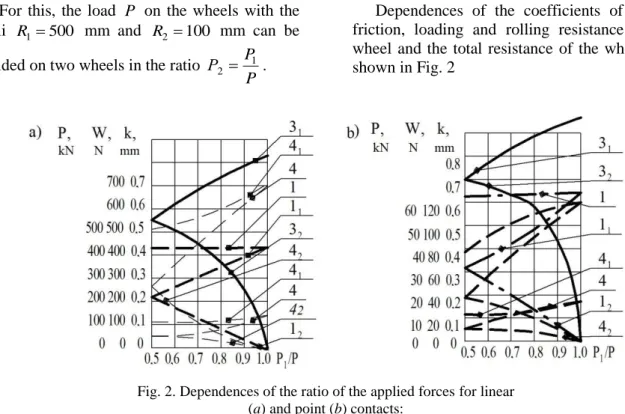
For this, the load P on the wheels with the radii R1500 mm and R2 100 mm can be
divided on two wheels in the ratio Р2 P1 P .
Dependences of the coefficients of rolling friction, loading and rolling resistance of the wheel and the total resistance of the wheels are shown in Fig. 2
Fig. 2. Dependences of the ratio of the applied forces for linear (a) and point (b) contacts:
1, 11, 12 – total value of the pressing force
and the force acting on each wheel, 31, 32 – rolling friction coefficients;
4, 41, 42– total rolling resistance value and rolling resistance of each wheel;
lower position of curves for wheelR100 mm, upper for wheelR500 mm
Analytic dependencies (6) and (7) are used to determine the coefficients rolling friction, so it is possible to restore one lacuna in the reference liter-ature. Losses in roller bearings are found by the coefficient of friction reduced to the shaft (ball
0.01...0.015
, roller 0.015...0.02 [2]). However, this does not take into account, which race is rotating, inner or outer one.
Assuming that the deviation in the coefficient is negligible, it should be borne in mind that the number of locally positioned bearings may be sig-nificant (conveyors, vehicles), as well as an in-crease in the efficiency from 0.99 to 0.995 per ten bearings gives it an increase in more than 5%.
2. Ball bearings. The tasks to be clarified when calculating resistance:
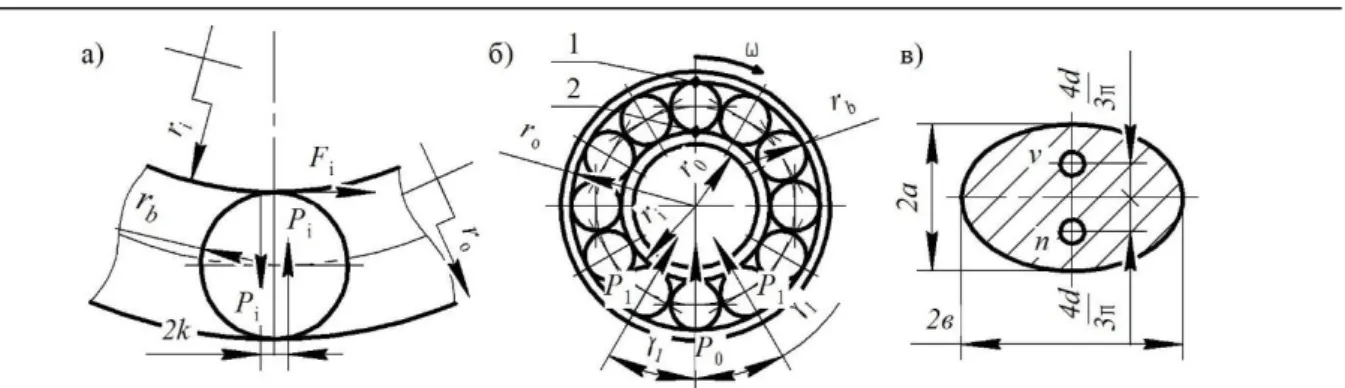
1) To take into account the difference in the co-efficients of rolling friction during rolling of the ball on the inner and outer races, since for calculat-ing their size we take them equal, and the
tangen-tial force acting on the ball (Fig. 3, a) is defined as [8]
к
i i
Pk F
r ;
2) To take into account the rotation of the race, since the special feature of the roller bearings de-sign is that the balls (rollers) pass different lines during one revolution of the inner or outer race.
Under the simplified scheme of the bearing, the problem is solved as follows. If the outer race ro-tates at an angular velocity o (Fig. 3, b), then the
speed of point 1 as the point belonging to the outer race will equal:
o i 2b o 2 i 2b
v r r n r r , (12)
Creative Commons Attribution 4.0 International
Fig. 3. Elements of bearings:
a – scheme for determining the tangential force during the rotation of inner race [1],
b – scheme for determining the speed of points of outer race and ball; c – contact pattern Naturally, that the instantaneous velocity center
of this race is located at point 2 of the ball touch. Assuming that there is no slip between the outer race and the ball, thenv1 v2.
The length of the ball rolling track on the outer race lo 2 ro, and on the inner race li 2 ri and the length difference will be l 2
rori
, thatis, on this track there will be ball sliding on the inner race.
In case of rotation of the inner race with the fixed outer race the difference l is evident that the ball will pass the outer race track that equals the inner race track.
We find the load on the balls based on their number [8]:
2.9 D d z
D d
. (13)
The force acting on the most loaded ball is:
0
5Q P
z
. (14)
For further calculations, the radius of the ball (without rounding to the standard one) and of the rolling bearing track will be equal [8, 9]:
b 0.3
d Dd ; rt 1.03rb.
For the number of balls z10 the load on the bearingQ (for example, if z10) [8]:
5 2 5 2
0 1 2cos 2cos 2
QP , (15)
where is the angle between the balls (here
36
). Based on this, the load on the side balls
5 2
1 0cos
P P , P2 P0cos5 22. (16)
The values of the half-width of contact patterns in formulas (9) and (11) are determined from ex-pressions (17) and (18). When rolling the ball on the inner ring:
i iv
3
b t i
1 1.397
1 1 1
P
b n
E
r r r
, (17)
where niv – is the coefficient, depending on the
tangency ellipse equation b t
b i
1 1
1 1 r r A
B
r r
. In
for-mulas (13) – (17) D – outer bearing diameter; d – inner bearing diameter;ri 0.5drb radius of the track of the inner race.
At bi for the most loaded ball, it is necessary to set optionally the value of P, and for the side balls
1
P or P2 depending on the number of balls. When rolling the ball on the outer race:
o ov
3
b t o
1 1.397
1 1 1
P
b n
E
r r r
, (18)
where nov is determined as a function;
b t
b
1 1
1 1
o r r A
B
r r
; ro 0.5d3rb is the radius of the
Creative Commons Attribution 4.0 International
3. Influence of resistance in bearings on wheel rolling resistance. Let us consider two roll-ing bearroll-ings of one series, but of essentially differ-ent sizes.
3.1. Ball bearing of 304 series. Calculation output data: bearing of 304 series, d20 mm,
52
D mm, static load Q7.94 kN, average di-ameter Dav0.5
Dd
36 mm, db 9.6 mm,number of balls z7 at 1
360 : 751.4 ,i 14.8
r mm; ro 242.4 mm; rt 4.944 mm. Half-width contact pattern of the ball, loaded with force P03 150 N, with the inner race
ir 0.23
b mm for ni 0.38, with the outer race
or 0.3
b mm for no 0.42. Correspondingly, the
side balls loaded by force P1 1 740:
i1 0.155
b mm; bo10.202 mm. Resistance to rolling of the most loaded ball: on the inner race
ir 44.45
W N, with the rolling friction coefficient
ir 0.0434
k mm, on the outer race Wor57.77 N with kor0.0564 mm; two side balls on the inner
race Wi118.30 N with ki10.029 mm and
o1 23.90
W N with ko10.038 mm.
Let us determine the work of the rolling friction forces during one rotation of the inner and outer races.
During rotation of the inner race, Nm:
i 2 i ir i1 or i1 13.4
A r W W W W ; (19)
During the rotation of the outer race, Nm:
o o or o1 i ir i1
0 1 o i
2
2 2
14.99 5.83 59.98 20.82 59.98 80.8.
A r W W r W W
f P P r r
(20)
Thus, during the rotation of the inner race, the rolling friction force work during one rotation equals Ai 13.4 Nm, in case of the outer race
ro-tation Ao 20.82 Nm (1.55 times higher), and tak-ing into account sliding
i.slid 20.82 59.98 80.8
A Nm, that is, 6 times higher.
In this case, the value of the conditional coeffi-cient of friction reduced to the shaft is equal to: during the rotation of the inner race
i i i 0.018 2 А Qr
, for the recommended value 0.010...0.015
, and during the rotation of the
outer race o o o 0.081 2 А Qr .
3.2. Ball bearing of 2306 series. Calculation output data for the bearing of 2306 series:
30
d mm, D72 mm, static load 20.6
Q kN, roller diameter
r 0.25( ) 10.5
d Dd mm, roller length
r r, r 10.5
l d d mm, number of rollers
5 12 D d z D d at 1 360 : 1230 , bearing
track radius on the inner race
i 0.5 0.5 r 20.25
r d d mm, track radius on the outer race ro 0.5d1.5dr30.75 mm.
The force acting on the most loaded and side rollers is determined from formulas (15) and (16).
It was proved in [9] that if a load is applied to a group of bodies according to the cosine law, then to determine the resistance to their rolling, all loads can be applied to one body, that is, the rolling re-sistance of all five rollers on the inner race for the linear contact is determined from the expression:
i r i
i r
1.522 Q r r b
BE r r
, (21)
and on the outer race:
i r o
i r
1.522 Q r r b
BE r r
. (22)
According to formula (6), the rolling friction coefficient will be respectively ki 0.0636 mm,
o 0.0876
k mm. The rolling resistance of rollers: on the outer race Wo343.7 Н, N, and on the
in-ner race Wi 249.6 N.
Work of rolling and sliding friction forces on the inner and outer races, Nm:
i 2 i i o 75.4,
A r W W
o 2 i i o o
A rW r W
o i
2 Qf r r 98.1 135.8 233.9,
Creative Commons Attribution 4.0 International
for the friction sliding coefficient of rollers on the inner race f 0.1.
The motion resistance coefficient is: during the
rotation of the inner race i Wi 0.012 Q
, during
the rotation of the outer race o
o 0.017
W Q
, for
the recommended value [9] for the wheel with up to 700 mm diameter 0.02.
4. Ball-bearing slewing gear (SG). The formu-la for determining the greatest pressure on the ball, given in [11], contains two unknowns: the average diameter of the rolling circle and the number of balls.
If the first unknown can be set on the basis of constructive considerations, then the number of balls can be set after finding their diameters. In addition, this formula is acceptable only if the re-action from the moment does not go beyond the support contour.
We propose finding the moment of the friction forces in the following sequence.
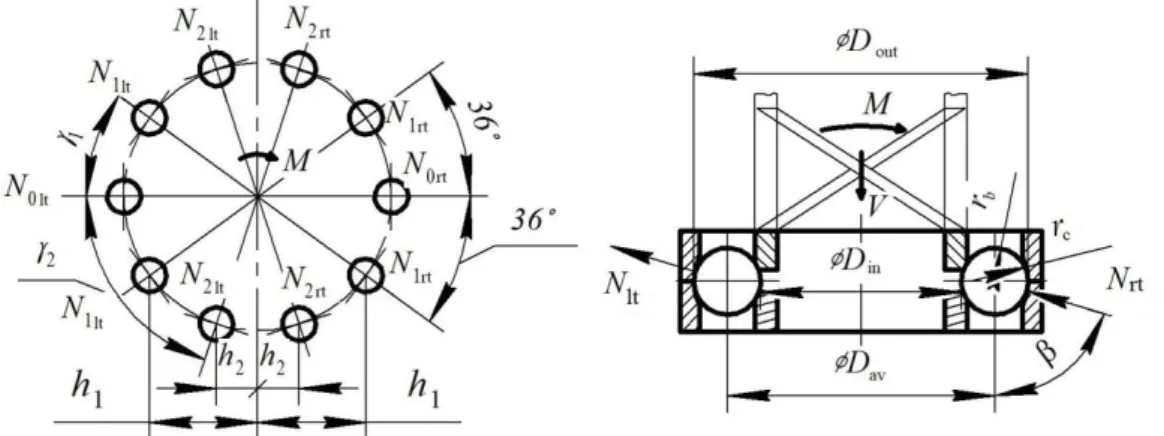
4.1. The slewing ring is broken, for example, into 10 sectors with a central angle 1 36 and for constructive reasons the average radius of the ball centers is taken Rav.
4.2. We apply the load to one conditional ball in the sector, similar to the ball bearing (15), we find the maximum vertical pressure on it from the moment, Nm:
0м
av 1 1 1 1
. 2 1 2sin cos 2sin 2 cos 2
М N
R
(24)
Under the known value of vertical pressure V , the pressure on the balloon will be:
1
0rt 0м
1 2 cos N N V
Nm, (25)
where is the angle between the reaction of the
ball and the vertical line (usually 45) (Fig. 4). Maximum pressures on conditional side balls, Nm:
1rt 0rt 1
2rt 0rt 1
cos ,
cos 2 .
N N
N N
(26)
4.3. Maximum pressure on the opposite (left) conditional ball:
1
0lt 0м
1 2 cos N N V
Nm. (27)
The pressure on the left conditional side balls is found in the same way as for the right ones.
4.4. After the value Rav, we roughly take the diameters of the ball db 0.4Rav.
4.5. We find the number of balls in one sector
with geometric conditions: av
b 5 R n d .
4.6. Maximum pressure on one ball of the right
sector P01 N0rt n
and the ball radius, based on
Hertz contact pressure for the track radius
tr 1.2 b r r mm:
2 0
b 0.1 r 3
P E r n
Nm, (28)
where nr is the value depending on the ratio of
tangible ellipse equation factors b tr
b 1 1 1 r r A B r ;
– boundary contact stresses depending on the steel grade, contact type and Brinell-hardness; for
tr 1.2 b
r r mm, nr0.86 (nа 1.96; ni 0.59 [4]).
4.7. We find the final diameter of the ball, while proceeding from conditions 4.4 and 4.6 and determine the number of balls.
4.8. Based on the equations (25), (26), (27) and the number of balls, we determine the pressure on one ball per sector, the rolling resistance by the formula (7) of one of the balls of 10 sectors.
We find the rolling resistance of zballs and to-tal pressure as the sum of values obtained by the formulas (25) and (27).
We find the rotational resistance coefficient as the ratio of the total rotational resistance to the to-tal pressure.
Creative Commons Attribution 4.0 International
ball centers Dav1500 mm (Rav 750 mm). In this case, the vertical pressure from the mo-ment, taking into account the side balls (24) will be
0м 112
N kN, and pressure on the right and left conditional balls (25) and (27) N0rt 183.6 kN,
0lt 133.2
N kN. Having taken the ball diameter
b 0.4 av 30
d R mm and the maximum pressure on one ball, we will have:
0rt 00
183.6
14.12 13
N P
n
kN,
where n is determined from geometric conditions
av
b
13 5 R n
d
. Let us check the taken ball radius
Fig. 4. Design diagram of the ball-bearing SG
by the theory of contact stresses provided that
tr 1.2b r r :
2 00
b 0.1 3
P E r
Nm, (29)
where rb 15 mm for
3000 MPa (surface hardened steel 45 [2]).For ni 0.59 taking into account the number of balls in the sector and pressure on the condition-al centrcondition-al and side bcondition-alls (26), we find the hcondition-alf- half-width of the contact pattern:
tr b 1
3 i
tr b
1.397
2 r r Р
b n
E r r
. (30)
The rolling friction coefficient is determined by the formula (7), and the rolling resistance subject
to two rolling surfaces, i.e.
b
2kP W
r .
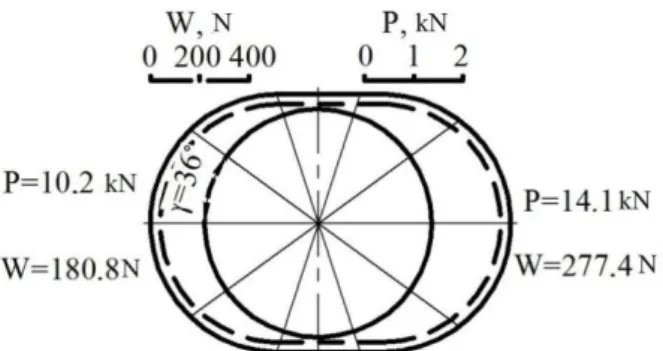
The distribution of pressure per ball on the ring length and the rolling resistance of each ball in the form of graphs are shown in Fig. 5 [5, 12-13].
When adding all the pressures on the balls and their resistance to rolling and disision of
17.42
W kN by Р1025.3 kN, we obtained the
value of the reduced rotational resistance of the crane 0.017, that significantly exceeds the recommended value 0.01.
The reasons for this discrepancy may be: a) ir-relevance of the value adopted here
to the valid one; b) understated value Мduring the experiment. It can be emphasized that in the examples of SG calculations, given in [11, 12], the coefficient is taken in relation to these quantities, and in [13] 0.04.Let us find the value of the rotational resistance coefficient, which falls on sliding during rolling along the ring. Usually it is taken into account only when moving along a cylinder ring. However, in the case of ball contact with both the plane and the bearing track, the contact pattern is not a point, but the ellipse with the axes 2аand 2 ,b the length of which is determined from the Hertz contact defor-mation formulas.
The average pressure per ball during its rotation by 3600 is
1 8.6
P kN. Herewith, the minor axis of the ellipse is a2.2 mm.
Concentrating the pressure at 4 points, we find that the pressure at the points v and n (see Fig-ure 3) is P18.6 kN. In this case, the vertical axis
Creative Commons Attribution 4.0 International
tr b 1
3 a
tr b
1.397 2.2
2 r r P
a n
E r r
mm. (31)
The distance from these points toRav is3 / 16a ,
i.e. 0.41 mm.
The difference in the distance travelled by one rotation of the ring is 4 a 5.15 mm. For
1
2P 4.3 kN, f 0.15 (steel on steel, no lubrica-tion), the work of sliding friction forces will be
sl 2 1 3.32
A P fl Nm. Expressing the work of normal forces 2P1 through the reduced coefficient, we can obtain Asl 2 P1 2 Rav, wherefrom and is
с av
2
0.00008 af
R
(32)
about 0.01 of the recommended value of the re-duced rotational resistance coefficient of the build-ing cranes. However, it should be borne in mind that the denominator of the formula defining с, includes the average radius of the ball centres Rav. The distribution of pressure per ball on the ring length and the rolling resistance of each ball in the form of graphs are shown in Fig. 5
Fig. 5. Distribution of pressures per one ball and resistance to its rolling along the ring
5. Roller slewing gear. For the calculation ex-ample, we considered the slewing gear of the con-struction tower crane with a fixed pillar and fixed rollers (Fig. 6).
Calculation output data: construction tower crane; average diameter of the thrust ball bearing
av 97.5
d mm; diameter of the bearing ring 2 1 500
D R mm; horizontal reaction
21.4 M H
h
t, where M87 t m – the
result-ing moment of the rotary part in the vertical plane;
4
h m –the distance between the line of applica-tion of reacapplica-tions H and the journal; vertical reac-tion V 18 t.
Fig. 6. Design diagram of the slewing gear of a construction tower crane with fixed rollers on roller bearings, thrust bearing and top slide journal
5.1. Calculation of support rollers. Load on the roller, located on the line of force H
0 88.65
1 2cos
H
P
kN, the force acting on
each of the two side rollers is the same and is equal
to 1 0 125.39
cos
P P
kN.
Creative Commons Attribution 4.0 International
750 MPa (steel 75, mode of operation 5M), its radius is determined from the Hertz contact forces formula:2
2 2 2
1 1 1
r 2 2 2
0.418 0.418 0.418 0.5
P E P E P E
R
R R
, (33)
it is 130 mm.
Half-width of the contact pattern
1 r
r
1.322 P RR b
BE R R
, (34)
and it is 1.75 mm.
Rolling coefficient of the side roller (6)
1 0.32
k mm, and that located on the horizontal axis ko0.23 mm.
Rolling resistance of three rollers:
0 2 1 154 617 771
W W W N.
Due to the high pressure on the rollers and the impossibility of selecting the appropriate roller bearing, it is possible to apply in the construction tower cranes the bearings with friction sliding co-efficient 0.1 and with the journal diameter
j 0.25 r 65
d D mm.
Friction resistance in roller journals:
j
j 1 0
r
0.5
2 16.97
0.5 d
W P P
D
kN. (35)
For the top journal diameter d1150 mm the
sliding resistance in it
tj 21.4
M
W H
h
kN. (36)
5.2. Resistance in thrust bearing. According to the value of static load on the bearing V 180
kN we take the bearing of 8216 series with d 80
mm, D115 mm, ball diameter db 14 mm, number of balls z20, track radius
t 0.54 r mm.
When loading one ball PV/ 209 kN, the half-width of the contact pattern (11)b0.447 mm
ni 0.49, na 2.7
.The rolling friction coefficient according to formula (7) is k0.084 mm.
The rolling resistance of 20 balls
b 1 20 108 20 2 160
W W N. The ball sliding resistance coefficient in accordance with (32) for
0.1
f (thick lubrication) c 0.01 and for its rolling resistance value is Wc 0,5 cV 900 N, which is about half of the rolling resistance and requires consideration when calculating the units with thrust bearings.
The total moment of frictional forces during the turning of a construction crane with a fixed tower consists of the resistances:
rolling of support rollers 771 N (20% of the to-tal);
– in the roller journals 17 N (0.4% of the total); – in the top journal 21 N (0.5% of the total); – in the support roller from the rolling of balls 2 160 N (56% of the total) and their sliding 900 N (23% of the total) for a total rotational resistance value of 3 870 N.
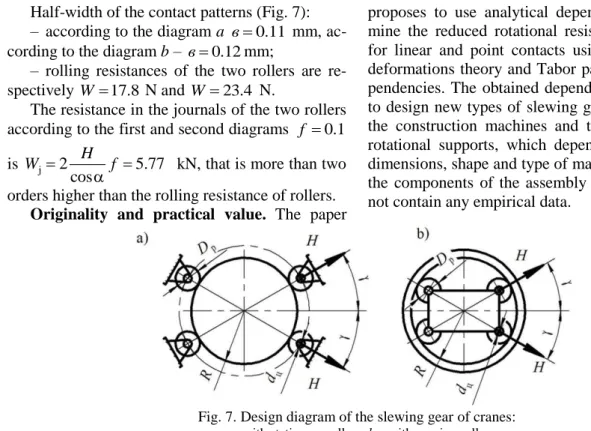
6. Rotational resistance of SG rollers with stationary and fixed rollers. In some construction cranes, the support rollers are stationary (Fig. 7, a) or movable (Fig. 7, b). Load per a roller
2 cos H P
.
It is obviously that for cylindrical rollers, the values of the maximum contact stresses will be different, and the diameters of the rollers and their rolling support on the slewing ring will have dif-ferent values as well.
For calculations we take the same radius, as in the previous example, D2R1 500 mm, the horizontal reaction is equal to H 25 kN, the boundary contact stress is
750 MPa, the roller width B0.25Dr0.5Rr.The radius of the roller for the diagram a (Fig. 7) can be found from formula (33), by re-placing P1 with H/ cos. According to the taken
values Rr 60 mm, the journal radius is taken to be equal to rj 15 mm for cases a and b (Fig. 7).
The radius of the roller for the diagram b (Fig. 7) can be found by the same formula (33) in the case of change of the sign under the radical to the inverse, and it will be equal to Rr50 mm.
Creative Commons Attribution 4.0 International
Half-width of the contact patterns (Fig. 7): – according to the diagram a в0.11 mm, ac-cording to the diagram b – в0.12mm;
– rolling resistances of the two rollers are re-spectively W 17.8 N and W23.4 N.
The resistance in the journals of the two rollers according to the first and second diagrams f 0.1
is j 2 5.77
cos H
W f
kN, that is more than two orders higher than the rolling resistance of rollers.
Originality and practical value. The paper
proposes to use analytical dependences to deter-mine the reduced rotational resistance coefficient for linear and point contacts using Hertz contact deformations theory and Tabor partial analytic de-pendencies. The obtained dependencies will allow to design new types of slewing gear assemblies of the construction machines and to find additional rotational supports, which depend on the overall dimensions, shape and type of material from which the components of the assembly are made and do not contain any empirical data.
Fig. 7. Design diagram of the slewing gear of cranes:
a – with stationary rollers; b – with moving rollers
Conclusions
The analysis of the dependencies and graphs obtained makes it possible to draw the following conclusions and suggestions:
– rolling friction coefficient and rolling re-sistance of the crane type wheels practically linear-ly depends on the wheel radius, and the coefficient of hysteresis losses linearly decreases from 0.9 to 0.6 per linear contact and linearly increases from 1.01 to 1.06 per point contact;
– the friction coefficient value of rolling bear-ings, reduced to the shaft, depends on whether in-ner or outer race rotates;
– during the outer race rotation on a different path, passed by a ball or a roller on the tracks of the outer and inner races, the friction coefficient reduced to the shaft, which falls on pure rolling, is
1.3...1.5 times higher than its value during the in-ner race rotation, and taking into account the slid-ing of balls or rollers on the inner race, it is 4...6 times higher than its size in ball bearings and 3 ... 4 times higher – in roller bearings;
– due to the high value of friction in case of outer race rotation, during the design of rolling assemblies, it is necessary to avoid such solutions, and, if it is impossible, to take into account this fact both for the determination of resistance and for the lubrication of the assembly;
– the given value of the resistance of the con-struction crane with the ball-bearing sewing gear is obtained analytically, is 70% higher than the one recommended by supplier;
– in case of construction cranes with a turning tower, the greatest resistance to rotation falls on support rollers (about 80%).
LIST OF REFERENCE LINKS
1. Бондаренко, Л. М. Деформаційні опори в машинах / Л. М. Бондаренко, М. П. Довбня, В. С. Ловєйкін. – Дніпропетровськ : Дніпро-VAL, 2002. – 200 с.
2. Бондаренко, Л. М. Уточнення розрахункової схеми навантаження групи тіл кочення / Л. М. Бондарен-ко, С. В. Ракша, М. Г. Брильова // Підйомно-транспортна техніка. – 2005. – № 1. – С. 47–52.
Creative Commons Attribution 4.0 International
4. Грузоподъёмные машины : учебник для вузов / М. П. Александров, Л. Н. Колобов, М. А. Лобов [и др.]. – Москва : Машиностроение, 1986. – 400 с.
5. Джонсон, К. Механика контактного взаимодействия / К. Джонсон. – Москва : Мир, 1989. – 510 с. 6. Иванов, М. Н. Детали машин. Курсовое проектирование / М. Н. Иванов, В. Н. Иванов. – Москва :
Высш. школа, 1975. – 551 с.
7. Ковальський, Б. С. Вопросы передвижения мостовых кранов / Б. С. Ковальський ; Восточноукр. нац. ун-т. – Луганск : [б. и.], 2000. – 63 с.
8. Кожевников, С. Н. Теория механизмов и машин / С. Н. Кожевников. – Москва : Машиностроение, 1969. – 584 с.
9. Писаренко, Г. С. Справочник по сопротивлению материалов / Г. С. Писаренко, А. П. Яковлев, В. В. Матвеев. – Киев : Наук. думка, 1988. – 736 с.
10. Расчеты грузоподъёмных и транспортирующих машин / Ф. К. Иванченко, В. С. Бондарев, Н. Т. Колес-ник, В. Я. Барабанов. – Киев : Выща школа, 1975. – 520 с.
11. Справочник по кранам : в 2 т. / М. П. Александров, М. М. Гохберг, А. А. Ковин [и др.] ; под общ. ред. М. М. Гохберга. – Ленинград : Машиностроение, 1988. – Т. 2. – 559 с.
12. Технологічні процеси під час відновлення опорно-обертального пристрою будівельних кранів / А. М. Храмцов, В. М. Богомаз, І. М. Щека, І. Є. Крамар // Проблеми та перспективи розвитку залізнич-ного транспорту : тези доп. 77 Міжнар. наук.-практ. конф. (Дніпро, 11–12 трав. 2017 р.) / Дніпропетр. нац. ун-т залізн. трансп. ім. акад. В. Лазаряна. – Дніпро, 2017. – С. 315–316.
13. Akhavian, R. Remote Monitoring of Dynamic Construction Processes Using Automated Equipment Tracking / R. Akhavian, А. Behzadan // Construction Research Congress (May 21–23, 2012). – West Lafayette, Indiana, United States, 2012. – Р. 1360–1369. doi: 10.1061/9780784412329.137
14. Criteria for the selection of sustainable onsite construction equipment / М. Waris, M. Shahir Liew, M. F. Khamidi, А. Idrus // International Journal of Sustainable Built Environment. – 2014. – Vol. 3. – Іss. 1. – Р. 96–110. doi: 10.1016/j.ijsbe.2014.06.002
15. Eldredge, K. R. The mechanism of roiling friction. I. The plastic range. II. The elastic range / K. R. Eldredge, D. Tabor // Wear. – 1958. – Vol. 1. – Іss. 5. – Р. 452. doi: 10.1016/0043-1648(58)90178-9
16. Holt, G. Analysis of interrelationships among excavator productivity modifying factors / G. Holt, D. Edwards // International Journal of Productivity and Performance Management. – 2015. – Vol. 64. – Іss. 6. – Р. 853– 869. doi: 10.1108/IJPPM-02-2014-0026
17. Pries, F. Innovation in the construction industry: the dominant role of the environment / F. Pries, F. Janszen // Construction Management and Economics. – 1995. – Vol. 13. – Іss. 1. – Р. 43–51. doi : 10.1080/01446199500000006
18. Slemenmeyer, H. Bearings for large capacity crane applications / H. Slemenmeyer, S. Aaronson // SAE Tech-nical Paper Series. – 1983. doi: 10.4271/831373
19. Su, X. Improving Construction Equipment Operation Safety from a Human-centered Perspective / Х. Su, J. Pan, М. Grinter // Procedia Engineering. – 2015. – Vol. 118. – Р. 290–295. doi: 10.1016/j.proeng.2015.08.429
20. Takahashi, H. Measurement of the rolling element load distribution in turntable bearings / H. Takahashi, H. Omary // SAE Technical Paper Series. – 1985. doi: 10.4271/850762
21. Yip, H. Predicting the maintenance cost of construction equipment: Comparison between general regression neural network and Box–Jenkins time series models / Н. Yip, H. Fan, Y. Chiang // Automation in Construc-tion. – 2014. – Vol. 38. – Р. 30–38. doi: 10.1016/j.autcon.2013.10.024
Л. М. БОНДАРЕНКО
1, О. П. ПОСМІТЮХА
2*, К. Ц. ГЛАВАЦЬКИЙ
3.
1Каф. «Прикладна механіка та матеріалознавство», Дніпровський національний університет залізничного транспорту імені академіка В. Лазаряна, вул. Лазаряна, 2, Дніпро, Україна, 49010, тел. +38(056)3731518,
ел. пошта [email protected], ORCID 0000-0002-2212-3058
2*Каф. «Прикладна механіка та матеріалознавство», Дніпровський національний університет залізничного транспорту імені академіка В. Лазаряна, вул. Лазаряна, 2, Дніпро, Україна, 49010, тел. +38 (066) 150 95 00,
ел. пошта [email protected], ORCID 0000-0002-9701-3873
3Каф. «Прикладна механіка та матеріалознавство», Дніпровський національний університет залізничного транспорту імені академіка В. Лазаряна, вул. Лазаряна, 2, Дніпро, Україна, 49010, тел. +38 (095) 816 99 90,
Creative Commons Attribution 4.0 International
АНАЛІТИЧНЕ ВИЗНАЧЕННЯ ПРИВЕДЕНОГО КОЕФІЦІЄНТА
ОПОРУ ОБЕРТАННЮ МЕХАНІЗМІВ ПОВОРОТУ БУДІВЕЛЬНИХ
МАШИН
Мета. Проектування нових зразків будівельних машин тісно пов’язане з розробкою механізмів повороту, а ті, в свою чергу, мають привід, потужність та габарити якого залежать від опору повороту та приведеного коефіцієнта тертя у вузлах. Відсутність аналітичних залежностей для визначення приведеного коефіцієнта тертя обертанню будівельних машин, по-перше, обмежує можливості конструктора у виборі матеріалів, а по-друге, не дає можливості приймати оптимальні конструктивні рішення. Тому мета статті – знайти ана-літичні рішення для визначення опорів обертанню в механізмах повороту будівельних машин, що дозволяє проектувати досконаліші механізми й машини у цілому. Існуючі методики спираються на емпіричні залеж-ності та експериментальні коефіцієнти, що зменшують точність підрахунків, збільшують габарити та вар-тість робіт. Пропонується підвищити точність та спростити процес визначення опору повороту й величину приведеного коефіцієнта опору обертанню будівельних баштових кранів. Методика. Досягти поставленої мети можна за допомогою аналітичних залежностей для визначення коефіцієнтів тертя кочення за лінійного й точкового контактів. Це дозволить точніше знайти величину коефіцієнта опору, а конструктору під час розрахунків вжити цілеспрямованих заходів щодо його зменшення, використовуючи механічні константи матеріалів вузлів кочення і їх геометричні параметри. Розрахунок ґрунтується на теорії контактних дефор-мацій Герца й теорії плоского руху точок тіла. Результати. Отримані залежності дозволять аналітично знай-ти опір кочення роликів у будівельних машинах із нерухомою й обертовою колонами, із круговими поворо-тними пристроями, а також у кулькових і роликових опорно-поворотних кругах. З’ясовані значення коефіці-єнтів опору обертанню для деяких їх типів механізмів дають близькі значення з рекомендованими, а для деяких – істотно відрізняються і вимагають їх уточнення у довідкових величинах. Наукова новизна роботи полягає у використанні аналітичних залежностей для визначення приведеного коефіцієнта опору обертанню за лінійного і точкового контактів із використанням теорії контактних деформацій Герца та частково аналі-тичних залежностей Табора. Практична значимість. Отримані залежності дозволять проектувати нові типи вузлів обертання механізмів повороту будівельних машин і виявляти додаткові опори обертанню.
Ключові слова: будівельна машина; опір; обертання; поворот; поворотний круг; рейка; тертя кочення
Л. Н. БОНДАРЕНКО
1, А. П. ПОСМИТЮХА
2*, К. Ц. ГЛАВАЦКИЙ
31Каф. «Прикладная механика и материаловедение», Днипровский национальный университет железнодорожного транс-порта имени академика В. Лазаряна, ул. Лазаряна, 2, Днипро, Украина, 49010, тел. +38 (056) 373-15-18,
эл. почта [email protected], ORCID 0000-0002-2212-3058
2*Каф. «Прикладная механика и материаловедение», Днипровский национальный университет железнодорожного тран-спорта имени академика В. Лазаряна, ул. Лазаряна, 2, Днипро, Украина, 49010, тел. +38 (066) 150 95 00,
эл. почта [email protected], ORCID 0000-0002-9701-3873
3Каф. «Прикладная механика и материаловедение», Днипровский национальный университет железнодорожного транс-порта имени академика В. Лазаряна, ул. Лазаряна, 2, Днипро, Украина, 49010, тел. +38 (095) 816 99 90,
эл. почта [email protected] ORCID 0000-0003-0921-9845
АНАЛИТИЧЕСКОЕ ОПРЕДЕЛЕНИЕ ПРИВЕДЕННОГО
КОЭФФИЦИЕНТА СОПРОТИВЛЕНИЯ ВРАЩЕНИЮ МЕХАНИЗМОВ
ПОВОРОТА СТРОИТЕЛЬНЫХ МАШИН
зависи-Creative Commons Attribution 4.0 International
мости и экспериментальные коэффициенты, уменьшающие точность подсчетов, увеличивающие габариты и стоимость работ. Предлагается повысить точность и упростить процесс определения сопротивления пово-рота и величину приведенного коэффициента сопротивления вращению строительных башенных кранов.
Методика. Достичь поставленной цели можно с помощью аналитических зависимостей для определения коэффициентов трения качения при линейном и точечном контактах. Это позволит точнее найти величину коэффициента сопротивления, а конструктору при расчетах принять целенаправленные меры по его уменьшению, используя механические константы материалов узлов качения и их геометрические парамет-ры. Расчет основывается на теории контактных деформаций Герца и теории плоского движения точек тела.
Результаты. Полученные зависимости позволят аналитически найти сопротивление качению роликов
в строительных машинах с неподвижной и вращающейся колоннами, с круговыми поворотными устройствами, а также в шариковых и роликовых опорно-поворотных кругах. Найденные значения коэффи-циентов сопротивления вращению для некоторых типов механизмов дают близкие значения с рекомендо-ванными, а для некоторых – существенно отличаются и требуют их уточнения в справочных величинах.
Научная новизна работы заключается в использовании аналитических зависимостей для определения
приведенного коэффициента сопротивления вращению для линейного и точечного контактов с использованием теории контактных деформаций Герца и частично аналитических зависимостей Табора.
Практическая значимость. Полученные зависимости позволят проектировать новые типы узлов вращения
механизмов поворота строительных машин и выявлять дополнительные опоры вращению.
Ключевые слова: строительная машина; сопротивление; вращения; поворот; поворотный круг; рельс; трение качения
REFERENCES
1. Bondarenko, L. M., Dovbnia, M. P., & Loveikin, V. S. (2002). Deformatsiini opory v mashynakh. Dni-propetrovsk: Dnipro-VAL. (in Ukrainian)
2. Bondarenko, L. M., Raksha, S. V., & Brylova, M. H. (2005). Utochnennia rozrakhunkovoi skhemy navanta-zhennia hrupy til kochennia. Pidiomno-transportna tekhnika, 1, 47-52. (in Ukrainian)
3. Bohomaz, V. M., Bondarenko, L. M., Bohomaz, O. V., & Brylyova, M. G. (2018). Effect of resistance to roll-ing on the dynamics of the liftroll-ing mechanisms of the transportroll-ing mac. Science and Transport Progress. 2(74), 124-132. doi: 10.15802/stp2018/130441 (in Russian)
4. Aleksandrov, M. P., Kolоbov, L. N., Lobov, M. A. Nikolskaya, T. A., & Polkovnikov, V. S. (1986).
Gruzopodemnye mashiny: Uchebnik dlya vuzov. Moscow: Mashinostroenie. (in Russian) 5. Dzhonson, K. (1989). Mekhanika kontaktnogo vzaimodeystviya. Moscow: Mir. (in Russian)
6. Ivanov, M. N., & Ivanov, V. N. (1975). Detali mashin. Kursovoe proektirovanie. Moscow: Vysshaya shkola. (in Russian)
7. Kovalskiy, B. S. (2000). Voprosy peredvizheniya mostovykh kranov. Lugansk. (in Russian)
8. Kozhevnikov, S. N. (1969). Teoriya mekhanizmov i mashin. Moscow: Mashinostroenie. (in Russian)
9. Pisarenko, G. S., Yakovlev, A. P., & Matveev, V. V. (1988). Spravochnik po soprotivleniyu materialov. Kiev: Naukova dumka. (in Russian)
10. Ivanchenko, F. K., Bondarev, V. S., Kolesnik, N. P., & Barabanov, V. Y. (1975). Raschety gruzopodemnykh i transportiruyushchikh mashin. Kiev: Vishcha shkola. (in Russian)
11. Aleksandrov, M. P., Gokhberg, M. M., Kovin, A. A., & Gokhberg, M. M. (Ed). (1988). Spravochnik po kranam (Vol. 1-2). Leningrad: Mashinostroenie. (in Russian)
12. Khramtsov, A. M., Bohomaz, V. M., Shcheka, I. M., & Kramar, I. Y. (2017). Tekhnolohichni protsesy pid chas vidnovlennia oporno-obertalnoho prystroiu budivelnykh kraniv. The Problems and Prospects of railway transport: 77th International scientific and practical conference. Dnipro:Dnipropetrovsk National University of Railway Transport named after Academician V. Lazaryan. (in Ukrainian)
13. Akhavian, R., & Behzadan, A. H. (2012). Remote Monitoring of Dynamic Construction Processes Using Au-tomated Equipment Tracking. Construction Research Congress 2012. West Lafayette, Indiana, United States. doi: 10.1061/9780784412329.137 (in English)
14. Waris, M., Shahir Liew, M., Khamidi, M. F., & Idrus, A. (2014). Criteria for the selection of sustainable onsite construction equipment. International Journal of Sustainable Built Environment, 3(1), 96-110. doi: 10.1016/j.ijsbe.2014.06.002 (in English)
Creative Commons Attribution 4.0 International
16. Holt, G. D., & Edwards, D. (2015). Analysis of interrelationships among excavator productivity modifying factors. International Journal of Productivity and Performance Management, 64(6), 853-869. doi: 10.1108/ijppm-02-2014-0026 (in English)
17. Pries, F., & Janszen, F. (1995). Innovation in the construction industry: the dominant role of the environment.
Construction Management and Economics, 13(1), 43-51. doi: 10.1080/01446199500000006 (in English) 18. Siemensmeyer, H., & Aaronson, S. F. (1983). Bearings for Large Capacity Crane Applications. SAE Technical
Paper Series. doi: 10.4271/831373 (in English)
19. Su, X., Pan, J., & Grinter, M. (2015). Improving Construction Equipment Operation Safety from a Human-centered Perspective. Procedia Engineering, 118, 290-295. doi: 10.1016/j.proeng.2015.08.429 (in English) 20. Takahashi, H., & Omory, T. (1985). Measurement of the Rolling Element Load Distribution in Turntable
Bearings. SAE Technical Paper Series. doi: 10.4271/850762 (in English)
21. Yip, H., Fan, H., & Chiang, Y. (2014). Predicting the maintenance cost of construction equipment: Compari-son between general regression neural network and Box–Jenkins time series models. Automation in Construction, 38, 30-38. doi: 10.1016/j.autcon.2013.10.024 (in English)