Cite this:Polym. Chem., 2019,10, 4126
Received 1st April 2019, Accepted 22nd June 2019
DOI: 10.1039/c9py00480g
rsc.li/polymers
controlled cationic polymerisation of
para
-alkoxystyrene
†
Alka Prasher,
Huamin Hu,
‡
Joji Tanaka,
‡
David A. Nicewicz and
Wei You
*
In this report we demonstrate methanol as an effective degenerative chain transfer agent to control the cationic polymerisation (initiated by triflic acid) of electron richp-alkoxy-styrenes, such asp -methoxy-styrene (p-MOS). Kinetic analysis revealed that an induction period occurs initially during which free cationic polymerisation occurs at low monomer conversion before proceeding through the pseudofirst order rate, analogous to the RAFT mechanism. Ethanol and isopropanol also demonstrated excellent control (Đ> 1.30), however, with an apparent increase in experimental molecular weight. Furthermore, methanol controlled polymers were successfully chain extended upon sequential monomer addition, demonstrating the‘livingness’of the alcohol mediated cationic polymerisation.
Introduction
The advancement of macromolecular synthesis has enabled the creation of complex architectures and functional materials.1–7 Although controlled radical polymerisation methods have dominated this area in general,8,9,14 materials generated by cationic polymerisation offer unique properties that are not readily accessible by radical chemistry.10,11In con-trast, controlled cationic polymerisation has gained less atten-tion, due to the synthetic challenge in controlling the highly reactive propagating cationic species that often leads to more side reactions.12 Historically, living cationic polymerisation has been classically controlled by atom transfer of the ω-capping halogen group to a catalytic Lewis acid activator.13 However, more recently, Kamigaito and coworkers have demonstrated a genuinely new strategy to control the cationic polymerisation by degenerate chain transfer, a strategy that has been widely utilized in controlled radical polymerisation.15 The initial pioneering work was led by Kamigaito and co-workers, where his group reported cationic Reversible-Addition Fragmentation Chain Transfer (RAFT) polymerisation mediated by thiocarbonylthio-ester (Fig. 1) as a chain transfer agent (CTA), using ppm levels of triflic acid (TfOH) as a cat-ionic initiator. This was proposed to proceed through
equili-brium between the sulfonium intermediate and the degenera-tive chain transfer of growing cationic propagating chains, in a manner analogous to radical mediated RAFT polymerisation.16 Furthermore, the Kamigaito group demonstrated a unique block copolymerisation generated from switching between cat-ionic and radical RAFT block copolymerisation.16,17Fors and co-workers further demonstrated cationic RAFT by exploiting the redox properties of thiocarbonylthio-ester.18 However, in contrast to the analogous reduction driven photoinduced elec-tron transfer (PET)-RAFT,19–21Fors’group focused on oxidation driven cationic polymerisation. This oxidative initiation of the cationic RAFT was demonstrated both electrochemically and through photoredox catalysis.18,22–25
Investigating beyond thiocarbonylthio-esters, the Kamigaito group further demonstrated phosphates to mediate cationic-RAFT via a phosphonium intermediate (Fig. 1).26 Similar to thiocarbonylthio ester, PvO bonds were proposed to add to the propagating cationic chain end and the reactivity was influ-enced by two Z-groups. The chain transfer constants (Ctr) of
phosphates and phosphinate based RAFT agents were found to be between those of dithiocarbamates and
trithiocarbo-Fig. 1 Examples of degenerative chain transfer agents for cationic
poly-merisation, consisting of three components, the re-initiating R-group (red), chain transfer moiety (black) and Z-group (blue), which influences the reactivity of the chain transfer group.
†Electronic supplementary information (ESI) available. See DOI: 10.1039/ c9py00480g
‡These authors have contributed to the work equally.
nates, for isobutyl vinyl ethers. Given the abundance of phos-phate in biologically relevant materials, this phosphos-phate-based cationic RAFT could offer a viable approach to prepare novel materials for bio-applications. Prior to this work, the Kamigaito group also showed that the sulfur atom alone as a thioether with a suitable re-initiating group can mediate cat-ionic-degenerative chain transfer polymerisation (Fig. 1).27In this case, the propagating chain adds to the sulfur atom without any resonance stabilisation and controls the chain growth through the degenerative chain transfer process.26
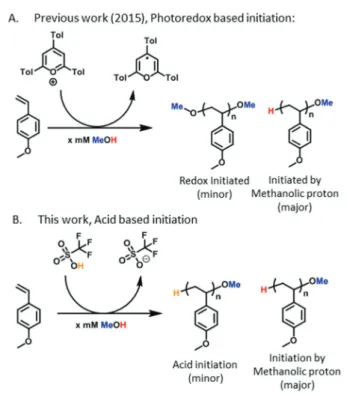
As our major contribution to this emerging field, we pre-viously reported methanol as an effective degenerative transfer agent (Fig. 2A) proceeding via an oxonium intermediate for the cationic polymerisation of an electron rich styrenic monomer, para-methoxystyrene (p-MOS).28 This was discov-ered serendipitously with 2,4,6-tri(p-tolyl)pyrylium tetrafluoro-borate as a photoredox initiator, where the molar mass of the polymers was observed to be dependent on the relative concen-trations of methanol, and independent of the quantity of the initiator used. The ability of methanol as a degenerative chain transfer agent was based on a high affinity of carbocationic species for oxygen atoms in ethers and alcohols. Though alco-hols are the commonly used nucleophiles to terminate cationic polymerisation, we proposed that the methyl ether terminated chains in our system were able to chain extend further upon sequential monomer addition, demonstrating the possible living nature of methanol terminated chain ends, for the poly-merisation ofp-MOS.28Our earlier report utilized a photoredox catalyst system which appeared to function solely as a cationic
initiator (Fig. 2A); still, the importance of the catalyst in the control of polymerisation remains largely unexplored. To gain a deeper understanding of the nature of methanol as a degen-erative chain transfer agent, we decided to de-couple the photoredox catalyst ( presumably an initiator to generate cations) from the rest of the polymerisation; instead, we employed triflic acid as the initiator to generate cations
‘cleanly’. Indeed, this triflic acid initiated polymerisation of
p-MOS can be controlled using methanol, supporting our orig-inal claims (Fig. 2B).
Experimental
Materials and methods
All reagents were purchased from Sigma-Aldrich, Fischer Scientific, or Acros and were used without additional purifi-cation unless otherwise noted. Anhydrous dichloromethane was dried further over an activated alumina plug; 4-methoxys-tyrene was distilled under calcium hydride before use and stabilised using tert-butylcatechol as an inhibitor. The stock solution of triflic acid in diethyl ether (20 mg ml−1) was pre-pared inside a glove box due to the hygroscopic and reactive nature of the acid.
Characterisation
Proton and carbon magnetic resonance spectra (1H NMR and
13C NMR) were recorded on a Bruker AVANCE III 600
CaryoProbe 400 MHz spectrometer with a solvent residual peak as the internal standard (1H NMR at 7.26 ppm for CDCl3). Size Exclusion Chromatography (SEC) analysis was
carried out using a Water Alliance 2695 instrument equipped with a refractive index detector (Waters 2414). Samples were passed through three columns (Waters Styragel HR5, HR4, and HR2) using THF as the mobile phase. All the experimental molar masses (Mn,SEC) and dispersities (Đ) were determined
using polystyrene standards purchased from Polyscience Corporation.
General polymerisation procedure
In a typical polymerisation, monomer (p-MOS, 500 mg, 500 µL, 3.7 mmol, 50 eq.), chain transfer agent (methanol, 2.7 mg, 3.4 µL, 74.5 μmol, 1 eq.) and solvent (dichloro-methane, 6.68 mL) were addedviagastight syringe into a pre-flame dried and argon purged sealed scintillation vial equipped with a magnetic stirrer. The solution was allowed to stir at−10 °C, followed by addition of triflic acid solution pre-pared as a 20 mg ml−1diethyl ether solution (140μL, 1.9μmol, 0.25 eq.) via a gastight syringe into the reaction mixture to initiate polymerisation. The polymerisation was left stirring for one hour. The polymerisation was sampled by quenching the aliquot into methanol with triethylamine. After confirming the full consumption of the monomer, the polymerisation was then quenched with triethylamine, and precipitated into cold methanol.
For in situ chain extension, after sampling the reaction mixture for GPC and NMR to confirm completion, an equi-valent repeating unit of monomer solution (500 mg, 3.7 mmol, 50 eq. as 0.5 M solution in dichloromethane, 7.453 ml) was added into the reaction mixture through a syringe. The reac-tion was stopped after 1 hour by quenching with triethyl amine and precipitated into methanol.
For chain extension after isolation, the isolated polymer was azeotroped with toluene to remove trace methanol and water prior to the reaction. The polymer (500 mg) was re-dis-solved in DCM (7.453 ml, equivalent to 0.5 M in repeat units). The solution was sealed and allowed to stir at−10 °C, followed by addition of triflic acid solution prepared as a 20 mg ml−1 diethyl ether solution (140μL, 1.9μmol, 0.25 eq.)viaa gastight syringe into the reaction mixture. The sequential monomer (500 µL, 3.7 mmol, equivalent moles of repeat units) was then added dropwise through a gastight syringe.
Calculation ofMn,th
The theoretical number-average molar masses (Mn,th) were
cal-culated as
Mn;th¼ρ½M0MM
½CTA0 þMCTA; ð1Þ
where [M]0 and [CTA]0 are the initial concentrations
(mol dm−3) of the monomer and the chain transfer agent, respectively, ρis the monomer conversion as determined by
1H NMR, andM
MandMCTAare the molar masses (g mol−1) of
the monomer and the chain transfer agent, respectively.
Results and discussion
Methanol is typically used as a nucleophile to quench cationic polymerisation and added at the end of the polymerisation. As our goal is to investigate the role of methanol as a RAFT agent, it was added at the beginning of the reaction before the addition of the polymerisation initiator. Following on closely from our previous work, we continued to use p-MOS as a model monomer and commenced the polymerisation with TfOH as the initiator. This was chosen as it was previously reported to initiate cationic polymerisation at low ppm concen-tration.16 All the polymerisations conducted were cooled to −10 °C before adding the initiating acid solution and main-tained at this temperature due to the reactive nature of our catalyst/monomer system. The monomer conversion was deter-mined by 1H-NMR spectroscopy by integrating the –CHH vinylic proton at 5.57 ppm and using the phenyl-methoxy
–OCH3at 3.77 as the internal reference. The1H-NMR analysis
of all the obtained polymers showed a full monomer conver-sion within 1 hour.
We then conducted a series of preliminary experiments to investigate the molar mass dependence on methanol concen-tration. The experiments were carried out using constant initial monomer ([M]0) and initiator ([I]0) concentrations of
500 mM and 2.5 mM, respectively, and a varying methanol
concentration (0, 5, 10, 20, and 50 mM, Fig. 3). TfOH initiated cationic polymerisation, without the presence of methanol, generated high molecular weight polymers (Mn,SEC = 22 480
g mol−1) with a broad dispersity (Đ= 3.44) (Fig. 3 and Table 1). The poor control with TfOH alone is due to the uncontrolled fast propagation of the monomer relative to the acid initiation, which is consistent with the results in the literature.29 However, when methanol was added to the reaction mixture prior to the addition of the acid, a profound decrease in experi-mental molar mass (Mn,SEC) accompanied by narrow dispersity
from SEC analysis (Đ< 1.30) was observed (Fig. 3 and Table 1). The control was comparable to xanthate29 and trithiocarbo-nate25based RAFT agents. Furthermore, the increasing MeOH concentration led to a decrease in molar mass, similar to our previous observation for the photoredox initiated MeOH con-trolled system.28 In all cases, Mn,SEC was in good agreement
with the theoretical molar mass (Mn,th, Fig. 3) calculated from
the targeted (Degree of Polymerisation) DP based on the monomer to CTA ratio ([M]0/[MeOH]), eqn (1).
Furthermore, 1H-NMR spectroscopy revealed an increased appearance ofα-CH3at 0.91–1.10 ppm with increasing
metha-nol concentration (Fig. 3, Ha), indicative of methanol
initiation. This was accompanied by an increase in theω-OCH3
end group (Fig. 3,Hd) that appeared at 2.90–3.11 ppm equally
with increasing methanol concentration when targeting a lower DP.
To ascertain whether the initiating protons are derived from methanolic protons, deuterated methanol (CD3OD, or
MeOH-d4) was used as a CTA to unequivocally distinguish
from TfOH initiated chains. As the2H-NMR signals are inher-ently weak, a relatively high concentration of CD3OD was used
([CD3OD] = 50 mM, [p-MOS] = 500 mM) to target a DP of 10. 2H-NMR spectroscopy revealed two broad 2H signals at
2.55–3.25 ppm from the ω-OCD3 and at 0.70–1.30 ppm from
α-CH2Dwith the observed integral ratio of 3 : 0.7 which is
con-sistent with the theoretical ratio of 3 : 1 with 100% deuterium initiation (ESI, Fig. S1†).
To probe further into the mechanism of polymerisation, the rate of monomer consumption was monitored over time (Fig. 4A, B and ESI, Fig. S2–S6†), targeting a DP of 50 ([M]0=
monomer conversion, where controlled chain growth is observed (Đ< 1.3). This is indicative of steady state controlled chain growth through the RAFT equilibrium between the pro-pagating chains and oxonium intermediate (Fig. 4C), analo-gous to the radical-mediated RAFT polymerisation. Interestingly, SEC analysis revealed the convergence of a poly-modal distribution into a monopoly-modal distribution with increasing conversion (Fig. S6†). Sauvet et al. reported a similar phenomenon of the formation of several distinct sol-vated propagating species in the beginning of the free cationic polymerisation ofp-MOS leading to polymodal distribution.30 However, as the reaction proceeds, the slower “solvent-free” chain ends stabilized by the intramolecular coordination of the residual aromatic ring becomes dominant. In contrast, monomodal distribution was observed even at low monomer conversion in our previous work.28
Our next objective was to investigate the effect of acid con-centration on polymerisation control. According to the (radical) RAFT mechanism, theMnshould be proportional to
the sum of the CTA and initiator consumed during polymeris-ation. In most cases, the initiator generated chains are often neglected due to a high CTA/initiator ratio.31,32 In this work, however, since we used a relatively low CTA/initiator ratio, the theoretical mass should consider the amount of initiator (i.e.,
Fig. 3 Cationic RAFT polymerisation ofpMOS with MeOH as the RAFT agent ([MeOH] = 0, 5, 10, 20, and 50 mM). Bottom left: SEC chromatograms
(dRI, THF) of p(p-MOS) controlled by MeOH. The targeted DP is the ratio of monomer to CTA ([pMOS]/[MeOH]) assuming additional chains gener-ated from the initiator to be negligible. Bottom right, the black line represents the theoretical molar mass calculgener-ated from eqn (1). Thefilled squares represent the experimental molar masses obtained by THF SEC with polystyrene as standards. The empty squares represent the dispersity values as determined by THF SEC. Top right, the1H-NMR spectrum shows the end groups of p(p-MOS).
Table 1 Triflic acid initiated methanol controlled polymerisation of
p-MOS
Entry [p-MOS] : [MeOH] : [TfOH]
Mn,tha
(g mol−1) Mn,SEC
c
(g mol−1) Đc
1d,e 500 : 0 : 2.5 26 900b 22 480 3.44
2d 500 : 50 : 2.5 1400 2230 1.23
3d 500 : 20 : 2.5 3400 3270 1.22
4d,e 500 : 10 : 2.5 6700 6230 1.22
5d 500 : 5 : 2.5 13 500 11 250 1.22
6f 500 : 10 : 0.6 6700 7530 1.27
7f 500 : 10 : 1 6700 7620 1.27
8f 500 : 10 : 2.5 6700 6920 1.23
9f 500 : 10 : 5 6700 7340 1.22
aThe molar mass calculated from eqn (1). bThe molar mass
deter-mined by the chain length calculated from the [p-MOS]0/[TfOH]0ratio of 200 : 1.cDetermined by SEC in THF with polystyrene standards.
dGPC and NMR presented in Fig. 3. eGPC presented in Fig. 6 and
Table 2.fGPC plotted in Fig. 5.
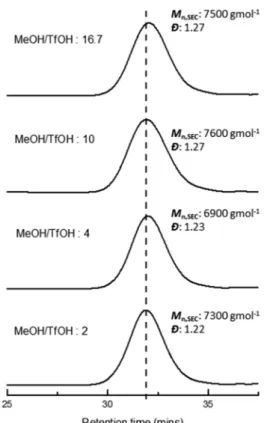
TfOH) added to account for the chains that were initiated by the initiator. Yet our findings clearly show that the molar mass was solely dependent on the amount of methanol (i.e., CTA) added, regardless of the amount of TfOH used. To further investigate the effect of initiator loading on the molar mass, a range of different TfOH concentrations ([TfOH] = 0.6, 1, 2.5, 5 mM, Table 1) were screened, whilst keeping the monomer and MeOH concentration constant ([M]0= 500 mM, [MeOH] =
10 mM, target DP = 50). A quantitative monomer consumption was achieved within 1 hour with the concentration of TfOH as low as 0.6 mM, which furnished relatively a Mn,SEC of 7500
g mol−1 with the theoretical [MeOH]/[TfOH] ratio as high as 16.7 (Fig. 5,Mn,SEC= 7500 g mol−1,Đ = 1.27). Clearly, in our
methanol controlled cationic polymerisation, the initiator concentration did not affect theMn,SEC. Even with the [MeOH]/
[TfOH] ratio as low as 2 ([TfOH] = 5 mM), a considerably lower
Mn,SEC should be expected taking into account 1/3 of the
polymer chains initiated from the TfOH. However, no considerable difference was observed with the molar mass
measured (Mn,SEC 7300 g mol−1, Đ = 1.22). In contrast,
Kamigaito reported that increasing TfOH concentration with respect to the CTA markedly lowered theMn,SECby SEC
ana-lysis, due to the increasing number of additional chains gener-ated from TfOH.16We attribute this‘unusual’behaviour (i.e.,
Mn,th largely independent of high initiator concentration) to
the free proton exchange occurring between other divalent oxygens present in the system (Scheme S1†) without generating additional chains from excessive TfOH. In addition, a surpris-ingly lower Đ at higher TfOH suggests protonated oxonium methanol to act as the main initiator and hence initiation is accelerated at a higher TfOH loading, thus leading to a lower
Đ. We suspect this phenomenon to also contribute towards the lack of the molar mass dependency of the synthesized poly-mers on the quantity of TfOH.
Mechanistically, as the key functional group is the alcohol motif, a series of experiments were carried out to investigate whether other alcohols could achieve the same level of control on this cationic polymerisation, i.e., effectively investigating
Fig. 4 (A, B) Kinetic analysis of triflic acid initiated cationic-RAFT polymerisation ofpMOS with MeOH as a RAFT agent. (C) Proposed mechanism for
the influence of the Z-group. Experimentally, for easy compari-son, we maintained identical experimental conditions (e.g., the same ratio of [alcohol] : [TfOH] : [p-MOS]0) for different
alcohol-based polymerisations. Specifically, when the substitu-ent was increased to ethyl-alcohol (A2, Table 2), the control was maintained (Đ = 1.24) with unimodal molecular weight distribution (Fig. 6), yet theMn,SECwas almost doubled
(Mn,SEC = 10 200 g mol−1) in comparison to methanol
controlled polymerisation. When the substituent of the Z-group was increased further using a secondary alcohol, iso-propyl alcohol (A3, Table 2), good control was still maintained over the molecular weight (Đ = 1.28), however, this was accompanied by a further shift in Mn,SEC (Fig. 6, Mn,SEC =
20 400 g mol−1). This was remarkably consistent with our
pre-vious findings where a photocationic initiator was used.27 However, typically an increase in molecular weight is indicative of a decrease in chain transfer activity (for example, less CTA being consumed), and is usually accompanied by a loss of control (i.e., higher Đ). Thus, observing a high molecular weight yet a low dispersity as we change the Z-group in this polymerization is rather strange and needs further investi-gation. Nevertheless, increasing further the steric effect of the Z-group to a tertiary alcohol was found to be detrimental for polymerisation control (A4, Table 2,Mn,SEC= 88 500 g mol−1, Đ= 1.55). Consistent with our previous work, trifluoroethanol was not able to control the polymerisation, as a result of a decreased nucleophilicity of the alcohol (A5, Table 2). Additionally, no presence of fluorine was detected by19F-NMR (Fig. S7†).
To investigate the generality of this method in controlling the cationic polymerisation of different monomers, a series of comparable monomers were screened. Preliminary results suggest that this chemistry is not applicable for the typical vinyl ether family of monomers such as isobutyl vinyl ether (entry M1, Table 3). A lack of control was also observed in styrenic monomers with the absence of a stabilising electron donating para-alkoxy group such as 4-methyl styrene (M2, Table 3) and tert-butyl styrene (M4, Table 3), whereas good control was found for para-alkoxy group containing styrene monomers such as 3,4-dimethoxy styrene (M3, Table 3) and
tert-butyloxy styrene (M5, Table 3). This indicates that the absence of the para-alkoxy group appears to be detrimental, thus highlighting the importance of stabilization of the propa-gating carbocation by electron rich aromatic groups for this methanol controlled polymerisation.33,34
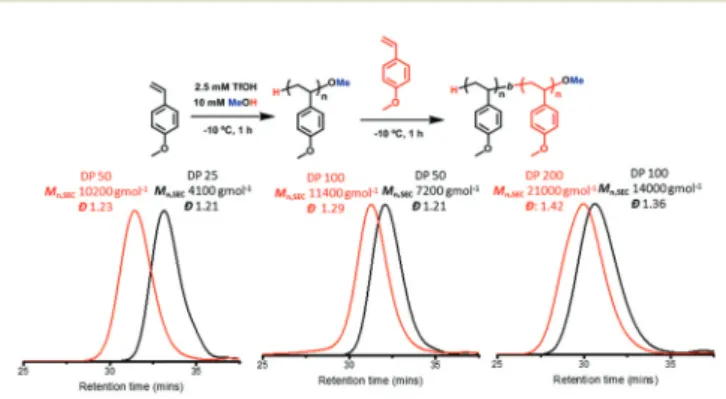
To further demonstrate the retention of the livingness of our system, a series of chain extensions from the initial block with targeted DPs of 25, 50 and 100 were carried out, aiming
Fig. 5 SEC chromatogram (dRI, THF) of p(p-MOS)50varying the triflic
acid concentration.
Table 2 Alcohol additive study
Entrya Alcohol Mn,thb(g mol−1) Mn,SECc(g mol−1) Đc
A1 Methanol 6700 7200 1.28
A2 Ethanol 6800 10 200 1.24
A3 Isopropanol 6800 20 400 1.28
A4 tert-Butanol 6800 88 500 1.55
A5 Trifluoroethanol 6800 26 400 1.71
A0 None 26 900d 22 480 3.44
Fig. 6 SEC chromatogram (dRI, THF) of p(p-MOS)50(targeted DP of 50,
in all cases) controlled with different alcohols,Mn,SECandĐtabulated in Table 2.
aAmolarratioof[p-MOS]:[Alcohol]:[TfOH]of500:10:2.5wasused. bMolar mass calculated fromeqn(1). cDetermined by SECin THF
to extend with an equal block length, respectively. Experimentally, this was done by sequentially adding a new monomer solution without the addition of more TfOH. In theory, if no base was used to quench the‘living’cationic poly-merisation, no termination should occur. In this scenario, the total number of active chains should remain constant through the polymerisation and be able to continue to propagate once new monomers are added. Pleasingly in all cases, a clear shift in Mn,SEC was observed by SEC analysis (Fig. 7). Although
unimodal, we found broader molecular weight distributions to be apparent (Đ> 1.3) when targeting longer blocks (DP = 100). When attempting to extend this polymer by an equally long block (DP = 100), it resulted in a broader distribution (Đ> 1.4), however the shift in molecular weight distribution was still noticeable (Fig. 7). The chain extendibility of our system after base mediated termination and isolation was also investigated. To ensure no additional chain transfer from the residual sol-vents, the isolated polymers were azeotroped with toluene prior to chain extension. Pleasingly, when the monomer was added after the addition of TfOH to the re-solubilised polymer (Mn,SEC= 3800 g mol−1,Đ= 1.31, Fig. S8†), a shift in molecular
weight distribution was observed by SEC analysis (Mn,SEC =
5800 g mol−1,Đ= 1.42, Fig. S8†), indicative of chain extension by chain transfer between dormant chains with newly formed propagating species.
Conclusions
Alcohols have been commonly used as a nucleophilic quencher for cationic polymerisation; however, in this work, we show that the cationic polymerisation ofp-MOS with TfOH can be controlled with methanol as the chain transfer agent through a RAFT-like mechanism. From our spectroscopic measurements, we have shown that alcoholic protons can generate new chains, following the initial nucleophilic attack. Generally, a well-controlled polymerisation was observed after 40% monomer conversion where the polymerisation follows the pseudo first order rate following the initial induction period. The ‘livingness’ of our system was further demon-strated by chain extensionvia sequential monomer addition. While methanol provides the best control, ethanol and isopro-pyl alcohol have also shown good control as CTAs. However, it is important to note that this phenomenon is very specific to electron rich styrenic monomers. How to extend this unique cationic polymerisation methodology to other monomers, in particular, the vinyl ether family, remains a challenge that would need further investigation. Nevertheless, this study offers a new contribution to the field of controlled cationic polymerisation.
Con
fl
icts of interest
There are no conflicts to declare.
Acknowledgements
This work was financially supported by the University of North Carolina at Chapel Hill. AP, HH, DAN and WY acknowledge Eastman Chemical Company for financial support. JT was sup-ported by the National Science Foundation under Award CHE-1808055.
Notes and references
1 P. Gurnani, C. Sanchez-Cano, K. Abraham, H. Xandri-Monje, A. B. Cook, M. Hartlieb, F. Lévi, R. Dallmann and S. Perrier,Macromol. Biosci., 2018, 1800213.
2 J. Zhang, J. Tanaka, P. Gurnani, P. Wilson, M. Hartlieb and S. Perrier,Polym. Chem., 2017,8, 4079–4087.
3 P. Gurnani, A. M. Lunn and S. Perrier,Polymer, 2016,106, 229–237.
4 J. Tanaka, S. Tani, R. Peltier, E. H. Pilkington, A. Kerr, T. P. Davis and P. Wilson, Polym. Chem., 2018, 9, 1551– 1556.
Entrya M
n,thb(g mol−1) Mn,SECc(g mol−1) Đc
M1 5000 3300 1.80
M2 5900 5300 1.87
M3 8200 6700 1.29
M4 8000 4400 1.54
M5 8800 13 200 1.23
aA molar ratio of [Monomer] : [MeOH] : [TfOH] of 500 : 10 : 2.5 was
used.bCalculated from eqn (1).cDetermined by SEC in THF with poly-styrene standards.
Fig. 7 SEC chromatogram (dRI, THF) of a series of chain extensions (in
red) of various chain lengths.
Table3 Cationic polymerisation in the presence of methanol with
5 C. Footman, P. A. de Jongh, J. Tanaka, R. Peltier, K. Kempe, T. P. Davis and P. Wilson,Chem. Commun., 2017,53, 8447– 8450.
6 A. B. Cook, R. Peltier, M. Hartlieb, R. Whitfield, G. Moriceau, J. A. Burns, D. M. Haddleton and S. Perrier,
Polym. Chem., 2018,9, 4025–4035.
7 R. Whitfield, A. Anastasaki, N. P. Truong, A. B. Cook, M. Omedes-Pujol, V. Loczenski Rose, T. A. H. Nguyen, J. A. Burns, S. Perrier, T. P. Davis and D. M. Haddleton,ACS Macro Lett., 2018,7, 909–915.
8 A. Anastasaki, V. Nikolaou and D. M. Haddleton, Polym. Chem., 2016,7, 1002–1026.
9 G. Moad,Polym. Chem., 2017,8, 177–219.
10 H. Mach and P. Rath,Lubr. Sci., 1999,11, 175–185.
11 A. J. Teator and F. A. Leibfarth,Science, 2019, 363, 1439– 1443.
12 S. Aoshima and S. Kanaoka,Chem. Rev., 2009,109, 5245– 5287.
13 J. P. Kennedy,J. Polym. Sci., Part A: Polym. Chem., 1999,37, 2285–2293.
14 S. Perrier,Macromolecules, 2017,50, 7433–7447.
15 M. Kamigaito, K. Satoh and M. Uchiyama, J. Polym. Sci., Part A: Polym. Chem., 2019,57, 243–254.
16 M. Uchiyama, K. Satoh and M. Kamigaito, Angew. Chem., Int. Ed., 2015,54, 1924–1928.
17 M. Guerre, M. Uchiyama, E. Folgado, M. Semsarilar, B. Améduri, K. Satoh, M. Kamigaito and V. Ladmiral,ACS Macro Lett., 2017,6, 393–398.
18 V. Kottisch, Q. Michaudel and B. P. Fors,J. Am. Chem. Soc., 2016,138, 15535–15538.
19 J. Yeow, R. Chapman, A. J. Gormley and C. Boyer, Chem. Soc. Rev., 2018,47, 4357–4387.
20 G. Ng, J. Yeow, R. Chapman, N. Isahak, E. Wolvetang, J. J. Cooper-White and C. Boyer,Macromolecules, 2018,51, 7600–7607.
21 J. Yeow, R. Chapman, J. Xu and C. Boyer, Polym. Chem., 2017,8, 5012–5022.
22 B. M. Peterson, S. Lin and B. P. Fors, J. Am. Chem. Soc., 2018,140, 2076–2079.
23 V. Kottisch, Q. Michaudel and B. P. Fors,J. Am. Chem. Soc., 2017,139, 10665–10668.
24 Q. Michaudel, T. Chauviré, V. Kottisch, M. J. Supej, K. J. Stawiasz, L. Shen, W. R. Zipfel, H. D. Abruña, J. H. Freed and B. P. Fors,J. Am. Chem. Soc., 2017,139, 15530–15538. 25 B. M. Peterson, V. Kottisch, M. J. Supej and B. P. Fors,ACS
Cent. Sci., 2018,4, 1228–1234.
26 M. Uchiyama, K. Satoh and M. Kamigaito, Polym. Chem., 2016,7, 1387–1396.
27 M. Uchiyama, K. Satoh and M. Kamigaito,Macromolecules, 2015,48, 5533–5542.
28 A. J. Perkowski, W. You and D. A. Nicewicz, J. Am. Chem. Soc., 2015,137, 7580–7583.
29 S. Sugihara, S. Okubo and Y. Maeda,Polym. Chem., 2016,7, 6854–6863.
30 G. Sauvet, M. Moreau and P. Sigwalt, Makromol. Chem., Macromol. Symp., 1986,3, 33–46.
31 G. Gody, T. Maschmeyer, P. B. Zetterlund and S. Perrier,
Macromolecules, 2014,47, 3451–3460.
32 G. Gody, T. Maschmeyer, P. B. Zetterlund and S. Perrier,
Macromolecules, 2014,47, 639–649.
33 A. Kanazawa, S. Shibutani, N. Yoshinari, T. Konno, S. Kanaoka and S. Aoshima,Macromolecules, 2012,45, 7749–7757. 34 N. Kolishetti and R. Faust,Macromolecules, 2008,41, 3842–