TECHNICAL UNIVERSITY OF CLUJ-NAPOCA
ACTA TECHNICA NAPOCENSIS
Series: Applied Mathematics, Mechanics, and Engineering Vol. 60, Issue IV, November, 2017
MECHANICAL PROPERTIES PREDICTION FOR TITANIUM NITRIDE
THIN FILMS
Florina Maria ȘERDEAN, Violeta Valentina MERIE, Marius Sorin PUSTAN, Corina
BÎRLEANU, Ștefan BOJAN
Abstract: Real-world applications require materials with specific properties which most of the time are determined with expensive equipment and time consuming tests. The solution proposed in this paper consists in acquiring an input data set based on existing experimental investigations and building an estimator using the obtained input data set. The estimator chosen for predicting the material properties of the thin films investigated in this paper is the Kriging predictor. Four samples of titanium nitride thin films deposited at different temperatures are considered and the hardness and Young’s modulus are determined for each of them. Based on the experimental data the appropriate Kriging estimator is established and the values for the two mechanical properties are predicted at intermediary temperatures.
Key words: mechanical properties, thin films, kriging estimator, atomic force microscopy, nanoindentation.
1. INTRODUCTION
Over the years a great interest has been shown in material properties due to the fact that they determine the suitability of materials for certain applications. Moreover, recently the concernment of many researchers has been focused on the material properties of thin films due to the explosive growth of this industry and the large variety of applications. Nitride thin films with different properties are used mainly as protective coatings for biomedical devices as well as for mechanical tools. Another applicability area for these thin films is as diffusion barriers used at manufacturing different MEMS.
Obviously, each use of the thin film requires certain material properties. From the economic point of view, there are several reasons in favor of estimating material properties. Finding a material with specific properties for a certain application requires several trials consisting in obtaining the materials and then testing them. This process is time consuming and sometimes involves significant costs. Therefore, there are
situations when thorough material
characterization is required fast and with low
costs. This can be obtained using interpolation functions of multiple variables if some experimental data is available. Other times the equipment might not be available for material characterization and then it is necessary to use an estimation of the material properties. Even if
these estimations obtained based on
interpolation are approximations and they come with errors, the resultant loss in accuracy is outweighed by the advantage given by the simplicity of the interpolation methods.
properties of the materials as a function of temperature or composition has even led to a study on the existing interpolation techniques for the prediction of physical properties [5].
One of the frequently used interpolation techniques due to its efficiency is the Kriging technique developed by the South African mining engineer D.G. Krige [6]. This method allows making predictions for combinations of variable values and also gives an estimation of the prediction error [7]. One of the main advantages of using this interpolation method consists in the fact that the predicted values for the input data that has already been observed equal the observed values. According to [6], Kriging is based on “a second-order stationary covariance process” which indicates that regardless of the existing input data there are constant expectations of the observations while their covariances depend only on the distances between the directly related input data. This interpolation technique makes estimations based on a metamodel that uses a predictor subjected to the criterion of minimum mean squared prediction errors which associates larger weights to the input data closer to the prediction point. Due to the fact that Kriging allows correlated errors and adjusts the used weights when a prediction for a new combination of variable values is required it has shown higher accuracy in predictions [8]. Initially Kriging was used in geostatistical mapping in the mining industry, but later it has proven to be useful in other domains such as meteorology [9], oceanography [10], and engineering [11].
2. MATERIALS AND EXPERIMENTAL PROCEDURE
Th e investigated titanium nitride thin films were deposited on silicon Si (100) substrates. A titanium target with purity of 99.95 % was employed during the deposition process. The atmosphere inside the deposition chamber consisted in a mixture of argon and nitrogen.
Titanium nitride thin films were deposited by DC reactive magnetron sputtering method. First the silicon substrates were cleaned in an ultrasonic bath with isopropyl alcohol in order
to remove any possible impurities. Afterwards they were blown with compressed air.
In the chamber of the reactive sputtering facility, a high vacuum (10-7 torr) was realized using a Varian TV551 turbo-molecular pump. The pressure inside the chamber was kept constant at 1 mtorr. The discharge current and the nitrogen flow rate were 350 mA and 1.2
cm3/min respectively. The films were
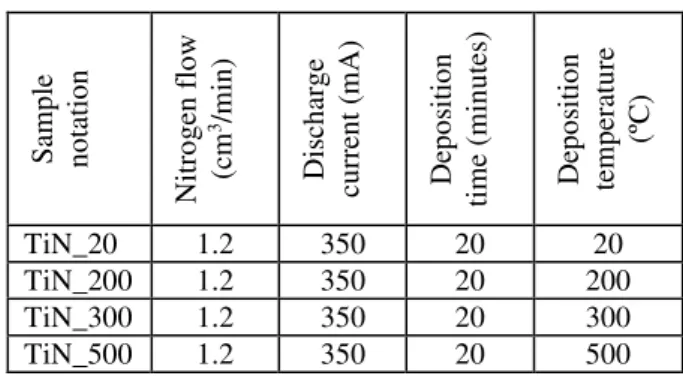
deposited for 20 minutes directly on silicon substrates. The titanium nitride thin films were deposited at four different temperatures of the substrates. The deposition process was realized for that purpose at 20, 200, 300 and 500 °C respectively.
The obtained thin films were notated as follows in order to facilitate the interpretation of the results (table 1).
Table 1
The notation and the deposition parameters of the investigated titanium nitride thin films.
The so-deposited thin films were
characterized from the mechanical point of view at nanoscale by atomic force microscopy investigations. The nanocharacterization was carried out using a XE 70 atomic force microscope. The tests were performed for a relative humidity of 13 %. The testing temperature was 22 °C. The nanoindentation tests employed a force limit of 25 nN. A TD 23838 nanoindentor was used for determining the mechanical properties. As the manufacturer
mentioned, the characteristics of this
nanoindentor are: cantilever stiffness of 272 N/m, tip radius smaller than 25 nm, tip height
of 90 µm, tip thickness of 41 µm and cantilever
length of 1050 µm respectively. The values for
the hardness and the Young’s modulus were obtained by interpreting the force vs. Z scan curves using the XEI Image Processing Tool for SPM (Scanning Probe Microscopy) data.
S
am
p
le
n
o
ta
ti
o
n
N
it
ro
g
en
f
lo
w
(c
m
3/m
in
)
D
is
ch
ar
g
e
cu
rr
en
t
(m
A
)
D
ep
o
si
ti
o
n
ti
m
e
(m
in
u
te
s)
D
ep
o
si
ti
o
n
te
m
p
er
at
u
re
(º
C
)
TiN_20 1.2 350 20 20
TiN_200 1.2 350 20 200
TiN_300 1.2 350 20 300
We used both the Oliver and Pharr and the Hertzian models for the interpretation of the obtained data in order to determine the two mechanical properties.
3. KRIGING MATHEMATICAL MODEL
More types of Kriging have been developed, but all of them are based on the basic linear
regression estimatorZ u*
( )
, given by [12]:
( )
( )
( )
( )
( )
=
= +
∑
− *
k 1
λ
n u
k k
Z u m u Z u m u (1)
where u is the estimation point; uk are the
neighboring data points, indexed by k; n(u) is
number of data points in local neighborhood
used for estimating Z u*
( )
; m u( )
, m u( )
k arethe expected values (means) of Z u
( )
and( )
kZ u ; λ ( )k u is the Kriging weight assigned for
estimating the value in point u; Z u
( )
k will beassigned a different weight when estimating the value for a different point.
The variable Z u
( )
is considered to be arandom variable that has a trend component,
( )
m u , and a residual component,
( )
= −
( ) ( )
R u Z u m u . According to (1), a
weighted sum of the residual components at surrounding data points is computed for
estimating the residual at estimation point u.
Ordinary Kriging which was used for estimating the material properties of titanium nitride thin films is based on the hypothesis that the mean is constant in the neighborhood of every point that needs to be estimated. This
leads to m u( )k =m u
( )
for each neighboringpoint uk and therefore, the Kriging estimator
becomes:
( ) ( )
( )
( ) ( )
( )
=
= =
= + −
= + −
∑
∑ ∑
*
k k
1
( )
k k k
1 1
Z λ Z u
λ (u)Ζ(u ) 1 λ (u) ( )
n u
k
n u n u
k k
u m u m u
m u
(2)
Requiring that the sum of the interpolation weights equals 1, then a Kriging estimator non-dependent on the unknown local mean is obtained:
( )
=
=
∑
( )
* OK
k k 1
λ Ζ(u )
n u OK
k
Z u (3)
where
=
=
∑( ) OK k 1
λ 1
n u
k
(4)
The weights, λOKk , that minimize the variance
of the estimator
σE2
( )
u =Var Z[ OK*( )
u −Z u( )
(5)taking into account that E Z OK*
( )
u −Z u( )
=0,are determined performing a minimization with respect to a Lagrange parameter (for more details see [13]). After determining the
interpolation weights and the Lagrange
parameter, the error variance of the estimation using Kriging can be computed.
Due to the mathematical robustness, the
Kriging method offers more accurate
estimations than most other interpolation [12]. Moreover, it reduces the effect of data clustering and also returns an error estimation along the predicted value which allows to conduct a simulation of probable realizations of the predicted value.
4. DACE SOFTWARE
DACE (Design and Analysis of Computer Experiments) is a Matlab software package that facilitates conducting Kriging approximations for real-world applications. It is used for establishing a surrogate model based on the input data that can be used for predicting values for new points. This software allows making a choice between regression models with polynomials of orders 0, 1 or 2. Also, the correlation model can be chosen from several models and they are of the following form:
(
θ)
θ=
=
∏
−1
, , ( , )
n
j j j j
C a b C a b (6)
where and are two -dimensional points and is a -dimensional parameter.
The input data is read from a file. Then the kriging model is created based on that data by normalizing the data, computing the distances and the regression matrix. Using the created model the values for new points are estimated.
instrument, its usage procedure and its validation can be found in [14].
5. RESULTS AND DISCUSSIONS
First, the four samples were characterized at nanoscale using the atomic force microscopy in order to determine two important mechanical properties: Young’s modulus and the hardness. The obtained values for each titanium nitride thin film are presented in Table 2.
Table 2
Young’s modulus and hardness for the investigated titanium nitride thin films.
Sample notation
Young’s modulus (GPa)
Hardness (GPa)
Deposition temperature
(ºC)
TiN_20 226.68 5.82 20
TiN_200 248.91 6.34 200
TiN_300 219.28 4.87 300
TiN_500 210.61 4.30 500
An increase of 9.81% is can be observed for Young’s modulus and of 8.93% for the hardness when the temperature increases from ambient temperature to 200 ºC. However, the continuous increase of temperature to 300 ºC determines a decrease of 11.9% and of 23.19% for the values of the two mechanical properties respectively. Also, a decrease of 3.95% for Young’s modulus and of 11.7% for the hardness is noticed when the temperature increases from 300 ºC to 500 ºC.
In order to predict the values of the two mechanical properties for intermediate values of the temperature the appropriate correlation and regression models have to be chosen. Therefore, the values of the mechanical properties determined for the sample deposited at 300 ºC were excluded from the input data when the Kriging model was built and they were used as a test point in order to determine the error. The tested correlation models were spline, spherical, linear, Gaussian, exponential and cubic, each in combination with the regression models with polynomials of orders 0, 1 and 2.
The best estimations were obtained for a combination of Gaussian correlation model and a regression model with polynomial of order 2 for both mechanical properties. The values of
the hardness and Young’s modulus determined for the sample deposited at 300 ºC were reintroduced in the input data set and the Kriging estimator was built using the determined correlation and regression models.
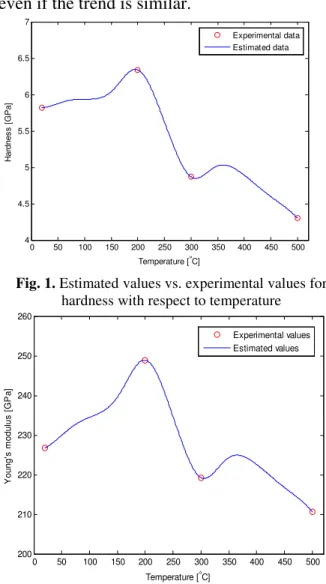
Using the obtained Kriging estimator, the values of the two mechanical properties were predicted for intermediate values of the
temperature. The generated plots are
represented in Figure1 and Figure 2. As it can be seen for both properties a continous decrease of the values is predicted when the temperature increases from 200 ºC to 300 ºC followed by a slight increase and then an almost linear decrease when the temperature increases from 300 ºC to 500 ºC. However, the smaller increase of the hardness values when comparing to the increase of Young’s modulus values is captured in the first temperature interval (from ambient temperature to 200 ºC) even if the trend is similar.
0 50 100 150 200 250 300 350 400 450 500 4
4.5 5 5.5 6 6.5 7
Temperature [°C]
H
a
rd
n
e
s
s
[
G
P
a
]
Experimental data Estimated data
Fig. 1. Estimated values vs. experimental values for
hardness with respect to temperature
0 50 100 150 200 250 300 350 400 450 500 200
210 220 230 240 250 260
Temperature [°C]
Y
o
u
n
g
's
m
o
d
u
lu
s
[
G
P
a
]
Experimental values Estimated values
6. CONCLUSIONS
Interpolation techniques have been
successfully used in engineering for different applications including estimating parameters and properties. In this paper, the Kriging interpolation method was used for predicting two mechanical properties of titanium nitride thin films.
First, four samples were deposited at different temperatures and then the XE 70 AFM was used for the experimental tests while the interpretation of the obtained results was conducted using the XEI Image Processing Tool for SPM program. The experimental values for both mechanical properties, hardness and Young’s modulus respectively, show an increase with the increase of temperature from 20 ºC to 200 ºC and a larger decrease with the increase of temperature from 200 ºC to 500 ºC.
Secondly, based on the experimental data the proper Kriging surrogate model was established and then it was used to estimate the values for the hardness and Young’s modulus at intermediary temperatures between 20 ºC and 500 ºC in order to establish the dependency of temperature for each of the two mechanical properties.
ACKNOWLEDGEMENT
This paper is written within the TUCN Internal Research Project Competition 2015 “Elaboration and structural, tribo-mechanical and optical characterization of some nitride thin films for MEMS applications (NitriMEMS)” (C.I.5/1.2/2015). The Internal Research Project Competition is funded by the Technical University of Cluj-Napoca in order to support and encourage young teams in addressing new topics in priority research areas of the university.
7. REFERENCES
[1] Zhang, W., Yuan, L., Zhang, D., Calculation of electromagnetic parameter based on interpolation algorithm, Journal of
Magnetism and Magnetic Materials, Vol. 393, 1 November 2015, pp. 24-29, ISSN 0304-8853,
http://dx.doi.org/10.1016/j.jmmm.2015.05.0 28
[2] Li, H., Zhang, Y., Wang, X., Yin, Z., Xiao, H., Obtaining multi-axial elastic potentials for rubber-like materials via an explicit, exact approach based on spline interpolation, Acta Mechanica Solida Sinica, Vol. 27, Issue 5, 2014, pp. 441-453, ISSN 0894-9166, http://dx.doi.org/10.1016/S0894-9166(14)60052-5
[3] Feng, S.Z., Cui, X.Y., Li, A.M., Xie, G.Z., A face-based smoothed point interpolation method (FS-PIM) for analysis of nonlinear heat conduction in multi-material bodies, International Journal of Thermal Sciences, Vol. 100, February 2016, pp. 430-437, ISSN 1290-0729,
http://dx.doi.org/10.1016/j.ijthermalsci.2015. 10.017
[4] Khosravifard, A., Hematiyan, M.R., Marin, L., Nonlinear transient heat conduction analysis of functionally graded materials in the presence of heat sources using an improved meshless radial point interpolation method, Applied Mathematical Modelling, Vol. 35, Issue 9, September 2011, pp.
4157-4174, ISSN 0307-904X,
http://dx.doi.org/10.1016/j.apm.2011.02.039 [5] Bélisle, E., Huang, Z., Le Digabel, S.,
Gheribi, A. E., Evaluation of machine
learning interpolation techniques for prediction of physical properties, Computational Materials Science, Vol. 98, 15 February 2015, pp. 170-177, ISSN 0927-0256,
http://dx.doi.org/10.1016/j.commatsci.2014. 10.032
[6] van Beers, W. C. M., Kriging metamodeling
for simulation, Tech. rep., Tilburg University, 2005
[7] Press, W. H., Teukolsky, S. A., Vetterling,
W. T., Flannery, B. P., Numerical Recipes
3rd Edition: The Art of Scientific Computing, 3rd Ed. Cambridge University Press, New York, NY, USA, 2007
survey, In Proceedings of the 36th Conference on Winter Simulation (2004), WSC ’04, Winter Simulation Conference, pp. 113–121
[9] Chang, W.-Y., Dai, X.-G., Chen, H.-W., A
case study of geostatistical interpolation in meteorological fields, Chinese Journal of Geophysics 47, 6 (2004), pp. 1104–1112
[10] Georgakarakos, S., Kitsiou, D., Mapping
abundance distribution of small pelagic species applying hydroacoustics and co-kriging techniques, In Essential Fish Habitat
Mapping in the Mediterranean, V.
Valavanis, Ed., vol. 203 of Developments in Hydrobiology. Springer Netherlands, 2008, pp. 155–169
[11] Simpson, T. W. , Mauery, T. M., Korte, J.
J., Mistree, F., Kriging models for global
approximation in Simulation-Based multidisciplinary design optimization, AIAA Journal 39, 12 (2001), pp. 2233–2241
[12] Bohling, G., Kriging, University Lecture,
2005
[13] Rusu, F., Tudose, L., Tudose, C., Bearing
life approximation using Kriging, ACTA
TECHNICA NAPOCENSIS – Series:
APPLIED MATHEMATICS AND
MECHANICS, ISSN 1221-5872, Vol. 58, Issue II, 2015, pp. 219-224
[14] Lophaven, S. N., Nielsen, H. B.,
Søndergaard, J., Dace. A Matlab Kriging
toolbox, Tech. rep., Technical University of Denmark, 2002
ESTIMAREA PROPRIETĂȚILOR MECANICE PENTRU FILMELE SUBȚIRI DE NITRURĂ DE TITAN
Aplicațiile întâlnite în practică necesită materiale cu proprietăți specifice care, de cele mai multe ori pot fi determinate folosind echipamente scumpe și teste ce necesită mult timp. Soluția propusă în această lucrare constă în colectarea unui set de date de intrare provenit din investigațiile experimentale existente deja și construirea unui estimator folosind setul de date de intrare obținut. Estimatorul ales pentru a prezice proprietățile de material ale filmelor subțiri investigate în această lucrarea este estimatorul Kriging. Se iau în studiu patru probe constând în filme subțiri de nitrură de titan depuse la temperaturi diferite și pentru fiecare din ele, se determină duritatea și modulul lui Young. Pornind de la datele experimentale se stabilește estimatorul Kriging potrivit și valorile pentru cele două proprietăți mecanice sunt estimate la temperaturi intermediare.
Florina Maria ȘERDEAN, PhD. Math., Lecturer, Technical University of Cluj-Napoca, Department of Mechanical Systems Engineering, 103-105 Muncii Avenue, 400641, Cluj-Napoca, Romania, [email protected].
Violeta Valentina MERIE, PhD. Eng., Lecturer, Technical University of Cluj-Napoca, Department of Materials Science and Engineering, 103-105 Muncii Avenue, 400641, Cluj-Napoca, Romania, [email protected].
Marius Sorin PUSTAN, PhD.Eng, Professor, Technical University of Cluj-Napoca, Department of Mechanical Systems Engineering, 103-105 Muncii Avenue, 400641, Cluj-Napoca, Romania, [email protected].
Corina BÎRLEANU, PhD.Eng, Professor, Technical University of Cluj-Napoca, Department of Mechanical Systems Engineering, 103-105 Muncii Avenue, 400641, Cluj-Napoca, Romania, [email protected].